REVIEW 6 minor 130 references
Supersymmetry and the collider Dark Matter picture
T0 review · 0 major / 6 minor · reviewed 2026-08-14 · deepseek-v4-flash
Pith's one-line read This review claims that the LHC's Run-2 search program for dark matter, with special focus on supersymmetric candidates, is comprehensive and that none of its searches observed a significant excess.
desk verdict An honest, well-structured status review of LHC dark matter searches as of August 2019; no new science, but accurate, traceable, and worth a serious referee. read the letter →
The pith
A machine-rendered reading of the paper's core claim, the machinery that carries it, and where it could break.
The reading
What carries the argument
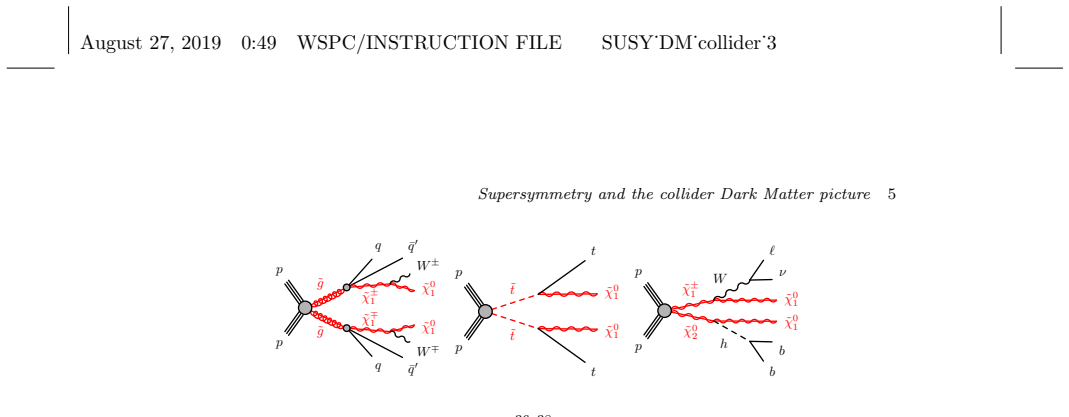
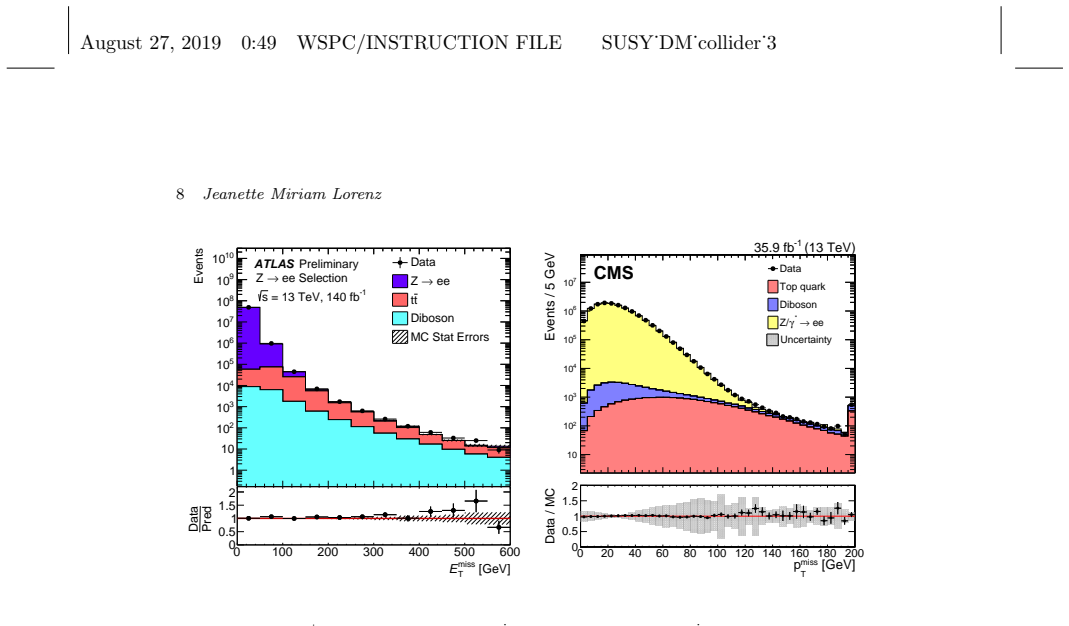
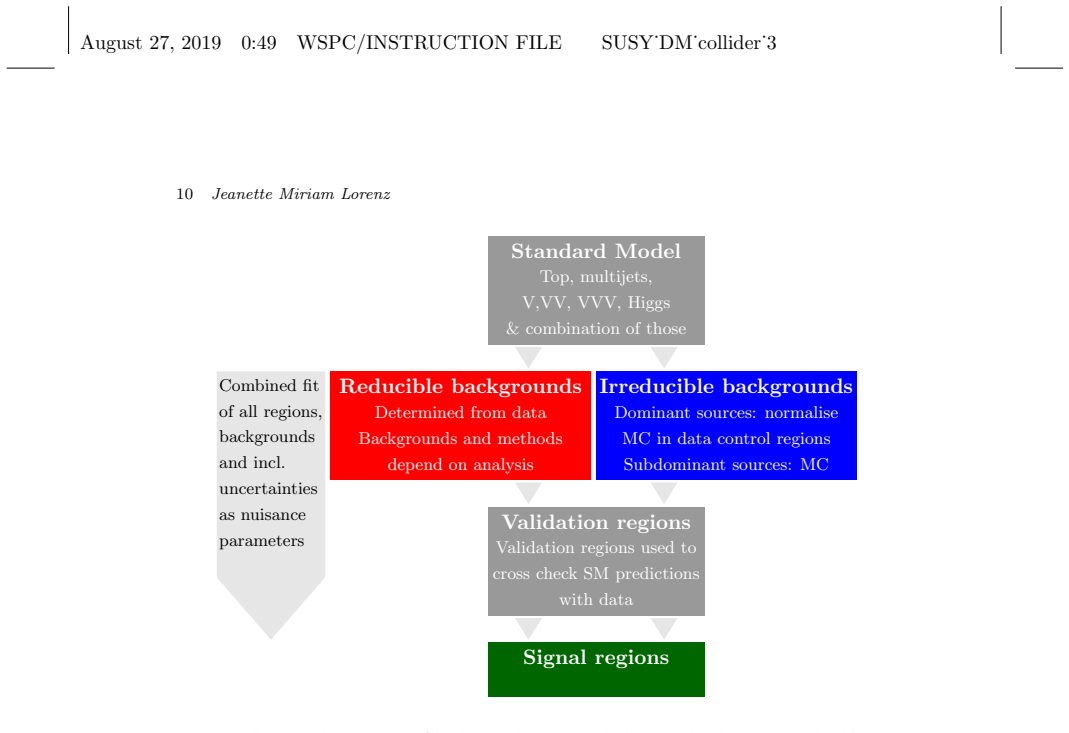
The machinery that carries the argument is the LHC search signature of missing transverse momentum ($E_T^{\text{miss}}$) produced by a stable, weakly interacting lightest supersymmetric particle, paired with decay-specific observables such as the effective mass $m_{\text{eff}}$, transverse mass $m_T$, the $m_{T2}$ variable, RJigsaw scale variables, and object-based $E_T^{\text{miss}}$ significance. Searches are designed and interpreted through simplified models, in which one sparticle pair is produced and decays to the LSP along a specific chain with all other sparticles decoupled; the analysis then defines exclusive signal regions and combines them in a profile likelihood fit to set 95% confidence-level exclusion limits. This combination of a common invisible-particle signature, model grids, and simultaneous fits is what lets the review translate many individual searches into one dark matter picture.
What would settle it
A single 5$\sigma$ excess in any of the signal regions the review compiles, say the 0-lepton multi-jet search, the three-body stop search, or the soft-dilepton compressed-higgsino search, would falsify the claim that none of the searches observed a significant excess, since the specific signal regions, luminosities, and event counts are listed in the cited experimental papers.
Extended reading notes
Core claim
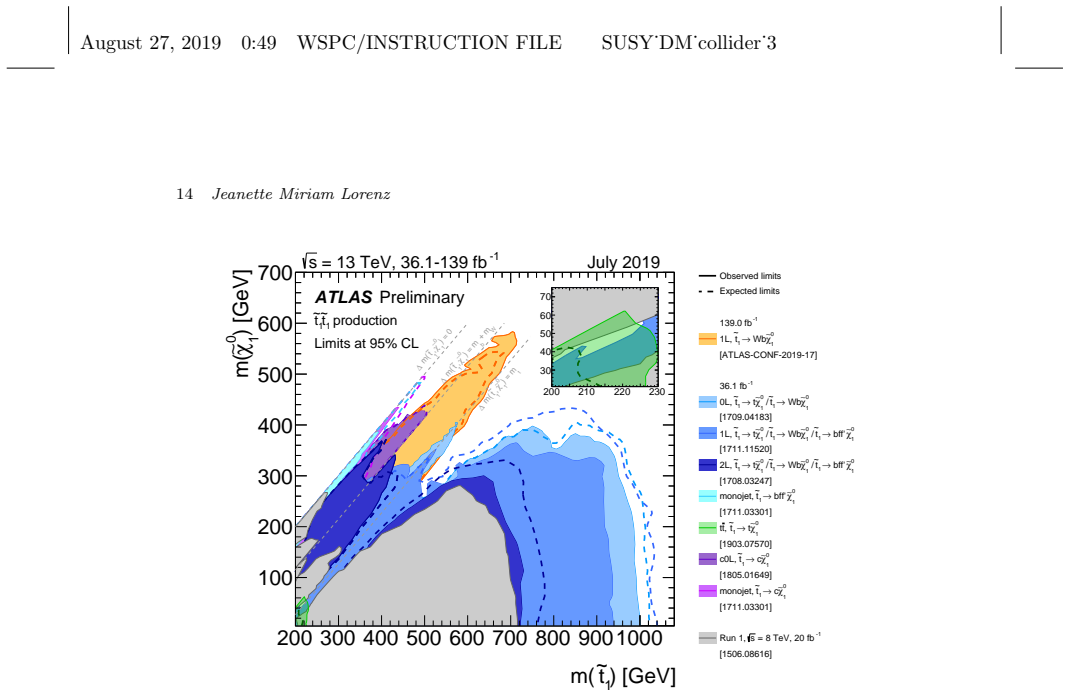
On the paper's own terms, the discovery is the status summary: after Run-2 data taking at 13 TeV with integrated luminosities reaching about 140 $fb^{{-1}}$, the LHC experiments have conducted a search program for dark matter that is broad enough to be called comprehensive, and none of the searches highlighted in this review observed a statistically significant excess. The consequence is that limits such as gluino masses up to about 2 TeV for a light LSP, squark masses up to about 1.6 TeV, stop exclusion up to about 720 GeV in the three-body decay region, first LHC constraints on staus between 120 and 390 GeV, and chargino limits that go beyond previous collider bounds in compressed higgsino scenarios now stand as the experimental picture. The review stresses that these limits are model-dependent, valid for the specific simplified decay patterns assumed, and that a global MSSM reinterpretation shows no chargino/neutralino mass range is robustly excluded in the full theory.
Load-bearing premise
The whole picture depends on the assumption that the simplified decay patterns used in the searches stand in for the full range of possible supersymmetric dark matter models; the review admits this is imperfect because a full-model fit finds no chargino or neutralino mass range that is robustly excluded.
Editorial extensions
If this is right
- If no significant excess is real, the remaining supersymmetric dark matter parameter space is pushed toward models with compressed spectra, low-momentum decay products, or long-lived particles.
- The relic-density-preferred mass ranges for pure higgsino (about 1.1 TeV) and pure wino (about 3 TeV) LSPs are not yet reached by Run-2 searches, so a future higher-energy or higher-luminosity collider would be needed to cover them.
- Many of the compiled searches used only partial Run-2 data, so applying the full dataset will sharpen the electroweakino and slepton limits before any new collider is built.
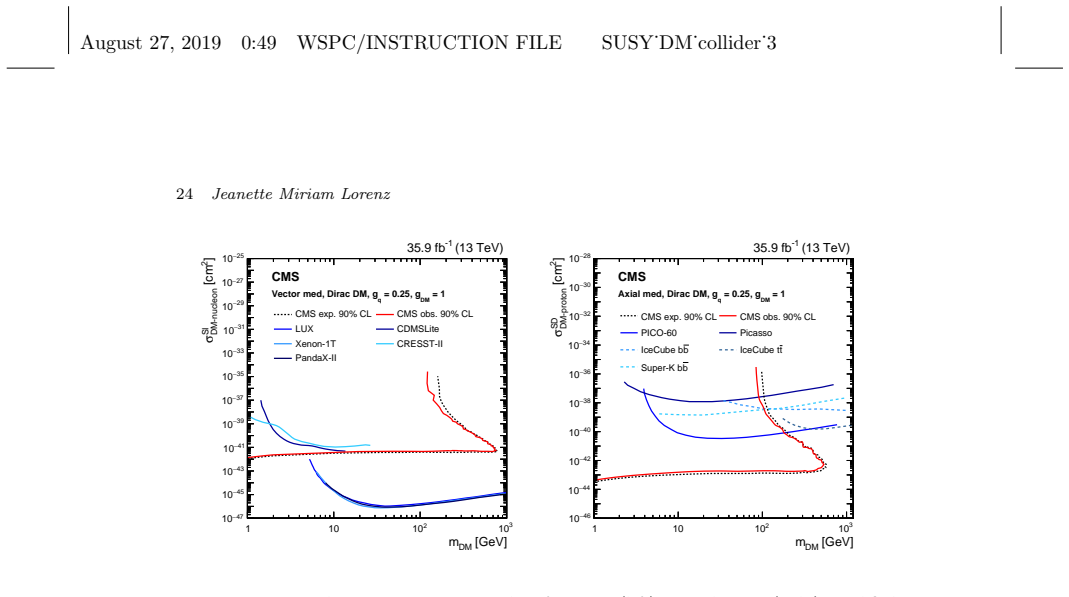
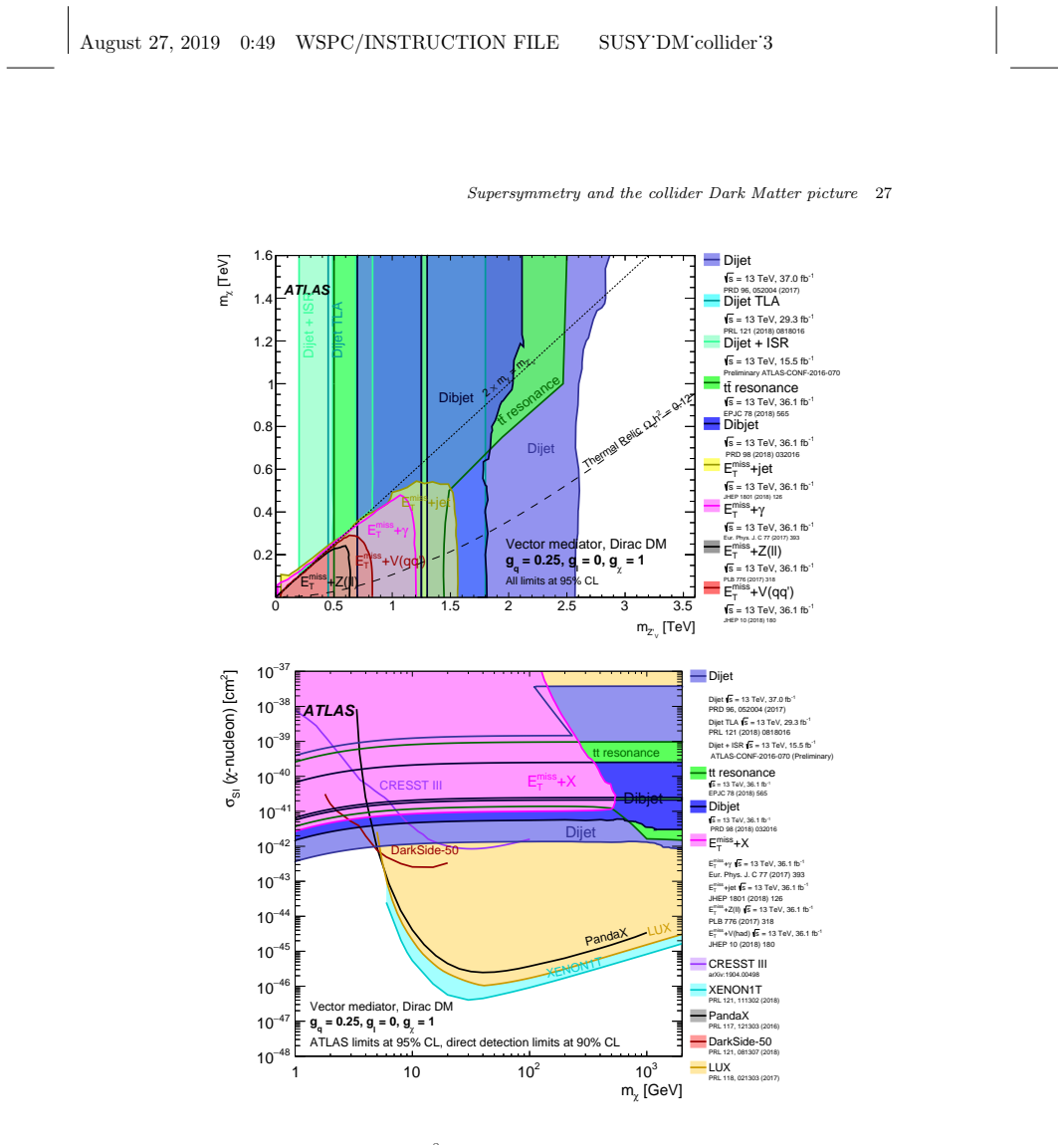
- Collider searches and direct detection are complementary: the LHC is more sensitive than direct detection experiments for low dark matter masses, while direct detection covers higher masses in the same simplified models.
Reading between the lines
- If the null picture holds through the full Run-2 dataset, the first LHC dark matter signal is more likely to appear in the currently systematics-limited compressed channels, such as soft two-lepton and disappearing-track signatures, rather than in the well-explored gluino and squark channels.
- The review's own caveat about simplified models implies that the true exclusion power on the full MSSM is weaker than the individual limit plots suggest; a global fit over all Run-2 searches would quantify how model-dependent the 'comprehensive' coverage really is.
- The mediator-model comparisons with direct detection assume benchmark couplings; changing the assumed quark and dark matter couplings would shift the relative sensitivity and could change which experiment leads in a given mass range.
- A testable extension would be to reinterpret the full set of Run-2 searches, including invisible Higgs and Z decays, in a common phenomenological MSSM scan, which would either confirm or soften the conclusion that existing searches cover supersymmetric dark matter.
Editorial analysis
A structured set of objections, weighed in public.
Referee Report
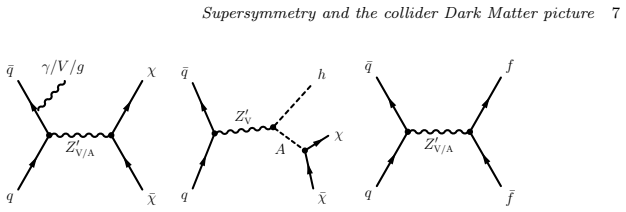
Summary. This manuscript is a review of the LHC collider search programme for dark matter, with emphasis on supersymmetric candidates. It describes the simplified models used by ATLAS and CMS (SUSY simplified models, mediator simplified models, Higgs/Z portals, effective field theory), explains the common event-topology ingredients such as missing transverse momentum, m_eff, m_T, and m_T2, and then highlights a selection of results: strong-production searches for gluinos and squarks, stop and sbottom searches, electroweakino searches (higgsino, wino/bino, slepton), generic jet/V/gamma/H plus missing-ET searches, invisible Higgs decays, and comparisons with direct detection. The central status claim is that the ATLAS/CMS search programme is comprehensive and that none of the reported searches observed a significant excess.
Significance. If the status summary is accurate, the paper is a useful and reliable snapshot of the collider dark matter landscape as of mid-2019. Its strengths are traceability to public ATLAS/CMS papers and notes, explicit discussion of model dependence, and, notably, the GAMBIT caveat in Sec. 4.3.4, which warns that simplified-model limits do not robustly exclude any chargino/neutralino mass range in the full MSSM. The paper also correctly notes in Sec. 9 that pure-higgsino and pure-wino LSPs at the relic-density-preferred masses and long-lived-particle scenarios are not yet covered. Because these limitations are stated rather than hidden, the review does not overclaim, and its value as a citable overview is real.
minor comments (6)
- [Abstract] The abstract contains a typo: 'which existence' should read 'whose existence'. In addition, 'WIMPS' in Section 1 should be 'WIMPs'.
- [§2.1] The relic-density constraint list is garbled: 'or 2 m(LSP)∼ m(h)' should presumably read 'or m(LSP) ∼ m(h)' without the stray '2'. Please also re-check the numeration of the list.
- [§3 / Fig. 3] The caption and figure panel for Fig. 3 include placeholder sub-captions such as 'Figure 1: Diagram 1' and 'Figure 2: Diagram 2' that appear to be remnants from another document; the final figure should be cleaned.
- [§4.3.2] When describing the RJigsaw analysis, the text says 'the excess could not be confirmed'; since multiple 3σ deviations were mentioned, it should read 'these excesses' or 'none of the excesses' for grammatical accuracy.
- [§7] The invisible-Higgs limit should be typeset as B(H → invisible) < 0.19 rather than the inline 'BH→invisible'.
- [§9] To avoid ambiguity in the concluding claim 'None of these searches observed a significant excess', please add an explicit sentence noting that the local 3σ excesses discussed in §4.3.2 are below the usual 5σ significance criterion and were not confirmed in the full dataset.
Circularity Check
No circularity: the review reports external experimental constraints and explicitly acknowledges the simplified-model caveats.
full rationale
This paper is a review article that surveys ATLAS and CMS dark matter and supersymmetry searches. It contains no new derivation, no fitted parameters presented as predictions, and no self-citation chain that carries a load-bearing argument. Its central claims, such as 'none of these searches observed a significant excess' and the quoted exclusion limits, are summaries of primary experimental results from the ATLAS and CMS collaborations and from the GAMBIT reinterpretation study. The only structurally weak premise, namely that simplified-model limits do not automatically map onto the full MSSM, is explicitly disclosed in Section 4.3.4 and again in the conclusion, where the author notes that pure-higgsino and pure-wino LSPs have not yet reached relic-density-preferred masses and that long-lived-particle scenarios are not covered by most conventional searches. Because the review's statements are judged against external published primary sources rather than against the review itself, there is no circular reduction by definition, by fitted input, or by self-citation. The paper is self-contained as a status report and therefore receives a circularity score of zero.
Assumptions & free parameters
free parameters (2)
- benchmark mediator couplings g_q, g_l, g_chi =
g_q=0.25, g_l=0, g_chi=1
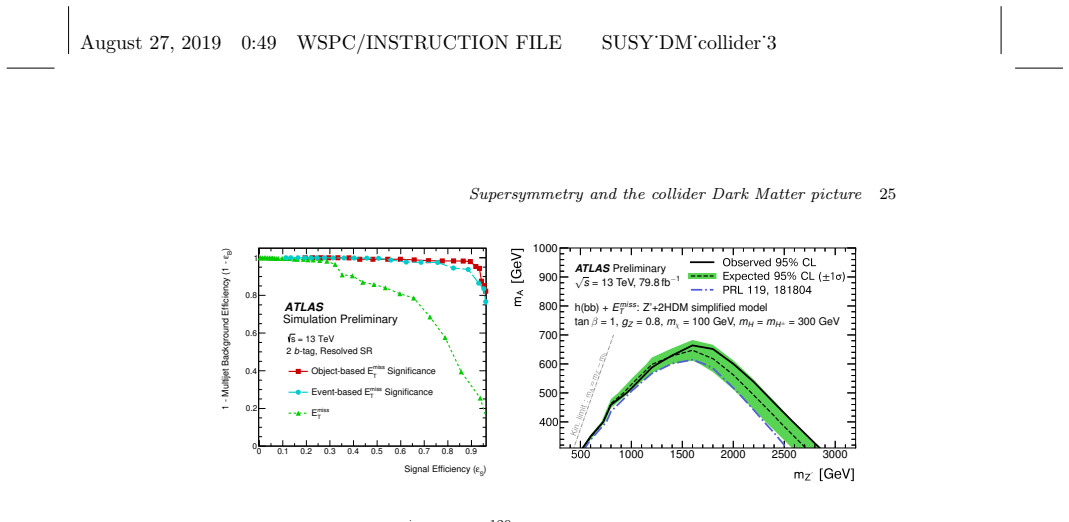
- 2HDM+U(1) benchmark parameters for h plus MET limits =
tan beta=1, g_Z'=0.8, m_chi=100 GeV, m_H=m_Hpm=300 GeV
assumptions (3)
- domain assumption R-parity conservation is assumed in all SUSY searches
- domain assumption Simplified models describe the signal topologies used for limits
- domain assumption The quoted ATLAS, CMS, LEP, and GAMBIT results are correct
Cite this review
Pith. "Pith review of Supersymmetry and the collider Dark Matter picture." pith.science (2026). https://pith.science/paper/LIJDZF7V
@misc{pith2026190809672,
  author       = {Pith},
  title        = {Pith review of: Supersymmetry and the collider Dark Matter picture},
  year         = {2026},
  howpublished = {\url{https://pith.science/paper/LIJDZF7V}},
  note         = {Machine review of arXiv:1908.09672}
}
read the original abstract
One of the key questions in particle physics and astrophysics is the nature of dark matter, which existence has been confirmed in many astrophysical and cosmological observations. Besides direct and indirect detection experiments, collider searches for dark matter offer the unique possibility to not only detect dark matter particles but in case of discovery to also study their properties by making statements about the potential underlying theory. The search program for dark matter at the ATLAS and CMS experiments at the Large Hadron Collider is comprehensive, and includes both supersymmetric dark matter candidates and other alternatives. This review presents the latest status in these searches, with special focus on supersymmetric dark matter particles.
Figures


Figures from the paper (22 more)






Reference graph
Works this paper leans on
-
[1]
Dress and G
M. Dress and G. Gerbier, in Phys. Rev. D 98, 030001, M. Tanabashi et al. (2018)
2018
-
[2]
Bertone, Cambridge University Press (2010)
G. Bertone, Cambridge University Press (2010)
2010
-
[3]
Clowe et al
D. Clowe et al. , Astrophys. J. 648, L109 (2006)
2006
-
[4]
Planck Collaboration, arXiv:1807.06205 [astro-ph.CO]
-
[5]
Planck Collaboration, arXiv:1807.06209 [astro-ph.CO]
-
[6]
Lahav and A.R
O. Lahav and A.R. Liddle, in Phys. Rev. D 98, 030001, M. Tanabashi et al. (2018)
2018
-
[7]
Jungman et al
G. Jungman et al. , Phys. Rept. 267, 195 (1996)
1996
-
[8]
ATLAS Collaboration, JHEP 1805 (2019) 142
2019
Show all 130 references
-
[9]
Evans and P
L. Evans and P. Bryant, JINST 3 (2008) S08001
2008
-
[10]
ATLAS Collaboration, JINST 3 (2008) S08003
2008
-
[11]
ATLAS-TDR-19 and ATLAS-TDR-19-ADD-1, 2010 and 2012 (unpublished)
ATLAS Collaboration, Report No. ATLAS-TDR-19 and ATLAS-TDR-19-ADD-1, 2010 and 2012 (unpublished)
2010
-
[12]
Abbott et al
B. Abbott et al. , JINST 13 (2018) T05008
2018
-
[13]
CMS Collaboration, JINST 3 (2008) S08004
2008
-
[14]
Boveia and C
A. Boveia and C. Doglioni, Ann. Rev. Nucl. Part. Sci. 68, 429 (2018)
2018
-
[15]
S. P. Martin, Report No. arXiv:hep-ph/9709356, 2016 (unpublished)
2016 arXiv
-
[16]
Fayet, Phys
P. Fayet, Phys. Lett. 64B, 159 (1976). August 27, 2019 0:49 WSPC/INSTRUCTION FILE SUSY˙DM˙collider˙3 Supersymmetry and the collider Dark Matter picture 29
1976
-
[17]
Fayet, Phys
P. Fayet, Phys. Lett. 69B, 489 (1977)
1977
-
[18]
G. R. Farrar and P. Fayet, Phys. Lett. 76B, 575 (1978)
1978
-
[19]
J. R. Ellis et al. , Nucl. Phys. B 238, 453 (1984)
1984
-
[20]
Goldberg, Phys
H. Goldberg, Phys. Rev. Lett. 50, 1419 (1983), Erratum: [Phys. Rev. Lett.103, 099905 (2009)]
1983
-
[21]
Toby Falk et al. , Phys. Lett. 339B, 248 (1994)
1994
-
[22]
LEP Collaborations, hep-ex/0312023 (2003)
2003 arXiv
-
[23]
Beneke et al
M. Beneke et al. , JHEP 1603, 119 (2016)
2016
-
[24]
Krall and M
R. Krall and M. Reece, Chin. Phys. C 42, no. 4, 043105 (2018)
2018
-
[25]
ATLAS Collaboration, Phys. Lett. B 716, 1 (2012)
2012
-
[26]
CMS Collaboration, Phys. Lett. B 716, 30 (2012)
2012
-
[27]
Barbieri and G
R. Barbieri and G. F. Giudice, Nucl. Phys. B 306, 63 (1988)
1988
-
[28]
de Carlos and J
B. de Carlos and J. A. Casas, Phys. Lett. B 309, 320 (1993)
1993
-
[29]
J. L. Feng, Ann. Rev. Nucl. Part. Sci. 63, 351 (2013)
2013
- [30]
-
[31]
C. F. Berger, J. S. Gainer, J. L. Hewett and T. G. Rizzo, JHEP 0902, 023 (2009)
2009
-
[32]
ATLAS Collaboration, JHEP 1510, 134 (2015)
2015
-
[33]
Alwall, M
J. Alwall, M. P. Le, M. Lisanti and J. G. Wacker, Phys. Lett. B 666, 34 (2008)
2008
-
[34]
Alwall, P
J. Alwall, P. Schuster and N. Toro, Phys. Rev. D 79, 075020 (2009)
2009
-
[35]
Alves et al
D. Alves et al. [LHC New Physics Working Group], J. Phys. G 39, 105005 (2012)
2012
-
[37]
ATLAS Collaboration, JHEP 1806, 108 (2018)
2018
-
[38]
ATLAS Collaboration, arXiv:1812.09432 (2018)
2018 arXiv
-
[39]
Gambit Collaboration. Eur. Phys. J. C 79, no. 5, 395 (2019)
2019
- [40]
- [41]
-
[42]
Abe et al
T. Abe et al. [LHC Dark Matter Working Group], Phys. Dark Univ. , 100351
-
[43]
R. E. Shrock and M. Suzuki, Phys. Lett. 110B, 250 (1982)
1982
-
[44]
Escudero et al
M. Escudero et al. , JCAP 1612, 029 (2016)
2016
-
[45]
Goodman et al
J. Goodman et al. , Phys. Rev. D 82, 116010 (2010)
2010
-
[46]
P. J. Fox et al. , Phys. Rev. D 85, 056011 (2012)
2012
-
[47]
Busoni et al
G. Busoni et al. , Phys. Lett. B 728, 412 (2014)
2014
-
[48]
Racco et al
D. Racco et al. , JHEP 1505, 009 (2015)
2015
-
[49]
ATLAS Collaboration. Eur. Phys. J. C 78 (2018) no.11, 903
2018
-
[50]
JINST 14, no
CMS Collaboration. JINST 14, no. 07, P07004 (2019)
2019
-
[51]
JETM-2019-03, 2019 (unpublished)
ATLAS Collaboration, Report No. JETM-2019-03, 2019 (unpublished)
2019
-
[53]
Hinchliffe et al
I. Hinchliffe et al. , Phys. Rev. D 55, 5520 (1997)
1997
-
[54]
D. R. Tovey, Phys. Lett. B 498, 1 (2001)
2001
-
[55]
M. E. Cabrera and J. A. Casas, arXiv:1207.0435 [hep-ph]
-
[56]
Arnison et al
G. Arnison et al. (UA1), Phys. Lett. B122, 103 (1983)
1983
-
[57]
Banner et al
M. Banner et al. (UA2), Phys. Lett. B122, 476 (1983)
1983
-
[58]
A. J. Barr et al. , JHEP 0911, 096 (2009)
2009
-
[59]
Borschensky et al
C. Borschensky et al. , Eur. Phys. J. C 74, no. 12, 3174 (2014)
2014
-
[60]
Beenakker et al
W. Beenakker et al. , Nucl. Phys. B 492, 51 (1997)
1997
-
[61]
Beenakker et al
W. Beenakker et al. , Nucl. Phys. B 515, 3 (1998)
1998
-
[62]
ATLAS Collaboration, https://twiki.cern.ch/twiki/bin/view/AtlasPublic/
-
[63]
CMS Collaboration, https://twiki.cern.ch/twiki/bin/view/CMSPublic/
-
[64]
CMS Collaboration, arXiv:1908.04722 [hep-ex]
1908 arXiv
-
[65]
ATLAS-CONF-2019-040, 2019 (unpublished)
ATLAS Collaboration, Report no. ATLAS-CONF-2019-040, 2019 (unpublished). August 27, 2019 0:49 WSPC/INSTRUCTION FILE SUSY˙DM˙collider˙3 30 Jeanette Miriam Lorenz
2019
-
[67]
ATLAS Collaboration, JHEP 1806, 107 (2018)
2018
-
[68]
ATLAS Collaboration, JHEP 1712, 034 (2017)
2017
-
[69]
ATLAS Collaboration, JHEP 1709, 084 (2017)
2017
-
[70]
ATLAS Collaboration, Phys. Rev. D 96, no. 11, 112010 (2017)
2017
-
[71]
ATLAS Collaboration, Phys. Rev. D 97, no. 11, 112001 (2018)
2018
-
[72]
ATLAS Collaboration, Phys. Rev. D 97, no. 9, 092006 (2018)
2018
-
[73]
ATLAS Collaboration, Eur. Phys. J. C 78, no. 8, 625 (2018)
2018
-
[74]
ATLAS Collaboration, Phys. Rev. D 99, no. 1, 012009 (2019)
2019
-
[75]
CMS-PAS-SUS-19-008, 2019 (unpublished)
CMS Collaboration, Report no. CMS-PAS-SUS-19-008, 2019 (unpublished)
2019
-
[76]
CMS Collaboration, JHEP 1906, 143 (2019)
2019
-
[77]
ATLAS-CONF-2019-017, 2019 (unpublished)
ATLAS Collaboration, Report No. ATLAS-CONF-2019-017, 2019 (unpublished)
2019
-
[78]
ATLAS Collaboration, JHEP 12 (2017) 085
2017
-
[79]
ATLAS Collaboration, Eur. Phys. J. C 77 (2017) 898
2017
-
[80]
ATLAS Collaboration, Eur. Phys. J. C 75 (2015) 510
2015
-
[81]
CMS Collaboration, JHEP 10 (2017) 005
2017
-
[82]
CMS Collaboration, JHEP 10 (2017) 019
2017
-
[83]
CMS Collaboration, Phys. Rev. D 97 (2018) 032009
2018
-
[84]
CMS Collaboration, Eur. Phys. J. C 77 (2017) 327
2017
-
[85]
CMS Collaboration, Eur. Phys. J. C 77 (2017) 294
2017
-
[86]
CMS Collaboration, Phys. Rev. D 95 (2017) 012003
2017
-
[87]
ATL-PHYS-PUB-2019-022, 2019 (unpublished)
ATLAS Collaboration, Report No. ATL-PHYS-PUB-2019-022, 2019 (unpublished)
2019
-
[89]
ATLAS Collaboration, Eur. Phys. J. C 78 (2018) 18
2018
-
[90]
DAmbrosio et al , Nucl
G. DAmbrosio et al , Nucl. Phys. B 645, 155 (2002)
2002
-
[91]
Barbieri and G
R. Barbieri and G. F. Giudice, Nucl. Phys. B 306 (1988) 63
1988
-
[92]
de Carlos and J
B. de Carlos and J. A. Casas, Phys. Lett. B 309 (1993) 320
1993
-
[93]
Dimopoulos et al
S. Dimopoulos et al. , Phys. Rev. Lett. 76 (1996) 3494
1996
-
[94]
K. T. Matchev and S. D. Thomas, Phys. Rev. D 62 (2000) 077702
2000
-
[95]
ATLAS Collaboration, Phys. Rev. D 98 (2018) 092002
2018
-
[96]
CMS Collaboration, JHEP 1803, 166 (2018)
2018
-
[97]
CMS Collaboration, JHEP 1803, 076 (2018)
2018
-
[98]
CMS Collaboration, Phys. Rev. D 97, no. 3, 032007 (2018)
2018
-
[99]
ATLAS Collaboration, JHEP 1806, 022 (2018)
2018
-
[100]
ATLAS Collaboration, Phys. Rev. D 97 (2018) 052010
2018
-
[101]
CMS Collaboration, Phys. Lett. B 782, 440 (2018)
2018
-
[102]
ATLAS Collaboration, ATLAS-CONF-2019-014
2019
-
[103]
ATLAS Collaboration, Eur. Phys. J. C 78 (2018) 995
2018
-
[104]
ATLAS Collaboration, Phys. Rev. D 98 (2018) 092012
2018
-
[105]
ATLAS-CONF-2019-020 (2019)
ATLAS Collaboration, Report No. ATLAS-CONF-2019-020 (2019)
2019
-
[106]
CMS Collaboration, JHEP 1803, 160 (2018)
2018
-
[107]
ATLAS-CONF-2019-019, 2019 (unpublished)
ATLAS Collaboration, Report No. ATLAS-CONF-2019-019, 2019 (unpublished)
2019
-
[108]
ATLAS-CONF-2019-031, 2019 (unpublished)
ATLAS Collaboration, Report No. ATLAS-CONF-2019-031, 2019 (unpublished)
2019
-
[109]
ATLAS-CONF-2019-018, 2019 (unpublished)
ATLAS Collaboration, Report No. ATLAS-CONF-2019-018, 2019 (unpublished)
2019
-
[110]
CMS Collaboration, Phys. Rev. D 97 (2018) 092005
2018
-
[111]
ATLAS Collaboration, JHEP 1801, 126 (2018)
2018
-
[112]
CMS Collaboration, JHEP 1807, 014 (2017)
2017
-
[113]
ATLAS Collaboration, Phys. Rev. D 94 (2016) 032005
2016
-
[114]
CMS Collaboration, JHEP 1902, 074 (2019)
2019
-
[115]
ATLAS Collaboration, Eur. Phys. J. C 77, no. 6, 393 (2017). August 27, 2019 0:49 WSPC/INSTRUCTION FILE SUSY˙DM˙collider˙3 Supersymmetry and the collider Dark Matter picture 31
2017
-
[116]
J. F. Gunion and H. E. Haber, Phys. Rev. D 67 (2003) 075019
2003
-
[117]
Berlin et al
A. Berlin et al. , JHEP 1406 (2014) 078
2014
-
[118]
G. C. Branco et al. , Phys. Rept. 516 (2012) 1
2012
-
[119]
ATLAS Collaboration, Phys. Rev. Lett. 119 (2017) 181804
2017
-
[120]
ATLAS-CONF-2018-039, 2018 (unpublished)
ATLAS Collaboration, Report No. ATLAS-CONF-2018-039, 2018 (unpublished)
2018
-
[121]
CMS Collaboration, Eur. Phys. J. C 79 (2019) 280
2019
-
[122]
CMS Collaboration, JHEP 1809 046 (2018)
2018
-
[123]
CMS Collaboration, JHEP 1710 180 (2017)
2017
-
[124]
ATLAS Collaboration, Phys. Rev. D 96, no. 11, 112004 (2017)
2017
-
[125]
ATLAS-CONF-2018-038, 2018 (unpublished)
ATLAS Collaboration, Report No. ATLAS-CONF-2018-038, 2018 (unpublished)
2018
-
[126]
Liss et al
T.M. Liss et al. , in Phys. Rev. D 98, M. Tanabashi et al. (2018)
2018
-
[127]
CMS Collaboration, arXiv:1907.03729 [hep-ex]
1907 arXiv
-
[128]
ATLAS Collaboration, [arXiv:1903.07570 [hep-ex]]
1903 arXiv
-
[129]
ATLAS-CONF-2019-005, 2019 (unpublished)
ATLAS Collaboration, Report No. ATLAS-CONF-2019-005, 2019 (unpublished)
2019
-
[130]
CMS Collaboration, Eur. Phys. J. C 79 (2019) 421
2019
-
[131]
ATLAS Collaboration, Phys. Rev. Lett. 122, no. 23, 231801 (2019)
2019
-
[132]
CMS Collaboration, Phys. Lett. B 793, 520 (2019)
2019
-
[133]
CMS Collaboration, https://twiki.cern.ch/twiki/bin/view/CMSPublic/SummaryPlotsEXO13TeV
-
[134]
ATLAS Collaboration, JHEP 1609, 175 (2016)
2016
Reviewed August 14, 2026 · model on record in the stance chip above.
Discussion (0). Continue with ORCID to comment.