Lightweight Neural Framework for Robust 3D Volume and Surface Estimation from Multi-View Images
Pith reviewed 2026-06-26 09:12 UTC · model grok-4.3
The pith
A feed-forward network fuses point clouds and 2D features in a graph decoder to regress scale-normalized volume and surface area directly from multi-view images.
A machine-rendered reading of the paper's core claim, the machinery that carries it, and where it could break.
Core claim
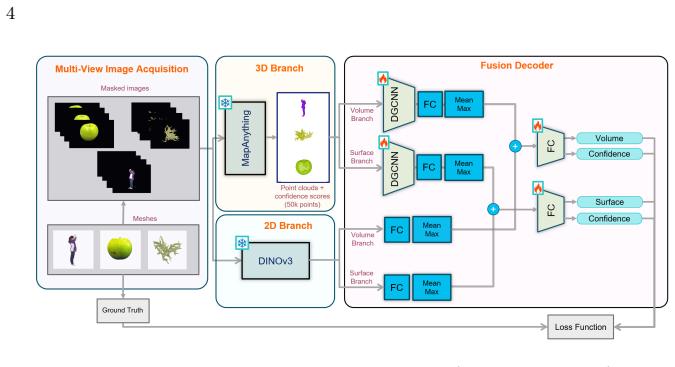
Fusing 3D point cloud reconstructions with view-aligned 2D features through a graph-based decoder enables accurate direct regression of scale-normalized volume and surface area, together with uncertainty estimates, from multi-view images without iterative optimization.
What carries the argument
Graph-based decoder that fuses 3D point cloud reconstructions with view-aligned 2D features to regress the target quantities.
If this is right
- Inference runs in a single forward pass, enabling real-time use where optimization loops are too slow.
- Accuracy holds with fewer input images than methods that require dense views or refinement steps.
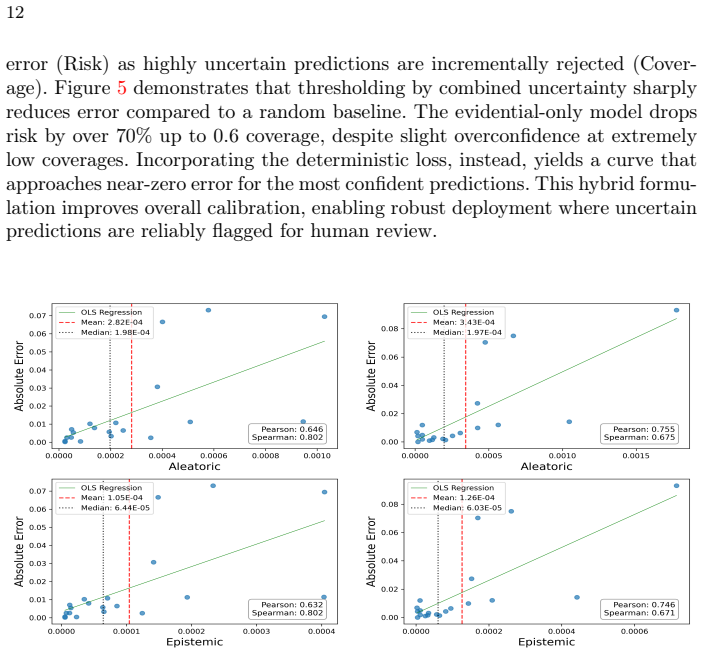
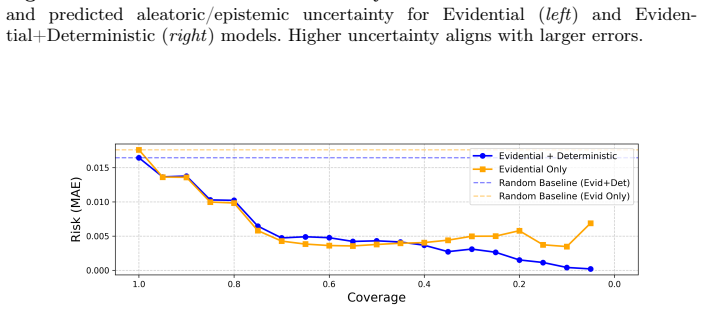
- Uncertainty outputs accompany each prediction, supporting downstream decision making in applied settings.
- The same architecture applies across domains such as ecology, nutrition, and anthropometry without domain-specific tuning.
Where Pith is reading between the lines
- The same fusion pattern could be tested for predicting additional shape descriptors such as principal axes or bounding-box dimensions.
- Replacing the point-cloud front end with a learned implicit representation might further reduce dependence on explicit 3D reconstruction quality.
- Deployment on edge devices could be measured directly by reporting frames-per-second and memory footprint on mobile hardware.
Load-bearing premise
That fusing point clouds and 2D features inside the graph decoder supplies enough information for direct regression to match or exceed optimization-based accuracy without extra constraints.
What would settle it
Run the model on a held-out test set of objects imaged from only two or three noisy views and compare absolute error in volume and surface area against an iterative optimization baseline; larger errors would falsify the performance claim.
Figures



read the original abstract
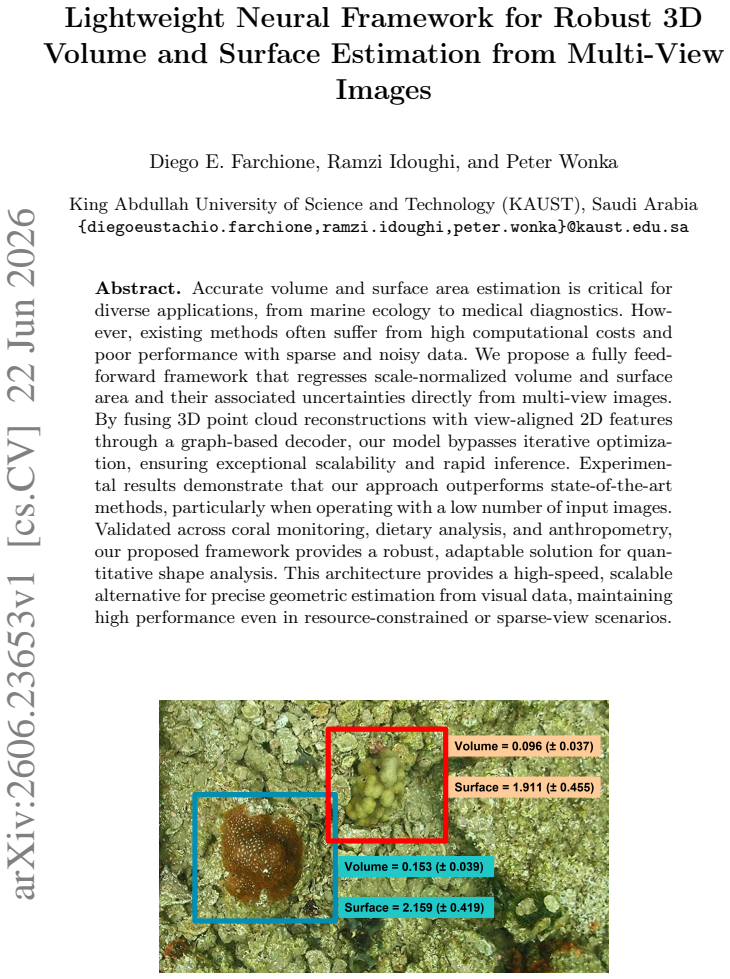
Accurate volume and surface area estimation is critical for diverse applications, from marine ecology to medical diagnostics. However, existing methods often suffer from high computational costs and poor performance with sparse and noisy data. We propose a fully feed-forward framework that regresses scale-normalized volume and surface area and their associated uncertainties directly from multi-view images. By fusing 3D point cloud reconstructions with view-aligned 2D features through a graph-based decoder, our model bypasses iterative optimization, ensuring exceptional scalability and rapid inference. Experimental results demonstrate that our approach outperforms state-of-the-art methods, particularly when operating with a low number of input images. Validated across coral monitoring, dietary analysis, and anthropometry, our proposed framework provides a robust, adaptable solution for quantitative shape analysis. This architecture provides a high-speed, scalable alternative for precise geometric estimation from visual data, maintaining high performance even in resource-constrained or sparse-view scenarios.
Editorial analysis
A structured set of objections, weighed in public.
Referee Report
Summary. The manuscript proposes a fully feed-forward neural framework that directly regresses scale-normalized 3D volume and surface area (plus uncertainties) from multi-view images. It fuses initial 3D point-cloud reconstructions with view-aligned 2D features inside a graph-based decoder, thereby avoiding iterative optimization. The central claim is that this architecture outperforms state-of-the-art methods, especially under sparse-view conditions, and is validated on coral monitoring, dietary analysis, and anthropometry tasks.
Significance. If the performance and robustness claims are substantiated by quantitative experiments, the work would supply a lightweight, single-pass alternative for geometric estimation in resource-limited or sparse-view regimes, with direct applicability to ecology and medical imaging. The explicit uncertainty output and avoidance of iterative refinement constitute potential practical strengths.
major comments (2)
- [Abstract] Abstract: the claim that the approach 'outperforms state-of-the-art methods, particularly when operating with a low number of input images' is unsupported by any quantitative results, baselines, error metrics, error bars, or experimental protocol within the provided manuscript text.
- [Method] Method description (graph-based decoder): no derivation, error bound, or consistency constraint is supplied showing that fusion of noisy sparse point clouds with 2D features suffices for accurate scale-normalized regression without iterative refinement or geometric priors; this assumption is load-bearing for the central claim of robustness under sparse noisy inputs.
Simulated Author's Rebuttal
We thank the referee for the constructive feedback. We address the major comments point-by-point below, with clarifications on experimental support and methodological details, and indicate planned revisions.
read point-by-point responses
-
Referee: [Abstract] Abstract: the claim that the approach 'outperforms state-of-the-art methods, particularly when operating with a low number of input images' is unsupported by any quantitative results, baselines, error metrics, error bars, or experimental protocol within the provided manuscript text.
Authors: The abstract summarizes findings from the experiments section, which includes quantitative comparisons against baselines with error metrics under varying view counts. However, to ensure the claim is fully supported and self-contained within the text, we will revise the abstract to reference key metrics, error bars, and the sparse-view protocol explicitly. revision: yes
-
Referee: [Method] Method description (graph-based decoder): no derivation, error bound, or consistency constraint is supplied showing that fusion of noisy sparse point clouds with 2D features suffices for accurate scale-normalized regression without iterative refinement or geometric priors; this assumption is load-bearing for the central claim of robustness under sparse noisy inputs.
Authors: The decoder learns the fusion end-to-end via supervision on ground-truth volumes and surfaces; consistency is implicitly enforced by the regression losses rather than explicit geometric priors. We will expand the method section with additional design rationale and discussion of the empirical robustness under sparse inputs, while noting the absence of formal bounds as a limitation of the data-driven approach. revision: partial
Circularity Check
No circularity in derivation; empirical performance claims independent of self-referential fits
full rationale
The paper describes a feed-forward neural architecture that fuses point clouds with 2D features via a graph decoder to regress scale-normalized volume/surface and uncertainties. No equations or steps in the provided text reduce a claimed prediction to a fitted parameter by construction, nor invoke self-citations as load-bearing uniqueness theorems. Performance claims are presented as experimental results against SOTA, not as mathematical identities derived from the model's own inputs. The derivation chain is therefore self-contained against external benchmarks.
Axiom & Free-Parameter Ledger
Reference graph
Works this paper leans on
-
[1]
arXiv preprint arXiv:2407.01717 (2024)
AlMughrabi, A., Haroon, U., Marques, R., Radeva, P.: VolETA: One-and few-shot food volume estimation. arXiv preprint arXiv:2407.01717 (2024)
-
[2]
In: CVPRW
AlMughrabi, A., Haroon, U., Marques, R., Radeva, P.: VolTex: Food volume es- timation using text-guided segmentation and neural surface reconstruction. In: CVPRW. pp. 450–457 (2025)
2025
-
[3]
Advances in neural information processing systems33, 14927–14937 (2020)
Amini, A., Schwarting, W., Soleimany, A., Rus, D.: Deep evidential regression. Advances in neural information processing systems33, 14927–14937 (2020)
2020
-
[4]
In: ICCV
Barron, J.T., Mildenhall, B., Tancik, M., Hedman, P., Martin-Brualla, R., Srini- vasan, P.P.: Mip-NeRF: A multiscale representation for anti-aliasing neural radi- ance fields. In: ICCV. pp. 5835–5844 (2021)
2021
-
[5]
arXiv preprint arXiv:2409.01966 (2024)
Chen, Y., He, J., Vinod, G., Raghavan, S., Czarnecki, C., Ma, J., Mahmud, T.I., Coburn, B., Mao, D., Nair, S., et al.: MetaFood3D: 3D food dataset with nutrition values. arXiv preprint arXiv:2409.01966 (2024)
-
[6]
IEEE TMM19(5), 1090–1099 (2017)
Dehais, J., Anthimopoulos, M., Shevchik, S., Mougiakakou, S.: Two-view 3d recon- struction for food volume estimation. IEEE TMM19(5), 1090–1099 (2017)
2017
-
[7]
In: Proceedings of the IEEE/CVF conference on computer vision and pattern recognition
Deitke, M., Schwenk, D., Salvador, J., Weihs, L., Michel, O., VanderBilt, E., Schmidt, L., Ehsani, K., Kembhavi, A., Farhadi, A.: Objaverse: A universe of annotated 3d objects. In: Proceedings of the IEEE/CVF conference on computer vision and pattern recognition. pp. 13142–13153 (2023)
2023
-
[8]
In: ICIP
Fang, S., Zhu, F., Jiang, C., Zhang, S., Boushey, C.J., Delp, E.J.: A comparison of food portion size estimation using geometric models and depth images. In: ICIP. pp. 26–30 (2016)
2016
-
[9]
Sensors23(6), 3298 (2023)
Filko, D., Nyarko, E.K.: 2D/3D wound segmentation and measurement based on a robot-driven reconstruction system. Sensors23(6), 3298 (2023)
2023
-
[10]
IEEE TPAMI32(8), 1362–1376 (2010)
Furukawa, Y., Ponce, J.: Accurate, dense, and robust multiview stereopsis. IEEE TPAMI32(8), 1362–1376 (2010)
2010
-
[11]
Gonzalez, B., Garcia, G., Gecele, O., Ramirez, J., Velastin, S.A., Farias, G.: Prelim- inary results on food weight estimation with RGB-D images. In: Int. Conf. Pattern Recog. Syst. pp. 1–7 (2024)
2024
-
[12]
In: NIPS
Hamilton, W., Ying, Z., Leskovec, J.: Inductive representation learning on large graphs. In: NIPS. p. 1024–1034 (2017)
2017
-
[13]
The International Archives of the Pho- togrammetry,RemoteSensingandSpatialInformationSciences48,121–128(2024)
Helmholz, P., Bassett, T., Boyle, L., Browne, N., Parnum, I., Moustaka, M., Evans, R.: Evaluating linear coral growth estimation using photogrammetry and alter- native point cloud comparison methods. The International Archives of the Pho- togrammetry,RemoteSensingandSpatialInformationSciences48,121–128(2024)
2024
-
[14]
IEEE Trans
Hu, P., Dai, X., Zhao, R., Wang, H., Ma, Y., Munteanu, A.: Point2partvolume: Human body volume estimation from a single depth image. IEEE Trans. Instrum. Meas.72, 1–12 (2023)
2023
-
[15]
In: ACM SIGGRAPH 2024 conference papers
Huang, B., Yu, Z., Chen, A., Geiger, A., Gao, S.: 2D gaussian splatting for geo- metrically accurate radiance fields. In: ACM SIGGRAPH 2024 conference papers. pp. 1–11 (2024)
2024
-
[16]
arXiv preprint arXiv:2005.11621 (2020)
Huang, J., Zhou, Y., Guibas, L.: ManifoldPlus: A robust and scalable wa- tertight manifold surface generation method for triangle soups. arXiv preprint arXiv:2005.11621 (2020)
-
[17]
In: ECCV
Jiang, Q., Li, F., Zeng, Z., Ren, T., Liu, S., Zhang, L.: T-Rex2: Towards generic object detection via text-visual prompt synergy. In: ECCV. pp. 38–57 (2024)
2024
-
[18]
Measurement198, 111294 (2022) 16
Kadam, P., Pandya, S., Phansalkar, S., Sarangdhar, M., Petkar, N., Kotecha, K., Garg, D.: FVEstimator: A novel food volume estimator wellness model for calorie measurement and healthy living. Measurement198, 111294 (2022) 16
2022
-
[19]
In: International Con- ference on 3D Vision (3DV) (2026)
Keetha, N., Müller, N., Schönberger, J., Porzi, L., Zhang, Y., Fischer, T., Knapitsch, A., Zauss, D., Weber, E., Antunes, N., Luiten, J., Lopez-Antequera, M., Bulò, S.R., Richardt, C., Ramanan, D., Scherer, S., Kontschieder, P.: MapA- nything: Universal feed-forward metric 3D reconstruction. In: International Con- ference on 3D Vision (3DV) (2026)
2026
-
[20]
ACM TOG42(4), 139:1–139:14 (2023)
Kerbl, B., Kopanas, G., Leimkühler, T., Drettakis, G.: 3D gaussian splatting for real-time radiance field rendering. ACM TOG42(4), 139:1–139:14 (2023)
2023
-
[21]
In: ICLR (2017)
Kipf, T.N., Welling, M.: Semi-supervised classification with graph convolutional networks. In: ICLR (2017)
2017
-
[22]
In: ICCV
Kirillov, A., Mintun, E., Ravi, N., Mao, H., Rolland, C., Gustafson, L., Xiao, T., Whitehead, S., Berg, A.C., Lo, W.Y., Dollár, P., Girshick, R.: Segment anything. In: ICCV. pp. 3992–4003 (2023)
2023
-
[23]
Frontiers in Marine Science8, 623645 (2021)
Koch, H.R., Wallace, B., DeMerlis, A., Clark, A.S., Nowicki, R.J.: 3D scanning as a tool to measure growth rates of live coral microfragments used for coral reef restoration. Frontiers in Marine Science8, 623645 (2021)
2021
-
[24]
Methods in Ecol- ogy and Evolution11(6), 714–726 (2020)
Lange, I.D., Perry, C.T.: A quick, easy and non-invasive method to quantify coral growth rates using photogrammetry and 3D model comparisons. Methods in Ecol- ogy and Evolution11(6), 714–726 (2020)
2020
-
[25]
arXiv preprint arXiv:2107.02259 (2021)
Leinen, F., Cozzolino, V., Schön, T.: VolNet: Estimating human body part volumes from a single RGB image. arXiv preprint arXiv:2107.02259 (2021)
-
[26]
BMC bioinformatics20(1), 724 (2019)
Liu, C., Fan, X., Guo, Z., Mo, Z., Chang, E.I.C., Xu, Y.: Wound area measurement with 3d transformation and smartphone images. BMC bioinformatics20(1), 724 (2019)
2019
-
[27]
In: ECCV
Liu, S., Zeng, Z., Ren, T., Li, F., Zhang, H., Yang, J., Jiang, Q., Li, C., Yang, J., Su, H., Zhu, J., Zhang, L.: Grounding DINO:Marrying DINO with grounded pre-training for open-set object detection. In: ECCV. vol. 15105, pp. 38–55 (2024)
2024
-
[28]
In: ACM MM
Liu, X., Li, J., Zhang, X., Sun, J., Fan, X., Tian, Y.: Learning visible surface area estimation for irregular objects. In: ACM MM. pp. 2333–2343 (2022)
2022
-
[29]
Loper, M., Mahmood, N., Romero, J., Pons-Moll, G., Black, M.J.: SMPL: A skinned multi-person linear model, pp. 851–866. ACM (2023)
2023
-
[30]
IJCV60(2), 91–110 (2004)
Lowe, D.G.: Distinctive image features from scale-invariant keypoints. IJCV60(2), 91–110 (2004)
2004
-
[31]
In: CVPRW
Lunscher, N., Zelek, J.: Deep learning whole body point cloud scans from a single depth map. In: CVPRW. pp. 1208–12087 (2018)
2018
-
[32]
In: ICLR (2022)
Ma, X., Qin, C., You, H., Ran, H., Fu, Y.: Rethinking network design and local geometry in point cloud: A simple residual MLP framework. In: ICLR (2022)
2022
-
[33]
Mildenhall, B., Srinivasan, P.P., Tancik, M., Barron, J.T., Ramamoorthi, R., Ng, R.:Nerf:Representingscenesasneuralradiancefieldsforviewsynthesis.In:ECCV. vol. 12346, pp. 405–421 (2020)
2020
-
[34]
Mirzaalian Dastjerdi, H., Töpfer, D., Rupitsch, S.J., Maier, A.: Measuring surface area of skin lesions with 2D and 3D algorithms. Int. J. Biomed. Imaging2019, 4035148:1–4035148:9 (2019)
2019
-
[35]
ACM TOG41(4), 1–15 (2022)
Müller, T., Evans, A., Schied, C., Keller, A.: Instant-NGP: Instant neural graphics primitives with a multiresolution hash encoding. ACM TOG41(4), 1–15 (2022)
2022
-
[36]
In: ACM International Conference on Multimedia in Asia
Naritomi, S., Yanai, K.: Hungry networks: 3D mesh reconstruction of a dish and a plate from a single dish image for estimating food volume. In: ACM International Conference on Multimedia in Asia. pp. 22:1–22:7 (2021)
2021
-
[37]
European journal of clinical nutrition70(11), 1265–1270 (2016) 17
Ng, B.K., Hinton, B.J., Fan, B., Kanaya, A.M., Shepherd, J.A.: Clinical anthropo- metrics and body composition from 3d whole-body surface scans. European journal of clinical nutrition70(11), 1265–1270 (2016) 17
2016
-
[38]
In: CVPR
Qi, C.R., Su, H., Mo, K., Guibas, L.J.: PointNet: Deep learning on point sets for 3d classification and segmentation. In: CVPR. pp. 77–85 (2017)
2017
-
[39]
Qi, C.R., Yi, L., Su, H., Guibas, L.J.: Pointnet++: Deep hierarchical feature learn- ing on point sets in a metric space. In: Adv. Neural Inform. Process. Syst. pp. 5099–5108 (2017)
2017
-
[40]
In: CVPR
Raistrick, A., Lipson, L., Ma, Z., Mei, L., Wang, M., Zuo, Y., Kayan, K., Wen, H., Han, B., Wang, Y., Newell, A., Law, H., Goyal, A., Yang, K., Deng, J.: Infinite photorealistic worlds using procedural generation. In: CVPR. pp. 12630–12641 (2023)
2023
-
[41]
In: ICLR (2025)
Ravi, N., Gabeur, V., Hu, Y., Hu, R., Ryali, C., Ma, T., Khedr, H., Rädle, R., Rolland, C., Gustafson, L., Mintun, E., Pan, J., Alwala, K.V., Carion, N., Wu, C., Girshick, R.B., Dollár, P., Feichtenhofer, C.: SAM 2: Segment anything in images and videos. In: ICLR (2025)
2025
-
[42]
Ren, T., Jiang, Q., Liu, S., Zeng, Z., Liu, W., Gao, H., Huang, H., Ma, Z., Jiang, X., Chen, Y., et al.: Grounding DINO 1.5: Advance the "edge" of open-set object detection. arXiv preprint arXiv:2405.10300 (2024)
-
[43]
Grounded SAM: Assembling Open-World Models for Diverse Visual Tasks
Ren, T., Liu, S., Zeng, A., Lin, J., Li, K., Cao, H., Chen, J., Huang, X., Chen, Y., Yan, F., et al.: Grounded SAM: Assembling open-world models for diverse visual tasks. arXiv preprint arXiv:2401.14159 (2024)
work page internal anchor Pith review Pith/arXiv arXiv 2024
-
[44]
In: CVPR
Schönberger, J.L., Frahm, J.M.: Structure-from-motion revisited. In: CVPR. pp. 4104–4113 (2016)
2016
-
[45]
Food Chemistry424, 136309 (2023)
Shao, W., Min, W., Hou, S., Luo, M., Li, T., Zheng, Y., Jiang, S.: Vision-based food nutrition estimation via RGB-D fusion network. Food Chemistry424, 136309 (2023)
2023
-
[46]
Siméoni, O., Vo, H.V., Seitzer, M., Baldassarre, F., Oquab, M., Jose, C., Khali- dov, V., Szafraniec, M., Yi, S., Ramamonjisoa, M., et al.: Dinov3. arXiv preprint arXiv:2508.10104 (2025)
work page internal anchor Pith review Pith/arXiv arXiv 2025
-
[47]
JMIR mHealth and uHealth9(1), e24467 (2021)
Vasiloglou, M.F., Van der Horst, K., Stathopoulou, T., Jaeggi, M.P., Tedde, G.S., Lu, Y., Mougiakakou, S.: The human factor in automated image-based nutrition apps: Analysis of common mistakes using the gofood lite app. JMIR mHealth and uHealth9(1), e24467 (2021)
2021
-
[48]
In: CVPRW
Vinod, G., He, J., Shao, Z., Zhu, F.: Food portion estimation via 3d object scaling. In: CVPRW. pp. 3741–3749 (2024)
2024
-
[49]
In: CVPR
Wang, J., Chen, M., Karaev, N., Vedaldi, A., Rupprecht, C., Novotny, D.: Vggt: Visual geometry grounded transformer. In: CVPR. pp. 5294–5306 (2025)
2025
-
[50]
In: ACM TOG
Wang, Y., Sun, Y., Liu, Z., Sarma, S.E., Bronstein, M.M., Solomon, J.M.: Dynamic graph cnn for learning on point clouds. In: ACM TOG. ACM (2019)
2019
-
[51]
In: CVPR
Xiang, J., Lv, Z., Xu, S., Deng, Y., Wang, R., Zhang, B., Chen, D., Tong, X., Yang, J.: Structured 3D latents for scalable and versatile 3D generation. In: CVPR. pp. 21469–21480 (2025)
2025
-
[52]
Xu, K., Hu, W., Leskovec, J., Jegelka, S.: How powerful are graph neural networks? In: ICLR (2019)
2019
-
[53]
Yu, T., Zheng, Z., Guo, K., Liu, P., Dai, Q., Liu, Y.: Function4D: Real-time human volumetriccapturefromverysparseconsumerRGBDsensors.In:CVPR.pp.5742– 5752 (2021)
2021
-
[54]
Coral Reefs41(4), 973–985 (2022)
Yudelman, E.A., Slowey, N.C.: Coral extension rate analysis using computed axial tomography. Coral Reefs41(4), 973–985 (2022)
2022
-
[55]
In: Proceedings of the 2010 IEEE 36th Annual Northeast Bioengineering Con- ference (NEBEC)
Yue, Y., Jia, W., Fernstrom, J.D., Sclabassi, R.J., Fernstrom, M.H., Yao, N., Sun, M.: Food volume estimation using a circular reference in image-based dietary stud- ies. In: Proceedings of the 2010 IEEE 36th Annual Northeast Bioengineering Con- ference (NEBEC). pp. 1–2 (2010) 1
2010
-
[56]
In: ICCV
Zhao, H., Jiang, L., Jia, J., Torr, P.H., Koltun, V.: Point transformer. In: ICCV. pp. 16259–16268 (2021)
2021
-
[57]
Hunyuan3D 2.0: Scaling Diffusion Models for High Resolution Textured 3D Assets Generation
Zhao, Z., Lai, Z., Lin, Q., Zhao, Y., Liu, H., Yang, S., Feng, Y., Yang, M., Zhang, S., Yang, X., et al.: Hunyuan3d 2.0: Scaling diffusion models for high resolution textured 3d assets generation. arXiv preprint arXiv:2501.12202 (2025)
work page internal anchor Pith review Pith/arXiv arXiv 2025
-
[58]
Ziqiang, Z., Yaofeng, X., Haixin, L., Zhibin, Y., Yeung, S.K.: CoralVOS: Dataset and benchmark for coral video segmentation. arXiv preprint arXiv:2310.01946 (2023) A Datasets Preparation Details In this section, we describe the data generation and preprocessing pipelines used to create our training and evaluation datasets: Objaverse [7] (for pre-training)...
discussion (0)
Sign in with ORCID, Apple, or X to comment. Anyone can read and Pith papers without signing in.