A Spectral Theory of Normalized Corrected GNN Propagation
Pith reviewed 2026-06-26 08:52 UTC · model grok-4.3
The pith
Normalized corrected GNN propagation preserves class signal for exact recovery in binary contextual stochastic block models after O(log n) steps.
A machine-rendered reading of the paper's core claim, the machinery that carries it, and where it could break.
Core claim
The central result is a high-probability exact-recovery theorem for the binary Contextual Stochastic Block Model after k=O(log n) propagation steps in the dense polylogarithmic regime p≥C log^B n/n, for any fixed B>4, under explicit graph-signal and feature-SNR conditions, using the symmetric normalized adjacency with its degree-stationary component removed.
What carries the argument
The symmetric normalized adjacency matrix with its degree-stationary component removed, matching standard GCN normalization while isolating the stationary direction most directly linked to oversmoothing.
If this is right
- Exact class recovery is achievable after a logarithmic number of propagation steps when the degree and SNR conditions are met.
- The removal of the stationary component prevents the operator from collapsing class information even at depth O(log n).
- In the multi-class setting most nodes are pulled toward their class centers under the same corrected propagation.
- Recovery success depends explicitly on the strength of the graph signal relative to feature noise.
Where Pith is reading between the lines
- The same correction might reduce oversmoothing in community-detection tasks on graphs that are not exactly CSBM but share comparable spectral gaps.
- The explicit dependence on depth and SNR supplies a practical rule for choosing how many layers to run once signal strength can be estimated from data.
- The theory suggests testing whether other normalization schemes that subtract a stationary mode produce analogous recovery thresholds on sparse or non-block graphs.
Load-bearing premise
The input graph is generated from the binary contextual stochastic block model in the stated dense polylogarithmic regime and the explicit graph-signal and feature-SNR conditions hold.
What would settle it
A collection of binary CSBM instances with p = C log^5 n / n that satisfy the SNR conditions yet fail to achieve exact label recovery after O(log n) corrected propagation steps with probability bounded away from zero.
Figures
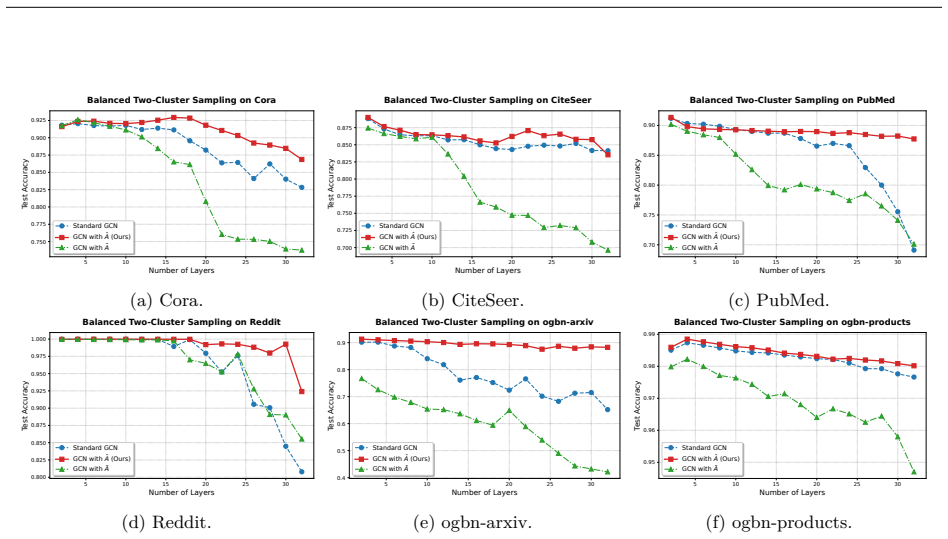
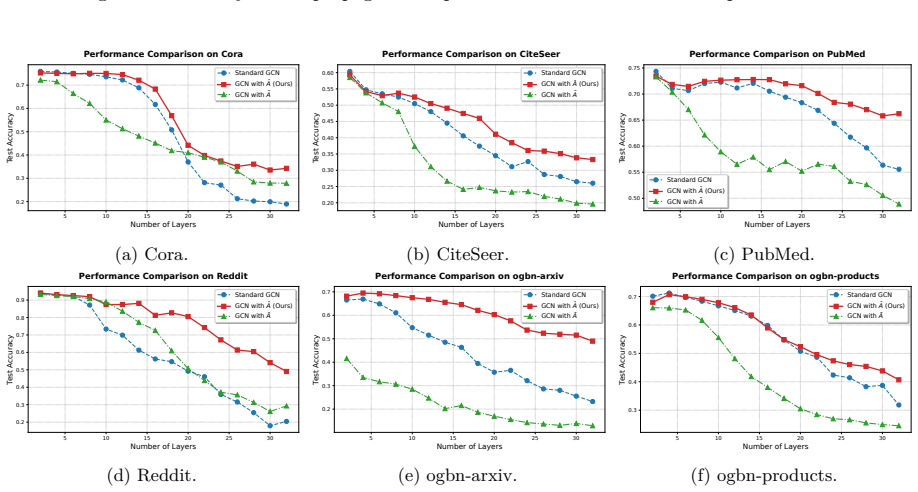
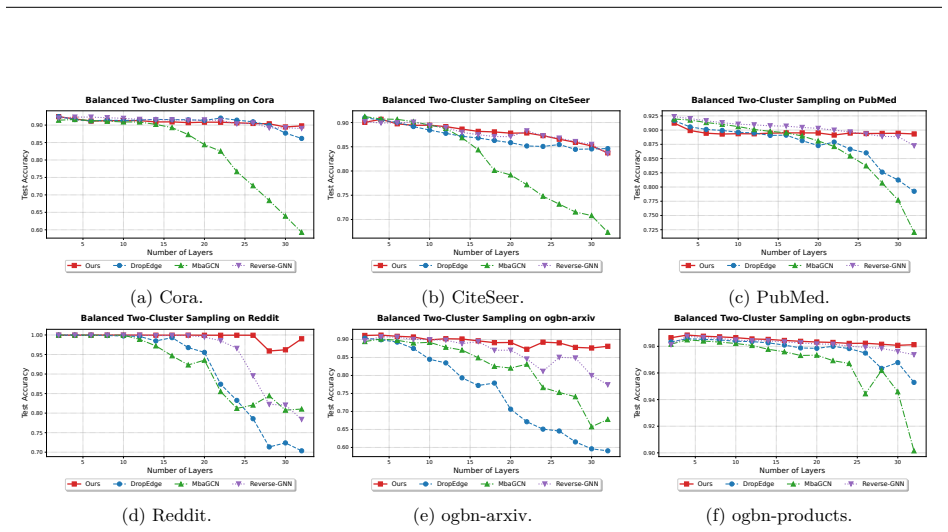
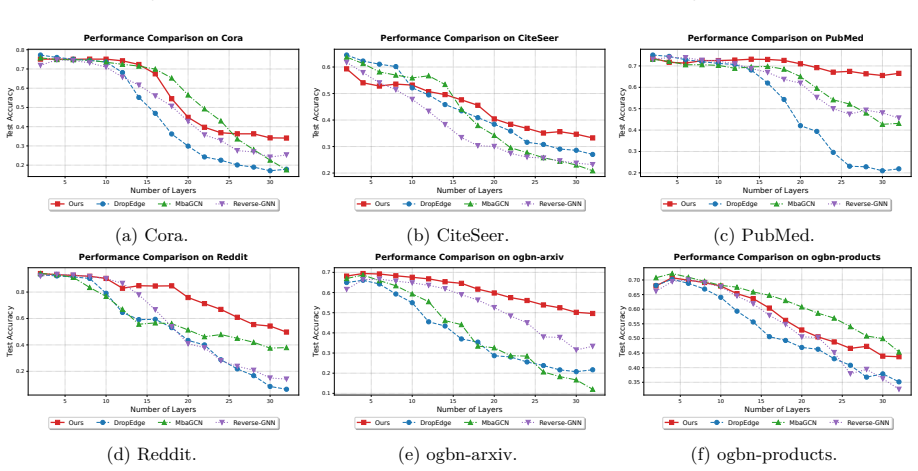
read the original abstract
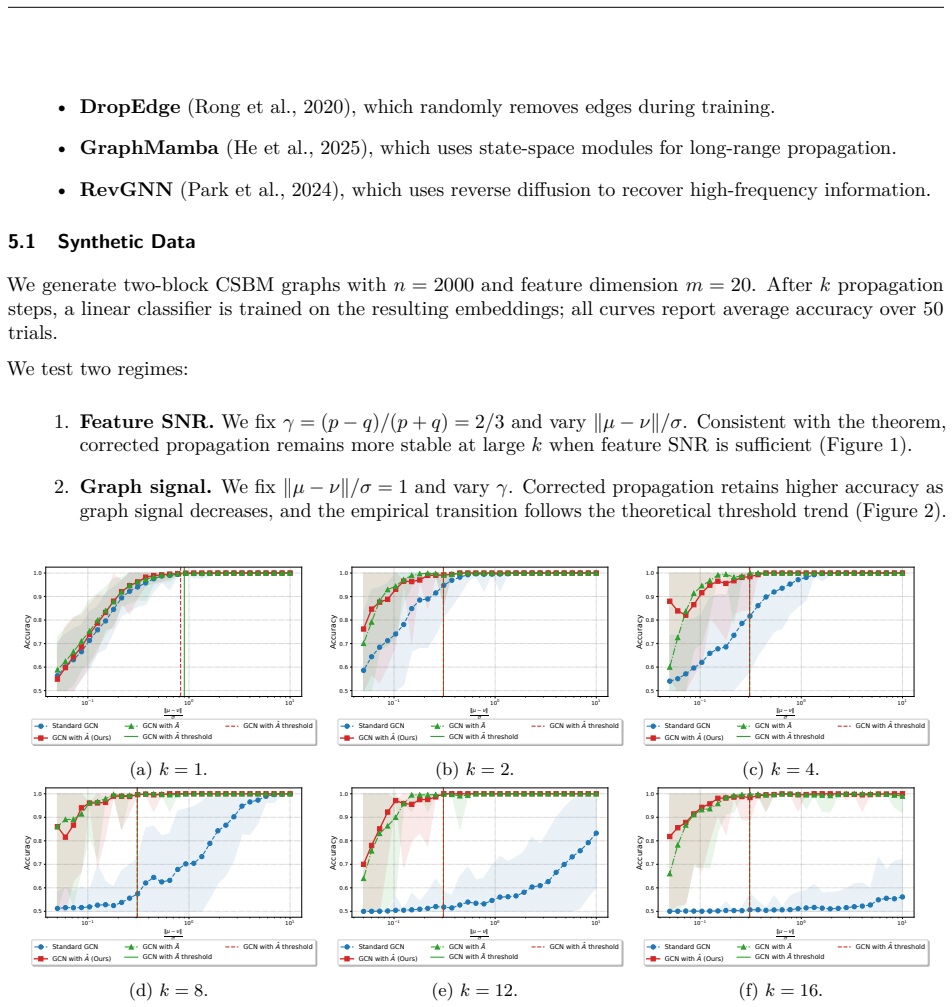
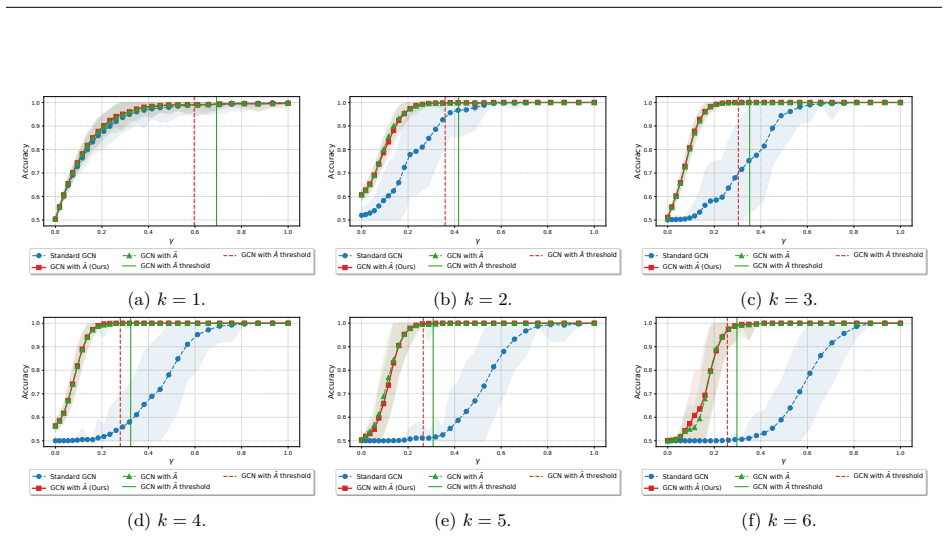
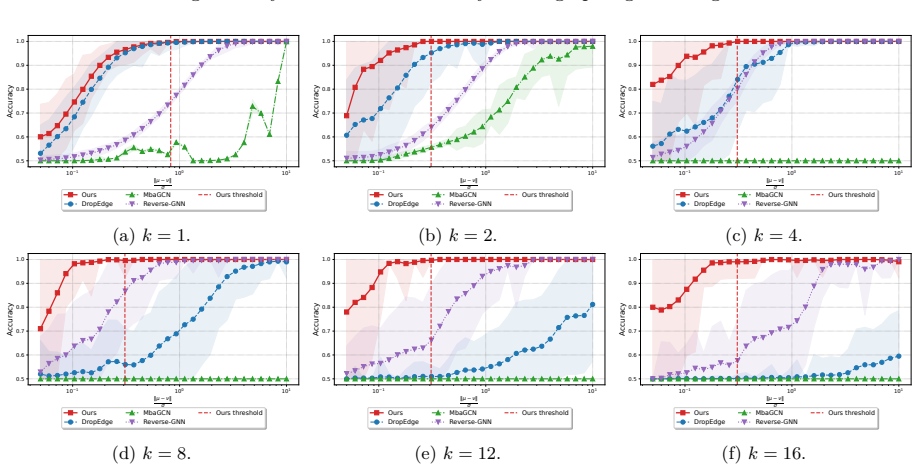
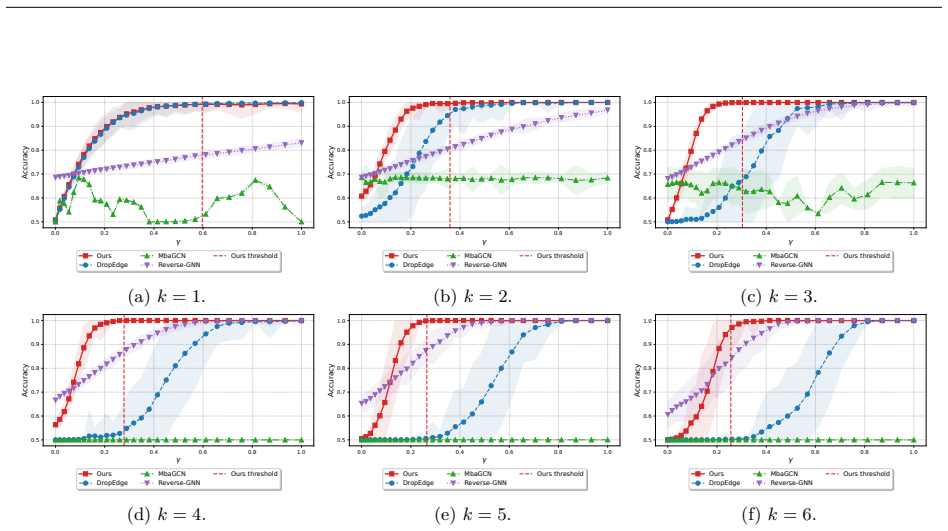
We develop a spectral theory for \emph{normalized corrected GNN propagation}. The object of study is the symmetric normalized adjacency with its degree-stationary component removed, matching the normalization used by standard GCN-style models while isolating the stationary direction most directly tied to oversmoothing. The central theoretical question is whether this corrected normalized operator preserves class-discriminative signal after many propagation layers. Our main result is a high-probability exact-recovery theorem for the binary Contextual Stochastic Block Model after \(k=O(\log n)\) propagation steps in the dense polylogarithmic regime \(p\ge C\log^B n/n\), for any fixed \(B>4\), under explicit graph-signal and feature-SNR conditions. We also establish a multi-class partial recovery theorem showing contraction toward class centers for most nodes. Synthetic and real node-classification experiments are included as empirical checks of the theory's predicted dependence on depth, graph signal, and feature noise.
Editorial analysis
A structured set of objections, weighed in public.
Referee Report
Summary. The manuscript develops a spectral theory for normalized corrected GNN propagation, defined via the symmetric normalized adjacency with its degree-stationary component removed. The central claim is a high-probability exact-recovery theorem for the binary Contextual Stochastic Block Model after k=O(log n) propagation steps in the dense polylogarithmic regime p ≥ C log^B n/n (B>4 fixed), under explicit graph-signal and feature-SNR conditions. A multi-class partial recovery theorem showing contraction toward class centers is also stated, together with synthetic and real node-classification experiments checking the predicted dependence on depth, graph signal, and feature noise.
Significance. If the theorems hold under the stated conditions, the work supplies a precise spectral characterization of how corrected normalization isolates non-stationary signal and thereby mitigates oversmoothing after logarithmic depth. The explicit high-probability exact-recovery guarantee tied to CSBM benchmarks, together with the multi-class contraction result, offers falsifiable predictions and a concrete link between GNN propagation operators and community recovery. The empirical section provides direct checks of the theory's scaling predictions.
minor comments (3)
- The abstract and introduction state the main theorem under 'explicit graph-signal and feature-SNR conditions' but do not list the precise inequalities or constants; these should be stated verbatim in the theorem statement (e.g., as Assumptions 1–3) so readers can immediately verify applicability.
- Notation for the corrected operator (symmetric normalized adjacency minus stationary component) is introduced without an equation number in the early sections; assigning a numbered display equation would improve traceability when the operator is invoked in the proof.
- The multi-class partial recovery theorem is described only qualitatively ('contraction toward class centers for most nodes'); a quantitative statement of the contraction rate or the fraction of nodes recovered would strengthen the result and allow direct comparison with the binary case.
Simulated Author's Rebuttal
We thank the referee for the accurate summary of the manuscript, the positive assessment of its significance, and the recommendation for minor revision. No specific major comments were listed in the report.
Circularity Check
No significant circularity; theorem is self-contained on external CSBM model
full rationale
The central result is a high-probability exact-recovery theorem for the binary Contextual Stochastic Block Model (CSBM) under explicitly stated graph-signal and feature-SNR conditions in the dense polylogarithmic regime. This is a standard random-graph model with external benchmarks; the derivation isolates the non-stationary component of the normalized adjacency and proves preservation of class-discriminative signal after k=O(log n) steps. No self-definitional steps, fitted inputs renamed as predictions, or load-bearing self-citations appear in the provided abstract or description. Experiments serve only as empirical checks of predicted dependence, not as definitional inputs. The result is scoped precisely to the stated assumptions and does not reduce to its own fitted quantities by construction.
Axiom & Free-Parameter Ledger
Reference graph
Works this paper leans on
-
[1]
Hamilton and Jure Leskovec , year = 2018, journal =
Rex Ying and Ruining He and Kaifeng Chen and Pong Eksombatchai and William L. Hamilton and Jure Leskovec , year = 2018, journal =
2018
-
[2]
Communications Materials , volume =
Philipp Reiser and Maximilian Neubert and Andreas Eberhard and Luca Torresi and Chen Zhou and Chen Shao and Houssam Metni and Clint van Hoesel and Henrik Schopmans and Timo Sommer and Pascal Friederich , title =. Communications Materials , volume =
-
[3]
International Conference on Learning Representations (ICLR) , year =
Semi-Supervised Classification with Graph Convolutional Networks , author =. International Conference on Learning Representations (ICLR) , year =
-
[4]
Proceedings of the 36th International Conference on Machine Learning , series =
Simplifying Graph Convolutional Networks , author =. Proceedings of the 36th International Conference on Machine Learning , series =
-
[5]
International Conference on Learning Representations (ICLR) , year =
Predict then Propagate: Graph Neural Networks meet Personalized PageRank , author =. International Conference on Learning Representations (ICLR) , year =
-
[6]
IEEE Signal Processing Magazine , volume =
The Emerging Field of Signal Processing on Graphs: Extending High-Dimensional Data Analysis to Networks and Other Irregular Domains , author =. IEEE Signal Processing Magazine , volume =
-
[7]
International Conference on Learning Representations , year =
Spectral Networks and Locally Connected Networks on Graphs , author =. International Conference on Learning Representations , year =
-
[8]
Advances in Neural Information Processing Systems , volume =
Convolutional Neural Networks on Graphs with Fast Localized Spectral Filtering , author =. Advances in Neural Information Processing Systems , volume =
-
[9]
International Conference on Learning Representations , year =
Graph Neural Networks Exponentially Lose Expressive Power for Node Classification , author =. International Conference on Learning Representations , year =
-
[10]
Thirty-Second AAAI conference on artificial intelligence , year =
Deeper Insights into Graph Convolutional Networks for Semi-Supervised Learning , author =. Thirty-Second AAAI conference on artificial intelligence , year =
-
[11]
Proceedings of the 37th International Conference on Machine Learning , publisher =
Chen, Ming and Wei, Zhewei and Huang, Zengfeng and Ding, Bolin and Li, Yaliang , year = 2020, month =. Proceedings of the 37th International Conference on Machine Learning , publisher =
2020
-
[12]
International Conference on Learning Representations , year =
PairNorm: Tackling Oversmoothing in GNNs , author =. International Conference on Learning Representations , year =
-
[13]
Yu Rong and Wenbing Huang and Tingyang Xu and Junzhou Huang , year = 2020, booktitle =
2020
-
[14]
The Thirty-eighth Annual Conference on Neural Information Processing Systems , year=
Analysis of Corrected Graph Convolutions , author=. The Thirty-eighth Annual Conference on Neural Information Processing Systems , year=
-
[15]
Cheeger, Jeff , journal=
-
[16]
Franco Scarselli and Marco Gori and Ah Chung Tsoi and Markus Hagenbuchner and Gabriele Monfardini , year = 2009, journal =
2009
-
[17]
Hong Cheng and Yang Zhou and Jeffrey Xu Yu , year = 2011, journal =
2011
-
[18]
Jerome Gilbert and Ernest Valveny and Horst Bunke , year = 2012, journal =
2012
-
[19]
T. A. Dang and E. Viennet , year = 2012, booktitle =
2012
-
[20]
2013 IEEE 13th International Conference on Data Mining , pages =
J. 2013 IEEE 13th International Conference on Data Mining , pages =
2013
-
[21]
Hamilton and Rex Ying and Jure Leskovec , year = 2017, journal =
William L. Hamilton and Rex Ying and Jure Leskovec , year = 2017, journal =
2017
-
[22]
Di Jin and Ziyang Liu and Weihao Li and Dongxiao He and Weixiong Zhang , year = 2019, journal =
2019
-
[23]
Nikhil Mehta and Lawrence Carin Duke and Piyush Rai , year = 2019, booktitle =
2019
-
[24]
Eli Chien and Wei-Cheng Chang and Cho-Jui Hsieh and Hsiang-Fu Yu and Jiong Zhang and Olgica Milenkovic and Inderjit S Dhillon , year = 2022, booktitle =
2022
-
[25]
International Conference on Machine Learning , pages=
Representation Learning on Graphs with Jumping Knowledge Networks , author=. International Conference on Machine Learning , pages=. 2018 , organization=
2018
-
[26]
arXiv preprint arXiv:2006.07107 , year=
Effective training strategies for deep graph neural networks , author=. arXiv preprint arXiv:2006.07107 , year=
arXiv 2006
-
[27]
ICML 2020 Workshop on Graph Representation Learning and Beyond , year=
A Note on Over-Smoothing for Graph Neural Networks , author=. ICML 2020 Workshop on Graph Representation Learning and Beyond , year=
2020
-
[28]
International Conference on Machine Learning , pages=
GRAND: Graph Neural Diffusion , author=. International Conference on Machine Learning , pages=. 2021 , organization=
2021
-
[29]
Yujun Yan and Milad Hashemi and Kevin Swersky and Yaoqing Yang and Danai Koutra , year = 2021, eprint =
2021
-
[30]
Lu, Zhou and Pu, Hongming and Wang, Feicheng and Hu, Zhiqiang and Wang, Liwei , year = 2017, booktitle =
2017
-
[31]
Muhammet Balcilar and Guillaume Renton and Pierre H
-
[32]
Advances in Neural Information Processing Systems , editor =
Generalization Analysis of Message Passing Neural Networks on Large Random Graphs , author =. Advances in Neural Information Processing Systems , editor =
-
[33]
Nicolas Keriven , year = 2022, booktitle =
2022
-
[34]
Keyulu Xu and Mozhi Zhang and Jingling Li and Simon Shaolei Du and Ken-Ichi Kawarabayashi and Stefanie Jegelka , year = 2021, booktitle =
2021
-
[35]
arXiv preprint arXiv:2303.10993 , year=
A Survey on Oversmoothing in Graph Neural Networks , author=. arXiv preprint arXiv:2303.10993 , year=
-
[36]
Advances in Neural Information Processing Systems (NeurIPS) , year =
Contextual Stochastic Block Models , author =. Advances in Neural Information Processing Systems (NeurIPS) , year =
-
[37]
Contextual Stochastic Block Model: Sharp Thresholds and Contiguity , author =. ArXiv , year =. 2011.09841 , archivePrefix =
arXiv 2011
-
[38]
Yifan Hou and Jian Zhang and James Cheng and Kaili Ma and Richard T. B. Ma and Hongzhi Chen and Ming-Chang Yang , year = 2020, booktitle =
2020
-
[39]
Eli Chien and Jianhao Peng and Pan Li and Olgica Milenkovic , year = 2021, booktitle =
2021
-
[40]
Proceedings of the 38th International Conference on Machine Learning , pages =
Graph Convolution for Semi-Supervised Classification: Improved Linear Separability and Out-of-Distribution Generalization , author =. Proceedings of the 38th International Conference on Machine Learning , pages =. 2021 , volume =
2021
-
[41]
The Eleventh International Conference on Learning Representations , year =
Effects of Graph Convolutions in Multi-layer Networks , author =. The Eleventh International Conference on Learning Representations , year =
-
[42]
Journal of Machine Learning Research , volume = 24, number = 246, pages =
Graph Attention Retrospective , author =. Journal of Machine Learning Research , volume = 24, number = 246, pages =
-
[43]
Optimality of Message-Passing Architectures for Sparse Graphs , volume =
Baranwal, Aseem and Fountoulakis, Kimon and Jagannath, Aukosh , booktitle =. Optimality of Message-Passing Architectures for Sparse Graphs , volume =
-
[44]
AI magazine , volume=
Collective classification in network data , author=. AI magazine , volume=
-
[45]
and Gharan, Shayan Oveis and Trevisan, Luca , title =
Lee, James R. and Gharan, Shayan Oveis and Trevisan, Luca , title =. 2014 , issue_date =. doi:10.1145/2665063 , journal =
-
[46]
Residual Connections and Normalization Can Provably Prevent Oversmoothing in
Michael Scholkemper and Xinyi Wu and Ali Jadbabaie and Michael T Schaub , booktitle=. Residual Connections and Normalization Can Provably Prevent Oversmoothing in
-
[47]
Advances in Neural Information Processing Systems (NeurIPS) , year=
Graph Neural Networks Need Cluster-Normalize-Activate Modules , author=. Advances in Neural Information Processing Systems (NeurIPS) , year=
-
[48]
Knowledge and Information Systems Journal , year=
Oversmoothing Alleviation in Graph Neural Networks: A Survey and Unified View , author=. Knowledge and Information Systems Journal , year=
-
[49]
Advances in Neural Information Processing Systems , year=
Almost Surely Asymptotically Constant Graph Neural Networks , author=. Advances in Neural Information Processing Systems , year=
-
[50]
The Thirty-ninth Annual Conference on Neural Information Processing Systems , year=
A Signed Graph Approach to Understanding and Mitigating Oversmoothing , author=. The Thirty-ninth Annual Conference on Neural Information Processing Systems , year=
-
[51]
arXiv preprint arXiv:2409.05191 , year=
Generalization of Geometric Graph Neural Networks with Lipschitz Loss Functions , author=. arXiv preprint arXiv:2409.05191 , year=
-
[52]
arXiv preprint arXiv:2403.09171 , year=
ADEdgeDrop: Adversarial Edge Dropping for Robust Graph Neural Networks , author=. arXiv preprint arXiv:2403.09171 , year=
-
[53]
arXiv preprint arXiv:2501.07903 , year=
Wave-driven Graph Neural Networks with Energy Dynamics for Over-smoothing Mitigation , author=. arXiv preprint arXiv:2501.07903 , year=
-
[54]
Journal of Big Data , volume=
A review of graph neural networks: concepts, architectures, techniques, challenges, datasets, applications, and future directions , author=. Journal of Big Data , volume=
-
[55]
IEEE Transactions on Knowledge and Data Engineering , year=
The Expressive Power of Graph Neural Networks: A Survey , author=. IEEE Transactions on Knowledge and Data Engineering , year=
-
[56]
SIAM Journal on Mathematics of Data Science , year=
Generalization Bounds for Message Passing Networks on Mixture of Graphons , author=. SIAM Journal on Mathematics of Data Science , year=
-
[57]
Physical Review X , volume=
Statistical physics analysis of graph neural networks: Approaching optimality in the contextual stochastic block model , author=. Physical Review X , volume=. 2025 , publisher=
2025
-
[58]
International Conference on Learning Representations (ICLR) , year=
Graph Attention is Not Always Beneficial: A Theoretical Analysis of Graph Attention Mechanisms via Contextual Stochastic Block Models , author=. International Conference on Learning Representations (ICLR) , year=
-
[59]
The Third Learning on Graphs Conference , year=
Optimal performance of Graph Convolutional Networks on the Contextual Stochastic Block Model , author=. The Third Learning on Graphs Conference , year=
-
[60]
arXiv preprint arXiv:2511.15327 , year=
KrawtchoukNet: A unified GNN solution for heterophily and over-smoothing with adaptive bounded polynomials , author=. arXiv preprint arXiv:2511.15327 , year=
-
[61]
arXiv preprint arXiv:2402.14802 , year=
Link Prediction with Physics-Inspired Graph Neural Networks , author=. arXiv preprint arXiv:2402.14802 , year=
-
[62]
arXiv preprint arXiv:2506.04765 , year=
OpenGT: A Comprehensive Benchmark For Graph Transformers , author=. arXiv preprint arXiv:2506.04765 , year=
-
[63]
arXiv preprint arXiv:2507.16347 , year=
Leveraging Personalized PageRank and Higher-Order Topological Structures for Heterophily Mitigation in Graph Neural Networks , author=. arXiv preprint arXiv:2507.16347 , year=
-
[64]
Proceedings of the Thirty-Fourth International Joint Conference on Artificial Intelligence (IJCAI) , pages=
Mamba-Based Graph Convolutional Networks: Tackling Over-smoothing with Selective State Space , author=. Proceedings of the Thirty-Fourth International Joint Conference on Artificial Intelligence (IJCAI) , pages=
-
[65]
Forty-first International Conference on Machine Learning (ICML) , year=
Mitigating Oversmoothing Through Reverse Process of GNNs for Heterophilic Graphs , author=. Forty-first International Conference on Machine Learning (ICML) , year=
discussion (0)
Sign in with ORCID, Apple, or X to comment. Anyone can read and Pith papers without signing in.