Oscillatory-nonnormal decomposition of dissipation in Ornstein-Uhlenbeck processes
Pith reviewed 2026-06-27 20:39 UTC · model grok-4.3
The pith
The steady-state entropy production rate of an Ornstein-Uhlenbeck process decomposes into oscillatory and nonnormal contributions with distinct trade-offs.
A machine-rendered reading of the paper's core claim, the machinery that carries it, and where it could break.
Core claim
We provide a decomposition of the steady-state entropy production rate associated with an Ornstein-Uhlenbeck process into two contributions: one associated with oscillatory behavior and one associated with nonnormality. Each contribution is associated with a different fundamental trade-off. The oscillatory contribution leads to the dissipation-coherence trade-off for noise-induced oscillations, which bounds the entropy production per oscillatory period by the number of oscillations within one correlation time, and this trade-off is twice as strict as those conjectured or derived for other systems. The nonnormal contribution leads to a trade-off between entropy production and acceleration of
What carries the argument
The decomposition of the entropy production rate into oscillatory and nonnormal components for linear stochastic dynamics.
Load-bearing premise
The dynamics must follow exactly a linear Ornstein-Uhlenbeck process that is Gaussian, Markovian, and has constant coefficients.
What would settle it
A direct measurement in an Ornstein-Uhlenbeck process where entropy production per oscillatory period exceeds the number of oscillations within one correlation time would falsify the oscillatory bound.
Figures
read the original abstract
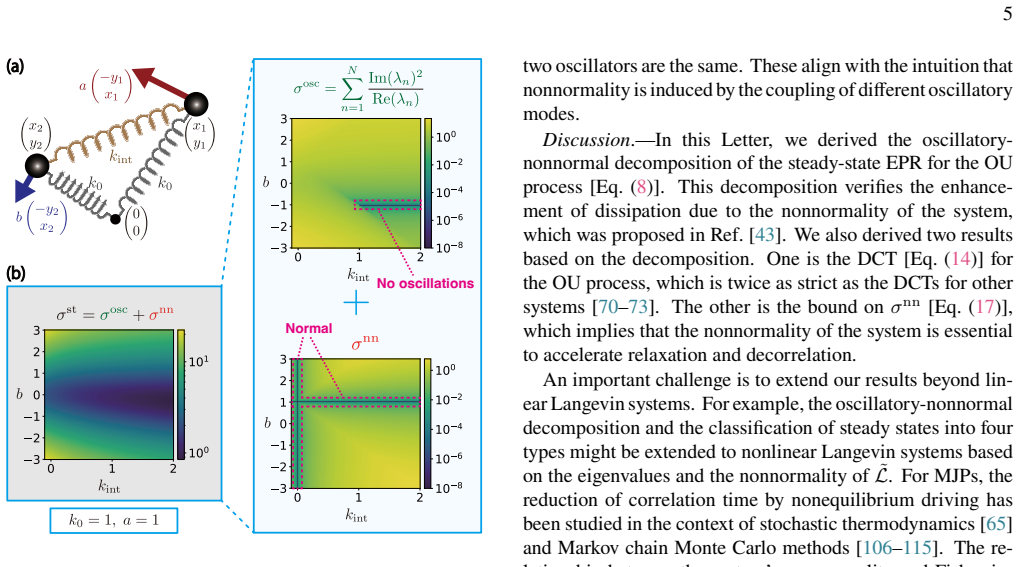
We provide a decomposition of the steady-state entropy production rate associated with an Ornstein-Uhlenbeck process into two contributions: one associated with oscillatory behavior and one associated with nonnormality. We also show that each contribution is associated with a different fundamental trade-off. The oscillatory contribution leads to the dissipation-coherence trade-off for noise-induced oscillations, which bounds the entropy production per oscillatory period by the number of oscillations within one correlation time. Notably, the tradeoff is twice as strict as those conjectured or derived for other systems. The nonnormal contribution leads to a trade-off between entropy production and acceleration of relaxation. We also demonstrate the decomposition using a simple bead-spring model.
Editorial analysis
A structured set of objections, weighed in public.
Referee Report
Summary. The manuscript decomposes the steady-state entropy production rate of an Ornstein-Uhlenbeck process into an oscillatory contribution and a nonnormal contribution. Each is tied to a distinct trade-off: the oscillatory part yields a dissipation-coherence bound (entropy production per period bounded by the number of oscillations per correlation time, claimed twice as strict as prior results), while the nonnormal part yields a trade-off between entropy production and relaxation acceleration. The decomposition is constructed exactly for linear OU dynamics and illustrated on a bead-spring model.
Significance. Within the exactly solvable class of linear, Markovian, Gaussian processes with constant coefficients, the paper supplies an explicit decomposition together with parameter-free bounds and falsifiable trade-offs. This provides a concrete, checkable advance for quantifying dissipation in systems exhibiting noise-induced oscillations or nonnormal transients, with the stricter oscillatory bound and the relaxation-acceleration link as potentially useful organizing principles.
minor comments (2)
- [Abstract and § on oscillatory trade-off] The abstract states that the oscillatory trade-off 'is twice as strict as those conjectured or derived for other systems'; the main text should include an explicit side-by-side comparison (with citations) to the earlier bounds so that the factor-of-two claim can be verified at a glance.
- [Demonstration section] In the bead-spring demonstration, state the numerical values of all matrix entries, noise strengths, and initial conditions used to generate the plotted trajectories and entropy-production curves.
Simulated Author's Rebuttal
We thank the referee for their positive assessment of the manuscript, their recognition of the explicit decomposition and the associated parameter-free bounds, and their recommendation to accept.
Circularity Check
No significant circularity
full rationale
The paper derives an exact decomposition of steady-state entropy production for linear Ornstein-Uhlenbeck processes (Gaussian, Markovian, constant coefficients) into oscillatory and nonnormality contributions, each linked to a trade-off, using the explicit dynamics of the process. The dissipation-coherence bound and relaxation-acceleration trade-off follow directly from the linear structure and are demonstrated on a bead-spring model without any reduction to fitted parameters, self-referential definitions, or load-bearing self-citations that substitute for independent derivation. All steps remain internally checkable from the stated assumptions and equations, with no evidence that claimed results are equivalent to inputs by construction.
Axiom & Free-Parameter Ledger
axioms (1)
- domain assumption Ornstein-Uhlenbeck process is a linear, time-homogeneous, Gaussian Markov process whose steady-state statistics are fully determined by the drift matrix and diffusion matrix.
discussion (0)
Sign in with ORCID, Apple, or X to comment. Anyone can read and Pith papers without signing in.