Vortex Nucleons as Partial-Wave Filters in Nucleon--Nucleon Scattering
Pith reviewed 2026-06-26 19:08 UTC · model grok-4.3
The pith
An on-axis vortex nucleon with fixed orbital projection m_L excludes low-L partial waves from nucleon-nucleon scattering.
A machine-rendered reading of the paper's core claim, the machinery that carries it, and where it could break.
Core claim
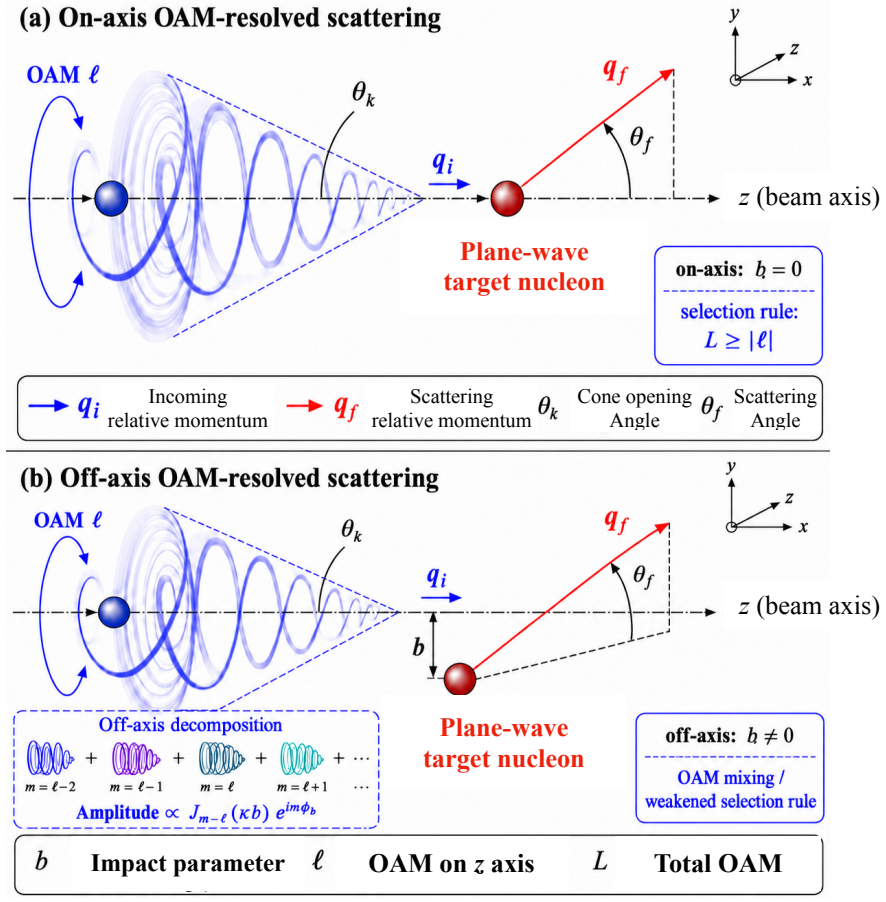
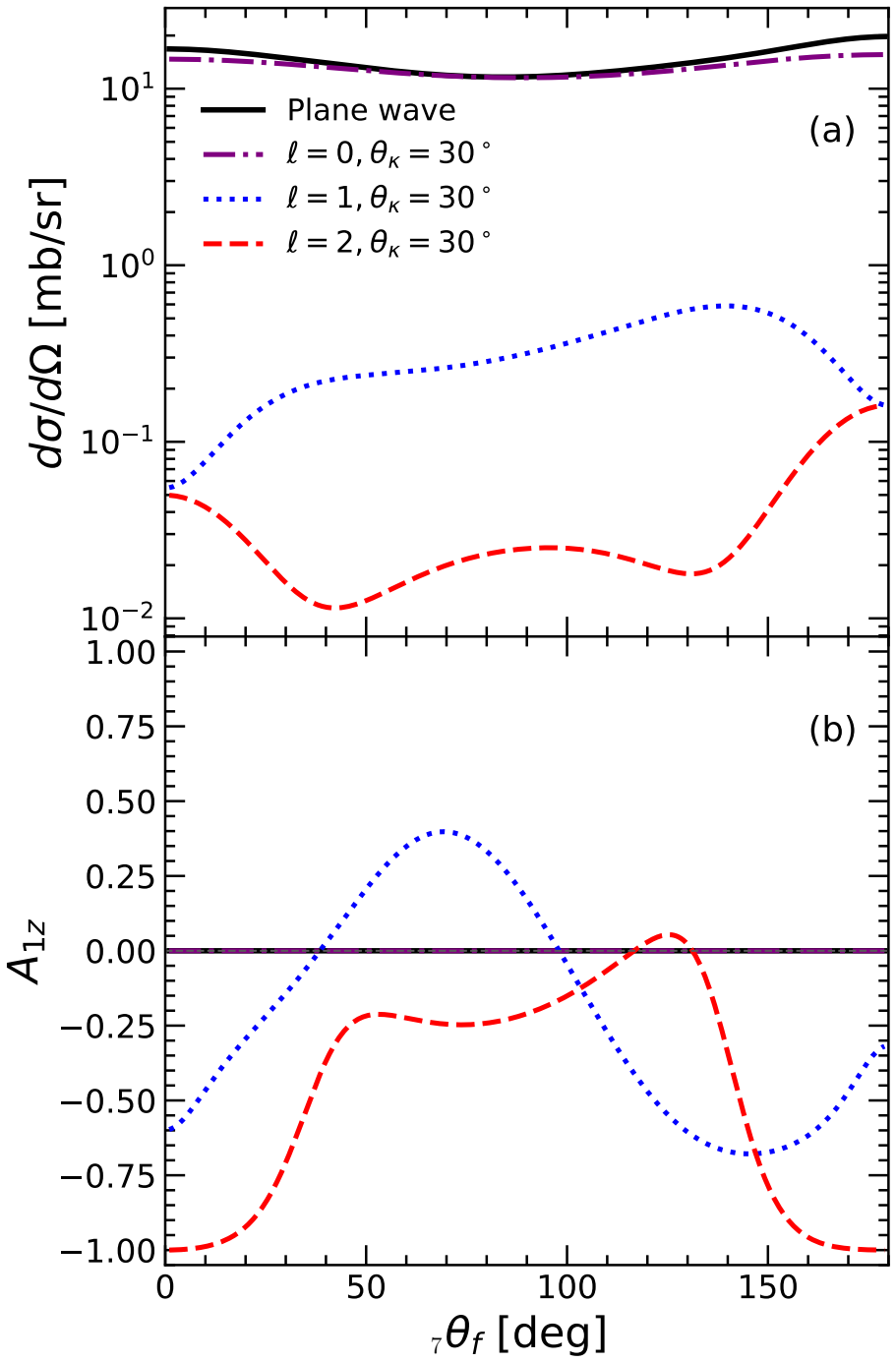
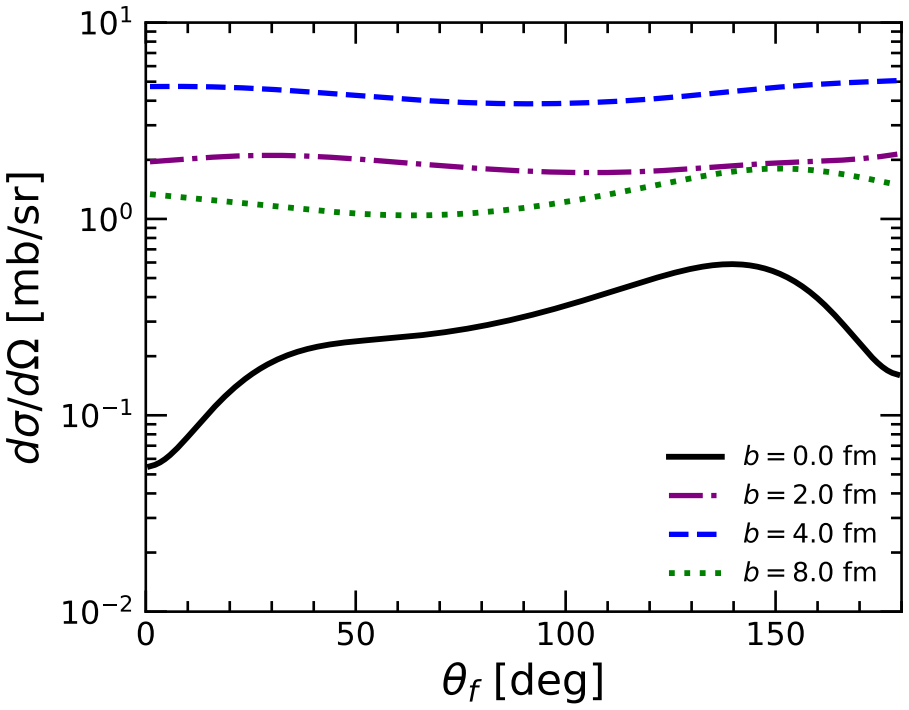
Using the standard LSJ partial-wave S matrix as input, an on-axis vortex incident state with fixed m_L=ℓ imposes the direct selection rule L≥|ℓ| on the initial nucleon-nucleon partial waves. As a result the initial S wave is excluded for ℓ=1 while both the initial S and P waves are excluded for ℓ=2. The underlying phase shifts are not modified; instead the vortex external state changes how the ordinary partial waves are projected into the scattering amplitude. Off-axis scattering introduces Bessel-function weights that partially relax the on-axis selection rule.
What carries the argument
The on-axis vortex incident state with fixed orbital angular-momentum projection m_L=ℓ, which enforces the L≥|ℓ| selection rule on initial partial waves via projection into the scattering amplitude.
If this is right
- The initial S wave is excluded for ℓ=1 vortex states.
- Both initial S and P waves are excluded for ℓ=2 vortex states.
- The phase shifts of the nucleon-nucleon interaction remain unmodified.
- Off-axis scattering introduces Bessel-function weights and partially relaxes the on-axis selection rule.
Where Pith is reading between the lines
- This approach could isolate higher partial-wave contributions in NN scattering experiments by preparing vortex states.
- The same vortex filtering might extend to other two-body scattering systems that admit partial-wave descriptions.
- Experimental realization would require verifying that the vortex structure does not introduce additional dynamical effects beyond the geometric projection.
Load-bearing premise
A vortex nucleon state with well-defined orbital angular momentum projection m_L can be prepared and the scattering remains fully described by the standard LSJ partial-wave S-matrix.
What would settle it
Observation of S-wave contributions to the scattering amplitude in an ℓ=1 on-axis vortex nucleon collision would contradict the claimed selection rule.
Figures
read the original abstract
We propose vortex nucleon scattering as an angular-momentum-resolved probe of nucleon--nucleon partial waves. Using the standard $LSJ$ partial-wave $S$ matrix as input, we show that an on-axis vortex incident state with a fixed orbital angular-momentum projection $m_L=\ell$ imposes the direct selection rule $L\geq |\ell|$ on the initial nucleon--nucleon partial waves. As a result, the initial $S$ wave is excluded for $\ell=1$, while both the initial $S$ and $P$ waves are excluded for $\ell=2$. The underlying phase shifts are not modified. Instead, the vortex external state changes how the ordinary partial waves are projected into the scattering amplitude. We further analyze off-axis scattering, where the displacement of the target from the vortex axis introduces Bessel-function weights and partially relaxes the on-axis selection rule. These results suggest that vortex nucleons can provide a new experimental handle on the partial-wave content of the strong nucleon--nucleon interaction.
Editorial analysis
A structured set of objections, weighed in public.
Referee Report
Summary. The paper proposes vortex nucleon scattering as an angular-momentum-resolved probe of nucleon-nucleon partial waves. Using the conventional LSJ partial-wave S-matrix as external input, it argues that an on-axis vortex incident state with fixed m_L = ℓ imposes the selection rule L ≥ |ℓ| on the initial partial waves (excluding the S-wave for ℓ=1 and both S- and P-waves for ℓ=2) while leaving the underlying phase shifts unmodified. The vortex structure only alters the projection of ordinary partial waves into the scattering amplitude. Off-axis scattering is analyzed via Bessel-function weights that partially relax the on-axis rule.
Significance. If the central claim holds, the work supplies a parameter-free, falsifiable prediction for how standard partial-wave amplitudes are filtered by a vortex incident state, grounded in angular-momentum addition. This could furnish a new experimental handle on the partial-wave content of the NN interaction without requiring any modification to on-shell phase shifts. The approach is internally consistent with the standard S-matrix framework and introduces no new free parameters or ad-hoc entities.
major comments (1)
- [Abstract] Abstract and main text: the claim that the selection rule L ≥ |ℓ| 'follows from the standard S-matrix input' is asserted without explicit derivation steps, projection formulas, or amplitude expressions showing how the Bessel-beam decomposition restricts the sum over L. This omission makes the central result difficult to verify beyond the conceptual level.
Simulated Author's Rebuttal
We thank the referee for the careful reading, the positive assessment of the work's internal consistency, and the recommendation for minor revision. We address the single major comment below.
read point-by-point responses
-
Referee: [Abstract] Abstract and main text: the claim that the selection rule L ≥ |ℓ| 'follows from the standard S-matrix input' is asserted without explicit derivation steps, projection formulas, or amplitude expressions showing how the Bessel-beam decomposition restricts the sum over L. This omission makes the central result difficult to verify beyond the conceptual level.
Authors: We agree that the derivation of the L ≥ |ℓ| selection rule from the fixed m_L = ℓ vortex state could be presented with greater explicitness. The manuscript already employs the standard LSJ S-matrix elements as external input and obtains the restriction solely from the angular-momentum projection in the Bessel-beam decomposition of the incident state; the phase shifts themselves remain unmodified. To make this transparent, the revised manuscript will insert the explicit projection formulas for the vortex incident state onto the partial-wave basis together with the resulting scattering amplitude expression. These additions will display how the sum over L is restricted by the fixed m_L without introducing new parameters or altering on-shell physics. revision: yes
Circularity Check
No significant circularity
full rationale
The paper explicitly takes the conventional LSJ partial-wave S-matrix as an external input and applies the standard angular-momentum addition rule |m_L| ≤ L to a vortex (Bessel) incident state. This produces the stated selection rule L ≥ |ℓ| without modifying or fitting any on-shell phase shifts. No self-citation chain, ansatz smuggling, or fitted-input-called-prediction is present; the derivation is self-contained against external benchmarks of angular-momentum algebra.
Axiom & Free-Parameter Ledger
Reference graph
Works this paper leans on
-
[1]
Machleidt, inAdvances in Nuclear Physics, Vol
R. Machleidt, inAdvances in Nuclear Physics, Vol. 19, edited by J. W. Negele and E. Vogt (Springer, Boston, 1989) pp. 189–376
1989
-
[2]
V. G. J. Stoks, R. A. M. Klomp, M. C. M. Rentmeester, and J. J. de Swart, Physical Review C48, 792 (1993)
1993
-
[3]
R. B. Wiringa, V. G. J. Stoks, and R. Schiavilla, Physical Review C51, 38 (1995). 11
1995
-
[4]
Machleidt, Physical Review C63, 024001 (2001)
R. Machleidt, Physical Review C63, 024001 (2001)
2001
-
[5]
Epelbaum, H.-W
E. Epelbaum, H.-W. Hammer, and U.-G. Meißner, Reviews of Modern Physics81, 1773 (2009)
2009
-
[6]
Machleidt and D
R. Machleidt and D. R. Entem, Physics Reports503, 1 (2011)
2011
-
[7]
Verbeeck, H
J. Verbeeck, H. Tian, and P. Schattschneider, Nature467, 301 (2010)
2010
-
[8]
K. Y. Bliokh, Y. P. Bliokh, I. P. Ivanov, G. Guzzinati, L. Clark, R. Van Boxem, A. B´ ech´ e, R. Juchtmans, M. A. Alonso, P. Schattschneider, F. Nori, and J. Verbeeck, Physics Reports 690, 1 (2017)
2017
-
[9]
S. M. Lloyd, M. Babiker, and J. Yuan, Reviews of Modern Physics89, 035004 (2017)
2017
-
[10]
K. Y. Bliokh, M. R. Dennis, and F. Nori, Physical Review Letters107, 174802 (2011)
2011
-
[11]
R. Van Boxem, B. Partoens, and J. Verbeeck, Physical Review A89, 032715 (2014), arXiv:1312.1184 [quant-ph]
Pith/arXiv arXiv 2014
-
[12]
I. P. Ivanov, Physical Review D85, 076001 (2012), arXiv:1201.5040 [hep-ph]
Pith/arXiv arXiv 2012
-
[13]
V. K. Ivanov, A. D. Chaikovskaia, and D. V. Karlovets, Physical Review A108, 062803 (2023), arXiv:2305.12419 [physics.atom-ph]
arXiv 2023
-
[14]
O. I. Tolstikhin and T. Morishita, Physical Review A99, 063415 (2019)
2019
- [15]
-
[16]
Strnat, A
S. Strnat, A. K. Sahoo, L. Sharma, J. Sommerfeldt, and A. Surzhykov, Atoms13, 23 (2025)
2025
-
[17]
A. L. Harris and S. Fritzsche, Journal of Physics B: Atomic, Molecular and Optical Physics 58, 095201 (2025)
2025
-
[18]
C. W. Clark, R. Barankov, M. G. Huber, M. Arif, D. G. Cory, and D. A. Pushin, Nature525, 504 (2015)
2015
-
[19]
Afanasev, V
A. Afanasev, V. G. Serbo, and M. Solyanik, Journal of Physics G: Nuclear and Particle Physics 45, 055102 (2018)
2018
-
[20]
A. V. Afanasev, D. V. Karlovets, and V. G. Serbo, Physical Review C100, 051601 (2019)
2019
-
[21]
A. V. Afanasev, D. V. Karlovets, and V. G. Serbo, Physical Review C103, 054612 (2021), arXiv:2102.10380 [nucl-th]
arXiv 2021
-
[22]
Z.-W. Lu, L. Guo, M. Ababekri, J.-L. Zhang, X.-F. Weng, Y. Wu, Y.-F. Niu, and J.-X. Li, Physical Review Letters134, 052501 (2025), arXiv:2406.05414 [nucl-th]
arXiv 2025
-
[23]
Maruyama, T
T. Maruyama, T. Hayakawa, R. Hajima, T. Kajino, and M.-K. Cheoun, Physical Review Research5, 043289 (2023). 12
2023
-
[24]
T. Kirschbaum, T. Schumm, and A. P´ alffy, Physical Review C110, 064326 (2024), arXiv:2404.13023 [nucl-th]
arXiv 2024
-
[25]
org/NN/(2026)
NN-Online, Nucleon–nucleon phase shifts and scattering observables,https://nn-online. org/NN/(2026)
2026
-
[26]
partial-wave filtering in nu- cleon–nucleon scattering with vortex nucleons
J. Hu, Y. Zhang, and H. Shen, Supplemental material for “partial-wave filtering in nu- cleon–nucleon scattering with vortex nucleons”. 13
discussion (0)
Sign in with ORCID, Apple, or X to comment. Anyone can read and Pith papers without signing in.