REVIEW 2 major objections 6 minor 28 references
Computing the Integral R2 Indicator by Perspective Mapping and Box Decomposition
T0 review · 2 major / 6 minor · reviewed 2026-07-12 · grok-4.5
Pith's one-line read A perspective map turns exact integral R2 into weighted box volumes, so hypervolume box-decomposition algorithms compute it in the same asymptotic time for every fixed number of objectives.
desk verdict Clean geometric reduction that turns exact integral R2 into weighted hypervolume box work, with matching upper and lower bounds and shipped verification code. read the letter →
The pith
A machine-rendered reading of the paper's core claim, the machinery that carries it, and where it could break.
The reading
What carries the argument
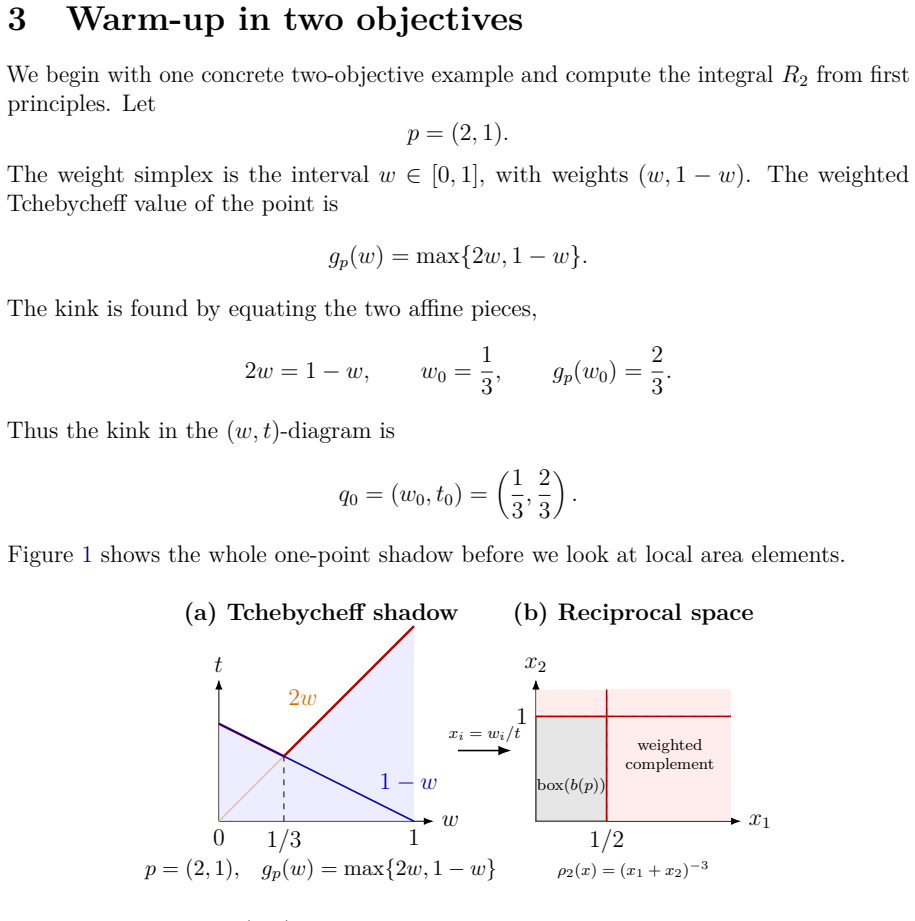
The bidirectional perspective mapping Φ(w,t)=w/t that sends Tchebycheff weight-loss coordinates to reciprocal objective space, converting the R2 integral into a weighted complement volume and ordinary hypervolume into an inverse-density integral over the same Tchebycheff interval.
What would settle it
Run the three-objective perspective algorithm on a non-dominated point set, compare its floating-point value against an independent exact subdivision of the weight simplex, and verify that absolute error stays at machine epsilon while observed runtime scales as O(n log n); any systematic discrepancy or super-linear growth would refute the reduction.
Extended reading notes
Core claim
After the ideal point is moved to the origin, the subgraph of the lower weighted Tchebycheff envelope maps bijectively (up to null sets) onto the complement of an anchored-box union in reciprocal objective space; the Jacobian supplies the density (x1+⋯+xN)^(-(N+1)). Any algorithm that decomposes that reciprocal region into M boxes therefore yields the exact integral R2 value in the decomposition time plus an O(2^N M) post-processing cost, which is linear in M for fixed N.
Load-bearing premise
The claim that the Ω(n log n) lower bound lifts to every fixed dimension rests on embedding two-dimensional instances by zero-padding, which is valid only when nonnegative (including zero) loss coordinates are allowed.
Editorial extensions
If this is right
- Exact integral R2 can be obtained in O(n log n) time for two and three objectives by feeding existing dimension-sweep box emitters into the weighted-integral post-processor.
- For every fixed N the asymptotic cost of exact R2 matches the best known complexity of hypervolume box decomposition.
- R2 differences equal finite weighted hypervolume differences, so exclusive contributions and improvement calculations transfer box-by-box.
- Exact value computation already requires Ω(n log n) decisions for every fixed N≥2 and is #P-hard when N is part of the input.
- Any hypervolume method whose geometric core is a box decomposition (gradients, Newton steps, expected improvement) can be ported to integral R2 by the same volume substitution.
Reading between the lines
- Because the map preserves combinatorial structure, any future improvement in high-dimensional box decomposition immediately yields a faster exact R2 algorithm without a separate correctness proof.
- A single library primitive that measures an anchored-box region under a user-chosen density could serve both hypervolume and integral-R2 clients.
- The zero-padding technique suggests that other multi-objective indicators reducible to a two-objective special case will inherit the same Ω(n log n) barrier once nonnegative coordinates are admitted.
- The weighted-box view may simplify future proofs of submodularity or approximation ratios for R2-based subset selection that previously relied on direct arguments over the simplex.
Signed reviews
Editorial analysis
A structured set of objections, weighed in public.
Referee Report
Summary. The paper develops a bidirectional perspective mapping that, after translating the ideal point to the origin, sends the subgraph of the lower weighted Tchebycheff envelope over the weight simplex to the complement of an anchored-box union in reciprocal objective space, with Jacobian density (x1+···+xN)^(-(N+1)). Absolute integral R2 is thereby a weighted complement volume, and R2 differences become finite weighted hypervolume differences. Any hypervolume algorithm that emits an M-box decomposition of U(b(P)) therefore yields exact integral R2 after replacing ordinary volumes by closed-form weighted corner integrals, at output-sensitive overhead O(2^N M) (O(M) for fixed N). Instantiating known box emitters gives O(n log n) for N=2,3, O(n^2) for N=4, and O(n^{⌊(N-1)/2⌋+1}) for fixed N≥4. Matching lower bounds are proved: Ω(n log n) already in two objectives (uniform-gap reduction on the reciprocal diagonal), a lift to every fixed N≥2 via zero-padding, and #P-hardness when N is part of the input via a perspective-weighted Bringmann–Friedrich construction. Appendices supply full proofs; verification scripts and a reference implementation are provided.
Significance. If correct, the result is a clean and reusable bridge between integral R2 and the mature theory of anchored-box unions / hypervolume. It upgrades exact integral-R2 computation from a largely biobjective or exponential-in-n setting to the best fixed-dimension hypervolume bounds, supplies matching algebraic decision-tree lower bounds and variable-dimension #P-hardness, and opens a systematic transfer path for contributions, gradients, and expected-improvement methods. Strengths that raise confidence include: fully written change-of-variables and reduction arguments (Lemmas 1–3, Theorems 1–7, Appendices A–B); closed-form weighted box integrals; floating-point agreement of perspective vs subdivision evaluators (Table 2); and reproducible rational sanity checks for the three reduction gadgets. For performance assessment, archiving, and skyline selection this is a substantial algorithmic and structural contribution.
major comments (2)
- Abstract and §1 state that the Ω(n log n) lower bound “lifts to every fixed N≥2” without qualification, but Proposition 2 and Remark 2 / Appendix A.3 establish the lift only on the closed nonnegative orthant via zero-padding, and explicitly note that a perturbation argument would be needed for strictly positive loss vectors. The abstract claim should be aligned with that domain (e.g., “on the nonnegative loss domain” or “for every fixed N≥2 under nonnegative coordinates”), so that the main-text statement is not stronger than the proof.
- §4.2 and Table 1 attribute the O(n log n) three-objective bound to a box emitter with M=O(n). The theoretical citation is Fonseca–Paquete–López-Ibáñez [9], while the implementation description leans on a tree-free blog post [6]. For the complexity claim to be self-contained in the archival literature, the manuscript should state explicitly that any correct O(n log n) three-dimensional hypervolume algorithm that emits a linear-size disjoint box decomposition (as [9] does) suffices, and treat [6] only as an implementation note rather than a load-bearing reference.
minor comments (6)
- Appendix C.1 title: “three dimesional” → “three-dimensional”.
- §2: “pointsin paremutuallynon-dominatedintheParetodominancerelation” appears to be a missing-space typesetting error; same for a few other run-on phrases later in the introduction.
- Figure 1 / Figure 2 captions are helpful; a short explicit statement that the gallery is illustrative only (already present in the text) could be repeated in the figure captions for readers who skim figures first.
- §5.2 weighted-box formula: the sign convention (−1)^{|ε|} vs (−1)^{N−|ε|} is standard but easy to mis-copy; a one-line check for the unit box or a pointer to the three-dimensional eight-corner formula in §4.2 would reduce implementation risk.
- §6 and §7 correctly flag that practical runtime vs QR2 and related methods is left for future work; a single sentence in the abstract or introduction that the present contribution is complexity-theoretic / structural (not an empirical bake-off) would set expectations cleanly.
- References [7] and [8] are the author’s own concurrent arXiv notes; keeping them is appropriate for background, but a brief parenthetical that the hardness of subset selection is prior work and not re-proved here would avoid any impression of circular dependence.
Circularity Check
No significant circularity: integral R2 is defined independently and the perspective map is a genuine Jacobian change of variables, not a redefinition that forces the result.
full rationale
The continuous integral R2 is introduced as the independent integral of the lower weighted Tchebycheff envelope over the weight simplex (Section 2). The perspective map Φ(w,t)=w/t and its Jacobian density (x1+⋯+xN)^(-(N+1)) are derived from first principles (2-D warm-up, Lemmas 1–3, Theorems 1 and 4); the correspondence between the Tchebycheff subgraph and the complement of an anchored-box union is proved by direct substitution, not assumed by definition. Complexity upper bounds then follow by reusing external box-decomposition emitters and replacing ordinary volumes with closed-form weighted corner sums—an algorithmic transfer, not a circular identification of the two indicators. Lower bounds are self-contained reductions from uniform gap and #MON-CNF with explicit gadgets (Appendices A–B). Self-citations ([6],[7],[8]) supply background, a 3-D emitter variant, and related hardness for subset selection; they are not used to define the claimed quantity or to force uniqueness. No fitted parameters are renamed as predictions, and no uniqueness theorem is imported from the authors to forbid alternatives. The derivation is therefore self-contained against external benchmarks.
Assumptions & free parameters
assumptions (5)
- domain assumption Ideal point translated to origin; approximation points are mutually non-dominated and strictly positive (Section 2).
- standard math Change-of-variables / Jacobian formula for Φ(w,t)=w/t yields density (sum x_i)^(-(N+1)) (Lemmas 2–3).
- domain assumption Existing hypervolume algorithms emit correct disjoint axis-aligned box decompositions of anchored orthants with stated complexities (Fonseca et al., Guerreiro et al., Lacour et al./HBDA).
- standard math Uniform-gap requires Ω(n log n) algebraic decision-tree decisions; #MON-CNF is #P-hard (Ben-Or, Preparata–Shamos, Bringmann–Friedrich).
- ad hoc to paper Fixed-N lower-bound lift via zero-padding is valid on the closed nonnegative orthant (Proposition 2 / Remark 2).
invented entities (1)
-
Perspective map Φ and reciprocal-box representation of integral R2
independent evidence
Cite this review
Pith. "Pith review of Computing the Integral R2 Indicator by Perspective Mapping and Box Decomposition." pith.science (2026). https://pith.science/paper/LK5Q3A7W
@misc{pith2026260630530,
  author       = {Pith},
  title        = {Pith review of: Computing the Integral R2 Indicator by Perspective Mapping and Box Decomposition},
  year         = {2026},
  howpublished = {\url{https://pith.science/paper/LK5Q3A7W}},
  note         = {Machine review of arXiv:2606.30530}
}
abstract
The continuous integral R2 indicator is a Pareto-compliant refinement of the classical finite-weight-vector R2 indicator, used in performance assessment, bounded archiving for a-posteriori multi-objective optimization, and skyline selection in databases. This work introduces a bidirectional perspective mapping between continuous integral R2 computation and integration over unions of anchored axis-aligned boxes. After translating the ideal point of a minimization problem to the origin, approximation points become strictly positive loss vectors, and the subgraph of the lower weighted Tchebycheff envelope over the weight simplex maps to the complement of an anchored-box union in reciprocal objective space. The Jacobian gives an absolute R2 formula as a weighted complement volume with density $(x_1+\cdots+x_N)^{-(N+1)}$, while differences of R2 values become finite weighted hypervolume differences. Hence, hypervolume algorithms that emit box decompositions can be reused by replacing ordinary box volumes with closed-form weighted box integrals. For $N$ objectives, this gives an output-sensitive overhead $O(2^N M)$ for an $M$-box decomposition, or $O(M)$ for fixed $N$. Using existing box-decomposition approaches, the integral R2 can be computed in $O(n \log n)$ for $N=2,3$, in $O(n^2)$ for $N=4$, and in $O\left(n^{\lfloor (N-1)/2\rfloor+1}\right)$ for $N\geq4$, with $n$ denoting the size of the approximation set. On the lower-bound side, exact value computation has an $\Omega(n\log n)$ lower bound in the algebraic decision-tree model already in two objectives, this bound lifts to every fixed $N\geq2$, and exact computation is $\#P$-hard when $N$ is part of the input. Together, the proposed perspective mapping provides a powerful tool for transferring algorithmic and structural results between anchored-box union and hypervolume theory and integral R2 computation.
Figures

Reference graph
Works this paper leans on
-
[9]
M. T. M. Emmerich. Three-objective integralR2 subset selection: NP-hardness and submodular approximation.arXiv preprint arXiv:2606.26591, 2026. https: //arxiv.org/abs/2606.26591
arXiv 2026
-
[6]
M. T. M. Emmerich and A. Deutz. Time complexity and zeros of the hypervolume indicator gradient field. InEVOLVE – A Bridge between Probability, Set Oriented Numerics, and Evolutionary Computation III, pages 169–193. Springer International Publishing, Heidelberg, 2014
2014
-
[1]
M. Ben-Or. Lower bounds for algebraic computation trees. InProceedings of the Fifteenth Annual ACM Symposium on Theory of Computing, pages 80–86. ACM, 1983
1983
-
[2]
Beume, C
N. Beume, C. M. Fonseca, M. López-Ibáñez, L. Paquete, and J. Vahrenhold. On the complexity of computing the hypervolume indicator.IEEE Transactions on Evolutionary Computation, 13(5):1075–1082, 2009
2009
-
[3]
Bringmann and T
K. Bringmann and T. Friedrich. Approximating the volume of unions and intersections of high-dimensional geometric objects.Computational Geometry, 43(6–7):601–610,
-
[4]
Extended version: arXiv:0809.0835
-
[5]
M. T. M. Emmerich and C. M. Fonseca. Computing hypervolume contributions in low dimensions: Asymptotically optimal algorithm and complexity results. InEvolu- tionary Multi-Criterion Optimization, pages 121–135. Springer, Berlin, Heidelberg, 2011
2011
-
[7]
M. T. M. Emmerich. A tree-free path to efficiently compute the hypervolume indicator in three dimensions.Multiobjective Optimization and Decision Analysis News, blog post, October 5, 2025.https://emmerix.net/2025/10/05/a-tree-free-path-t o-efficiently-compute-the-hypervolume-indicator-in-three-dimensions/
2025
Show all 28 references
-
[8]
M. T. M. Emmerich. Preference-shaped expected hypervolume andR2 improvement: Exact computation and monotonicity.arXiv preprint arXiv:2605.28746, 2026
2026 arXiv
-
[10]
C. M. Fonseca, L. Paquete, and M. López-Ibáñez. An improved dimension-sweep algo- rithm for the hypervolume indicator. InProceedings of the 2006 IEEE International Conference on Evolutionary Computation, pages 1157–1163. IEEE, 2006
2006
-
[11]
A. P. Guerreiro, C. M. Fonseca, and M. T. M. Emmerich. A fast dimension-sweep algorithm for the hypervolume indicator in four dimensions. InProceedings of the 24th Canadian Conference on Computational Geometry, 2012
2012
-
[12]
A. P. Guerreiro and C. M. Fonseca. Computing and updating hypervolume contribu- tions in up to four dimensions.IEEE Transactions on Evolutionary Computation, 22(3):449–463, 2018
2018
-
[13]
The hypervolume indicator: Computational problems and algorithms,
A. P. Guerreiro, C. M. Fonseca, and L. Paquete, “The hypervolume indicator: Computational problems and algorithms,”ACM Computing Surveys, vol. 54, no. 6, pp. 1–42, 2021. 26
2021
-
[14]
M. P. Hansen and A. Jaszkiewicz. Evaluating the quality of approximations of the non-dominated set. Technical Report IMM-REP-1998-7, Institute of Mathematical Modeling, Technical University of Denmark, 1998
1998
-
[15]
C. G. J. Jacobi,Über die Functionaldeterminanten, ed. and trans. by P. Stäckel, Ostwalds Klassiker der exakten Wissenschaften, Nr. 78, W. Engelmann, Leipzig, 1896
-
[16]
Jaszkiewicz and P
A. Jaszkiewicz and P. Zielniewicz. Exact calculation and properties of theR2 mul- tiobjective quality indicator.IEEE Transactions on Evolutionary Computation, 29(4):1227–1238, 2025. doi:10.1109/TEVC.2024.3440571
2025 doi
-
[17]
Kaplan, N
H. Kaplan, N. Rubin, M. Sharir, and E. Verbin. Efficient colored orthogonal range counting.SIAM Journal on Computing, 38(3):982–1011, 2008. doi:10.1137/070684 483
2008 doi
-
[18]
Klamroth, R
K. Klamroth, R. Lacour, and D. Vanderpooten. On the representation of the search region in multi-objective optimization.European Journal of Operational Research, 245(3):767–778, 2015. doi:10.1016/j.ejor.2015.03.031
2015 doi
-
[19]
Lacour, K
R. Lacour, K. Klamroth, and C. M. Fonseca. A box decomposition algorithm to compute the hypervolume indicator.Computers & Operations Research, 79:347–360,
-
[20]
doi:10.1016/j.cor.2016.06.021
2016 doi
-
[21]
Miettinen,Nonlinear Multiobjective Optimization, vol
K. Miettinen,Nonlinear Multiobjective Optimization, vol. 12. Springer Science & Business Media, 1999
1999
-
[22]
F. P. Preparata and M. I. Shamos.Computational Geometry: An Introduction. Springer-Verlag, New York, 1985
1985
-
[23]
Schäpermeier and P
L. Schäpermeier and P. Kerschke. Reinvestigating theR2 indicator: Achieving Pareto compliance by integration. InProceedings of the International Conference on Parallel Problem Solving from Nature, Springer Nature Switzerland, 2024
2024
-
[24]
Schäpermeier and P
L. Schäpermeier and P. Kerschke.R2 v2: The Pareto-compliantR2 indicator for better benchmarking in bi-objective optimization.Evolutionary Computation, pages 1–17, 2025
2025
-
[25]
Shang, H
K. Shang, H. Ishibuchi, M.-L. Zhang, and Y. Liu. A new R2 indicator for better hypervolume approximation. InProceedings of the Genetic and Evolutionary Compu- tation Conference (GECCO ’18), pages 745–752. ACM, New York, NY, USA, 2018. https://doi.org/10.1145/3205455.3205543
2018 doi
-
[26]
H. Wang, M. Emmerich, A. Deutz, V. A. S. Hernández, and O. Schütze. The hypervolume Newton method for constrained multi-objective optimization problems. Mathematical and Computational Applications, 28(1):10, 2023
2023
-
[27]
While, P
L. While, P. Hingston, L. Barone, and S. Huband. A faster algorithm for calculating hypervolume.IEEE Transactions on Evolutionary Computation, 10(1):29–38, 2006
2006
-
[28]
K. Yang, M. Emmerich, A. Deutz, and T. Bäck. Efficient computation of expected hypervolume improvement using box decomposition algorithms.Journal of Global Optimization, 75(1):3–34, 2019. 27
2019
Reviewed July 12, 2026 · model on record in the stance chip above.
Discussion (0). Continue with ORCID to comment.