REVIEW 4 major objections 5 minor 52 references
Interplay between Hund's rule and Kondo effect in a quantum dot
T0 review · 4 major / 5 minor · reviewed 2026-08-07 · deepseek-v4-flash
Pith's one-line read A GaAs quantum dot shows Kondo zero-bias anomalies for every third-shell occupancy N=7 through 11, with widths and addition energies tracing a triangle peaked at half-filling, attributed to Hund's exchange acting with Kondo screening.
desk verdict Clean experimental observation of shell-filling ZBAs with a triangular width pattern, plus a plausible but quantitatively unproven Hund–Kondo interpretation. read the letter →
The pith
A machine-rendered reading of the paper's core claim, the machinery that carries it, and where it could break.
The reading
What carries the argument
The load-bearing object is the multi-orbital Anderson model with threefold orbital degeneracy, intra- and inter-orbital Coulomb repulsion U, and ferromagnetic Hund exchange J, applied to the partially filled third shell. Two calculational tools built from it carry the argument. The first is the isolated-dot spectral function with Hund multiplets, which yields the analytic addition energies Ec = U, U+(2/3)J, U+2J, U+(2/3)J, U for N=7..11 by averaging transitions between the ground-state manifold and the N±1 states. The second is the zero-bandwidth (molecular) version of the same model, in which the leads are discrete levels; its spectral function contains the Kondo resonance plus finite-energy satellites from excited Hund multiplets. The paper attributes the ZBA amplitude to the Kondo resonance and the unexpectedly large ZBA width to these satellites, and reproduces the N=9 line shape by broadening the zero-bandwidth spectral function with a 0.45 meV width. A rotationally invariant slave-boson (RISB) calculation is used to show that the renormalized Kondo width of a pure quasiparticle resonance would instead have a minimum at half-filling, which is opposite to the data, motivating the satellite explanation.
What would settle it
Measure the temperature dependence of the subtracted zero-bias conductance for N=7 and N=11 between 10 mK and 600 mK: real Kondo anomalies should vanish on the same energy scale set by the Hund multiplets, while subtraction artifacts should remain roughly temperature-independent; the same test should show the Coulomb-peak separation shrinking with temperature as predicted by the thermal-population formula.
Extended reading notes
Core claim
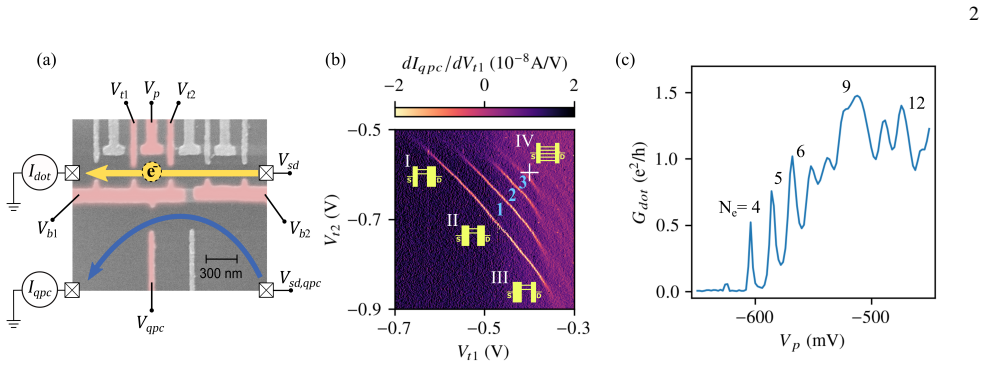
The central claim is that the third shell of a gate-defined GaAs quantum dot realizes a multi-orbital Kondo impurity with Hund's rule exchange, and that this is visible in transport. Consecutive electron numbers N=7,8,9,10,11 all show zero-bias anomalies in the differential conductance, with amplitudes that are electron-hole symmetric around half-filling: very small at N=7 and 11, around 0.1 $e^{2}$/h at N=8 and 10, and of order $e^{2}$/h at N=9. The widths of these anomalies and the addition energies Ec both trace a triangle with maximum at N=9. The addition energies are reproduced analytically by a constant-interaction model augmented by Hund exchange, giving Ec = U, U+(2/3)J, U+2J, U+(2/3)J, U for N=7..11, with U=0.36 meV and J=0.18 meV. The Kondo resonance itself is too sharp to account for the measured widths, so the paper argues that the width comes from satellites of excited Hund multiplets in the spectral function of a zero-bandwidth Anderson model, which at low temperature shows full spin screening (a singlet ground state) while retaining these finite-energy features. The dot is thus presented as a model system for a Hund's coupled mixed-valence impurity of the kind relevant to Hund's metals.
Load-bearing premise
The central claim collapses if the small zero-bias peaks at N=7 and N=11, each only about 0.01 $e^{2}$/h after subtracting the two Coulomb resonances, are fitting artifacts rather than real Kondo anomalies.
Editorial extensions
If this is right
- The observation makes the quantum dot a controllable model system for a Hund's coupled mixed-valence impurity, offering a bridge between single-impurity Kondo physics and Hund's metal physics.
- ZBA widths cannot be interpreted as a direct measure of Kondo temperature in multi-orbital dots with Hund coupling; the excited-multiplet satellites must be folded in, and the addition energy must be read at temperatures where the Kondo resonance is suppressed.
- The analytic formula for the addition energy provides a direct experimental handle on the Hund exchange J: fitting the triangular addition-energy pattern in a shell gives J from the height of the peak at half-filling.
- The electron-hole symmetry of the ZBAs, with equal behavior at N=8 and N=10 and at N=7 and N=11, should hold in any shell where the orbitals are equivalent, and can be used as a fingerprint of Hund-coupled orbital filling.
- The temperature dependence of the addition energy at half-filling, with Ec increasing as the Kondo resonance builds up at low temperature, provides a thermodynamic signature of Kondo weight transfer in a quantum dot.
Reading between the lines
- If the interpretation is correct, the same triangular pattern should reappear when the fourth shell of the same device is filled, with the triangle's peak shifted to the appropriate half-filling occupancy; a null result there would point to a special role of the third shell.
- The satellite-broadening picture predicts that the ZBA width at fixed occupancy should grow with J relative to U; tuning the device to a different confining potential (which changes orbital splitting and J) should change the triangle's slope while preserving its symmetry.
- Since the zero-bandwidth model treats the leads as discrete levels, a quantitative prediction is that the apparent ZBA width should depend on the lead band structure; measuring in the same dot with differently shaped barriers (changing the density of states) would test whether the width tracks Hund-multiplet energies or hybridization details.
- A direct extension to Hund's metal physics: if the dot is coupled to a superconducting lead, the competition between Kondo screening and pairing should show a Hund-multiplet-dependent suppression of the induced gap, testable by measuring the subgap conductance.
Editorial analysis
A structured set of objections, weighed in public.
Referee Report
Summary. The manuscript reports transport measurements on a gate-defined GaAs quantum dot in the few-electron regime, focusing on the third shell with occupations N=7–11. The authors observe zero-bias anomalies (ZBAs) for all these occupancies, with a maximum amplitude and width at half-filling (N=9), and a triangular variation of the addition energy across the shell. They model the dot as a three-orbital Anderson impurity with intra- and inter-orbital Coulomb repulsion U and Hund's exchange J, deriving an analytic addition-energy sequence Ec = U, U+(2/3)J, U+2J, U+(2/3)J, U for N=7–11. They also present rotationally invariant slave-boson (RISB) calculations of the Kondo-resonance width as a function of occupation, which yield a minimum at half-filling, opposite to the measured ZBA-width maximum. To reconcile this, they invoke a zero-bandwidth (molecular) model with excited Hund multiplets and a hand-chosen broadening of 0.45 meV, and they report temperature-dependent measurements that they interpret as the Kondo effect enhancing the addition energy at low temperature. The central claim is that the quantum dot serves as a model system for a Hund's-coupled mixed-valence impurity, as in Hund's metals.
Significance. If the interpretation is correct, the experiment would be a clean, electron-number-resolved demonstration of Hund's-rule-coupled Kondo physics in a tunable quantum dot, with direct relevance to Hund's metals and multi-orbital impurity models. The paper's strengths include exact electron counting, systematic shell-filling data, a simple analytic parameterization of the addition energies, and a careful benchmark of the RISB approximation against NRG for the two-orbital Anderson model. However, the significance is conditional: the central quantitative link between the measured ZBA-width triangle and the Hund-Kondo mechanism is not established by the calculations presented, because the only controlled many-body calculation (RISB) predicts the opposite occupancy dependence, and the fallback zero-bandwidth model treats the width as an input parameter. The addition-energy 'theory' is also a two-parameter fit to the same data, and different parameter sets are used in different comparisons.
major comments (4)
- [Appendix A, Fig. 2(c), Fig. 3(a)] The extraction of the ZBAs relies on fitting and subtracting two sech^2 Coulomb resonances, yet for N=7 and N=11 the remaining zero-bias maximum is only about 0.01 e^2/h, which is near the noise floor. No error bars or fit-parameter uncertainties are provided for the amplitudes or widths of the subtracted ZBAs. Since the triangular variation of Δ_ZBA is the central experimental observable, the absence of a quantitative error estimate makes the claim that ZBAs are present for all N=7–11, and that their widths follow a triangle, insufficiently supported.
- [Section 'For the Kondo effect...', Fig. 4(b),(c)] The RISB calculation, benchmarked against NRG in the supplement, predicts a pronounced minimum of the Kondo-resonance width Γ̃/Γ at half-filling for all U/πΓ values shown, in direct contrast to the measured maximum of Δ_ZBA at N=9 in Fig. 4(b). The authors acknowledge this and state that the ZBAs 'do not exclusively result from the quasiparticle Kondo resonances.' The alternative zero-bandwidth molecular model (Fig. 4(d),(e)) has no conduction band, so its spectral width is an input (the hand-chosen 0.45 meV broadening) rather than a prediction, and the paper does not compute from this model the N_e-dependence of Δ_ZBA shown in Fig. 4(b). The central claim that the triangular width variation arises from Hund-Kondo interplay is therefore not supported by a controlled calculation.
- [Fig. 3(c), Fig. 6(b), Eq. (5)] The theoretical addition energies in Fig. 3(c) are computed with U=0.36 meV and J=0.18 meV, while the temperature-dependent addition-energy fit in Fig. 6(b) uses U=0.41 meV and J=0.06 meV. These parameters are evidently adjusted to the data they describe; the analytic sequence Ec = U, U+(2/3)J, U+2J, U+(2/3)J, U is a two-parameter fit to the measured addition energies, not an independent prediction. The use of different (U,J) values in the two comparisons means the model is not validated with fixed parameters across observables, weakening the quantitative support for the proposed mechanism.
- [Fig. 5(c), End Matter] The claim that the ZBA amplitude originates from the Kondo effect while the width is influenced by excited Hund multiplets is not quantitatively demonstrated. The zero-bandwidth spectral function is broadened with a hand-selected 0.45 meV width and is only visually compared with the N=9 data (Fig. 4(e)); no quantitative measure of agreement, and no calculation for other occupancies, is provided. The temperature dependence of the broadened spectral function in Fig. 5(c) is also compared only qualitatively with the data in Fig. 6(a).
minor comments (5)
- [Abstract] The sentence 'For 7 to 11 electrons occupying the quantum dot Zero-bias anomalies characteristic for the Kondo effect are observed' has a grammatical and punctuation error; 'Zero-bias' should begin a new sentence after 'dot.'
- [Introduction, page 1] There are several spacing/formatting issues, e.g., '10𝑛𝑚thick', '100𝑛𝑚below', '𝑛 𝑒 =2.4x10 11', and '𝜇𝑒 =5.1x10 5'. These should be cleaned up.
- [Fig. 4(d) caption] The labels 'CI' and 'CI+Exc' are used in the figure but are not defined in the caption; the text introduces them, but the caption should state that the upper panel is the constant-interaction model and the lower panel includes exchange.
- [Supplemental Material, Eq. (B5)] Eq. (B5) contains a typo: '𝑘 𝐵𝐼' should be '𝑘 𝐵𝑇'.
- [Throughout] The terms 'EndMatter' and 'End Matter' are used inconsistently; please unify.
Circularity Check
The addition-energy 'theory' is a two-parameter fit to the same measured Ec values, and the zero-bandwidth spectral function is compared to the ZBA width only after inserting an assumed 0.45 meV broadening; the ZBA observation itself remains independent.
-
fitted input called prediction
[Main text, 'To model our results...' and Fig. 3(c) caption; Eq. for Ec(Ne) near Fig. 3]
"The addition energies are easily calculated yielding Ec(Ne)=U, U+2/3J, U+2J, U+2/3J, U for Ne=7,..., respectively (see supplemental material), which nicely explain the triangular variation with Ne of the addition energies in Figure 3(c) as direct consequence of the exchange interaction. ... The shown theoretical values are calculated for U=0.36meV and J=0.18meV."
The plotted 'theoretical values' in Fig. 3(c) are evaluated with U=0.36 meV and J=0.18 meV, the two parameters that place the model's five Ec values onto the measured addition-energy data. These parameters are not independently determined (e.g., from excitation spectra or a separate observable); they are chosen to reproduce the same Ec(Ne) points that the model is then said to 'nicely explain.' The triangular shape is a genuine model consequence, but the baseline U and the Hund splitting J are inputs taken from the target data, so the agreement is a two-parameter fit presented as a theoretical derivation rather than an independent confirmation. The caption of Fig. 6(b) explicitly calls its similar curve a fit, whereas Fig. 3(c) omits that label.
-
other
[Main text, 'In order to compare our calculated spectral function...' and End Matter, Fig. 5(c) caption]
"In order to compare our calculated spectral function with the experimental observation we assume a finite band width. Figure 4(e) shows the result of this broadened spectral function which is nicely comparable to the experimentally obtained ZBA as shown for Ne=9 in Fig. 4(a). ... The spectral function is represented in blue for a low temperature of 23 mK and in red for the temperature at which the dot spin is maximum. The broadening width is around 0.45 meV."
The zero-bandwidth (molecular) model has no itinerant conduction band; its bare spectral function is a set of discrete lines. The width of the curve compared with the measured ZBA is therefore created by the assumed 0.45 meV broadening, which is an input to the calculation and not a derived quantity. Since the experimental ZBA width is the observable the paper aims to explain ('unexpected widths'), inserting the broadening makes the theoretical line shape match the target by construction rather than by prediction. The paper also shows the broadened spectrum only at half-filling, so the triangular N_e-dependence of Δ_ZBA in Fig. 4(b) is not computed by this model at all.
full rationale
The experimental core of the paper—the appearance of zero-bias anomalies for N=7–11 and the triangular evolution of their measured widths—is genuinely independent data and is not manufactured by the theory. The RISB calculation is benchmarked against external NRG results, and the paper honestly reports that RISB predicts a Kondo-width minimum at half-filling, opposite to the data. That contradiction is a scientific weakness, not circularity. However, two load-bearing pieces of the theoretical support do reduce to their own inputs: the analytic addition-energy 'theoretical values' use U and J chosen to match the same Ec data they explain, and the zero-bandwidth spectral-function comparison requires a hand-assumed 0.45 meV broadening to reproduce the broad ZBA. These are fitted or assumed parameters presented as explanatory theory, giving partial circularity even though the central experimental observations remain independent.
Assumptions & free parameters
free parameters (3)
- U (intra-orbital Coulomb repulsion) =
0.36 meV (Fig. 3c); 0.41 meV (Fig. 6b)
- J (Hund's exchange coupling) =
0.18 meV (Fig. 3c); 0.06 meV (Fig. 6b)
- Broadening width for spectral function comparison =
0.45 meV
assumptions (5)
- domain assumption The third shell of the dot is three-fold orbitally degenerate, with intra- and inter-orbital Coulomb U=U' and Hund exchange J (constant-interaction model augmented by exchange).
- domain assumption Isotropic coupling of each orbital to its own conduction bath, V_nu=V, and no orbital anisotropies or crystal-field splittings.
- standard math Linear response relation Eq. (B2) with alpha=1/2 connects differential conductance directly to the dot spectral function.
- domain assumption RISB saddle-point approximation with the mapping Gamma_NRG to 2 Gamma_RISB reproduces NRG results for two-orbital Anderson models.
- domain assumption Zero-bandwidth (molecular) Anderson model captures the relevant multiplet structure of the dot and leads.
Cite this review
Pith. "Pith review of Interplay between Hund's rule and Kondo effect in a quantum dot." pith.science (2026). https://pith.science/paper/LKDYSX2P
@misc{pith2026250521675,
  author       = {Pith},
  title        = {Pith review of: Interplay between Hund's rule and Kondo effect in a quantum dot},
  year         = {2026},
  howpublished = {\url{https://pith.science/paper/LKDYSX2P}},
  note         = {Machine review of arXiv:2505.21675}
}
read the original abstract
The interaction between localized spins on a quantum dot and free electrons in the reservoirs forms a many-particle entangled system giving rise to the Kondo effect. Here, we investigate electron transport in the third shell of a gate-defined GaAs quantum dot. The addition energy shows a maximum at half-filling of the shell which can be described analytically with Hund's rule exchange interaction. For 7 to 11 electrons occupying the quantum dot Zero-bias anomalies characteristic for the Kondo effect are observed, but with unexpected widths. Here the quantum dot has to be described as a multi-orbital Kondo impurity with Hund's interaction. In this way this quantum dot can be seen as a model system for a Hund's coupled mixed-valence quantum impurity as appearing in Hund's metals where local ferromagnetic interactions between orbitals lead to the emergence of complex electronic states.
Figures


Figures from the paper (5 more)


Reference graph
Works this paper leans on
-
[1]
R. A. Logan and J. M. Rowell, Conductance anomalies in semi- conductor tunnel diodes, Phys. Rev. Lett.13, 404–406 (1964). (document)
work page 1964
-
[2]
A. F. G. Wyatt, Anomalous densities of states in normal tantalum and niobium, Phys. Rev. Lett.13, 401–404 (1964)
work page 1964
-
[3]
H. R. Zeller and I. Giaever, Tunneling, zero-bias anomalies, and small superconductors, Phys. Rev.181, 789–799 (1969). (document)
work page 1969
-
[4]
A. Yu. Kitaev, Fault-tolerant quantum computation by anyons, Ann. Phys. (N.Y.)303, 2–30 (2003). (document)
work page 2003
-
[5]
Y. Oreg, G. Refael, and F. von Oppen, Helical liquids and Majo- rana bound states in quantum wires, Phys. Rev. Lett.105, 177002 (2010)
work page 2010
-
[6]
R. M. Lutchyn, J. D. Sau, and S. Das Sarma, Majorana Fermions and a Topological Phase Transition in Semiconductor- Superconductor Heterostructures, Phys. Rev. Lett.105, 077001 (2010). (document)
work page 2010
- [7]
- [8]
Show all 52 references
-
[9]
B. L. Altshuler and A. G. Aronov, Zero bias anomaly in tunnel resistance and electron-electron interaction, Solid State Com- mun.30, 115–117 (1979). (document)
1979
-
[10]
Kondo, Resistance minimum in dilute magnetic alloys, Prog
J. Kondo, Resistance minimum in dilute magnetic alloys, Prog. Theor. Phys.32, 37–49 (1964).(document)
1964
-
[11]
L. I. Glazman and M. E. Raikh, Resonant Kondo transparency of a barrier with quasilocal impurity states, JETP Lett.47, 452– 455 (1988).(document)
1988
-
[12]
Lee, On-Site Coulomb Repulsion and Resonant Tunneling, Phys
Tai Kai Ng and Patrick A. Lee, On-Site Coulomb Repulsion and Resonant Tunneling, Phys. Rev. Lett.61, 1768–1771 (1988)
1988
-
[13]
Meir and N
Y. Meir and N. S. Wingreen, Landauer formula for the current through an interacting electron region, Phys. Rev. Lett.68, 2512– 2515 (1992)
1992
-
[14]
K ¨onig, H
J. K ¨onig, H. Schoeller, and G. Sch¨on, Zero-bias anomalies and boson-assisted tunneling through quantum dots, Phys. Rev. Lett. 76, 1715–1718 (1996). (document)
1996
-
[15]
Goldhaber-Gordon, Hadas Shtrikman, D
D. Goldhaber-Gordon, Hadas Shtrikman, D. Mahalu, David Abusch-Magder, U. Meirav, and M. A. Kastner, Kondo effect in a single-electron transistor, Nature391, 156–159 (1998). (document)
1998
-
[16]
Cronenwett, Tjerk H
Sara M. Cronenwett, Tjerk H. Oosterkamp, and Leo P. Kouwen- hoven, A tunable Kondo effect in quantum dots, Science281, 540–544 (1998)
1998
-
[17]
Klitzing, A quantum dot in the limit of strong coupling to reservoirs, Physica B: Condensed Matter256-258, 182–185 (1998)
J ¨org Schmid, J¨ urgen Weis, Karl Eberl, and Klaus V. Klitzing, A quantum dot in the limit of strong coupling to reservoirs, Physica B: Condensed Matter256-258, 182–185 (1998)
1998
-
[18]
(document)
Jesper Nyg ˚ard, David Henry Cobden, and Poul Erik Linde- lof, Kondo physics in carbon nanotubes, Nature408, 342–346 (2000). (document)
2000
-
[19]
A. W. Heine, D. Tutuc, G. Zwicknagl, R. J. Haug, Competition between Kondo Screening and Quantum Hall Edge Reconstruc- tion, Phys. Rev. Lett.116, 096802 (2016). (document)
2016
-
[20]
I. V. Borzenets, J. Shim, J. C. H. Chen, A. Ludwig, A. D. Wieck, S. Tarucha, H. S. Sim, and M. Yamamoto, Observation of the Kondo screening cloud, Nature579, 210–213 (2020). (docu- ment)
2020
-
[21]
L. P. Kouwenhoven, D. G. Austing, and S. Tarucha, Few-electron quantum dots, Rep. Prog. Phys.64, 701–736 (2001). (document)
2001
-
[22]
A. H. Nevidomskyy, and P. Coleman, Kondo Resonance Nar- rowing in𝑑- and𝑓-Electron Systems, Phys. Rev. Lett.103, 147205 (2009). (document)
2009
-
[23]
Florens, A
S. Florens, A. Freyn, N. Roch, W. Wernsdorfer, F. Balestro, P. Roura-Bas, and A. A. Aligia, Universal transport signatures in two-electron molecular quantum dots: gate-tunable Hund’s rule, underscreened Kondo effect and quantum phase transitions, J. Phys.: Condens. Matter23, 2...
2011
-
[24]
de’ Medici, J
L. de’ Medici, J. Mravlje, and A. Georges, Janus-Faced Influ- ence of Hund’s Rule Coupling in Strongly Correlated Materials, Phys. Rev. Lett.107, 256401 (2011)
2011
-
[25]
K. M. Stadler, Z. P. Yin, J. von Delft, G. Kotliar, and A. We- ichselbaum, Dynamical Mean-Field Theory Plus Numerical Renormalization-Group Study of Spin-Orbital Separation in a Three-Band Hund Metal, Phys. Rev. Lett.115, 136401 (2015)
2015
-
[26]
X. Deng, K. M. Stadler, K. Haule, A. Weichselbaum, J. von Delft, and G. Kotliar, Signatures of Mottness and Hundness in archetypal correlated metals, Nat. Commun.10, 2721 (2019)
2019
-
[27]
Drouin-Touchette, E
V. Drouin-Touchette, E. J. K¨onig, Y. Komijani, and P. Coleman, Interplay of charge and spin fluctuations in a Hund’s coupled impurity, Phys. Rev. Res.4, L042011 (2022). (document) 6
2022
-
[28]
Georges and G
A. Georges and G. Kotliar, The Hund-metal path to strong elec- tronic correlations, Phys. Today77, 46–53 (2024). (document)
2024
-
[29]
A. A. Khajetoorians, M. Valentyuk, M. Steinbrecher, T. Schlenk, A. Shick, J. Kolorenc, A. I. Lichtenstein, T. O. Wehling, R. Wiesendanger, J. Wiebe, Tuning emergent magnetism in a Hund’s impurity, Nature Nanotechnology10, 958–964 (2015). (document)
2015
-
[30]
Wagner, P
T. Wagner, P. Strasberg, J. C. Bayer, E. P. Rugeramigabo, T. Brandes, and R. J. Haug, Strong suppression of shot noise in a feedback-controlled single-electron transistor, Nat. Nan- otechnol.12, 218 (2017). (document)
2017
-
[31]
Simmel, R
F. Simmel, R. H. Blick, J. P. Kotthaus, W. Wegscheider, and M. Bichler, Anomalous Kondo effect in a quantum dot at nonzero bias, Phys. Rev. Lett.83, 804 (1999). (document)
1999
-
[32]
Tarucha, D
S. Tarucha, D. G. Austing, and T. Honda, Shell filling and spin effects in a few electron quantum dot, Phys. Rev. Lett.77, 3613 (1996). (document)
1996
-
[33]
C. W. J. Beenakker, Theory of Coulomb-blockade oscillations in the conductance of a quantum dot, Phys. Rev. B44, 1646–1656 (1991). (document), A
1991
-
[34]
Schmid, J
J. Schmid, J. Weis, K. Eberl, and K. V. Klitzing, Absence of odd-even parity behavior for Kondo resonances in quantum dots, Phys. Rev. Lett.84, 5824–5827 (2000). (document)
2000
-
[35]
F¨ uhner, U
C. F¨ uhner, U. F. Keyser, R. J. Haug, D. Reuter, and A. D. Wieck, Flux-quantum-modulated Kondo conductance in a multielectron quantum dot, Phys. Rev. B66, 161305 (2002)
2002
-
[36]
U. F. Keyser, C. F¨ uhner, S. Borck, R. J. Haug, M. Bichler, G. Abstreiter, and W. Wegscheider, Kondo Effect in a Few- Electron Quantum Ring, Phys. Rev. Lett.90, 196601 (2003). (document)
2003
-
[37]
Rontani, F
M. Rontani, F. Rossi, F. Manghi, and E. Molinari, Addition ener- gies in semiconductor quantum dots: Role of electron–electron interaction, Appl. Phys. Lett.72, 957–959 (1998). (document)
1998
-
[38]
The present parametrization differs from the commonly used Kanamori parametrization which is applicable for transition metal atoms in a cubic environment where the d-states are split 𝑡2𝑔 and𝑒 𝑔 states by the Crystalline Electric Field.(document)
-
[39]
Fr ´esard, Many-body physics: From Kondo to Hubbard mod- eling and simulation (Forschungszentrum J¨ ulich, 2015) Chap
R. Fr ´esard, Many-body physics: From Kondo to Hubbard mod- eling and simulation (Forschungszentrum J¨ ulich, 2015) Chap. The Slave-Boson Approach to Correlated Fermions (document)
2015
-
[40]
(document), 8, B 2
Yaakov Kleeorin and Yigal Meir, Quantum phase transition in a realistic double-quantum-dot system, Scientific Reports8, 10539 (2018). (document), 8, B 2
2018
-
[41]
J. R. Schrieffer, The Kondo effect—The link between magnetic and nonmagnetic impurities in metals?, J. Appl. Phys.38, 1143– 1150 (1967). (document)
1967
-
[42]
M. D. Daybell and W. A. Steyert, Localized magnetic impurity states in metals: Some experimental relationships, Rev. Mod. Phys.40, 380–389 (1968). (document)
1968
-
[43]
Fulde, J
P. Fulde, J. Keller, and G. Zwicknagl, Theory of heavy fermion systems, Solid State Phys.41, 1 (1988). (document)
1988
-
[44]
Runge and G
E. Runge and G. Zwicknagl, Electronic structure calculations and strong correlations: A model study, Ann. Phys.508, 333– 354 (1996)
1996
-
[45]
A. C. Hewson,The Kondo Problem to Heavy Fermions, Cam- bridge University Press, (1993). (document), B 2
1993
-
[46]
N. E. Bickers, D. L. Cox, and J. W. Wilkins, Self-consistent large-𝑁expansion for normal-state properties of dilute magnetic alloys, Phys. Rev. B36, 2036–2079 (1987). (document)
1987
-
[47]
Nozi `eres and A
Ph. Nozi `eres and A. Blandin, Kondo effect in real metals, J. Phys. (Paris)41, 193–211 (1980). (document)
1980
-
[48]
Schlottmann and P
P. Schlottmann and P. D. Sacramento, Multichannel Kondo prob- lem and some applications, Adv. Phys.42, 641–682 (1993). (document)
1993
-
[49]
Lechermann, A
F. Lechermann, A. Georges, G. Kotliar, and O. Parcollet, Ro- tationally invariant slave-boson formalism and momentum de- pendence of the quasiparticle weight, Phys. Rev. B76, 155102 (2007). B 2
2007
-
[50]
Nishikawa, D
Y. Nishikawa, D. J. G. Crow, and A. C. Hewson, Renormalized parameters and perturbation theory for an𝑛-channel Anderson model with Hund’s rule coupling: Asymmetric case, Phys. Rev. B82, 245109 (2010). B 2 END MATTER Model Hamiltonian and calculational methods.—In order to anal...
2010
-
[51]
Spectral function and addition energy of an isolated QD The current through the dot is given by 𝐼(𝑉𝑠𝑑)∼ ∑︁ 𝜈𝜎 ∫ +∞ −∞ 𝑑𝜔[𝑓(𝜔−𝛼𝑒𝑉 𝑠𝑑)−𝑓 (𝜔+ (1−𝛼)𝑒𝑉𝑠𝑑)] 𝑡𝜈𝜎(𝜔,𝑉𝑠𝑑,𝑇) (B1) FIG. 7. The purple line is the conductivity as a function of source- drain voltage for a plunger gate voltag...
-
[52]
Our notation closely follows Ref
Rotationally Invariant Slave Boson (RISB) approach The central focus is the low-energy many-body (Kondo) res- onance in the low-temperature spectral function for the model Hamiltonian 𝐻=𝐻 𝑑𝑜𝑡+𝐻 ℎ𝑦𝑏+𝐻𝑙𝑒𝑎𝑑𝑠 (B7) where 𝐻𝑑𝑜𝑡 = ∑︁ 𝜈𝜎 𝜖𝑑𝑛𝑑𝜈𝜎+ 1 2𝑈𝑛𝑑𝜈𝜎𝑛𝑑𝜈−𝜎 + 1 2 ∑︁ 𝜈≠𝜈′,𝜎𝜎′[𝑈′𝑛𝑑𝜈𝜎𝑛𝑑...
Reviewed August 7, 2026 · model on record in the stance chip above.
Discussion (0). Sign in to comment.