Entangled photons from para-positronium decay: Do coincidences from scattered photons imply a Bell state?
Pith reviewed 2026-07-01 05:40 UTC · model grok-4.3
The pith
Polarization-dependent Compton scattering verifies that para-positronium decay photons form a Bell state.
A machine-rendered reading of the paper's core claim, the machinery that carries it, and where it could break.
Core claim
We show how polarization-dependent Compton scattering can be used to verify that the two annihilation photons in the spin-zero case (para-positronium) are emitted in a maximally entangled Bell state. Our theoretical approach based on two-photon density matrices connects concepts from relativistic quantum electrodynamics and quantum information theory.
What carries the argument
The two-photon density matrix formalism that links the QED decay amplitudes to the polarization-dependent Compton scattering cross sections.
If this is right
- Coincidence rates measured after Compton scattering become a direct test that can distinguish the Bell state from other two-photon polarization states.
- The method supplies a concrete experimental protocol for verifying entanglement in annihilation photon pairs without requiring direct polarization analyzers at the decay site.
- Scattering probabilities calculated from the density matrix yield specific angular and polarization correlations that serve as the signature of maximal entanglement.
- The formalism shows how the initial Bell-state correlations survive propagation and become observable in the scattered-photon statistics.
Where Pith is reading between the lines
- The same scattering-based probe could be applied to photon pairs from other sources that are expected to occupy Bell states, such as certain atomic cascades.
- If the density-matrix predictions hold, the technique offers a route to test whether environmental effects or higher-order QED corrections alter the observed entanglement in decay experiments.
- Experimental groups already equipped for positronium studies could adapt existing Compton detectors to perform the proposed coincidence analysis.
Load-bearing premise
The two-photon density matrix formalism accurately captures the polarization-dependent scattering behavior needed to distinguish the Bell state from other possible states.
What would settle it
An experiment that records coincidence rates of Compton-scattered photon pairs from para-positronium decay matching the predictions for a separable or non-Bell two-photon state would falsify the verification claim.
Figures
read the original abstract
Electron and positron can form a meta-stable bound state called positronium that decays via pair annihilation. We show how polarization-dependent Compton scattering can be used to verify that the two annihilation photons in the spin-zero case (para-positronium) are emitted in a maximally entangled Bell state. Our theoretical approach based on two-photon density matrices connects concepts from relativistic quantum electrodynamics and quantum information theory.
Editorial analysis
A structured set of objections, weighed in public.
Referee Report
Summary. The paper claims that polarization-dependent Compton scattering can verify the two annihilation photons from para-positronium decay are emitted in a maximally entangled Bell state. It presents a theoretical approach using two-photon density matrices to connect relativistic quantum electrodynamics with quantum information theory.
Significance. If the central claim holds, the work would provide a concrete experimental protocol linking QED predictions for positronium annihilation to Bell-state verification via scattering coincidences. This could strengthen tests of entanglement in high-energy photon pairs and offer a bridge between established QED calculations and quantum-information observables, though its impact depends on whether the predicted patterns are shown to be unique.
major comments (1)
- [Abstract / theoretical approach] The central claim (abstract and introduction) requires that the two-photon density matrix, when folded with the polarization-dependent Klein-Nishina kernel, produces coincidence rates that uniquely identify the para-positronium Bell state. No explicit comparison to separable or partially entangled two-photon states is provided to demonstrate that alternative density matrices cannot reproduce the same angular or polarization correlations under the same scattering conditions.
Simulated Author's Rebuttal
We thank the referee for their detailed review and constructive feedback on our manuscript. We address the major comment below and outline the planned revisions.
read point-by-point responses
-
Referee: [Abstract / theoretical approach] The central claim (abstract and introduction) requires that the two-photon density matrix, when folded with the polarization-dependent Klein-Nishina kernel, produces coincidence rates that uniquely identify the para-positronium Bell state. No explicit comparison to separable or partially entangled two-photon states is provided to demonstrate that alternative density matrices cannot reproduce the same angular or polarization correlations under the same scattering conditions.
Authors: We agree that uniqueness must be demonstrated to substantiate the claim that the observed coincidence rates identify the Bell state. The manuscript derives the rates specifically for the QED-predicted maximally entangled state of para-positronium, but does not include side-by-side comparisons. In the revised manuscript we will add explicit calculations for representative alternative states (a fully separable product state and a partially entangled mixed state) folded with the same Klein-Nishina kernel, showing that their angular and polarization-dependent coincidence patterns differ measurably from the Bell-state case. This addition will directly address the referee's concern. revision: yes
Circularity Check
No significant circularity detected; derivation relies on standard external formalisms
full rationale
The provided abstract and context present a theoretical connection via two-photon density matrices between relativistic QED (Klein-Nishina scattering) and quantum information (Bell states), without any quoted equations, self-citations, fitted parameters, or ansatzes that reduce the central claim to its own inputs by construction. No self-definitional steps, predictions forced by fits, or load-bearing self-citations appear. The approach is self-contained against external benchmarks such as standard density-matrix formalism and Compton scattering kernels, consistent with the reader's assessment of no explicit circular reasoning. This is the expected outcome for papers whose core derivation does not collapse to renaming or self-reference.
Axiom & Free-Parameter Ledger
Reference graph
Works this paper leans on
-
[1]
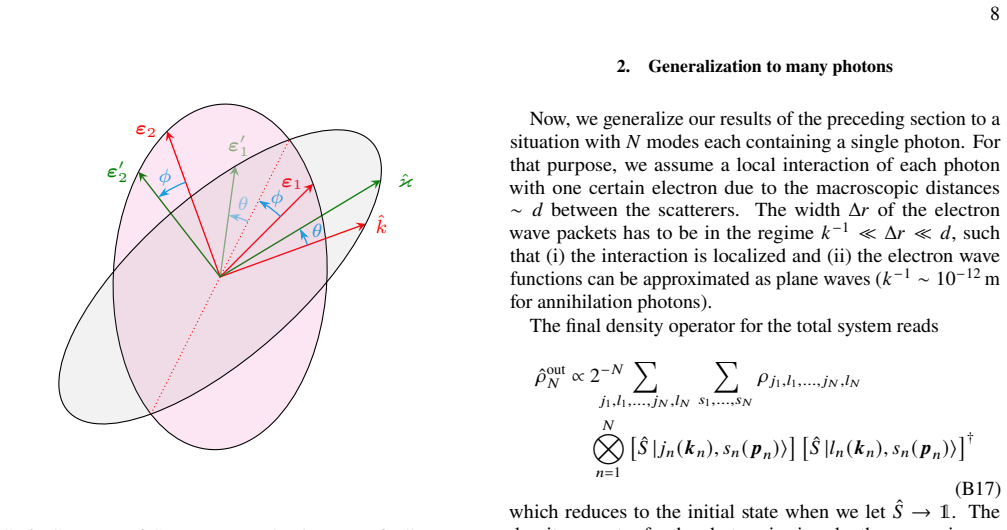
One photon We start with the simplest case, that is the scattering of one photon from one electron. The initial state of this system is given by the product ˆ𝜌in 𝑁=1 = ∑︁ 𝑗,𝑙 𝜌 𝑗,𝑙 |𝑗(𝒌)⟩ ⟨𝑙(𝒌)| ⊗ 1 2 ∑︁ 𝑠 |𝑠(𝒑)⟩ ⟨𝑠(𝒑)|,(B1) where 𝜌 𝑗,𝑙 denotes the density matrix of the photon with respect to its polarization while the electron is completely unpolarized. ...
-
[2]
For that purpose, we assume a local interaction of each photon with one certain electron due to the macroscopic distances ∼𝑑 between the scatterers
Generalization to many photons Now, we generalize our results of the preceding section to a situation with𝑁 modes each containing a single photon. For that purpose, we assume a local interaction of each photon with one certain electron due to the macroscopic distances ∼𝑑 between the scatterers. The width Δ𝑟 of the electron wave packets has to be in the re...
-
[3]
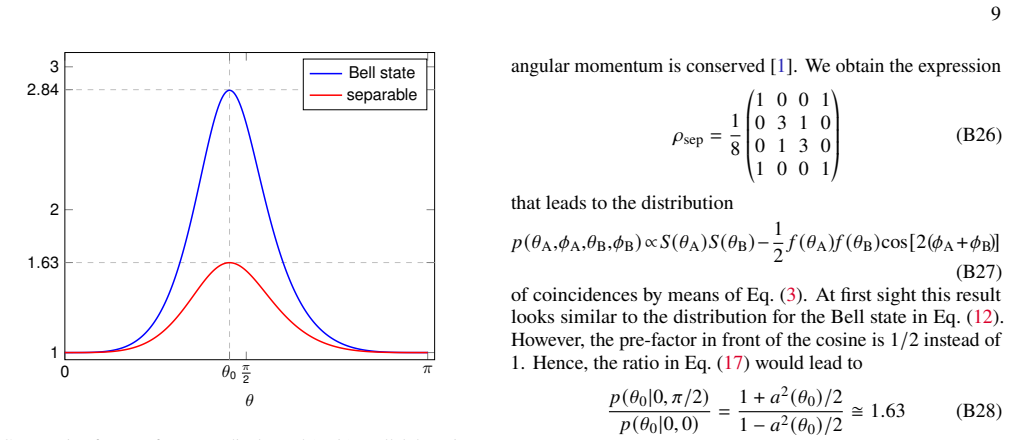
84 θ Bell stateseparable FIG. 7. Ratio of counts for perpendicular and (anti-)parallel detection of coincidences for a Bell state (blue curve), Eq.(17), and the con- structed separable state (red curve), Eq.(B28), respectively. We study the dependency on the scattering angle𝜃A =𝜃 B ≡𝜃 . In both cases, this ratio attains its maximum at𝜃0 81.7 ◦, but the ma...
-
[4]
For that purpose, we consider the initial state |𝜓⟩=|𝜓 p-Ps (𝒌)⟩ from Eq.(2)
Two photons Weillustratetheprocedureforcalculatingcoincidencesfrom Compton scattering for the example of two emitted photons from the p-Ps decay. For that purpose, we consider the initial state |𝜓⟩=|𝜓 p-Ps (𝒌)⟩ from Eq.(2). By setting 𝑁=2 in Eq. (B22) we obtain the relation 𝑝(𝜃 A, 𝜙A, 𝜃B, 𝜙B)=N 𝜘(𝜃A) 𝑚 2 𝜘(𝜃B) 𝑚 2 ×Tr {V (𝜃A, 𝜙A) ⊗ V (𝜃B, 𝜙B) ·𝜌 } , (B23)...
-
[5]
(17) would lead to 𝑝(𝜃 0|0, 𝜋/2) 𝑝(𝜃 0|0,0) = 1+𝑎 2(𝜃 0)/2 1−𝑎 2(𝜃 0)/2 1.63(B28) instead of2.84
Hence, the ratio in Eq. (17) would lead to 𝑝(𝜃 0|0, 𝜋/2) 𝑝(𝜃 0|0,0) = 1+𝑎 2(𝜃 0)/2 1−𝑎 2(𝜃 0)/2 1.63(B28) instead of2.84. This different behavior is illustrated in Fig. 7. WenotethattheauthorsofRef.[ 1]consideredalsoaproduct stateoftwocircularlypolarizedphotons |+,+⟩ or |−,−⟩ . These statesarealreadysymmetricwithrespecttoarotationaroundthe 𝑧-axis,thatis 𝐷...
-
[6]
[28, 41], where one of the two photons is scattered two times, that is on one side is an additional scatterer
Multiple Compton scattering events In the following, we briefly discuss the setup from Refs. [28, 41], where one of the two photons is scattered two times, that is on one side is an additional scatterer. We have to adapt our formalismtothissituationandcalculatetheangulardistribution of coincidences via the prescription 𝑝(𝜃 A, 𝜙A, 𝜃B2, 𝜙B2;𝜃 B1) ∝ ∑︁ 𝑗1,𝑙1...
-
[7]
Bohm and Y
D. Bohm and Y. Aharonov, Discussion of experimental proof for the paradox of Einstein, Rosen, and Podolsky, Physical Review 108, 1070 (1957)
1957
-
[8]
A. Acín, J. I. Latorre, and P. Pascual, Three-party entanglement from positronium, Phys. Rev. A63, 042107 (2001)
2001
-
[9]
M. H. L. Pryce and J. C. Ward, Angular correlation effects with annihilation radiation, Nature160, 435 (1947)
1947
-
[10]
H. S. Snyder, S. Pasternack, and J. Hornbostel, Angular correla- tion of scattered annihilation radiation, Physical Review73, 440 (1948)
1948
-
[11]
J. A. Wheeler, Polyelectrons, Annals of the New York Academy of Sciences48, 219 (1946)
1946
-
[12]
Bleuler and H
E. Bleuler and H. L. Bradt, Correlation between the states of polarization of the two quanta of annihilation radiation, Phys. Rev.73, 1398 (1948)
1948
-
[13]
R.Hanna,Polarizationofannihilationradiation,Nature162,332 (1948)
1948
-
[14]
C. S. Wu and I. Shaknov, The angular correlation of scattered annihilation radiation, Physical Review77, 136 (1950)
1950
-
[15]
23, 880 (1969)
J.F.Clauser,M.A.Horne,A.Shimony,andR.A.Holt,Proposed experimenttotestlocalhidden-variabletheories,Phys.Rev.Lett. 23, 880 (1969)
1969
-
[16]
M. A. Horne,Experimental consequences of local hidden vari- able theories, Dissertation, Boston University (1970)
1970
-
[17]
Genovese, Research on hidden variable theories: A review of recent progresses, Physics Reports413, 319 (2005)
M. Genovese, Research on hidden variable theories: A review of recent progresses, Physics Reports413, 319 (2005)
2005
-
[18]
G.Bertolini,M.Bettoni,andE.Lazzarini,Angularcorrelationof scattered annihilation radiation, Il Nuovo Cimento (1955-1965) 2, 661 (1955)
1955
-
[19]
Langhoff, Die Linearpolarisation der Vernichtungsstrahlung von Positronen, Zeitschrift für Physik160, 186 (1960)
H. Langhoff, Die Linearpolarisation der Vernichtungsstrahlung von Positronen, Zeitschrift für Physik160, 186 (1960)
1960
-
[20]
L.R.Kasday,The distribution of Compton scattered annihilation photons, and the Einstein-Podolsky-Rosen argument, Disserta- tion, Columbia University (1972)
1972
-
[21]
Faraci, D
G. Faraci, D. Gutkowski, S. Notarrigo, and A. Pennisi, An experimental test of the EPR paradox, Lettere al Nuovo Cimento 9, 607 (1974)
1974
-
[22]
L. R. Kasday, J. D. Ullman, and C.-S. Wu, Angular correlation of Compton-scattered annihilation photons and hidden variables, Il Nuovo Cimento B (1971-1996)25, 633 (1975)
1971
-
[23]
Wilson, J
A. Wilson, J. Lowe, and D. Butt, Measurement of the relative planes of polarization of annihilation quanta as a function of separation distance, Journal of Physics G: Nuclear Physics2, 613 (1976)
1976
-
[24]
Bohm and B
D. Bohm and B. J. Hiley, Nonlocality and polarization corre- lations of annihilation quanta, Il Nuovo Cimento B35, 137 (1976)
1976
-
[25]
M.Bruno,M.d’Agostino,andC.Maroni,Measurementoflinear polarization of positron annihilation photons, Il Nuovo Cimento B (1971-1996)40, 143 (1977)
1971
-
[26]
Bertolini, E
G. Bertolini, E. Diana, and A. Scotti, Correlation of annihilation 𝛾-ray polarization, Il Nuovo Cimento B63, 651 (1981)
1981
-
[27]
Osuch, M
S. Osuch, M. Popkiewicz, Z. Szeflinski, and Z. Wilhelmi, Exper- imental test of Bell’s inequality using annihilation photons, Acta Physica Polonica, Series B27(1996)
1996
-
[28]
Kuncic, A
Z. Kuncic, A. McNamara, K. Wu, and D. Boardman, Polariza- tion enhanced X-ray imaging for biomedicine, Nuclear Instru- mentsandMethodsinPhysicsResearchSectionA:Accelerators, Spectrometers, Detectors and Associated Equipment648, S208 (2011)
2011
-
[29]
McNamara, M
A. McNamara, M. Toghyani, J. Gillam, and K. Wu, Towards optimal imaging with PET: an in silico feasibility study, Physics in Medicine & Biology59, 7587 (2014)
2014
-
[30]
Toghyani, J
M. Toghyani, J. Gillam, A. McNamara, and Z. Kuncic, Polarisation-basedcoincidenceeventdiscrimination: Aninsilico study towards a feasible scheme for Compton-PET, Physics in Medicine & Biology61, 5803 (2016)
2016
-
[31]
Makek, D
M. Makek, D. Bosnar, L. Pavelić, P. Šenjug, and P. Žugec, Single-layer Compton detectors for measurement of polarization correlations of annihilation quanta, Nuclear Instruments and Methods in Physics Research Section A: Accelerators, Spec- trometers, Detectors and Associated Equipment958, 162835 (2020)
2020
-
[32]
Watts, J
D. Watts, J. Bordes, J. Brown, A. Cherlin, R. Newton, J. Allison, M.Bashkanov,N.Efthimiou,andN.Zachariou,Photonquantum entanglement in the MeV regime and its application in PET imaging, Nature communications12, 2646 (2021)
2021
-
[33]
Musin, A
A.Ivashkin,D.Abdurashitov,A.Baranov, F.Guber,S.Morozov, S. Musin, A. Strizhak, and I. Tkachev, Testing entanglement of annihilation photons, Scientific Reports13, 7559 (2023)
2023
-
[34]
Bordes, J
J. Bordes, J. R. Brown, D. P. Watts, M. Bashkanov, K. Gibson, R.Newton,andN.Zachariou,Firstdetailedstudyofthequantum decoherence of entangled gamma photons, Phys. Rev. Lett.133, 132502 (2024)
2024
-
[35]
puzzle of decoherence
S. Parashari, D. Bosnar, I. Friščić, A. M. Kožuljević, Z. Kuncic, P. Žugec, and M. Makek, Closing the door on the “puzzle of decoherence” of annihilation quanta, Physics Letters B852, 138628 (2024)
2024
-
[36]
Moskal, D
P. Moskal, D. Kumar, S. Sharma, E. Y. Beyene, N. Chug, A. Coussat, C. Curceanu, E. Czerwiński, M. Das, K. Dulski, et al., Nonmaximal entanglement of photons from positron- electron annihilation demonstrated using a plastic PET scanner, Science Advances11, eads3046 (2025)
2025
-
[37]
Tkachev, S
I. Tkachev, S. Musin, D. Abdurashitov, A. Baranov, F. Guber, A. Ivashkin, and A. Strizhak, Measuring the evolution of en- tanglement in Compton scattering, Scientific Reports15, 6064 (2025)
2025
-
[38]
Moskal, N
P. Moskal, N. Krawczyk, B. Hiesmayr, M. Bała, C. Curceanu, E. Czerwiński, K. Dulski, A. Gajos, M. Gorgol, R. Del Grande, et al., Feasibility studies of the polarization of photons beyond the optical wavelength regime with the J-PET detector, The European Physical Journal C78, 970 (2018)
2018
-
[39]
B. C. Hiesmayr and P. Moskal, Witnessing entanglement in Compton scattering processes via mutually unbiased bases, Sci- entific reports9, 8166 (2019)
2019
-
[40]
B.Hiesmayr,W.Krzemień,andM.Bała,Quantumerrorchannels in high energetic photonic systems, Scientific Reports14, 9672 (2024)
2024
-
[41]
M. Bała, W. Krzemień, B. C. Hiesmayr, J. Baran, K. Dulski, K. Klimaszewski, L. Raczyński, R. Y. Shopa, and W. Wiślicki, Probing arbitrary polarized photon pairs undergoing double ComptonscatteringsbyadedicatedMCsimulatorvalidatedwith experimental data, The European Physical Journal C85, 1115 (2025)
2025
- [42]
-
[43]
Žugec, E
P. Žugec, E. Andreas Vivoda, M. Makek, and I. Friščić, A reconciliation of the Pryce-Ward and Klein-Nishina statistics for semi-classical simulations of annihilation photons correlations, Physics Letters B875, 140346 (2026)
2026
-
[44]
Bell Test of Photons from Electron-Positron Annihilation via POVM-based Compton Polarimetry
J. Clarke, P. Asenov, J. Smeets, J.-S. Wang, D. B. Cassidy, 11 and A. Serafini, Bell test of photons from electron-positron annihilation via POVM-based Compton polarimetry (2026), arXiv:2604.25034
work page internal anchor Pith review Pith/arXiv arXiv 2026
-
[45]
Caradonna, D
P. Caradonna, D. Reutens, T. Takahashi, S. Takeda, and V. Vegh, Probing entanglement in Compton interactions, Journal of Physics Communications3, 105005 (2019)
2019
-
[46]
P.Caradonna,I.D’Amico,D.G.Jenkins,andD.P.Watts,Stokes- parameter representation for Compton scattering of entangled and classically correlated two-photon systems, Phys. Rev. A109, 033719 (2024)
2024
-
[47]
P.Caradonna,KinematicanalysisofmultipleComptonscattering in quantum-entangled two-photon systems, Annals of Physics 470, 169779 (2024)
2024
-
[48]
Caradonna, Compton scattering mediated by quantum entan- glement, Physical Review A111, 053708 (2025)
P. Caradonna, Compton scattering mediated by quantum entan- glement, Physical Review A111, 053708 (2025)
2025
-
[49]
Caradonna and K
P. Caradonna and K. Shimazoe, Entanglement, steering, and separabilityinCompton-scatteredannihilationphotons,Physical Review A112, 032413 (2025)
2025
-
[50]
Caradonna and K
P. Caradonna and K. Shimazoe, Polarization symmetry as a signature of Bell states in Compton scattering, Physical Review Research8, 023288 (2026)
2026
-
[51]
Fano, Remarks on the classical and quantum-mechanical treatment of partial polarization, Journal of the Optical Society of America39, 859 (1949)
U. Fano, Remarks on the classical and quantum-mechanical treatment of partial polarization, Journal of the Optical Society of America39, 859 (1949)
1949
-
[52]
W. H. McMaster, Matrix representation of polarization, Reviews of Modern Physics33, 8 (1961)
1961
-
[53]
A.Wightman,NoteonpolarizationeffectsinComptonscattering, Physical Review74, 1813 (1948)
1948
-
[54]
Berko and H
S. Berko and H. N. Pendleton, Positronium, Annual Review of Nuclear and Particle Science30, 543 (1980)
1980
-
[55]
Rich, Recent experimental advances in positronium research, Rev
A. Rich, Recent experimental advances in positronium research, Rev. Mod. Phys.53, 127 (1981)
1981
-
[56]
G. S. Adkins, D. B. Cassidy, and J. Pérez-Ríos, Precision spec- troscopy of positronium: Testing bound-state QED theory and thesearchforphysicsbeyondthestandardmodel,PhysicsReports 975, 1 (2022)
2022
-
[57]
S. D. Bass, S. Mariazzi, P. Moskal, and E. Ste ¸pień, Colloquium: Positronium physics and biomedical applications, Rev. Mod. Phys.95, 021002 (2023)
2023
-
[58]
Greiner,Feldquantisierung(Verlag Harri Deutsch, Thun und Frankfurt am Main, 1993)
W. Greiner,Feldquantisierung(Verlag Harri Deutsch, Thun und Frankfurt am Main, 1993)
1993
-
[59]
J. M. Jauch and F. Rohrlich,The Theory of Photons and Elec- trons(Addison-Wesley Publishing Company, Inc, Cambridge, Massachusetts, 1955)
1955
-
[60]
C.N.Yang,Selectionrulesforthedematerializationofaparticle into two photons, Physical Review77, 242 (1950)
1950
-
[61]
D. F. V. James, P. G. Kwiat, W. J. Munro, and A. G. White, Measurement of qubits, Phys. Rev. A64, 052312 (2001)
2001
-
[62]
M. A. Nielsen and I. L. Chuang,Quantum Computation and Quantum Information(Cambridge University Press, Cambridge, United Kingdom, 2016)
2016
-
[63]
R. A. Horn and C. R. Johnson,Matrix Analysis(Cambridge University Press, New York, NY, 2013)
2013
-
[64]
Peres, Separability criterion for density matrices, Phys
A. Peres, Separability criterion for density matrices, Phys. Rev. Lett.77, 1413 (1996)
1996
-
[65]
Horodecki, P
M. Horodecki, P. Horodecki, and R. Horodecki, Separability of n-particle mixed states: necessary and sufficient conditions in terms of linear maps, Physics Letters A283, 1 (2001)
2001
-
[66]
We note that this state does not show a rotational symmetry with respect to the𝑧-axis as premised in Refs. [1, 40]
-
[67]
Bound-state Compton scattering of linearly polarized photons
J. Sommerfeldt, N. M. Mayer, A. Maiorova, W. Middents, S. Fritzsche, T. Stöhlker, and A. Surzhykov, Bound-state Compton scattering of linearly polarized photons (2026), arXiv:2604.14748
work page internal anchor Pith review Pith/arXiv arXiv 2026
-
[68]
Kumar, S
D. Kumar, S. Sharma, P. Moskal, and J.-P. collaboration., In- vestigating quantum entanglement of high-energy photons from positron annihilation in a porous medium, inJournal of Physics: Conference Series, Vol. 3029 (2025) p. 012006
2025
-
[69]
M.E.Tschaffon,J.Seiler,andM.Freyberger,Averagecorrelation as an indicator for nonclassicality, Physical Review Research5, 023063 (2023)
2023
-
[70]
M.E.TschaffonandJ.Seiler,Averagecorrelationasanindicator for inseparability, Physical Review Research6, 013186 (2024)
2024
-
[71]
Itzykson and J.-B
C. Itzykson and J.-B. Zuber,Quantum Field Theory(McGraw- Hill Inc., 1980)
1980
-
[72]
A.SenandZ.K.Silagadze,Two-photondecayofp-wavepositro- nium: a tutorial, Canadian Journal of Physics97, 693 (2019)
2019
-
[73]
J. D. Bjorken and S. D. Drell,Relativistische Quantenmechanik (B. I. Wissenschaftsverlag, Mannheim, 1966)
1966
-
[74]
J. D. Jackson,Klassische Elektrodynamik(Walter de Gruyter, Berlin/Boston, 2006)
2006
discussion (0)
Sign in with ORCID, Apple, or X to comment. Anyone can read and Pith papers without signing in.