Finite-Shot Sensitivity for Moment Estimation in Quantum Metrology
Pith reviewed 2026-06-25 20:08 UTC · model grok-4.3
The pith
A bias-corrected moment estimator for quantum metrology reduces finite-shot bias to O(ν^{-3}) and supplies sensitivity corrections beyond the leading error-propagation term.
A machine-rendered reading of the paper's core claim, the machinery that carries it, and where it could break.
Core claim
For general quantum statistical models the finite-shot sensitivity expansion is expressed through the calibration curve and the central moments of the measured observable. Nonlinear calibration curves bias the usual moment estimator at finite ν; a bias-corrected estimator is built with bias O(ν^{-3}). This supplies sensitivity corrections beyond the leading error-propagation term. A general density-matrix condition is identified under which the entire 1/ν² correction vanishes. In unitary examples the leading residual correction appears at order 1/ν³, is governed by calibration curvature, and can be reduced or cancelled by higher-rank components of the same observable.
What carries the argument
The bias-corrected estimator constructed from the known calibration curve and the central moments of the measured observable.
If this is right
- The bias-corrected estimator achieves finite-shot sensitivity that matches the asymptotic limit more rapidly than the uncorrected version.
- In unitary parameter estimation the 1/ν³ correction term is controlled by the curvature of the calibration curve.
- Higher-rank components of the measured observable can cancel or reduce this 1/ν³ term.
- Explicit thresholds can be computed for the number of measurements ν required before asymptotic sensitivity becomes operationally relevant.
Where Pith is reading between the lines
- Applying the bias correction to existing moment-based protocols in optical or atomic metrology could lower the effective shot budget needed for target precision.
- The density-matrix condition for vanishing 1/ν² terms may hold in pure-state unitary evolution and could be checked for common sensing Hamiltonians.
Load-bearing premise
The finite-shot sensitivity expansion can be written solely in terms of a known calibration curve and the central moments of the measured observable for arbitrary quantum statistical models.
What would settle it
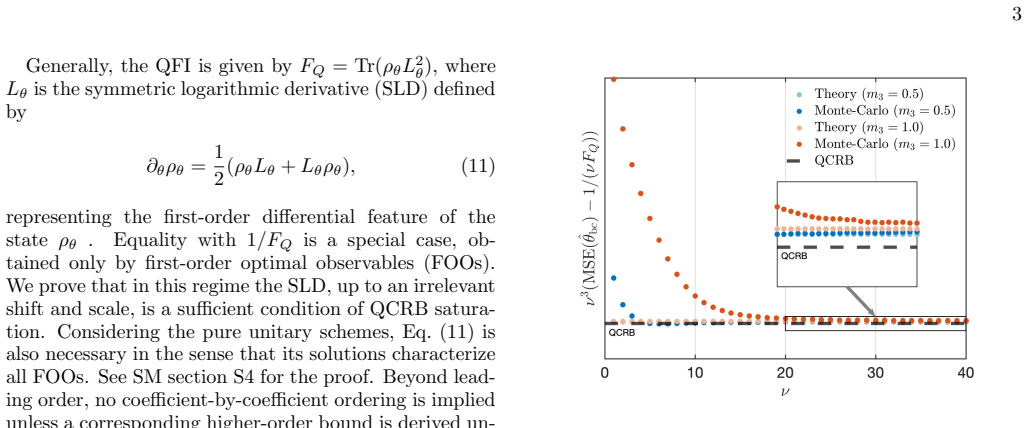
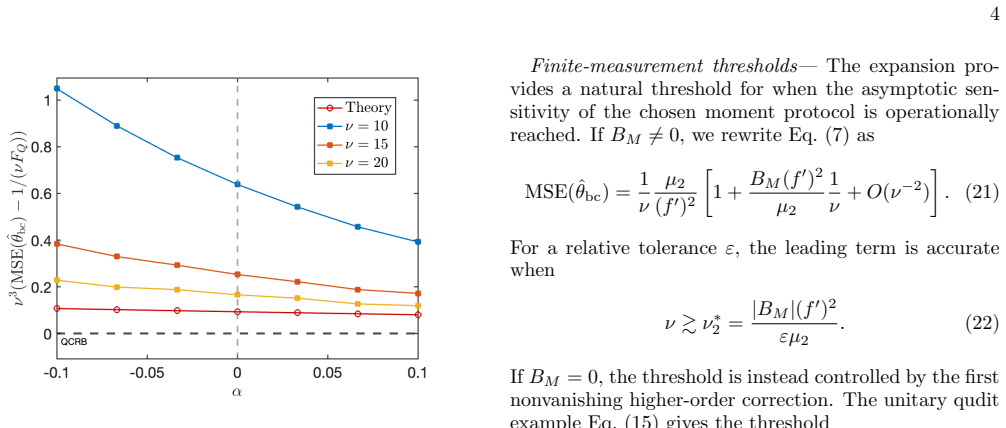
Compute the sample-mean estimator bias for a nonlinear calibration curve at moderate ν (e.g., 10 to 100) and verify whether the residual bias after correction scales as O(ν^{-3}) rather than O(ν^{-2}).
Figures
read the original abstract
The quantum Cram\'er-Rao bound can be saturated only asymptotically and does not specify how many measurements are needed for a concrete estimator to approach it. We develop a finite-measurement theory for method-of-moments estimation, where the parameter is inferred from the sample mean of a calibrating observable rather than from the full likelihood. For general quantum statistical models, the expansion is written in terms of the calibration curve and the central moments of the measured observable. Nonlinear calibration curves make the usual moment estimator biased at finite measurement number; we construct a bias-corrected estimator with bias $O(\nu^{-3})$. This gives sensitivity corrections beyond the leading error-propagation term of the chosen moment protocol. We identify a general density-matrix condition under which the full $1/\nu^2$ correction vanishes. In unitary examples, the leading residual correction appears at order $1/\nu^3$, is governed by calibration curvature, and can be reduced or cancelled by higher-rank components of the same measured observable. The resulting thresholds quantify how many measurements are needed before the asymptotic sensitivity of a moment-estimation protocol is operationally visible.
Editorial analysis
A structured set of objections, weighed in public.
Referee Report
Summary. The manuscript develops a finite-measurement theory for method-of-moments estimation in quantum metrology. For general quantum statistical models, the finite-shot expansion of the estimator is expressed in terms of the calibration curve and the central moments of the measured observable. Nonlinear calibration curves bias the standard moment estimator at finite ν; a bias-corrected estimator is constructed with bias O(ν^{-3}). This yields sensitivity corrections beyond the leading error-propagation term. A general density-matrix condition is identified under which the full 1/ν² correction vanishes. In unitary examples the leading residual correction appears at order 1/ν³, is governed by calibration curvature, and can be reduced or cancelled by higher-rank components of the observable. The resulting thresholds quantify when the asymptotic sensitivity of a moment-estimation protocol becomes operationally visible.
Significance. If the derivations hold, the work supplies a concrete finite-shot extension of asymptotic quantum metrology bounds for moment-based protocols. The explicit bias-correction construction, the vanishing-condition criterion, and the curvature-governed 1/ν³ residual provide practical design tools for determining the number of measurements needed before asymptotic sensitivity is reached. The general expansions (rather than protocol-specific numerics) increase the result's range of applicability across quantum statistical models.
major comments (2)
- [Abstract; bias-correction construction section] Abstract and the section constructing the bias-corrected estimator: the claimed O(ν^{-3}) bias for the corrected estimator is derived using the central moments of the observable. The manuscript must explicitly state whether these moments are oracle (population) quantities or are replaced by sample moments computed from the same ν shots. If the latter, the O(ν^{-1/2}) convergence of sample moments, when inserted into an O(ν^{-1}) correction term, propagates to bias contributions at O(ν^{-2}) or O(ν^{-1.5}), which would prevent the stated order from holding for any practical data-driven implementation. This distinction is load-bearing for the finite-shot sensitivity claim.
- [Section stating the density-matrix condition] The paragraph deriving the density-matrix condition for vanishing of the 1/ν² correction: the condition is stated for the general expansion written in terms of central moments. If the moments are sample estimates, the condition's validity and the order of the residual must be re-derived or shown to be robust; otherwise its operational utility is limited to the oracle-moment case.
minor comments (1)
- Notation for the calibration curve and the observable moments should be introduced with a single consistent symbol table or equation block to avoid ambiguity when the same symbols appear in both the asymptotic and finite-shot expansions.
Simulated Author's Rebuttal
We thank the referee for the careful reading and for identifying the need to clarify the role of population versus sample moments. This distinction is indeed important for interpreting the operational reach of the finite-shot results. We address the two major comments below and will revise the manuscript accordingly.
read point-by-point responses
-
Referee: [Abstract; bias-correction construction section] Abstract and the section constructing the bias-corrected estimator: the claimed O(ν^{-3}) bias for the corrected estimator is derived using the central moments of the observable. The manuscript must explicitly state whether these moments are oracle (population) quantities or are replaced by sample moments computed from the same ν shots. If the latter, the O(ν^{-1/2}) convergence of sample moments, when inserted into an O(ν^{-1}) correction term, propagates to bias contributions at O(ν^{-2}) or O(ν^{-1.5}), which would prevent the stated order from holding for any practical data-driven implementation. This distinction is load-bearing for the finite-shot sensitivity claim.
Authors: We agree that the distinction must be stated explicitly. The derivations treat the central moments as population (oracle) quantities; the bias-corrected estimator is constructed by subtracting the known O(ν^{-1}) and O(ν^{-2}) bias terms expressed in those population moments. This yields the claimed O(ν^{-3}) bias for the corrected estimator in the theoretical expansion. We will add an explicit statement in the abstract and the bias-correction section clarifying that the moments are population quantities. We will also insert a short remark noting that a fully data-driven implementation using sample moments from the same shots would alter the bias order, consistent with the referee's observation, and that the O(ν^{-3}) result therefore characterizes the oracle case relevant to understanding when asymptotic sensitivity becomes visible. revision: yes
-
Referee: [Section stating the density-matrix condition] The paragraph deriving the density-matrix condition for vanishing of the 1/ν² correction: the condition is stated for the general expansion written in terms of central moments. If the moments are sample estimates, the condition's validity and the order of the residual must be re-derived or shown to be robust; otherwise its operational utility is limited to the oracle-moment case.
Authors: The density-matrix condition is derived for the population-moment expansion and identifies the exact cancellation of the 1/ν² term in that setting. We will revise the paragraph to state this assumption explicitly. Because the condition is an exact property of the theoretical expansion, it holds as written for population moments; we do not claim robustness under sample-moment substitution without further analysis. A full re-derivation for the sample case lies outside the present scope, but we will add a brief discussion of the limitation and its implication that the vanishing condition is most directly useful when moments can be treated as known (e.g., via separate calibration or pre-computation). revision: yes
Circularity Check
No circularity: derivation uses general expansions in terms of calibration curves and moments without reduction to fitted inputs or self-citations.
full rationale
The abstract frames the finite-shot expansion and bias-corrected estimator explicitly in terms of a known calibration curve and central moments of the observable for general quantum statistical models, with no indication that any derived O(ν^{-3}) bias term or 1/ν² correction is obtained by fitting to the target sensitivity or by renaming the paper's own inputs. No self-citation load-bearing steps, uniqueness theorems, or ansatzes are referenced in the provided text. The construction therefore remains self-contained against external benchmarks and does not reduce by construction to its inputs.
Axiom & Free-Parameter Ledger
Reference graph
Works this paper leans on
-
[1]
Ye and P
J. Ye and P. Zoller, Essay: Quantum sensing with atomic, molecular, and optical platforms for fundamental physics, Phys. Rev. Lett.132, 190001 (2024)
2024
-
[2]
J. Aasi, J. Abadie, B. Abbott, R. Abbott, T. Abbott, M. Abernathy, C. Adams, T. Adams, P. Addesso, R. Ad- hikari,et al., Enhanced sensitivity of the LIGO gravita- tional wave detector by using squeezed states of light, Nat. Photonics7, 613 (2013)
2013
-
[3]
M. Tse, H. Yu, N. Kijbunchoo, A. Fernandez-Galiana, P. Dupej, L. Barsotti, C. Blair, D. Brown, S. Dwyer, A. Effler,et al., Quantum-enhanced advanced LIGO de- tectors in the era of gravitational-wave astronomy, Phys. Rev. Lett.123, 231107 (2019)
2019
-
[4]
Pedrozo-Pe˜ nafiel, S
E. Pedrozo-Pe˜ nafiel, S. Colombo, C. Shu, A. F. Adiy- atullin, Z. Li, E. M´ endez, B. Braverman, A. Kawasaki, D. Akamatsu, Y. Xiao, and V. Vuleti´ c, Entanglement on an optical atomic-clock transition, Nature588, 414 (2020)
2020
-
[5]
Wasilewski, K
W. Wasilewski, K. Jensen, H. Krauter, J. J. Renema, M. V. Balabas, and E. S. Polzik, Quantum noise limited and entanglement-assisted magnetometry, Phys. Rev. Lett.104, 133601 (2010)
2010
-
[6]
Wolfgramm, A
F. Wolfgramm, A. Cer` e, F. A. Beduini, A. Predojevi´ c, M. Koschorreck, and M. W. Mitchell, Squeezed-light op- tical magnetometry, Phys. Rev. Lett.105, 053601 (2010)
2010
-
[7]
M. A. Taylor and W. P. Bowen, Quantum metrology and its application in biology, Physics Reports615, 1 (2016)
2016
- [8]
-
[9]
M. G. Paris, Quantum estimation for quantum technol- ogy, International Journal of Quantum Information7, 125 (2009)
2009
-
[10]
Giovannetti, S
V. Giovannetti, S. Lloyd, and L. Maccone, Advances in quantum metrology, Nat. Photonics5, 222 (2011)
2011
-
[11]
C. L. Degen, F. Reinhard, and P. Cappellaro, Quantum sensing, Rev. Mod. Phys.89, 035002 (2017)
2017
-
[12]
Pezze, A
L. Pezze, A. Smerzi, M. K. Oberthaler, R. Schmied, and P. Treutlein, Quantum metrology with nonclassical states of atomic ensembles, Rev. Mod. Phys.90, 035005 (2018)
2018
-
[13]
C. W. Helstrom, Quantum detection and estimation the- ory, J. Stat. Phys.1, 231 (1969)
1969
-
[14]
A. S. Holevo,Probabilistic and statistical aspects of quan- tum theory, Vol. 1 (Springer Science & Business Media, 2011)
2011
-
[15]
S. L. Braunstein and C. M. Caves, Statistical distance and the geometry of quantum states, Phys. Rev. Lett. 72, 3439 (1994)
1994
-
[16]
Pezz´ e and A
L. Pezz´ e and A. Smerzi, Entanglement, nonlinear dy- namics, and the Heisenberg limit, Phys. Rev. Lett.102, 100401 (2009)
2009
-
[17]
Hyllus, W
P. Hyllus, W. Laskowski, R. Krischek, C. Schwem- mer, W. Wieczorek, H. Weinfurter, L. Pezz´ e, and A. Smerzi, Fisher information and multiparticle entan- glement, Phys. Rev. A85, 022321 (2012)
2012
-
[18]
T´ oth, Multipartite entanglement and high-precision metrology, Phys
G. T´ oth, Multipartite entanglement and high-precision metrology, Phys. Rev. A85, 022322 (2012)
2012
-
[19]
S. Imai, A. Smerzi, and L. Pezz` e, Metrological usefulness of entanglement and nonlinear Hamiltonians, Phys. Rev. A111, L020402 (2025)
2025
-
[20]
W. Du, J. Kong, G. Bao, P. Yang, J. Jia, S. Ming, C.- 6 H. Yuan, J. F. Chen, Z. Y. Ou, M. W. Mitchell, and W. Zhang, SU(2)-in-SU(1,1) nested interferometer for high sensitivity, loss-tolerant quantum metrology, Phys. Rev. Lett.128, 033601 (2022)
2022
-
[21]
X. Zhao, Y. Yang, and G. Chiribella, Quantum metrology with indefinite causal order, Phys. Rev. Lett.124, 190503 (2020)
2020
-
[22]
N. Kong, H. Wang, M. Tian, Y. Xu, G. Chen, Y. Xiang, and Q. He, Noncommutativity as a universal characteri- zation for enhanced quantum metrology, Phys. Rev. Lett. 136, 010201 (2026)
2026
-
[23]
Enrico Fermi
L. Pezz` e and A. Smerzi, Quantum theory of phase esti- mation, inAtom Interferometry, Proceedings of the In- ternational School of Physics “Enrico Fermi”, Vol. 188 (IOS Press, 2014) pp. 691–741
2014
-
[24]
Gessner and A
M. Gessner and A. Smerzi, Hierarchies of frequentist bounds for quantum metrology: From Cram´ er-Rao to barankin, Phys. Rev. Lett.130, 260801 (2023)
2023
-
[25]
J. Liu, H. Yuan, X.-M. Lu, and X. Wang, Quantum Fisher information matrix and multiparameter estima- tion, J. Phys. A53, 023001 (2020)
2020
-
[26]
Kurdzia lek and R
S. Kurdzia lek and R. Demkowicz-Dobrza´ nski, Measure- ment noise susceptibility in quantum estimation, Phys. Rev. Lett.130, 160802 (2023)
2023
-
[27]
Zhou, C.-L
S. Zhou, C.-L. Zou, and L. Jiang, Saturating the quantum Cram´ er–Rao bound using locc, Quantum Sci. Technol.5, 025005 (2020)
2020
-
[28]
Datta, L
A. Datta, L. Zhang, N. Thomas-Peter, U. Dorner, B. J. Smith, and I. A. Walmsley, Quantum metrology with im- perfect states and detectors, Phys. Rev. A83, 063836 (2011)
2011
-
[29]
Y. L. Len, T. Gefen, A. Retzker, and J. Ko lody´ nski, Quantum metrology with imperfect measurements, Nat. Commun.13, 6971 (2022)
2022
-
[30]
S. Zhou, S. Michalakis, and T. Gefen, Optimal protocols for quantum metrology with noisy measurements, PRX Quantum4, 040305 (2023)
2023
-
[31]
Polino, M
E. Polino, M. Riva, M. Valeri, R. Silvestri, G. Corrielli, A. Crespi, N. Spagnolo, R. Osellame, and F. Sciarrino, Experimental multiphase estimation on a chip, Optica6, 288 (2019)
2019
-
[32]
J. R. Hervas, A. Z. Goldberg, A. S. Sanz, Z. Hradil, J. ˇReh´ aˇ cek, and L. L. S´ anchez-Soto, Beyond the quan- tum Cram´ er-Rao bound, Phys. Rev. Lett.134, 010804 (2025)
2025
-
[33]
Hervas, A
J. Hervas, A. Goldberg, A. Sanz, Z. Hradil, J. ˇReh´ aˇ cek, and L. S´ anchez-Soto, Higher-order corrections to the quantum Cram´ er-Rao bound, Phys. Rev. A112, 022426 (2025)
2025
-
[34]
Gessner, A
M. Gessner, A. Smerzi, and L. Pezz` e, Metrological non- linear squeezing parameter, Phys. Rev. Lett.122, 090503 (2019)
2019
-
[35]
Gessner, A
M. Gessner, A. Smerzi, and L. Pezz` e, Multiparameter squeezing for optimal quantum enhancements in sensor networks, Nat. Commun.11, 3817 (2020)
2020
-
[36]
Y. Li, L. Pezz` e, M. Gessner, Z. Ren, W. Li, and A. Smerzi, Frequentist and Bayesian quantum phase es- timation, Entropy20, 628 (2018)
2018
-
[37]
Rubio and J
J. Rubio and J. Dunningham, Quantum metrology in the presence of limited data, New J. Phys.21, 043037 (2019)
2019
-
[38]
C. Han, Z. Ma, Y. Qiu, R. Fang, J. Wu, C. Zhan, M. Li, J. Huang, B. Lu, and C. Lee, Atomic clock locking with Bayesian quantum parameter estimation: Scheme and experiment, Phys. Rev. Appl.22, 044058 (2024)
2024
-
[39]
Barankin, Locally best unbiased estimates, Ann
E. Barankin, Locally best unbiased estimates, Ann. Math. Stat.20, 477 (1949)
1949
-
[40]
J. S. Abel, A bound on mean-square-estimate error, IEEE Trans. Inf. Theory39, 1675 (2002)
2002
-
[41]
Gebhart, M
V. Gebhart, M. Gessner, and A. Smerzi, Fundamental bounds for parameter estimation with few measurements, Phys. Rev. Research6, 043261 (2024)
2024
-
[42]
H.-L. Shi and A. Smerzi, Global bounds beyond local quantum metrology, arXiv:2605.28374 (2026)
Pith/arXiv arXiv 2026
-
[43]
Mukhopadhyay, V
C. Mukhopadhyay, V. Montenegro, and A. Bayat, Cur- rent trends in global quantum metrology, J. Phys. A: Math. Theor.58, 063001 (2025)
2025
-
[44]
C. R. Rao, Criteria of estimation in large samples, in Contributions to Statistics(Elsevier, 1965) pp. 345–362
1965
-
[45]
S. L. Braunstein, How large a sample is needed for the maximum likelihood estimator to be approximately gaus- sian?, J. Phys. A25, 3813 (1992)
1992
-
[46]
Fadel, N
M. Fadel, N. Roux, and M. Gessner, Quantum metrology with a continuous-variable system, Rep. Prog. Phys.88, 106001 (2025)
2025
-
[47]
J. E. Kolassa,Series approximation methods in statistics (Springer New York, 2006)
2006
-
[48]
FINITE-SHOT SENSITIVITY FOR MOMENT ESTIMATION IN QUANTUM METROLOGY
P. McCullagh,Tensor methods in statistics: Mono- graphs on statistics and applied probability(Chapman and Hall/CRC, 2018). 7 SUPPLEMENTAL MATERIAL FOR “FINITE-SHOT SENSITIVITY FOR MOMENT ESTIMATION IN QUANTUM METROLOGY” Appendix S1: Method of moments in the non-asymptotic regime The method of moments (MoM) protocol uses the measured mean value ¯M= 1 ν P i...
2018
-
[49]
MSE(ˆθ0) = 1 ν g2 1µ2 + 1 ν2 (g1g2µ3 +µ 2 2(3 4 g2 2 +g 1g3)) +O( 1 ν3 ) = 1 ν µ2 (f ′)2 + 1 ν2 (−µ3 f ′′ (f ′)4 +µ 2 2 15 4 (f ′′)2 −f ′f ′′′ (f ′)6 ) +O( 1 ν3 )
+O( 1 ν3 ),(S1.12) E[ˆθ2 0] =θ 2 + 1 ν (g2 1 +g 2θ)µ2 + 1 ν2 ((1 3 g3θ+g 1g2)µ3 + 3µ2 2(1 4 g2 2 + 1 3 g1g3 + 1 12 θg4)) +O( 1 ν3 ),(S1.13) We can then provide the correction to the variance in the non-asymptotic regime. MSE(ˆθ0) = 1 ν g2 1µ2 + 1 ν2 (g1g2µ3 +µ 2 2(3 4 g2 2 +g 1g3)) +O( 1 ν3 ) = 1 ν µ2 (f ′)2 + 1 ν2 (−µ3 f ′′ (f ′)4 +µ 2 2 15 4 (f ′′)2 −f ...
-
[50]
+ 1 ν3 ·( 1 24 g4(µ4 −3µ 2
-
[51]
+ 1 12 g5µ2µ3 + 1 48 g6µ3
-
[52]
+O( 1 ν4 ),(S2.7) E[ˆθ2 0] =θ 2 + 1 ν (g2 1 +g 2θ)µ2 + 1 ν2 ((1 3 g3θ+g 1g2)µ3 + 3µ2 2(1 4 g2 2 + 1 3 g1g3 + 1 12 θg4)) + 1 ν3 ((µ4 −3µ 2 2)(1 4 g2 2 + 1 3 g1g3 + 1 12 θg4) + 10µ2µ3( 1 60 g5θ+ 1 12 g1g4 + 1 6 g2g3) + 15µ3 2( 1 360 g6θ+ 1 60 g1g5 + 1 24 g2g4 + 1 36 g2
-
[53]
(S2.8) Thus one obtains MSE(ˆθbc) = A ν + BM ν2 + DM ν3 +O(ν −4),(S2.9) where BM =V 0 −2Ab ′ 1,(S2.10) DM = 1 12(f ′)10 4f ′′′f ′5 3µ2 2 −µ 4 +f ′4 h 15f ′′2(µ4 −3µ 2
+O( 1 ν4 ). (S2.8) Thus one obtains MSE(ˆθbc) = A ν + BM ν2 + DM ν3 +O(ν −4),(S2.9) where BM =V 0 −2Ab ′ 1,(S2.10) DM = 1 12(f ′)10 4f ′′′f ′5 3µ2 2 −µ 4 +f ′4 h 15f ′′2(µ4 −3µ 2
-
[54]
+ 6f′′µ3µ′′ 2 −4µ 3 f (4)µ2 −3f ′′′µ′ 2 i +f ′3 h 3f (5)µ3 2 + 18µ2 2 f (4)µ′ 2 +f ′′′µ′′ 2 + 2f′′µ2 (26f ′′′µ3 + 3µ2µ′′′ 2 )−48f ′′2µ3µ′ 2 i −f ′2µ2 h 28f ′′′2µ2 2 + 216f′′f ′′′µ′ 2µ2 + 3f′′ 15f (4)µ2 2 +f ′′ 32f ′′µ3 −µ ′2 2 + 26µ2µ′′ 2 i + 3f′′2f ′µ2 2 (101f ′′′µ2 + 128f′′µ′ 2) −297f ′′4µ3 2 −24f ′8µ2˜b′ 2 . (S2.11) The coefficient identifies protocols...
-
[55]
sin θ √ 4m3 2+m2 3 m2 −2λm 3 2 cos θ √ 4m3 2+m2 3 m2 −1 4m3 2 +m 2 3 .(S5.4) Based on Eq. (S1.14) and Eq.(S2.9) respectively, we derive the corrections to the original MoM estimator (true value θ= 0) MSE(ˆθ0) = 1 4m2ν + 7λ2 + 16 m3 2 + 4m2 3 64m4 2ν2 +O(ν −3),(S5.5) and the biased-corrected estimator MSE(ˆθbc) = 1 4m2ν + λ2 32m2ν2 +O(ν −3).(S5.6) With a c...
discussion (0)
Sign in with ORCID, Apple, or X to comment. Anyone can read and Pith papers without signing in.