REVIEW 3 major objections 5 minor 101 references
PARTE: Part-Guided Texturing for 3D Human Reconstruction from a Single Image
T0 review · 3 major / 5 minor · reviewed 2026-08-06 · deepseek-v4-flash
Pith's one-line read PARTE shows that conditioning texture generation on explicit 3D human part labels fixes the part-misalignment failure of single-image 3D human reconstruction.
desk verdict PARTE delivers a solid empirical step for part-guided texturing in single-image 3D human reconstruction, but the headline Part IoU gain is partly circular because the same Sapiens segmenter supplies the part labels and the evaluation metric. read the letter →
The pith
A machine-rendered reading of the paper's core claim, the machinery that carries it, and where it could break.
The reading
What carries the argument
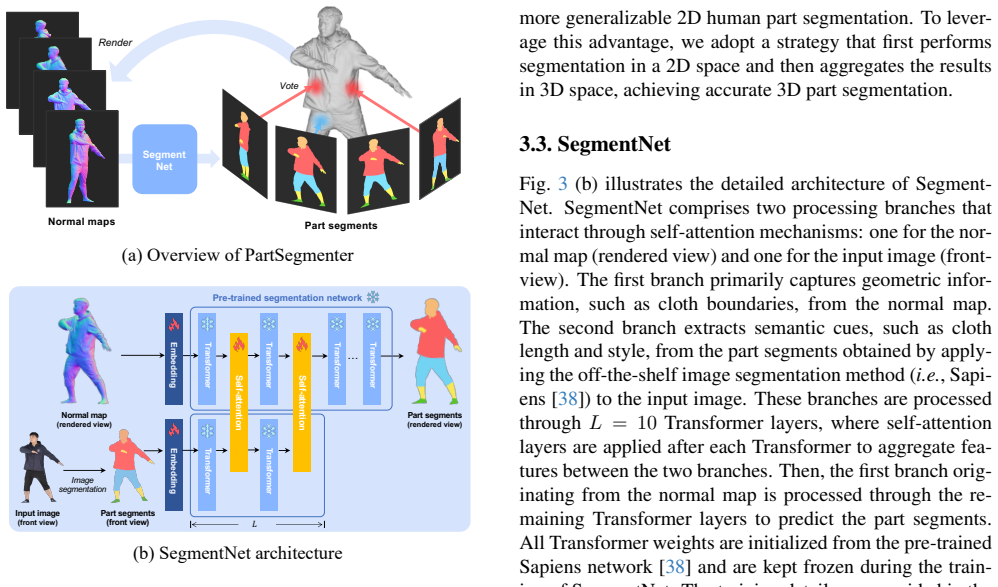
Two coupled modules carry the argument. PartSegmenter contains SegmentNet, a network built from the frozen Transformer layers of a pre-trained human segmentation model, with two branches that exchange features through self-attention: one reads normal maps rendered from the textureless surface at each of thirty viewpoints, capturing geometric cues such as cloth boundaries in regions invisible to the camera, and the other reads the front-view image's part segments, capturing semantic cues such as cloth style; the per-view 2D part maps are unprojected onto the mesh and aggregated by majority voting into per-vertex 3D labels. PartTexturer contains PartDiffusion, a pre-trained latent diffusion network modified with fusion layers that inject three conditions through self-attention: part segments at the rendering viewpoint, per-part image patches formed by multiplying the front-view image with its part segments, and per-part text prompts produced by a captioning model; these conditions enter the score-distillation loss that optimizes the MLP color field, so each region is painted from its own appearance cue rather than from one global prompt.
What would settle it
Run PARTE on a test set of people wearing outfits outside the five-class taxonomy (dresses, skirts, layered or multi-piece clothing, accessories) using ground-truth 3D part annotations, and compare texture misalignment against standard garments: the part-guidance claim predicts a sharp rise in texture bleeding wherever segmentation fails. Alternatively, deliberately corrupt the part segmentations fed to PartTexturer (swap upper/lower labels or erase a part) and check that texture quality drops in proportion; if texture quality is insensitive to segmentation quality, the part-guidance mechanism is not the source of the reported gains.
Extended reading notes
Core claim
On the paper's own terms, the discovery is that texture misalignment across human parts, a failure common to both regression-based and diffusion-based single-image 3D human reconstruction, can be removed by explicitly conditioning texture generation on dense 3D part segmentations rather than on global image context alone. The framework first builds a textureless human mesh with an off-the-shelf geometry method, labels its surface with five part categories by aggregating 2D segmentations from thirty viewpoints through majority voting in 3D, and then optimizes an MLP color field under a front-view reconstruction loss plus a score-distillation-sampling loss, using a custom diffusion network that ingests the rendered part segments, the front-view image, and per-part text prompts. The experiments report consistent gains: on THuman2.1, PSNR of 22.175 with Part IoU 0.641 versus 21.089 and 0.588 for the best prior method, and similar margins on HuMMan; ablations show that removing part guidance drops Part IoU from 0.641 to 0.461, and that grafting the same texturer onto the geometry of 2K2K, SiTH, HumanRef, and SIFU raises each method's texture quality without altering its geometry.
Load-bearing premise
The method is only as good as its part labels: if the 3D part segmentation is wrong, the part-guided texturing is confidently wrong, and the paper's own limitation section concedes that unseen garment types such as dresses are mis-segmented and therefore mis-textured.
Editorial extensions
If this is right
- Part-guided texturing acts as a plug-and-play upgrade: replacing the texturing stage of 2K2K, SiTH, HumanRef, SIFU, and TeCH improves their PSNR, LPIPS, and Part IoU without changing their geometry, so existing reconstruction pipelines can adopt PARTE as their texture stage.
- On ground-truth geometry, PartDiffusion outperforms the diffusion texturing schemes of DreamFusion-style score distillation, HumanRef's reference U-Net, and TeCH's DreamBooth, isolating the texturing gain from geometry errors.
- The 3D part segmentation intermediate makes the output editable: a single garment can be re-textured by inpainting its 2D projection and re-running PartTexturer, and cloth surfaces can be cut out as 3D assets along part boundaries.
- Because part labels are voted from thirty viewpoints, the guidance is 3D-consistent rather than front-view-only, which is what allows coherent back- and side-view texturing from a single photo.
Reading between the lines
- The success of this two-stage split suggests a general recipe for compositional 3D reconstruction: identify the object's semantic parts first, then let a generative prior paint each part under explicit region constraints; the same scheme could transfer to animals, vehicles, or multi-object scenes where sub-regions have independent appearances.
- Per-part text prompts generated automatically from the input image give the diffusion model region-level semantic control at near-zero annotation cost, a cheap way to add part-level controllability to other text-to-3D or image-to-3D pipelines.
- A stress test the paper does not run: deliberately corrupt the part segmentations fed to PartTexturer and measure the texture-quality drop; the causal claim that part guidance drives the gains predicts a steep, monotone degradation, which would also quantify how much headroom remains for improving SegmentNet.
- The dress failure implies the five-class taxonomy is the current ceiling; extending to finer or open-vocabulary part labels (separating hair from face, adding accessories, adding garment classes such as dresses) is the natural next step and probably necessary for unrestricted clothing.
Editorial analysis
A structured set of objections, weighed in public.
Referee Report
Summary. PARTE is a single-image 3D human reconstruction method that makes explicit use of 3D human part information to guide texture synthesis. The pipeline first reconstructs a textureless surface with TeCH, then PartSegmenter predicts dense part labels on that surface by aggregating 2D segmentations from normal-map renderings at 30 viewpoints, where SegmentNet combines normal-map features with front-view Sapiens segments. PartTexturer then optimizes an MLP color field with a reconstruction loss on the front view and an SDS loss whose diffusion predictor, PartDiffusion, is conditioned on rendered part maps, masked front-view image patches, and per-part text prompts from BLIP. The paper reports improved PSNR, LPIPS, and Part IoU over PIFu, 2K2K, SiTH, HumanRef, SIFU, and TeCH on THuman2.1 and HuMMan, plus ablations and plug-in experiments showing that PARTE improves the texturing of other geometry reconstruction methods.
Significance. The modular design is a clean and plausible contribution: separating dense 3D part estimation from part-conditioned texture synthesis is well motivated, and the plug-in results in Table S1 show that the texturing module can benefit existing geometry pipelines. The PSNR and LPIPS gains, though modest in absolute terms, are consistent across two datasets and across ablations, and they are not affected by the segmentation-metric loop. The main weakness is the evaluation of part alignment: Part IoU is computed with Sapiens, the same model that produces the pseudo-GT labels, the front-view conditioning segments, and the novel-view training segments. As the paper's own limitation section demonstrates for dresses, a Sapiens-consistent texture is not necessarily a correctly part-aligned texture. The part-alignment claim therefore needs an independent check before the headline result can be accepted.
major comments (3)
- [Sec. 5.2, Tables 2 and 3; Secs. 3.3/4.3/S5.2] The part-alignment evidence is partly circular. Part IoU is computed by applying Sapiens to rendered images of both the reconstruction and the GT (Sec. 5.2), while Sapiens is also used to generate the pseudo-GT part labels for THuman2.1 and HuMMan (Sec. 5.1), to extract the front-view segments that feed SegmentNet (Sec. 3.3), and to generate the novel-view part segments used to train PartDiffusion (Sec. S5.2). PARTE is therefore optimized, through both modules, to be consistent with Sapiens, whereas the baselines are not; the Part IoU gains may partly measure self-consistency with the labeler rather than true part alignment. Sec. S7 makes the risk concrete: for dresses, Sapiens-based labeling fails, and the Sapiens-based evaluator cannot penalize the resulting misalignment. Please provide an independent part-alignment evaluation, e.g., with a different segmentation model, with 4D-DRESS's own semantic labels, or with human raters.
- [Table 1 and Sec. 5.1] The 3D part segmentation metrics (Part CD and Label Acc) are computed against GT labels that are themselves Sapiens outputs, and SegmentNet is initialized from Sapiens and conditioned on Sapiens front-view segments. The comparison with Human3D, which is fine-tuned on the same pseudo-GT but does not use Sapiens at inference, is therefore not a neutral test of segmentation quality. I request results on a dataset with human-verified part labels or with a held-out labeler.
- [Sec. S6, Table S4] The 4D-DRESS evaluation is said to use a dataset with accurate 3D part labels, but the table does not state whether Part IoU is computed against those ground-truth labels or via Sapiens. If the GT labels are used, this would be a valuable non-circular check and should be stated prominently; if Sapiens is still used, the circularity concern applies to this table as well.
minor comments (5)
- [Sec. S7, Abstract, Conclusion] The admitted limitation that unseen cloth types such as dresses cause segmentation failures and incorrect texturing should be reflected in the abstract and conclusion, which currently claim state-of-the-art 3D human reconstruction without this scope condition.
- [Eq. (1) and Sec. S5.2] The relative weighting of L_recon and L_SDS is not reported; the supplementary gives the guidance scale and timestep range but not the loss weights. Please add these values for reproducibility.
- [Sec. 5.2] Please specify whether background and the 'others' class are excluded from Part IoU, and whether the metric is averaged per view or over pooled pixels; this affects comparability with baseline numbers.
- [Table 3] Because PARTE reuses TeCH's geometry, PARTE's P2S/CD values are identical to TeCH's; the caption should state this explicitly to avoid the impression that PARTE independently produces those geometry numbers.
- [Sec. 3.3] The sentence stating that all Transformer weights are initialized from Sapiens and kept frozen is ambiguous because the inserted self-attention layers are trainable; please clarify which parameters are optimized.
Circularity Check
Part IoU and the 3D part-segmentation metrics are computed with Sapiens, the same model that supplies PARTE's pseudo-GT labels and conditioning signals, so the headline part-alignment gain is partly self-consistency; PSNR and LPIPS remain independent.
-
self definitional
[Sec. 5.1 (Datasets); Sec. 5.2 (Evaluation Metrics); also Sec. 3.3, Sec. 4.3, Sec. S5.2]
"To obtain ground truth (GT) part segmentations for the scans, we apply Sapiens [38] to 360 rendered images from uniformly distributed viewpoints and aggregate the results in 3D space. ... Part IoU evaluates the part alignment of the reconstructed human textures in 2D space. It is computed as the average IoU of part segments of the rendered images, where each segment is obtained by applying Sapiens [38] to the rendered images."
Part alignment is not measured against an independent label source. The GT part labels used for supervision and evaluation are Sapiens outputs (Sec. 5.1), the front-view and novel-view Sapiens segments are used as conditioning and training inputs (Sec. 3.3, Sec. 4.3, Sec. S5.2), and Part IoU is computed by running Sapiens on rendered images (Sec. 5.2). Thus PARTE is explicitly trained and conditioned to produce textures whose Sapiens-based segmentations coincide with Sapiens-based pseudo-GT, and then scored on that same coincidence. Baselines are not conditioned on Sapiens segments, so the Part IoU advantage partly measures in-distribution self-consistency rather than true part alignment.
full rationale
The core method is not circular: PartSegmenter and PartDiffusion are trained on held-out THuman2.1 scans with reconstruction and SDS objectives, and the headline texture-fidelity claim is independently supported by PSNR and LPIPS on rendered images from held-out scans. There is no load-bearing self-citation chain; Sapiens is an external model. The circularity is confined to the part-alignment and part-segmentation evaluation: the pseudo-GT labels, the conditioning signals, and the Part IoU metric all come from the same Sapiens segmenter, so PARTE is rewarded for reproducing Sapiens labels that it was trained and conditioned to reproduce. This can inflate Part IoU and the related 3D segmentation metrics over baselines independent of true part alignment. The score is 4 rather than higher because PSNR and LPIPS provide independent evidence for the central texture-quality claim, and the paper's own S7 limitation exposes the failure mode rather than hiding it.
Assumptions & free parameters
free parameters (7)
- number_of_part_categories =
5
- viewpoints_for_3D_voting =
30
- SegmentNet_transformer_layers_L =
10
- SDS_guidance_scale =
100
- MLP_hidden_dimension =
32
- hash_encoding_max_resolution =
2048
- noise_timestep_range =
[0.02, 0.98]
assumptions (4)
- domain assumption Sapiens provides reliable 2D human part segmentation for arbitrary images.
- domain assumption A pre-trained diffusion model's score function is a valid prior for human appearance in SDS loss.
- domain assumption Normal maps of a textureless human surface contain sufficient structural cues to infer part labels in invisible regions.
- domain assumption TeCH geometry reconstruction is accurate enough for part segmentation and texturing.
invented entities (2)
-
PartSegmenter
independent evidence
-
PartDiffusion
independent evidence
Cite this review
Pith. "Pith review of PARTE: Part-Guided Texturing for 3D Human Reconstruction from a Single Image." pith.science (2026). https://pith.science/paper/LL3H5IBB
@misc{pith2026250717332,
  author       = {Pith},
  title        = {Pith review of: PARTE: Part-Guided Texturing for 3D Human Reconstruction from a Single Image},
  year         = {2026},
  howpublished = {\url{https://pith.science/paper/LL3H5IBB}},
  note         = {Machine review of arXiv:2507.17332}
}
read the original abstract
The misaligned human texture across different human parts is one of the main limitations of existing 3D human reconstruction methods. Each human part, such as a jacket or pants, should maintain a distinct texture without blending into others. The structural coherence of human parts serves as a crucial cue to infer human textures in the invisible regions of a single image. However, most existing 3D human reconstruction methods do not explicitly exploit such part segmentation priors, leading to misaligned textures in their reconstructions. In this regard, we present PARTE, which utilizes 3D human part information as a key guide to reconstruct 3D human textures. Our framework comprises two core components. First, to infer 3D human part information from a single image, we propose a 3D part segmentation module (PartSegmenter) that initially reconstructs a textureless human surface and predicts human part labels based on the textureless surface. Second, to incorporate part information into texture reconstruction, we introduce a part-guided texturing module (PartTexturer), which acquires prior knowledge from a pre-trained image generation network on texture alignment of human parts. Extensive experiments demonstrate that our framework achieves state-of-the-art quality in 3D human reconstruction. The project page is available at https://hygenie1228.github.io/PARTE/.
Figures


Figures from the paper (3 more)


Reference graph
Works this paper leans on
-
[1]
Gaussian shell maps for efficient 3D human generation
Rameen Abdal, Wang Yifan, Zifan Shi, Yinghao Xu, Ryan Po, Zhengfei Kuang, Qifeng Chen, Dit-Yan Yeung, and Gordon Wetzstein. Gaussian shell maps for efficient 3D human generation. In CVPR, 2024. 3
2024
-
[2]
Single-image 3D human digitization with shape-guided diffusion
Badour AlBahar, Shunsuke Saito, Hung-Yu Tseng, Changil Kim, Johannes Kopf, and Jia-Bin Huang. Single-image 3D human digitization with shape-guided diffusion. In SIG- GRAPH Asia, 2023. 1
2023
-
[3]
Learning to re- construct people in clothing from a single rgb camera
Thiemo Alldieck, Marcus Magnor, Bharat Lal Bhatnagar, Christian Theobalt, and Gerard Pons-Moll. Learning to re- construct people in clothing from a single rgb camera. In CVPR, 2019. 2
2019
-
[4]
imGHUM: Implicit generative models of 3D human shape and articulated pose
Thiemo Alldieck, Hongyi Xu, and Cristian Sminchisescu. imGHUM: Implicit generative models of 3D human shape and articulated pose. In ICCV, 2021. 3
2021
-
[5]
Photorealistic monocular 3D reconstruction of hu- mans wearing clothing
Thiemo Alldieck, Mihai Zanfir, and Cristian Sminchis- escu. Photorealistic monocular 3D reconstruction of hu- mans wearing clothing. In CVPR, 2022. 2
2022
-
[6]
Photorealistic monocular 3D reconstruction of hu- mans wearing clothing
Thiemo Alldieck, Mihai Zanfir, and Cristian Sminchis- escu. Photorealistic monocular 3D reconstruction of hu- mans wearing clothing. In CVPR, 2022. 1
2022
-
[7]
Learning on graph with lapla- cian regularization
Rie Ando and Tong Zhang. Learning on graph with lapla- cian regularization. In NeurIPS, 2006. 3
2006
-
[8]
MultiDiffusion: Fusing diffusion paths for controlled image generation
Omer Bar-Tal, Lior Yariv, Yaron Lipman, and Tali Dekel. MultiDiffusion: Fusing diffusion paths for controlled image generation. Proceedings of Machine Learning Research ,
Show all 101 references
-
[9]
HuMMan: Multi-modal 4D human dataset for versatile sensing and modeling
Zhongang Cai, Daxuan Ren, Ailing Zeng, Zhengyu Lin, Tao Yu, Wenjia Wang, Xiangyu Fan, Yang Gao, Yi- fan Yu, Liang Pan, Fangzhou Hong, Mingyuan Zhang, Chen Change Loy, Lei Yang, and Ziwei Liu. HuMMan: Multi-modal 4D human dataset for versatile sensing and modeling. In ECCV, 2022. 1, 6
2022
-
[10]
DreamAvatar: Text-and-shape guided 3D human avatar generation via diffusion models
Yukang Cao, Yan-Pei Cao, Kai Han, Ying Shan, and Kwan- Yee K Wong. DreamAvatar: Text-and-shape guided 3D human avatar generation via diffusion models. In CVPR,
-
[11]
Gener- alizable human gaussians from single-view image
Jinnan Chen, Chen Li, Jianfeng Zhang, Lingting Zhu, Buzhen Huang, Hanlin Chen, and Gim Hee Lee. Gener- alizable human gaussians from single-view image. arXiv preprint arXiv:2406.06050, 2024. 1
2024 arXiv
-
[12]
Fan- tasia3D: Disentangling geometry and appearance for high- quality text-to-3D content creation
Rui Chen, Yongwei Chen, Ningxin Jiao, and Kui Jia. Fan- tasia3D: Disentangling geometry and appearance for high- quality text-to-3D content creation. In ICCV, 2023. 2
2023
-
[13]
PrimDiffusion: V olumetric primitives diffusion for 3D human generation
Zhaoxi Chen, Fangzhou Hong, Haiyi Mei, Guangcong Wang, Lei Yang, and Ziwei Liu. PrimDiffusion: V olumetric primitives diffusion for 3D human generation. In NeurIPS,
-
[14]
Structured 3D features for reconstructing con- trollable avatars
Enric Corona, Mihai Zanfir, Thiemo Alldieck, Ed- uard Gabriel Bazavan, Andrei Zanfir, and Cristian Smin- chisescu. Structured 3D features for reconstructing con- trollable avatars. In CVPR, 2023. 2
2023
-
[15]
An efficient method of triangu- lating equi-valued surfaces by using tetrahedral cells
Akio Doi and Akio Koide. An efficient method of triangu- lating equi-valued surfaces by using tetrahedral cells. IE- ICE TRANSACTIONS on Information and Systems , 1991. 3
1991
-
[16]
Soft-gated warping-GAN for pose- guided person image synthesis
Haoye Dong, Xiaodan Liang, Ke Gong, Hanjiang Lai, Jia Zhu, and Jian Yin. Soft-gated warping-GAN for pose- guided person image synthesis. NIPS, 2018. 3
2018
-
[17]
AG3D: Learning to gen- erate 3D avatars from 2D image collections
Zijian Dong, Xu Chen, Jinlong Yang, Michael J Black, Ot- mar Hilliges, and Andreas Geiger. AG3D: Learning to gen- erate 3D avatars from 2D image collections. InICCV, 2023. 3
2023
-
[18]
Collaborative regression of expressive bodies using moderation
Yao Feng, Vasileios Choutas, Timo Bolkart, Dimitrios Tzionas, and Michael J Black. Collaborative regression of expressive bodies using moderation. In 3DV, 2021. 3
2021
-
[19]
StyleGAN-Human: A data-centric odyssey of human gen- eration
Jianglin Fu, Shikai Li, Yuming Jiang, Kwan-Yee Lin, Chen Qian, Chen Change Loy, Wayne Wu, and Ziwei Liu. StyleGAN-Human: A data-centric odyssey of human gen- eration. In ECCV, 2022. 2, 4, 6, 7, 8, 9
2022
-
[20]
Text-guided 3D human generation from 2D collections
Tsu-Jui Fu, Wenhan Xiong, Yixin Nie, Jingyu Liu, Barlas Oguz, and William Yang Wang. Text-guided 3D human generation from 2D collections. In EMNLP, 2023. 3
2023
-
[21]
ConTex-Human: Free-view rendering of human from a single image with texture-consistent synthesis
Xiangjun Gao, Xiaoyu Li, Chaopeng Zhang, Qi Zhang, Yanpei Cao, Ying Shan, and Long Quan. ConTex-Human: Free-view rendering of human from a single image with texture-consistent synthesis. In CVPR, 2024. 2
2024
-
[22]
StylePeople: A generative model of fullbody human avatars
Artur Grigorev, Karim Iskakov, Anastasia Ianina, Renat Bashirov, Ilya Zakharkin, Alexander Vakhitov, and Victor Lempitsky. StylePeople: A generative model of fullbody human avatars. In CVPR, 2021. 3
2021
-
[23]
High-fidelity 3D hu- man digitization from single 2k resolution images
Sang-Hun Han, Min-Gyu Park, Ju Hong Yoon, Ju-Mi Kang, Young-Jae Park, and Hae-Gon Jeon. High-fidelity 3D hu- man digitization from single 2k resolution images. In CVPR, 2023. 1, 2, 8
2023
-
[24]
ClothFlow: A flow-based model for clothed person generation
Xintong Han, Xiaojun Hu, Weilin Huang, and Matthew R Scott. ClothFlow: A flow-based model for clothed person generation. In ICCV, 2019. 3
2019
-
[25]
ARCH++: Animation-ready clothed human reconstruction revisited
Tong He, Yuanlu Xu, Shunsuke Saito, Stefano Soatto, and Tony Tung. ARCH++: Animation-ready clothed human reconstruction revisited. In ICCV, 2021. 1, 2
2021
-
[26]
Learning locally editable virtual humans
Hsuan-I Ho, Lixin Xue, Jie Song, and Otmar Hilliges. Learning locally editable virtual humans. In CVPR, 2023. 1
2023
-
[27]
SiTH: Single-view textured human reconstruction with image-conditioned dif- fusion
I Ho, Jie Song, Otmar Hilliges, et al. SiTH: Single-view textured human reconstruction with image-conditioned dif- fusion. In CVPR, 2024. 1, 2, 8, 6
2024
-
[28]
Classifier-free diffusion guidance
Jonathan Ho and Tim Salimans. Classifier-free diffusion guidance. In NeurIPS workshop, 2021. 4
2021
-
[29]
AvatarCLIP: zero-shot text- driven generation and animation of 3D avatars.TOG, 2022
Fangzhou Hong, Mingyuan Zhang, Liang Pan, Zhongang Cai, Lei Yang, and Ziwei Liu. AvatarCLIP: zero-shot text- driven generation and animation of 3D avatars.TOG, 2022. 3
2022
-
[30]
EV A3D: Compositional 3D human generation from 2D image collections
Fangzhou Hong, Zhaoxi Chen, LAN Yushi, Liang Pan, and Ziwei Liu. EV A3D: Compositional 3D human generation from 2D image collections. In ICLR, 2023
2023
-
[31]
StructLDM: Structured latent diffusion for 3D human generation
Tao Hu, Fangzhou Hong, and Ziwei Liu. StructLDM: Structured latent diffusion for 3D human generation. In ECCV, 2024
2024
-
[32]
HumanNorm: Learn- ing normal diffusion model for high-quality and realistic 3D human generation
Xin Huang, Ruizhi Shao, Qi Zhang, Hongwen Zhang, Ying Feng, Yebin Liu, and Qing Wang. HumanNorm: Learn- ing normal diffusion model for high-quality and realistic 3D human generation. In CVPR, 2024
2024
-
[33]
DreamWaltz: Make a scene with complex 3D animatable avatars
Yukun Huang, Jianan Wang, Ailing Zeng, He Cao, Xi- anbiao Qi, Yukai Shi, Zheng-Jun Zha, and Lei Zhang. DreamWaltz: Make a scene with complex 3D animatable avatars. In NeurIPS, 2024. 3
2024
-
[34]
TeCH: Text- guided reconstruction of lifelike clothed humans
Yangyi Huang, Hongwei Yi, Yuliang Xiu, Tingting Liao, Jiaxiang Tang, Deng Cai, and Justus Thies. TeCH: Text- guided reconstruction of lifelike clothed humans. In 3DV,
-
[35]
ARCH: Animatable reconstruction of clothed humans
Zeng Huang, Yuanlu Xu, Christoph Lassner, Hao Li, and Tony Tung. ARCH: Animatable reconstruction of clothed humans. In CVPR, 2020. 1, 2
2020
-
[36]
Zero-shot text-guided object gen- eration with dream fields
Ajay Jain, Ben Mildenhall, Jonathan T Barron, Pieter Abbeel, and Ben Poole. Zero-shot text-guided object gen- eration with dream fields. In CVPR, 2022. 2
2022
-
[37]
Avatar- Craft: Transforming text into neural human avatars with parameterized shape and pose control
Ruixiang Jiang, Can Wang, Jingbo Zhang, Menglei Chai, Mingming He, Dongdong Chen, and Jing Liao. Avatar- Craft: Transforming text into neural human avatars with parameterized shape and pose control. In ICCV, 2023. 3
2023
-
[38]
Sapiens: Foundation for human vi- sion models
Rawal Khirodkar, Timur Bagautdinov, Julieta Martinez, Su Zhaoen, Austin James, Peter Selednik, Stuart Anderson, and Shunsuke Saito. Sapiens: Foundation for human vi- sion models. In ECCV, 2024. 4, 5, 6, 3
2024
-
[39]
Chupa: Carving 3D clothed humans from skinned shape priors us- ing 2D diffusion probabilistic models
Byungjun Kim, Patrick Kwon, Kwangho Lee, Myunggi Lee, Sookwan Han, Daesik Kim, and Hanbyul Joo. Chupa: Carving 3D clothed humans from skinned shape priors us- ing 2D diffusion probabilistic models. In ICCV, 2023. 3
2023
-
[40]
Kingma and Jimmy Ba
Diederik P. Kingma and Jimmy Ba. Adam: A method for stochastic optimization. In ICLR, 2015. 3, 4
2015
-
[41]
DreamHuman: Animatable 3D avatars from text
Nikos Kolotouros, Thiemo Alldieck, Andrei Zanfir, Ed- uard Bazavan, Mihai Fieraru, and Cristian Sminchisescu. DreamHuman: Animatable 3D avatars from text. In NeurIPS, 2023. 3
2023
-
[42]
Instant 3D human avatar generation using image diffusion models
Nikos Kolotouros, Thiemo Alldieck, Enric Corona, Ed- uard Gabriel Bazavan, and Cristian Sminchisescu. Instant 3D human avatar generation using image diffusion models. In ECCV, 2024. 1, 3
2024
-
[43]
360-degree textures of people in clothing from a single im- age
Verica Lazova, Eldar Insafutdinov, and Gerard Pons-Moll. 360-degree textures of people in clothing from a single im- age. In 3DV, 2019. 2
2019
-
[44]
BLIP: Bootstrapping language-image pre-training for uni- fied vision-language understanding and generation
Junnan Li, Dongxu Li, Caiming Xiong, and Steven Hoi. BLIP: Bootstrapping language-image pre-training for uni- fied vision-language understanding and generation. In ICML, 2022. 5, 4
2022
-
[45]
Object-driven text-to-image synthesis via adversarial training
Wenbo Li, Pengchuan Zhang, Lei Zhang, Qiuyuan Huang, Xiaodong He, Siwei Lyu, and Jianfeng Gao. Object-driven text-to-image synthesis via adversarial training. In CVPR,
-
[46]
Collaging class-specific GANs for semantic image synthesis
Yuheng Li, Yijun Li, Jingwan Lu, Eli Shechtman, Yong Jae Lee, and Krishna Kumar Singh. Collaging class-specific GANs for semantic image synthesis. In ICCV, 2021. 3
2021
-
[47]
High-fidelity clothed avatar re- construction from a single image
Tingting Liao, Xiaomei Zhang, Yuliang Xiu, Hongwei Yi, Xudong Liu, Guo-Jun Qi, Yong Zhang, Xuan Wang, Xi- angyu Zhu, and Zhen Lei. High-fidelity clothed avatar re- construction from a single image. In CVPR, 2023. 2
2023
-
[48]
Tingting Liao, Hongwei Yi, Yuliang Xiu, Jiaxiang Tang, Yangyi Huang, Justus Thies, and Michael J. Black. TADA! text to animatable digital avatars. In 3DV, 2024. 3
2024
-
[49]
Microsoft COCO: Common objects in context
Tsung-Yi Lin, Michael Maire, Serge Belongie, James Hays, Pietro Perona, Deva Ramanan, Piotr Doll ´ar, and C Lawrence Zitnick. Microsoft COCO: Common objects in context. In ECCV, 2014. 2, 4
2014
-
[50]
DeepFashion: Powering robust clothes recognition and retrieval with rich annotations
Ziwei Liu, Ping Luo, Shi Qiu, Xiaogang Wang, and Xiaoou Tang. DeepFashion: Powering robust clothes recognition and retrieval with rich annotations. In CVPR, 2016. 2, 4
2016
-
[51]
A convnet for the 2020s
Zhuang Liu, Hanzi Mao, Chao-Yuan Wu, Christoph Feicht- enhofer, Trevor Darrell, and Saining Xie. A convnet for the 2020s. In CVPR, 2022. 4
2022
-
[52]
Decoupled weight decay regularization
Ilya Loshchilov and Frank Hutter. Decoupled weight decay regularization. In ICLR, 2019. 4
2019
-
[53]
Learning semantic per- son image generation by region-adaptive normalization
Zhengyao Lv, Xiaoming Li, Xin Li, Fu Li, Tianwei Lin, Dongliang He, and Wangmeng Zuo. Learning semantic per- son image generation by region-adaptive normalization. In CVPR, 2021. 3
2021
-
[54]
Learn- ing to dress 3D people in generative clothing
Qianli Ma, Jinlong Yang, Anurag Ranjan, Sergi Pujades, Gerard Pons-Moll, Siyu Tang, and Michael J Black. Learn- ing to dress 3D people in generative clothing. In CVPR,
-
[55]
En3D: An enhanced generative model for sculpting 3D humans from 2D synthetic data
Yifang Men, Biwen Lei, Yuan Yao, Miaomiao Cui, Zhouhui Lian, and Xuansong Xie. En3D: An enhanced generative model for sculpting 3D humans from 2D synthetic data. In CVPR, 2024. 1, 3
2024
-
[56]
3D clothed human reconstruction in the wild
Gyeongsik Moon, Hyeongjin Nam, Takaaki Shiratori, and Kyoung Mu Lee. 3D clothed human reconstruction in the wild. In ECCV, 2022. 2
2022
-
[57]
DeClotH: Decomposable 3D cloth and hu- man body reconstruction from a single image
Hyeongjin Nam, Donghwan Kim, Jeongtaek Oh, and Ky- oung Mu Lee. DeClotH: Decomposable 3D cloth and hu- man body reconstruction from a single image. In CVPR, 2025
2025
-
[58]
HumanSplat: Generalizable single-image human gaus- sian splatting with structure priors
Panwang Pan, Zhuo Su, Chenguo Lin, Zhen Fan, Yongjie Zhang, Zeming Li, Tingting Shen, Yadong Mu, and Yebin Liu. HumanSplat: Generalizable single-image human gaus- sian splatting with structure priors. In NeurIPS, 2025. 2
2025
-
[59]
Semantic image synthesis with spatially-adaptive normalization
Taesung Park, Ming-Yu Liu, Ting-Chun Wang, and Jun- Yan Zhu. Semantic image synthesis with spatially-adaptive normalization. In CVPR, 2019. 3
2019
-
[60]
Automatic differentiation in PyTorch
Adam Paszke, Sam Gross, Soumith Chintala, Gregory Chanan, Edward Yang, Zachary DeVito, Zeming Lin, Al- ban Desmaison, Luca Antiga, and Adam Lerer. Automatic differentiation in PyTorch. 2017. 2
2017
-
[61]
Georgios Pavlakos, Vasileios Choutas, Nima Ghorbani, Timo Bolkart, Ahmed A. A. Osman, Dimitrios Tzionas, and Michael J. Black. Expressive body capture: 3D hands, face, and body from a single image. In CVPR, 2019. 3
2019
-
[62]
CharacterGen: Efficient 3D char- acter generation from single images with multi-view pose canonicalization
Hao-Yang Peng, Jia-Peng Zhang, Meng-Hao Guo, Yan-Pei Cao, and Shi-Min Hu. CharacterGen: Efficient 3D char- acter generation from single images with multi-view pose canonicalization. TOG, 2024. 2
2024
-
[63]
Barron, and Ben Milden- hall
Ben Poole, Ajay Jain, Jonathan T. Barron, and Ben Milden- hall. DreamFusion: Text-to-3D using 2D diffusion. In ICLR, 2023. 2, 5
2023
-
[64]
PointNet: Deep learning on point sets for 3D classification and segmentation
Charles R Qi, Hao Su, Kaichun Mo, and Leonidas J Guibas. PointNet: Deep learning on point sets for 3D classification and segmentation. In CVPR, 2017. 4
2017
-
[65]
PointNet++: Deep hierarchical feature learning on point sets in a metric space
Charles Ruizhongtai Qi, Li Yi, Hao Su, and Leonidas J Guibas. PointNet++: Deep hierarchical feature learning on point sets in a metric space. In NeurIPS, 2017. 4
2017
-
[66]
Learn- ing transferable visual models from natural language super- vision
Alec Radford, Jong Wook Kim, Chris Hallacy, Aditya Ramesh, Gabriel Goh, Sandhini Agarwal, Girish Sastry, Amanda Askell, Pamela Mishkin, Jack Clark, et al. Learn- ing transferable visual models from natural language super- vision. In ICML, 2021. 3, 4
2021
-
[67]
https://renderpeople.com/ 3d-people
Renderpeople, 2018. https://renderpeople.com/ 3d-people. 1
2018
-
[68]
High-resolution image synthesis with latent diffusion models
Robin Rombach, Andreas Blattmann, Dominik Lorenz, Patrick Esser, and Bj ¨orn Ommer. High-resolution image synthesis with latent diffusion models. In CVPR, 2022. 5, 7, 1, 2, 4
2022
-
[69]
High-resolution image synthesis with latent diffusion models
Robin Rombach, Andreas Blattmann, Dominik Lorenz, Patrick Esser, and Bj ¨orn Ommer. High-resolution image synthesis with latent diffusion models. In CVPR, 2022. 1, 2, 3
2022
-
[70]
DreamBooth: Fine tuning text-to-image diffusion models for subject-driven generation
Nataniel Ruiz, Yuanzhen Li, Varun Jampani, Yael Pritch, Michael Rubinstein, and Kfir Aberman. DreamBooth: Fine tuning text-to-image diffusion models for subject-driven generation. In CVPR, 2023. 2
2023
-
[71]
PIFu: Pixel-aligned implicit function for high-resolution clothed human digiti- zation
Shunsuke Saito, Zeng Huang, Ryota Natsume, Shigeo Mor- ishima, Angjoo Kanazawa, and Hao Li. PIFu: Pixel-aligned implicit function for high-resolution clothed human digiti- zation. In ICCV, 2019. 1, 2, 8
2019
-
[72]
PIFuHD: Multi-level pixel-aligned implicit function for high-resolution 3D human digitization
Shunsuke Saito, Tomas Simon, Jason Saragih, and Hanbyul Joo. PIFuHD: Multi-level pixel-aligned implicit function for high-resolution 3D human digitization. In CVPR, 2020. 1, 2
2020
-
[73]
DiffHuman: probabilistic photorealistic 3D reconstruction of humans
Akash Sengupta, Thiemo Alldieck, Nikos Kolotouros, En- ric Corona, Andrei Zanfir, and Cristian Sminchisescu. DiffHuman: probabilistic photorealistic 3D reconstruction of humans. In CVPR, 2024. 2
2024
-
[74]
Deep marching tetrahedra: a hybrid represen- tation for high-resolution 3D shape synthesis
Tianchang Shen, Jun Gao, Kangxue Yin, Ming-Yu Liu, and Sanja Fidler. Deep marching tetrahedra: a hybrid represen- tation for high-resolution 3D shape synthesis. In NeurIPS,
-
[75]
Unsuper- vised person image generation with semantic parsing trans- formation
Sijie Song, Wei Zhang, Jiaying Liu, and Tao Mei. Unsuper- vised person image generation with semantic parsing trans- formation. In CVPR, 2019. 3
2019
-
[76]
Image synthesis from reconfig- urable layout and style
Wei Sun and Tianfu Wu. Image synthesis from reconfig- urable layout and style. In ICCV, 2019. 3
2019
-
[77]
3D segmentation of humans in point clouds with synthetic data
Ayc ¸a Takmaz, Jonas Schult, Irem Kaftan, Mertcan Akc ¸ay, Bastian Leibe, Robert Sumner, Francis Engelmann, and Siyu Tang. 3D segmentation of humans in point clouds with synthetic data. In ICCV, 2023. 4, 6, 7
2023
-
[78]
Complete 3D human reconstruction from a single incomplete image
Junying Wang, Jae Shin Yoon, Tuanfeng Y Wang, Kr- ishna Kumar Singh, and Ulrich Neumann. Complete 3D human reconstruction from a single incomplete image. In CVPR, 2023. 2
2023
-
[79]
4D-DRESS: A 4D dataset of real-world human clothing with semantic annotations
Wenbo Wang, Hsuan-I Ho, Chen Guo, Boxiang Rong, Artur Grigorev, Jie Song, Juan Jose Zarate, and Otmar Hilliges. 4D-DRESS: A 4D dataset of real-world human clothing with semantic annotations. In CVPR, 2024. 4
2024
-
[80]
Gene- MAN: Generalizable single-image 3D human reconstruc- tion from multi-source human data
Wentao Wang, Hang Ye, Fangzhou Hong, Xue Yang, Jianfu Zhang, Yizhou Wang, Ziwei Liu, and Liang Pan. Gene- MAN: Generalizable single-image 3D human reconstruc- tion from multi-source human data. In ICLR, 2025. 2
2025
-
[81]
InstanceDiffusion: Instance- level control for image generation
Xudong Wang, Trevor Darrell, Sai Saketh Rambhatla, Ro- hit Girdhar, and Ishan Misra. InstanceDiffusion: Instance- level control for image generation. In CVPR, 2024. 3, 7, 4
2024
-
[82]
ProlificDreamer: High- fidelity and diverse text-to-3D generation with variational score distillation
Zhengyi Wang, Cheng Lu, Yikai Wang, Fan Bao, Chongx- uan Li, Hang Su, and Jun Zhu. ProlificDreamer: High- fidelity and diverse text-to-3D generation with variational score distillation. In NeurIPS, 2023. 2
2023
-
[83]
Photo Wake-Up: 3D character animation from a single photo
Chung-Yi Weng, Brian Curless, and Ira Kemelmacher- Shlizerman. Photo Wake-Up: 3D character animation from a single photo. In CVPR, 2019. 2
2019
-
[84]
Get3DHuman: Lifting StyleGAN-human into a 3D gener- ative model using pixel-aligned reconstruction priors
Zhangyang Xiong, Di Kang, Derong Jin, Weikai Chen, Linchao Bao, Shuguang Cui, and Xiaoguang Han. Get3DHuman: Lifting StyleGAN-human into a 3D gener- ative model using pixel-aligned reconstruction priors. In ICCV, 2023. 3
2023
-
[85]
ICON: Implicit clothed humans obtained from normals
Yuliang Xiu, Jinlong Yang, Dimitrios Tzionas, and Michael J Black. ICON: Implicit clothed humans obtained from normals. In CVPR, 2022. 1
2022
-
[86]
ECON: Explicit clothed humans opti- mized via normal integration
Yuliang Xiu, Jinlong Yang, Xu Cao, Dimitrios Tzionas, and Michael J Black. ECON: Explicit clothed humans opti- mized via normal integration. In CVPR, 2023. 1
2023
-
[87]
3D human texture es- timation from a single image with transformers
Xiangyu Xu and Chen Change Loy. 3D human texture es- timation from a single image with transformers. In ICCV,
-
[88]
XAGen: 3D expressive human avatars generation
Zhongcong Xu, Jianfeng Zhang, Jun Hao Liew, Jiashi Feng, and Mike Zheng Shou. XAGen: 3D expressive human avatars generation. In NeurIPS, 2023. 3
2023
-
[89]
Human-3Diffusion: Realistic avatar creation via explicit 3D consistent diffusion models
Yuxuan Xue, Xianghui Xie, Riccardo Marin, and Gerard Pons-Moll. Human-3Diffusion: Realistic avatar creation via explicit 3D consistent diffusion models. arXiv preprint arXiv:2406.08475, 2024. 1
2024 arXiv
-
[90]
ReCo: Region-controlled text-to- image generation
Zhengyuan Yang, Jianfeng Wang, Zhe Gan, Linjie Li, Kevin Lin, Chenfei Wu, Nan Duan, Zicheng Liu, Ce Liu, Michael Zeng, et al. ReCo: Region-controlled text-to- image generation. In CVPR, 2023. 3
2023
-
[91]
Function4D: Real-time human vol- umetric capture from very sparse consumer RGBD sensors
Tao Yu, Zerong Zheng, Kaiwen Guo, Pengpeng Liu, Qiong- hai Dai, and Yebin Liu. Function4D: Real-time human vol- umetric capture from very sparse consumer RGBD sensors. In CVPR, 2021. 1, 6, 2, 4, 5
2021
-
[92]
Semantic human mesh recon- struction with textures
Xiaoyu Zhan, Jianxin Yang, Yuanqi Li, Jie Guo, Yanwen Guo, and Wenping Wang. Semantic human mesh recon- struction with textures. In CVPR, 2024. 1, 2
2024
-
[93]
3D- aware semantic-guided generative model for human synthe- sis
Jichao Zhang, Enver Sangineto, Hao Tang, Aliaksandr Siarohin, Zhun Zhong, Nicu Sebe, and Wei Wang. 3D- aware semantic-guided generative model for human synthe- sis. In ECCV, 2022. 3
2022
-
[94]
HumanRef: Single image to 3D hu- man generation via reference-guided diffusion
Jingbo Zhang, Xiaoyu Li, Qi Zhang, Yanpei Cao, Ying Shan, and Jing Liao. HumanRef: Single image to 3D hu- man generation via reference-guided diffusion. In CVPR,
-
[95]
The unreasonable effectiveness of deep features as a perceptual metric
Richard Zhang, Phillip Isola, Alexei A Efros, Eli Shecht- man, and Oliver Wang. The unreasonable effectiveness of deep features as a perceptual metric. In CVPR, 2018. 6
2018
-
[96]
Global-correlated 3d-decoupling transformer for clothed avatar reconstruction
Zechuan Zhang, Li Sun, Zongxin Yang, Ling Chen, and Yi Yang. Global-correlated 3d-decoupling transformer for clothed avatar reconstruction. In NeurIPS, 2023. 1
2023
-
[97]
SIFU: Side- view conditioned implicit function for real-world usable clothed human reconstruction
Zechuan Zhang, Zongxin Yang, and Yi Yang. SIFU: Side- view conditioned implicit function for real-world usable clothed human reconstruction. In CVPR, 2024. 1, 2, 8
2024
-
[98]
Point transformer
Hengshuang Zhao, Li Jiang, Jiaya Jia, Philip HS Torr, and Vladlen Koltun. Point transformer. In ICCV, 2021. 4
2021
-
[99]
LayoutDiffusion: Controllable diffusion model for layout-to-image generation
Guangcong Zheng, Xianpan Zhou, Xuewei Li, Zhongang Qi, Ying Shan, and Xi Li. LayoutDiffusion: Controllable diffusion model for layout-to-image generation. In CVPR,
-
[100]
PaMIR: Parametric model-conditioned implicit representa- tion for image-based human reconstruction, 2021
Zerong Zheng, Tao Yu, Yebin Liu, and Qionghai Dai. PaMIR: Parametric model-conditioned implicit representa- tion for image-based human reconstruction, 2021. 1, 2
2021
-
[101]
SEAN: Image synthesis with semantic region-adaptive nor- malization
Peihao Zhu, Rameen Abdal, Yipeng Qin, and Peter Wonka. SEAN: Image synthesis with semantic region-adaptive nor- malization. In CVPR, 2020. 3
2020
Reviewed August 6, 2026 · model on record in the stance chip above.
Discussion (0). Continue with ORCID to comment.