REVIEW 2 major objections 5 minor 23 references
ProDisc-VAD: An Efficient System for Weakly-Supervised Anomaly Detection in Video Surveillance Applications
T0 review · 2 major / 5 minor · reviewed 2026-08-16 · deepseek-v4-flash
Pith's one-line read ProDisc-VAD claims that a 0.4M-parameter detection head on frozen CLIP features reaches 97.98% frame-level AUC on ShanghaiTech and 87.12% on UCF-Crime.
desk verdict A clean, efficient MIL head on frozen CLIP features with consistent ablations, but PIDE's pseudo-labeling applies false anomaly labels to every normal bag, so the claimed synergy needs verification. read the letter →
The pith
A machine-rendered reading of the paper's core claim, the machinery that carries it, and where it could break.
The reading
What carries the argument
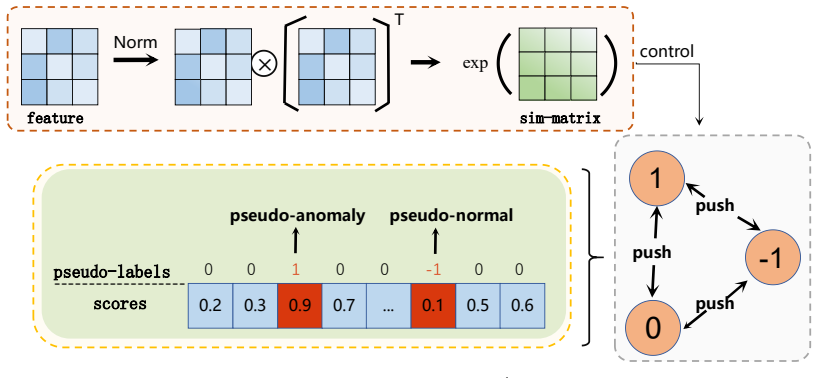
The load-bearing mechanism is the pair (PIL, PIDE). PIL is a small set of $K=5$ learnable key/value normal prototypes combined with instance features through cosine-similarity softmax attention and a residual connection; it supplies a compact normality context that prevents normal data from dominating the feature space. PIDE is a parameter-free selection rule: per bag, the argmax score gets pseudo-label $+1$, the argmin gets $-1$, and a supervised contrastive (SupCon) loss at temperature $\tau_c=0.1$ is applied only to these extremes, with loss weight $5.0$ in the total training objective. Together, the first keeps normal patterns under control while the second concentrates discriminative pressure on the two most confident points per video.
What would settle it
Take a held-out set with frame-level ground truth, record PIDE's chosen argmax and argmin instances, and measure how often the argmax is truly anomalous and the argmin is truly normal; also rerun training with PIDE restricted to abnormal bags. If normal-bag extremes are mostly wrong labels, or if restricting PIDE to abnormal bags leaves the reported +2.90% UCF-Crime gain intact, then the claimed reliable-extreme-pseudo-label mechanism is not what drives the improvement.
Extended reading notes
Core claim
The central claim is that two complementary mechanisms on top of a frozen CLIP ViT-B/16 feature extractor are enough to handle the normality dominance and label ambiguity of weakly-supervised video anomaly detection. The Prototype Interaction Layer (PIL) maintains $K=5$ learnable normal prototypes; each instance feature attends to these prototypes by cosine similarity, forms a normality context, and adds it back through a learned residual, giving a controlled normality baseline without a reconstruction model. The Pseudo-Instance Discriminative Enhancement (PIDE) loss then selects, per training video, the single highest-scoring instance as a pseudo-anomaly and the single lowest-scoring instance as a pseudo-normal, and applies a supervised contrastive loss that pulls together instances with the same pseudo-label and pushes apart instances with opposite pseudo-labels. The paper reports that this combination beats either module alone, with joint gains of +2.86% AUC on ShanghaiTech and +2.90% on UCF-Crime over the plain MIL baseline, reaching 97.98% and 87.12% with only 0.4M head parameters.
Load-bearing premise
The whole gain of the PIDE loss rests on the belief that the single frame a model scores highest in every training video is really an anomaly and the single frame it scores lowest is really normal, even though in videos labeled normal neither of those beliefs can be true.
Editorial extensions
If this is right
- Combining PIL and PIDE gives the best results on both datasets, with joint gains of +2.86 AUC points on ShanghaiTech and +2.90 on UCF-Crime over the plain MIL baseline, so the two modules are claimed to be complementary rather than redundant.
- With 0.0004 G parameters, 1.7 MB model size, and 0.0009 s per-video inference for the head, the full detector runs on a single commodity GPU while staying within about one AUC point of VadCLIP on UCF-Crime and ahead of it on ShanghaiTech.
- The parameter-free extreme-selection rule means no score threshold needs tuning across datasets, which is claimed to avoid the threshold sensitivity of pseudo-labeling methods.
- Qualitative results show the model can localize the anomalous segment in a UCF-Crime explosion video, not just classify the whole video as abnormal.
- Pre-extracted frozen CLIP features with 10-crop augmentation are sufficient; no backbone fine-tuning is used, which is what lets the detection head stay tiny.
Reading between the lines
- An untested consequence is that PIDE's benefit may be a form of contrastive regularization rather than accurate pseudo-labeling: since normal videos contribute one fake anomaly pseudo-label per bag, measuring pseudo-label precision would separate these explanations.
- Because the selection rule is parameter-free and the head is only 0.4M parameters, a streaming variant that maintains running top/bottom scores instead of per-bag argmax/argmin is a natural extension the paper does not evaluate.
- The choice of $K=5$ prototypes is empirical; if PIL's gain comes from suppressing normality dominance, larger $K$ should eventually erase the gain, giving a direct test of the 'controlled normality' story.
- The comparison set does not include other lightweight heads trained on the same frozen CLIP features, so an exact apples-to-apples comparison would isolate whether the gain comes from PIL+PIDE rather than from the features themselves.
Signed reviews
Editorial analysis
A structured set of objections, weighed in public.
Referee Report
Summary. This paper proposes ProDisc-VAD, a lightweight weakly-supervised video anomaly detection system that uses a 0.4M-parameter head on frozen CLIP features. The method introduces two components: a Prototype Interaction Layer (PIL) that models normality via attention over a small set of learnable prototypes, and a Pseudo-Instance Discriminative Enhancement (PIDE) loss that applies supervised contrastive learning to the highest- and lowest-scoring instances in each bag. The paper reports 97.98% frame-level AUC on ShanghaiTech and 87.12% on UCF-Crime, with ablations showing that both PIL and PIDE improve over a MIL baseline and that their combination produces the best results. The central claim is that this combination achieves strong performance with far fewer parameters than recent ViT-based methods such as VadCLIP.
Significance. If the results are robust, this work demonstrates a significant efficiency-performance trade-off: a detection head with 0.0004 G parameters reaches results comparable to much larger models, and the released code supports reproducibility. The PIDE mechanism, however, has a structural flaw in normal bags that undermines the claimed "low-noise" justification and the attribution of the synergy gain. The significance therefore rests on whether the loss provides a useful inductive bias despite, or because of, the mislabeling, which the paper does not currently establish. The efficiency gains are clear and valuable, but the central methodological claim needs stronger support before the paper can be recommended for acceptance.
major comments (2)
- [Section II-B, Eq. (6), Algorithm 1] The extreme-instance selection is applied to every bag without consulting the video-level label. In normal videos, all instances are normal, so the argmax instance receives a false +1 pseudo-label in every normal bag. Since UCF-Crime contains roughly as many normal as abnormal training videos, approximately half of all positive pseudo-anchors are false by construction. This contradicts the paper's claim that extreme-scoring instances are 'most reliable' and 'low-noise' pseudo-labels, and it means the +2.90% gain attributed to PIL+PIDE over baseline in Table III cannot be explained by the stated mechanism. Please provide an ablation that excludes normal bags from PIDE, or a variant that filters them via predicted normality confidence, and report pseudo-label precision on training bags. If the gain persists, the paper should be reworded to describe PIDE as a contrastive regularizer rather than a reliable pseudo-label method.
- [Table III and Section III-B] The paper reports no error bars, no number of random seeds, and no sensitivity analysis for the four hyperparameters K, lambda, m, and tau_c. The claims that 'K=5 was found empirically' and that the synergy is robust are not supported by the evidence. Please include a sensitivity study over a reasonable range for each hyperparameter (e.g., K=1-10, lambda=1-10, m=1-3, tau_c=0.05-0.2) and run the main table and ablations with at least three seeds to report mean and standard deviation.
minor comments (5)
- [Abstract] The abstract describes the results as 'state-of-the-art performance,' but Table I shows ProDisc-VAD (87.12% on UCF-Crime) is below VadCLIP (88.02%); please adjust the wording to 'competitive' or explicitly qualify the claim to efficiency-based state-of-the-art.
- [References [15] and [16]] References [15] and [16] do not match the cited phenomena: [15] is about prototypical networks and [16] about hard negative mining, neither of which supports the statement that thresholding [15] or top-scoring selection [16] is a prevalent pseudo-labeling strategy in WS-VAD. Please replace with appropriate references or rephrase the sentence.
- [Section II-A] The text states that prototypes are 'initialized using standard methods' but does not specify the initialization; please provide the exact initialization procedure for the key and value prototypes.
- [Title and abstract] The method name is inconsistently rendered as 'ProDisc-V AD' (title, Section II) and 'ProDisc-VAD' (abstract, Section IV); please unify the naming throughout the manuscript.
- [Figure 2] The figure legend mentions 'normal-prototypes_key' and 'normal-prototypes-value' but the text uses PK and PV; please align the notation for clarity.
Circularity Check
No circularity: the reported AUCs are held-out empirical measurements, PIDE is self-training rather than a derivation, and no load-bearing self-citations or construction-equivalent equations appear.
full rationale
The paper's central claims are frame-level AUCs on ShanghaiTech and UCF-Crime test sets (Table I), ablation gains over a baseline (Table III), and efficiency measurements. These values are empirical results against held-out ground truth; no equation in the paper is constructed from these target AUCs, and no fitted parameter is renamed as a prediction. The PIDE loss (Section II-B, Eqs. (6)-(9)) does generate pseudo-labels from the model's own argmax/argmin scores and then applies a supervised contrastive loss to those same features. This is a self-referential training mechanism (a known confirmation-bias risk), but it is not a circular derivation: the paper does not claim to 'predict' these pseudo-labels, and the reported detection performance is evaluated independently on ground-truth frame labels. The 'extreme-scoring instances are most reliable' premise is an unverified assumption and a potential correctness/robustness weakness, but it is not a case of a result reducing by construction to its inputs. I found no load-bearing self-citations: the references are to external methods and to VadCLIP only for feature extraction. There is no imported uniqueness theorem and no ansatz smuggled in via citation. The prototype count K=5 is described as empirical tuning, not as a derived result. Overall, the derivation chain is self-contained with respect to circularity; any concerns about pseudo-label noise or normal-bag handling belong to correctness evaluation, not circularity analysis.
Assumptions & free parameters
free parameters (5)
- K (number of normal prototypes) =
5
- lambda (PIDE loss weight) =
5.0
- m (extreme instances per class per bag) =
1
- tau_c (PIDE contrastive temperature) =
0.1
- tau_p (PIL attention temperature)
assumptions (4)
- domain assumption Video-level labels are correct and every abnormal video contains at least one anomalous frame (MIL assumption).
- domain assumption Frozen CLIP ViT-B/16 features contain enough anomaly/normal signal for a small head to exploit.
- ad hoc to paper The argmax/argmin instances are the most reliable pseudo-labels and are safe to contrast even in normal bags.
- ad hoc to paper K=5 prototypes are sufficient to model normality without being overwhelmed by normal data.
Cite this review
Pith. "Pith review of ProDisc-VAD: An Efficient System for Weakly-Supervised Anomaly Detection in Video Surveillance Applications." pith.science (2026). https://pith.science/paper/LL6NTXDB
@misc{pith2026250502179,
  author       = {Pith},
  title        = {Pith review of: ProDisc-VAD: An Efficient System for Weakly-Supervised Anomaly Detection in Video Surveillance Applications},
  year         = {2026},
  howpublished = {\url{https://pith.science/paper/LL6NTXDB}},
  note         = {Machine review of arXiv:2505.02179}
}
read the original abstract
Weakly-supervised video anomaly detection (WS-VAD) using Multiple Instance Learning (MIL) suffers from label ambiguity, hindering discriminative feature learning. We propose ProDisc-VAD, an efficient framework tackling this via two synergistic components. The Prototype Interaction Layer (PIL) provides controlled normality modeling using a small set of learnable prototypes, establishing a robust baseline without being overwhelmed by dominant normal data. The Pseudo-Instance Discriminative Enhancement (PIDE) loss boosts separability by applying targeted contrastive learning exclusively to the most reliable extreme-scoring instances (highest/lowest scores). ProDisc-VAD achieves strong AUCs (97.98% ShanghaiTech, 87.12% UCF-Crime) using only 0.4M parameters, over 800x fewer than recent ViT-based methods like VadCLIP. Code is available at https://github.com/modadundun/ProDisc-VAD.
Figures


Figures from the paper (3 more)


Reference graph
Works this paper leans on
-
[1]
Anomalynet: An anomaly detection network for video surveillance,
J. T. Zhou, J. Du, H. Zhu, X. Peng, Y . Liu, and R. S. M. Goh, “Anomalynet: An anomaly detection network for video surveillance,” IEEE Transactions on Information Forensics and Security , vol. 14, no. 10, pp. 2537–2550, 2019
work page 2019
-
[2]
Big data analytics for video surveillance,
B. N. Subudhi, D. K. Rout, and A. Ghosh, “Big data analytics for video surveillance,” Multimedia Tools and Applications , vol. 78, no. 18, pp. 26 129–26 162, 2019
work page 2019
-
[3]
Weakly-supervised video anomaly detection with robust temporal feature magnitude learning,
Y . Tian, G. Pang, Y . Chen, R. Singh, J. W. Verjans, and G. Carneiro, “Weakly-supervised video anomaly detection with robust temporal feature magnitude learning,” in Proceedings of the IEEE/CVF inter- national conference on computer vision , 2021, pp. 4975–4986
work page 2021
-
[4]
Weakly-supervised video anomaly detection with snippet anomalous attention,
Y . Fan, Y . Yu, W. Lu, and Y . Han, “Weakly-supervised video anomaly detection with snippet anomalous attention,” IEEE Transactions on Circuits and Systems for Video Technology , vol. 34, no. 7, pp. 5480– 5492, 2024
work page 2024
-
[5]
Real-world anomaly detection in surveillance videos,
W. Sultani, C. Chen, and M. Shah, “Real-world anomaly detection in surveillance videos,” in Proceedings of the IEEE conference on computer vision and pattern recognition , 2018, pp. 6479–6488
2018
-
[6]
Weakly supervised video anomaly detection via center-guided discriminative learning,
B. Wan, Y . Fang, X. Xia, and J. Mei, “Weakly supervised video anomaly detection via center-guided discriminative learning,” in 2020 IEEE international conference on multimedia and expo (ICME) . IEEE, 2020, pp. 1–6
work page 2020
-
[7]
Unbiased multi- ple instance learning for weakly supervised video anomaly detection,
H. Lv, Z. Yue, Q. Sun, B. Luo, Z. Cui, and H. Zhang, “Unbiased multi- ple instance learning for weakly supervised video anomaly detection,” in Proceedings of the IEEE/CVF conference on computer vision and pattern recognition, 2023, pp. 8022–8031
work page 2023
-
[8]
Mist: Multiple instance self- training framework for video anomaly detection,
J.-C. Feng, F.-T. Hong, and W.-S. Zheng, “Mist: Multiple instance self- training framework for video anomaly detection,” in Proceedings of the IEEE/CVF conference on computer vision and pattern recognition, 2021, pp. 14 009–14 018
2021
Show all 23 references
-
[9]
Deep anomaly discovery from unlabeled videos via normality advantage and self- paced refinement,
G. Yu, S. Wang, Z. Cai, X. Liu, C. Xu, and C. Wu, “Deep anomaly discovery from unlabeled videos via normality advantage and self- paced refinement,” in Proceedings of the IEEE/CVF conference on computer vision and pattern recognition , 2022, pp. 13 987–13 998
2022
-
[10]
Generative cooperative learning for unsupervised video anomaly detection,
M. Z. Zaheer, A. Mahmood, M. H. Khan, M. Segu, F. Yu, and S.-I. Lee, “Generative cooperative learning for unsupervised video anomaly detection,” in Proceedings of the IEEE/CVF conference on computer vision and pattern recognition , 2022, pp. 14 744–14 754
2022
-
[11]
A simple frame- work for contrastive learning of visual representations,
T. Chen, S. Kornblith, M. Norouzi, and G. Hinton, “A simple frame- work for contrastive learning of visual representations,” in Interna- tional conference on machine learning. PmLR, 2020, pp. 1597–1607
2020
-
[12]
Momentum contrast for unsupervised visual representation learning,
K. He, H. Fan, Y . Wu, S. Xie, and R. Girshick, “Momentum contrast for unsupervised visual representation learning,” in Proceedings of the IEEE/CVF conference on computer vision and pattern recognition , 2020, pp. 9729–9738
2020
-
[13]
Unsupervised learning of visual features by contrasting cluster assign- ments,
M. Caron, I. Misra, J. Mairal, P. Goyal, P. Bojanowski, and A. Joulin, “Unsupervised learning of visual features by contrasting cluster assign- ments,” Advances in neural information processing systems , vol. 33, pp. 9912–9924, 2020
2020
-
[14]
Exploiting completeness and uncertainty of pseudo labels for weakly supervised video anomaly detection,
C. Zhang, G. Li, Y . Qi, S. Wang, L. Qing, Q. Huang, and M.-H. Yang, “Exploiting completeness and uncertainty of pseudo labels for weakly supervised video anomaly detection,” in Proceedings of the IEEE/CVF Conference on Computer Vision and Pattern Recognition , 2023, pp. 16 271–16 280
2023
-
[15]
Prototypical networks for few- shot learning,
J. Snell, K. Swersky, and R. Zemel, “Prototypical networks for few- shot learning,” Advances in neural information processing systems , vol. 30, 2017
2017
-
[16]
Contrastive learn- ing with hard negative samples,
J. Robinson, C.-Y . Chuang, S. Sra, and S. Jegelka, “Contrastive learn- ing with hard negative samples,” arXiv preprint arXiv:2010.04592 , 2020
2010 arXiv
-
[17]
Vadclip: Adapting vision-language models for weakly supervised video anomaly detection,
P. Wu, X. Zhou, G. Pang, L. Zhou, Q. Yan, P. Wang, and Y . Zhang, “Vadclip: Adapting vision-language models for weakly supervised video anomaly detection,” in Proceedings of the AAAI Conference on Artificial Intelligence, vol. 38, no. 6, 2024, pp. 6074–6082
2024
-
[18]
Graph con- volutional label noise cleaner: Train a plug-and-play action classifier for anomaly detection,
J.-X. Zhong, N. Li, W. Kong, S. Liu, T. H. Li, and G. Li, “Graph con- volutional label noise cleaner: Train a plug-and-play action classifier for anomaly detection,” in Proceedings of the IEEE/CVF conference on computer vision and pattern recognition , 2019, pp. 1237–1246
2019
-
[19]
Claws: Clustering assisted weakly supervised learning with normalcy sup- pression for anomalous event detection,
M. Z. Zaheer, A. Mahmood, M. Astrid, and S.-I. Lee, “Claws: Clustering assisted weakly supervised learning with normalcy sup- pression for anomalous event detection,” in Computer Vision–ECCV 2020: 16th European Conference, Glasgow, UK, August 23–28, 2020, Proceedings, Part XXI...
2020
-
[20]
Self-training multi-sequence learning with transformer for weakly supervised video anomaly detection,
S. Li, F. Liu, and L. Jiao, “Self-training multi-sequence learning with transformer for weakly supervised video anomaly detection,” in Proceedings of the AAAI Conference on Artificial Intelligence, vol. 36, no. 2, 2022, pp. 1395–1403
2022
-
[21]
Self- supervised sparse representation for video anomaly detection,
J.-C. Wu, H.-Y . Hsieh, D.-J. Chen, C.-S. Fuh, and T.-L. Liu, “Self- supervised sparse representation for video anomaly detection,” in European Conference on Computer Vision. Springer, 2022, pp. 729– 745
2022
-
[22]
Decouple and resolve: transformer-based models for online anomaly detection from weakly labeled videos,
T. Liu, C. Zhang, K.-M. Lam, and J. Kong, “Decouple and resolve: transformer-based models for online anomaly detection from weakly labeled videos,” IEEE Transactions on Information Forensics and Security, vol. 18, pp. 15–28, 2022
2022
-
[23]
Look around for anomalies: Weakly-supervised anomaly detection via context- motion relational learning,
M. Cho, M. Kim, S. Hwang, C. Park, K. Lee, and S. Lee, “Look around for anomalies: Weakly-supervised anomaly detection via context- motion relational learning,” in Proceedings of the IEEE/CVF confer- ence on computer vision and pattern recognition , 2023, pp. 12 137– 12 146
2023
Reviewed August 16, 2026 · model on record in the stance chip above.
Discussion (0). Continue with ORCID to comment.