REVIEW 3 major objections 5 minor 94 references
Fast Quantum Interconnects via Neutral Atom Ensembles
T0 review · 3 major / 5 minor · reviewed 2026-08-06 · deepseek-v4-flash
Pith's one-line read A scalable, cavity-free interconnect uses Rydberg dipole-dipole interactions to entangle distant neutral-atom qubits at rates around 300,000 per second.
desk verdict Genuinely new cavity-free interconnect mechanism; solid proposal, but the headline rate is conditional on unquantified thermal motion and the analytic scaling has an arithmetic slip. read the letter →
The pith
A machine-rendered reading of the paper's core claim, the machinery that carries it, and where it could break.
The reading
What carries the argument
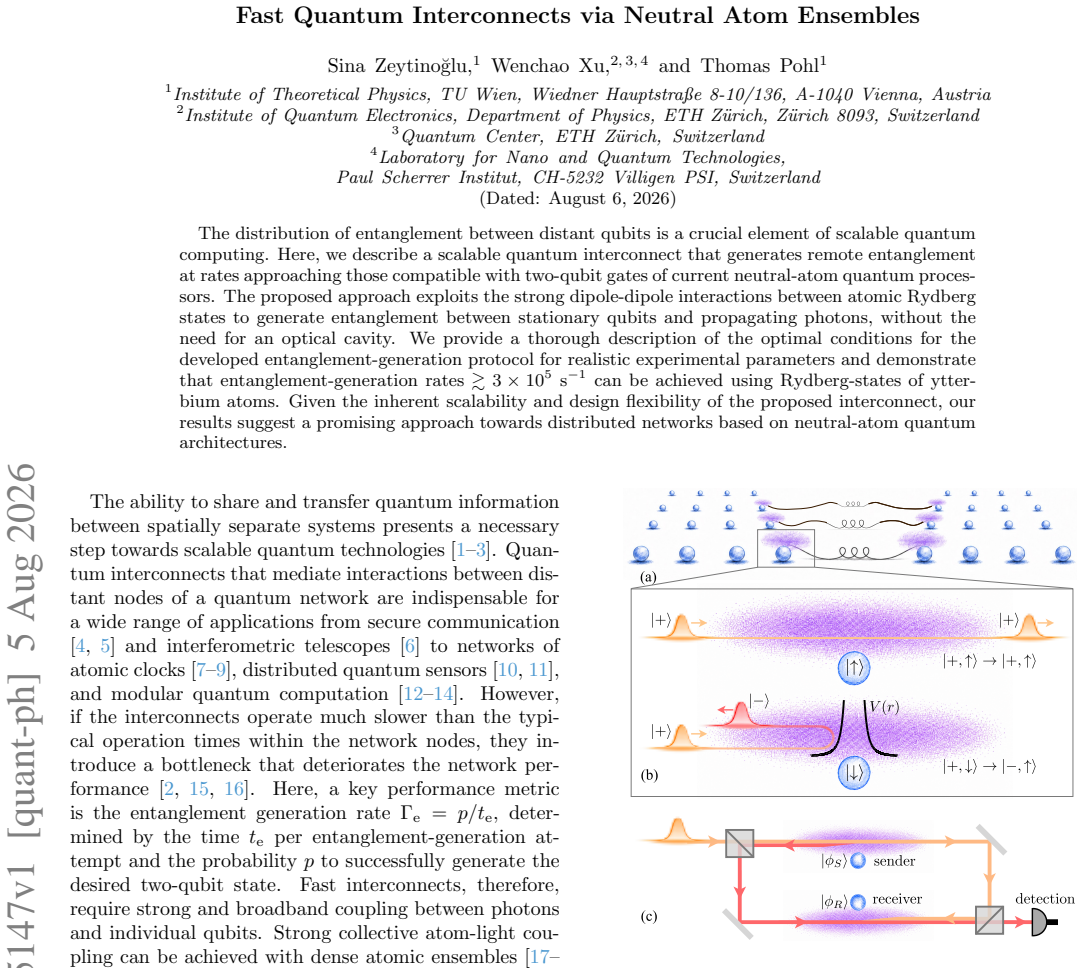
The load-bearing element is the resonant dipole-exchange interaction between the qubit atom and the ensemble atoms, $\hat{V} = \sum_j V(\mathbf{R}-\mathbf{r}_j)\big(|\downarrow\rangle\langle\uparrow|\otimes |r_+\rangle_j\langle r_-| + \mathrm{h.c.}\big)$, which couples two opposite-parity Rydberg states of the ensemble when the qubit flips. Laser-driven under electromagnetically induced transparency, photons travel through the ensemble as Rydberg dark-state polaritons, and the exchange interaction converts a forward-propagating photon into a backward-propagating one conditioned on the qubit state. The protocol's speed is set by the bandwidths of the transmission and reflection spectra; the optimal qubit-ensemble distance follows the characteristic exchange length $r_h = r_b\sqrt{\mathrm{OD}_b}$, and the reflection spectrum develops a double-peak structure whose separation scales as $\mathrm{OD}_b^{3/2}$, explaining the rate scaling.
What would settle it
Measure the conditional reflection spectrum $R(r_\perp,\omega)$ of a single qubit coupled to a $^{174}$Yb ensemble under the paper's optimized conditions and check for the two near-resonance reflection peaks whose separation should grow as $\mathrm{OD}_b^{3/2}$. If the peaks are wiped out by atomic motion or the entanglement rate does not follow $\Gamma_e/\gamma_p \sim \rho^{0.74}$ as the density is varied, the scheme would not perform as claimed.
Extended reading notes
Core claim
The paper's central claim is that a mesoscopic Rydberg ensemble next to a qubit atom acts as a qubit-controlled mirror: a propagating photon is either transmitted or reflected depending on the qubit's Rydberg state. With such nodes at a sender and a receiver, a single photon that passes first through one ensemble and then the other generates the two-qubit Bell state $(|0\rangle_S|1\rangle_R + |1\rangle_S|0\rangle_R)/\sqrt{2}$, with success heralded by photon detection in the reflected output port. For $^{174}$Yb parameters, numerical simulation of the full spatio-temporal dynamics yields entanglement-generation rates $\Gamma_e \gtrsim 3\times 10^5$ s$^{-1}$ at a peak density of $2\times 10^{13}$ cm$^{-3}$, with the maximum rate scaling as $\Gamma_e/\gamma_p \sim \rho^{0.74}$ and as $\mathrm{OD}_b^{*,1.19}$ in terms of the blockaded optical depth; in the reflection-limited regime the rate scales as $\mathrm{OD}_b^{3/2}$. The paper reports that parallel operation of a handful of such interconnects would reach aggregate rates near $10^6$ s$^{-1}$.
Load-bearing premise
The load-bearing premise is that the ensemble atoms and the qubit atom are effectively stationary during the protocol, so the dipole-dipole phases in the interaction Hamiltonian are deterministic; thermal motion or positional disorder that smears these phases would degrade the conditional reflection and the predicted rates.
Editorial extensions
If this is right
- Entanglement can be generated at $\Gamma_e \approx 3\times 10^5$ s$^{-1}$ without a cavity, matching the pace of fast two-qubit gates in current neutral-atom processors.
- The favorable scaling $\Gamma_e \sim \mathrm{OD}_b^{3/2}$ (equivalently $\rho^{0.74}$ at fixed parameters) means denser ensembles and stronger Rydberg interactions directly translate into faster interconnects.
- Parallel operation of several ensemble-pairs yields aggregate entanglement rates near $10^6$ s$^{-1}$.
- The qubit-controlled reflection gives a basic mechanism for single-photon generation, and the paper suggests it may enable protocols that use coherent light instead of single-photon pulses.
- Because the scheme uses the same dipole-dipole resource as neutral-atom gates, it fits existing tweezer-array platforms without new resonator hardware.
Reading between the lines
- A natural test is to probe the conditional reflection spectrum at finite temperature; if thermal motion blurs the dipolar phases, operating at lower temperature or applying spin-echo refocusing of the exchange interaction could restore fidelity.
- The same sender-receiver photon cascade could be turned around to perform a deterministic Bell measurement, which would make the node useful for quantum repeaters, not just point-to-point links.
- The rate scaling suggests pushing to higher atomic densities and larger $C_3$ coefficients; other two-electron atoms with narrow intercombination lines, such as strontium, should show the same behavior.
- Since the protocol is cavity-free, integrating it with existing telecom-frequency conversion would allow the interconnect to operate over fiber-optic distances.
Editorial analysis
A structured set of objections, weighed in public.
Referee Report
Summary. The paper proposes a cavity-free quantum interconnect in which a single atomic qubit, coupled by Rydberg dipolar exchange to a mesoscopic atomic ensemble, conditionally reflects or transmits propagating photons. A sender-receiver protocol converts these conditional operations into heralded remote Bell-state generation. The authors derive optical propagation equations for the qubit-dependent susceptibilities, optimize the ensemble length, qubit-ensemble distance, control-field Rabi frequency, and pulse duration, and report entanglement-generation rates Γe ≳ 3×10^5 s^-1 for 174Yb ensemble atoms coupled to a 171Yb qubit, together with scaling laws Γe/γp ∼ ρ^0.74 and Γe^* ∼ OD_b^*^{1.19}. The central mechanism relies on EIT slow-light polaritons and resonant dipole-dipole exchange between the qubit and Rydberg states of the ensemble.
Significance. If the reported rates hold, this is a significant proposal: it offers a route to neutral-atom interconnects operating at speeds approaching current two-qubit gate times without requiring optical resonators. The parameter choices are grounded in measured Yb properties (γp/2π = 91 kHz, γr/2π = 5 kHz, C3 = 20 GHz μm^3), and the scaling laws are explicit and falsifiable. The paper does not fit any parameter to the target rate; the rate is an output of the model, which is a strength. The main caveats are that the headline rate rests on simulations whose full 3D form is deferred to the Supplemental Material, and that the deterministic phase-matching assumption has not been tested against thermal motion or positional disorder.
major comments (3)
- [§3, Fig. 3(c), and text after Eq. (4)] The claimed Γe^* ∼ OD_b^{3/2} scaling is internally inconsistent with the stated geometric scaling. The text states l^*/r_b ∼ OD_b^{0.45} and that the reflection resonances scale as ω0/γp ∼ (l^*/r_b)^3, which implies ω0/γp ∼ OD_b^{1.35}, not OD_b^{3/2}. If the numerical data in Fig. 3(c) indeed follow a 3/2 power law, the analytic explanation must account for an additional OD_b^{0.15} factor; if the explanation is correct, the fitted exponent in the figure should be revised. Because this scaling is presented as a major finding, the discrepancy must be resolved.
- [Eq. (1) and Eqs. (6)–(7) (protocol)] The protocol assumes deterministic, phase-matched dipolar exchange between the qubit and every ensemble atom. No analysis is given of thermal sampling of the qubit position in its optical tweezer, positional disorder of ensemble atoms, or Doppler dephasing of the Rydberg spinwaves during the slow-light traversal. A fractional position fluctuation δl/l* changes the exchange phase by roughly 3δl/l*, and Doppler dephasing over the pulse duration is not bounded. Without quantitative estimates or a finite-temperature simulation, the claimed success probability p and the resulting rate are conditional on this unverified assumption.
- [§4 and End Matter] The headline rate Γe^* = 3×10^5 s^-1 is obtained from the "complete spatio-temporal dynamics" described only in the Supplemental Material, while the main text presents an effectively one-dimensional model in which transverse diffraction is neglected by the ad hoc choice σ ≤ l^*/9. The main text should either provide the 3D model's equations and its validation or include a sensitivity analysis showing that the 1D treatment and the Gaussian-mode assumption do not change the optimized rate by more than a small factor. As written, the central quantitative claim cannot be independently checked from the main text alone.
minor comments (5)
- [Eq. (3)] Please specify the boundary conditions used to propagate the field amplitudes through the ensembles and the precise definition of the incident mode E^(in); the text currently defines only the ratios T0 and R, which is insufficient to reproduce the propagation calculation.
- [Fig. 4 cross-reference] The sentence "Figure 3 shows the obtained entanglement-generation rate as a function of the control-field Rabi frequency" appears to refer to Fig. 4; please correct the cross-reference.
- [Reference [63]] The placeholder "Supplemental Material ... at URL" should be replaced with the actual link or DOI in the published version.
- [Heading] The heading "END MA TTER" contains a typo and should read "END MATTER".
- [Eq. (6)] The state |ψ> in Eq. (6) is written without normalization; please state explicitly that this is the unnormalized state conditioned on photon detection, with the success probability p given by Eq. (7).
Circularity Check
No significant circularity: the predicted entanglement rates and scaling laws are outputs of standard EIT/Rydberg propagation equations with externally sourced atomic parameters, not fitted targets or self-citational constraints.
full rationale
I walked the claimed derivation chain. The interaction Hamiltonian in Eq. (1) is the standard dipole-exchange coupling with a C3 coefficient taken from published ytterbium Rydberg data. The propagation matrix in Eq. (3) is the standard EIT/Rydberg-polariton formalism, with the zero-frequency limits in Eq. (4) given explicitly; the fuller derivation is deferred to the authors' Supplemental Material, but that is a derivational reference, not an imported empirical result. The success probability in Eq. (7) is computed from the simulated transmission and reflection amplitudes, and the rate Gamma_e = p/t_e is a definitional combination of the output probability and the attempt time. The headline value Gamma_e ~ 3e5 s^-1 and the scaling laws Gamma_e/gamma_p ~ rho^0.74 and Gamma_e ~ OD_b^1.19 are numerical and analytic outputs of the model, obtained by optimizing geometry, Rabi frequency, and pulse duration; no parameter is fitted to a pre-existing target rate. The cited prior work that includes the authors, such as [60], [63], and [80], supplies published equations and experimental mechanisms, not a uniqueness theorem that forbids alternative models. The unresolved question of thermal motion and positional disorder is a robustness or correctness concern about the assumptions of deterministic phases; it does not make the derivation circular, because the claimed rates are conditional outputs of those assumptions rather than identities with the inputs. Overall, the central claim is self-contained with respect to the stated model and external atomic parameters, so no circular step is exhibited.
Assumptions & free parameters
free parameters (3)
- C_3 dipolar coefficient =
20 GHz μm^3
- Peak atomic density ρ =
2×10^13 cm^-3
- Rydberg-state decay rate γ_r =
2π×5 kHz
assumptions (4)
- domain assumption The qubit-ensemble interaction is a pure resonant dipolar exchange V(r)=C_3/r^3 sin^2(θ) with no additional interaction channels (Eq. 1, End Matter).
- domain assumption The photon propagation through the ensemble follows the effective EIT equations (Eq. 3), the derivation of which is in the Supplemental Material [63].
- domain assumption Ensemble atoms and the qubit atom remain at fixed positions during the pulse; motional dephasing is neglected.
- ad hoc to paper A single-photon Gaussian input mode and Gaussian density profiles are assumed, with transverse diffraction neglected by setting σ=sqrt(Lλ/π) and, if needed, reducing L to σ≤l*/9.
Cite this review
Pith. "Pith review of Fast Quantum Interconnects via Neutral Atom Ensembles." pith.science (2026). https://pith.science/paper/LLU6KF4P
@misc{pith2026260805147,
  author       = {Pith},
  title        = {Pith review of: Fast Quantum Interconnects via Neutral Atom Ensembles},
  year         = {2026},
  howpublished = {\url{https://pith.science/paper/LLU6KF4P}},
  note         = {Machine review of arXiv:2608.05147}
}
abstract
Distributing entanglement between distant qubits is a crucial element of scalable quantum computing. Here, we describe a scalable quantum interconnect that generates remote entanglement at rates approaching those compatible with two-qubit gates of current neutral-atom quantum processors. The proposed approach exploits the strong dipole-dipole interactions between atomic Rydberg states to generate entanglement between stationary qubits and propagating photons, without the need for an optical cavity. We provide a thorough description of the optimal conditions for the developed entanglement-generation protocol for realistic experimental parameters and demonstrate that entanglement-generation rates $\gtrsim 3\times 10^5$ s$^{-1}$ can be achieved using Rydberg states of ytterbium atoms. Given the inherent scalability and design flexibility of the proposed interconnect, our results suggest a promising approach towards distributed networks based on neutral-atom quantum architectures.
Figures


Figures from the paper (2 more)


Reference graph
Works this paper leans on
-
[1]
The quantum internet.Nature, 453(7198):1023–1030, 2008
H Jeff Kimble. The quantum internet.Nature, 453(7198):1023–1030, 2008
2008
-
[2]
Quantum internet: A vision for the road ahead.Science, 362(6412):eaam9288, 2018
Stephanie Wehner, David Elkouss, and Ronald Hanson. Quantum internet: A vision for the road ahead.Science, 362(6412):eaam9288, 2018
2018
-
[3]
Berggren, Hannes Bernien, Sunil Bhave, Lincoln D
David Awschalom, Karl K. Berggren, Hannes Bernien, Sunil Bhave, Lincoln D. Carr, Paul Davids, Sophia E. Economou, Dirk Englund, Andrei Faraon, Martin Fe- jer, Saikat Guha, Martin V. Gustafsson, Evelyn Hu, Liang Jiang, Jungsang Kim, Boris Korzh, Prem Ku- mar, Paul G. Kwiat, Marko Lonˇ car, Mikhail D. Lukin, David A.B. Miller, Christopher Monroe, Sae Woo Na...
2021
-
[4]
The security of practical quantum key distribution.Reviews of modern physics, 81(3):1301– 1350, 2009
Valerio Scarani, Helle Bechmann-Pasquinucci, Nico- las J Cerf, Miloslav Duˇ sek, Norbert L¨ utkenhaus, and Momtchil Peev. The security of practical quantum key distribution.Reviews of modern physics, 81(3):1301– 1350, 2009
2009
-
[5]
Security of quantum key distribution
Renato Renner. Security of quantum key distribution. International Journal of Quantum Information, 6(01):1– 127, 2008
2008
-
[6]
Longer-baseline telescopes using quantum repeaters
Daniel Gottesman, Thomas Jennewein, and Sarah Croke. Longer-baseline telescopes using quantum repeaters. Physical review letters, 109(7):070503, 2012
2012
-
[7]
A quantum network of clocks.Nature Physics, 10(8):582– 587, 2014
Peter Komar, Eric M Kessler, Michael Bishof, Liang Jiang, Anders S Sørensen, Jun Ye, and Mikhail D Lukin. A quantum network of clocks.Nature Physics, 10(8):582– 587, 2014
2014
-
[8]
Optical atomic clocks.Reviews of Modern Physics, 87(2):637–701, 2015
Andrew D Ludlow, Martin M Boyd, Jun Ye, Ekkehard Peik, and Piet O Schmidt. Optical atomic clocks.Reviews of Modern Physics, 87(2):637–701, 2015
2015
Show all 94 references
-
[9]
B. C. Nichol, R. Srinivas, D. P. Nadlinger, P. Drmota, D. Main, G. Araneda, C. J. Ballance, and D. M. Lu- cas. An elementary quantum network of entangled opti- cal atomic clocks.Nature, 609(7928):689–694, 2022
2022
-
[10]
Distributed quantum metrology with linear networks and separable inputs
Wenchao Ge, Kurt Jacobs, Zachary Eldredge, Alexey V Gorshkov, and Michael Foss-Feig. Distributed quantum metrology with linear networks and separable inputs. Physical review letters, 121(4):043604, 2018
2018
-
[11]
Distributed quantum sensing using continuous- variable multipartite entanglement.Physical Review A, 97(3):032329, 2018
Quntao Zhuang, Zheshen Zhang, and Jeffrey H Shapiro. Distributed quantum sensing using continuous- variable multipartite entanglement.Physical Review A, 97(3):032329, 2018
2018
-
[12]
Demonstrat- ing the viability of universal quantum computation us- ing teleportation and single-qubit operations.Nature, 402(6760):390–393, 1999
Daniel Gottesman and Isaac L Chuang. Demonstrat- ing the viability of universal quantum computation us- ing teleportation and single-qubit operations.Nature, 402(6760):390–393, 1999
1999
-
[13]
The future of quantum computing with superconducting qubits.Journal of Applied Physics, 132(16), 2022
Sergey Bravyi, Oliver Dial, Jay M Gambetta, Dar ´ ıo Gil, and Zaira Nazario. The future of quantum computing with superconducting qubits.Journal of Applied Physics, 132(16), 2022
2022
-
[14]
Conner, Joel Grebel, Yash J
Xuntao Wu, Haoxiong Yan, Gustav Andersson, Alexan- der Anferov, Ming-Han Chou, Christopher R. Conner, Joel Grebel, Yash J. Joshi, Shiheng Li, Jacob M. Miller, Rhys G. Povey, Hong Qiao, and Andrew N. Cleland. Modular quantum processor with an all-to-all reconfig- urable router....
2024
-
[15]
Arquin: Architectures for multinode superconducting quantum computers.ACM Transactions on Quantum Computing, 5(3):1–59, 2024
James Ang, Gabriella Carini, Yanzhu Chen, Isaac Chuang, Michael Demarco, Sophia Economou, Alec Eick- busch, Andrei Faraon, Kai-Mei Fu, Steven Girvin, et al. Arquin: Architectures for multinode superconducting quantum computers.ACM Transactions on Quantum Computing, 5(3):1–59, 2024
2024
-
[16]
Rfc 9340: Architectural principles for a quantum internet, 2023
Wojciech Kozlowski, Stephanie Wehner, Rodney Van Meter, Bruno Rijsman, Angela Sara Cacciapuoti, Marcello Caleffi, and Shota Nagayama. Rfc 9340: Architectural principles for a quantum internet, 2023
2023
-
[17]
Storage and control of optical photons using rydberg polaritons
D Maxwell, DJ Szwer, D Paredes-Barato, H Busche, Jonathan D Pritchard, Alexandre Gauguet, Kevin J Weatherill, MPA Jones, and Charles S Adams. Storage and control of optical photons using rydberg polaritons. Physical review letters, 110(10):103001, 2013
2013
-
[18]
Stopped light and image storage by electro- magnetically induced transparency¡? format?¿ up to the regime of one minute.Physical review letters, 111(3):033601, 2013
Georg Heinze, Christian Hubrich, and Thomas Half- mann. Stopped light and image storage by electro- magnetically induced transparency¡? format?¿ up to the regime of one minute.Physical review letters, 111(3):033601, 2013
2013
-
[19]
Quantum memories: emerging applications and recent advances.Journal of modern optics, 63(20):2005–2028, 2016
Khabat Heshami, Duncan G England, Peter C Humphreys, Philip J Bustard, Victor M Acosta, Joshua Nunn, and Benjamin J Sussman. Quantum memories: emerging applications and recent advances.Journal of modern optics, 63(20):2005–2028, 2016
2005
-
[20]
Con- tactless nonlinear optics mediated by long-range rydberg interactions.Nature Physics, 13(7):655–658, 2017
Hannes Busche, Paul Huillery, Simon W Ball, Teodora Ilieva, Matthew PA Jones, and Charles S Adams. Con- tactless nonlinear optics mediated by long-range rydberg interactions.Nature Physics, 13(7):655–658, 2017
2017
-
[21]
Broadband coherent opti- cal memory based on electromagnetically induced trans- parency.Physical Review A, 102(6):063720, 2020
Yan-Cheng Wei, Bo-Han Wu, Ya-Fen Hsiao, Pin-Ju Tsai, and Ying-Cheng Chen. Broadband coherent opti- cal memory based on electromagnetically induced trans- parency.Physical Review A, 102(6):063720, 2020
2020
-
[22]
Rydberg atom quantum technologies.Journal of Physics B: Atomic, Molecular and Optical Physics, 53(1):012002, 2019
Charles S Adams, Jonathan D Pritchard, and James P Shaffer. Rydberg atom quantum technologies.Journal of Physics B: Atomic, Molecular and Optical Physics, 53(1):012002, 2019
2019
-
[23]
Enhanced optical cross section via collective cou- pling of atomic dipoles in a 2d array.Physical review letters, 116(10):103602, 2016
Robert J Bettles, Simon A Gardiner, and Charles S Adams. Enhanced optical cross section via collective cou- pling of atomic dipoles in a 2d array.Physical review letters, 116(10):103602, 2016
2016
-
[24]
Storing light with subradiant correlations in arrays of atoms.Physical review letters, 117(24):243601, 2016
G Facchinetti, Stewart D Jenkins, and Janne Ru- ostekoski. Storing light with subradiant correlations in arrays of atoms.Physical review letters, 117(24):243601, 2016
2016
-
[25]
Cooperative resonances in light scattering from two-dimensional atomic arrays.Physical review letters, 118(11):113601, 2017
Ephraim Shahmoon, Dominik S Wild, Mikhail D Lukin, and Susanne F Yelin. Cooperative resonances in light scattering from two-dimensional atomic arrays.Physical review letters, 118(11):113601, 2017
2017
-
[26]
Free-space photonic quantum link and chi- ral quantum optics.Physical Review A, 98(4):043825, 2018
A Grankin, PO Guimond, DV Vasilyev, B Vermersch, and P Zoller. Free-space photonic quantum link and chi- ral quantum optics.Physical Review A, 98(4):043825, 2018
2018
-
[27]
A subradiant optical mir- ror formed by a single structured atomic layer.Nature, 583(7816):369–374, 2020
Jun Rui, David Wei, Antonio Rubio-Abadal, Simon Hol- lerith, Johannes Zeiher, Dan M Stamper-Kurn, Christian Gross, and Immanuel Bloch. A subradiant optical mir- ror formed by a single structured atomic layer.Nature, 583(7816):369–374, 2020
2020
-
[28]
A subwavelength atomic array switched by a sin- gle rydberg atom.Nature Physics, 19(5):714–719, 2023
Kritsana Srakaew, Pascal Weckesser, Simon Hollerith, David Wei, Daniel Adler, Immanuel Bloch, and Johannes Zeiher. A subwavelength atomic array switched by a sin- gle rydberg atom.Nature Physics, 19(5):714–719, 2023. 7
2023
-
[29]
Cavity-based quantum networks with single atoms and optical pho- tons.Reviews of Modern Physics, 87(4):1379–1418, 2015
Andreas Reiserer and Gerhard Rempe. Cavity-based quantum networks with single atoms and optical pho- tons.Reviews of Modern Physics, 87(4):1379–1418, 2015
2015
-
[30]
An integrated diamond nanopho- tonics platform for quantum-optical networks.Science, 354(6314):847–850, 2016
Alp Sipahigil, Ruffin E Evans, Denis D Sukachev, Michael J Burek, Johannes Borregaard, Mihir K Bhaskar, Christian T Nguyen, Jose L Pacheco, Haig A Atikian, Charles Meuwly, et al. An integrated diamond nanopho- tonics platform for quantum-optical networks.Science, 354(6314):847...
2016
-
[31]
De- terministic delivery of remote entanglement on a quan- tum network.Nature, 558(7709):268–273, 2018
Peter C Humphreys, Norbert Kalb, Jaco PJ Morits, Ray- mond N Schouten, Raymond FL Vermeulen, Daniel J Twitchen, Matthew Markham, and Ronald Hanson. De- terministic delivery of remote entanglement on a quan- tum network.Nature, 558(7709):268–273, 2018
2018
-
[32]
Entanglement of nanophotonic quantum memory nodes in a telecom network.Nature, 629(8012):573–578, 2024
Can M Knaut, Aziza Suleymanzade, Y-C Wei, Daniel R Assumpcao, P-J Stas, Yan Qi Huan, Bartholomeus Machielse, Erik N Knall, Madison Sutula, Gefen Baranes, et al. Entanglement of nanophotonic quantum memory nodes in a telecom network.Nature, 629(8012):573–578, 2024
2024
-
[33]
Atom-by-atom assembly of defect-free one-dimensional cold atom arrays.Science, 354(6315):1024–1027, 2016
Manuel Endres, Hannes Bernien, Alexander Keesling, Harry Levine, Eric R Anschuetz, Alexandre Krajen- brink, Crystal Senko, Vladan Vuletic, Markus Greiner, and Mikhail D Lukin. Atom-by-atom assembly of defect-free one-dimensional cold atom arrays.Science, 354(6315):1024–1027, 2016
2016
-
[34]
An atom-by- atom assembler of defect-free arbitrary two-dimensional atomic arrays.Science, 354(6315):1021–1023, 2016
Daniel Barredo, Sylvain De L´ es´ eleuc, Vincent Lienhard, Thierry Lahaye, and Antoine Browaeys. An atom-by- atom assembler of defect-free arbitrary two-dimensional atomic arrays.Science, 354(6315):1021–1023, 2016
2016
-
[35]
Alkaline-earth atoms in optical tweezers.Physical Review X, 8(4):041055, 2018
Alexandre Cooper, Jacob P Covey, Ivaylo S Madjarov, Sergey G Porsev, Marianna S Safronova, and Manuel En- dres. Alkaline-earth atoms in optical tweezers.Physical Review X, 8(4):041055, 2018
2018
-
[36]
Microscopic control and detection of ultracold strontium in optical- tweezer arrays.Physical Review X, 8(4):041054, 2018
MA Norcia, A W Young, and AM Kaufman. Microscopic control and detection of ultracold strontium in optical- tweezer arrays.Physical Review X, 8(4):041054, 2018
2018
-
[37]
Probing many-body dynamics on a 51- atom quantum simulator.Nature, 551(7682):579–584, 2017
Hannes Bernien, Sylvain Schwartz, Alexander Keesling, Harry Levine, Ahmed Omran, Hannes Pichler, Soon- won Choi, Alexander S Zibrov, Manuel Endres, Markus Greiner, et al. Probing many-body dynamics on a 51- atom quantum simulator.Nature, 551(7682):579–584, 2017
2017
-
[38]
Quantum simulation of 2d antiferromagnets with hundreds of rydberg atoms.Nature, 595(7866):233–238, 2021
Pascal Scholl, Michael Schuler, Hannah J Williams, Alexander A Eberharter, Daniel Barredo, Kai- Niklas Schymik, Vincent Lienhard, Louis-Paul Henry, Thomas C Lang, Thierry Lahaye, et al. Quantum simulation of 2d antiferromagnets with hundreds of rydberg atoms.Nature, 595(7866):...
2021
-
[39]
A quantum processor based on coher- ent transport of entangled atom arrays.arXiv preprint arXiv:2112.03923, 2021
Dolev Bluvstein, Harry Levine, Giulia Semeghini, Tout T Wang, Sepehr Ebadi, Marcin Kalinowski, Alexander Keesling, Nishad Maskara, Hannes Pichler, Markus Greiner, et al. A quantum processor based on coher- ent transport of entangled atom arrays.arXiv preprint arXiv:2112.03923, 2021
2021 arXiv
-
[40]
Quantum optimization of maximum independent set us- ing rydberg atom arrays.Science, 376(6598):1209–1215, 2022
Sepehr Ebadi, Alexander Keesling, Madelyn Cain, Tout T Wang, Harry Levine, Dolev Bluvstein, Giulia Se- meghini, Ahmed Omran, J-G Liu, Rhine Samajdar, et al. Quantum optimization of maximum independent set us- ing rydberg atom arrays.Science, 376(6598):1209–1215, 2022
2022
-
[41]
High-fidelity parallel entangling gates on a neutral- atom quantum computer.Nature, 622(7982):268–272, 2023
Simon J Evered, Dolev Bluvstein, Marcin Kalinowski, Sepehr Ebadi, Tom Manovitz, Hengyun Zhou, Sophie H Li, Alexandra A Geim, Tout T Wang, Nishad Maskara, et al. High-fidelity parallel entangling gates on a neutral- atom quantum computer.Nature, 622(7982):268–272, 2023
2023
-
[42]
Logical quantum processor based on reconfigurable atom arrays.Nature, 626(7997):58–65, 2024
Dolev Bluvstein, Simon J Evered, Alexandra A Geim, So- phie H Li, Hengyun Zhou, Tom Manovitz, Sepehr Ebadi, Madelyn Cain, Marcin Kalinowski, Dominik Hangleiter, et al. Logical quantum processor based on reconfigurable atom arrays.Nature, 626(7997):58–65, 2024
2024
-
[43]
Multiplexed telecommunication-band quantum networking with atom arrays in optical cavi- ties.Physical Review Research, 3(4):043154, 2021
William Huie, Shankar G Menon, Hannes Bernien, and Jacob P Covey. Multiplexed telecommunication-band quantum networking with atom arrays in optical cavi- ties.Physical Review Research, 3(4):043154, 2021
2021
-
[44]
An architecture for quantum networking of neutral atom processors.Applied Physics B, 128(8):151, 2022
CB Young, A Safari, P Huft, J Zhang, E Oh, R Chin- narasu, and M Saffman. An architecture for quantum networking of neutral atom processors.Applied Physics B, 128(8):151, 2022
2022
-
[45]
Quantum networks with neutral atom processing nodes
Jacob P Covey, Harald Weinfurter, and Hannes Bernien. Quantum networks with neutral atom processing nodes. npj Quantum Information, 9(1):90, 2023
2023
-
[46]
High-rate and high-fidelity modular interconnects between neutral atom quantum processors.PRX Quantum, 5(2):020363, 2024
Yiyi Li and Jeff D Thompson. High-rate and high-fidelity modular interconnects between neutral atom quantum processors.PRX Quantum, 5(2):020363, 2024
2024
-
[47]
Par- allelized telecom quantum networking with a ytterbium- 171 atom array.arXiv preprint arXiv:2502.17406, 2025
Lintao Li, Xiye Hu, Zhubing Jia, William Huie, Won Kyu Calvin Sun, Yuhao Dong, Jacob P Covey, et al. Par- allelized telecom quantum networking with a ytterbium- 171 atom array.arXiv preprint arXiv:2502.17406, 2025
2025
-
[48]
Fault-tolerant optical interconnects for neutral-atom ar- rays.Physical Review Research, 7(1):013313, 2025
Josiah Sinclair, Joshua Ramette, Brandon Grinkemeyer, Dolev Bluvstein, Mikhail D Lukin, and Vladan Vuleti´ c. Fault-tolerant optical interconnects for neutral-atom ar- rays.Physical Review Research, 7(1):013313, 2025
2025
-
[49]
Scalable network- ing of neutral-atom qubits: Nanofiber-based approach for multiprocessor fault-tolerant quantum computers.PRX Quantum, 6(1):010101, 2025
Shinichi Sunami, Shiro Tamiya, Ryotaro Inoue, Hay- ata Yamasaki, and Akihisa Goban. Scalable network- ing of neutral-atom qubits: Nanofiber-based approach for multiprocessor fault-tolerant quantum computers.PRX Quantum, 6(1):010101, 2025
2025
-
[50]
Dynamics of single atoms in opti- cal tweezers near a chip’s surface.Physical Review Ap- plied, 24(2):024002, 2025
Lei Xu, Ling-Xiao Wang, Guang-Jie Chen, Zhu-Bo Wang, Xin-Biao Xu, Guang-Can Guo, Chang-Ling Zou, and Guo-Yong Xiang. Dynamics of single atoms in opti- cal tweezers near a chip’s surface.Physical Review Ap- plied, 24(2):024002, 2025
2025
-
[51]
Quantum information with rydberg atoms.Reviews of modern physics, 82(3):2313, 2010
Mark Saffman, Thad G Walker, and Klaus Mølmer. Quantum information with rydberg atoms.Reviews of modern physics, 82(3):2313, 2010
2010
-
[52]
Narrow-line cooling and imaging of ytter- bium atoms in an optical tweezer array.Physical review letters, 122(14):143002, 2019
Samuel Saskin, JT Wilson, Brandon Grinkemeyer, and JD Thompson. Narrow-line cooling and imaging of ytter- bium atoms in an optical tweezer array.Physical review letters, 122(14):143002, 2019
2019
-
[53]
Ytterbium nuclear- spin qubits in an optical tweezer array.Physical Review X, 12(2):021027, 2022
Alec Jenkins, Joanna W Lis, Aruku Senoo, William F McGrew, and Adam M Kaufman. Ytterbium nuclear- spin qubits in an optical tweezer array.Physical Review X, 12(2):021027, 2022
2022
-
[54]
High-fidelity gates and mid-circuit erasure conversion in an atomic qubit
Shuo Ma, Genyue Liu, Pai Peng, Bichen Zhang, Sven Jandura, Jahan Claes, Alex P Burgers, Guido Pupillo, Shruti Puri, and Jeff D Thompson. High-fidelity gates and mid-circuit erasure conversion in an atomic qubit. Nature, 622(7982):279–284, 2023
2023
-
[55]
Hybrid atom tweezer array of nuclear spin and optical clock qubits
Yuma Nakamura, Toshi Kusano, Rei Yokoyama, Keito Saito, Koichiro Higashi, Naoya Ozawa, Tetsushi Takano, Yosuke Takasu, and Yoshiro Takahashi. Hybrid atom tweezer array of nuclear spin and optical clock qubits. Physical Review X, 14(4):041062, 2024
2024
-
[56]
Iterative assem- 8 bly of 171 yb atom arrays with cavity-enhanced optical lattices.PRX Quantum, 5(3):030316, 2024
Matthew A Norcia, Hyemin Kim, William B Cairncross, M Stone, A Ryou, M Jaffe, MO Brown, K Barnes, P Battaglino, TC Bohdanowicz, et al. Iterative assem- 8 bly of 171 yb atom arrays with cavity-enhanced optical lattices.PRX Quantum, 5(3):030316, 2024
2024
-
[57]
Quantum nonlin- ear optics with single photons enabled by strongly inter- acting atoms.Nature, 488(7409):57–60, 2012
Thibault Peyronel, Ofer Firstenberg, Qi-Yu Liang, Se- bastian Hofferberth, Alexey V Gorshkov, Thomas Pohl, Mikhail D Lukin, and Vladan Vuleti´ c. Quantum nonlin- ear optics with single photons enabled by strongly inter- acting atoms.Nature, 488(7409):57–60, 2012
2012
-
[58]
Probing an electron scattering resonance using rydberg molecules within a dense and ul- tracold gas.Physical review letters, 116(5):053001, 2016
Michael Schlagm¨ uller, Tara Cubel Liebisch, Huan Nguyen, Graham Lochead, Felix Engel, Fabian B¨ ottcher, Karl M Westphal, Kathrin S Kleinbach, Robert L¨ ow, Se- bastian Hofferberth, et al. Probing an electron scattering resonance using rydberg molecules within a dense and ul-...
2016
-
[59]
Quan- tum nonlinear optics with counter-propagating photons
Bankim Chandra Das, Ashley Harkavi, Aditya Prakash, Ariel Nakav, Lee Drori, and Ofer Firstenberg. Quan- tum nonlinear optics with counter-propagating photons. arXiv preprint arXiv:2506.01124, 2025
2025 arXiv
-
[60]
Symmetry-protected collisions between strongly interacting photons.Nature, 542(7640):206–209, 2017
Jeff D Thompson, Travis L Nicholson, Qi-Yu Liang, Ser- gio H Cantu, Aditya V Venkatramani, Soonwon Choi, Ilya A Fedorov, Daniel Viscor, Thomas Pohl, Mikhail D Lukin, et al. Symmetry-protected collisions between strongly interacting photons.Nature, 542(7640):206–209, 2017
2017
-
[61]
Fast preparation and detection of a rydberg qubit using atomic ensembles.Physical Review Letters, 127(5):050501, 2021
Wenchao Xu, Aditya V Venkatramani, Sergio H Cant´ u, Tamara ˇSumarac, Valentin Kl¨ usener, Mikhail D Lukin, and Vladan Vuleti´ c. Fast preparation and detection of a rydberg qubit using atomic ensembles.Physical Review Letters, 127(5):050501, 2021
2021
-
[62]
Controlling rydberg atom-polariton interactions: from exceptional points to fast readout.arXiv preprint arXiv:2601.06345, 2026
Tamara ˇSumarac, Emily H Qiu, Shai Tsesses, Peiran Niu, Adrian J Menssen, Wenchao Xu, Valentin Walther, Uroˇ s Deli´ c, Soonwon Choi, Mikhail D Lukin, et al. Controlling rydberg atom-polariton interactions: from exceptional points to fast readout.arXiv preprint arXiv:2601.06345, 2026
2026
-
[63]
See Supplemental Material for a detailed discussion of the polariton-qubit interaction, the characteristic length scales, bandwidth estimations, the proposed entangle- ment generation protocol, and the experimental imple- mentation, at URL
-
[64]
Electromagnetically induced transparency: Optics in coherent media.Reviews of modern physics, 77(2):633–673, 2005
Michael Fleischhauer, Atac Imamoglu, and Jonathan P Marangos. Electromagnetically induced transparency: Optics in coherent media.Reviews of modern physics, 77(2):633–673, 2005
2005
-
[65]
Cooperative atom-light interaction in a blockaded ryd- berg ensemble.Physical review letters, 105(19):193603, 2010
Jonathan D Pritchard, D Maxwell, Alexandre Gauguet, Kevin J Weatherill, MPA Jones, and Charles S Adams. Cooperative atom-light interaction in a blockaded ryd- berg ensemble.Physical review letters, 105(19):193603, 2010
2010
-
[66]
Photon- photon interactions via rydberg blockade.Physical review letters, 107(13):133602, 2011
Alexey V Gorshkov, Johannes Otterbach, Michael Fleis- chhauer, Thomas Pohl, and Mikhail D Lukin. Photon- photon interactions via rydberg blockade.Physical review letters, 107(13):133602, 2011
2011
-
[67]
Electromagnetically induced trans- parency with rydberg atoms.Physical review letters, 107(21):213601, 2011
David Petrosyan, Johannes Otterbach, and Michael Fleischhauer. Electromagnetically induced trans- parency with rydberg atoms.Physical review letters, 107(21):213601, 2011
2011
-
[68]
Strongly interacting rydberg excitations of a cold atomic gas.Science, 336(6083):887– 889, 2012
YO Dudin and A Kuzmich. Strongly interacting rydberg excitations of a cold atomic gas.Science, 336(6083):887– 889, 2012
2012
-
[69]
Attractive photons in a quantum nonlinear medium.Nature, 502(7469):71–75, 2013
Ofer Firstenberg, Thibault Peyronel, Qi-Yu Liang, Alexey V Gorshkov, Mikhail D Lukin, and Vladan Vuleti´ c. Attractive photons in a quantum nonlinear medium.Nature, 502(7469):71–75, 2013
2013
-
[70]
Quantum and non- linear optics in strongly interacting atomic ensembles
Callum Murray and Thomas Pohl. Quantum and non- linear optics in strongly interacting atomic ensembles. InAdvances in Atomic, Molecular, and Optical Physics, volume 65, pages 321–372. Elsevier, 2016
2016
-
[71]
Nonlinear quantum optics mediated by rydberg interactions.Journal of Physics B: Atomic, Molecular and Optical Physics, 49(15):152003, 2016
Ofer Firstenberg, Charles S Adams, and Sebastian Hof- ferberth. Nonlinear quantum optics mediated by rydberg interactions.Journal of Physics B: Atomic, Molecular and Optical Physics, 49(15):152003, 2016
2016
-
[72]
Colloquium: Strongly interacting photons in one- dimensional continuum.Reviews of Modern Physics, 89(2):021001, 2017
Dibyendu Roy, Christopher M Wilson, and Ofer Firsten- berg. Colloquium: Strongly interacting photons in one- dimensional continuum.Reviews of Modern Physics, 89(2):021001, 2017
2017
-
[73]
Measurement of the angular dependence of the dipole-dipole interac- tion between two individual rydberg atoms at a f¨ orster resonance.Phys
Sylvain Ravets, Henning Labuhn, Daniel Barredo, Thierry Lahaye, and Antoine Browaeys. Measurement of the angular dependence of the dipole-dipole interac- tion between two individual rydberg atoms at a f¨ orster resonance.Phys. Rev. A, 92:020701, Aug 2015
2015
-
[74]
Design and analysis of communication protocols for quantum repeater networks
Cody Jones, Danny Kim, Matthew T Rakher, Paul G Kwiat, and Thaddeus D Ladd. Design and analysis of communication protocols for quantum repeater networks. New Journal of Physics, 18(8):083015, 2016
2016
-
[75]
Tutorial: Remote entanglement protocols for station- ary qubits with photonic interfaces.arXiv preprint arXiv:2310.19878, 2023
Hans KC Beukers, Matteo Pasini, Hyeongrak Choi, Dirk Englund, Ronald Hanson, and Johannes Borregaard. Tutorial: Remote entanglement protocols for station- ary qubits with photonic interfaces.arXiv preprint arXiv:2310.19878, 2023
-
[76]
Such an effective 1D treatment is often applied for simu- lations of Rydberg-polaritons [60, 64]
-
[77]
Stark effect in rapidly varying fields.Physical Review, 100(2):703, 1955
Stanley H Autler and Charles H Townes. Stark effect in rapidly varying fields.Physical Review, 100(2):703, 1955
1955
-
[78]
Sub- wavelength imaging and field mapping via electromag- netically induced transparency and autler-townes split- ting in rydberg atoms.Applied Physics Letters, 104(24), 2014
Christopher L Holloway, Joshua A Gordon, Andrew Schwarzkopf, David A Anderson, Stephanie A Miller, Nithiwadee Thaicharoen, and Georg Raithel. Sub- wavelength imaging and field mapping via electromag- netically induced transparency and autler-townes split- ting in rydberg atoms...
2014
-
[79]
Coher- ent storage and manipulation of broadband photons via dynamically controlled autler–townes splitting.Nature Photonics, 12(12):774–782, 2018
Erhan Saglamyurek, Taras Hrushevskyi, Anindya Ras- togi, Khabat Heshami, and Lindsay J LeBlanc. Coher- ent storage and manipulation of broadband photons via dynamically controlled autler–townes splitting.Nature Photonics, 12(12):774–782, 2018
2018
-
[80]
Polariton exchange interactions in mul- tichannel optical networks.Physical Review Letters, 123(11):113605, 2019
Mohammadsadegh Khazali, Callum R Murray, and Thomas Pohl. Polariton exchange interactions in mul- tichannel optical networks.Physical Review Letters, 123(11):113605, 2019
2019
-
[81]
Spin-singlet bose-einstein condensation of two-electron atoms.Phys- ical Review Letters, 91(4):040404, 2003
Yosuke Takasu, Kenichi Maki, Kaduki Komori, Tetsushi Takano, Kazuhito Honda, Mitsutaka Kumakura, Tsu- tomu Yabuzaki, and Yoshiro Takahashi. Spin-singlet bose-einstein condensation of two-electron atoms.Phys- ical Review Letters, 91(4):040404, 2003
2003
-
[82]
Trapped arrays of alkaline earth rydberg atoms in optical tweez- ers.arXiv preprint arXiv:1912.08754, 2019
Jack Wilson, Samuel Saskin, Yijian Meng, Shuo Ma, Ro- hit Dilip, Alex Burgers, and Jeff Thompson. Trapped arrays of alkaline earth rydberg atoms in optical tweez- ers.arXiv preprint arXiv:1912.08754, 2019
1912 arXiv
-
[83]
J. T. Wilson, S. Saskin, Y. Meng, S. Ma, R. Dilip, A. P. Burgers, and J. D. Thompson. Trapping alkaline earth rydberg atoms optical tweezer arrays.Phys. Rev. Lett., 128:033201, Jan 2022
2022
-
[84]
High-fidelity universal gates in the 171 yb ground-state nuclear-spin qubit.PRX Quantum, 6(2):020334, 2025
JA Muniz, M Stone, DT Stack, M Jaffe, JM Kin- dem, L Wadleigh, E Zalys-Geller, X Zhang, C-A Chen, MA Norcia, et al. High-fidelity universal gates in the 171 yb ground-state nuclear-spin qubit.PRX Quantum, 6(2):020334, 2025
2025
-
[85]
Spectroscopy and modeling of yb 171 rydberg states for high-fidelity two- qubit gates.Physical Review X, 15(1):011009, 2025
Michael Peper, Yiyi Li, Daniel Y Knapp, Mila Bileska, 9 Shuo Ma, Genyue Liu, Pai Peng, Bichen Zhang, Sebas- tian P Horvath, Alex P Burgers, et al. Spectroscopy and modeling of yb 171 rydberg states for high-fidelity two- qubit gates.Physical Review X, 15(1):011009, 2025
2025
-
[86]
Continuous protection of a collective state from inho- mogeneous dephasing.Physical Review X, 11(1):011008, 2021
Ran Finkelstein, Ohr Lahad, Itsik Cohen, Omri David- son, Shai Kiriati, Eilon Poem, and Ofer Firstenberg. Continuous protection of a collective state from inho- mogeneous dephasing.Physical Review X, 11(1):011008, 2021
2021
-
[87]
A practical guide to electromagnetically in- duced transparency in atomic vapor.New Journal of Physics, 25(3):035001, 2023
Ran Finkelstein, Samir Bali, Ofer Firstenberg, and Irina Novikova. A practical guide to electromagnetically in- duced transparency in atomic vapor.New Journal of Physics, 25(3):035001, 2023
2023
-
[88]
Accurate modeling of rydberg atoms and their interactions: Theory and implementation in pairinteraction.arXiv preprint arXiv:2605.14993, 2026
Johannes M¨ ogerle, Frederic Hummel, Alicia Keil, Tangi Legrand, Eduard J Braun, Henri Menke, Jonathan King, Beatriz Olmos, Sebastian Hofferberth, Hans Pe- ter B¨ uchler, et al. Accurate modeling of rydberg atoms and their interactions: Theory and implementation in pairinterac...
2026 arXiv
-
[89]
Intracavity rydberg superatom for optical quantum engineering: Coherent control, single-shot de- tection, and opticalπphase shift.Phys
Julien Vaneecloo, S´ ebastien Garcia, and Alexei Our- joumtsev. Intracavity rydberg superatom for optical quantum engineering: Coherent control, single-shot de- tection, and opticalπphase shift.Phys. Rev. X, 12:021034, May 2022
2022
-
[90]
Quantum-logic gate between two optical photons with an average efficiency above 40 Phys
Thomas Stolz, Hendrik Hegels, Maximilian Winter, Bianca R¨ ohr, Ya-Fen Hsiao, Lukas Husel, Gerhard Rempe, and Stephan D¨ urr. Quantum-logic gate between two optical photons with an average efficiency above 40 Phys. Rev. X, 12:021035, May 2022
2022
-
[91]
Realization of a cavity-coupled rydberg array, 2026
Jacopo De Santis, Bal´ azs Dura-Kov´ acs, Mehmet¨Onc¨ u, Adrien Bouscal, Dimitrios Vasileiadis, and Johannes Zei- her. Realization of a cavity-coupled rydberg array, 2026
2026
-
[92]
From quantum multiplexing to high- performance quantum networking.Nature Photonics, 4(11):792–796, 2010
WJ Munro, KA Harrison, AM Stephens, SJ Devitt, and Kae Nemoto. From quantum multiplexing to high- performance quantum networking.Nature Photonics, 4(11):792–796, 2010
2010
-
[93]
Chiral quantum optics
Peter Lodahl, Sahand Mahmoodian, Søren Stobbe, Arno Rauschenbeutel, Philipp Schneeweiss, J¨ urgen Volz, Hannes Pichler, and Peter Zoller. Chiral quantum optics. Nature, 541(7638):473–480, 2017
2017
-
[94]
XYrSY6ezpaeiJBbzOO/T/7w7dqc=
Alexandra S Sheremet, Mihail I Petrov, Ivan V Iorsh, Alexander V Poshakinskiy, and Alexander N Poddubny. Waveguide quantum electrodynamics: Collective radi- ance and photon-photon correlations.Reviews of Modern Physics, 95(1):015002, 2023. END MA TTER Figure 5 shows the detail...
2023
Reviewed August 6, 2026 · model on record in the stance chip above.
Discussion (0). Sign in to comment.