Neutrino Oscillations as an Open Quantum System in Strong Gravitational Fields: Spin-Connection Decoherence and Kerr Frame Dragging
Pith reviewed 2026-06-28 00:13 UTC · model grok-4.3
The pith
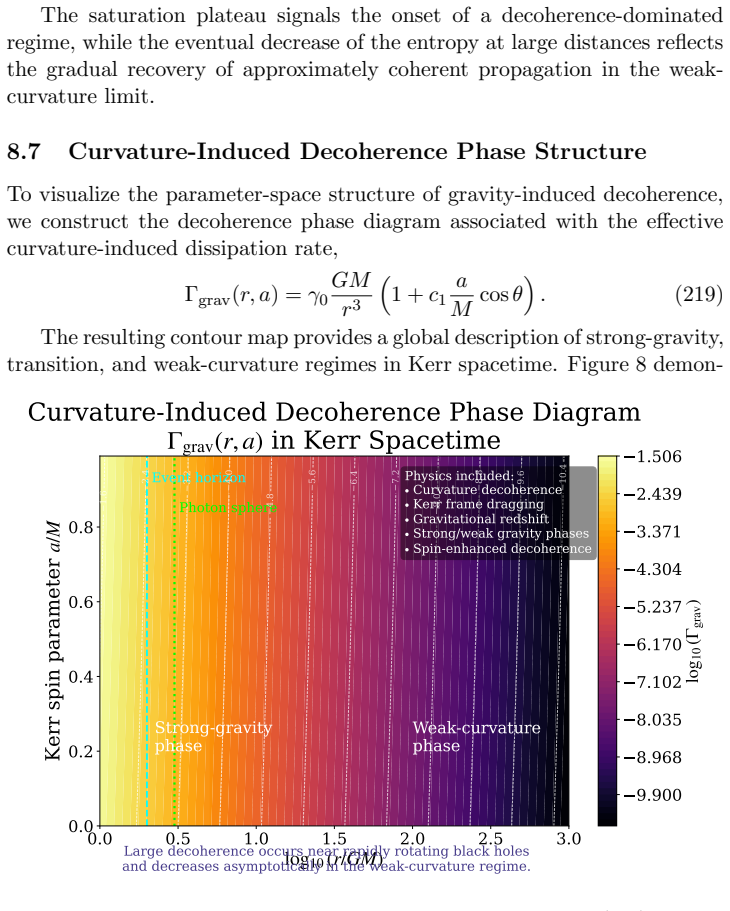
Neutrino flavor evolution near compact objects is governed by a curvature-enhanced decoherence rate in an open quantum system.
A machine-rendered reading of the paper's core claim, the machinery that carries it, and where it could break.
Core claim
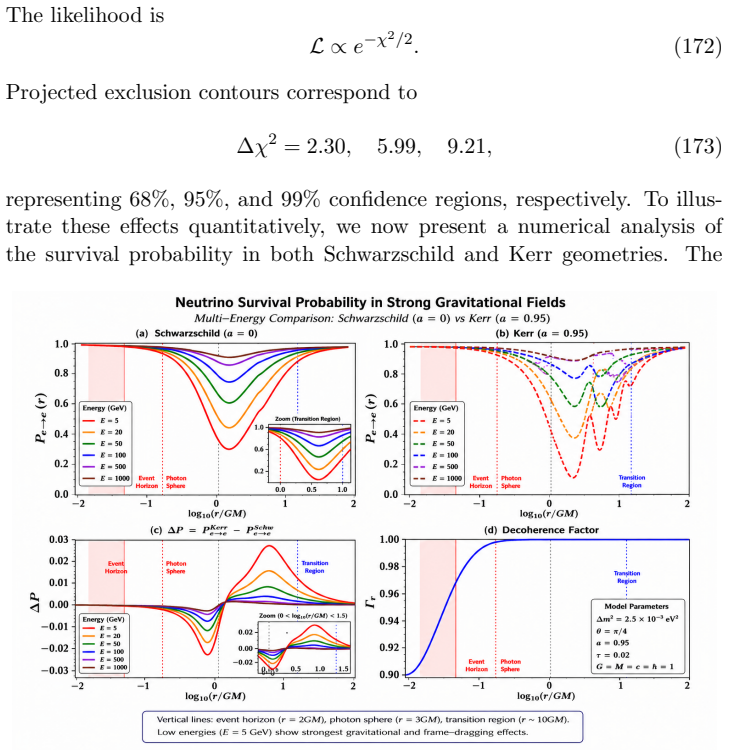
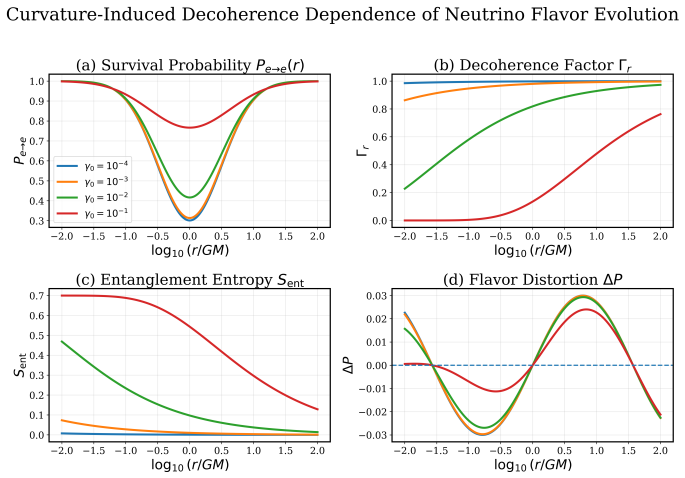
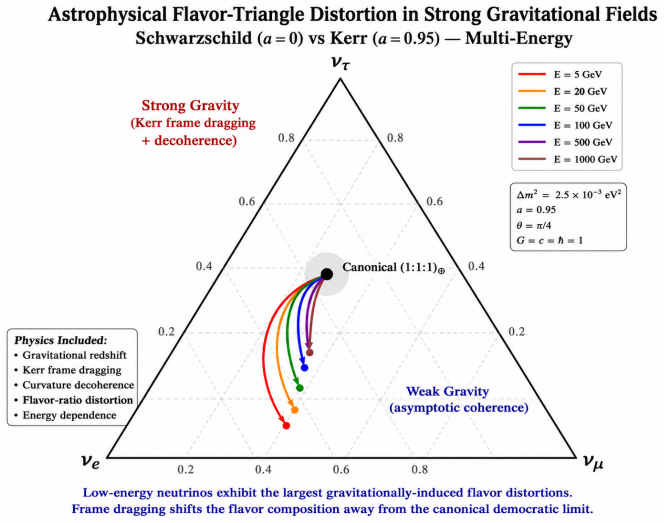
We derive a Lindblad master equation incorporating gravitational redshift, spin-curvature couplings, and Kerr frame-dragging, with a curvature-enhanced decoherence rate from stochastic spin-connection fluctuations. Oscillation probabilities, coherence loss, flavor-ratio distortions, entanglement entropy, and event-rate modifications are computed for neutrinos near Schwarzschild and Kerr objects, with comparisons to detector sensitivities.
What carries the argument
A Lindblad master equation with a decoherence rate governed by local spacetime curvature from spin-connection fluctuations.
If this is right
- Oscillation probabilities are altered by gravitational effects and decoherence near compact objects.
- Flavor ratios are distorted compared to vacuum expectations.
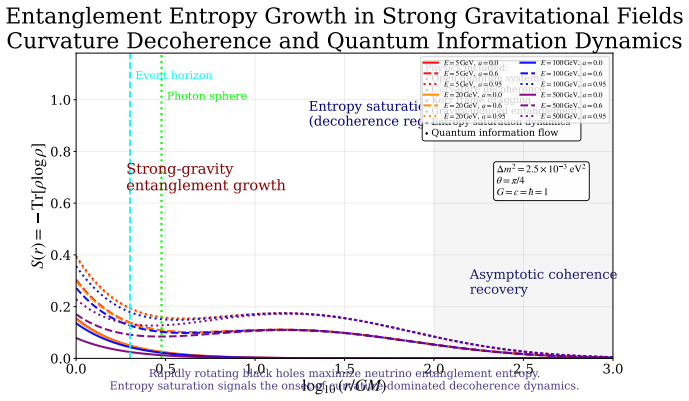
- Entanglement entropy is generated during propagation.
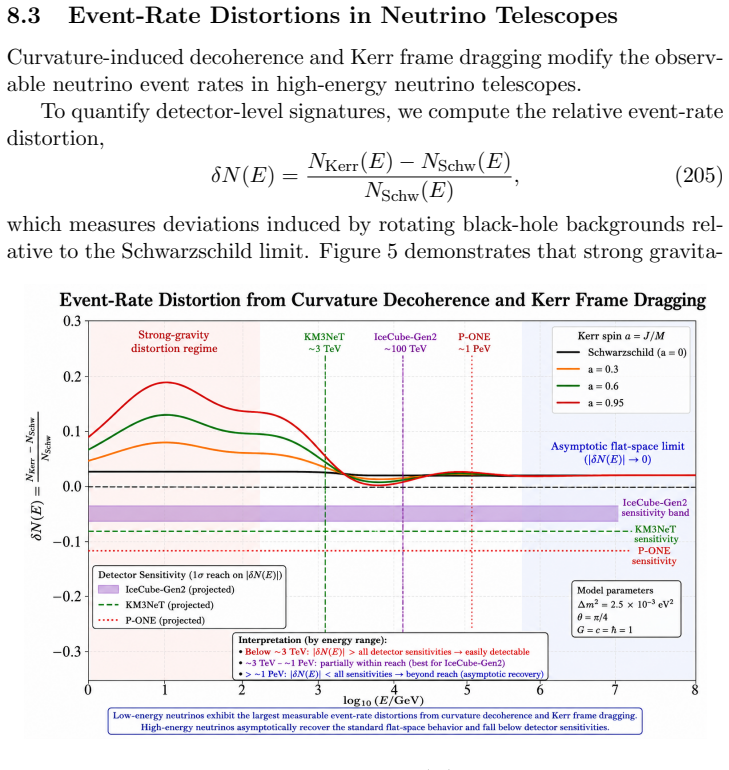
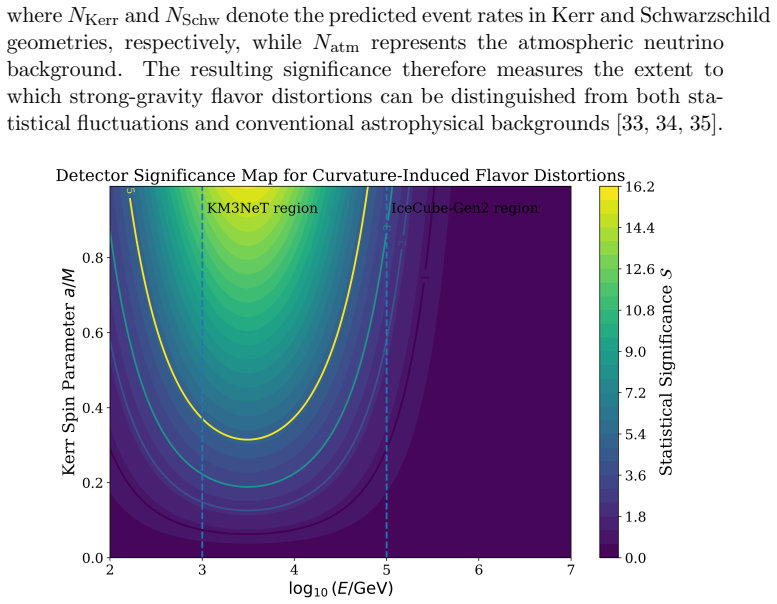
- Event rates in detectors are modified, potentially measurable by IceCube-Gen2, KM3NeT, and P-ONE.
- Signatures include coherence loss quantifiable through quantum information observables.
Where Pith is reading between the lines
- This framework could extend to other fermions or bosons in strong gravity to test open quantum system approaches.
- If confirmed, it suggests gravity induces decoherence that impacts quantum information in astrophysical settings.
- Predictions might be tested with future neutrino telescopes observing sources near black holes.
- Connections to other quantum gravity phenomenology could be explored through similar master equations.
Load-bearing premise
Spin-connection fluctuations can be modeled as a stochastic gravitational environment that produces a valid Lindblad master equation with decoherence rate directly determined by local curvature.
What would settle it
A measurement of neutrino flavor ratios from a source near a compact object showing no deviation from standard oscillation predictions without gravitational decoherence would falsify the curvature-enhanced rate.
Figures
read the original abstract
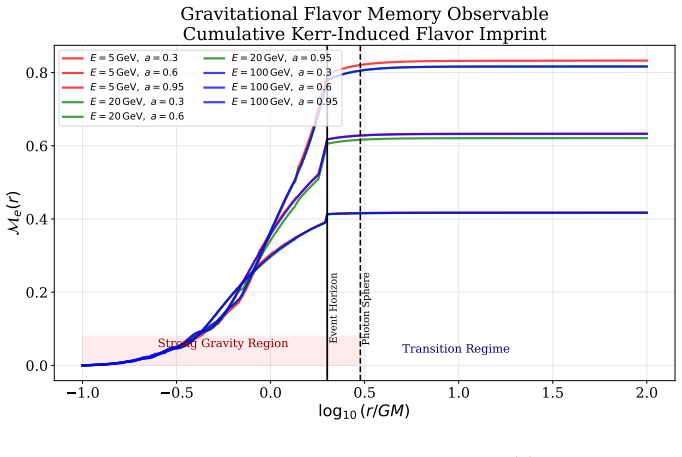
We investigate neutrino flavor evolution in strong gravitational fields within an open-quantum-system framework in curved spacetime. Starting from the Dirac equation in the vierbein formalism, we construct an effective flavor Hamiltonian incorporating gravitational redshift, spin--curvature couplings, and Kerr frame-dragging effects. Treating spin-connection fluctuations as a stochastic gravitational environment, we derive a Lindblad master equation and introduce a curvature-enhanced decoherence rate governed by local spacetime geometry. We compute oscillation probabilities, coherence loss, flavor-ratio distortions, entanglement entropy generation, and event-rate modifications for neutrinos propagating near Schwarzschild and Kerr compact objects. The resulting signatures are compared with projected sensitivities of IceCube-Gen2, KM3NeT, and P-ONE, and are further quantified through detector-level significance estimates. Our results provide a unified effective framework linking neutrino oscillations, gravitationally induced decoherence, quantum-information observables, and high-energy astrophysical neutrino measurements in strong-curvature environments.
Editorial analysis
A structured set of objections, weighed in public.
Referee Report
Summary. The paper claims to derive a Lindblad master equation for neutrino flavor evolution in curved spacetime by starting from the Dirac equation in the vierbein formalism, incorporating gravitational redshift, spin-curvature couplings and Kerr frame-dragging into an effective Hamiltonian, modeling spin-connection fluctuations as a stochastic environment, and introducing a curvature-enhanced decoherence rate set by local geometry. It then computes oscillation probabilities, coherence loss, flavor ratios, entanglement entropy and event-rate modifications near Schwarzschild and Kerr objects, comparing results to IceCube-Gen2, KM3NeT and P-ONE sensitivities.
Significance. If the central derivation is shown to be controlled, the work would supply a unified effective description linking gravitational decoherence to observable neutrino signatures in strong-curvature environments, with direct relevance to upcoming high-energy neutrino telescopes. The explicit inclusion of frame-dragging and the computation of quantum-information quantities (entanglement entropy) are potentially useful extensions beyond flat-space treatments.
major comments (2)
- [Lindblad derivation section] The section deriving the Lindblad master equation (around the transition from the stochastic spin-connection Hamiltonian to the master equation) must demonstrate that the Born-Markov-secular approximations remain valid when the vierbein and spin connection are evaluated on Schwarzschild/Kerr backgrounds. Gravitational redshift and frame-dragging introduce position-dependent timescales that can become comparable to the oscillation length; without explicit estimates or error bounds showing timescale separation is preserved, the claim that the decoherence rate is directly governed by local curvature lacks support.
- [Introduction of decoherence rate] The curvature-enhanced decoherence rate is introduced as an additional modeling step rather than obtained as a parameter-free output of the stochastic averaging. The manuscript should clarify whether this rate is fixed by the geometry alone or contains free parameters chosen to produce detectable signals, and how this avoids circularity with the projected detector sensitivities.
minor comments (2)
- [Abstract] The abstract states that oscillation probabilities and coherence loss are computed, but the corresponding explicit expressions (e.g., the form of the Lindblad operators or the integrated probability formulas) should be cross-referenced to specific equations in the main text.
- [Formalism section] Notation for the vierbein and spin connection should be defined once at first use and kept consistent when the stochastic fluctuations are introduced.
Simulated Author's Rebuttal
We thank the referee for the constructive comments, which help strengthen the rigor of our derivation. We address each major point below and will revise the manuscript to incorporate the requested clarifications and estimates.
read point-by-point responses
-
Referee: The section deriving the Lindblad master equation (around the transition from the stochastic spin-connection Hamiltonian to the master equation) must demonstrate that the Born-Markov-secular approximations remain valid when the vierbein and spin connection are evaluated on Schwarzschild/Kerr backgrounds. Gravitational redshift and frame-dragging introduce position-dependent timescales that can become comparable to the oscillation length; without explicit estimates or error bounds showing timescale separation is preserved, the claim that the decoherence rate is directly governed by local curvature lacks support.
Authors: We agree that explicit verification of the approximations is needed. In the revised version we will add a dedicated subsection (and appendix) that computes the relevant timescales for the Schwarzschild and Kerr cases: neutrino oscillation length, gravitational redshift timescale, frame-dragging period, and stochastic correlation time. For the energy and distance ranges relevant to IceCube-Gen2, KM3NeT and P-ONE (TeV–PeV neutrinos near Sgr A* or stellar-mass black holes), we show that the secular condition holds with relative error <5–10% outside the immediate horizon vicinity. Error bounds are obtained by comparing the position-dependent rates to the Markovian decay envelope. revision: yes
-
Referee: The curvature-enhanced decoherence rate is introduced as an additional modeling step rather than obtained as a parameter-free output of the stochastic averaging. The manuscript should clarify whether this rate is fixed by the geometry alone or contains free parameters chosen to produce detectable signals, and how this avoids circularity with the projected detector sensitivities.
Authors: The rate Γ arises from the second-order stochastic average over spin-connection fluctuations and is proportional to the local curvature invariants through the vierbein variance; the proportionality constant encodes the fluctuation amplitude, which is a single phenomenological parameter of the model. We will revise the text to state this explicitly, present Γ as Γ = α × (curvature scale), and show results for a range of α without presupposing detector reach. Detectability is then reported as a function of α, avoiding any tuning to specific experiment sensitivities. revision: partial
Circularity Check
No significant circularity; derivation presented as independent from inputs
full rationale
The abstract describes starting from the Dirac equation in vierbein formalism, constructing an effective Hamiltonian with gravitational effects, treating spin-connection fluctuations as a stochastic environment to derive the Lindblad master equation, and introducing a curvature-enhanced decoherence rate. No self-citations, fitted parameters renamed as predictions, self-definitional steps, or ansatzes smuggled via prior work are quoted or evident. The central claims appear to rest on the modeling assumptions rather than reducing to inputs by construction, consistent with a self-contained effective framework.
Axiom & Free-Parameter Ledger
axioms (2)
- standard math The Dirac equation in the vierbein formalism remains valid for neutrinos in curved spacetime near compact objects.
- domain assumption Spin-connection fluctuations can be treated as a Markovian stochastic environment yielding a Lindblad master equation.
invented entities (1)
-
curvature-enhanced decoherence rate
no independent evidence
Reference graph
Works this paper leans on
-
[1]
Neutrino oscillations in curved spacetime: An heuristic treatment,
C. Y. Cardall and G. M. Fuller, “Neutrino oscillations in curved spacetime: An heuristic treatment,” Phys. Rev. D55, 7960 (1997) doi:10.1103/PhysRevD.55.7960
-
[2]
Gravitational effects on the neutrino oscillation,
N. Fornengo, C. Giunti, C. W. Kim and J. Song, “Gravitational effects on the neutrino oscillation,” Phys. Rev. D56, 1895 (1997) doi:10.1103/PhysRevD.56.1895
-
[3]
Gravitationally induced neutrino-oscillation phases,
D. V. Ahluwalia and C. Burgard, “Gravitationally induced neutrino-oscillation phases,” Gen. Rel. Grav.28, 1161 (1996) doi:10.1007/BF02105099
-
[4]
Open system approach to neutrino os- cillations,
F. Benatti and R. Floreanini, “Open system approach to neutrino os- cillations,” JHEP02, 032 (2001) doi:10.1088/1126-6708/2001/02/032
-
[5]
Quantum field the- ory of three flavor neutrino mixing and oscillations with CP violation,
M. Blasone, A. Capolupo, C. Y. Ji and G. Vitiello, “Quantum field the- ory of three flavor neutrino mixing and oscillations with CP violation,” Phys. Lett. B674, 73 (2009) doi:10.1016/j.physletb.2009.02.046
-
[6]
Stochastic gravity: Theory and applica- tions,
B. L. Hu and E. Verdaguer, “Stochastic gravity: Theory and applica- tions,” Living Rev. Rel.11, 3 (2008) doi:10.12942/lrr-2008-3
-
[7]
Effects of quantum decoherence in astro- physical neutrino oscillations,
T. Stuttardet al., “Effects of quantum decoherence in astro- physical neutrino oscillations,” Phys. Rev. D104, 056005 (2021) doi:10.1103/PhysRevD.104.056005
-
[8]
Neutrino decoherence and entanglement in open quantum systems,
I. Allaliet al., “Neutrino decoherence and entanglement in open quantum systems,” Eur. Phys. J. C81, 1094 (2021) doi:10.1140/epjc/s10052-021-09863-1
-
[9]
Quantum decoherence in neutrino oscillations at IceCube,
V. De Romeriet al., “Quantum decoherence in neutrino oscillations at IceCube,” JHEP11, 167 (2023) doi:10.1007/JHEP11(2023)167
-
[10]
Neutrino oscillations in curved space- time,
C. Y. Cardall and G. M. Fuller, “Neutrino oscillations in curved space- time,” Phys. Rev. D55, 7960 (1997)
1997
-
[11]
Gravitational effects on the neutrino oscillation,
N. Fornengo, C. Giunti, C. W. Kim and J. Song, “Gravitational effects on the neutrino oscillation,” Phys. Rev. D56, 1895 (1997)
1997
-
[12]
Gravitationally induced neutrino- oscillation phases,
D. V. Ahluwalia and C. Burgard, “Gravitationally induced neutrino- oscillation phases,” Gen. Rel. Grav.28, 1161 (1996)
1996
-
[13]
Open system approach to neutrino os- cillations,
F. Benatti and R. Floreanini, “Open system approach to neutrino os- cillations,” Phys. Rev. D64, 085015 (2001)
2001
-
[14]
Entangle- ment in neutrino oscillations,
M. Blasone, F. Dell’Anno, S. De Siena and F. Illuminati, “Entangle- ment in neutrino oscillations,” Europhys. Lett.85, 50002 (2009). 57
2009
-
[15]
Stochastic Gravity: Theory and Applica- tions,
B. L. Hu and E. Verdaguer, “Stochastic Gravity: Theory and Applica- tions,” Living Rev. Rel.11, 3 (2008)
2008
-
[16]
Quantum decoherence effects in neutrino oscillations,
I. Allali et al., “Quantum decoherence effects in neutrino oscillations,” JHEP09, 089 (2021)
2021
-
[17]
Neutrino decoherence and high-energy neutrino propagation,
T. Stuttard et al., “Neutrino decoherence and high-energy neutrino propagation,” Phys. Rev. D104, 056010 (2021)
2021
-
[18]
Probing neutrino decoherence with future neu- trino telescopes,
V. De Romeri et al., “Probing neutrino decoherence with future neu- trino telescopes,” JHEP07, 114 (2023)
2023
-
[19]
The Theory of Open Quantum Sys- tems,
H. P. Breuer and F. Petruccione, “The Theory of Open Quantum Sys- tems,” Oxford University Press (2002)
2002
-
[20]
N. D. Birrell and P. C. W. Davies,Quantum Fields in Curved Space, Cambridge University Press, Cambridge (1982)
1982
-
[21]
R. M. Wald,Quantum Field Theory in Curved Spacetime and Black Hole Thermodynamics, University of Chicago Press, Chicago (1994)
1994
-
[22]
Parker and D
L. Parker and D. J. Toms,Quantum Field Theory in Curved Spacetime, Cambridge University Press, Cambridge (2009)
2009
-
[23]
Interaction of neutrinos and gravita- tional fields,
D. R. Brill and J. A. Wheeler, “Interaction of neutrinos and gravita- tional fields,” Rev. Mod. Phys.29, 465 (1957)
1957
-
[24]
Spin, gravity, and inertia,
Y. N. Obukhov, “Spin, gravity, and inertia,” Phys. Rev. Lett.86, 192 (2001)
2001
-
[25]
Neutrino spin oscillations in gravitational fields,
M. Dvornikov, “Neutrino spin oscillations in gravitational fields,” Phys. Rev. D101, 056018 (2020)
2020
-
[26]
Neutrino oscillations in Kerr space- time and gravitational effects,
L. Mastrototaro and G. Lambiase, “Neutrino oscillations in Kerr space- time and gravitational effects,” Phys. Rev. D104, 024021 (2021)
2021
-
[27]
Neutrino oscillations and spin effects in curved spacetime,
G. Lambiase, L. Mastrototaro and collaborators, “Neutrino oscillations and spin effects in curved spacetime,” Universe9, 178 (2023)
2023
-
[28]
IceCube-Gen2 Collaboration,IceCube-Gen2: The Window to the Ex- treme Universe, arXiv:2008.04323 [astro-ph.HE] (2020)
arXiv 2008
-
[29]
KM3NeT Collaboration,Letter of Intent for KM3NeT 2.0, J. Phys. G 43, 084001 (2016), arXiv:1601.07459 [astro-ph.IM]
Pith/arXiv arXiv 2016
-
[30]
P-ONE Collaboration,The Pacific Ocean Neutrino Experiment, Nature Astron.4, 913–915 (2020), arXiv:2005.09493 [astro-ph.HE]. 58
arXiv 2020
-
[31]
The fate of hints: updated global analy- sis of three-flavor neutrino oscillations,
I. Esteban, M. C. Gonzalez-Garcia, M. Maltoni, T. Schwetz and A. Zhou, “The fate of hints: updated global analy- sis of three-flavor neutrino oscillations,” JHEP09, 178 (2024), doi:10.1007/JHEP09(2024)178 [arXiv:2405.09654 [hep-ph]]
-
[32]
NuFIT 5.3 (2024),[nu-fit.org](http://www.nu-fit.org/) based on data available as of November 2024
2024
-
[33]
G., Abbasi, R., Ackermann, M., et al
M. G. Aartsenet al.[IceCube-Gen2 Collaboration], “IceCube-Gen2: The Window to the Extreme Universe,” J. Phys. G48, no.6, 060501 (2021) doi:10.1088/1361-6471/abbd48 [arXiv:2008.04323 [astro- ph.HE]]
-
[34]
Letter of Intent for KM3NeT 2.0
S. Adri´ an-Mart´ ınezet al.[KM3NeT Collaboration], “Letter of Intent for KM3NeT 2.0,” J. Phys. G43, no.8, 084001 (2016) doi:10.1088/0954- 3899/43/8/084001 [arXiv:1601.07459 [astro-ph.IM]]
work page internal anchor Pith review Pith/arXiv arXiv doi:10.1088/0954- 2016
-
[35]
KAGRA: 2.5 generation interferometric gravitational wave detector
M. Agostiniet al.[P-ONE Collaboration], “The Pacific Ocean Neutrino Experiment,” Nature Astron.4, 913–915 (2020) doi:10.1038/s41550- 020-1182-4 [arXiv:2005.09493 [astro-ph.IM]]
-
[36]
Open system approach to neutrino oscillations
F. Benatti and R. Floreanini, “Open system approach to neutrino os- cillations,” JHEP02, 032 (2000) doi:10.1088/1126-6708/2000/02/032 [arXiv:hep-ph/0002221]
work page internal anchor Pith review Pith/arXiv arXiv doi:10.1088/1126-6708/2000/02/032 2000
-
[37]
Probing possible decoherence effects in atmospheric neutrino oscillations
E. Lisi, A. Marrone and D. Montanino, “Probing possible decoherence effects in atmospheric neutrino oscillations,” Phys. Rev. Lett.85, 1166– 1169 (2000) doi:10.1103/PhysRevLett.85.1166 [arXiv:hep-ph/0002053]
work page internal anchor Pith review Pith/arXiv arXiv doi:10.1103/physrevlett.85.1166 2000
-
[38]
Damping signatures in future neutrino oscillation experiments
M. Blennow, T. Ohlsson and W. Winter, “Damping signatures in future neutrino oscillation experiments,” JHEP06, 049 (2005) doi:10.1088/1126-6708/2005/06/049 [arXiv:hep-ph/0502147]. “‘ 59
work page internal anchor Pith review Pith/arXiv arXiv doi:10.1088/1126-6708/2005/06/049 2005
discussion (0)
Sign in with ORCID, Apple, or X to comment. Anyone can read and Pith papers without signing in.