REVIEW 3 major objections 4 minor 20 references
Grain-boundary-mediated kinetic arrest in graphite-to-diamond transformation
T0 review · 3 major / 4 minor · reviewed 2026-07-13 · grok-4.5
Pith's one-line read Grain boundaries in graphite first help diamond form and then stop it from spreading, locking in mixed carbon phases.
desk verdict Clear MD mechanism that grain-boundary density decouples nucleation from propagation and explains arrested mixed sp2/sp3 products; soft spot is classical potential + 50 ps holds. read the letter →
The pith
A machine-rendered reading of the paper's core claim, the machinery that carries it, and where it could break.
The reading
What carries the argument
Grain-boundary-mediated kinetic arrest: grain boundaries act as dual-role sites that both seed non-diamond sp3 carbon (which can reorganize into diamond nuclei under heat) and then block cooperative diamond propagation across crystallographic mismatches, confining transformation to single grains.
What would settle it
HPHT experiments that start from carefully prepared single-crystal graphite versus controlled polycrystals of graded grain size under matched pressure-temperature schedules and then quantify the fraction of diamond versus mixed nanocomposite products; if crystallinity does not systematically shift the outcome, the claimed mechanism fails.
Extended reading notes
Core claim
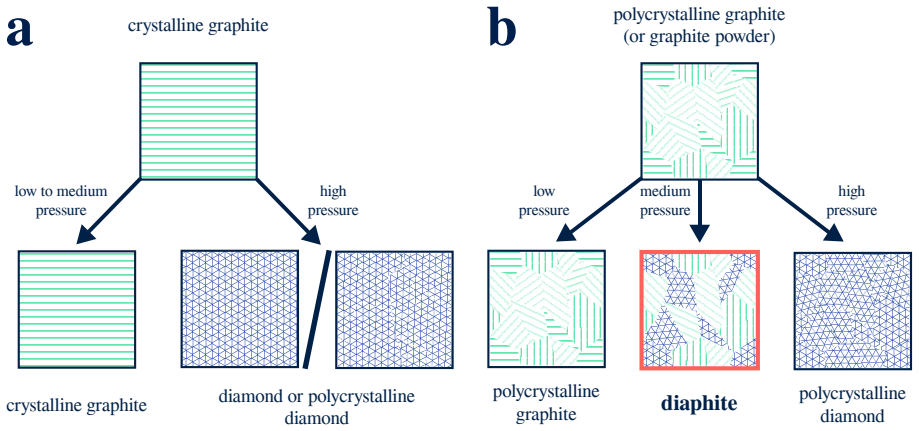
Precursor grain structure governs the graphite-to-diamond pathway by decoupling nucleation from cooperative propagation: grain boundaries first facilitate local sp3 nucleation, after which diamond growth proceeds inside individual grains but is arrested at crystallographically mismatched boundaries. Structurally heterogeneous graphite therefore stabilizes kinetically trapped mixed sp2/sp3 states, whereas large or single-crystalline domains favour bulk transformation into diamond.
Load-bearing premise
The carbon interatomic potential and the short hold times used in the simulations correctly capture both the real nucleation barrier and the subsequent grain-boundary arrest kinetics.
Editorial extensions
If this is right
- Metastable diamond-graphite nanocomposites are kinetic products of precursor microstructure, not finely tuned thermodynamic intermediates.
- Precursor crystallinity becomes an explicit experimental control knob for directing graphite-to-diamond pathways.
- Intermediate grain sizes optimise the balance between nucleation and propagation, maximising diamond-like domains while preserving grain-correlated spatial patterns.
- Very small grains generate excess non-diamond sp3 that further frustrates growth, locking in more diffuse mixed states.
Reading between the lines
- Similar grain-boundary arrest may operate in other reconstructive solid-solid transitions where nucleation is easy but coherent propagation across misoriented domains is hard.
- Industrial diamond synthesis recipes that already use powders may be optimisable by deliberate grain-size selection rather than solely by pressure-temperature tuning.
- The same logic predicts that highly textured or few-grain precursors should yield more complete conversion under milder conditions than randomly polycrystalline feedstocks.
Signed reviews
Editorial analysis
A structured set of objections, weighed in public.
Referee Report
Summary. The manuscript reports large-scale molecular-dynamics simulations (ACE carbon potential, ~10^4-atom cells, 200 trajectories on a P–T grid) of polycrystalline graphite under HPHT conditions. It claims that grain boundaries first promote local non-diamond sp3 nucleation; subsequent thermally activated rearrangement produces diamond seeds that grow within individual grains but are arrested at crystallographically mismatched boundaries. Consequently, heterogeneous precursors stabilize mixed sp2/sp3 (diaphite-like) states, whereas large or single-crystalline domains transform cooperatively to diamond. Precursor grain structure is therefore advanced as a control parameter that decouples nucleation from propagation and reframes metastable nanocomposites as kinetically trapped products of microstructure rather than thermodynamic intermediates.
Significance. If the kinetic-arrest mechanism is robust, the work supplies a concrete microstructural explanation for the well-documented experimental variability of graphite-to-diamond conversion under nominally identical HPHT conditions and identifies precursor crystallinity as a practical synthesis handle. Strengths include the systematic sampling of two grain densities across a dense P–T grid, the use of multiple structural metrics (coordination, CNA diamond identification, time-of-first-sp3 maps), and the internal consistency of the non-monotonic grain-size effect and the pressure-versus-temperature dependence of diamond-like content. These results are of clear interest to high-pressure materials science and diamond synthesis.
major comments (3)
- [Methods §2.2] Methods §2.2: the 50 ps isothermal-isobaric holds at target P–T are short relative to experimental kinetic timescales. The central claim of grain-boundary-mediated kinetic arrest rests on the assertion that the mixed sp2/sp3 states observed at the end of these holds are truly arrested rather than transient. Longer holds, or at least a subset of trajectories extended by an order of magnitude, are needed to test whether grain-boundary migration or annealing eventually allows further transformation.
- [Methods §2.2] Methods §2.2 and potential citations: the dual role of grain boundaries (nucleation facilitation versus propagation arrest) is observed with a single ACE carbon potential. While the potential has been benchmarked for graphite, diamond and mixed phases, the ordering of the grain-boundary-assisted nucleation barrier relative to cooperative bulk propagation is load-bearing. Explicit comparison of barrier heights (or at least of nucleation rates) against DFT or an independent potential would strengthen that the arrest mechanism is not an artefact of the force field.
- [Results / Methods §2.1] Results (Figs. 1–3) and Methods §2.1: only two discrete grain densities (5- and 10-grain Voronoi cells of fixed 45 Å side length) are examined. The claimed non-monotonic grain-size dependence and the limiting single-crystal behaviour are therefore inferred rather than directly mapped. At least one larger-grain or true single-crystal control series under identical protocol would make the continuum from arrested to cooperative transformation quantitative.
minor comments (4)
- [Figure 2c] Figure 2c caption and main text: the statement that “increasing pressure alone does not systematically increase diamond content” is important; a quantitative plot of diamond-like fraction versus pressure at fixed temperature (with error bars across the 20 independent runs) would make the claim more precise.
- [Methods §2.3] Methods §2.3: the 1.7 Å bond cut-off and CNA diamond identification are standard, but a brief sensitivity check (or reference to the companion transferability paper) would reassure readers that the classification of “non-diamond sp3” versus “diamond-like” is robust.
- [Abstract] Abstract and Introduction: the term “diaphite” is used without definition on first appearance; a short parenthetical or reference would improve accessibility.
- [Figure 1] Figure 1 schematic: the pressure/temperature regimes labelled “low/medium/high” are qualitative; aligning them more explicitly with the simulated grid (25–35 GPa, 1500–3500 K) would tighten the link between cartoon and data.
Circularity Check
No circularity: forward MD trajectories produce the kinetic-arrest claim; self-citations are methodological or parallel, not load-bearing.
full rationale
The paper's central claim—that grain boundaries decouple sp3 nucleation from cooperative diamond propagation, thereby kinetically arresting mixed sp2/sp3 states—is obtained by generating Voronoi polycrystals, running isothermal–isobaric MD with a published ACE carbon potential, and classifying final structures via common-neighbour analysis. No free parameters are fitted to the target outcomes and then re-presented as predictions; the 200 trajectories are forward simulations whose outcomes (preferential boundary nucleation, temperature-driven seed formation, arrest at crystallographic mismatch, non-monotonic grain-size effect) are reported as observed. The two self-citations are non-load-bearing: ref. 17 is a prior transferability benchmark of the same potential against ab initio data (methodological support, not the mechanism), and ref. 9 is a companion paper on fractality/percolation of the developing phase explicitly deferred as “discussed elsewhere.” Neither supplies a uniqueness theorem, ansatz, or definition that forces the kinetic-arrest conclusion. The derivation chain is therefore self-contained simulation evidence, not a reduction of outputs to inputs by construction.
Assumptions & free parameters
free parameters (3)
- simulation cell side length =
45 Å
- hold time at target P–T =
50 ps
- bond cut-off for coordination =
1.7 Å
assumptions (4)
- domain assumption The ACE carbon potential of Qamar et al. accurately ranks graphite, diamond, and mixed sp2/sp3 structures and their relative barriers under HPHT conditions.
- domain assumption Voronoi-tessellated grains with random seeds under periodic boundaries are representative of experimental polycrystalline graphite or graphite powders.
- domain assumption Common-neighbour analysis as implemented in OVITO correctly partitions diamond-like versus non-diamond four-coordinated domains.
- domain assumption Classical MD trajectories of ~10^4 atoms and ~200 ps total length capture the essential nucleation-versus-propagation competition.
Cite this review
Pith. "Pith review of Grain-boundary-mediated kinetic arrest in graphite-to-diamond transformation." pith.science (2026). https://pith.science/paper/LMGFKRP2
@misc{pith2026260708868,
  author       = {Pith},
  title        = {Pith review of: Grain-boundary-mediated kinetic arrest in graphite-to-diamond transformation},
  year         = {2026},
  howpublished = {\url{https://pith.science/paper/LMGFKRP2}},
  note         = {Machine review of arXiv:2607.08868}
}
abstract
The graphite-to-diamond transition exhibits striking variability under high-pressure, high-temperature (HPHT) conditions, producing diamond, graphitic phases, or metastable, mixed diamond-graphite nanocomposites despite similar synthesis conditions. Existing atomistic models, largely based on idealised single-crystal graphite, do not explain the persistence of partially transformed intermediate states under HPHT conditions. Here, using large-scale molecular dynamics simulations, we show that precursor grain structure governs graphite-to-diamond transformation pathways by decoupling diamond nucleation from cooperative transformation propagation. Grain boundaries first facilitate local sp$^3$ nucleation, after which diamond growth propagates within individual grains but becomes arrested at crystallographically mismatched grain boundaries. As a result, structurally heterogeneous graphite stabilizes kinetically arrested mixed sp$^2$-sp$^3$ states, whereas large or single-crystalline domains favour cooperative bulk transformation into diamond. Our findings identify structural heterogeneity as a missing control parameter alongside pressure and temperature, reframing metastable transformation products as kinetically trapped states arising from precursor microstructure rather than thermodynamic intermediates. Precursor crystallinity therefore emerges as a practical control parameter governing graphite-to-diamond transformation pathways.
Figures


Reference graph
Works this paper leans on
-
[1]
Péter Németh, Kit McColl, Rachael L. Smith, Mara Murri, Laurence A. J. Garvie, Matteo Alvaro, Béla Pécz, Adrian P. Jones, Furio Corà, Christoph G. Salzmann, and Paul F. McMillan. Diamond-Graphene Composite Nanostructures.Nano Lett., 20(5):3611–3619, May 2020. ISSN 1530-6984. doi: 10.1021/acs.nanolett.0c00556. URLhttps://doi.org/ 10.1021/acs.nanolett.0c00556
-
[2]
Kun Luo, Bing Liu, Wentao Hu, Xiao Dong, Yanbin Wang, Quan Huang, Yufei Gao, Lei Sun, Zhisheng Zhao, Yingju Wu, Yang Zhang, Mengdong Ma, Xiang-Feng Zhou, 7 Julong He, Dongli Yu, Zhongyuan Liu, Bo Xu, and Yongjun Tian. Coherent inter- faces govern direct transformation from graphite to diamond.Nature, 607(7919):486– 491, July 2022. ISSN 1476-4687. doi: 10....
-
[3]
Discovery of Gradia between Graphite and Diamond.Acc
Baozhong Li, Bing Liu, Kun Luo, Ke Tong, Zhisheng Zhao, and Yongjun Tian. Discovery of Gradia between Graphite and Diamond.Acc. Mater. Res., 5(5):614–624, May 2024. doi: 10.1021/accountsmr.4c00029. URLhttps://doi.org/10.1021/accountsmr.4c00029
-
[4]
Litasov, Tomoharu Yamashita, Futoshi Isobe, Valentin P
Hiroaki Ohfuji, Tetsuo Irifune, Konstantin D. Litasov, Tomoharu Yamashita, Futoshi Isobe, Valentin P. Afanasiev, and Nikolai P. Pokhilenko. Natural occurrence of pure nano- polycrystallinediamondfromimpactcrater.Sci Rep, 5(1):14702, October2015. ISSN2045-
-
[5]
URLhttps://www.nature.com/articles/srep14702
doi: 10.1038/srep14702. URLhttps://www.nature.com/articles/srep14702
-
[6]
Tetsuo Irifune, Ayako Kurio, Shizue Sakamoto, Toru Inoue, Hitoshi Sumiya, and Ken- ichi Funakoshi. Formation of pure polycrystalline diamond by direct conversion of graphite at high pressure and high temperature.Phys. Earth Planet. Inter., 143-144: 593–600, June 2004. ISSN 0031-9201. doi: 10.1016/j.pepi.2003.06.004. URLhttps: //www.sciencedirect.com/scien...
-
[7]
S. Fahy, Steven G. Louie, and Marvin L. Cohen. Theoretical total-energy study of the transformationofgraphiteintohexagonaldiamond.Phys. Rev. B,35:7623–7626, May1987. doi: 10.1103/PhysRevB.35.7623. URLhttps://link.aps.org/doi/10.1103/PhysRevB. 35.7623
-
[8]
S. Scandolo, M. Bernasconi, G. L. Chiarotti, P. Focher, and E. Tosatti. Pressure- induced transformation path of graphite to diamond.Phys. Rev. Lett., 74:4015–4018, May 1995. doi: 10.1103/PhysRevLett.74.4015. URLhttps://link.aps.org/doi/10. 1103/PhysRevLett.74.4015
Show all 20 references
-
[9]
R. Z. Khaliullin, H. Eshet, T. D. Kühne, J. Behler, and M. Parrinello. Nucleation mech- anism for the direct graphite-to-diamond phase transition.Nat. Mater., 10:693—-697, September 2011. doi: 10.1038/nmat3078. URLhttps://www.nature.com/articles/ nmat3078#citeas
2011 doi
-
[10]
Fractality and per- colation in the phase transition of polycrystalline graphite.Phys
Vilmos Neuman, Zuzanna Malinowska-Trzmielak, and Mark Wilson. Fractality and per- colation in the phase transition of polycrystalline graphite.Phys. Rev. B, Jul 2026. doi: 10.1103/6zv5-drsn. URLhttps://link.aps.org/doi/10.1103/6zv5-drsn
2026 doi
-
[11]
Construction of Voronoi poly- hedra.J
Witold Brostow, Jean-Pierre Dussault, and Bennett L Fox. Construction of Voronoi poly- hedra.J. Comput. Phys., 29(1):81–92, October 1978. ISSN 0021-9991. doi: 10.1016/ 0021-9991(78)90110-9. URLhttps://www.sciencedirect.com/science/article/pii/ 0021999178901109. 8
1978
-
[12]
L Finney
J. L Finney. A procedure for the construction of Voronoi polyhedra.J. Comput. Phys., 32(1):137–143, July 1979. ISSN 0021-9991. doi: 10.1016/0021-9991(79)90146-3. URL https://www.sciencedirect.com/science/article/pii/0021999179901463
1979 doi
-
[13]
Atomsk: A tool for manipulating and converting atomic data files
Pierre Hirel. Atomsk: A tool for manipulating and converting atomic data files. Comput. Phys. Commun., 197:212–219, December 2015. ISSN 0010-4655. doi: 10. 1016/j.cpc.2015.07.012. URLhttps://www.sciencedirect.com/science/article/pii/ S0010465515002817
2015
-
[14]
Persistent Homology Analysis for Materials Research and Persistent Homology Software: HomCloud.J
Ippei Obayashi, Takenobu Nakamura, and Yasuaki Hiraoka. Persistent Homology Analysis for Materials Research and Persistent Homology Software: HomCloud.J. Phys. Soc. Jpn., 91(9):091013, September 2022. ISSN 0031-9015. doi: 10.7566/JPSJ.91.091013. URL https://journals.jps.jp/doi...
2022 doi
-
[15]
Thompson, H
Aidan P. Thompson, H. Metin Aktulga, Richard Berger, Dan S. Bolintineanu, W. Michael Brown, Paul S. Crozier, Pieter J. in ’t Veld, Axel Kohlmeyer, Stan G. Moore, Trung Dac Nguyen, Ray Shan, Mark J. Stevens, Julien Tranchida, Christian Trott, and Steven J. Plimpton. LAMMPS - a ...
2022 doi
-
[16]
Atomic cluster expansion for accurate and transferable interatomic poten- tials.Phys
Ralf Drautz. Atomic cluster expansion for accurate and transferable interatomic poten- tials.Phys. Rev. B, 99(1):014104, January 2019. doi: 10.1103/PhysRevB.99.014104. URL https://link.aps.org/doi/10.1103/PhysRevB.99.014104
2019 doi
-
[17]
Atomic Cluster Expansion for Quantum-Accurate Large-Scale Simulations of Carbon.J
Minaam Qamar, Matous Mrovec, Yury Lysogorskiy, Anton Bochkarev, and Ralf Drautz. Atomic Cluster Expansion for Quantum-Accurate Large-Scale Simulations of Carbon.J. Chem. Theory Comput., 19(15):5151–5167, August 2023. ISSN 1549-9618. doi: 10.1021/ acs.jctc.2c01149. URLhttps://d...
2023 doi
-
[18]
Transferability of carbon potentials for novel carbon polymorphs.Modelling and Simulation in Materials Science and Engineering, 34(2):025004, Feb 2026
Zuzanna Malinowska-Trzmielak, Nicole Grobert, and Mark Wilson. Transferability of carbon potentials for novel carbon polymorphs.Modelling and Simulation in Materials Science and Engineering, 34(2):025004, Feb 2026. doi: 10.1088/1361-651x/ae3e04. URL https://iopscience.iop.org/...
2026 doi
-
[19]
Visualization and analysis of atomistic simulation data with OVITO–the Open Visualization Tool.Modelling Simul
Alexander Stukowski. Visualization and analysis of atomistic simulation data with OVITO–the Open Visualization Tool.Modelling Simul. Mater. Sci. Eng., 18(1):015012, December 2009. ISSN 0965-0393. doi: 10.1088/0965-0393/18/1/015012. URLhttps: //doi.org/10.1088/0965-0393/18/1/015012
2009 doi
-
[20]
Maras, O
E. Maras, O. Trushin, A. Stukowski, T. Ala-Nissila, and H. Jónsson. Global transition path search for dislocation formation in Ge on Si(001).Comput. Phys. Commun., 205: 13–21, August 2016. ISSN 0010-4655. doi: 10.1016/j.cpc.2016.04.001. URLhttps://www. sciencedirect.com/scienc...
2016 doi
Reviewed July 13, 2026 · model on record in the stance chip above.
Discussion (0). Continue with ORCID to comment.