Gradient Flow Renormalization Schemes for Composite Fermion Operators
Pith reviewed 2026-07-02 02:15 UTC · model grok-4.3
The pith
Gradient flow A and V schemes fix fermion wavefunction renormalization nonperturbatively with conserved currents, allowing direct matching to MSbar at short flow times via two-point function ratios.
A machine-rendered reading of the paper's core claim, the machinery that carries it, and where it could break.
Core claim
The A and V schemes are gradient flow normalization prescriptions in which the flowed fermion wavefunction renormalization factor is fixed nonperturbatively by the partially conserved axial charge (A scheme) or the conserved vector current (V scheme). These schemes are defined directly through standard flowed two-point correlation functions, can be matched to MSbar in the short-flow-time limit using known ringed-scheme coefficients, and are implemented via ratios of correlation functions that connect lattice-accessible flow times to shorter times where perturbative matching is reliable.
What carries the argument
The A and V schemes, gradient flow normalization prescriptions that fix the flowed fermion wavefunction renormalization nonperturbatively using the partially conserved axial charge or conserved vector current.
If this is right
- Renormalization factors for composite fermion operators are obtained from simple ratios of two-point correlation functions at accessible flow times.
- Anomalous dimensions and evolution factors that connect different flow times follow directly from the same ratios.
- The ratio of matching factors Z_V/Z_A is determined nonperturbatively on the lattice.
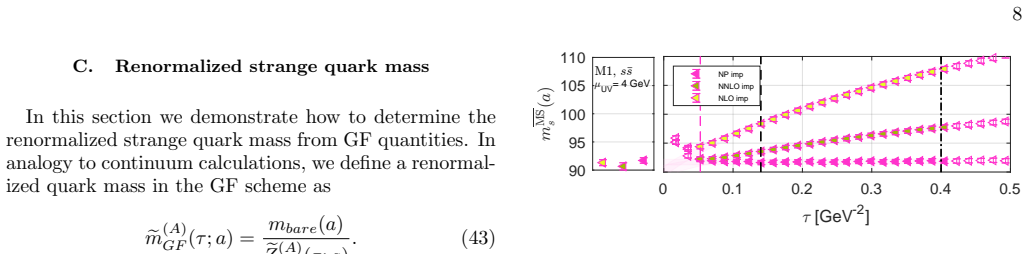
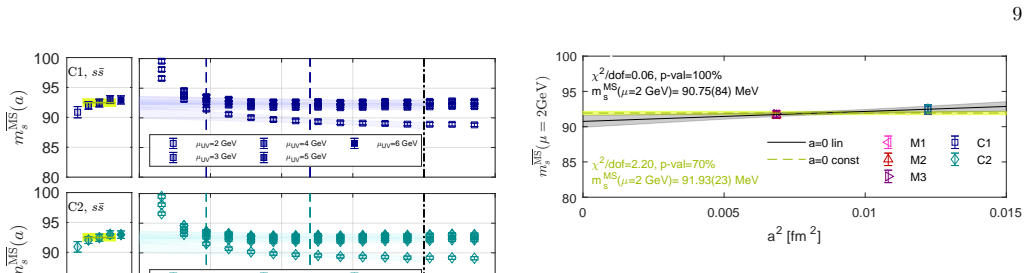
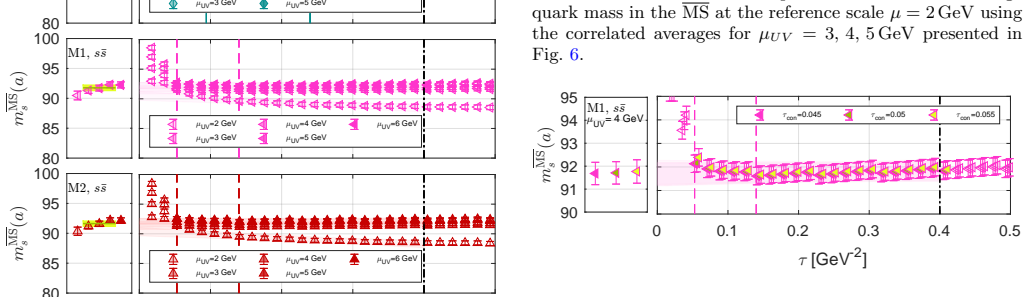
- A new nonperturbative determination of the renormalized strange quark mass is obtained from the same framework.
Where Pith is reading between the lines
- The same current-based fixing procedure could be tested on other fermion discretizations to check scheme independence.
- Evolution factors extracted this way could be used to connect lattice results at moderate flow times to continuum extrapolations at even smaller flow times.
- The method supplies a practical route to renormalizing four-fermion operators that appear in weak-decay matrix elements.
Load-bearing premise
Fixing the flowed fermion wavefunction renormalization with the axial charge or vector current introduces no additional scheme-specific systematic errors beyond those already present in the ringed-scheme matching coefficients.
What would settle it
A direct comparison, at the same small flow time, between the renormalization factor obtained from the A or V scheme and an independent nonperturbative determination in the MSbar scheme that shows a statistically significant discrepancy after all known matching coefficients are applied.
Figures

read the original abstract
We introduce gradient flow (GF) normalization prescriptions for fermionic composite operators in which the flowed fermion wavefunction renormalization factor is fixed nonperturbatively using either the partially conserved axial charge or the conserved vector current. The resulting $A$ and $V$ schemes are defined through standard flowed two-point correlation functions and therefore avoid the backward-flow construction required by local ringed-scheme definitions. In the short-flow-time limit, the $A$ and $V$ schemes can be matched to $\overline{\mathrm{MS}}$ using known ringed-scheme short-flow-time expansion (SFTX) coefficients. We show how these schemes can be implemented through ratios of two-point correlation functions, leading to simple nonperturbative determinations of renormalization factors, anomalous dimensions, and evolution factors which connect lattice-accessible flow times to shorter flow times where perturbative matching is reliable. We illustrate the method with RBC-UKQCD domain-wall fermion ensembles, including a GF determination of the ratio of matching factors $Z_V/Z_A$, and a new GF determination of the renormalized strange quark mass.
Editorial analysis
A structured set of objections, weighed in public.
Referee Report
Summary. The paper introduces gradient flow renormalization schemes A and V for fermionic composite operators. These fix the flowed fermion wavefunction renormalization nonperturbatively via the partially conserved axial charge (PCAC) or conserved vector current (CVC), defining the schemes through standard flowed two-point correlation functions without requiring backward flow. The central claim is that in the short-flow-time limit these schemes match to MSbar using the known ringed-scheme short-flow-time expansion (SFTX) coefficients, enabling nonperturbative determinations of renormalization factors, anomalous dimensions, and evolution factors via correlation-function ratios. The method is illustrated on RBC-UKQCD domain-wall ensembles with results for Z_V/Z_A and the renormalized strange quark mass.
Significance. If the matching holds without additional scheme-dependent corrections, the approach offers a technically simpler route to nonperturbative renormalization of composite operators in lattice QCD, avoiding backward-flow constructions while connecting lattice flow times to perturbative regimes. The explicit use of PCAC/CVC for Z_psi and the ratio-based implementation are practical strengths for reproducibility on existing ensembles.
major comments (2)
- [Abstract / matching section] Abstract and matching discussion: the claim that A/V schemes match to MSbar using ringed-scheme SFTX coefficients assumes that nonperturbative Z_psi fixing via PCAC or CVC at finite t introduces no additional O(t^0) or higher contributions to the expansion coefficients. No derivation is supplied showing why the short-t expansions remain identical once the normalization condition differs from the ringed scheme; this is load-bearing for the central matching procedure.
- [Results / illustration section] Implementation via ratios: the procedure for determining renormalization factors and evolution factors from two-point function ratios is presented without an explicit error budget or numerical demonstration that residual t-dependent effects from the finite-t PCAC/CVC condition vanish in the short-t limit at the claimed precision.
minor comments (2)
- [Abstract] The abstract states that the schemes 'avoid the backward-flow construction required by local ringed-scheme definitions' but does not cite the specific ringed-scheme reference or equation being contrasted.
- [Introduction / scheme definition] Notation for the A and V schemes is introduced without a dedicated equation defining the normalization condition on Z_psi(t) for each case.
Simulated Author's Rebuttal
We thank the referee for their careful reading of the manuscript and for the constructive comments. We address each major point below, indicating where revisions will be made to strengthen the presentation.
read point-by-point responses
-
Referee: [Abstract / matching section] Abstract and matching discussion: the claim that A/V schemes match to MSbar using ringed-scheme SFTX coefficients assumes that nonperturbative Z_psi fixing via PCAC or CVC at finite t introduces no additional O(t^0) or higher contributions to the expansion coefficients. No derivation is supplied showing why the short-t expansions remain identical once the normalization condition differs from the ringed scheme; this is load-bearing for the central matching procedure.
Authors: The A and V schemes differ from the ringed scheme solely through the nonperturbative fixing of the multiplicative wave-function renormalization Z_ψ(t) via PCAC or CVC. Because the short-flow-time expansion coefficients are obtained from the perturbative expansion of the flowed composite operators themselves, and the PCAC/CVC conditions become exact in the continuum limit, any finite-t normalization effects are absorbed into Z_ψ(t) without generating additional scheme-dependent O(t^0) terms in the matching. The short-t limit therefore remains identical to the ringed-scheme SFTX. To make this reasoning explicit, we will add a short derivation in the revised matching section. revision: yes
-
Referee: [Results / illustration section] Implementation via ratios: the procedure for determining renormalization factors and evolution factors from two-point function ratios is presented without an explicit error budget or numerical demonstration that residual t-dependent effects from the finite-t PCAC/CVC condition vanish in the short-t limit at the claimed precision.
Authors: We agree that an explicit error budget and a direct numerical check of residual t dependence would improve clarity. In the revised manuscript we will augment the results section with a dedicated error budget that isolates the size of finite-t PCAC/CVC corrections, together with additional plots demonstrating the suppression of these effects as t is reduced on the RBC-UKQCD ensembles. revision: yes
Circularity Check
No significant circularity; A/V schemes defined from correlation functions and matched via external SFTX coefficients
full rationale
The paper defines the A and V schemes nonperturbatively by fixing the flowed fermion wavefunction renormalization Z_psi using PCAC or the conserved vector current, then implements them via ratios of standard flowed two-point correlation functions. Matching to MSbar in the short-flow-time limit is stated to use known ringed-scheme SFTX coefficients (external to this work). No step reduces a claimed prediction or result to a fitted parameter or self-referential definition by construction. The derivation chain remains independent of its own outputs.
Axiom & Free-Parameter Ledger
Reference graph
Works this paper leans on
-
[1]
The ringed scheme A well-defined prescription is provided by Suzuki’s “ringed” scheme [14]. In this scheme ˚Zχ(τ) is de- fined via the expectation value of the local operator ⟨¯χ(τ, x) ← →/D χ(τ, x)⟩, reading ˚Zχ(τ) = s −2 dim(R)N f (4πτ) 2 ⟨¯χ(τ;x) ← →/D χ(τ;x)⟩ ,(12) where dim(R) is the dimension of the fermion represen- tation. 3 The ringed scheme can ...
-
[2]
The basic idea is simple: the anomalous dimension of the conserved current vanishes, and so its flow-time dependence is en- tirely due to the wavefunction renormalization
The GF axial and vector scheme An alternative definition can be obtained by fixing the normalization of the axial or vector currents. The basic idea is simple: the anomalous dimension of the conserved current vanishes, and so its flow-time dependence is en- tirely due to the wavefunction renormalization. There- fore, the conserved currents can be used to ...
-
[3]
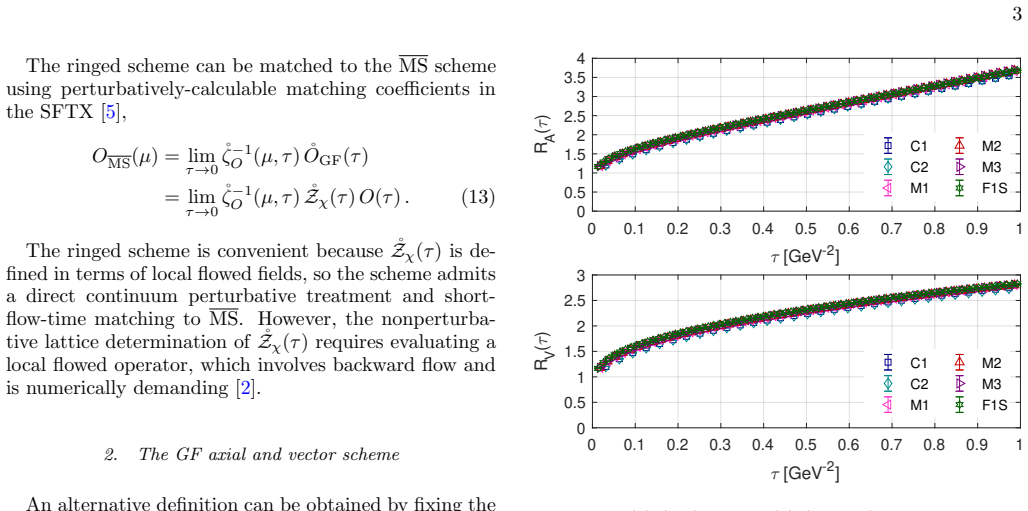
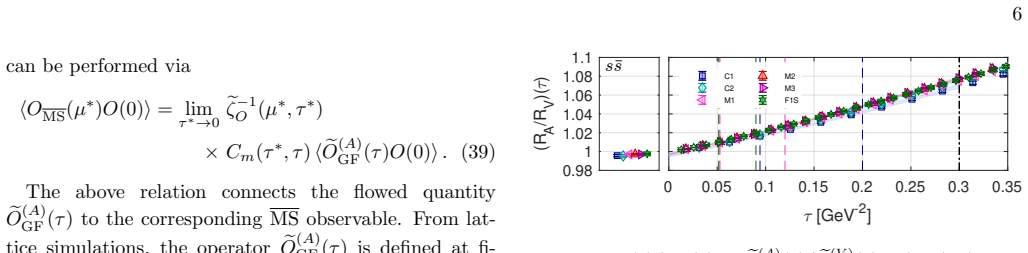
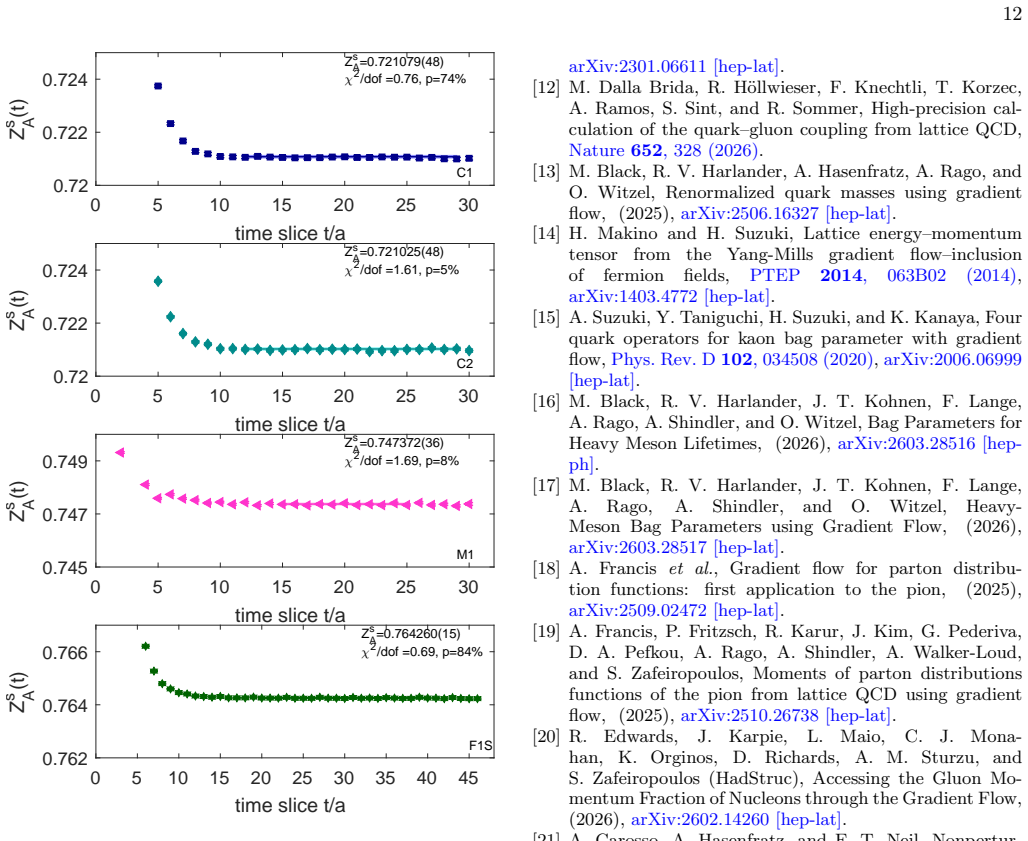
in the chiral limit, but is natural for the hadronic correlator normalization used here. In Fig. 1, we show the ratiosR A(τ) andR V (τ), which are respectively proportional to eZ (A) χ (τ) and eZ (V) χ (τ) as defined in Eq. (15) for theA 0 andVoperators. These ratios are determined using a set of domain-wall fermion ensembles generated by the RBC-UKQCD co...
-
[4]
Standard Model parameters and observables from gradient flow
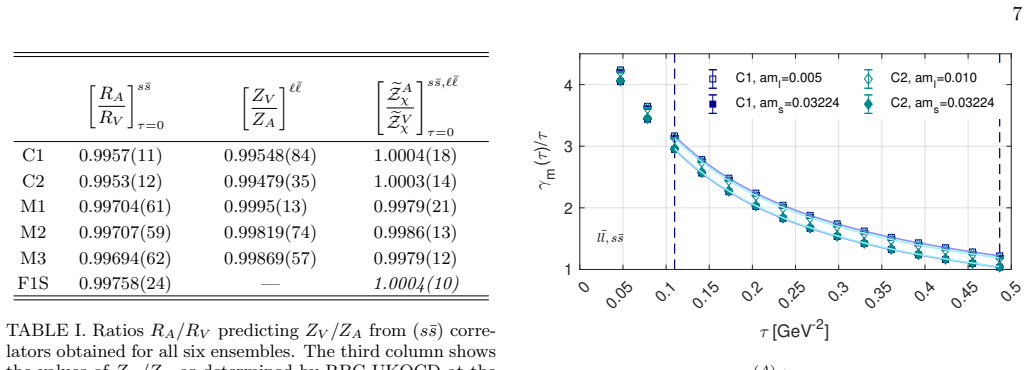
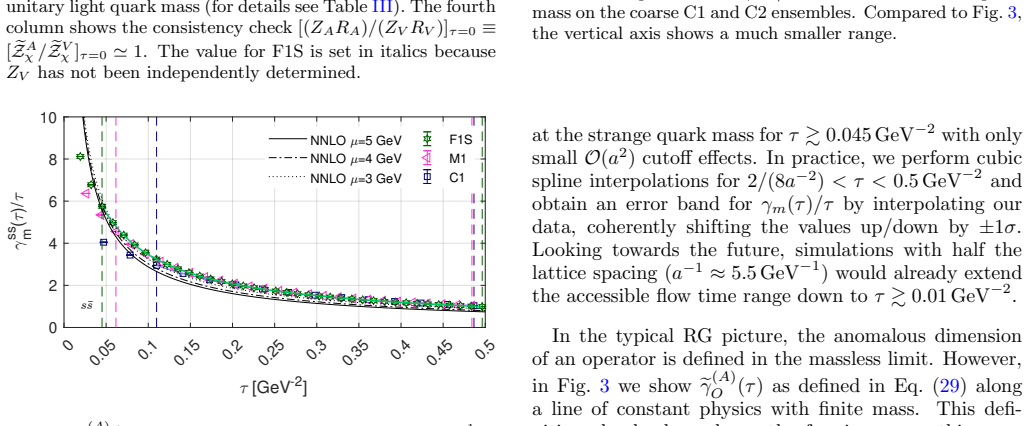
not yet included in the average. While we expect our systematic uncertainties to be competitive, quanti- fying the impact of approximatingeγ m(τ) by using F1S data instead of a continuum extrapolated result is trou- blesome and we refrain from quoting a full error budget. The numerical analysis presented here is intended as a demonstration of the method. ...
-
[5]
What is Particle Theory?
A.H. and O.W. are grateful for the hospitality at the Kavli Institute of Theoretical Physics at UC Santa Barbara, where part of this work was carried out during the program “What is Particle Theory?”. These computations used resources provided by the OMNI cluster at the University of Siegen, the HAWK cluster at the High-Performance Computing Center Stuttg...
-
[6]
Properties and uses of the Wilson flow in lattice QCD
M. L¨ uscher, Properties and uses of the Wilson flow in lattice QCD, JHEP1008, 071, arXiv:1006.4518 [hep-lat]
work page internal anchor Pith review Pith/arXiv arXiv
-
[7]
Chiral symmetry and the Yang--Mills gradient flow
M. L¨ uscher, Chiral symmetry and the Yang–Mills gradi- ent flow, JHEP1304, 123, arXiv:1302.5246 [hep-lat]
work page internal anchor Pith review Pith/arXiv arXiv
-
[8]
Perturbative analysis of the gradient flow in non-abelian gauge theories
M. L¨ uscher and P. Weisz, Perturbative analysis of the gradient flow in non-abelian gauge theories, JHEP1102, 051, arXiv:1101.0963 [hep-th]
work page internal anchor Pith review Pith/arXiv arXiv
-
[9]
Energy-momentum tensor from the Yang-Mills gradient flow
H. Suzuki, Energy–momentum tensor from the Yang–Mills gradient flow, PTEP2013, 083B03 (2013), [Erratum: PTEP 2015, 079201 (2015)], arXiv:1304.0533 [hep-lat]
work page internal anchor Pith review Pith/arXiv arXiv 2013
-
[10]
J. Borgulat, R. V. Harlander, J. T. Kohnen, and F. Lange, Short-flow-time expansion of quark bilinears through next-to-next-to-leading order QCD, JHEP05, 12 0 5 10 15 20 25 30 time slice t/a 0.72 0.722 0.724ZA s(t) ZA s=0.721079(48) @2/dof =0.76, p=74% C1 0 5 10 15 20 25 30 time slice t/a 0.72 0.722 0.724ZA s(t) ZA s=0.721025(48) @2/dof =1.61, p=5% C2 0 5...
-
[11]
A new method for the beta function in the chiral symmetry broken phase
Z. Fodor, K. Holland, J. Kuti, D. Nogradi, and C. H. Wong, A new method for the beta function in the chi- ral symmetry broken phase, EPJ Web Conf.175, 08027 (2018), arXiv:1711.04833 [hep-lat]
work page internal anchor Pith review Pith/arXiv arXiv 2018
-
[12]
A. Hasenfratz and O. Witzel, Continuous renormaliza- tion groupβfunction from lattice simulations, Phys. Rev. D101, 034514 (2020), arXiv:1910.06408 [hep-lat]
-
[13]
Surface plasmon based sensing with broadband coherent laser pulses
M. Dalla Bridaet al.(ALPHA), Determination of the qcd λ-parameter andα s from the gradient flow, Phys. Rev. Lett.122, 212001 (2019), arXiv:1809.00978 [hep-lat]
work page internal anchor Pith review Pith/arXiv arXiv 2019
-
[14]
M. Brunoet al.(ALPHA), Qcd coupling from a nonperturbative determination of theλparameter in three-flavor qcd, Phys. Rev. Lett.119, 102001 (2017), arXiv:1706.03821 [hep-lat]
work page internal anchor Pith review Pith/arXiv arXiv 2017
- [16]
-
[17]
Dalla Brida, R
M. Dalla Brida, R. H¨ ollwieser, F. Knechtli, T. Korzec, A. Ramos, S. Sint, and R. Sommer, High-precision cal- culation of the quark–gluon coupling from lattice QCD, Nature652, 328 (2026)
2026
- [18]
-
[19]
Lattice energy-momentum tensor from the Yang-Mills gradient flow -- inclusion of fermion fields
H. Makino and H. Suzuki, Lattice energy–momentum tensor from the Yang-Mills gradient flow–inclusion of fermion fields, PTEP2014, 063B02 (2014), arXiv:1403.4772 [hep-lat]
work page internal anchor Pith review Pith/arXiv arXiv 2014
- [20]
- [21]
- [22]
-
[23]
A. Franciset al., Gradient flow for parton distribu- tion functions: first application to the pion, (2025), arXiv:2509.02472 [hep-lat]
-
[24]
A. Francis, P. Fritzsch, R. Karur, J. Kim, G. Pederiva, D. A. Pefkou, A. Rago, A. Shindler, A. Walker-Loud, and S. Zafeiropoulos, Moments of parton distributions functions of the pion from lattice QCD using gradient flow, (2025), arXiv:2510.26738 [hep-lat]
-
[25]
R. Edwards, J. Karpie, L. Maio, C. J. Mona- han, K. Orginos, D. Richards, A. M. Sturzu, and S. Zafeiropoulos (HadStruc), Accessing the Gluon Mo- mentum Fraction of Nucleons through the Gradient Flow, (2026), arXiv:2602.14260 [hep-lat]
-
[26]
Nonperturbative Renormalization of Operators in Near-Conformal Systems Using Gradient Flows
A. Carosso, A. Hasenfratz, and E. T. Neil, Nonpertur- bative Renormalization of Operators in Near-Conformal Systems Using Gradient Flows, Phys. Rev. Lett.121, 201601 (2018), arXiv:1806.01385 [hep-lat]
work page internal anchor Pith review Pith/arXiv arXiv 2018
-
[27]
A. Hasenfratz, C. J. Monahan, M. D. Rizik, A. Shindler, and O. Witzel, A novel nonperturbative renormalization scheme for local operators, PoSLATTICE2021, 155 (2022), arXiv:2201.09740 [hep-lat]
-
[28]
A. Hasenfratz, E. T. Neil, Y. Shamir, B. Svetitsky, and O. Witzel, Infrared fixed point and anomalous dimen- sions in a composite Higgs model, Phys. Rev. D107, 114504 (2023), arXiv:2304.11729 [hep-lat]
-
[29]
A. Hasenfratz, E. T. Neil, Y. Shamir, B. Svetitsky, and O. Witzel, Infrared fixed point of the SU(3) gauge theory with Nf=10 flavors, Phys. Rev. D108, L071503 (2023), arXiv:2306.07236 [hep-lat]
-
[30]
Borgulat,The gradient flow at higher orders in pertur- bation theory, Ph.D
J. Borgulat,The gradient flow at higher orders in pertur- bation theory, Ph.D. thesis, RWTH Aachen U. (2026)
2026
-
[31]
A. Shindler, PDF Moments from Flowed Local Opera- tors: A Lattice QCD Approach to Hadron Structure, Talk at ”Standard Model parameters and observables from gradient flow” (2026), Higgs Centre for Theoreti- cal Physics, University of Edinburgh
2026
-
[32]
A General Method for Non-Perturbative Renormalization of Lattice Operators
G. Martinelli, C. Pittori, C. T. Sachrajda, M. Testa, and A. Vladikas, A General method for nonperturbative renormalization of lattice operators, Nucl. Phys. B445, 81 (1995), arXiv:hep-lat/9411010. 13
work page internal anchor Pith review Pith/arXiv arXiv 1995
-
[33]
Black, R
M. Black, R. V. Harlander, J. T. Kohnen, F. Lange, A. Rago, A. Shindler, and O. Witzel, Dataset: Heavy- Meson Bag Parameters using Gradient Flow (2026)
2026
- [34]
-
[35]
A. Hasenfratz, E. T. Peterson, and O. Witzel, Deter- mination of the strong coupling constant andλ ms from the gradient flow, Phys. Rev. D108, 014503 (2023), arXiv:2303.00704 [hep-lat]
-
[36]
A. Hasenfratz and O. Witzel, Continuousβfunction for the SU(3) gauge systems with two and twelve fun- damental flavors, PoSLATTICE2019, 094 (2019), arXiv:1911.11531 [hep-lat]
-
[37]
C. Alltonet al.(RBC/UKQCD), Physical Results from 2+1 Flavor Domain Wall QCD and SU(2) Chiral Per- turbation Theory, Phys. Rev.D78, 114509 (2008), arXiv:0804.0473 [hep-lat]
-
[38]
Continuum Limit Physics from 2+1 Flavor Domain Wall QCD
Y. Aokiet al.(RBC, UKQCD), Continuum Limit Physics from 2+1 Flavor Domain Wall QCD, Phys. Rev. D83, 074508 (2011), arXiv:1011.0892 [hep-lat]
work page internal anchor Pith review Pith/arXiv arXiv 2011
-
[39]
Domain wall QCD with physical quark masses
T. Blumet al.(RBC, UKQCD), Domain wall QCD with physical quark masses, Phys. Rev. D93, 074505 (2016), arXiv:1411.7017 [hep-lat]
work page internal anchor Pith review Pith/arXiv arXiv 2016
-
[40]
P. A. Boyle, L. Del Debbio, A. J¨ uttner, A. Khamseh, F. Sanfilippo, and J. T. Tsang, The decay constantsf D andf Ds in the continuum limit ofN f =2+1domain wall lattice QCD, JHEP12, 008, arXiv:1701.02644 [hep- lat]
work page internal anchor Pith review Pith/arXiv arXiv
- [41]
- [42]
-
[43]
J. Borgulat, N. Felten, R. Harlander, and J. T. Kohnen, Two-loop gradient-flow renormalization of scalar QCD, SciPost Phys. Core8, 032 (2025), arXiv:2501.07150 [hep- ph]
-
[44]
K. G. Chetyrkin, J. H. K¨ uhn, and M. Steinhauser, Run- Dec: A Mathematica package for running and decoupling of the strong coupling and quark masses, Comput. Phys. Commun.133, 43 (2000), arXiv:hep-ph/0004189
work page internal anchor Pith review Pith/arXiv arXiv 2000
-
[45]
Version 3 of {\tt RunDec} and {\tt CRunDec}
F. Herren and M. Steinhauser, Version 3 of RunDec and CRunDec, Comput. Phys. Commun.224, 333 (2018), arXiv:1703.03751 [hep-ph]
work page internal anchor Pith review Pith/arXiv arXiv 2018
-
[46]
Schmelling, Averaging correlated data, Phys
M. Schmelling, Averaging correlated data, Phys. Scripta 51, 676 (1995)
1995
-
[47]
Y. Aokiet al.(Flavour Lattice Averaging Group (FLAG)), FLAG Review 2024, (2024), arXiv:2411.04268 [hep-lat]
work page internal anchor Pith review Pith/arXiv arXiv 2024
-
[48]
Z.-C. Huet al.(CLQCD), Quark masses and low-energy constants in the continuum from the tadpole-improved clover ensembles, Phys. Rev. D109, 054507 (2024), arXiv:2310.00814 [hep-lat]
- [49]
-
[50]
C. McNeile, C. T. H. Davies, E. Follana, K. Hornbostel, and G. P. Lepage, High-Precision c and b Masses, and QCD Coupling from Current-Current Correlators in Lat- tice and Continuum QCD, Phys. Rev. D82, 034512 (2010), arXiv:1004.4285 [hep-lat]
work page internal anchor Pith review Pith/arXiv arXiv 2010
-
[51]
Lattice QCD at the physical point: light quark masses
S. D¨ urr, Z. Fodor, C. Hoelbling, S. D. Katz, S. Krieg, T. Kurth, L. Lellouch, T. Lippert, K. K. Szabo, and G. Vulvert (BMW), Lattice QCD at the physical point: light quark masses, Phys. Lett. B701, 265 (2011), arXiv:1011.2403 [hep-lat]
work page internal anchor Pith review Pith/arXiv arXiv 2011
-
[52]
Lattice QCD at the physical point: Simulation and analysis details
S. D¨ urr, Z. Fodor, C. Hoelbling, S. D. Katz, S. Krieg, T. Kurth, L. Lellouch, T. Lippert, K. K. Szabo, and G. Vulvert (BMW), Lattice QCD at the physical point: Simulation and analysis details, JHEP08, 148, arXiv:1011.2711 [hep-lat]
work page internal anchor Pith review Pith/arXiv arXiv
-
[53]
MILC results for light pseudoscalars
A. Bazavovet al.(MILC), MILC results for light pseu- doscalars, PoSCD09, 007 (2009), arXiv:0910.2966 [hep- ph]
work page internal anchor Pith review Pith/arXiv arXiv 2009
-
[54]
C. Alexandrouet al.(Extended Twisted Mass), Quark masses using twisted-mass fermion gauge ensembles, Phys. Rev. D104, 074515 (2021), arXiv:2104.13408 [hep- lat]
-
[55]
A. T. Lytle, C. T. H. Davies, D. Hatton, G. P. Lep- age, and C. Sturm (HPQCD), Determination of quark masses fromn f =4lattice QCD and the RI-SMOM in- termediate scheme, Phys. Rev. D98, 014513 (2018), arXiv:1805.06225 [hep-lat]
work page internal anchor Pith review Pith/arXiv arXiv 2018
-
[56]
Up-, down-, strange-, charm-, and bottom-quark masses from four-flavor lattice QCD
A. Bazavovet al.(Fermilab Lattice, MILC, TUMQCD), Up-, down-, strange-, charm-, and bottom-quark masses from four-flavor lattice QCD, Phys. Rev. D98, 054517 (2018), arXiv:1802.04248 [hep-lat]
work page internal anchor Pith review Pith/arXiv arXiv 2018
-
[57]
High-precision quark masses and QCD coupling from $n_f=4$ lattice QCD
B. Chakraborty, C. T. H. Davies, B. Galloway, P. Knecht, J. Koponen, G. C. Donald, R. J. Dowdall, G. P. Lepage, and C. McNeile, High-precision quark masses and QCD coupling fromn f = 4 lattice QCD, Phys. Rev. D91, 054508 (2015), arXiv:1408.4169 [hep-lat]
work page internal anchor Pith review Pith/arXiv arXiv 2015
-
[58]
Up, down, strange and charm quark masses with Nf = 2+1+1 twisted mass lattice QCD
N. Carrascoet al.(European Twisted Mass), Up, down, strange and charm quark masses with N f = 2+1+1 twisted mass lattice QCD, Nucl. Phys. B887, 19 (2014), arXiv:1403.4504 [hep-lat]
work page internal anchor Pith review Pith/arXiv arXiv 2014
-
[59]
L. Del Debbio, F. Erben, J. M. Flynn, R. Mukherjee, and J. T. Tsang (RBC, UKQCD), Absorbing discretiza- tion effects with a massive renormalization scheme: The charm-quark mass, Phys. Rev. D110, 054512 (2024), arXiv:2407.18700 [hep-lat]
discussion (0)
Sign in with ORCID, Apple, or X to comment. Anyone can read and Pith papers without signing in.