REVIEW 3 major objections 5 minor 88 references
The Effects of Kinematic MHD on the Atmospheric Circulation of Eccentric Hot Jupiters
T0 review · 3 major / 5 minor · reviewed 2026-08-08 · deepseek-v4-flash
Pith's one-line read The first 3D general circulation models of an eccentric hot Jupiter with temperature-dependent magnetic drag predict that the planet's equatorial jet weakens and narrows as field strength grows, that a dayside thermal inversion appears…
desk verdict Solid first kinematic-MHD GCM of an eccentric hot Jupiter with testable spectral predictions, but the abstract's monotonic scaling claim does not survive their own Figures 5 and 13. read the letter →
The pith
A machine-rendered reading of the paper's core claim, the machinery that carries it, and where it could break.
The reading
What carries the argument
The central mechanism is a locally calculated magnetic drag timescale, applied in the momentum equation as a Rayleigh drag $-u/\tau_{\mathrm{mag}}$ with a matching Ohmic dissipation term in the energy equation. The timescale is $\tau_{\mathrm{mag}} = 4\pi\rho\eta/(B^2|\sin\phi|)$, where $B$ is the assumed dipole field strength, $\phi$ the latitude, $\rho$ the density, and $\eta = 230\sqrt{T}/x_e$ the magnetic resistivity; the ionization fraction $x_e$ comes from the Saha equation summed over the first 28 elements. Because resistivity depends exponentially on temperature through ionization, the drag varies by orders of magnitude between the hot dayside and cooler nightside, so the same field strength slows winds strongly near periastron and barely at all near apastron. This temperature dependence is what couples orbital phase, magnetic field strength, and the predicted Doppler variability.
What would settle it
A JWST emission spectrum of TOI-150b near periastron and another near apastron would settle the phase-dependent-inversion claim: the models predict the roughly 6.2-micron water feature in emission at periastron (thermal inversion present) and in absorption at apastron (no inversion), with the periastron CO2 feature at roughly 4.2 microns weakening as field strength rises to 10 Gauss. Observing no such phase flip in the water feature would contradict the central mechanism.
Extended reading notes
Core claim
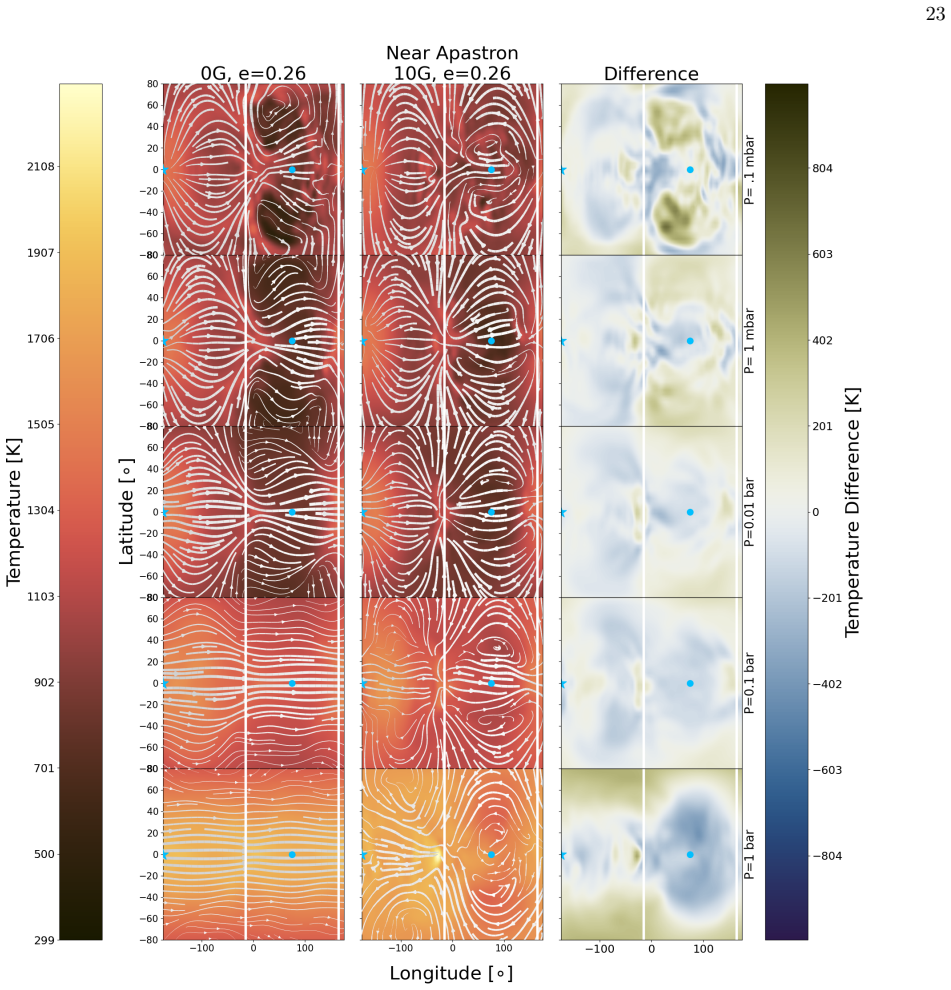
The paper establishes that the first application of kinematic (temperature-dependent) magnetic drag to an eccentric hot Jupiter changes both the circulation and the observable spectra in a field-strength-dependent way. Compared with a circular-orbit simulation of the same planet, the eccentric model develops a narrower, stronger equatorial superrotating jet and westward flow at high latitudes that spreads toward mid-latitudes as the dipole field strength is increased to 10-30 Gauss. The thermal structure becomes phase-dependent: a dayside temperature inversion exists only near periastron, where irradiation peaks, and the day-night temperature contrast grows with field strength. When the 3D structures are post-processed into R=100,000 emission spectra, higher field strengths produce less Doppler broadening, and the 10-Gauss model shows the largest inter-orbit variation in net Doppler shift when the same hemisphere is viewed at different orbital phases, a signature the authors attribute to the local drag responding to the changing temperature structure.
Load-bearing premise
The paper assumes a pseudo-synchronous rotation period of 4.14 days for the planet, and the authors state plainly that this rotation rate is unconstrained observationally; all the predicted circulation changes, thermal-inversion timing, and Doppler shifts are computed against that assumed spin, so a different real rotation rate would change the wind pattern and the spectroscopic signatures.
Editorial extensions
If this is right
- If the models are right, TOI-150b's equatorial jet is weaker and narrower for stronger assumed fields, and westward flow extends from high latitudes toward mid-latitudes at 10-30 Gauss.
- Thermal inversions on this planet should appear only near periastron and disappear near apastron, so emission spectra should flip from showing water in emission to water in absorption across the orbit.
- Stronger magnetic fields should yield measurably less Doppler broadening in high-resolution emission spectra, and the 10-Gauss model predicts the largest orbit-to-orbit Doppler variability for a fixed viewing geometry.
- Phase curves should peak before periastron, with the peak occurring closer to periastron as field strength increases.
- Clouds, modeled here in 1D, should be more abundant near apastron and may vanish at periastron, with only small (no more than 5 percent) spectral effects.
Reading between the lines
- Extending the paper's logic, hotter eccentric planets whose equilibrium temperature stays above the thermal ionization threshold all orbit would keep magnetic drag active year-round, so their inter-orbit variability could be even larger than what is predicted here for TOI-150b.
- The prediction that 10 Gauss maximizes variability while 30 Gauss suppresses it implies a non-monotonic mapping between field strength and observable variability; if that mapping holds, single-epoch Doppler measurements cannot rank field strengths without multi-epoch, phase-resolved data.
- Because the drag timescale depends on local temperature, any cloud or chemistry process that alters the temperature profile would shift where and when the drag acts; coupling the 3D model with the cloud prescription used here in 1D would test whether clouds mute the predicted Doppler variability.
- The paper's estimate that the orbit has only a 22 percent geometric chance of showing a secondary eclipse means that a nondetection would not falsify the models, while a detection would constrain the orbital geometry and sharpen the phase-curve predictions.
Editorial analysis
A structured set of objections, weighed in public.
Referee Report
Summary. Beltz et al. present the first 3D general circulation model study of an eccentric hot Jupiter (TOI-150b, e=0.26) with kinematic MHD drag. They run eccentric and circular models with dipole field strengths B = 0, 3, 10, and 30 G, using a locally calculated, temperature-dependent drag timescale from Perna et al. (2010). They find that eccentricity alone narrows and strengthens the equatorial jet, produces high-latitude westward winds, and creates a phase-dependent thermal inversion, and that MHD drag weakens and narrows the jet, alters the dayside circulation, and reduces Doppler broadening and net Doppler shifts in simulated high-resolution emission spectra. The paper further explores 1D cloud models and low-resolution spectra, and concludes that the eccentric-orbit effects and their spectroscopic signatures scale with the chosen magnetic field strength.
Significance. The study is a useful extension of the kinematic MHD approach to a physically important regime: eccentric hot Jupiters with periodically varying irradiation and thermal ionization. The drag prescription is locally calculated and not fitted to the target results; the magnetic field strength is varied as a free parameter, and the reported jet weakening, circulation changes, and spectral signatures emerge from the simulations. The work also connects 3D dynamics to concrete, testable predictions, such as phase-dependent thermal inversions, the 4.2 micron CO2 feature, and the 6.2 micron H2O emission/absorption switch. If the claims are appropriately qualified, the paper will be a valuable reference for observers targeting eccentric hot Jupiters and for modelers incorporating magnetic effects beyond simple uniform Rayleigh drag.
major comments (3)
- [Abstract, Section 3.2, Figure 5, Section 5] The abstract states that the strength and magnitude of the eccentric-orbit circulation effects 'scale with the chosen global magnetic field strength,' and Section 5 states that 'Increasing the magnetic field strength weakens the equatorial jet.' This monotonic scaling is contradicted by the paper's own results: Section 3.2 states that 'the jet in the 3G case is stronger in the upper atmosphere than the 0G case' (Figure 5), and the Figure 5 caption claims a weaker and narrower jet with increasing field strength. Because the scaling claim is part of the headline contribution, the abstract, conclusions, and figure caption should be revised to describe a non-monotonic or phase-dependent dependence, or to explicitly separate the 3G exception from the strong-field (10G/30G) trend.
- [Abstract, Section 3.5.1, Figure 13, Section 5] The claim of 'decreased Doppler broadening as magnetic field strengths increase' is not supported by the presented data. Section 3.5.1 states that 'the 10G model has the least amount of broadening at each phase, showing even less broadening than the 30G model except for at phase=0,' and Figure 13 plots this directly. The broadening is therefore not monotonically decreasing with field strength. The abstract and conclusions should be reworded to state that active magnetic drag reduces Doppler broadening relative to the drag-free case, with a non-monotonic dependence across the 3G, 10G, and 30G models, and the authors should either explain the 10G versus 30G behavior or present it as an apparently nonlinear response.
- [Section 4.3] The acknowledged limitation about pseudo-synchronous rotation should be given more weight in the presentation of the Doppler-shift predictions. As written, Section 4.3 notes that the 4.14-day rotation period is observationally unconstrained and that different rotation rates would alter the circulation and Doppler shifts, but the abstract presents the spectroscopic variability and Doppler-broadening trends as robust eccentric-orbit signatures. Either the abstract should carry a brief caveat, or the discussion should include a sensitivity estimate, such as a comparison against a synchronously rotating eccentric model or an order-of-magnitude estimate of the expected change in net Doppler shift.
minor comments (5)
- [Section 3.3, footnote 4] The footnote contains a typo: 'timsecale' should be 'timescale.'
- [Section 4.2] The opening sentence, 'Our work is builds upon Kataria et al. (2013),' should be corrected to 'Our work builds upon Kataria et al. (2013).'
- [Section 3.1, Figure 3 caption] The phrase 'the eccentric model has a faster rotation rate then the circular model' should read 'than the circular model.'
- [Section 3.5.1, Figure 13] The quantity 'Full-Width 80%-Max' is not defined in the text; a sentence explaining the normalization and the cross-correlation width measure would improve reproducibility.
- [Section 3.1] The discussion attributes the circulation changes to 'the inclusion of eccentricity,' but the eccentric model also uses a faster pseudo-synchronous rotation period. The text acknowledges this on the previous page, but a one-sentence reminder in Section 3.1 would prevent readers from misinterpreting the comparison as isolating eccentricity alone.
Circularity Check
No circular derivation: the Doppler and circulation predictions are emergent GCM outputs of a physically defined drag prescription, not refitted inputs.
full rationale
The paper's central claims are not equivalent by construction to any fitted input. The kinematic MHD drag timescale tau_mag = 4*pi*rho*eta/(B^2*|sin(phi)|) is defined from the non-ideal MHD equations, with resistivity eta = 230*sqrt(T)/x_e and a Saha ionization fraction, and is then applied as a Rayleigh drag in the RM-GCM. The magnetic field strength B is a free parameter varied across models (0, 3, 10, 30 G), not fitted to the wind or Doppler outputs. The strengthened equatorial jet, westward mid-latitude flow, phase-dependent thermal inversion, and spectral Doppler shifts are emergent properties of the GCM integration. High-resolution spectra are post-processed from the GCM temperature and wind structure using independent radiative transfer and ExoMol opacities, so the Doppler-shift predictions are not a renaming of the model inputs. The pseudo-synchronous rotation period (4.14 d, from Hut 1981) is an externally motivated assumption, and the paper explicitly flags that 'this rotation rate is unconstrained observationally' (Section 4.3); that is a limitation, not a circular step. Several self-citations (Beltz et al. 2021, 2022b) document earlier implementations of the same drag prescription and are used for comparison, not as load-bearing proof of the present conclusions. The manuscript does contain internal consistency tensions with its own scaling claims: Section 3.2 states that 'the jet in the 3G case is stronger in the upper atmosphere than the 0G case,' and Section 3.5.1 reports that the 10G model has less broadening than the 30G model at most phases. These contradict a simple monotonic scaling with field strength, but they are qualitative and correctness concerns, not cases where an output reduces to an input by definition. No fitted parameter is relabeled as a prediction.
Assumptions & free parameters
free parameters (2)
- Surface dipolar magnetic field strength B =
0, 3, 10, 30 G (four separate eccentric models)
- Sedimentation efficiency f_sed in 1D cloud model =
3, 1, 0.5
assumptions (6)
- domain assumption Pseudo-synchronous rotation with period 4.14 days for all eccentric models
- domain assumption Magnetic field is a dipole aligned with the rotation axis, so drag is applied only in the east-west direction
- domain assumption Kinematic MHD approximation is valid where the magnetic Reynolds number Rmag < 1
- domain assumption Ionization fraction from Saha balance over the first 28 elements, with electron density approximately equal to ion density
- domain assumption Solar metallicity and local chemical equilibrium in spectral post-processing
- domain assumption The RM-GCM primitive equations and picket-fence radiative transfer approximate the atmospheric physics
Cite this review
Pith. "Pith review of The Effects of Kinematic MHD on the Atmospheric Circulation of Eccentric Hot Jupiters." pith.science (2026). https://pith.science/paper/LMM5IVSY
@misc{pith2026250204169,
  author       = {Pith},
  title        = {Pith review of: The Effects of Kinematic MHD on the Atmospheric Circulation of Eccentric Hot Jupiters},
  year         = {2026},
  howpublished = {\url{https://pith.science/paper/LMM5IVSY}},
  note         = {Machine review of arXiv:2502.04169}
}
read the original abstract
Hot Jupiters are typically considered to be tidally locked due to their short orbital periods. The extreme irradiation can result in atmospheric species becoming thermally ionized on the dayside, which then interact with the planet's magnetic field by resisting flow across magnetic field lines, shaping the atmospheric structure. However, an eccentric orbit results in temporally dependent irradiation and a non-permanent dayside, as the planet-star distance can change drastically during its orbit. In this paper, we present 3D atmospheric models of TOI-150b, an eccentric (e=0.26), Jupiter-mass 1.75 M_Jup planet whose equilibrium temperature varies from 1300K to 1700K. We conduct simulations for magnetic field strengths ranging from 0-30 Gauss using the kinematic magnetohydrodynamics (MHD) approach. When compared to simulations of the planet assuming a circular orbit, we find that the eccentric orbit results in a strengthened and narrowed equatorial jet, westward winds at mid-latitudes, and a phase-dependent thermal inversion. The strength and magnitude of these effects scale with the chosen global magnetic field strength. We also generate high-resolution (R=100,000) emission spectra to study net Doppler shifts and find inter-orbit spectroscopic variability at moderate magnetic field strengths, as well as decreased Doppler broadening as magnetic field strengths increase. This work represents the first time that the kinematic MHD approach has been applied to an eccentric hot Jupiter and highlights the importance of a locally calculated, temperature dependent magnetic drag prescription for predicting atmospheric structure and resulting spectra.
Figures


Figures from the paper (14 more)


Reference graph
Works this paper leans on
-
[1]
, " * write output.state after.block = add.period write newline
ENTRY address archivePrefix author booktitle chapter doi edition editor eprint howpublished institution journal key month number organization pages publisher school series title misctitle type volume year version url label extra.label sort.label short.list INTEGERS output.state before.all mid.sentence after.sentence after.block FUNCTION init.state.consts ...
-
[2]
write newline
" write newline "" before.all 'output.state := FUNCTION format.url url empty "" new.block "" url * "" * if FUNCTION format.eprint eprint empty "" archivePrefix empty "" archivePrefix "arXiv" = new.block " " eprint * " " * new.block " " eprint * " " * if if if FUNCTION format.doi doi empty "" " " doi * " " * if FUNCTION format.pid doi empty eprint empty ur...
-
[3]
thebibliography [1] 20pt to REFERENCES 6pt =0pt 10pt plus 3pt =0pt =0pt =1pt plus 1pt =0pt =0pt -12pt =13pt plus 1pt =20pt =13pt plus 1pt \@M =10000 =-1.0em =0pt =0pt 0pt =0pt =1.0em @enumiv\@empty 10000 10000 `\.\@m \@noitemerr \@latex@warning Empty `thebibliography' environment \@ifnextchar \@reference \@latexerr Missing key on reference command Each re...
-
[4]
Adams , F. C., & Laughlin , G. 2006, , 649, 1004, 10.1086/506145
doi:10.1086/506145 2006
-
[5]
2004, Monthly Weather Review, 132, 2845 , 10.1175/MWR2823.1
Adcroft, A., Campin, J.-M., Hill, C., & Marshall, J. 2004, Monthly Weather Review, 132, 2845 , 10.1175/MWR2823.1
-
[6]
2019, , 625, A136, 10.1051/0004-6361/201834891
Arcangeli , J., D \'e sert , J.-M., Parmentier , V., et al. 2019, , 625, A136, 10.1051/0004-6361/201834891
-
[7]
Batygin , K., Stanley , S., & Stevenson , D. J. 2013, , 776, 53, 10.1088/0004-637X/776/1/53
-
[8]
Bell , T. J., Dang , L., Cowan , N. B., et al. 2021, , 504, 3316, 10.1093/mnras/stab1027
Show all 88 references
-
[9]
Beltz , H., Rauscher , E., Brogi , M., & Kempton , E. M. R. 2021, , 161, 1, 10.3847/1538-3881/abb67b
2021 doi
-
[10]
Beltz , H., Rauscher , E., Kempton , E. M. R., et al. 2022 a , , 164, 140, 10.3847/1538-3881/ac897b
2022 doi
-
[11]
T., & Guilliat , A
Beltz , H., Rauscher , E., Roman , M. T., & Guilliat , A. 2022 b , , 163, 35, 10.3847/1538-3881/ac3746
2022 doi
-
[12]
2012, , 537, A67, 10.1051/0004-6361/201116852
Bonavita , M., Chauvin , G., Desidera , S., et al. 2012, , 537, A67, 10.1051/0004-6361/201116852
2012 doi
-
[13]
2021, , 645, A24, 10.1051/0004-6361/202039344
Borsa , F., Allart , R., Casasayas-Barris , N., et al. 2021, , 645, A24, 10.1051/0004-6361/202039344
2021 doi
-
[14]
I., Stefansson , G., Monson , A
Ca \ n as , C. I., Stefansson , G., Monson , A. J., et al. 2019, , 877, L29, 10.3847/2041-8213/ab21c0
2019 doi
-
[15]
Cho , J. Y. K., Menou , K., Hansen , B. M. S., & Seager , S. 2003, , 587, L117, 10.1086/375016
2003 doi
-
[16]
Crossfield , I. J. M., Hansen , B. M. S., Harrington , J., et al. 2010, , 723, 1436, 10.1088/0004-637X/723/2/1436
2010 doi
-
[17]
2013, , 435, 3159, 10.1093/mnras/stt1509
Dobbs-Dixon , I., & Agol , E. 2013, , 435, 3159, 10.1093/mnras/stt1509
2013 doi
-
[18]
2012, , 751, 87, 10.1088/0004-637X/751/2/87
Dobbs-Dixon , I., Agol , E., & Burrows , A. 2012, , 751, 87, 10.1088/0004-637X/751/2/87
2012 doi
-
[19]
J., Lodders , K., Marley , M
Fortney , J. J., Lodders , K., Marley , M. S., & Freedman , R. S. 2008, , 678, 1419, 10.1086/528370
2008 doi
-
[20]
2016, , 591, A144, 10.1051/0004-6361/201527600
Fromang , S., Leconte , J., & Heng , K. 2016, , 591, A144, 10.1051/0004-6361/201527600
2016 doi
-
[21]
W., Bushby , P
Hindle , A. W., Bushby , P. J., & Rogers , T. M. 2021 a , , 922, 176, 10.3847/1538-4357/ac0e2e
2021 doi
-
[22]
2021 b , , 916, L8, 10.3847/2041-8213/ac0fec
---. 2021 b , , 916, L8, 10.3847/2041-8213/ac0fec
2021 doi
-
[23]
1981, , 99, 126
Hut , P. 1981, , 99, 126
1981
-
[24]
M., McCullough , P
Johns-Krull , C. M., McCullough , P. R., Burke , C. J., et al. 2008, , 677, 657, 10.1086/528950
2008 doi
-
[25]
P., Fortney , J
Kataria , T., Showman , A. P., Fortney , J. J., et al. 2015, , 801, 86, 10.1088/0004-637X/801/2/86
2015 doi
-
[26]
P., Lewis , N
Kataria , T., Showman , A. P., Lewis , N. K., et al. 2013, , 767, 76, 10.1088/0004-637X/767/1/76
2013 doi
-
[27]
A., Charbonneau , D., Allen , L
Knutson , H. A., Charbonneau , D., Allen , L. E., et al. 2007, , 447, 183, 10.1038/nature05782
2007 doi
-
[28]
Koll , D. D. B., & Komacek , T. D. 2018, , 853, 133, 10.3847/1538-4357/aaa3de
2018 doi
-
[29]
D., & Showman , A
Komacek , T. D., & Showman , A. P. 2016, , 821, 16, 10.3847/0004-637X/821/1/16
2016 doi
-
[30]
D., Showman , A
Komacek , T. D., Showman , A. P., & Tan , X. 2017, , 835, 198, 10.3847/1538-4357/835/2/198
2017 doi
-
[31]
2019, , 490, 1094, 10.1093/mnras/stz2433
Kossakowski , D., Espinoza , N., Brahm , R., et al. 2019, , 490, 1094, 10.1093/mnras/stz2433
2019 doi
-
[32]
R., Parmentier , V., et al
Kreidberg , L., Line , M. R., Parmentier , V., et al. 2018, , 156, 17, 10.3847/1538-3881/aac3df
2018 doi
- [33]
-
[34]
2008, , 674, 1106, 10.1086/523957
Langton , J., & Laughlin , G. 2008, , 674, 1106, 10.1086/523957
2008 doi
- [35]
-
[36]
Lee , E. K. H., Wardenier , J. P., Prinoth , B., et al. 2022, , 929, 180, 10.3847/1538-4357/ac61d6
2022 doi
- [37]
-
[38]
K., Showman , A
Lewis , N. K., Showman , A. P., Fortney , J. J., Knutson , H. A., & Marley , M. S. 2014, , 795, 150, 10.1088/0004-637X/795/2/150
2014 doi
-
[39]
K., Showman , A
Lewis , N. K., Showman , A. P., Fortney , J. J., et al. 2010, , 720, 344, 10.1088/0004-637X/720/1/344
2010 doi
- [40]
-
[41]
2008, , 481, 529, 10.1051/0004-6361:20078167
Loeillet , B., Shporer , A., Bouchy , F., et al. 2008, , 481, 529, 10.1051/0004-6361:20078167
2008 doi
-
[42]
Malsky , I., Rauscher , E., Kempton , E. M. R., et al. 2021, , 923, 62, 10.3847/1538-4357/ac2a2a
2021 doi
-
[43]
T., et al
Malsky , I., Rauscher , E., Roman , M. T., et al. 2024, , 961, 66, 10.3847/1538-4357/ad0b70
2024 doi
-
[44]
L., Line , M
Mansfield , M., Bean , J. L., Line , M. R., et al. 2018, , 156, 10, 10.3847/1538-3881/aac497
2018 doi
-
[45]
S., & McKay, C
Marley, M. S., & McKay, C. P. 1999, Icarus, 138, 268, https://doi.org/10.1006/icar.1998.6071
1999
-
[46]
S., Saumon, D., Guillot, T., et al
Marley, M. S., Saumon, D., Guillot, T., et al. 1996, Science, 272, 1919, 10.1126/science.272.5270.1919
1996
-
[47]
S., Seager , S., Saumon , D., et al
Marley , M. S., Seager , S., Saumon , D., et al. 2002, , 568, 335, 10.1086/338800
2002 doi
-
[48]
M., Stevenson , K
May , E. M., Stevenson , K. B., Bean , J. L., et al. 2022, , 163, 256, 10.3847/1538-3881/ac6261
2022 doi
-
[49]
J., Baraffe, I., Acreman, D
Mayne, N. J., Baraffe, I., Acreman, D. M., et al. 2014, Geoscientific Model Development, 7, 3059, 10.5194/gmd-7-3059-2014
2014 doi
-
[50]
C., Robinson , T
Mayorga , L. C., Robinson , T. D., Marley , M. S., May , E. M., & Stevenson , K. B. 2021, , 915, 41, 10.3847/1538-4357/abff50
2021 doi
-
[51]
M., Grimm , S
Mendon c a , J. M., Grimm , S. L., Grosheintz , L., & Heng , K. 2016, , 829, 115, 10.3847/0004-637X/829/2/115
2016 doi
-
[52]
M., Malik , M., Demory , B.-O., & Heng , K
Mendon c a , J. M., Malik , M., Demory , B.-O., & Heng , K. 2018, , 155, 150, 10.3847/1538-3881/aaaebc
2018 doi
-
[53]
2012, The Astrophysical Journal, 745, 138, 10.1088/0004-637x/745/2/138
Menou, K. 2012, The Astrophysical Journal, 745, 138, 10.1088/0004-637x/745/2/138
2012 doi
-
[54]
2009, , 700, 887, 10.1088/0004-637X/700/1/887
Menou , K., & Rauscher , E. 2009, , 700, 887, 10.1088/0004-637X/700/1/887
2009 doi
-
[55]
1949, Journal of the American Statistical Association, 44, 335, 10.1080/01621459.1949.10483310
Metropolis, N., & Ulam, S. 1949, Journal of the American Statistical Association, 44, 335, 10.1080/01621459.1949.10483310
1949
-
[56]
W., Mayor , M., et al
Naef , D., Latham , D. W., Mayor , M., et al. 2001, , 375, L27, 10.1051/0004-6361:20010853
2001 doi
-
[57]
2014, , 562, A133, 10.1051/0004-6361/201322342
Parmentier , V., & Guillot , T. 2014, , 562, A133, 10.1051/0004-6361/201322342
2014 doi
-
[58]
J., & Marley , M
Parmentier , V., Guillot , T., Fortney , J. J., & Marley , M. S. 2015, , 574, A35, 10.1051/0004-6361/201323127
2015 doi
-
[59]
Perez-Becker , D., & Showman , A. P. 2013, , 776, 134, 10.1088/0004-637X/776/2/134
2013 doi
-
[60]
2010 a , , 719, 1421, 10.1088/0004-637X/719/2/1421
Perna , R., Menou , K., & Rauscher , E. 2010 a , , 719, 1421, 10.1088/0004-637X/719/2/1421
2010 doi
-
[61]
2010 b , , 724, 313, 10.1088/0004-637X/724/1/313
---. 2010 b , , 724, 313, 10.1088/0004-637X/724/1/313
2010 doi
-
[62]
M., et al
Pino , L., Brogi , M., D \'e sert , J. M., et al. 2022, , 668, A176, 10.1051/0004-6361/202244593
2022 doi
-
[63]
N., Becker , J
Quinn , S. N., Becker , J. C., Rodriguez , J. E., et al. 2019, , 158, 177, 10.3847/1538-3881/ab3f2b
2019 doi
-
[64]
2012, , 750, 96, 10.1088/0004-637X/750/2/96
Rauscher , E., & Menou , K. 2012, , 750, 96, 10.1088/0004-637X/750/2/96
2012 doi
-
[65]
2013, The Astrophysical Journal, 764, 103, 10.1088/0004-637x/764/1/103
Rauscher, E., & Menou, K. 2013, The Astrophysical Journal, 764, 103, 10.1088/0004-637x/764/1/103
2013 doi
-
[66]
D., & Marley , M
Robinson , T. D., & Marley , M. S. 2014, , 785, 158, 10.1088/0004-637X/785/2/158
2014 doi
-
[67]
Rogers , T. M. 2017, Nature Astronomy, 1, 0131, 10.1038/s41550-017-0131
2017 doi
-
[68]
M., & Komacek, T
Rogers, T. M., & Komacek, T. D. 2014, The Astrophysical Journal, 794, 132, 10.1088/0004-637x/794/2/132
2014 doi
-
[69]
M., & McElwaine , J
Rogers , T. M., & McElwaine , J. N. 2017, , 841, L26, 10.3847/2041-8213/aa72da
2017 doi
-
[70]
T., Kempton, E
Roman, M. T., Kempton, E. M.-R., Rauscher, E., et al. 2021, The Astrophysical Journal, 908, 101, 10.3847/1538-4357/abd549
2021 doi
-
[71]
Russell , C. T. 1993, Reports on Progress in Physics, 56, 687, 10.1088/0034-4885/56/6/001
1993 doi
-
[72]
1991, Contributions to Plasma Physics, 31, 331, 10.1002/ctpp.2150310307
Sato , M. 1991, Contributions to Plasma Physics, 31, 331, 10.1002/ctpp.2150310307
1991 doi
-
[73]
B., Kempton , E
Savel , A. B., Kempton , E. M. R., Rauscher , E., et al. 2023, , 944, 99, 10.3847/1538-4357/acb141
2023 doi
-
[74]
B., Kempton , E
Savel , A. B., Kempton , E. M. R., Malik , M., et al. 2022, , 926, 85, 10.3847/1538-4357/ac423f
2022 doi
-
[75]
A., & Shepherd , T
Shaw , T. A., & Shepherd , T. G. 2007, Journal of the Atmospheric Sciences, 64, 190, 10.1175/JAS3823.1
2007 doi
-
[76]
2020, Space Science Reviews, 216, 139, 10.1007/s11214-020-00758-8
Showman, A., Tan, X., & Parmentier, V. 2020, Space Science Reviews, 216, 139, 10.1007/s11214-020-00758-8
2020 doi
- [77]
-
[78]
P., Cooper , C
Showman , A. P., Cooper , C. S., Fortney , J. J., & Marley , M. S. 2008, , 682, 559, 10.1086/589325
2008 doi
-
[79]
P., Fortney , J
Showman , A. P., Fortney , J. J., Lian , Y., et al. 2009, , 699, 564, 10.1088/0004-637X/699/1/564
2009 doi
-
[80]
P., & Guillot , T
Showman , A. P., & Guillot , T. 2002, , 385, 166, 10.1051/0004-6361:20020101
2002 doi
-
[81]
P., & Polvani , L
Showman , A. P., & Polvani , L. M. 2011, , 738, 71, 10.1088/0004-637X/738/1/71
2011 doi
-
[82]
W., Kitzmann , D., Patzer , A
Stock , J. W., Kitzmann , D., Patzer , A. B. C., & Sedlmayr , E. 2018, , 479, 865, 10.1093/mnras/sty1531
2018 doi
-
[83]
Tennyson , J., & Yurchenko , S. N. 2018, Atoms, 6, 26, 10.3390/atoms6020026
2018 doi
-
[84]
I., & Vallis , G
Thomson , S. I., & Vallis , G. K. 2019, Quarterly Journal of the Royal Meteorological Society, 145, 2627, 10.1002/qj.3582
2019 doi
-
[85]
B., McKay , C
Toon , O. B., McKay , C. P., Ackerman , T. P., & Santhanam , K. 1989, , 94, 16287, 10.1029/JD094iD13p16287
1989 doi
-
[86]
2023, , 520, 3867, 10.1093/mnras/stad214
Tsai , S.-M., Steinrueck , M., Parmentier , V., Lewis , N., & Pierrehumbert , R. 2023, , 520, 3867, 10.1093/mnras/stad214
2023 doi
- [87]
-
[88]
Zhang , J., Kempton , E. M. R., & Rauscher , E. 2017, , 851, 84, 10.3847/1538-4357/aa9891
2017 doi
Reviewed August 8, 2026 · model on record in the stance chip above.
Discussion (0). Continue with ORCID to comment.