REVIEW 4 major objections 3 minor 32 references
Hamiltonian Dynamics and Fundamental Phenomena in Biophysics: A Review
T0 review · 4 major / 3 minor · reviewed 2026-08-02 · deepseek-v4-flash
Pith's one-line read This review argues that metabolic or photonic energy can drive macromolecules into coherent collective oscillations, and presents experimental evidence that these oscillations produce long-range 1/r^3 resonant electrodynamic forces between
desk verdict A clear self-review of the Pettini Fröhlich programme: theory well presented, but the experimental identification of collective modes is circular and lacks artifact controls. read the letter →
The pith
A machine-rendered reading of the paper's core claim, the machinery that carries it, and where it could break.
The reading
What carries the argument
The central mathematical machinery is the time-dependent variational principle (TDVP), which turns a quantum Hamiltonian into a fully classical one by extremalizing the action on a manifold of product coherent states. Applied to the Wu–Austin model, it yields a classical Hamiltonian in action-angle variables (J_ω, θ_ω) with J_ω = ħ n_ω, and the Koopman–von Neumann reformulation of the Liouville equation produces nonlinear rate equations whose stationary solutions exhibit a nonequilibrium bifurcation into the lowest-frequency mode. For the two-dipole problem, the load-bearing identity is the resonant normal-mode splitting ω_{i,±}(r) ≃ ω0 ± √(ζ_A ζ_B) χ′_{ii}(r, ω0)/(2ω0), which makes the inte
What would settle it
Check whether the 0.314 THz BSA feature appears when the dye is free in solution or when labelled protein is illuminated at powers below the predicted threshold; either observation would falsify the phonon-condensation assignment. More directly, vary protein radius or Young modulus (e.g., via mutants or osmolytes) and verify that the resonance frequency follows the spheroid-mode formula; if the line does not shift with R_H or E, it is not a collective deformation mode. For the electronic channel, place a single silent mutation that preserves binding but changes the EIIP spectrum: the paper's m
Extended reading notes
Core claim
The paper's central claim is that classical Hamiltonian mechanics, obtained by dequantizing quantum models with the time-dependent variational principle, describes two real biophysical phenomena: the channelling of supplied energy into the lowest-frequency collective mode of a macromolecule (phonon condensation), and the resulting activation of long-range resonant electrodynamic forces. At resonance, the interaction potential scales as 1/r^3 in the near zone and 1/r in the far zone; at thermal equilibrium the same calculation gives only a 1/r^6 free energy because the action-difference term J_+ − J_− vanishes at first order. The review asserts that this theoretical picture is experimentally
Load-bearing premise
The load-bearing premise is that the sharp THz features observed under illumination (0.314 THz in BSA; 71 and 96 GHz in R-PE) are global collective deformation modes of the whole protein, created by a genuinely out-of-equilibrium coherent state, rather than local dye, solvent, heating, or photochemical artifacts.
Editorial extensions
If this is right
- If correct, enzyme–substrate encounters in cells could be guided by frequency-matched 1/r^3 forces, changing how reaction kinetics and specificity are modeled.
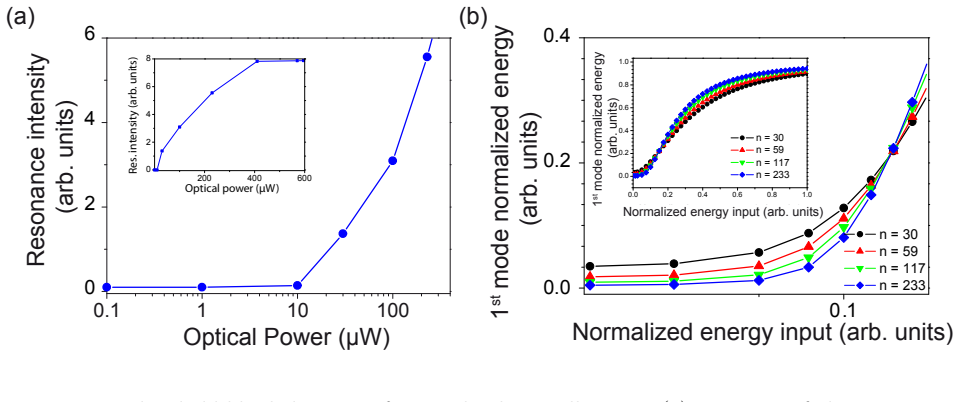
- The threshold and saturation behavior of the THz absorption gives a direct experimental signature of the condensation transition; measuring it in other proteins would test how generic the phenomenon is.
- The sequence-specific co-resonance peak offers a new, testable spectroscopic signature of DNA–protein recognition, potentially independent of binding-affinity measurements.
- The reversible clustering transition driven by electrodynamic forces provides a physical mechanism for biomolecular condensate formation that is distinct from multivalent phase separation.
- The position-space Hamiltonian provides a route to atomistic molecular dynamics that could decide whether realistic force fields support condensation at 300 K.
Reading between the lines
- [Editorial extension] If the 1/r^3 force is real, it should be detectable in biochemical observables such as concentration-dependent shifts in reaction rates or equilibrium constants; the authors' frequency-shift data make this a quantitative prediction.
- [Editorial extension] The electronic-channel co-resonance predicts that cognate protein–nucleic-acid pairs beyond EcoRI (e.g., transcription factors and their motifs) should show similar cross-spectral peaks that track sequence spectrum rather than binding affinity.
- [Editorial extension] A systematic scan of the BSA resonance frequency across proteins of known Young modulus and radius would directly test the collective-mode assignment, since Eq. (39) fixes the scaling of ν0 with E and R_H.
- [Editorial extension] The claim that long-range forces vanish at equilibrium implies that the 1/r^3 frequency shift should decay on a measurable timescale after the laser is switched off; time-resolved measurement of this transient would separate coherent-state physics from static concentration artifacts.
Signed reviews
Editorial analysis
A structured set of objections, weighed in public.
Referee Report
Summary. The paper is a review of a theoretical and experimental programme whose central claim is that biologically supplied (or laser-supplied) energy can drive macromolecules into an out-of-equilibrium, coherent collective oscillation — a classical analogue of Fröhlich phonon condensation — and that the resulting giant oscillating dipoles activate long-range, resonant 1/r^3 electrodynamic forces between biomolecules. The theoretical part derives classical Hamiltonians from quantum models via the time-dependent variational principle: the Wu–Austin model yields action-angle Hamiltonians and Fröhlich-like rate equations with a nonequilibrium condensation transition; a position-space Hamiltonian is simulated to recover condensation at room temperature; and a Davydov–Holstein–Fröhlich model for DNA–EcoRI is used to predict a sequence-specific electron-current co-resonance. The experimental part reviews THz near-field spectroscopy on BSA and R-PE, fluorescence correlation spectroscopy on R-PE clustering, and concentration-dependent frequency shifts, concluding that the observed phenomena support the proposed coherent-oscillation and long-range-force picture.
Significance. If the central experimental identifications are correct, the review consolidates a substantial and provocative programme: it provides a classical Hamiltonian underpinning for Fröhlich's ideas, derives a clean distinction between equilibrium (1/r^6) and out-of-equilibrium (1/r^3) interactions, and connects these to a new electrodynamic mechanism for biomolecular recognition. The TDVP/KvN formalism is elegant and clearly presented, and the reported reproducibility of the BSA THz feature across two laboratories, as well as the reversibility of the R-PE clustering transition, are notable strengths. However, the experimental pillar rests on mode assignments that are not uniquely established, and several 'quantitative' comparisons rely on adjustable parameters. The paper would be more convincing if it distinguished more sharply between established results, model-dependent inferences, and conjectures.
major comments (4)
- [VIII.3] The R-PE 71 GHz collective-mode assignment is weakened by a circular inversion. The text states that the mode is 'consistent with the lowest extension mode of a torus' and then obtains E≈5.3 GPa by inverting the Blevins formula from that very mode. This does not validate the assignment; it merely re-expresses the observed frequency in terms of an elastic parameter. The only independent check offered is the 96/71≈1.35 ratio versus √2≈1.41, a single datum without quoted error bars. Please provide an independently measured Young modulus or an independent prediction of both mode frequencies, or explicitly state that the torus-mode interpretation is one possible model rather than a confirmed identification.
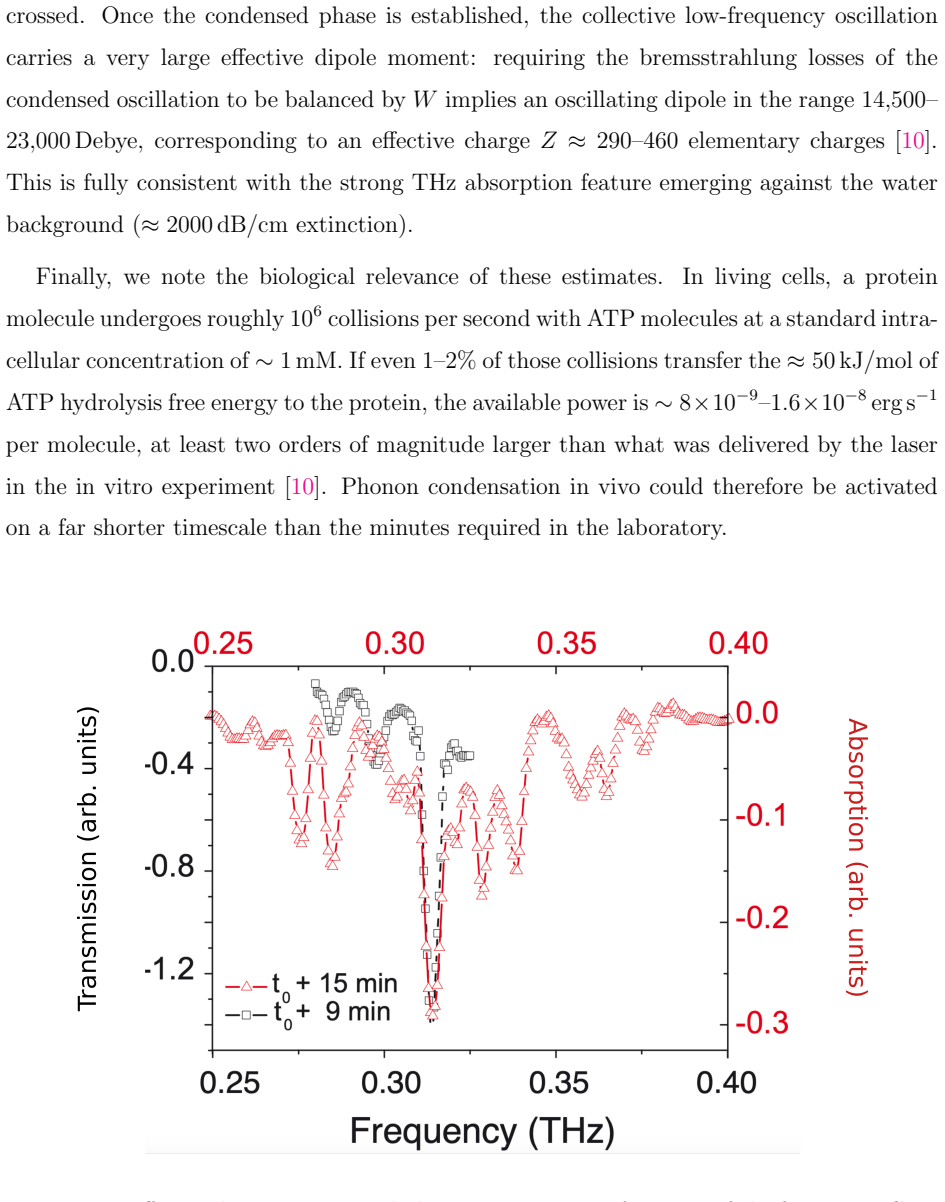
- [VIII.2] The identification of the 0.314 THz BSA feature as the l=2 spheroidal mode of the whole protein is underdetermined by the controls described. The feature appears only when Alexa 488 is covalently bound and the laser is on, but the text does not report controls that exclude a dye-localized vibrational mode or a local photothermal modification of the protein near the attachment sites. The two weaker resonances at 0.278 and 0.285 THz are 'tentatively' assigned to torsional modes predicted at 0.257 and 0.246 THz, leaving discrepancies of about 8–16% that are attributed to non-spherical shape without quantitative modelling. Since this is the primary experimental evidence for phonon condensation, the assignment needs stronger support or the claim needs to be correspondingly weakened.
- [VIII.5, Fig. 14] The claimed 'quantitative' agreement for the concentration-dependent frequency shifts is based on theoretical curves computed with different values of molecular dipole moments (see Fig. 14 caption and Supplementary Materials). With an adjustable dipole moment, the data primarily demonstrate linearity in concentration, not a parameter-free confirmation of the 1/r^3 amplitude. Please state the fitted dipole values, compare them with independent estimates, and provide uncertainties on the experimental slopes; otherwise, this should be described as consistency with the model, not quantitative validation.
- [II.1.2, Eq. (7)] The quartic term is introduced to stabilise the Wu–Austin Hamiltonian, and the text asserts that it 'does not alter the condensation mechanism.' This is a load-bearing assumption for the subsequent rate equations, since the original Hamiltonian has no finite ground state. No derivation or quantitative argument is given for why the quartic stabilisation leaves the condensation mechanism unchanged. Please either supply the argument or explicitly label this as an assumption of the reviewed programme.
minor comments (3)
- [VIII.2] The estimate of the onset timescale relies on balancing the optical input power with bremsstrahlung losses and yields a very large effective dipole of 14,500–23,000 D with an effective charge of 290–460 elementary charges. This is an order-of-magnitude estimate with several broad assumptions; it should be presented as such and its sensitivity to the assumed number of absorbed photons per fluorophore should be indicated.
- [VII.5] The DNA–EcoRI co-resonance at 20–29 THz is obtained from numerical simulation, not from experiment. The phrase 'quantitative agreement with the RRM prediction' is stronger than what is shown, since the RRM itself is an empirical spectral method; rephrasing as 'agreement with the RRM value' would be more precise.
- [General / VII.2] There are several typographical and formatting issues, e.g. 'paqrticle-particle' in Sec. VII.2, and inconsistent use of diacritics such as 'Fr¨ohlich' in the text. These should be corrected in a final polish.
Circularity Check
Core TDVP/Fröhlich derivation and BSA 0.308 THz prediction are non-circular, but two experimental consistency checks in the R-PE and frequency-shift sections are parameter fits presented as support.
-
fitted input called prediction
[Sec. VIII.3, R-PE phonon condensation / torus-mode assignment]
"The collective mode frequency is consistent with the lowest extension mode of a torus of major radius R=37.5 Å and minor radius r=30 Å, yielding a Young modulus E≈5.3 GPa by inversion of the Blevins formula [30], a value that lies squarely between those of myoglobin (3.5 GPa) and BSA (6.75 GPa), both predominantly α-helical proteins like R-PE."
The 71 GHz peak is inserted into the torus-mode formula to solve for E, so the 'agreement' between the observed peak and the mode assignment is imposed by construction rather than predicted. The only empirical residue is that the fitted E falls in a plausible protein range, which is a weak consistency check. Presenting this as support for identifying the 71 GHz feature as the phonon-condensation collective mode is a fitted input doing evidential work.
-
fitted input called prediction
[Sec. VIII.5, frequency shifts / Fig. 14 caption]
"Purple squares and orange stars refer to theoretical outcomes worked out with different values of molecular dipole moments (see Supplementary Materials). The steepening of the slope with laser power is also quantitatively consistent with theory: a larger oscillation amplitude generates a larger oscillating dipole moment and hence a stronger electrodynamic coupling."
In Eq. (22), the interaction energy—and hence the predicted frequency shift—is proportional to the normal-mode action difference set by the oscillating dipole moment. The paper explicitly allows 'different values of molecular dipole moments' for the theoretical curves, meaning the absolute shift amplitude is tuned to the data. The 1/r^3 concentration dependence is still a real prediction, but the claimed quantitative match of the shift magnitude is a fit, not a first-principles outcome.
full rationale
The formal derivation chain is not circular. Eq. (12) is the TDVP expectation value of the Wu–Austin Hamiltonian; Eq. (14) follows from the stated KvN second-order expansion; Eq. (22) gives U(r) from the normal-mode frequency shifts; and the equilibrium cancellation of the 1/r^3 term is argued from the action difference, not assumed by definition. The BSA test is a genuine prediction: Eq. (39) with independently measured E=6.75 GPa and R_H=35 Å gives 0.308 THz against 0.314 THz observed. The self-citations (Refs. [10,11,30]) are to the authors' own prior papers, but the review reproduces the essential equations and the BSA check is parameter-free, so they are not load-bearing as external authority. The circularity concerns are confined to two experimental consistency steps: the R-PE Young modulus is recovered from the very 71 GHz peak it is used to validate, and the theoretical frequency-shift magnitude is computed with adjustable molecular dipole moments. These are partial fits within the experimental pillar; they do not by construction force the condensation transition itself, which has independent, parameter-free support in the BSA prediction and in the numerical rate-equation analysis. On the instructions' scale this warrants a 5, not a 6+: the central derivation has independent content while some supporting 'agreements' reduce to fitted parameters. Possible dye-localized or photothermal artifacts are a correctness risk, not a circularity finding.
Assumptions & free parameters
free parameters (4)
- R-PE Young modulus E =
≈5.3 GPa
- Effective dipole moments for frequency-shift predictions =
not disclosed (Supplementary of Ref. [30])
- Dimensionless rate-equation parameters B, C, quartic couplings =
B=1, C=0.1, Υ=10^-4
- BSA effective oscillating charge/dipole =
Z≈290–460 e; 14,500–23,000 Debye
assumptions (5)
- standard math TDVP restricted to product coherent states yields a faithful classical Hamiltonian for the quantum model
- domain assumption Born-Markov second-order perturbation theory is applicable to the classical Liouville/KvN dynamics of the bath
- ad hoc to paper The quartic stabilising term makes the Wu-Austin Hamiltonian physically well posed and does not alter the condensation mechanism
- domain assumption Debye screening is ineffective for oscillating fields above ~250 MHz in physiological saline
- domain assumption Optical pumping of fluorophores transfers absorbed photon energy into low-frequency protein modes via the 'proteinquake' mechanism
Cite this review
Pith. "Pith review of Hamiltonian Dynamics and Fundamental Phenomena in Biophysics: A Review." pith.science (2026). https://pith.science/paper/LMOXBOBZ
@misc{pith2026260720508,
  author       = {Pith},
  title        = {Pith review of: Hamiltonian Dynamics and Fundamental Phenomena in Biophysics: A Review},
  year         = {2026},
  howpublished = {\url{https://pith.science/paper/LMOXBOBZ}},
  note         = {Machine review of arXiv:2607.20508}
}
read the original abstract
We review a theoretical and experimental programme addressing two closely related phenomena in biophysics: the classical analogue of Fr\"ohlich phonon condensation in macromolecules driven out of thermal equilibrium, and the resulting activation of long-range resonant electrodynamic intermolecular forces.The first is obtained by applying the time-dependent variational principle (TDVP) to the quantum Wu-Austin model,yielding a fully classical Hamiltonian in action-angle variables whose nonlinear rate equations display a nonequilibrium phase transition: supplied energy is channelled into the lowest-frequency collective mode. The second is based on a classical electrodynamic Hamiltonian for two coupled oscillating dipoles, whose normal modes predict long-range (1/r^3) resonant interactions. These are absent at thermal equilibrium but emerge under out-of-equilibrium coherent oscillations.We also discuss how to link Fr\"ohlich rate equations directly to Hamilton equations, clarifying the role of bath-mediated nonlinear couplings and the conditions for strong condensation at room temperature.In addition, TDVP is applied to a Davydov-Holstein-Fr\"ohlich model describing electron-phonon dynamics along a specific DNA sequence and its cognate restriction enzyme EcoRI. The time-domain Fourier cross-spectrum of the resulting electron currents shows a sharp co-resonance peak for the canonical recognition sequence, which disappears under randomisation, providing a sequence-specific electrodynamic signature of DNA-protein recognition.Experimental evidence from THz near-field spectroscopy, fluorescence correlation spectroscopy, and direct protein clustering is reviewed. Together these results support the view that metabolic energy can drive macromolecules into coherent oscillatory states, activating selective long-range electrodynamic forces relevant to biochemical organisation in living matter.
Figures


Figures from the paper (11 more)




Reference graph
Works this paper leans on
-
[1]
S. F. Banani, H. O. Lee, A. A. Hyman, and M. K. Rosen,Biomolecular Condensates: Orga- nizers of Cellular Biochemistry, Nat. Rev. Mol. Cell Biol.18, 285 (2017)
2017
-
[2]
Berry, C
J. Berry, C. P. Brangwynne, and M. Haataja,Physical Principles of Intracellular Organization via Active and Passive Phase Transitions, Rep. Prog. Phys.81, 046601 (2018)
2018
-
[3]
L. J. Sweetlove and A. R. Fernie,The Role of Dynamic Enzyme Assemblies and Substrate Channelling in Metabolic Regulation, Nat. Commun.9, 2136 (2018)
2018
-
[4]
Fr¨ ohlich,Long-Range Coherence and Energy Storage in Biological Systems, Int
H. Fr¨ ohlich,Long-Range Coherence and Energy Storage in Biological Systems, Int. J. Quantum Chem.2, 641 (1968)
1968
-
[5]
Fr¨ ohlich,Long Range Coherence and the Action of Enzymes, Nature (London)228, 1093 (1970)
H. Fr¨ ohlich,Long Range Coherence and the Action of Enzymes, Nature (London)228, 1093 (1970)
1970
-
[6]
Fr¨ ohlich,Selective Long Range Dispersion Forces between Large Systems, Phys
H. Fr¨ ohlich,Selective Long Range Dispersion Forces between Large Systems, Phys. Lett. A39, 153 (1972). 36
1972
-
[7]
Fr¨ ohlich,Long-Range Coherence in Biological Systems, Riv
H. Fr¨ ohlich,Long-Range Coherence in Biological Systems, Riv. Nuovo Cimento7, 399 (1977)
1977
-
[8]
T. M. Wu and S. Austin,Bose Condensation in Biosystems, Phys. Lett. A64, 151 (1977)
1977
Show all 32 references
-
[9]
T. M. Wu and S. Austin,Bose-Einstein Condensation in Biological Systems, J. Theor. Biol. 71, 209 (1978)
1978
-
[10]
Nardecchia, M
I. Nardecchia, M. Pettiniet al.,Out-of-Equilibrium Collective Oscillation as Phonon Conden- sation in a Model Protein, Phys. Rev. X8, 031061 (2018)
2018
-
[11]
Preto, M
J. Preto, M. Pettini, and J. A. Tuszynski,Possible Role of Electrodynamic Interactions in Long-Distance Biomolecular Recognition, Phys. Rev. E91, 052710 (2015)
2015
-
[12]
Preto, E
J. Preto, E. Floriani, V. Calandrini, G. Katona, M. Pettini,Hamiltonian model for en- ergy condensation in classical systems: Relevance to proteins, Phys.Rev.Research8, L022016 (2026)
2026
-
[13]
Faraji, V
E. Faraji, V. Calandrini, P. Kurian, R. Franzosi, S. Mancini, E. Floriani, G. Pettini, and M. Pettini,Electrodynamic Forces Driving DNA–Protein Interactions at Large Distances, Front. Phys.20, 061200 (2025)
2025
-
[14]
Bolterauer,Elementary Arguments that the Wu–Austin Hamiltonian has no Finite Ground State, Bioelectrochem
H. Bolterauer,Elementary Arguments that the Wu–Austin Hamiltonian has no Finite Ground State, Bioelectrochem. Bioenerg.48, 301 (1999)
1999
-
[15]
Kramer and M
P. Kramer and M. Saraceno,Geometry of the Time-Dependent Variational Principle in Quan- tum Mechanics, inGroup Theoretical Methods in Physics(Springer, 1980), pp. 112–121
1980
-
[16]
Kramer,A Review of the Time-Dependent Variational Principle, J
P. Kramer,A Review of the Time-Dependent Variational Principle, J. Phys. Conf. Ser.99, 012009 (2008)
2008
-
[17]
Jauslin and D
H.-R. Jauslin and D. Sugny,Dynamics of Mixed Classical-Quantum Systems, Geometric Quan- tization and Coherent States, inMathematical Horizons for Quantum Physics, IMS-NUS Lec- ture Notes, Vol. 20 (World Scientific, 2010)
2010
-
[18]
B. O. Koopman,Hamiltonian Systems and Transformation in Hilbert Space, Proc. Natl. Acad. Sci. U.S.A.17, 315 (1931)
1931
-
[19]
von Neumann,Zur Operatorenmethode in der klassischen Mechanik, Ann
J. von Neumann,Zur Operatorenmethode in der klassischen Mechanik, Ann. Math.33, 587 (1932)
1932
-
[20]
J. R. Reimers, L. K. McKemmish, R. H. McKenzie, A. E. Mark, and N. S. Hush,Weak, Strong, and Coherent Regimes of Fr¨ ohlich Condensation and Their Applications to Terahertz Medicine and Quantum Consciousness, Proc. Natl. Acad. Sci. U.S.A.106, 4219 (2009). 37
2009
-
[21]
Haken,Cooperative Phenomena in Systems Far from Thermal Equilibrium and in Non- physical Systems, Rev
H. Haken,Cooperative Phenomena in Systems Far from Thermal Equilibrium and in Non- physical Systems, Rev. Mod. Phys.47, 67 (1975)
1975
-
[22]
Cosic,Macromolecular Bioactivity: Is it Resonant Interaction between Macromolecules? Theory and Applications, IEEE Trans
I. Cosic,Macromolecular Bioactivity: Is it Resonant Interaction between Macromolecules? Theory and Applications, IEEE Trans. Biomed. Eng.41, 1101 (1994)
1994
-
[23]
Veljkovic, I
V. Veljkovic, I. Cosic, B. Dimitrijevic, and D. Lalovic,Is it Possible to Analyze DNA and Protein Sequences by the Methods of Digital Signal Processing?, IEEE Trans. Biomed. Eng. 32, 337 (1985)
1985
-
[24]
Giese,Long-Distance Charge Transport in DNA: The Hopping Mechanism, Acc
B. Giese,Long-Distance Charge Transport in DNA: The Hopping Mechanism, Acc. Chem. Res.33, 631 (2000)
2000
-
[25]
H. B. Gray and J. R. Winkler,Electron Transfer in Proteins, Annu. Rev. Biochem.65, 537 (1996)
1996
-
[26]
Faraji, R
E. Faraji, R. Franzosi, S. Mancini, and M. Pettini,Transition between Random and Periodic Electron Currents on a DNA Chain, Int. J. Mol. Sci.22, 7361 (2021)
2021
-
[27]
Cosic,The Resonant Recognition Model of Macromolecular Bioactivity: Theory and Appli- cations(Birkh¨ auser, Basel, 1997)
I. Cosic,The Resonant Recognition Model of Macromolecular Bioactivity: Theory and Appli- cations(Birkh¨ auser, Basel, 1997)
1997
-
[28]
Kurian, A
P. Kurian, A. Capolupo, T. J. A. Craddock, and G. Vitiello,Water-Mediated Correlations in DNA-Enzyme Interactions, Phys. Lett. A382, 33 (2018)
2018
-
[29]
Ansari, J
A. Ansari, J. Berendzen, S. F. Bowne, H. Frauenfelder, I. E. Iben, T. B. Sauke, E. Shyamsun- der, and R. D. Young, Proc. Natl. Acad. Sci. U.S.A.82, 5000 (1985)
1985
-
[30]
Lechelon, M
M. Lechelon, M. Pettiniet al.,Experimental Evidence for Long-Distance Electrodynamic In- termolecular Forces, Sci. Adv.8, eabl5855 (2022)
2022
-
[31]
Perticaroli, J
S. Perticaroli, J. D. Nickels, G. Ehlers, H. O’Neill, Q. Zhang, and A. P. Sokolov,Secondary Structure and Rigidity in Model Proteins, Soft Matter9, 9548 (2013)
2013
-
[32]
Zhang, G
Z. Zhang, G. S. Agarwal, and M. O. Scully,Quantum Fluctuations in the Fr¨ ohlich Condensate of Molecular Vibrations Driven Far from Equilibrium, Phys. Rev. Lett.122, 158101 (2019). 38
2019
Reviewed August 2, 2026 · model on record in the stance chip above.
Discussion (0). Continue with ORCID to comment.