REVIEW 5 major objections 6 minor 47 references
One carefully refined item-item graph, reused three ways, beats specialized multimodal recommenders while using less compute.
Reviewed by Pith at T0; open to challenge. T0 means a machine referee read the full paper against a public rubric. the ladder, T0–T4 →
T0 review · grok-4.5
2026-07-31 10:44 UTC pith:LNMAGFUM
load-bearing objection Solid systems packaging of one cleaned item–item graph reused three ways; empirics are the real load-bearing part, and the NCER hub story is softer than the theorems claim. the 5 major comments →
One Graph, Multiple Gains: Single High-Quality Item-Item Graph for Multimodal Recommendation
The pith
A machine-rendered reading of the paper's core claim, the machinery that carries it, and where it could break.
Core claim
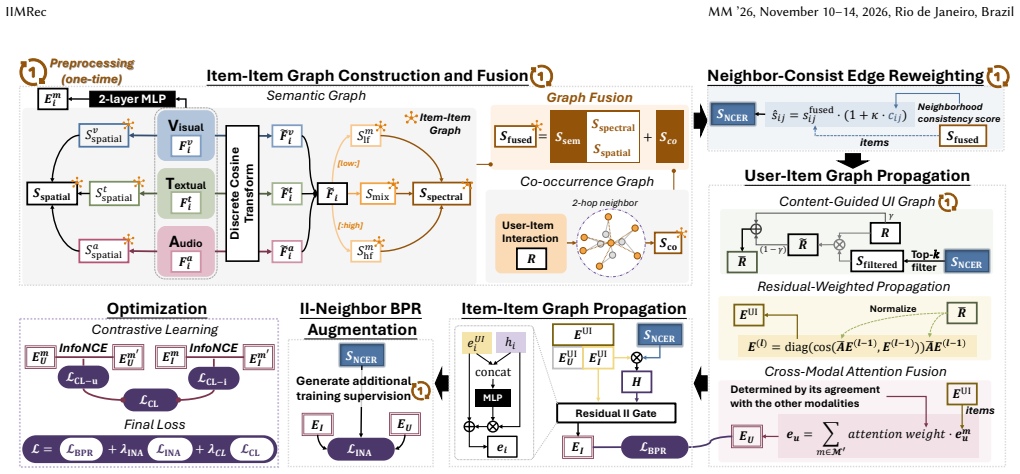
A single item-item graph, refined once by neighborhood-consistency reweighting and then systematically reused for representation gating, interaction-graph expansion, and BPR augmentation, is enough to outperform state-of-the-art multimodal recommenders while cutting training time and memory, with the largest gains under cold-start and sparse conditions.
What carries the argument
Neighborhood Consistency Edge Reweighting (NCER): edges in a fused semantic-plus-co-occurrence item-item graph are multiplied by (1 + κ · shared-neighbor fraction), which the authors prove reduces the Frobenius noise-to-signal ratio when true edges have higher triadic overlap than noise edges; that refined graph then drives Residual II Gate (RIG) and II-Neighbor BPR Augmentation (INA).
Load-bearing premise
True semantic edges systematically share more neighbors than noisy edges, so boosting high-overlap connections actually cleans the graph rather than amplifying hubs or cross-community accidents.
What would settle it
On a dataset where noise edges have equal or higher shared-neighbor scores than true edges, NCER should stop improving (or hurt) Recall/NDCG relative to the unreweighted fused graph, and the cold-start and sparsity gains should shrink or vanish.
If this is right
- Precomputing one refined item-item graph can replace multiple ad-hoc modality graphs and still improve ranking quality.
- Per-item adaptive gates can safely absorb semantic neighbors without forcing every item to take the same propagation strength.
- Top neighbors of observed positives can be used as discounted soft labels without conflicting with standard BPR.
- Cold-start and low-activity users benefit most when virtual edges and soft positives are drawn from a noise-reduced item graph.
- Training cost can fall because the expensive graph work is done once offline and cached.
Where Pith is reading between the lines
- The same triadic-closure filter could be tried on pure collaborative item-item graphs in non-multimodal settings where content features are absent.
- If hub items still dominate shared-neighbor counts, an extra degree-normalized consistency score might be needed before NCER is safe at web scale.
- RIG’s learned gates could be inspected post-hoc as a diagnostic of which items have trustworthy multimodal neighborhoods.
- The build-once, reuse-everywhere pattern may transfer to session or sequential recommenders that already maintain item affinity tables.
Editorial analysis
A structured set of objections, weighed in public.
Referee Report
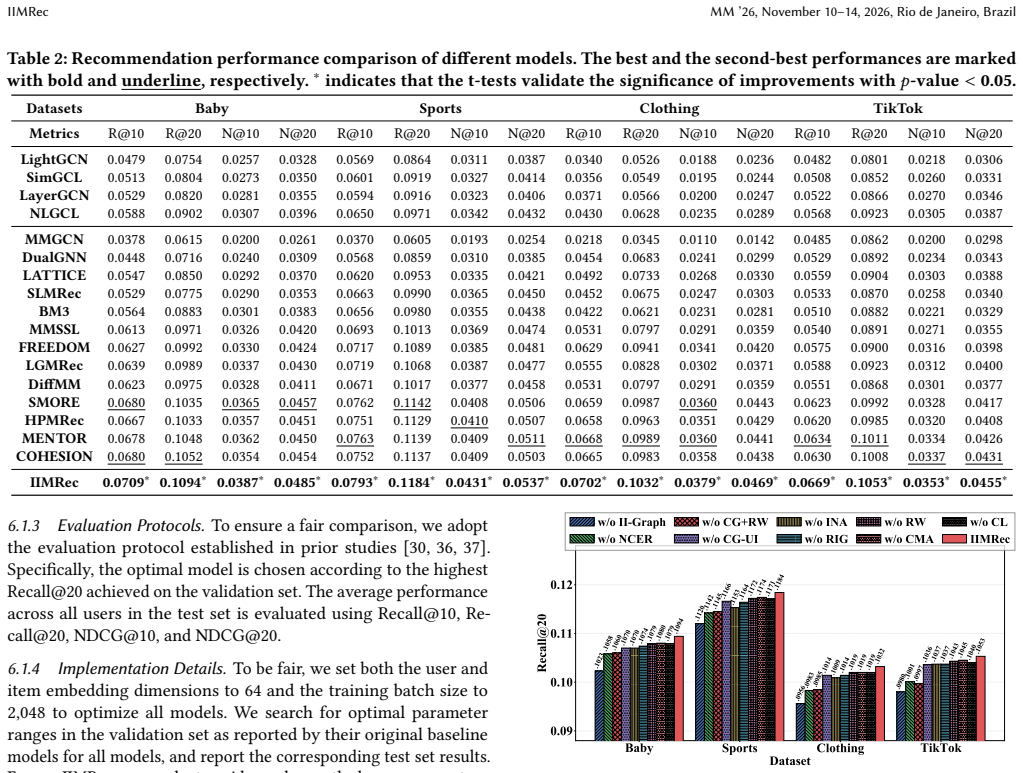
Summary. The paper proposes IIMRec, a multimodal recommendation framework built around a single item-item graph constructed once in preprocessing (fusing semantic KNN graphs over spatial/DCT features with a co-occurrence graph), refined by Neighborhood Consistency Edge Reweighting (NCER), and reused at three pipeline stages: a Residual II Gate (RIG) for item-item propagation, content-guided expansion of the user-item interaction graph, and II-Neighbor BPR Augmentation (INA) that treats top semantic neighbors of positives as discounted soft positives. The paper provides three theorems (NCER noise-ratio reduction, RIG non-degeneracy, INA PAC-Bayes generalization) and an extensive empirical study on four datasets (Baby, Sports, Clothing, TikTok) against a strong battery of recent multimodal baselines, with ablations, sparsity/cold-start splits, an efficiency table, and hyperparameter sweeps. IIMRec wins on essentially every metric, with the largest margins under cold-start and sparse conditions.
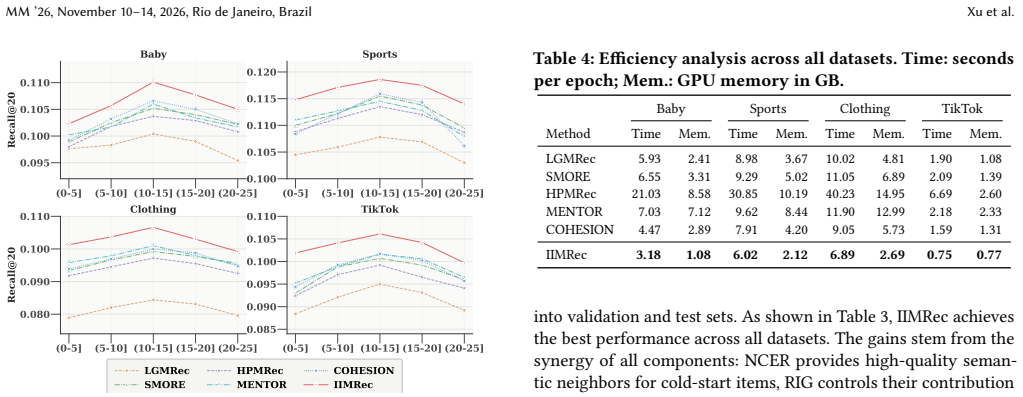
Significance. If the results hold, the contribution is a well-executed, practically useful recipe: the "build once, leverage everywhere" framing is a clean organizational idea, the empirical evaluation is comparatively strong for this venue class (four datasets, recent strong baselines including SMORE, MENTOR, COHESION, HPMRec, significance tests, component ablations, sparsity/cold-start analyses, and an efficiency study showing IIMRec is both faster and lighter than the baselines it beats), and code is promised. The efficiency gains (Table 4: roughly 2-6x faster per epoch and substantially less GPU memory than the strongest competitors) are, if reproducible, as consequential as the accuracy gains. The cold-start results in Table 3 are the most persuasive evidence that the semantic graph is doing real work rather than merely amplifying popularity. However, the theoretical scaffolding is weaker than the empirical core: the central noise-suppression premise of NCER is structurally contradicted by the hub-noise model the paper itself invokes, Theorem 5.3 is close to vacuous, and Theorem 5.5 imports assumptions its proof does not justify. These do not necessarily undermine the empirical claims, but,
major comments (5)
- [§5.1, Theorem 5.2 and Eq. (7)-(8)] The load-bearing premise of NCER is contradicted by the noise model the paper itself names. §1/§2 motivate NCER as a remedy for 'hub effects and feature contamination,' and the co-occurrence graph C = R^T R (Eq. 5) is explicitly popularity-driven. But hub noise is precisely the failure mode of Assumption 5.1: an edge incident on a hub item shares many common neighbors by construction (the hub's degree inflates (BB^T)_ij in Eq. 7), so hub-induced noise edges receive high c_ij and are amplified by the (1 + kappa*c_ij) factor in Eq. 8, not suppressed. Moreover, c_ij is computed from B, the binarized fused graph that already contains the noise: the measurement of 'structural reliability' and the quantity being measured are the same contaminated signal, so Theorem 5.2's condition c_bar_S* > c_bar_N cannot be verified from the observable quantities the proof uses. This needs either (a) an empi
- [Theorem 5.2 vs. Appendix A, Eqs. (17) and (26)] There is a statement-level mismatch between the main-text theorem and its proof. Eq. (17) bounds ||N_hat||_F / ||S_hat||_F (ratio against the full reweighted observed graph), while the appendix derives Eq. (26) in terms of ||N_hat||_F / ||S*_hat||_F (ratio against the clean component) and only gestures at the conversion via an epsilon/||S*||_F correction in the final sentence. Additionally, Eq. (25) claims ||S* o W||_F^2 >= ||S*||_F^2 (1 + kappa c_bar_S*)^2, but W_ii-type entries with c < c_bar pull the norm the other way; the inequality as written only holds with the corresponding O(kappa^2 Var) term that the noise side carries. The proof should be rewritten so the claimed bound and the derived bound are the same object, with the variance terms handled symmetrically.
- [§5.2, Theorem 5.3 and Appendix B] The non-degeneracy result is close to vacuous as stated: since the gate is a sigmoid output, g_i in (0,1) holds by construction for every item, regardless of the gradient analysis. The substantive question — whether gates saturate arbitrarily close to 0 or 1, defeating per-item adaptivity — is not addressed. Worse, the stationary-point argument in Appendix B Case 1 does not establish an interior equilibrium: the positive-side and negative-side gradient contributions (Eqs. 30 and 33) have opposite signs, and the claim that 'the balance is achieved at an interior point because the BPR weights depend on the margin' is an assertion, not an argument; nothing rules out the stationary point lying at the effective boundary. Recommendation: either prove a real statement (e.g., gradients bounded away from zero in a neighborhood of saturation under stated conditions) or downgrade Theorem 5.3 to qua
- [§5.3, Theorem 5.5 and Appendix C] The PAC-Bayes argument has two unjustified steps. First, the augmented triplets (u, j, n') are deterministic functions of the observed interactions (j is drawn from N_II(p) where (u,p) is an observed edge), so the n + delta_eff*n_aug samples are not i.i.d. and the standard bound (Eq. 35) does not transfer to the augmented denominator without an explicit dependence correction. Second, the effective sample size delta_eff = delta^2 * q is imported by analogy to noisy-label learning [11] without derivation; the claim that discount delta reduces 'both the gradient magnitude (linear in delta) and the effective signal strength (linear in delta*q)' and hence contributes delta^2*q samples is a heuristic, not a consequence of the cited framework. Also note a symbol collision: delta is simultaneously the INA discount factor (Eq. 13) and the PAC-Bayes confidence parameter (log(1/delta) in Eq. 19), a
- [§6.3, Figure 2 (ablation design)] The ablation does not isolate the claimed mechanism. w/o NCER shows NCER helps, but any reweighting that amplifies community-dense/popular edges would also help on these benchmarks — popularity amplification is itself a strong prior, and it is the opposite of the claimed 'noise suppression' mechanism. A cheap, decisive control exists: compare NCER against (i) degree/popularity-proportional reweighting (1 + kappa * deg-normalized popularity of i,j) and (ii) random reweighting with the same marginal distribution of multipliers. If NCER beats (i), the triadic-closure mechanism is supported; if it merely matches, the contribution is a well-tuned popularity prior and the paper's framing should be revised. Given that the paper's central pitch is 'high-quality graph' rather than 'better-weighted graph,' this control is load-bearing for the stated contribution.
minor comments (6)
- [Figure 2] Figure 2's variant labels are corrupted in the rendered PDF ('w/o /glyph1197CER', 'w/o I/glyph1197A'), making the two most important ablations (NCER, INA) hard to identify; please fix the font embedding.
- [§4.7, §6.5, Table 4] The 'zero overhead during training' claim should be complemented by reporting the one-time preprocessing cost (multi-modality KNN construction, DCT, BB^T for NCER, neighbor table). Table 4 is per-epoch only; a wall-clock total (preprocessing + training to convergence) would make the efficiency claim airtight.
- [Multiple equations] Typesetting artifacts throughout: 'Í' appears in place of a summation symbol in Eqs. (2), (10), (14), (15); Eq. (10)'s left-hand side is labeled e_u where it should be the fused user embedding expression; missing period after Eq. (6).
- [§4.3, §4.6, §5.3] Notation collision: delta denotes the INA discount (Eq. 13), the PAC-Bayes confidence (Theorem 5.5), and appears in delta_eff = delta^2*q using the INA meaning — please rename one. Similarly, k is used both as the KNN neighbor count and as the normalization constant in Eq. (7); since row-wise top-k gives |N(i)| = k this is consistent, but a sentence noting that (BB^T)_ij <= k would preempt confusion.
- [§6.4] Cold-start protocol (§6.4) cites 'prior setting [22]' (the authors' own work); a brief description of how cold-start items receive modality features and UI-graph edges (they have no interactions, so CG-UI virtual edges flow one way) would help reproducibility.
- [References] Reference [14] (BPR) is cited as arXiv:1205.2618; the canonical citation is the UAI 2009 paper.
Circularity Check
No significant circularity: theorems are conditional inequalities from stated assumptions; main claims are held-out empirical comparisons.
full rationale
IIMRec’s load-bearing claims are (i) empirical gains vs external baselines on held-out Recall/NDCG (Tables 2–4, Fig. 3) and (ii) three conditional theory results. Theorem 5.2 states that NCER reduces the Frobenius noise-to-signal ratio when clean edges have higher average neighborhood consistency than noise edges (Assumption 5.1); the proof multiplies edge weights by (1+κ c_ij) and compares ratios under that premise—it does not define the noise ratio as the reweighting, nor fit c from the target metric. Theorem 5.3 derives the BPR gradient w.r.t. the RIG gate and argues interior stationary points under regularity; the gate is learned, not set equal to the claimed non-degeneracy. Theorem 5.5 is a standard PAC-Bayes bound with an effective sample-size term δ_eff·n_aug that is tighter only when soft positives have positive predictive value—again conditional, not tautological. Hyperparameters (k, κ, γ, δ, λ) are validation-tuned and evaluated on test rankings, which is ordinary supervised practice, not fitted-input-called-prediction of the reported metrics. Author self-citations appear as related work and baselines (COHESION, MENTOR, NLGCL, etc.) but are not invoked as uniqueness theorems that force the method; central comparisons include independent SOTA systems. Concerns that hub noise can violate Assumption 5.1 (triadic closure amplifying hubs) are assumption-validity / correctness issues, not derivation circularity. No step reduces a claimed prediction to its inputs by construction.
Axiom & Free-Parameter Ledger
free parameters (7)
- k (Top-k neighbors for all KNN / INA tables) =
10 (typical optimum)
- κ (NCER reweighting strength) =
0.4 (0.6 on TikTok)
- γ (content-guided UI blend) =
0.2–0.4 preferred
- δ (INA soft-positive discount) =
stable in [0.2,0.6]
- λ_INA and λ_CL (loss weights) =
λ_INA≈0.6; λ_CL≈1e-4
- ρ (DCT low/high frequency split) =
0.5
- temperatures τ, τ_cl =
0.2
axioms (6)
- domain assumption Observed item-item similarity decomposes as clean community-structured S* plus bounded noise N; clean edges have higher neighborhood overlap than noise edges (Assumption 5.1).
- domain assumption Triadic closure / shared-neighbor count is a valid structural reliability signal on item-item affinity graphs built from multimodal features and co-occurrence.
- domain assumption Top neighbors of an interacted item are more likely user-preferred than random non-interacted items, so discounted soft BPR pushes with positive effective sample size δ_eff (INA / Theorem 5.5).
- domain assumption LightGCN-style linear propagation on (expanded) UI graphs and BPR pairwise ranking are appropriate primary objectives for implicit multimodal recommendation.
- standard math Frobenius-norm noise-to-signal ratio and PAC-Bayes bounds with effective noisy-label sample size are meaningful proxies for recommendation generalization here.
- ad hoc to paper Gate MLP outputs remain interior (0,1) under bounded embeddings and non-degenerate initialization so RIG cannot hard-collapse (Theorem 5.3).
invented entities (3)
-
NCER (Neighborhood Consistency Edge Reweighting)
no independent evidence
-
RIG (Residual II Gate)
no independent evidence
-
INA (II-Neighbor BPR Augmentation)
no independent evidence
read the original abstract
Multimodal recommendation leverages item multimodal features alongside collaborative signals to capture user preferences. While item-item graphs have become a key building block in advanced models, existing methods typically construct them with noisy similarity edges and limit their role to a single function of item-item representation propagation, leaving substantial potential untapped. In this paper, we propose IIMRec, a framework that constructs a single high-quality item-item graph during preprocessing and systematically reuses it across three stages of the recommendation pipeline: representation enhancement, interaction graph enhancement, and optimization enhancement. The graph is built by fusing semantic and co-occurrence signals, then refined via Neighborhood Consistency Edge Reweighting (NCER), which applies the triadic closure principle to amplify structurally reliable edges and suppress spurious ones. Once constructed, the graph is leveraged in three complementary ways: (1) Item-item propagation with a Residual II Gate (RIG) that adaptively controls per-item absorption of semantic neighborhood signals for representation enhancement; (2) A content-guided UI graph expansion that introduces virtual user-item edges through high-confidence semantic neighbors for interaction graph enhancement; (3) II-Neighbor BPR Augmentation (INA) that treats top neighbors of positive items as discounted soft positives for optimization enhancement. We provide theoretical analysis showing that NCER reduces the spectral noise-to-signal ratio, RIG converges to a non-degenerate gating regime, and INA yields a tighter generalization bound. Extensive experiments on four datasets demonstrate that IIMRec consistently outperforms state-of-the-art baselines while running faster and consuming less GPU memory, with particularly strong gains under cold-start and sparse-interaction conditions.
Figures

Reference graph
Works this paper leans on
-
[1]
Zheyu Chen, Jinfeng Xu, and Haibo Hu. 2025. Don’t Lose Yourself: Boosting Multimodal Recommendation via Reducing Node-neighbor Discrepancy in Graph Convolutional Network. InICASSP 2025-2025 IEEE International Conference on Acoustics, Speech and Signal Processing (ICASSP). IEEE, 1–5
2025
-
[2]
Zheyu Chen, Jinfeng Xu, Hewei Wang, Shuo Yang, Zitong Wan, and Haibo Hu
-
[3]
2010.Networks, crowds, and markets: Reasoning about a highly connected world
David Easley, Jon Kleinberg, et al. 2010.Networks, crowds, and markets: Reasoning about a highly connected world. Vol. 1. Cambridge university press Cambridge
2010
-
[4]
Zhiqiang Guo, Jianjun Li, Guohui Li, Chaoyang Wang, Si Shi, and Bin Ruan. 2024. LGMRec: Local and Global Graph Learning for Multimodal Recommendation. In Proceedings of the AAAI Conference on Artificial Intelligence, Vol. 38. 8454–8462
2024
-
[5]
Ruining He and Julian McAuley. 2016. VBPR: visual bayesian personalized ranking from implicit feedback. InProceedings of the AAAI conference on artificial intelligence, Vol. 30
2016
-
[6]
Xiangnan He, Kuan Deng, Xiang Wang, Yan Li, Yongdong Zhang, and Meng Wang. 2020. Lightgcn: Simplifying and powering graph convolution network for recommendation. InProceedings of the 43rd International ACM SIGIR conference on research and development in Information Retrieval. 639–648
2020
-
[7]
Yangqin Jiang, Lianghao Xia, Wei Wei, Da Luo, Kangyi Lin, and Chao Huang
-
[8]
Yungi Kim, Taeri Kim, Won-Yong Shin, and Sang-Wook Kim. 2024. MONET: Modality-Embracing Graph Convolutional Network and Target-Aware Attention for Multimedia Recommendation. InProceedings of the 17th ACM International Conference on Web Search and Data Mining. 332–340
2024
-
[9]
Yijie Li, Hewei Wang, Jinfeng Xu, Puzhen Wu, Yunzhong Xiao, Shaofan Wang, and Soumyabrata Dev. 2025. Ddunet: Dual dynamic u-net for highly-efficient cloud segmentation. InIGARSS 2025-2025 IEEE International Geoscience and Remote Sensing Symposium. IEEE, 4705–4711
2025
-
[10]
Julian McAuley, Christopher Targett, Qinfeng Shi, and Anton Van Den Hengel
-
[11]
Nagarajan Natarajan, Inderjit S Dhillon, Pradeep K Ravikumar, and Ambuj Tewari
-
[12]
Rongqing Kenneth Ong and Andy WH Khong. 2025. Spectrum-based modality representation fusion graph convolutional network for multimodal recommen- dation. InProceedings of the Eighteenth ACM International Conference on Web Search and Data Mining. 773–781
2025
-
[13]
Aaron van den Oord, Yazhe Li, and Oriol Vinyals. 2018. Representation learning with contrastive predictive coding.arXiv preprint arXiv:1807.03748(2018)
Pith/arXiv arXiv 2018
-
[14]
Steffen Rendle, Christoph Freudenthaler, Zeno Gantner, and Lars Schmidt-Thieme
-
[15]
Jinhui Tang, Xiaoyu Du, Xiangnan He, Fajie Yuan, Qi Tian, and Tat-Seng Chua
-
[16]
Zhulin Tao, Xiaohao Liu, Yewei Xia, Xiang Wang, Lifang Yang, Xianglin Huang, and Tat-Seng Chua. 2022. Self-supervised learning for multimedia recommenda- tion.IEEE Transactions on Multimedia(2022)
2022
-
[17]
Qifan Wang, Yinwei Wei, Jianhua Yin, Jianlong Wu, Xuemeng Song, and Liqiang Nie. 2021. Dualgnn: Dual graph neural network for multimedia recommendation. IEEE Transactions on Multimedia(2021)
2021
-
[18]
Wei Wei, Chao Huang, Lianghao Xia, and Chuxu Zhang. 2023. Multi-Modal Self-Supervised Learning for Recommendation. InProceedings of the ACM Web Conference 2023. 790–800
2023
-
[19]
Yinwei Wei, Xiang Wang, Liqiang Nie, Xiangnan He, and Tat-Seng Chua. 2020. Graph-refined convolutional network for multimedia recommendation with implicit feedback. InProceedings of the 28th ACM international conference on multimedia. 3541–3549
2020
-
[20]
Yinwei Wei, Xiang Wang, Liqiang Nie, Xiangnan He, Richang Hong, and Tat-Seng Chua. 2019. MMGCN: Multi-modal graph convolution network for personalized recommendation of micro-video. InProceedings of the 27th ACM international conference on multimedia. 1437–1445
2019
-
[21]
Jinfeng Xu, Zheyu Chen, Jinze Li, Shuo Yang, Hewei Wang, Yijie Li, Mengran Li, Puzhen Wu, and Edith CH Ngai. 2025. Mdvt: Enhancing multimodal recommen- dation with model-agnostic multimodal-driven virtual triplets. InProceedings of the 31st ACM SIGKDD Conference on Knowledge Discovery and Data Mining V. 2. 3378–3389
2025
-
[22]
Jinfeng Xu, Zheyu Chen, Jinze Li, Shuo Yang, Wei Wang, Xiping Hu, Raymond Chi-Wing Wong, and Edith CH Ngai. 2025. Enhancing Robustness and General- ization Capability for Multimodal Recommender Systems via Sharpness-Aware Minimization.IEEE Transactions on Knowledge and Data Engineering(2025)
2025
-
[23]
Jinfeng Xu, Zheyu Chen, Wei Wang, Xiping Hu, Sang-Wook Kim, and Edith CH Ngai. 2025. COHESION: Composite Graph Convolutional Network with Dual- Stage Fusion for Multimodal Recommendation. InProceedings of the 48th In- ternational ACM SIGIR Conference on Research and Development in Information Retrieval. 1830–1839
2025
-
[24]
Jinfeng Xu, Zheyu Chen, Shuo Yang, Jinze Li, and Edith CH Ngai. 2025. The Best is Yet to Come: Graph Convolution in the Testing Phase for Multimodal Recommendation. InProceedings of the 33rd ACM International Conference on Multimedia. 6325–6334
2025
-
[25]
Jinfeng Xu, Zheyu Chen, Shuo Yang, Jinze Li, Zitong Wan, Hewei Wang, Weijie Liu, Yijie Li, and Edith CH Ngai. 2025. VI-MMRec: Similarity-Aware Training Cost-free Virtual User-Item Interactions for Multimodal Recommendation.arXiv preprint arXiv:2512.08702(2025)
arXiv 2025
-
[26]
Jinfeng Xu, Zheyu Chen, Shuo Yang, Jinze Li, Hewei Wang, and Edith CH Ngai
-
[27]
Jinfeng Xu, Zheyu Chen, Shuo Yang, Jinze Li, Hewei Wang, Jianheng Tang, Wei Wang, Xiping Hu, and Edith CH Ngai. 2026. Well Begun is Half Done: Training-Free and Model-Agnostic Semantically Guaranteed User Representa- tion Initialization for Multimodal Recommendation. InProceedings of the 49th International ACM SIGIR Conference on Research and Development ...
2026
-
[28]
Jinfeng Xu, Zheyu Chen, Shuo Yang, Jinze Li, Hewei Wang, Wei Wang, Xiping Hu, and Edith Ngai. 2025. NLGCL: Naturally Existing Neighbor Layers Graph Contrastive Learning for Recommendation. InProceedings of the Nineteenth ACM Conference on Recommender Systems. 319–329
2025
-
[29]
Jinfeng Xu, Zheyu Chen, Shuo Yang, Jinze Li, Hewei Wang, Wei Wang, Xip- ing Hu, and Edith Ngai. 2026. NLGCL+: Naturally Existing Neighbour Layers Graph Contrastive Learning with Adaptive Sample Weighting for Multimodal Recommendation.ACM Transactions on Recommender Systems(2026)
2026
-
[30]
Jinfeng Xu, Zheyu Chen, Shuo Yang, Jinze Li, Wei Wang, Xiping Hu, Steven Hoi, and Edith Ngai. 2026. A survey on multimodal recommender systems: Recent advances and future directions.IEEE Transactions on Multimedia(2026)
2026
-
[31]
Junliang Yu, Hongzhi Yin, Xin Xia, Tong Chen, Lizhen Cui, and Quoc Viet Hung Nguyen. 2022. Are graph augmentations necessary? simple graph contrastive learning for recommendation. InProceedings of the 45th international ACM SIGIR conference on research and development in information retrieval. 1294–1303
2022
-
[32]
Jinghao Zhang, Yanqiao Zhu, Qiang Liu, Shu Wu, Shuhui Wang, and Liang Wang
-
[33]
InProceedings of the AAAI Conference on Artificial Intelligence, Vol
Mentor: multi-level self-supervised learning for multimodal recommen- dation. InProceedings of the AAAI Conference on Artificial Intelligence, Vol. 39. 12908–12917
-
[34]
Xin Zhou. 2023. MMRec: Simplifying Multimodal Recommendation.arXiv preprint arXiv:2302.03497(2023)
Pith/arXiv arXiv 2023
-
[35]
Xin Zhou, Donghui Lin, Yong Liu, and Chunyan Miao. 2023. Layer-refined graph convolutional networks for recommendation. In2023 IEEE 39th International Conference on Data Engineering (ICDE). IEEE, 1247–1259
2023
-
[36]
Xin Zhou and Zhiqi Shen. 2023. A tale of two graphs: Freezing and denoising graph structures for multimodal recommendation. InProceedings of the 31st ACM International Conference on Multimedia. 935–943
2023
-
[37]
Xin Zhou, Hongyu Zhou, Yong Liu, Zhiwei Zeng, Chunyan Miao, Pengwei Wang, Yuan You, and Feijun Jiang. 2023. Bootstrap latent representations for multi-modal recommendation. InProceedings of the ACM Web Conference 2023. 845–854. MM ’26, November 10–14, 2026, Rio de Janeiro, Brazil Xu et al. A Proof of Theorem 5.2 (NCER Noise Reduction) Proof. Decompose the...
2023
-
[41]
Hongyu Zhou, Xin Zhou, Zhiwei Zeng, Lingzi Zhang, and Zhiqi Shen. 2023. A comprehensive survey on multimodal recommender systems: Taxonomy, evalua- tion, and future directions.arXiv preprint arXiv:2302.04473(2023)
Pith/arXiv arXiv 2023
-
[46]
• SimGCL[ 31] performs graph contrastive learning by injecting random noise directly into the representation space instead of augmenting the graph structure
General recommendation models: • LightGCN[ 6] simplifies graph convolutional network (GCN)- based collaborative filtering by eliminating redundant compo- nents such as feature transformation and nonlinear activation. • SimGCL[ 31] performs graph contrastive learning by injecting random noise directly into the representation space instead of augmenting the...
-
[47]
• DualGNN[ 17] constructs an auxiliary user-user graph to capture user preference correlations alongside multimodal item features
Multimodal recommendation models: • MMGCN[ 20] employs separate GCNs to process and integrate information from different modalities. • DualGNN[ 17] constructs an auxiliary user-user graph to capture user preference correlations alongside multimodal item features. • LATTICE[ 32] builds item-item semantic graphs from multi- modal features to capture latent ...
2026
-
[2012]
BPR: Bayesian personalized ranking from implicit feedback.arXiv preprint arXiv:1205.2618(2012)
Pith/arXiv arXiv 2012
-
[2013]
Learning with noisy labels.Advances in neural information processing systems26 (2013)
2013
-
[2015]
InProceedings of the 38th international ACM SIGIR conference on research and development in information retrieval
Image-based recommendations on styles and substitutes. InProceedings of the 38th international ACM SIGIR conference on research and development in information retrieval. 43–52
-
[2019]
IEEE Transactions on Knowledge and Data Engineering32, 5 (2019), 855–867
Adversarial training towards robust multimedia recommender system. IEEE Transactions on Knowledge and Data Engineering32, 5 (2019), 855–867
2019
-
[2021]
InProceedings of the 29th ACM International Conference on Multimedia
Mining latent structures for multimedia recommendation. InProceedings of the 29th ACM International Conference on Multimedia. 3872–3880
-
[2024]
DiffMM: Multi-Modal Diffusion Model for Recommendation. (2024)
2024
-
[2025]
InProceed- ings of the 34th ACM International Conference on Information and Knowledge Management
Hypercomplex Prompt-aware Multimodal Recommendation. InProceed- ings of the 34th ACM International Conference on Information and Knowledge Management. 403–414
discussion (0)
Sign in with ORCID, Apple, or X to comment. Anyone can read and Pith papers without signing in.