REVIEW 2 major objections 1 minor 30 references
DD-INR: Dynamics-Driven Implicit Neural Representation for Accelerated Whole-Brain Functional MRI Reconstruction
T0 review · 2 major / 1 minor · reviewed 2026-06-27 · grok-4.3
Pith's one-line read DD-INR reconstructs accelerated fMRI by representing only the time-varying dynamic brain signals with an implicit neural representation, recovering BOLD activations that conventional methods lose.
desk verdict DD-INR splits fMRI into static background plus dynamic INR component, but the split lacks any shown validation that it preserves task BOLD time courses. read the letter →
The pith
A machine-rendered reading of the paper's core claim, the machinery that carries it, and where it could break.
The reading
What carries the argument
Dynamics-driven implicit neural representation applied exclusively to the temporally varying component of the fMRI signal
What would settle it
A controlled simulation or in-vivo experiment in which known ground-truth BOLD activation patterns are not recovered at the expected temporal precision after DD-INR reconstruction would falsify the central claim.
Extended reading notes
Core claim
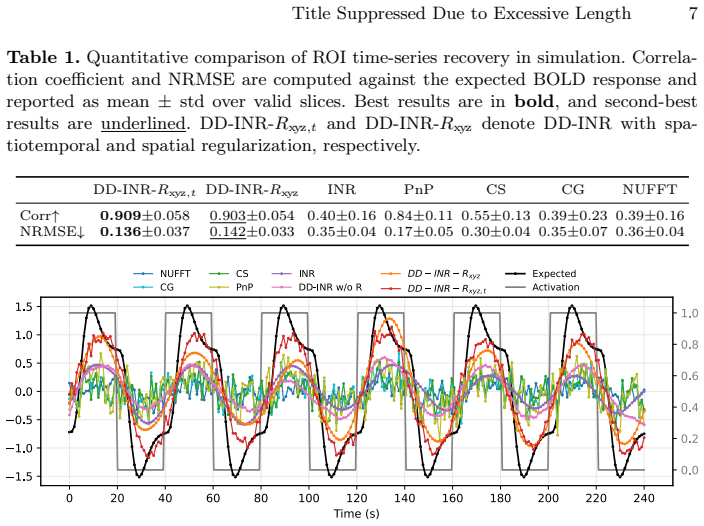
DD-INR splits fMRI data into a static background and a temporally varying dynamic component, then represents only the dynamic component with a dedicated implicit neural representation. This focuses modeling effort on activation-relevant changes while keeping the representation compact. The approach incorporates incoherent time-varying sampling and a tailored spatiotemporal prior, yielding better image quality and more accurate retrieval of activation patterns than traditional methods in both simulation and in-vivo experiments.
Load-bearing premise
fMRI signals can be cleanly divided into a static background and a dynamic component so that modeling only the dynamic part recovers all task-evoked BOLD activity without loss of temporal fidelity.
Editorial extensions
If this is right
- Higher acceleration factors become feasible while preserving both spatial detail and temporal BOLD fidelity.
- Activation maps derived from the reconstructed data more closely match those from fully sampled reference scans.
- The model remains compact because capacity is allocated only to the dynamic component rather than the entire volume.
- The framework supports practical scan times without sacrificing sensitivity to neurovascular responses.
Reading between the lines
- The static-dynamic split may be useful in other dynamic imaging domains where a large unchanging background dominates the signal.
- Explicit separation of components could allow independent tuning of spatial and temporal regularization terms.
- The method suggests that future acceleration schemes could be designed around the assumption that only a small fraction of voxels change over time.
Editorial analysis
A structured set of objections, weighed in public.
Referee Report
Summary. The paper proposes DD-INR, a dynamics-driven implicit neural representation framework for accelerated whole-brain fMRI reconstruction. It decomposes the data into a static background map and a temporally varying dynamic residual that is modeled exclusively by a dedicated INR, leveraging incoherent time-varying sampling and a spatiotemporal prior. The central claim is that this yields superior image quality and better recovery of task-evoked activation patterns compared with traditional methods, as shown in both simulation and in-vivo experiments; source code is released.
Significance. If the decomposition preserves the small BOLD fluctuations without temporal distortion, the method could meaningfully increase feasible acceleration factors while maintaining activation sensitivity, addressing a practical bottleneck in fMRI studies. The public code release strengthens reproducibility.
major comments (2)
- [Abstract / Method description] The headline claim of improved activation-pattern recovery rests on the assumption that the static/dynamic split isolates task-evoked BOLD changes without leakage or attenuation. No equation, algorithm, or quantitative validation (e.g., correlation of extracted dynamic time courses with ground-truth BOLD in simulation) is supplied to confirm this; any implicit temporal regularization in the INR would directly undermine the reported gains.
- [Abstract] The abstract states outperformance “in terms of image quality and retrieval of activation patterns” yet supplies no numerical metrics, error bars, statistical tests, or comparison tables. Without these, the central empirical claim cannot be evaluated for support.
minor comments (1)
- Notation for the INR input coordinates and the precise form of the spatiotemporal prior should be defined explicitly with equations rather than prose.
Simulated Author's Rebuttal
We thank the referee for the constructive feedback on our manuscript. We address each major comment below and outline the revisions we will make to strengthen the paper.
read point-by-point responses
-
Referee: [Abstract / Method description] The headline claim of improved activation-pattern recovery rests on the assumption that the static/dynamic split isolates task-evoked BOLD changes without leakage or attenuation. No equation, algorithm, or quantitative validation (e.g., correlation of extracted dynamic time courses with ground-truth BOLD in simulation) is supplied to confirm this; any implicit temporal regularization in the INR would directly undermine the reported gains.
Authors: We appreciate the referee pointing out the need for explicit validation of the decomposition step. The full manuscript (Section 3) describes the split as computing the static background via temporal averaging across the time series and defining the dynamic residual as the per-voxel subtraction from this mean; only the residual is then passed to the INR. However, we agree that no dedicated quantitative check (such as time-course correlation against simulated ground-truth BOLD) is currently reported. In the revision we will add this analysis in the simulation experiments, together with a short clarification that the INR architecture uses a coordinate-based MLP without explicit low-pass temporal filtering, so that any regularization arises only from the data-driven fitting to the incoherent samples. This will directly address the concern about potential attenuation of task-evoked fluctuations. revision: yes
-
Referee: [Abstract] The abstract states outperformance “in terms of image quality and retrieval of activation patterns” yet supplies no numerical metrics, error bars, statistical tests, or comparison tables. Without these, the central empirical claim cannot be evaluated for support.
Authors: We concur that the abstract would be more informative with concrete numbers. The revised abstract will incorporate the key quantitative results already present in the results section (e.g., mean PSNR/SSIM gains and activation-map Dice or correlation improvements versus the compared baselines), along with a brief statement that differences were assessed with paired statistical tests across the simulation and in-vivo cohorts. revision: yes
Circularity Check
No significant circularity; method is a self-contained modeling choice
full rationale
The DD-INR paper introduces a data-splitting heuristic (static background plus INR-modeled dynamics) and reports empirical gains on image quality and activation detection in simulation and in-vivo data. No quoted equations, self-citations, or fitted-parameter renamings appear in the abstract or description that would make any claimed prediction equivalent to its inputs by construction. The central premise remains an architectural assumption whose validity is tested externally rather than enforced by definition or prior self-work.
Assumptions & free parameters
Cite this review
Pith. "Pith review of DD-INR: Dynamics-Driven Implicit Neural Representation for Accelerated Whole-Brain Functional MRI Reconstruction." pith.science (2026). https://pith.science/paper/LP7JEU7E
@misc{pith2026260610756,
  author       = {Pith},
  title        = {Pith review of: DD-INR: Dynamics-Driven Implicit Neural Representation for Accelerated Whole-Brain Functional MRI Reconstruction},
  year         = {2026},
  howpublished = {\url{https://pith.science/paper/LP7JEU7E}},
  note         = {Machine review of arXiv:2606.10756}
}
read the original abstract
Accelerated acquisition of fMRI enables enhanced detection of neurovascular (BOLD) activity in the brain, but image reconstruction becomes challenging with high k-space undersampling: Task-evoked BOLD signals are small in magnitude, which traditional anatomical MRI reconstruction methods fail to recover, as they favor spatial accuracy over temporal fidelity. We present DD-INR, a Dynamics-Driven Implicit Neural Representation framework tailored for accelerated fMRI that benefits from incoherent time-varying sampling and a tailored spatiotemporal prior, outperforming traditional methods, demonstrated in simulation and in-vivo acquisition, both in terms of image quality and retrieval of activation patterns. DD-INR achieves this by splitting the fMRI data into a static background and a temporally varying dynamic component, representing only the dynamics with a dedicated INR, thereby focusing the model's capacity on activation-relevant changes while remaining compact. In general, DD-INR provides a promising framework for accelerated fMRI reconstruction, with the potential to improve the sensitivity and robustness of fMRI studies within practical scan time limits. The source code is available at https://github.com/JoosenLi/DD-INR.
Figures


Figures from the paper (1 more)

Reference graph
Works this paper leans on
-
[1]
In: International Confer- enceonMedicalImageComputingandComputer-AssistedIntervention
Aggarwal, H., Al-Shikhley, L., Thirion, B.: Across-subject ensemble-learning al- leviates the need for large samples for fMRI decoding. In: International Confer- enceonMedicalImageComputingandComputer-AssistedIntervention. pp.35–45. Springer (2024)
2024
-
[2]
In: 2023 IEEE 9th International Workshop on Computational Advances in Multi-Sensor Adaptive Processing (CAMSAP)
Amor, Z., Comby, P.A., Ster, C.L., Vignaud, A., Ciuciu, P.: Non-cartesian non- fourier fMRI imaging for high-resolution retinotopic mapping at 7 tesla. In: 2023 IEEE 9th International Workshop on Computational Advances in Multi-Sensor Adaptive Processing (CAMSAP). p. 201–205 (2023)
2023
-
[3]
https://doi.org/10.1109/TMI.2006.883453
Aubert-Broche,B.,Griffin,M.,Pike,G.,Evans,A.,Collins,D.:TwentyNewDigital Brain Phantoms for Creation of Validation Image Data Bases25(11), 1410–1416. https://doi.org/10.1109/TMI.2006.883453
-
[4]
In: International Conference on Medical Image Com- puting and Computer-Assisted Intervention
Baik, D., Yoo, J.: Dynamic-aware spatio-temporal representation learning for dy- namic MRI reconstruction. In: International Conference on Medical Image Com- puting and Computer-Assisted Intervention. pp. 174–184. Springer (2025)
2025
-
[5]
Neuroimage43(1), 90–102 (2008)
Chang, C., Thomason, M.E., Glover, G.H.: Mapping and correction of vascular hemodynamic latency in the bold signal. Neuroimage43(1), 90–102 (2008)
2008
-
[6]
In: International Con- ference on Medical Image Computing and Computer-Assisted Intervention
Chen, L., Balter, J.M., Shen, L., Park, J.J.: Single-spoke motion-compensated dy- namic 3d MRI reconstruction via neural representation. In: International Con- ference on Medical Image Computing and Computer-Assisted Intervention. pp. 513–522. Springer (2025)
2025
-
[7]
NeuroImage 174, 97–110 (2018)
Chiew, M., Graedel, N.N., Miller, K.L.: Recovering task fMRI signals from highly under-sampled data with low-rank and temporal subspace constraints. NeuroImage 174, 97–110 (2018)
2018
-
[8]
Journal of Open Source Software10(108), 7743 (2025)
Comby, P.A., Daval-Frérot, G., Pan, C., Tanabene, A., Oudjman, L., Cencini, M., Ciuciu, P.: MRI-nufft: Doing non-cartesian MRI has never been easier. Journal of Open Source Software10(108), 7743 (2025)
2025
Show all 30 references
-
[9]
In: 2025 33rd European Signal Processing Conference (EUSIPCO)
Comby, P.A., Terris, M., Vignaud, A., Ciuciu, P.: Plug-and-play reconstruction for 3d non-cartesian fMRI data. In: 2025 33rd European Signal Processing Conference (EUSIPCO). pp. 1015–1019. IEEE (2025) 10 Q. Li et al
2025
-
[10]
Imaging Neuroscience3, IMAG–a (2025)
Comby, P.A., Vignaud, A., Ciuciu, P.: Snake: A modular realistic fMRI data sim- ulator from the space-time domain to k-space and back. Imaging Neuroscience3, IMAG–a (2025)
2025
-
[11]
Springer Science & Business Media (2011)
Faro, S.H., Mohamed, F.B., Law, M., Ulmer, J.T.: Functional neuroradiology: prin- ciples and clinical applications. Springer Science & Business Media (2011)
2011
-
[12]
IEEE Transactions on Medical Imaging44(5), 2143– 2156 (2025)
Feng, J., Feng, R., Wu, Q., Shen, X., Chen, L., Li, X., Feng, L., Chen, J., Zhang, Z., Liu, C., et al.: Spatiotemporal implicit neural representation for unsupervised dynamic MRI reconstruction. IEEE Transactions on Medical Imaging44(5), 2143– 2156 (2025)
2025
-
[13]
In: 2024 IEEE International Symposium on Biomedical Imaging (ISBI)
Gu, H., Zhang, C., Yu, Z., Rettenmeier, C., Stenger, V.A., Akçakaya, M.: Non- cartesian self-supervised physics-driven deep learning reconstruction for highly- accelerated multi-echo spiral fMRI. In: 2024 IEEE International Symposium on Biomedical Imaging (ISBI). pp. 1–5. IEEE (2024)
2024
-
[14]
In: International Conference on Medical Image Computing and Computer-Assisted Intervention
Hu, C., Li, C., Wang, H., Liu, Q., Zheng, H., Wang, S.: Self-supervised learning for MRI reconstruction with a parallel network training framework. In: International Conference on Medical Image Computing and Computer-Assisted Intervention. pp. 382–391. Springer (2021)
2021
-
[15]
In: International Conference on Medical Image Computing and Computer-Assisted Intervention
Hu, D., Han, K., Cheng, J., Li, G.: Consecutive-contrastive spherical u-net: En- hancing reliability of individualized functional brain parcellation for short-duration fMRI scans. In: International Conference on Medical Image Computing and Computer-Assisted Intervention. pp. 8...
2024
-
[16]
In: International Conference on Medical Image Computing and Computer-Assisted Intervention
Huang, J., Chen, N., Qiu, A.: Topological cycle graph attention network for brain functional connectivity. In: International Conference on Medical Image Computing and Computer-Assisted Intervention. pp. 723–732. Springer (2024)
2024
-
[17]
Medical Image Analysis 73, 102190 (2021)
Huang, W., Ke, Z., Cui, Z.X., Cheng, J., Qiu, Z., Jia, S., Ying, L., Zhu, Y., Liang, D.: Deep low-rank plus sparse network for dynamic mr imaging. Medical Image Analysis 73, 102190 (2021)
2021
-
[18]
Huang, W., Li, H.B., Pan, J., Cruz, G., Rueckert, D., Hammernik, K.: Neural implicitk-spaceforbinning-freenon-cartesiancardiacmrimaging.In:International Conference on Information Processing in Medical Imaging. pp. 548–560. Springer (2023)
2023
-
[19]
In: International Conference on Medical Image Computing and Computer-Assisted Intervention
Huang, W., Wang, N., Liao, C., Lin, Y., Gao, M., Rueckert, D., Setsompop, K.: Physics-informed implicit neural representations for joint b0 estimation and echo planar imaging. In: International Conference on Medical Image Computing and Computer-Assisted Intervention. pp. 481–4...
2025
-
[20]
In: International Conference on Medical Image Computing and Computer-Assisted Intervention
Korkmaz, Y., Cukur, T., Patel, V.M.: Self-supervised MRI reconstruction with un- rolled diffusion models. In: International Conference on Medical Image Computing and Computer-Assisted Intervention. pp. 491–501. Springer (2023)
2023
-
[21]
Proceedings of the national academy of sciences 113(43), E6679–E6685 (2016)
Lewis, L.D., Setsompop, K., Rosen, B.R., Polimeni, J.R.: Fast fMRI can detect os- cillatory neural activity in humans. Proceedings of the national academy of sciences 113(43), E6679–E6685 (2016)
2016
-
[22]
In: 2024 IEEE International Symposium on Biomed- ical Imaging (ISBI)
Li, Q., Liang, D., Li, Y.: Acceleration: Sequentially-scanning dual-energy com- puted tomography imaging using high temporal resolution image reconstruction and temporal extrapolation. In: 2024 IEEE International Symposium on Biomed- ical Imaging (ISBI). pp. 1–5. IEEE (2024)
2024
-
[23]
Petrov, A.Y., Herbst, M., Andrew Stenger, V.: Improving temporal resolution in fMRI using a 3d spiral acquisition and low rank plus sparse (l+s) reconstruction 157, 660–674 (2017)
2017
-
[24]
IEEE transactions on neural networks and learning systems35(1), 770–782 (2022) Title Suppressed Due to Excessive Length 11
Shen, L., Pauly, J., Xing, L.: Nerp: implicit neural representation learning with prior embedding for sparsely sampled image reconstruction. IEEE transactions on neural networks and learning systems35(1), 770–782 (2022) Title Suppressed Due to Excessive Length 11
2022
-
[25]
In: 2025 IEEE 22nd International Symposium on Biomedical Imaging (ISBI)
Shen, X., Feng, J., Feng, R., Zhang, Y., Wei, H.: Imj-plus: Implicit representa- tion for dynamic MRI and coil sensitivity joint reconstruction using low-rank plus sparse regularization. In: 2025 IEEE 22nd International Symposium on Biomedical Imaging (ISBI). pp. 1–5. IEEE (2025)
2025
-
[26]
Advances in neural information processing systems 33, 7462–7473 (2020)
Sitzmann, V., Martel, J., Bergman, A., Lindell, D., Wetzstein, G.: Implicit neural representations with periodic activation functions. Advances in neural information processing systems 33, 7462–7473 (2020)
2020
-
[27]
Ad- vances in neural information processing systems29 (2016)
Sun, J., Li, H., Xu, Z., et al.: Deep admm-net for compressive sensing MRI. Ad- vances in neural information processing systems29 (2016)
2016
-
[28]
IEEE Transactions on Medical Imaging (2025)
Xu, S., Früh, M., Hammernik, K., Lingg, A., Kübler, J., Krumm, P., Rueckert, D., Gatidis, S., Küstner, T.: Self-supervised feature learning for cardiac cine mr image reconstruction. IEEE Transactions on Medical Imaging (2025)
2025
-
[29]
arXiv preprint arXiv:2107.02561 (2021)
Zheng, J., Ramasinghe, S., Lucey, S.: Rethinking positional encoding. arXiv preprint arXiv:2107.02561 (2021)
2021
-
[30]
Physics in Medicine & Biology70(12), 12TR01 (2025)
Zhu, Y., Liu, Y., Zhang, Y., Liang, D.: Implicit neural representation for medical image reconstruction. Physics in Medicine & Biology70(12), 12TR01 (2025)
2025
Reviewed June 27, 2026 · model on record in the stance chip above.
Discussion (0). Continue with ORCID to comment.