Pith. sign in

REVIEW 2 major objections 242 references

The first hours and days of the 2021 explosion of the recurrent symbiotic nova RS Ophiuchii

T0 review · 2 major / 0 minor · reviewed 2026-06-27 · grok-4.3

Pith's one-line read Bipolar ejecta in RS Oph form from white dwarf rotation and power shocks that reprocess into the pseudophotosphere.

desk verdict The paper models new 2021 RS Oph data into an early bipolar ejecta picture and claims internal shocks reprocess enough energy to explain much of the pseudophotosphere light, but the support for that claim is not shown in the abstract. read the letter →

arxiv 2606.13202 v1 pith:LPC2VKOP submitted 2026-06-11 astro-ph.SR

classification astro-ph.SR
keywords recurrentsymbioticnovaRSOphiuchibipolarejectawhitedwarfrotationinternalshocksspectralenergydistributiongamma-rayemissionpseudophotosphere
verification ladder T0 review T1 audit T2 compute T3 formal

The pith

A machine-rendered reading of the paper's core claim, the machinery that carries it, and where it could break.

The reading

The paper models the spectral energy distribution of the 2021 RS Ophiuchi explosion from nine hours before optical maximum through day 42, using optical spectroscopy, simultaneous BVRcIc photometry, and ultraviolet data from prior outbursts. The models show the ejecta developing a bipolar geometry with a flared, density-enhanced equatorial disk and low-density regions along the poles. Luminosity from internal shocks within the equatorial outflow matches the output of the warm white dwarf pseudophotosphere while that component is visible, indicating that reprocessed shock radiation supplies a substantial fraction of the observed light. The authors trace the origin of this geometry to the rotation of the accreting white dwarf, which also creates conditions for gamma-ray production inside the ejecta.

What carries the argument

The bipolar ejecta structure with a flared density-enhanced equatorial disk and low-density bipolar regions, whose formation is attributed to rotation of the accreting white dwarf.

What would settle it

High-resolution imaging or spectroscopy that shows no equatorial density enhancement matching the modeled parameters, or gamma-ray observations that yield fluxes inconsistent with the inferred shock luminosities during the first 42 days.

Watch

Extended reading notes

Core claim

Our SED models revealed an early stage of development of the ejecta bipolar structure, consisting of a flared, density-enhanced equatorial disk and low-density regions in bipolar directions. The comparability of the internal shocks' luminosity in the equatorial outflow, inferred from our model parameters, with the luminosity of the warm WD pseudophotosphere during its presence in the spectrum (until ∼day 42) confirmed that a significant part of its radiation originates from reprocessed shock emission. We explain the formation and evolution of the bipolar ejecta structure during RS Oph explosions by the rotation of the accreting WD. Such an ejecta structure provides a natural framework for th

Load-bearing premise

The observed spectrum can be decomposed into a flared equatorial disk plus low-density bipolar regions such that the calculated internal-shock luminosity directly accounts for the pseudophotosphere output without other major contributions.

Editorial extensions

If this is right

  • Rotation of the accreting white dwarf sets the bipolar geometry of the ejecta in RS Oph explosions.
  • Internal shocks in the equatorial outflow reprocess energy that supplies a significant fraction of the pseudophotosphere luminosity until day 42.
  • The resulting structure generates strong internal shocks capable of producing gamma-ray emission inside the ejecta.
  • The same ejecta geometry and shock reprocessing operated in the 2006 and 1985 outbursts of RS Oph.

Reading between the lines

Editorial extensions of the paper, not claims the author makes directly.

  • If white dwarf spin controls the ejecta opening angle, future high-resolution observations could constrain the rotation period directly from the bipolar structure.
  • Gamma-ray monitoring campaigns timed to the first weeks after outburst could test the predicted internal-shock luminosities.
  • The reprocessing channel may operate in other recurrent novae and could reduce the need to invoke separate energy sources to match observed light curves.
Share X Bluesky LinkedIn Reddit HN

Editorial analysis

A structured set of objections, weighed in public.

Desk editor's note, referee report, simulated authors' rebuttal, and a circularity audit.

Referee Report

2 major / 0 minor

Summary. The paper models the spectral energy distribution (SED) of the 2021 RS Ophiuchi explosion from 9 hours before optical maximum to day 42, using optical spectroscopy, BVRcIc photometry, and supplementary JHKL/UV data from the 2006 and 1985 events. The models indicate an early bipolar ejecta structure consisting of a flared, density-enhanced equatorial disk and low-density bipolar regions. The authors infer that the luminosity of internal shocks in the equatorial outflow is comparable to the warm WD pseudophotosphere luminosity (present until ~day 42), confirming that a significant fraction of the pseudophotosphere radiation is reprocessed shock emission. They attribute the bipolar structure to rotation of the accreting WD and note that this geometry naturally generates internal shocks capable of producing gamma-ray emission.

Significance. If the SED decomposition and luminosity comparison hold, the work provides a physically motivated framework for the early geometry and energy budget of recurrent symbiotic novae, linking ejecta morphology directly to WD rotation and internal shocks. This could inform models of gamma-ray production in such systems and the role of reprocessing in the observed pseudophotosphere.

major comments (2)
  1. [Abstract] Abstract: The abstract states modeling results and conclusions but supplies no information on the functional form of the SED components, fitting procedure, error treatment, or validation against the data, so the support for the central claims cannot be assessed from available text.
  2. [Abstract] Abstract: The central claim that comparability of inferred internal shock luminosity (from equatorial outflow model parameters) to warm WD pseudophotosphere luminosity confirms reprocessing origin depends on the SED model correctly decomposing the flared density-enhanced equatorial disk plus low-density bipolar regions, and on the shock luminosity being computed such that it can be directly compared without unaccounted geometric factors, reprocessing efficiency <1, or contributions from the WD itself or other components. The model also incorporates JHKL and UV data from the 2006/1985 events, which may not match 2021 conditions exactly.

Simulated Author's Rebuttal

2 responses · 0 unresolved

We thank the referee for their thorough and constructive review. We address the two major comments below. We agree that the abstract can be strengthened to better outline the modeling methodology and will revise it accordingly while preserving its concise nature.

read point-by-point responses
  1. Referee: [Abstract] Abstract: The abstract states modeling results and conclusions but supplies no information on the functional form of the SED components, fitting procedure, error treatment, or validation against the data, so the support for the central claims cannot be assessed from available text.

    Authors: The abstract is intentionally brief to highlight the primary results and conclusions. Full details on the SED components (flared equatorial disk with enhanced density, low-density bipolar regions, and separate blackbody for the WD pseudophotosphere), the fitting procedure (chi-squared minimization to combined spectroscopy and BVRcIc photometry), error treatment (incorporating observational uncertainties and parameter covariances), and validation (via reproduction of spectral line profiles and photometric evolution) are provided in Sections 2, 3, and 4 of the manuscript. To address the concern, we will revise the abstract to include a concise statement on the modeling approach and data sources. revision: yes

  2. Referee: [Abstract] Abstract: The central claim that comparability of inferred internal shock luminosity (from equatorial outflow model parameters) to warm WD pseudophotosphere luminosity confirms reprocessing origin depends on the SED model correctly decomposing the flared density-enhanced equatorial disk plus low-density bipolar regions, and on the shock luminosity being computed such that it can be directly compared without unaccounted geometric factors, reprocessing efficiency <1, or contributions from the WD itself or other components. The model also incorporates JHKL and UV data from the 2006/1985 events, which may not match 2021 conditions exactly.

    Authors: The decomposition is validated by the quality of the fits across all epochs and wavelengths, with the equatorial disk component required to match the IR excess and the bipolar components required for the UV/optical. Shock luminosity is computed from the dissipation of kinetic energy in the equatorial outflow using the fitted densities, velocities, and covering factors; geometric dilution and reprocessing are incorporated via the model solid angles, with efficiency near unity as the shocks directly heat the emitting gas. The WD pseudophotosphere is modeled as an independent component. Supplementary JHKL/UV data from prior outbursts are used only to supplement limited 2021 coverage in the earliest phases, with the paper noting the similarity of early evolution; we will add explicit discussion of these assumptions and any potential differences in the revised manuscript. revision: yes

Circularity Check

0 steps flagged · score 0.0 of 10

No circularity: claims rest on independent SED modeling of 2021 data

full rationale

The paper models the 2021 SED with optical spectroscopy and photometry, supplemented by prior-event data, to infer ejecta structure and shock luminosities. The comparability statement is an inference drawn from those fitted parameters rather than a quantity forced by construction or reduced to a self-citation. No step matches the enumerated circularity patterns; the central confirmation is presented as a consistency check against external observations, not an internal redefinition or fitted-input prediction. The derivation chain remains self-contained.

Assumptions & free parameters 0 free parameters · 0 assumptions · 0 invented entities

Insufficient information in the abstract to identify specific free parameters, axioms, or invented entities; the modeling is described only at the level of revealed structures and luminosity comparisons.

how reviews work

0 comments
Cite this review

Pith. "Pith review of The first hours and days of the 2021 explosion of the recurrent symbiotic nova RS Ophiuchii." pith.science (2026). https://pith.science/paper/LPC2VKOP

@misc{pith2026260613202,
  author       = {Pith},
  title        = {Pith review of: The first hours and days of the 2021 explosion of the recurrent symbiotic nova RS Ophiuchii},
  year         = {2026},
  howpublished = {\url{https://pith.science/paper/LPC2VKOP}},
  note         = {Machine review of arXiv:2606.13202}
}
abstract

The accretion of matter on a massive white dwarf (WD) can lead to repeated nuclear explosions on its surface over a timescale of years to decades. The seventh explosion of the recurrent symbiotic nova RS Ophiuchi (RS Oph) was recorded on August 8, 2021. In this paper, we examine its early evolution, from 9 hours before its optical maximum until day 42. We achieved our goal by modeling the spectral energy distribution (SED) using optical spectroscopy and simultaneous $BVR_{\rm C}I_{\rm C}$ photometry, supplemented by $JHKL$ photometry and ultraviolet spectroscopy from previous explosions in 2006 and 1985. Our SED models revealed an early stage of development of the ejecta bipolar structure, consisting of a flared, density-enhanced equatorial disk and low-density regions in bipolar directions. The comparability of the internal shocks' luminosity in the equatorial outflow, inferred from our model parameters, with the luminosity of the warm WD pseudophotosphere during its presence in the spectrum (until $\sim$day 42) confirmed that a significant part of its radiation originates from reprocessed shock emission. We explain the formation and evolution of the bipolar ejecta structure during RS Oph explosions by the rotation of the accreting WD. Such an ejecta structure provides a natural framework for the generation of strong internal shocks and thus $\gamma$-ray emission inside the ejecta.

Figures

Figures reproduced from arXiv: 2606.13202 by the authors.

Figure 1
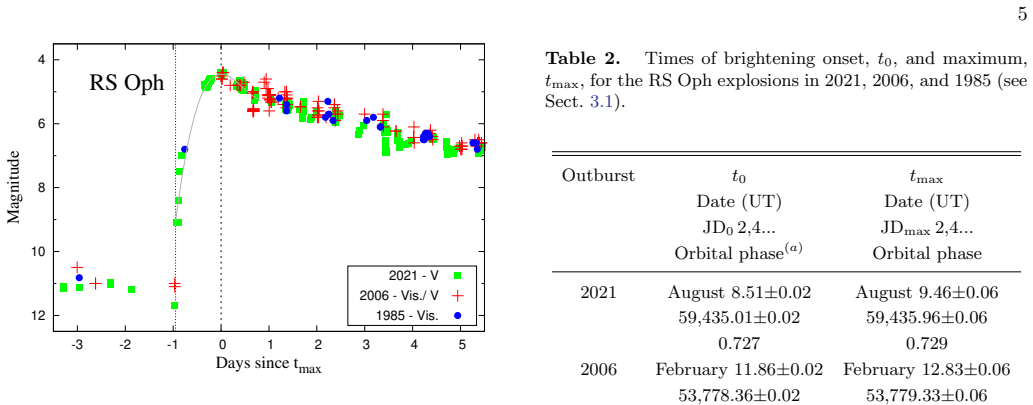
Figure 1. Comparison of V and visual LCs of RS Oph around the maxima of its explosions in 2021, 2006, and 1985. The gray curve is a third-degree polynomial that fits the V magnitudes around the 2021 maximum. The vertical dotted and dashed lines indicate the time of the brightness onset and its maximum, respectively ( [PITH_FULL_IMAGE:figures/full_fig_p005_1.png] view at source ↗
Figure 2
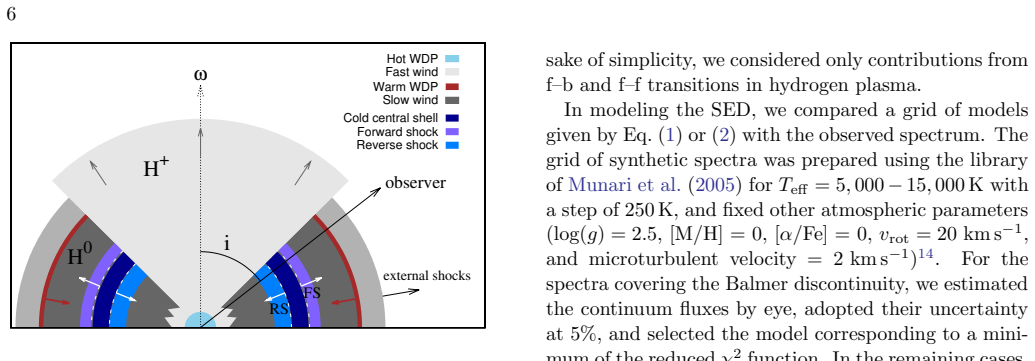
Figure 2. Sketch for the RS Oph ejecta inferred from SED models (side view, Sect. 4.1). Due to the WD rotation, the wind is compressed and slowed down towards the equa￾tor at the expense of the polar directions, where we indicate a fast ionized wind (Sect. 4.2). The radius of the optically thick/thin compressed wind interface (i.e., the warm WDP, brown line) starts to shrink after the maximum due to its expansion and the lowe… view at source ↗
Figure 3
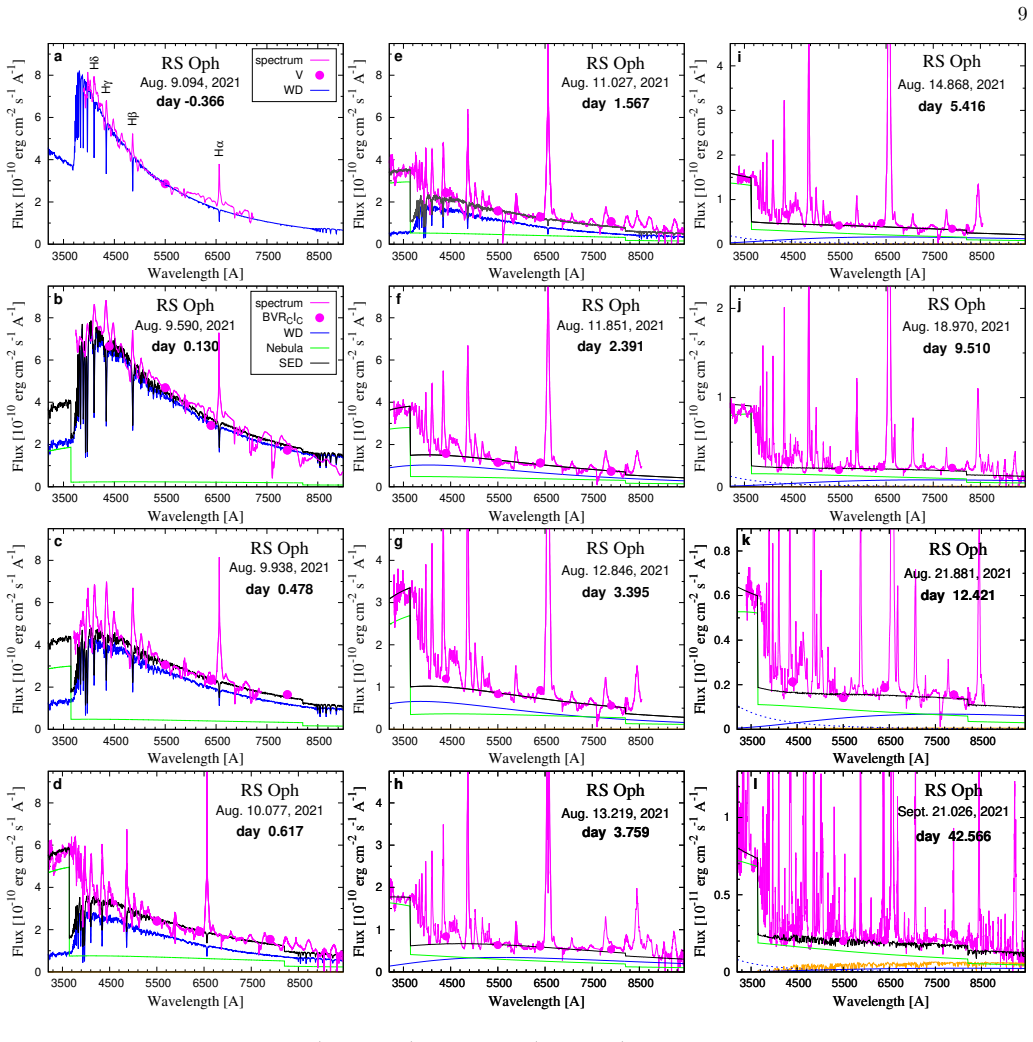
Figure 3. Examples of the observed (in magenta) and modeled (black lines) SEDs of RS Oph at selected dates from the onset of its 2021 outburst. The meaning of lines and symbols is as shown in the keys (top left panels). The solid blue line represents the radiation of the warm WDP, while the dotted blue line (from day 5.416) represents the radiation of the hot WDP (see Sect. 3.2). The spectrum of the giant (in orange, panel l)… view at source ↗
Figures from the paper (10 more)
Figure 4
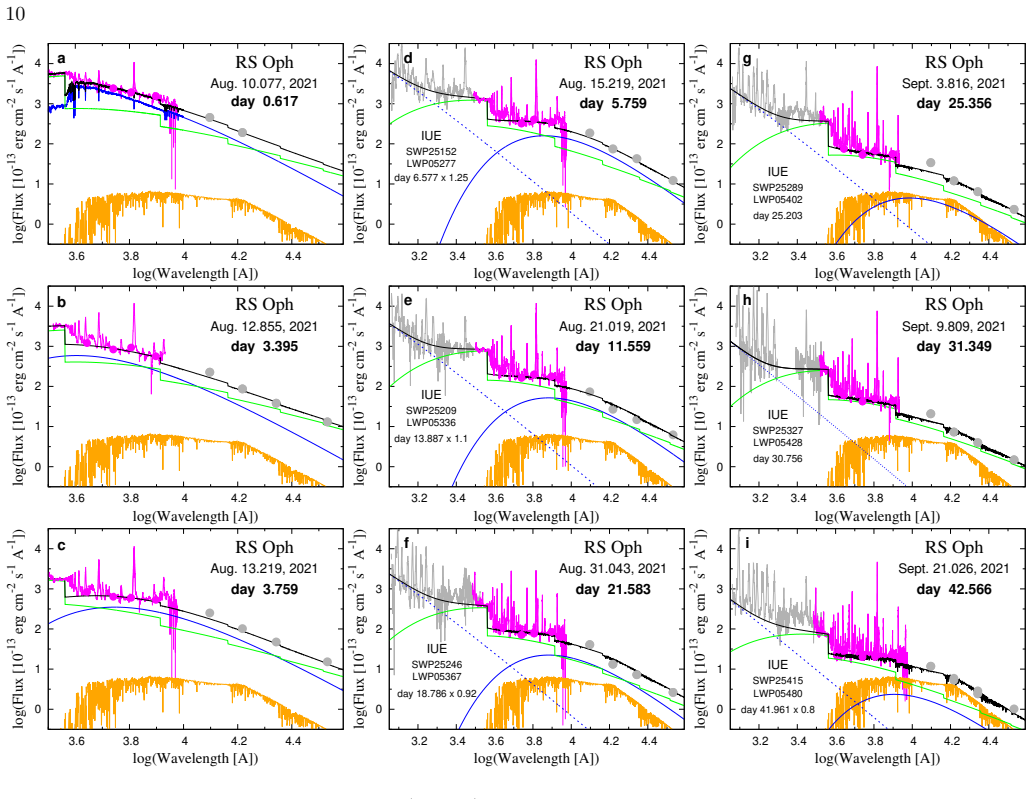
Figure 4. Figure 4: Examples of SED models in the UV/optical/near-IR domain. Given the similarity of the RS Oph eruptions, our observations were supplemented with (near-)simultaneous observations of the previous two eruptions (in gray). Denotation of lines and points is the same as in [P…
Figure 6
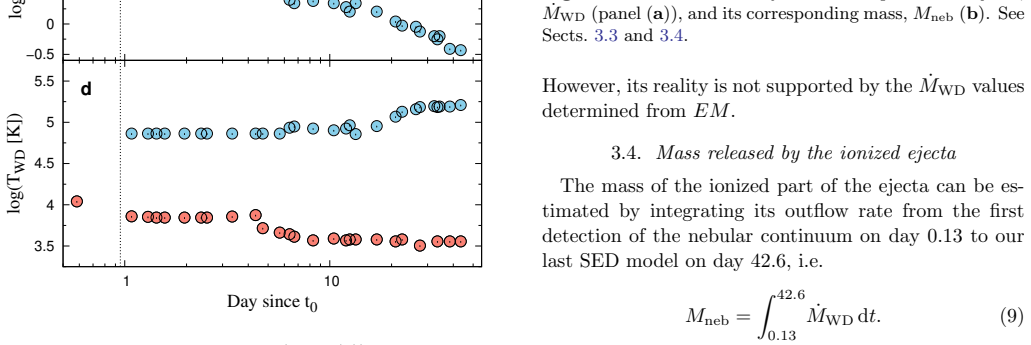
Figure 6. Figure 6: Mass-loss rate by the ionized part of the ejecta, M˙ WD (panel (a)), and its corresponding mass, Mneb (b). See Sects. 3.3 and 3.4. However, its reality is not supported by the M˙ WD values determined from EM. 3.4. Mass released by the ionized ejecta The mass of the ion…
Figure 5
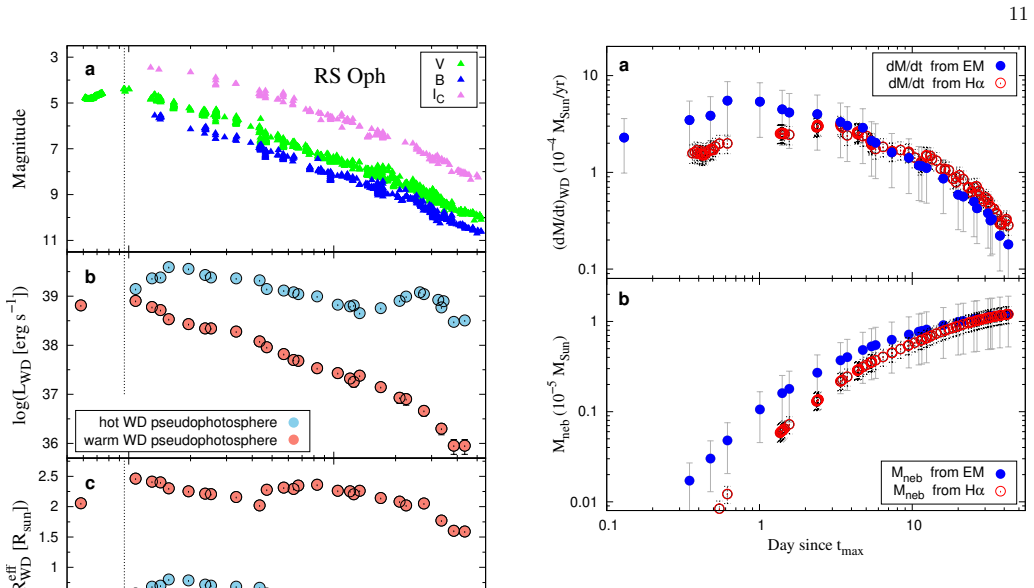
Figure 5. Figure 5: The B, V , and IC LCs (panel (a)), and evolution in LWD (b), R eff WD (c), and TWD (d) parameters from the onset of the RS Oph explosion, t0. Parameter values are in [PITH_FULL_IMAGE:figures/full_fig_p011_5.png]
Figure 7
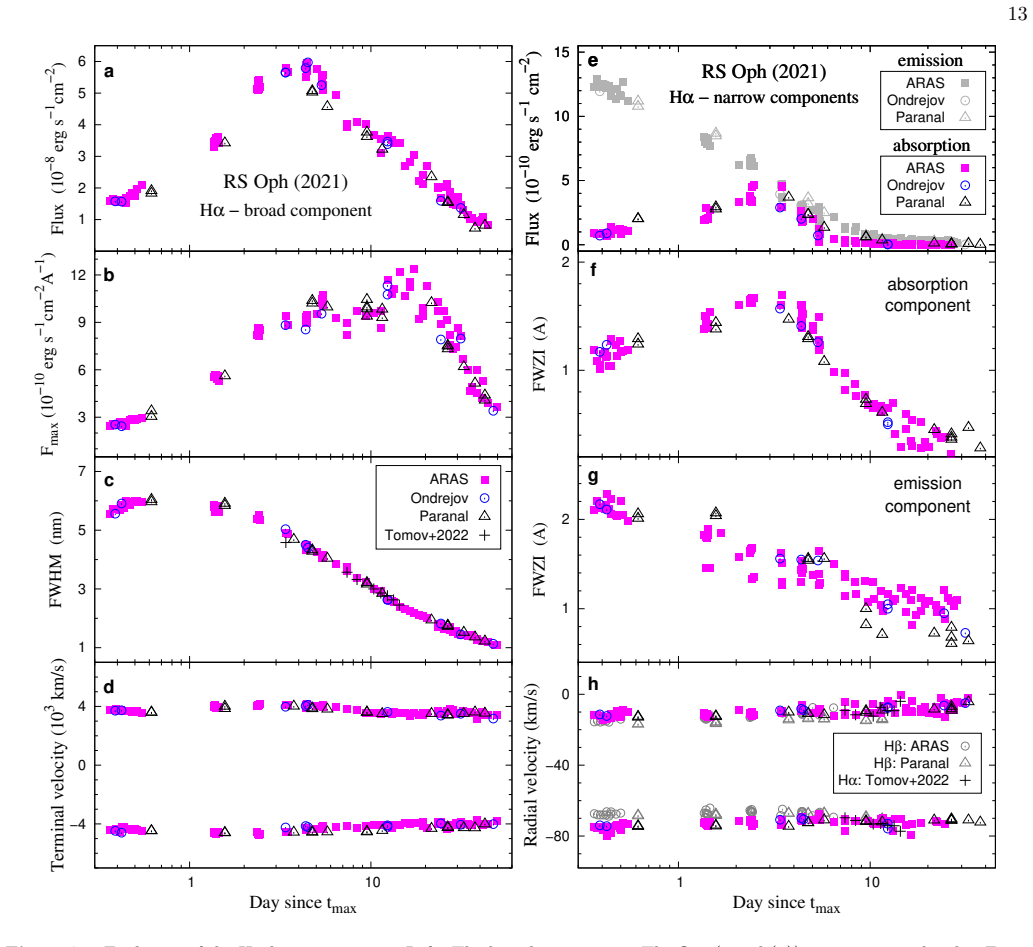
Figure 7. Figure 7: Evolution of the Hα line parameters. Left: The broad component: The flux (panel (a)), its maximum height, Fmax, above the continuum (b), FWHM (c), and terminal velocities of the wings (d). The description is in Sect. 3.5.1 and the data in [PITH_FULL_IMAGE:figures/full…
Figure 8
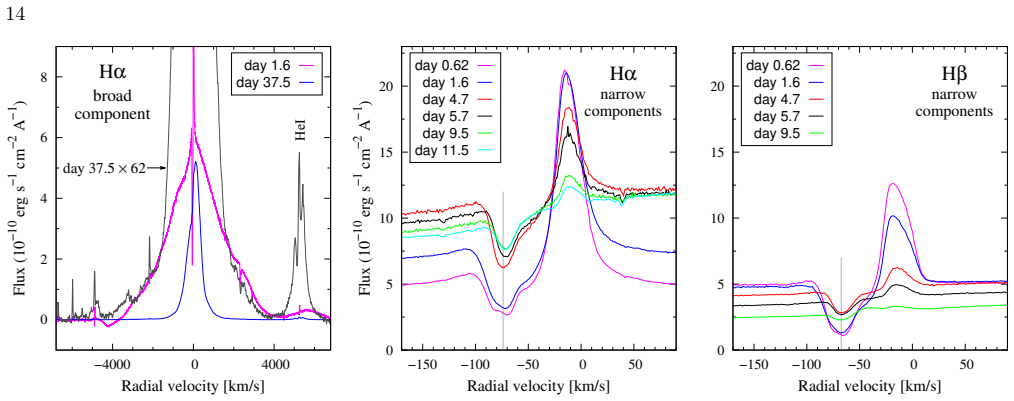
Figure 8. Figure 8: Example of the evolution of the broad and narrow components of the hydrogen line profiles measured on UVES spectra. Left panel shows the Hα broad component measured on days 1.567 and 37.532. This comparison shows a significant narrowing of the line emission core (see …
Figure 9
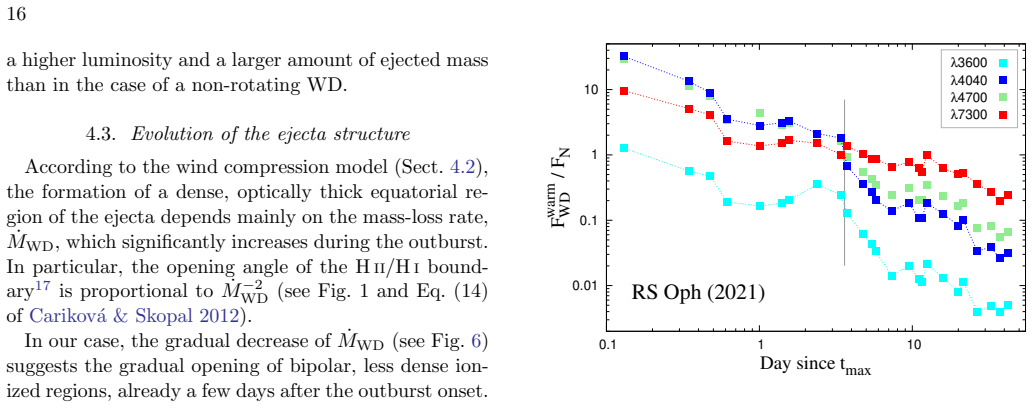
Figure 9. Figure 9: The ratio of fluxes from the warm WDP, F warm WD , and the nebula, FN, at selected wavelengths, 3,600 ˚A, 4,040 ˚A, 4,700 ˚A, and 7,300 ˚A, given by SED models. The rapid decrease of this ratio indicates a rapid opening of bipo￾lar ionized regions (see Sects. 4.3). The…
Figure 10
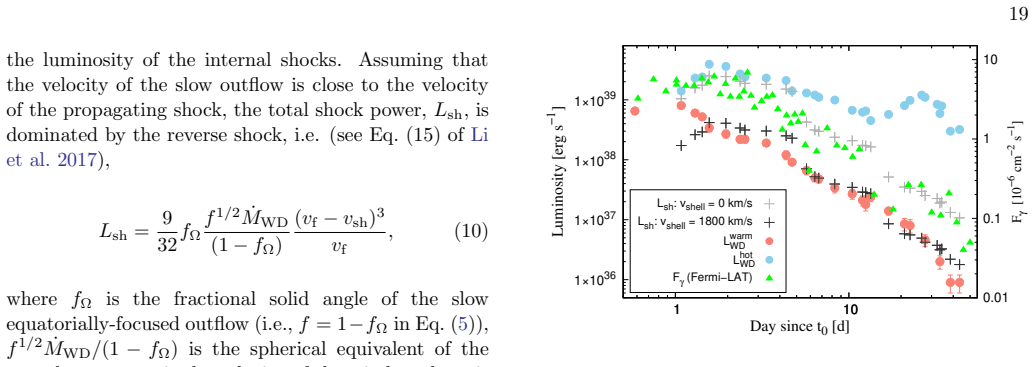
Figure 10. Figure 10: shows a good agreement between the values of L warm WD and Lsh for vsh = 1 800 km s−1 . However, it is likely that the actual values of Lsh are smaller than the values of L warm WD determined directly from the spectrum, because the efficiency of generating shocks is e…
Figure 11
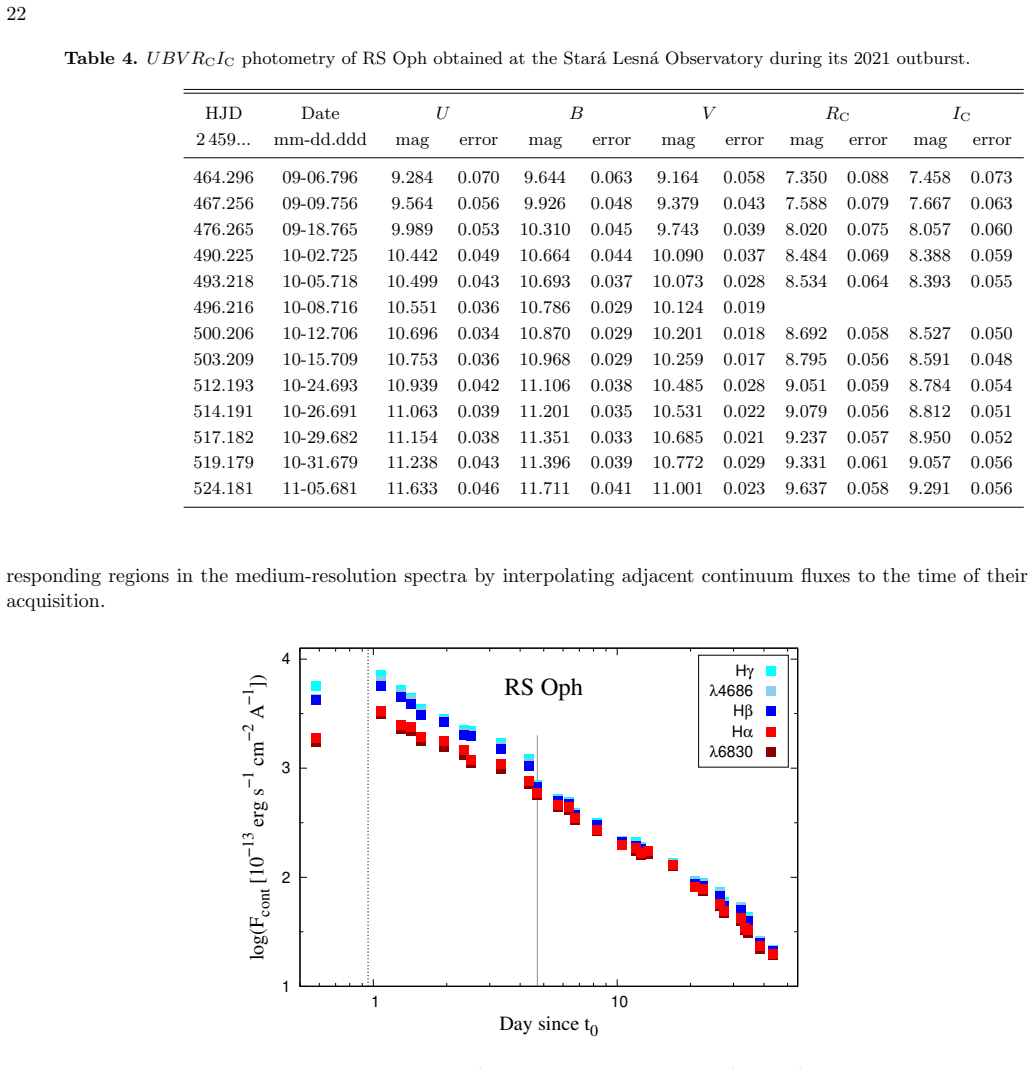
Figure 11. Figure 11: Evolution of the continuum fluxes, Fcont., at/around selected emission lines (see keys) given by SED models. The vertical dotted line indicates the time of the optical maximum (see [PITH_FULL_IMAGE:figures/full_fig_p022_11.png]
Figure 12
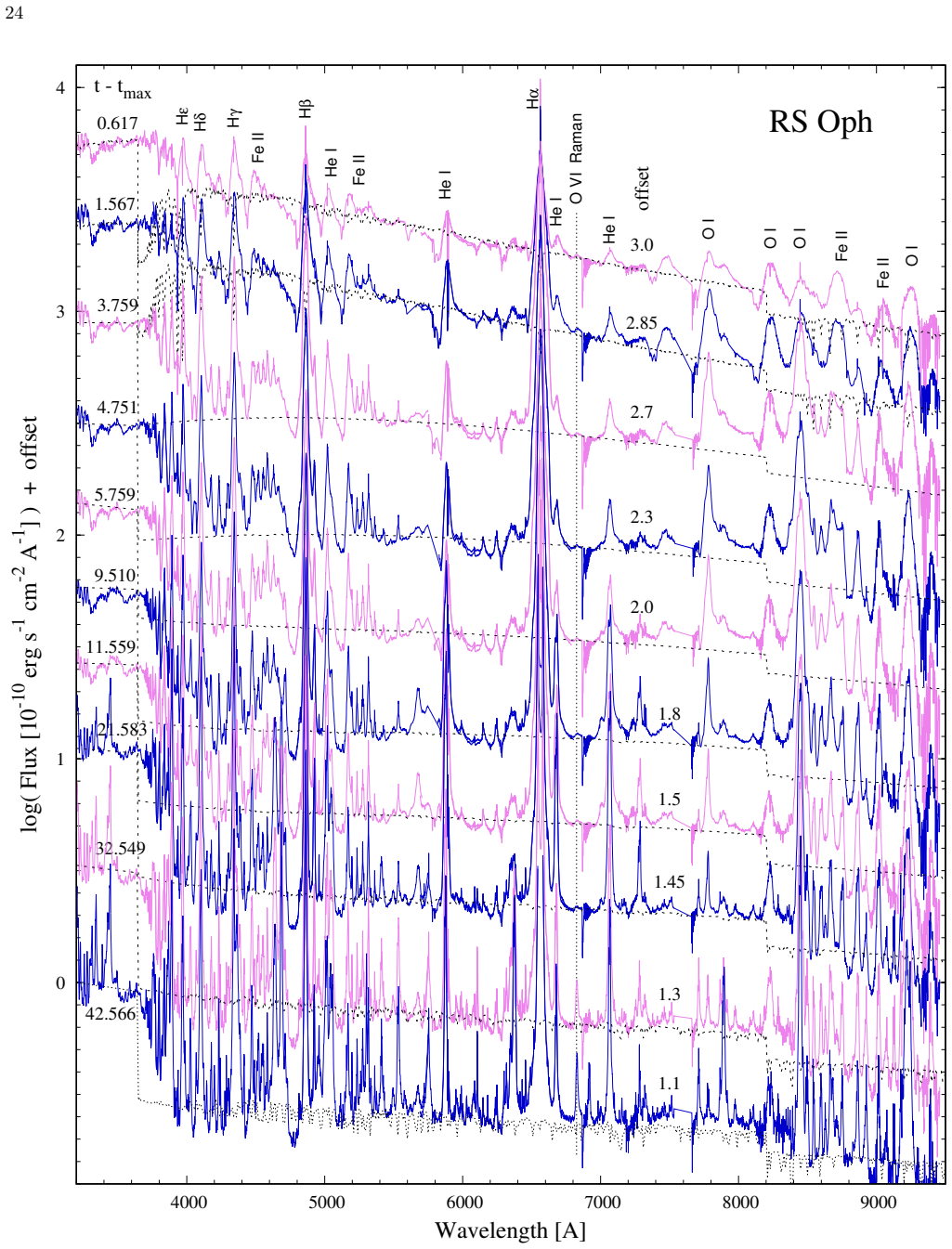
Figure 12. Figure 12: The evolution of the RS Oph optical spectrum measured by the UVES spectrograph from day 0.617 to day 42.566. A strong nebular continuum is indicated by the Balmer jump in emission. It dominates the spectrum from day 3.7, when the overall continuum flattens (see also …
Figure 13
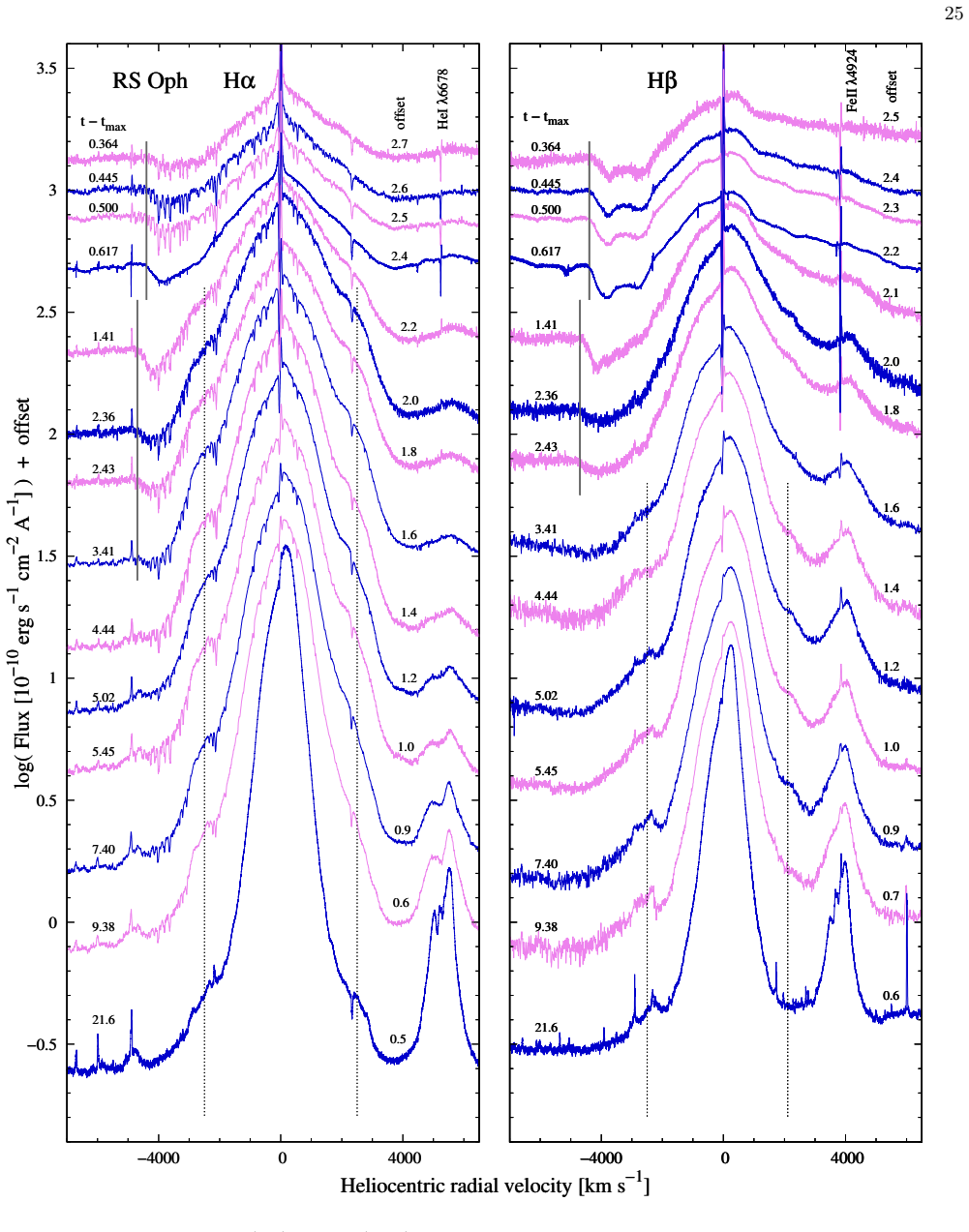
Figure 13. Figure 13: Evolution of the Hα (left) and Hβ (right) line profiles during the first hours and days of the RS Oph explosion. Vertical gray lines denote the terminal velocity of the broad absorption component, while the dotted lines denote emission bumps located around ±2,500 km s…

Discussion (0). Continue with ORCID to comment.

Reference graph

Works this paper leans on

242 extracted references · 181 canonical work pages

  1. [1]

    , keywords =

    Detection of RS Oph with LST-1 and modelling of its HE/VHE gamma-ray emission. , keywords =. doi:10.1051/0004-6361/202452447 , archivePrefix =. 2503.13283 , primaryClass =

  2. [2]

    Nature Astronomy , keywords =

    Proton acceleration in thermonuclear nova explosions revealed by gamma rays. Nature Astronomy , keywords =. doi:10.1038/s41550-022-01640-z , archivePrefix =. 2202.07681 , primaryClass =

  3. [3]

    , keywords =

    On the unidentified bands 6830-7088 in symbiotic stars. , keywords =. doi:10.1093/mnras/190.1.75 , adsurl =

  4. [4]

    , year = 1974, month = jun, volume = 167, pages =

    Photometry of the eclipsing system AR Pavonis. , year = 1974, month = jun, volume = 167, pages =. doi:10.1093/mnras/167.3.635 , adsurl =

  5. [5]

    , year = 1979, month = apr, volume =

    Novalike Object in Vulpecula (Nova Vulpeculae 1979?). , year = 1979, month = apr, volume =

  6. [6]

    V., Chomiuk, L., et al

    Direct evidence for shock-powered optical emission in a nova. Nature Astronomy , keywords =. doi:10.1038/s41550-020-1070-y , archivePrefix =. 2004.05562 , primaryClass =

  7. [7]

    , keywords =

    Multi-wavelength spectroscopic study of shock-driven phenomena in explosive outbursts in symbiotic-like recurrent novae with an emphasis on RS Ophiuchi. , keywords =. doi:10.1051/0004-6361/202245185 , archivePrefix =. 2303.07805 , primaryClass =

  8. [8]

    2009, title Clustering of luminous red galaxies - III

    Near-infrared H- and K-band studies of the 2006 outburst of the recurrent nova RSOphiuchi. , keywords =. doi:10.1111/j.1365-2966.2009.15279.x , archivePrefix =. 0903.3794 , primaryClass =

Show all 242 references
  1. [9]

    , keywords =

    Milliarcsecond N-Band Observations of the Nova RS Ophiuchi: First Science with the Keck Interferometer Nuller. , keywords =. doi:10.1086/529422 , archivePrefix =. 0801.4165 , primaryClass =

  2. [10]

    , eprint =

    A catalogue of symbiotic stars. , eprint =. doi:10.1051/aas:2000280 , adsurl =

  3. [11]

    , keywords =

    On the absence of symbiotic stars in globular clusters. , keywords =. doi:10.1093/mnras/staa1714 , archivePrefix =. 2004.05453 , primaryClass =

  4. [12]

    Information Bulletin on Variable Stars , year = 1976, month = aug, volume =

    Observations of the Symbiotic Star CI Cyg in 1975. Information Bulletin on Variable Stars , year = 1976, month = aug, volume =

  5. [13]

    , year = 1991, month = apr, volume =

    Brightness Variation of the Cool Component of the Symbiotic Eclipsing Variable Ci-Cygni. , year = 1991, month = apr, volume =

  6. [14]

    Izvestiya Ordena Trudovogo Krasnogo Znameni Krymskoj Astrofizicheskoj Observatorii , year = 1992, month = jan, volume =

    The photometric observations of the symbiotic variables Z And, AG Peg and V443 HER in the eighties. Izvestiya Ordena Trudovogo Krasnogo Znameni Krymskoj Astrofizicheskoj Observatorii , year = 1992, month = jan, volume =

  7. [15]

    , keywords =

    AGB winds in interacting binary stars. , keywords =. doi:10.1093/mnras/staa403 , archivePrefix =. 2002.02570 , primaryClass =

  8. [16]

    , keywords =

    UBVRI photometry II: the Cousins VRI system, its temperature and absolute flux calibration, and relevance for two-dimensional photometry. , keywords =. doi:10.1086/130542 , adsurl =

  9. [17]

    , keywords =

    Equatorial Disk Formation around Rotating Stars Due to Ram Pressure Confinement by the Stellar Wind. , keywords =. doi:10.1086/172676 , adsurl =

  10. [18]

    Milli-arcsecond imaging with PIONIER/VLTI

    An incisive look at the symbiotic star <ASTROBJ>SS Leporis</ASTROBJ>. Milli-arcsecond imaging with PIONIER/VLTI. , keywords =. doi:10.1051/0004-6361/201118036 , archivePrefix =. 1112.1514 , primaryClass =

  11. [19]

    , keywords =

    Hubble Space Telescope Imaging of the Expanding Nebular Remnant of the 2006 Outburst of the Recurrent Nova RS Ophiuchi. , keywords =. doi:10.1086/520929 , archivePrefix =. 0706.2745 , primaryClass =

  12. [20]

    , year = 1947, month = jan, volume =

    The Electron Velocity Distribution in Gaseous Nebulae and Stellar Envelopes. , year = 1947, month = jan, volume =. doi:10.1086/144890 , adsurl =

  13. [21]

    , year = 1944, month = jan, volume =

    On the mechanism of accretion by stars. , year = 1944, month = jan, volume =. doi:10.1093/mnras/104.5.273 , adsurl =

  14. [22]

    , keywords =

    Modelling the circumstellar medium in RS Ophiuchi and its link to Type Ia supernovae. , keywords =. doi:10.1093/mnras/stw001 , archivePrefix =. 1601.02635 , primaryClass =

  15. [23]

    , year = 1966, month = oct, volume =

    The Continuous Spectrum of AG Pegasi. , year = 1966, month = oct, volume =

  16. [24]

    , keywords =

    The spectroscopic orbits and other parameters of the symbiotic binary FN Sgr. , keywords =. doi:10.1051/0004-6361:20042552 , adsurl =

  17. [25]

    , keywords =

    Spectroscopic orbits and variations of RS Ophiuchi. , keywords =. doi:10.1051/0004-6361/200811417 , archivePrefix =. 0902.2177 , primaryClass =

  18. [26]

    , keywords =

    The variable light curve of the eclipsing symbiotic star AR Pavonis. , keywords =

  19. [27]

    Contributions of the Astronomical Observatory Skalnate Pleso , keywords =

    A description of the shellspec code. Contributions of the Astronomical Observatory Skalnate Pleso , keywords =

  20. [28]

    , keywords =

    The Relationship between Infrared, Optical, and Ultraviolet Extinction. , keywords =. doi:10.1086/167900 , adsurl =

  21. [29]

    , archivePrefix = "arXiv", eprint =

    Ionization structure of hot components in symbiotic binaries during active phases. , archivePrefix = "arXiv", eprint =. doi:10.1051/0004-6361/201219221 , adsurl =

  22. [30]

    , keywords =

    AMBER/VLTI interferometric observations of the recurrent Nova RS Ophiuchii 5.5 days after outburst. , keywords =. doi:10.1051/0004-6361:20066609 , archivePrefix =. astro-ph/0611602 , primaryClass =

  23. [31]

    , keywords =

    Fermi LAT Gamma-ray Detection of the Recurrent Nova RS Ophiuchi during its 2021 Outburst. , keywords =. doi:10.3847/1538-4357/ac7eb7 , archivePrefix =. 2207.02921 , primaryClass =

  24. [32]

    , keywords =

    Binary orbits as the driver of -ray emission and mass ejection in classical novae. , keywords =. doi:10.1038/nature13773 , archivePrefix =. 1410.3473 , primaryClass =

  25. [33]

    , keywords =

    New Insights into Classical Novae. , keywords =. doi:10.1146/annurev-astro-112420-114502 , archivePrefix =. 2011.08751 , primaryClass =

  26. [34]

    Information Bulletin on Variable Stars , keywords =

    Pulsating AGB star in the symbiotic nova PU Vulpeculae. Information Bulletin on Variable Stars , keywords =

  27. [35]

    13th Cambridge Workshop on Cool Stars, Stellar Systems and the Sun , year = 2005, editor =

    A Wind analysis of an evolved Giant - FUSE and HST/STIS observations of an eclipsing Symbiotic Binary. 13th Cambridge Workshop on Cool Stars, Stellar Systems and the Sun , year = 2005, editor =

  28. [36]

    , keywords =

    An illumination effect and an eccentric orbit for the symbiotic binary PU Vul revealed by 32 yr of optical spectroscopy. , keywords =. doi:10.1093/mnras/sty1686 , archivePrefix =. 1802.10565 , primaryClass =

  29. [37]

    , keywords =

    Low-frequency radio observations of recurrent nova RS Ophiuchi with MeerKAT and LOFAR. , keywords =. doi:10.1093/mnras/stad1418 , archivePrefix =. 2301.10552 , primaryClass =

  30. [38]

    Optical and IR Telescope Instrumentation and Detectors , year = 2000, editor =

    Design, construction, and performance of UVES, the echelle spectrograph for the UT2 Kueyen Telescope at the ESO Paranal Observatory. Optical and IR Telescope Instrumentation and Detectors , year = 2000, editor =. doi:10.1117/12.395512 , adsurl =

  31. [39]

    , keywords =

    Evidence for Multiple Shocks from the -Ray Emission of RS Ophiuchi. , keywords =. doi:10.3847/1538-4357/acc105 , archivePrefix =. 2211.02059 , primaryClass =

  32. [40]

    An IUE Survey of Interstellar H i Lyman-Alpha Absorption. II. Interpretations. , keywords =. doi:10.1086/174139 , adsurl =

  33. [41]

    Astronomy Letters , year = 2000, month = aug, volume =

    UBVRI Photometry of the Eclipsing Symbiotic System CI Cygni in 1996-1999. Astronomy Letters , year = 2000, month = aug, volume =. doi:10.1134/1.1306988 , adsurl =

  34. [42]

    , keywords =

    Collimation and Asymmetry of the Hot Blast Wave from the Recurrent Nova V745 Sco. , keywords =. doi:10.3847/0004-637X/825/2/95 , archivePrefix =. 1604.04537 , primaryClass =

  35. [43]

    , year = 1998, month = apr, volume =

    Stellar radii of M giants. , year = 1998, month = apr, volume =. doi:10.1016/S1384-1076(98)00003-7 , adsurl =

  36. [44]

    , keywords =

    Circumstellar matter around M-giants in symbiotic binaries: SY MUSCAE and RW Hydrae. , keywords =

  37. [45]

    , keywords =

    A review of Bondi-Hoyle-Lyttleton accretion. , keywords =. doi:10.1016/j.newar.2004.06.001 , archivePrefix =. astro-ph/0406166 , primaryClass =

  38. [46]

    The case of slowly accelerating oxygen-rich outflows

    Wind morphology around cool evolved stars in binaries. The case of slowly accelerating oxygen-rich outflows. , keywords =. doi:10.1051/0004-6361/202037492 , archivePrefix =. 2001.04482 , primaryClass =

  39. [47]

    Astronomy Letters , year = 2000, month = mar, volume =

    Evolution of the Symbiotic Star AS338 after Its Strong Outburst in 1983. Astronomy Letters , year = 2000, month = mar, volume =. doi:10.1134/1.20379 , adsurl =

  40. [48]

    , keywords =

    Infrared observations of the 1985 outburst of RS Ophiuchi. , keywords =. doi:10.1093/mnras/234.3.755 , adsurl =

  41. [49]

    Infrared Spectroscopy of Symbiotic Stars. III. First Orbits for Three S-Type Systems. , keywords =. doi:10.1086/319966 , adsurl =

  42. [50]

    , keywords =

    The active phase of the hot component of Z Andromedae. , keywords =. doi:10.1086/175446 , adsurl =

  43. [51]

    I - Their progress and the expansion of the envelope

    A theory of hydrogen shell flashes on accreting white dwarfs. I - Their progress and the expansion of the envelope. II - The stable shell burning and the recurrence period of shell flashes. , keywords =. doi:10.1086/160029 , adsurl =

  44. [52]

    , year = 1982, month = jun, volume =

    A Theory of Hydrogen Shell Flashes on Accreting White Dwarfs - Part Two - the Stable Shell Burning and the Recurrence Period of Shell Flashes. , year = 1982, month = jun, volume =. doi:10.1086/160030 , adsurl =

  45. [53]

    , keywords =

    AG Draconis observed with XMM-Newton. , keywords =. doi:10.1051/0004-6361:20078593 , adsurl =

  46. [54]

    S and D'-Type Systems

    Light Curves of Symbiotic Stars in Massive Photometric Surveys II. S and D'-Type Systems. , keywords =

  47. [55]

    The Physics and Dynamics of Planetary Nebulae

  48. [56]

    , keywords =

    A Prediction Formula of Supersoft X-ray Phase of Classical Novae. , keywords =. doi:10.1088/0004-637X/709/2/680 , archivePrefix =. 0912.1136 , primaryClass =

  49. [57]

    , keywords =

    Discovery of a nova super-remnant cavity surrounding RS Ophiuchi. , keywords =. doi:10.1093/mnrasl/slae016 , archivePrefix =. 2402.05855 , primaryClass =

  50. [58]

    Astronomical photometry

  51. [59]

    Science , keywords =

    Time-resolved hadronic particle acceleration in the recurrent nova RS Ophiuchi. Science , keywords =. doi:10.1126/science.abn0567 , archivePrefix =. 2202.08201 , primaryClass =

  52. [60]

    , keywords =

    Growing White Dwarfs to the Chandrasekhar Limit: The Parameter Space of the Single Degenerate SNIa Channel. , keywords =. doi:10.3847/0004-637X/819/2/168 , archivePrefix =. 1508.03141 , primaryClass =

  53. [61]

    , keywords =

    Simulations of multiple nova eruptions induced by wind accretion in symbiotic systems. , keywords =. doi:10.1093/mnras/staa3600 , archivePrefix =. 2010.05869 , primaryClass =

  54. [62]

    Infrared Spectroscopy of Symbiotic Stars. VII. Binary Orbit and Long Secondary Period Variability of CH Cygni. , keywords =. doi:10.1088/0004-637X/692/2/1360 , archivePrefix =. 0811.0631 , primaryClass =

  55. [63]

    Infrared Spectroscopy of Symbiotic Stars. IX. D-type Symbiotic Novae. , keywords =. doi:10.1088/0004-637X/770/1/28 , adsurl =

  56. [64]

    , keywords =

    Radio Observations of the 1985 Outburst of RS Ophiuchi. , keywords =. doi:10.1086/184687 , adsurl =

  57. [65]

    , keywords =

    HST Eclipse Mapping of Dwarf Nova OY Carinae in Quiescence: an ``Fe II Curtain'' with Mach 6 Velocity Dispersion Veils the White Dwarf. , keywords =. doi:10.1086/174064 , adsurl =

  58. [66]

    Case B calculations for H I and He II

    Recombination-line intensities for hydrogenic ions - I. Case B calculations for H I and He II. , keywords =. doi:10.1093/mnras/224.3.801 , adsurl =

  59. [67]

    Astronomy Letters , keywords =

    Spectrum of the Yellow Symbiotic Star LT Delphini before, during, and after the 2017 Outburst. Astronomy Letters , keywords =. doi:10.1134/S1063773719040042 , archivePrefix =. 1904.11855 , primaryClass =

  60. [68]

    , keywords =

    X-Rays from RS Ophiuchi's 2021 Eruption: Shocks In and Out of Ionization Equilibrium. , keywords =. doi:10.3847/1538-4357/ad1041 , archivePrefix =. 2311.17156 , primaryClass =

  61. [69]

    , keywords =

    Eclipse cross-sections of cool components in double star systems. , keywords =

  62. [70]

    , keywords =

    Orbital Elements of the Symbiotic Star Z Andromedae from Optical Linear Polarization During the Quiescent Phase. , keywords =. doi:10.1088/0004-6256/140/1/235 , adsurl =

  63. [71]

    Harvard College Observatory Bulletin , year = 1941, month = jun, volume = 915, pages =

    Notes on Variable Stars. Harvard College Observatory Bulletin , year = 1941, month = jun, volume = 915, pages =

  64. [72]

    Contributions of the Astronomical Observatory Skalnate Pleso , keywords =

    Insights from mid-infrared interferometric observations of the symbiotic nova RS Ophiuchi. Contributions of the Astronomical Observatory Skalnate Pleso , keywords =. doi:10.31577/caosp.2025.55.3.98 , adsurl =

  65. [73]

    Astrophys

    Optically Thick Winds in Nova Outbursts. Astrophys. J. , keywords =. doi:10.1086/175041 , adsurl =

  66. [74]

    , keywords =

    Evolution of the Symbiotic Nova PU Vul Outbursting White Dwarf, Nebulae, and Pulsating Red Giant Companion. , keywords =. doi:10.1088/0004-637X/750/1/5 , archivePrefix =. 1202.6171 , primaryClass =

  67. [75]

    , keywords =

    X-ray Flashes in Recurrent Novae: M31N 2008-12a and the Implications of the Swift Nondetection. , keywords =. doi:10.3847/0004-637X/830/1/40 , archivePrefix =. 1607.07985 , primaryClass =

  68. [76]

    , keywords =

    A Self-consistent Model for a Full Cycle of Recurrent Novae Wind Mass-Loss Rate and X-Ray Luminosity. , keywords =. doi:10.3847/1538-4357/838/2/153 , archivePrefix =. 1701.01825 , primaryClass =

  69. [77]

    , keywords =

    Physics of nova outbursts: A theoretical model of classical nova outbursts with self-consistent wind mass loss. , keywords =. doi:10.1093/pasj/psac051 , archivePrefix =. 2206.03136 , primaryClass =

  70. [78]

    , keywords =

    A Light-curve Analysis of the X-Ray Flash First Observed in Classical Novae. , keywords =. doi:10.3847/2041-8213/ac85c1 , archivePrefix =. 2208.01249 , primaryClass =

  71. [79]

    , keywords =

    The orbital period of the symbiotic star AX Per. , keywords =. doi:10.1086/130957 , adsurl =

  72. [80]

    Cambridge and New York, Cambridge University Press, 1986, 295 p

    The symbiotic stars. Cambridge and New York, Cambridge University Press, 1986, 295 p. , year = 1986, adsurl =

  73. [81]

    , keywords =

    The nature of symbiotic stars. , keywords =. doi:10.1086/161888 , adsurl =

  74. [82]

    Far-Infrared Data for Symbiotic Stars. II. The IRAS Survey Observations. , keywords =. doi:10.1086/114778 , adsurl =

  75. [83]

    , keywords =

    On the Nature of the Symbiotic Binary CI Cygni. , keywords =. doi:10.1086/115712 , adsurl =

  76. [84]

    , year = 1979, month = apr, volume =

    Novalike Object in Vulpecula. , year = 1979, month = apr, volume =

  77. [85]

    Contributions of the Astronomical Observatory Skalnate Pleso , keywords =

    1 meter telescope in Kolonica saddle - technical parameters and observing programs. Contributions of the Astronomical Observatory Skalnate Pleso , keywords =

  78. [86]

    Introduction to Stellar Winds

  79. [87]

    , keywords =

    Spectroscopic view on the outburst activity of the symbiotic binary AG Draconis. , keywords =. doi:10.1093/mnras/stv2807 , archivePrefix =. 1512.03209 , primaryClass =

  80. [88]

    Nature Astronomy , keywords =

    A nova outburst powered by shocks. Nature Astronomy , keywords =. doi:10.1038/s41550-017-0222-1 , archivePrefix =. 1709.00763 , primaryClass =

  81. [89]

    , eprint =

    Multiperiodic variations in the last 104-yr light curve of the symbiotic star BF Cyg. , eprint =. doi:10.1111/j.1365-2966.2005.09895.x , adsurl =

  82. [90]

    , keywords =

    Activity cycle of the giant star of Z Andromedae and its spin period. , keywords =. doi:10.1111/j.1365-2966.2008.12847.x , archivePrefix =. 0712.2120 , primaryClass =

  83. [91]

    , keywords =

    The Peculiar Light Curve of the Symbiotic Star AX Per of the Last 125 Years. , keywords =. doi:10.1088/0004-6256/146/5/117 , archivePrefix =. 1308.3617 , primaryClass =

  84. [92]

    , keywords =

    H alpha as a Tracer of Mass Loss from OB Stars. , keywords =. doi:10.1086/166097 , adsurl =

  85. [93]

    , keywords =

    High-resolution imaging of the evolving bipolar outflows in symbiotic novae: The case of the RS Ophiuchi 2021 nova outburst. , keywords =. doi:10.1051/0004-6361/202451364 , archivePrefix =. 2407.05794 , primaryClass =

  86. [94]

    , keywords =

    On the progenitors of Type Ia supernovae. , keywords =. doi:10.1016/j.physrep.2018.02.002 , archivePrefix =. 1802.03125 , primaryClass =

  87. [95]

    The Observatory , year = 1984, month = jun, volume =

    Wind accretion onto white dwarfs. The Observatory , year = 1984, month = jun, volume =

  88. [96]

    , keywords =

    The Common Envelope Phase in the Outbursts of Classical Novae. , keywords =. doi:10.1086/168836 , adsurl =

  89. [97]

    , keywords =

    Shaping of nova remnants by binary motion. , keywords =. doi:10.1093/mnras/284.1.137 , adsurl =

  90. [98]

    , keywords =

    Chandra Detection of Extended X-ray Emission from the Recurrent Nova RS Ophiuchi. , keywords =. doi:10.1088/0004-637X/707/2/1168 , archivePrefix =. 0910.5484 , primaryClass =

  91. [99]

    , keywords =

    Population synthesis for symbiotic stars with white dwarf accretors. , keywords =. doi:10.1111/j.1365-2966.2006.10947.x , archivePrefix =. astro-ph/0608449 , primaryClass =

  92. [100]

    , keywords =

    Particle acceleration and non-thermal emission during the V407 Cygni nova outburst. , keywords =. doi:10.1051/0004-6361/201220289 , archivePrefix =. 1209.0625 , primaryClass =

  93. [101]

    , keywords =

    Gamma-ray emission from internal shocks in novae. , keywords =. doi:10.1051/0004-6361/201731692 , archivePrefix =. 1710.05515 , primaryClass =

  94. [102]

    , eprint =

    First Resolved Images of the Mira AB Symbiotic Binary at Centimeter Wavelengths. , eprint =. doi:10.1086/500303 , adsurl =

  95. [103]

    Annals of Harvard College Observatory , keywords =

    A new eclipsing star of unusual character. Annals of Harvard College Observatory , keywords =

  96. [104]

    , year = 2011, month = sep, volume = 123, pages =

    High-Dispersion Spectroscopy of BF Cygni at the Beginning of the 2006 Outburst. , year = 2011, month = sep, volume = 123, pages =. doi:10.1086/662076 , adsurl =

  97. [105]

    Research Notes of the American Astronomical Society , year = 2019, month = feb, volume =

    First Release of the New Online Database of Symbiotic Variables. Research Notes of the American Astronomical Society , year = 2019, month = feb, volume =. doi:10.3847/2515-5172/ab0429 , adsurl =

  98. [106]

    Thermal emission

    Shocks in nova outflows - I. Thermal emission. , keywords =. doi:10.1093/mnras/stu844 , archivePrefix =. 1403.1579 , primaryClass =

  99. [107]

    , keywords =

    Gamma-ray novae as probes of relativistic particle acceleration at non-relativistic shocks. , keywords =. doi:10.1093/mnras/stv742 , archivePrefix =. 1501.05308 , primaryClass =

  100. [108]

    , keywords =

    Does Kozai Resonance Drive CH Cygni?. , keywords =. doi:10.1086/300404 , adsurl =

  101. [109]

    , keywords =

    IUE low resolution observations of the symbiotic star CH Cygni in 1979-1986. , keywords =

  102. [110]

    , keywords =

    On the Nature of the Symbiotic Star BF Cygni. , keywords =. doi:10.1086/115229 , adsurl =

  103. [111]

    , keywords =

    On the nova-like eruptions of symbiotic binaries. , keywords =. doi:10.1093/mnras/256.2.177 , adsurl =

  104. [112]

    , keywords =

    On the Nature of the Symbiotic Binary AX Persei. , keywords =. doi:10.1086/116085 , adsurl =

  105. [113]

    , keywords =

    The Inscrutable Hot Component in the Symbiotic Binary Z Andromedae. , keywords =. doi:10.1086/118131 , adsurl =

  106. [114]

    Advances in Space Research , keywords =

    Mm/submm observations of symbiotic binary stars: implications for the mass loss and mass exchange. Advances in Space Research , keywords =. doi:10.1016/S0273-1177(02)00599-9 , archivePrefix =. astro-ph/0102198 , primaryClass =

  107. [115]

    Symbiotic Stars Probing Stellar Evolution , year = 2003, editor =

    Ellipsoidal Variability of Symbiotic Giants. Symbiotic Stars Probing Stellar Evolution , year = 2003, editor =

  108. [116]

    Baltic Astronomy , keywords =

    Symbiotic Stars: Continually Embarrassing Binaries. Baltic Astronomy , keywords =

  109. [117]

    , keywords =

    No Expanding Fireball: Resolving the Recurrent Nova RS Ophiuchi with Infrared Interferometry. , keywords =. doi:10.1086/507584 , archivePrefix =. astro-ph/0607399 , primaryClass =

  110. [118]

    , keywords =

    ^ 7 Be detection in the 2021 outburst of RS Oph. , keywords =. doi:10.1093/mnras/stac2708 , archivePrefix =. 2209.11008 , primaryClass =

  111. [119]

    , keywords =

    Expanding Bipolar X-Ray Structure After the 2006 Eruption of RS Oph. , keywords =. doi:10.3847/1538-4357/ac4583 , archivePrefix =. 2110.04315 , primaryClass =

  112. [120]

    , year = 1985, month = jan, volume =

    RS Ophiuchi. , year = 1985, month = jan, volume =

  113. [121]

    , keywords =

    Temperature and luminosity of hot components in symbiotic stars. , keywords =

  114. [122]

    , keywords =

    Temperatures and luminosities of symbiotic novae. , keywords =

  115. [123]

    , keywords =

    Spectral classification of the cool giants in symbiotic systems. , keywords =. doi:10.1051/aas:1999105 , adsurl =

  116. [124]

    , keywords =

    Photometry of AS 296 in outbursts : a puzzling color evolution. , keywords =

  117. [125]

    , keywords =

    The Ongoing Outburst of the Eclipsing Symbiotic Nova AS 296: The First 1200 days. , keywords =. doi:10.1086/116238 , adsurl =

  118. [126]

    UBV-JHKL Photometry Over Days 1200-2300

    The Ongoing Outburst of the Eclipsing Symbiotic Nova as 296=FG Ser.II. UBV-JHKL Photometry Over Days 1200-2300. , keywords =. doi:10.1086/117403 , adsurl =

  119. [127]

    Astronomy Reports , year = 1997, month = nov, volume =

    The classical symbiotic star YY Herculis. Astronomy Reports , year = 1997, month = nov, volume =

  120. [128]

    The symbiotic star YY Herculis. I. Photometric history over 1890-1996. , keywords =

  121. [129]

    , keywords =

    An extensive library of 2500 10 500 A synthetic spectra. , keywords =. doi:10.1051/0004-6361:20042490 , archivePrefix =. astro-ph/0502047 , primaryClass =

  122. [130]

    Central Bureau Electronic Telegrams , year = 2006, month = aug, volume = 596, adsurl =

    BF Cygni. Central Bureau Electronic Telegrams , year = 2006, month = aug, volume = 596, adsurl =

  123. [131]

    The Astronomer's Telegram , keywords =

    The symbiotic star YY Her is in outburst. The Astronomer's Telegram , keywords =

  124. [132]

    arXiv e-prints , keywords =

    The Symbiotic Stars. arXiv e-prints , keywords =. doi:10.48550/arXiv.1909.01389 , archivePrefix =. 1909.01389 , primaryClass =

  125. [133]

    Contributions of the Astronomical Observatory Skalnate Pleso , keywords =

    Symbiotic novae. Contributions of the Astronomical Observatory Skalnate Pleso , keywords =. doi:10.31577/caosp.2025.55.3.47 , archivePrefix =. 2412.20499 , primaryClass =

  126. [134]

    A pictorial atlas of the spectroscopic evolution: the first 18 days

    The 2021 outburst of RS Oph. A pictorial atlas of the spectroscopic evolution: the first 18 days. arXiv e-prints , keywords =. doi:10.48550/arXiv.2109.01101 , archivePrefix =. 2109.01101 , primaryClass =

  127. [135]

    The 2021 outburst of RS Oph: a pictorial atlas of the spectroscopic evolution. II. From day 19 to 102 (solar conjunction). arXiv e-prints , keywords =. doi:10.48550/arXiv.2203.01378 , archivePrefix =. 2203.01378 , primaryClass =

  128. [136]

    The Astronomer's Telegram , keywords =

    Photometry and spectroscopy of the 2021 outburst of the symbiotic star YY Her. The Astronomer's Telegram , keywords =

  129. [137]

    , keywords =

    Radio interferometric imaging of RS Oph bipolar ejecta for the 2021 nova outburst. , keywords =. doi:10.1051/0004-6361/202244821 , archivePrefix =. 2209.12794 , primaryClass =

  130. [138]

    Peremennye Zvezdy Prilozhenie , keywords =

    Observations of three symbiotic stars: Z Andromedae, AX Persei, and CI Cygni. Peremennye Zvezdy Prilozhenie , keywords =

  131. [139]

    Wind accretion in binary stars. I. Mass accretion ratio. , keywords =. doi:10.1051/0004-6361:20040070 , archivePrefix =. astro-ph/0403329 , primaryClass =

  132. [140]

    , year = 2006, month = feb, volume =

    RS Ophiuchi. , year = 2006, month = feb, volume =

  133. [141]

    , year = 1972, month = jul, volume =

    Analytic Approximations to the Mass-Radius Relation and Energy of Zero-Temperature Stars. , year = 1972, month = jul, volume =. doi:10.1086/151568 , adsurl =

  134. [142]

    , keywords =

    Shock-driven synchrotron radio emission from the 2021 outburst of RS Ophiuchi. , keywords =. doi:10.1093/mnras/stae201 , archivePrefix =. 2401.05643 , primaryClass =

  135. [143]

    Progress of Theoretical Physics Supplement , year = 2007, month = jan, volume =

    The Phases of X-Ray Emission of RS Oph. Progress of Theoretical Physics Supplement , year = 2007, month = jan, volume =. doi:10.1143/PTPS.169.187 , adsurl =

  136. [144]

    , keywords =

    High-resolution X-ray spectra of RS Ophiuchi (2006 and 2021): Revealing the cause of SSS variability. , keywords =. doi:10.1051/0004-6361/202245269 , archivePrefix =. 2212.07169 , primaryClass =

  137. [145]

    , keywords =

    Transient and asymmetric dust structures in the TeV-bright nova RS Oph revealed by spectropolarimetry. , keywords =. doi:10.1051/0004-6361/202346997 , archivePrefix =. 2309.11288 , primaryClass =

  138. [146]

    , keywords =

    A new approach to symbiotic stars. , keywords =. 1987

  139. [147]

    , keywords =

    Raman scattering as a diagnostic possibility in astrophysics. , keywords =

  140. [148]

    , keywords =

    PU Vulpeculae: an eclipsing symbiotic nova. , keywords =

  141. [149]

    , keywords =

    An asymmetric shock wave in the 2006 outburst of the recurrent nova RS Ophiuchi. , keywords =. doi:10.1038/nature04949 , archivePrefix =. astro-ph/0606224 , primaryClass =

  142. [150]

    , keywords =

    Shocks in the Outflow of the RS Oph 2021 Eruption Observed with X-Ray Gratings. , keywords =. doi:10.3847/1538-4357/ac8f46 , archivePrefix =. 2209.02123 , primaryClass =

  143. [151]

    , keywords =

    The RS Oph Outburst of 2021 Monitored in X-Rays with NICER. , keywords =. doi:10.3847/1538-4357/ace9bd , archivePrefix =. 2307.11485 , primaryClass =

  144. [152]

    (San Francisco: Freeman), p

    Astrophysics of gaseous nebulae and active galactic nuclei. (San Francisco: Freeman), p. 80 , adsurl =

  145. [153]

    Evolutionary considerations

    Symbiotic stars. Evolutionary considerations. , keywords =

  146. [154]

    , keywords =

    The 2021 outburst of the recurrent nova RS Ophiuchi observed in X-rays by the Neil Gehrels Swift Observatory: a comparative study. , keywords =. doi:10.1093/mnras/stac1295 , archivePrefix =. 2205.03232 , primaryClass =

  147. [155]

    , keywords =

    Spectroscopic and photometric insights into the early evolution of Nova V6594 Sgr. , keywords =. doi:10.1093/mnras/staf933 , adsurl =

  148. [156]

    , keywords =

    Metallicity and effective temperature of the secondary of RS Ophiuchi. , keywords =. doi:10.1051/0004-6361:20078622 , archivePrefix =. 0804.3316 , primaryClass =

  149. [157]

    Photometry of the variable stars using CCD detectors. I. Photometric reduction. Contributions of the Astronomical Observatory Skalnate Pleso , keywords =

  150. [158]

    , keywords =

    The Eclipse of the Symbiotic Star BF CYG. , keywords =. doi:10.1086/117878 , adsurl =

  151. [159]

    , keywords =

    Wind-accretion Disks in Wide Binaries, Second-generation Protoplanetary Disks, and Accretion onto White Dwarfs. , keywords =. doi:10.1088/0004-637X/764/2/169 , archivePrefix =. 1203.2918 , primaryClass =

  152. [160]

    , keywords =

    High Angular Resolution Observations of Late-Type Stars. , keywords =. doi:10.1086/338029 , adsurl =

  153. [161]

    , keywords =

    The spectroscopic orbits and the geometrical configuration of the symbiotic binary AR Pavonis. , keywords =. doi:10.1051/0004-6361:20020335 , archivePrefix =. astro-ph/0203288 , primaryClass =

  154. [162]

    , keywords =

    Optical Morphology, Inclination, and Expansion Velocity of the Ejected Shell of Nova Monocerotis 2012. , keywords =. doi:10.1088/0004-637X/768/1/49 , archivePrefix =. 1303.3715 , primaryClass =

  155. [163]

    RS Ophiuchi (1985) and the Recurrent Nova Phenomenon , year = 1987, editor =

    The Previous Outbursts of RS Ophiuchi. RS Ophiuchi (1985) and the Recurrent Nova Phenomenon , year = 1987, editor =

  156. [164]

    , keywords =

    An Expanding Shell and Synchrotron Jet in RS Ophiuchi. , keywords =. doi:10.1086/525555 , archivePrefix =. 0711.1142 , primaryClass =

  157. [165]

    , keywords =

    Lepto-hadronic Interpretation of 2021 RS Ophiuchi Nova Outburst. , keywords =. doi:10.3847/1538-4357/acd6ed , archivePrefix =. 2305.10735 , primaryClass =

  158. [166]

    , keywords =

    Orbital Periods for Three Recurrent Novae. , keywords =. doi:10.1088/0004-637X/697/1/721 , archivePrefix =. 0903.1349 , primaryClass =

  159. [167]

    , keywords =

    Comprehensive Photometric Histories of All Known Galactic Recurrent Novae. , keywords =. doi:10.1088/0067-0049/187/2/275 , archivePrefix =. 0912.4426 , primaryClass =

  160. [168]

    , keywords =

    The expanding fireball of Nova Delphini 2013. , keywords =. doi:10.1038/nature13834 , archivePrefix =. 1505.04852 , primaryClass =

  161. [169]

    High resolution spectroscopy of symbiotic stars. VI. Orbital and stellar parameters for AR Pavonis. , keywords =. doi:10.1051/0004-6361:20000338 , adsurl =

  162. [170]

    , keywords =

    Orbital motion in symbiotic Mira systems. , keywords =. doi:10.1051/0004-6361:20021295 , adsurl =

  163. [171]

    Baltic Astronomy , keywords =

    Absolute Dimensions of the Outbursting WD in the Symbiotic Nova as 338 from Mapping of the 2005 Eclipse. Baltic Astronomy , keywords =

  164. [172]

    On the Interpretation of the Ultraviolet Spectra of Symbiotic Stars and Recurrent Novae. I. , keywords =. doi:10.1086/173239 , adsurl =

  165. [173]

    , keywords =

    The O I] 1641 A line as a probe of symbiotic star winds. , keywords =. doi:10.1051/0004-6361/201014271 , archivePrefix =. 1004.2532 , primaryClass =

  166. [174]

    The role of asphericity of the ejecta

    A unified model for the spectrophotometric development of classical and recurrent novae. The role of asphericity of the ejecta. , keywords =. doi:10.1051/0004-6361/201322470 , archivePrefix =. 1309.7388 , primaryClass =

  167. [175]

    Wind mass transfer in S-type symbiotic binaries. II. Indication of wind focusing. , archivePrefix = "arXiv", eprint =. doi:10.1051/0004-6361/201525645 , adsurl =

  168. [176]

    , year = 2017, month = jun, volume =

    Mass Outflow from Cool Giants in Symbiotic Stars. , year = 2017, month = jun, volume =. doi:10.1088/1538-3873/aa64cc , adsurl =

  169. [177]

    , keywords =

    Wind asymmetry imprint in the UV light curves of the symbiotic binary SY Mus. , keywords =. doi:10.1051/0004-6361/201629756 , archivePrefix =. 1703.06041 , primaryClass =

  170. [178]

    Wind mass transfer in S-type symbiotic binaries. III. Confirmation of a wind focusing in EG Andromedae from the nebular [O III] 5007 line. , keywords =. doi:10.1051/0004-6361/202039103 , archivePrefix =. 2012.08417 , primaryClass =

  171. [179]

    Baltic Astronomy , keywords =

    Symbiotic Nova PU Vul -- 33 Years of Observations. Baltic Astronomy , keywords =. doi:10.1515/astro-2017-0369 , adsurl =

  172. [180]

    , keywords =

    ORFEUS spectroscopy of the O BT VI lines in symbiotic stars and the Raman scattering process. , keywords =

  173. [181]

    , keywords =

    A discussion on the classification and evolution of symbiotic stars. , keywords =. doi:10.1007/BF00642518 , adsurl =

  174. [182]

    , keywords =

    A radio survey of symbiotic stars. , keywords =. doi:10.1086/162399 , adsurl =

  175. [183]

    , keywords =

    A Highly Sensitive Radio Survey of Symbiotic Stars at 3.6 Centimeters. , keywords =. doi:10.1086/172742 , adsurl =

  176. [184]

    Contributions of the Astronomical Observatory Skalnate Pleso , keywords =

    Photometry of Symbiotic Stars - XIV. Contributions of the Astronomical Observatory Skalnate Pleso , keywords =. 2019

  177. [185]

    Publications of the Astronomical Institute of the Czech Academy of Sciences , year = 2002, month = jan, volume =

    Spectroscopy with Ond r ejov Observatory 2-m telescope. Publications of the Astronomical Institute of the Czech Academy of Sciences , year = 2002, month = jan, volume =

  178. [186]

    Information Bulletin on Variable Stars , year = 1991, month = may, volume =

    New Ephemeris of the Eclipsing Symbiotic Star AX Per. Information Bulletin on Variable Stars , year = 1991, month = may, volume =

  179. [187]

    Information Bulletin on Variable Stars , year = 1992, month = sep, volume =

    UBV Photometry of the Symbiotic Binary BF Cygni. Information Bulletin on Variable Stars , year = 1992, month = sep, volume =

  180. [188]

    , keywords =

    On the nature of apparent changes of the orbital period in symbiotic binaries. , keywords =

  181. [189]

    , keywords =

    What mimics the reflection effect in symbiotic binaries?. , keywords =. doi:10.1051/0004-6361:20000217 , adsurl =

  182. [190]

    , keywords =

    Discovery of the eclipse in the symbiotic binary Z Andromedae. , keywords =. doi:10.1051/0004-6361:20030332 , archivePrefix =. astro-ph/0304046 , primaryClass =

  183. [191]

    Disentangling the composite continuum of symbiotic binaries. I. S-type systems. , keywords =. 2005. doi:10.1051/0004-6361:20034262 , archivePrefix =. astro-ph/0507272 , primaryClass =

  184. [192]

    , eprint =

    Broad H wings from the optically thin stellar wind of the hot components in symbiotic binaries. , eprint =. doi:10.1051/0004-6361:20064935 , adsurl =

  185. [193]

    , keywords =

    On the effect of emission lines on UBVR photometry. , keywords =. doi:10.1016/j.newast.2007.04.003 , archivePrefix =. 0704.3856 , primaryClass =

  186. [194]

    Journal of the American Association of Variable Star Observers (JAAVSO) , archivePrefix = "arXiv", eprint =

    How to Understand the Light Curves of Symbiotic Stars. Journal of the American Association of Variable Star Observers (JAAVSO) , archivePrefix = "arXiv", eprint =

  187. [195]

    Stellar Novae: Past and Future Decades , year = 2014, editor =

    Multiwavelength Modeling the SED of Very Slow Novae PU Vulpeculae and V723 Cassiopeiae. Stellar Novae: Past and Future Decades , year = 2014, editor =

  188. [196]

    The method and examples

    Multiwavelength modelling the SED of supersoft X-ray sources I. The method and examples. , keywords =. doi:10.1016/j.newast.2013.10.009 , archivePrefix =. 1401.1848 , primaryClass =

  189. [197]

    Multiwavelength modeling the SED of supersoft X-ray sources. II. RS Ophiuchi: From the explosion to the SSS phase. , keywords =. doi:10.1016/j.newast.2013.12.005 , archivePrefix =. 1402.6126 , primaryClass =

  190. [198]

    , keywords =

    Multiwavelength Modeling of the SED of Nova V339 Del: Stopping the Wind and Long-lasting Super-Eddington Luminosity with Dust Emission. , keywords =. doi:10.3847/1538-4357/ab1f07 , archivePrefix =. 1905.01867 , primaryClass =

  191. [199]

    , keywords =

    Multiwavelength Modeling the SED of Luminous Supersoft X-Ray Sources in Large Magellanic Cloud and Small Magellanic Cloud. , keywords =. doi:10.3847/1538-3881/ac897d , archivePrefix =. 2209.02524 , primaryClass =

  192. [200]

    , keywords =

    The Emergence of a Neutral Wind Region in the Orbital Plane of Symbiotic Binaries during Their Outbursts. , keywords =. doi:10.3847/1538-3881/acd193 , archivePrefix =. 2305.04220 , primaryClass =

  193. [201]

    Contributions of the Astronomical Observatory Skalnate Pleso , keywords =

    Recent activity of the symbiotic star AX Per. Contributions of the Astronomical Observatory Skalnate Pleso , keywords =

  194. [202]

    , keywords =

    Eclipses in the symbiotic system CH CYG. , keywords =

  195. [203]

    , keywords =

    A photometric and spectroscopic study of the symbiotic binary BF CYG. , keywords =. doi:10.1093/mnras/292.3.703 , adsurl =

  196. [204]

    , keywords =

    A photometric study of the eclipsing symbiotic binary AR Pavonis. , keywords =. doi:10.1046/j.1365-8711.2000.03040.x , adsurl =

  197. [205]

    , keywords =

    A photometric and spectroscopic study of the eclipsing symbiotic binary AX Persei. , keywords =. doi:10.1051/0004-6361:20000413 , adsurl =

  198. [206]

    Photometry of symbiotic stars. XI. EG And, Z And, BF Cyg, CH Cyg, CI Cyg, V1329 Cyg, TX CVn, AG Dra, RW Hya, AR Pav, AG Peg, AX Per, QW Sge, IV Vir and the LMXB V934 Her. Contributions of the Astronomical Observatory Skalnate Pleso , keywords =

  199. [207]

    , keywords =

    Structure of the hot object in the symbiotic prototype Z Andromedae during its 2000-03 active phase. , keywords =. doi:10.1051/0004-6361:20052917 , archivePrefix =. astro-ph/0603718 , primaryClass =

  200. [208]

    RS Ophiuchi (2006) and the Recurrent Nova Phenomenon , year = 2008, editor =

    Non-spherical Mass Outflow from RS -0.5ex During its 2006 Outburst. RS Ophiuchi (2006) and the Recurrent Nova Phenomenon , year = 2008, editor =. doi:10.48550/arXiv.0802.3711 , archivePrefix =. 0802.3711 , primaryClass =

  201. [209]

    , archivePrefix = "arXiv", eprint =

    Formation of a disk structure in the symbiotic binary AX Persei during its 2007-10 precursor-type activity. , archivePrefix = "arXiv", eprint =. doi:10.1051/0004-6361/201116969 , adsurl =

  202. [210]

    , keywords =

    Measuring the orbital inclination of Z Andromedae from Rayleigh scattering. , keywords =. doi:10.1051/0004-6361/201117393 , archivePrefix =. 1210.5760 , primaryClass =

  203. [211]

    Astronomische Nachrichten , archivePrefix = "arXiv", eprint =

    Recent photometry of symbiotic stars. Astronomische Nachrichten , archivePrefix = "arXiv", eprint =. doi:10.1002/asna.201111655 , adsurl =

  204. [212]

    , keywords =

    Early evolution of the extraordinary Nova Delphini 2013 (V339 Del). , keywords =. doi:10.1051/0004-6361/201424284 , archivePrefix =. 1407.8212 , primaryClass =

  205. [213]

    , keywords =

    New outburst of the symbiotic nova AG Pegasi after 165 yr. , keywords =. 2017. doi:10.1051/0004-6361/201629593 , archivePrefix =. 1705.00076 , primaryClass =

  206. [214]

    , keywords =

    The path to Z And-type outbursts: The case of V426 Sagittae (HBHA 1704-05). , keywords =. doi:10.1051/0004-6361/201937199 , archivePrefix =. 2003.10135 , primaryClass =

  207. [215]

    Wind-mass transfer in S-type symbiotic binaries. IV. Indication of high wind-mass-transfer efficiency from active phases. , keywords =. doi:10.1051/0004-6361/202347396 , archivePrefix =. 2310.13133 , primaryClass =

  208. [216]

    , keywords =

    V1047 Cen: The First Z And-type Outburst Observed in the Classical Nova Binary. , keywords =. doi:10.3847/1538-4357/adc0f6 , archivePrefix =. 2503.14994 , primaryClass =

  209. [217]

    , keywords =

    Multi-frequency observations of the 1985 outburst of RS ophiuchi. , keywords =. doi:10.1007/BF00655002 , adsurl =

  210. [218]

    , keywords =

    The Thermonuclear Runaway and the Classical Nova Outburst. , keywords =. doi:10.1088/1538-3873/128/963/051001 , archivePrefix =. 1605.04294 , primaryClass =

  211. [219]

    The Astronomer's Telegram , keywords =

    Spectroscopic Follow-up Observation of the 2021 outburst of the recurrent nova RS Ophiuchi. The Astronomer's Telegram , keywords =

  212. [220]

    Astronomy Letters , keywords =

    Spectrophotometric Monitoring of the Activity of the Symbiotic Star CH Cyg from 2008 to 2018. Astronomy Letters , keywords =. doi:10.1134/S1063773721040071 , adsurl =

  213. [221]

    Astronomy Reports , year = 2000, month = mar, volume =

    Photometric and Spectrophotometric Observations of the Evolution of a Strong Outburst of the Classical Symbiotic Star YY Herculis. Astronomy Reports , year = 2000, month = mar, volume =. doi:10.1134/1.163841 , adsurl =

  214. [222]

    Astronomy Letters , year = 2001, month = nov, volume =

    Photometric and Spectrophotometric Observations of the Classical Symbiotic Star YY Her during Its Return to Quiescence. Astronomy Letters , year = 2001, month = nov, volume =. doi:10.1134/1.1415859 , adsurl =

  215. [223]

    Research in Astronomy and Astrophysics , keywords =

    Spectroscopic and photometric observations of symbiotic nova PU Vul during 2009-2016. Research in Astronomy and Astrophysics , keywords =. doi:10.1088/1674-4527/18/8/98 , archivePrefix =. 1803.05739 , primaryClass =

  216. [224]

    , keywords =

    VLBI observations of RS Oph-a recurrent nova with non-spherical ejection. , keywords =. doi:10.1093/mnras/237.1.81 , adsurl =

  217. [225]

    Contributions of the Astronomical Observatory Skalnate Pleso , keywords =

    Eruptive stars monitoring and the ARAS database. Contributions of the Astronomical Observatory Skalnate Pleso , keywords =

  218. [226]

    Accretion rates

    Wind accretion in binary stars - II. Accretion rates. , keywords =. doi:10.1093/mnras/280.4.1264 , archivePrefix =. astro-ph/9602089 , primaryClass =

  219. [227]

    , archivePrefix = "arXiv", eprint =

    AG Pegasi - now a classical symbiotic star in outburst?. , archivePrefix = "arXiv", eprint =. doi:10.1093/mnras/stw2012 , adsurl =

  220. [228]

    , keywords =

    Mass outflow from the symbiotic binary RS Oph during its 2021 outburst. , keywords =. doi:10.1051/0004-6361/202243068 , archivePrefix =. 2301.06643 , primaryClass =

  221. [229]

    Astrofizika , keywords =

    On the origin and evolutionary stage of symbiotic stars. Astrofizika , keywords =

  222. [230]

    Empirical velocity laws for cool giants. I. The symbiotic binary EG Andromedae. , keywords =. 1991

  223. [231]

    , keywords =

    PU Vulpeculae : the outburst of a symbiotic nova. , keywords =

  224. [232]

    , keywords =

    3D simulations of RS Ophiuchi: from accretion to nova blast. , keywords =. doi:10.1051/0004-6361:200809703 , archivePrefix =. 0804.2628 , primaryClass =

  225. [233]

    Classical Novae , year = 2008, editor =

    Properties of novae: an overview. Classical Novae , year = 2008, editor =. doi:10.1017/CBO9780511536168.004 , adsurl =

  226. [234]

    , keywords =

    Symbiotic stars and dust. , keywords =. doi:10.1093/mnras/171.1.171 , adsurl =

  227. [235]

    , year = 2006, month = mar, volume =

    RS Ophiuchi. , year = 2006, month = mar, volume =

  228. [236]

    An Extended Grid of Nova Models. II. The Parameter Space of Nova Outbursts. , keywords =. doi:10.1086/428435 , archivePrefix =. astro-ph/0503143 , primaryClass =

  229. [237]

    Are S-type symbiotics synchronized?

    Rotational velocities of the giants in symbiotic stars - II. Are S-type symbiotics synchronized?. , keywords =. doi:10.1111/j.1365-2966.2007.12150.x , archivePrefix =. astro-ph/0603415 , primaryClass =

  230. [238]

    Evidence of fast rotation in S-type symbiotics

    Rotational velocities of the giants in symbiotic stars - III. Evidence of fast rotation in S-type symbiotics. , keywords =. doi:10.1111/j.1365-2966.2008.13751.x , archivePrefix =. 0807.3817 , primaryClass =

  231. [239]

    Bulgarian Astronomical Journal , keywords =

    Rotation of the red giants and white dwarfs in symbiotic binary stars. Bulgarian Astronomical Journal , keywords =

  232. [240]

    , keywords =

    The recurrent nova RS Oph: simultaneous B- and V- band observations of the flickering variability. , keywords =. doi:10.1093/mnras/sty1816 , archivePrefix =. 1807.01555 , primaryClass =

  233. [241]

    Bulgarian Astronomical Journal , keywords =

    H spectroscopy of the recurrent nova RS Oph during the 2021 outburst. Bulgarian Astronomical Journal , keywords =. doi:10.48550/arXiv.2109.11306 , archivePrefix =. 2109.11306 , primaryClass =

  234. [242]

    , keywords =

    Interpretation of the light curve of gamma-ray emission from the 2021 outburst of the recurrent nova RS Ophiuchi. , keywords =. doi:10.1103/PhysRevD.106.103011 , archivePrefix =. 2203.16404 , primaryClass =

Pith tools

Reviewed June 27, 2026 · model on record in the stance chip above.