Quantum CT via Dynamic Interval Encoding and Prior-Balanced QUBO Reconstruction
Pith reviewed 2026-06-26 00:36 UTC · model grok-4.3
The pith
Dynamic local gray-level encoding in QUBO enables more faithful grayscale CT reconstruction from sparse and limited-angle views.
A machine-rendered reading of the paper's core claim, the machinery that carries it, and where it could break.
Core claim
The paper establishes that encoding active pixels only inside adaptive local gray-level intervals, steered by boundary-hit updates, and balancing the data-fidelity term with an edge-preserving prior before constructing the QUBO produces grayscale CT images whose structures and gray-level values match ground truth more closely than those obtained from analytic, iterative, variational, or learned baselines under sparse-view and limited-angle fan-beam conditions.
What carries the argument
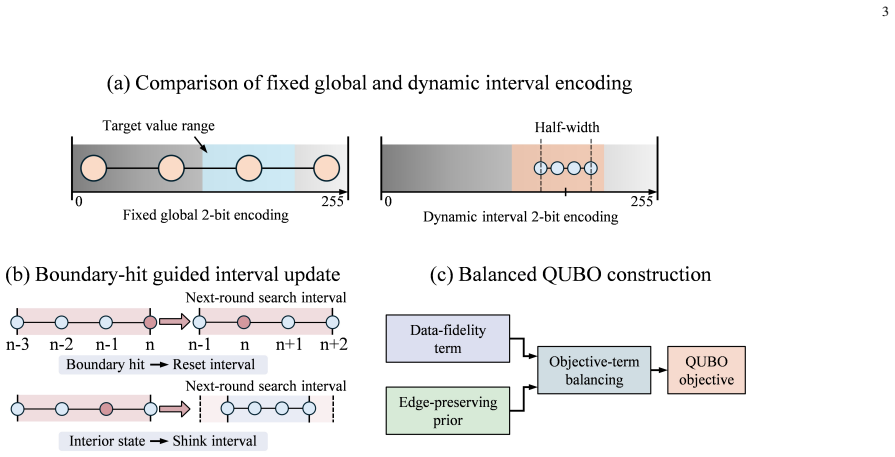
Dynamic interval encoding, which restricts each pixel's binary variables to a local gray-level window around the running estimate and uses boundary hits to toggle between expansion and refinement inside a prior-balanced QUBO.
If this is right
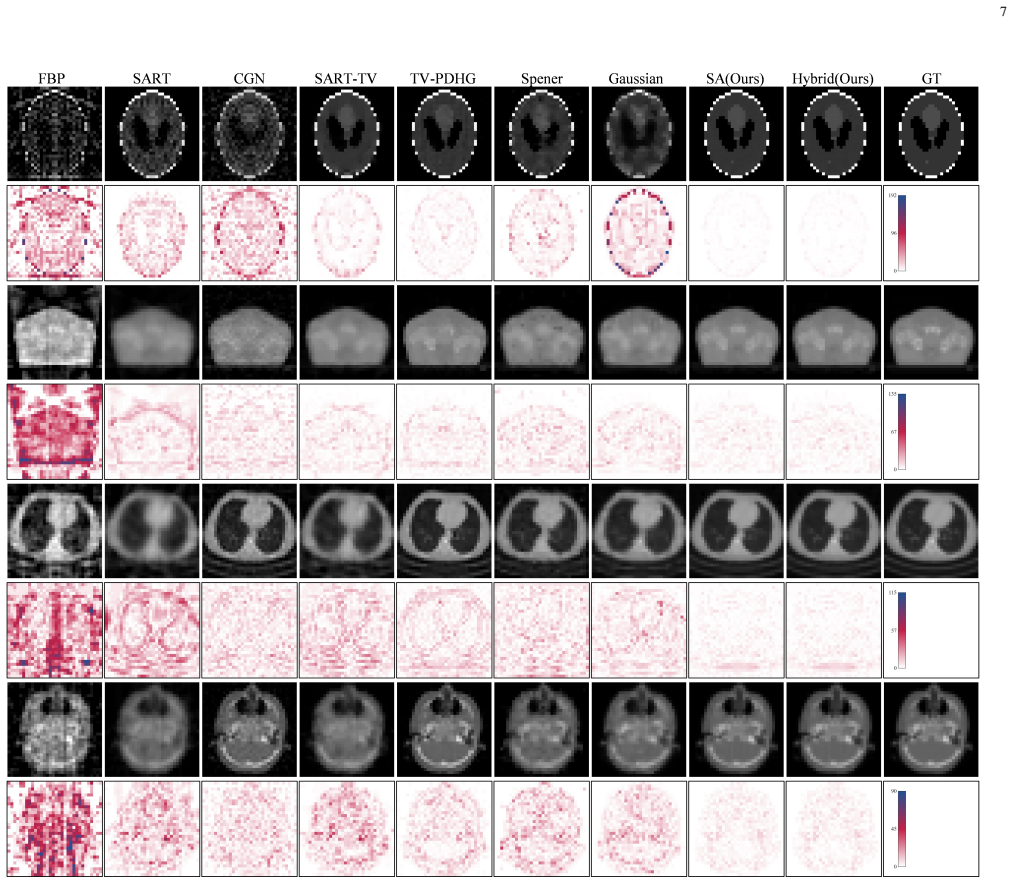
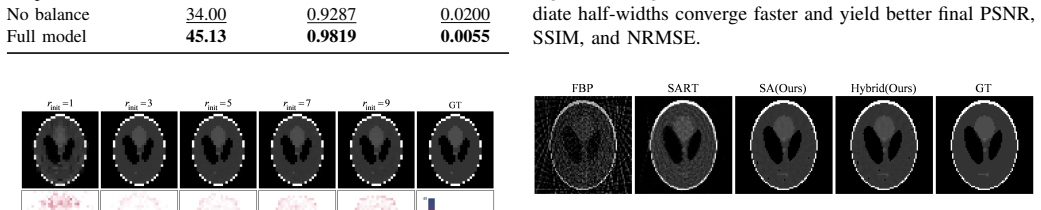
- The method recovers both structures and gray-level distributions more faithfully than the tested analytic, iterative, variational, and representation-based methods.
- The formulation executes on hardware-backed hybrid quantum-classical solvers such as the D-Wave BQM.
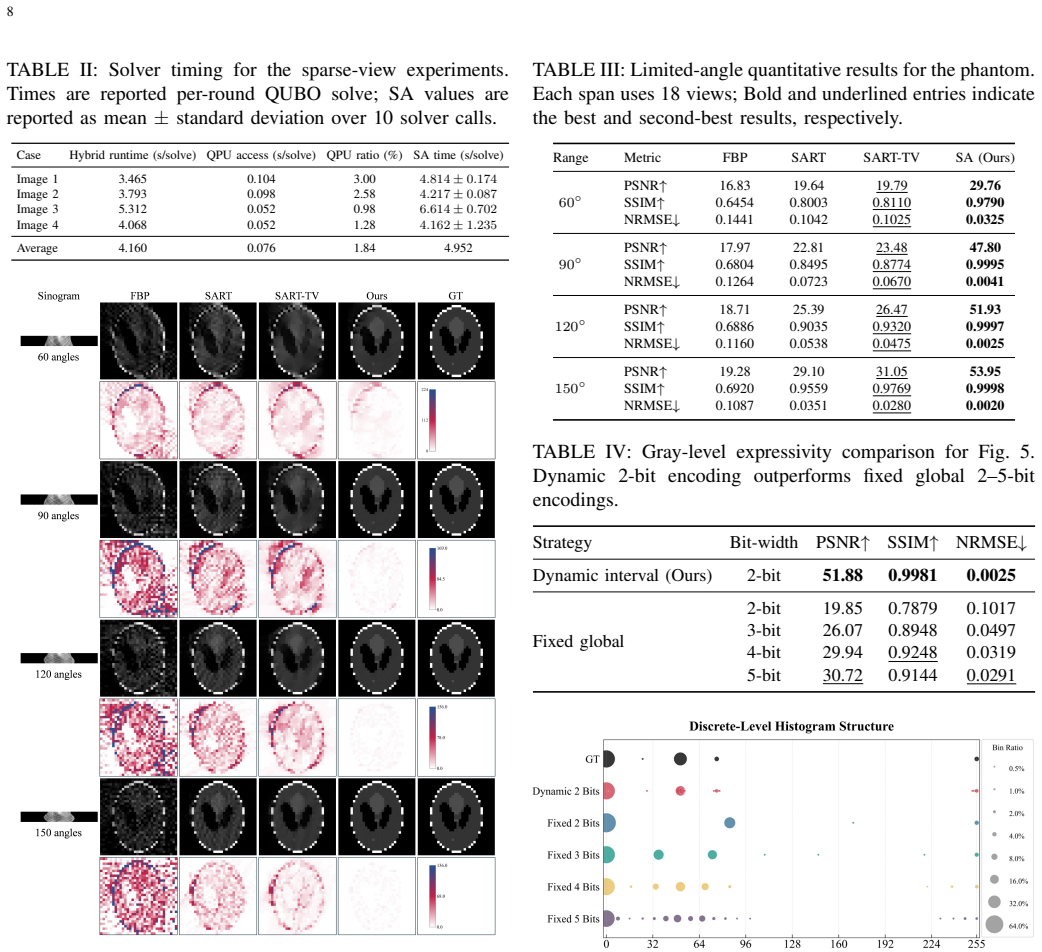
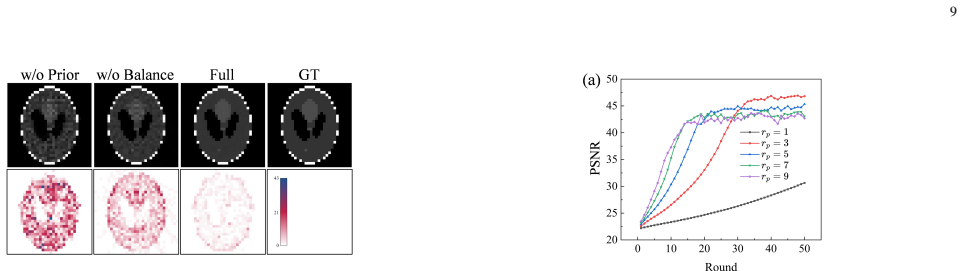
- Ablation and expressivity analyses indicate that the performance lift stems mainly from the local encoding strategy and the balanced data-prior coupling.
- The approach remains executable on current hybrid solvers without requiring fully fault-tolerant quantum hardware.
Where Pith is reading between the lines
- The variable budget per pixel can be kept smaller than global encodings while still supporting high gray-level precision, potentially lowering the qubit or coupling requirements for larger images.
- The same local-interval mechanism may transfer to other inverse problems that currently suffer from fixed-precision quantization error in binary optimization formulations.
- Further scaling could be tested by replacing the hybrid solver with newer quantum annealing or gate-model backends to measure wall-clock or solution-quality changes.
Load-bearing premise
The boundary-hit update rule and prior-balancing step produce stable convergence without introducing quantization or optimization artifacts that offset the reported fidelity gains.
What would settle it
A controlled experiment on the same sparse-view and limited-angle fan-beam phantoms in which the proposed reconstructions exhibit lower structural similarity or intensity accuracy metrics, or visible new artifacts, relative to the evaluated baselines.
Figures
read the original abstract
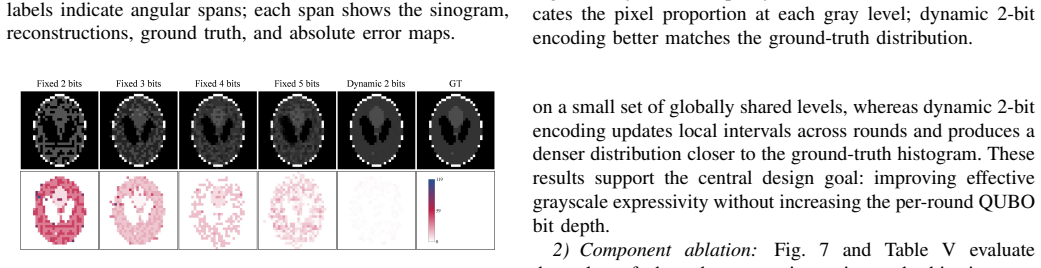
Quadratic unconstrained binary optimization (QUBO)-based quantum computed tomography (CT) casts reconstruction as a binary quadratic problem for quantum annealing and hybrid quantum--classical solvers. For grayscale CT, however, image encoding is constrained by the binary-variable budget: fixed global bit-plane encodings increase QUBO size and coupling complexity as gray-level precision improves, whereas low-bit encodings introduce quantization error. We propose a QUBO-based grayscale CT reconstruction framework that combines dynamic interval encoding with prior-balanced optimization. Each refinement round encodes active pixels only within local gray-level intervals around the current estimate, and a boundary-hit-guided update rule adaptively switches between search expansion and local refinement. To improve optimization stability, the method balances projection-domain data consistency and an edge-preserving quadratic prior before forming the final QUBO. Sparse-view and limited-angle fan-beam CT experiments show that the proposed method recovers structures and gray-level distributions more faithfully than the evaluated analytic, iterative, variational, and representation-based baselines. Expressivity analysis and ablation studies further indicate that the improvement mainly arises from effective gray-level representation through dynamic local encoding and more stable data-fidelity--prior coupling. Experiments on the D-Wave hybrid binary quadratic model (BQM) solver further demonstrate that the formulation is executable on a hardware-backed hybrid quantum--classical backend.
Editorial analysis
A structured set of objections, weighed in public.
Referee Report
Summary. The manuscript proposes a QUBO-based framework for grayscale CT reconstruction that uses dynamic interval encoding (encoding active pixels only within local gray-level intervals around the current estimate) together with a boundary-hit-guided update rule and prior-balanced optimization (balancing projection-domain data consistency against an edge-preserving quadratic prior). It claims that this yields more faithful recovery of structures and gray-level distributions than analytic, iterative, variational, and representation-based baselines on sparse-view and limited-angle fan-beam CT experiments, attributes the gains primarily to the encoding and coupling via expressivity analysis and ablations, and demonstrates executability on the D-Wave hybrid BQM solver.
Significance. If the empirical claims and attribution to the proposed mechanisms hold, the work would offer a concrete route to mitigate the binary-variable budget constraint in QUBO formulations of grayscale inverse problems, potentially enabling practical hybrid quantum-classical CT pipelines. The explicit ablation studies and hardware-backed demonstration constitute strengths that could support reproducibility and adoption.
major comments (2)
- [Method (boundary-hit-guided update rule and prior-balancing)] The boundary-hit-guided update rule is presented as an adaptive heuristic that switches between search expansion and local refinement, yet no derivation from first principles, convergence analysis, or explicit check against new quantization/optimization artifacts is supplied (see the method description of the update rule and prior-balancing step). This is load-bearing for the central claim that observed gains arise from encoding stability and data-fidelity–prior coupling rather than implicit regularization or solver-specific effects.
- [Abstract / Experiments] The abstract asserts qualitative superiority in structure and gray-level recovery on fan-beam experiments but supplies no quantitative metrics, error bars, dataset sizes, or numerical ablation results; without these the central empirical claim cannot be verified at the level required for a journal in the field.
Simulated Author's Rebuttal
We thank the referee for the constructive comments. We respond to each major comment below, indicating planned revisions where appropriate.
read point-by-point responses
-
Referee: [Method (boundary-hit-guided update rule and prior-balancing)] The boundary-hit-guided update rule is presented as an adaptive heuristic that switches between search expansion and local refinement, yet no derivation from first principles, convergence analysis, or explicit check against new quantization/optimization artifacts is supplied (see the method description of the update rule and prior-balancing step). This is load-bearing for the central claim that observed gains arise from encoding stability and data-fidelity–prior coupling rather than implicit regularization or solver-specific effects.
Authors: We acknowledge that the boundary-hit-guided update rule is presented as a heuristic without a formal derivation from first principles or convergence analysis in the current manuscript. The attribution of gains to the encoding and prior-balancing mechanisms is grounded in the expressivity analysis and ablation studies. To address the concern, we will expand the revised manuscript with additional discussion of the heuristic rationale and an explicit examination of potential quantization and optimization artifacts. revision: partial
-
Referee: [Abstract / Experiments] The abstract asserts qualitative superiority in structure and gray-level recovery on fan-beam experiments but supplies no quantitative metrics, error bars, dataset sizes, or numerical ablation results; without these the central empirical claim cannot be verified at the level required for a journal in the field.
Authors: We agree that the abstract would be strengthened by the inclusion of quantitative metrics. In the revision we will update the abstract to report key numerical results from the experiments, including average PSNR and SSIM values with error bars, dataset sizes, and references to the ablation studies. revision: yes
Circularity Check
No significant circularity detected in the proposed QUBO CT framework
full rationale
The paper presents an algorithmic framework for QUBO-based grayscale CT reconstruction that combines dynamic interval encoding, a boundary-hit-guided update rule, and prior balancing. Performance claims are supported by sparse-view and limited-angle experiments plus ablation studies, without any derivation chain that reduces by construction to fitted inputs, self-definitions, or load-bearing self-citations. The method builds on standard QUBO and CT priors as external foundations, and no step equates a claimed result to its own inputs via renaming, ansatz smuggling, or uniqueness theorems imported from the authors' prior work.
Axiom & Free-Parameter Ledger
Reference graph
Works this paper leans on
-
[1]
Quantum annealing in the transverse Ising model,
T. Kadowaki and H. Nishimori, “Quantum annealing in the transverse Ising model,”Physical Review E, vol. 58, no. 5, pp. 5355–5363, 1998
1998
-
[2]
Ising formulations of many NP problems,
A. Lucas, “Ising formulations of many NP problems,”Frontiers in Physics, vol. 2, p. 5, 2014
2014
-
[3]
Exploring the limitations of hybrid adiabatic quantum computing for emission tomography reconstruction,
M. A. Nau, A. H. Vija, W. Gohn, M. P. Reymann, and A. K. Maier, “Exploring the limitations of hybrid adiabatic quantum computing for emission tomography reconstruction,”Journal of Imaging, vol. 9, no. 10, p. 221, 2023
2023
-
[4]
Quantum annealing-based computed tomography using vari- ational approach for a real-number image reconstruction,
A. Haga, “Quantum annealing-based computed tomography using vari- ational approach for a real-number image reconstruction,”Physics in Medicine & Biology, vol. 69, no. 4, p. 04NT02, 2024
2024
-
[5]
A highly accurate quantum optimization algorithm for CT image reconstruction based on sinogram patterns,
K. Jun, “A highly accurate quantum optimization algorithm for CT image reconstruction based on sinogram patterns,”Scientific Reports, vol. 13, p. 14407, 2023
2023
-
[6]
Utilizing quantum annealing in computed tomography image reconstruction,
K. Dremel, D. Prjamkov, M. Firsching, M. Weule, T. Lang, A. Papadaki, S. Kasperl, M. Blaimer, and T. O. J. Fuchs, “Utilizing quantum annealing in computed tomography image reconstruction,”IEEE Transactions on Quantum Engineering, vol. 6, p. 3100810, 2025
2025
-
[7]
Quantum optimization algorithms for CT image segmentation from X-ray data,
K. Jun and H. Lee, “Quantum optimization algorithms for CT image segmentation from X-ray data,”Scientific Reports, vol. 15, p. 20649, 2025
2025
-
[8]
A. C. Kak and M. Slaney,Principles of Computerized Tomographic Imaging. New York, NY , USA: IEEE Press, 1988
1988
-
[9]
Practical cone-beam algorithm,
L. A. Feldkamp, L. C. Davis, and J. W. Kress, “Practical cone-beam algorithm,”Journal of the Optical Society of America A, vol. 1, no. 6, pp. 612–619, 1984
1984
-
[10]
Algebraic reconstruction techniques (ART) for three-dimensional electron microscopy and X-ray photography,
R. Gordon, R. Bender, and G. T. Herman, “Algebraic reconstruction techniques (ART) for three-dimensional electron microscopy and X-ray photography,”Journal of Theoretical Biology, vol. 29, no. 3, pp. 471– 481, 1970
1970
-
[11]
Simultaneous algebraic reconstruction technique (SART): A superior implementation of the ART algorithm,
A. H. Andersen and A. C. Kak, “Simultaneous algebraic reconstruction technique (SART): A superior implementation of the ART algorithm,” Ultrasonic Imaging, vol. 6, no. 1, pp. 81–94, 1984
1984
-
[12]
Methods of conjugate gradients for solving linear systems,
M. R. Hestenes and E. Stiefel, “Methods of conjugate gradients for solving linear systems,”Journal of Research of the National Bureau of Standards, vol. 49, no. 6, pp. 409–436, 1952
1952
-
[13]
Accelerated projection methods for com- puting pseudoinverse solutions of systems of linear equations,
A. Bjorck and T. Elfving, “Accelerated projection methods for com- puting pseudoinverse solutions of systems of linear equations,”BIT Numerical Mathematics, vol. 19, no. 2, pp. 145–163, 1979
1979
-
[14]
Nonlinear total variation based noise removal algorithms,
L. I. Rudin, S. Osher, and E. Fatemi, “Nonlinear total variation based noise removal algorithms,”Physica D: Nonlinear Phenomena, vol. 60, no. 1–4, pp. 259–268, 1992
1992
-
[15]
Compressed sensing,
D. L. Donoho, “Compressed sensing,”IEEE Transactions on Informa- tion Theory, vol. 52, no. 4, pp. 1289–1306, 2006
2006
-
[16]
Image reconstruction in circular cone-beam computed tomography by constrained, total-variation minimization,
E. Y . Sidky and X. Pan, “Image reconstruction in circular cone-beam computed tomography by constrained, total-variation minimization,” Physics in Medicine & Biology, vol. 53, no. 17, pp. 4777–4807, 2008
2008
-
[17]
A first-order primal-dual algorithm for convex problems with applications to imaging,
A. Chambolle and T. Pock, “A first-order primal-dual algorithm for convex problems with applications to imaging,”Journal of Mathematical Imaging and Vision, vol. 40, no. 1, pp. 120–145, 2011
2011
-
[18]
Deep con- volutional neural network for inverse problems in imaging,
K. H. Jin, M. T. McCann, E. Froustey, and M. Unser, “Deep con- volutional neural network for inverse problems in imaging,”IEEE Transactions on Image Processing, vol. 26, no. 9, pp. 4509–4522, 2017
2017
-
[19]
Framing U-Net via deep convolutional framelets: Application to sparse-view CT,
Y . Han and J. C. Ye, “Framing U-Net via deep convolutional framelets: Application to sparse-view CT,”IEEE Transactions on Medical Imaging, vol. 37, no. 6, pp. 1418–1429, 2018
2018
-
[20]
Learned primal-dual reconstruction,
J. Adler and O. ¨Oktem, “Learned primal-dual reconstruction,”IEEE Transactions on Medical Imaging, vol. 37, no. 6, pp. 1322–1332, 2018
2018
-
[21]
Deep learning computed tomography: Learning projection-domain weights from image domain in limited angle problems,
T. W ¨urfl, M. Hoffmann, V . Christlein, K. Breininger, Y . Huang, M. Unberath, and A. K. Maier, “Deep learning computed tomography: Learning projection-domain weights from image domain in limited angle problems,”IEEE Transactions on Medical Imaging, vol. 37, no. 6, pp. 1454–1463, 2018
2018
-
[22]
LEARN: Learned experts’ assessment- based reconstruction network for sparse-data CT,
H. Chen, Y . Zhang, Y . Chen, J. Zhang, W. Zhang, H. Sun, Y . Lv, P. Liao, J. Zhou, and G. Wang, “LEARN: Learned experts’ assessment- based reconstruction network for sparse-data CT,”IEEE Transactions on Medical Imaging, vol. 37, no. 6, pp. 1333–1347, 2018
2018
-
[23]
Deep image prior,
D. Ulyanov, A. Vedaldi, and V . Lempitsky, “Deep image prior,” in Proceedings of the IEEE Conference on Computer Vision and Pattern Recognition, 2018, pp. 9446–9454
2018
-
[24]
Unsupervised self-prior embedding neural representation for iterative sparse-view CT reconstruction,
X. Tian, L. Chen, Q. Wu, C. Du, J. Shi, H. Wei, and Y . Zhang, “Unsupervised self-prior embedding neural representation for iterative sparse-view CT reconstruction,”Proceedings of the AAAI Conference on Artificial Intelligence, vol. 39, no. 7, pp. 7383–7391, 2025
2025
-
[25]
3DGR-CT: Sparse- view CT reconstruction with a 3D gaussian representation,
Y . Li, X. Fu, H. Li, S. Zhao, R. Jin, and S. K. Zhou, “3DGR-CT: Sparse- view CT reconstruction with a 3D gaussian representation,”Medical Image Analysis, vol. 103, p. 103585, 2025
2025
-
[26]
Discretized gaussian representation for tomographic reconstruction,
S. Wu, Y . Lu, Y . Guo, W. Ji, S. Huang, F. Yang, S. Sirejiding, Q. He, J. Tong, Y . Ji, Y . Ding, and H. Lu, “Discretized gaussian representation for tomographic reconstruction,” inProceedings of the IEEE/CVF International Conference on Computer Vision, 2025, pp. 25 073–25 082
2025
-
[27]
Quantum medical imaging algorithms,
B. T. Kiani, A. Villanyi, and S. Lloyd, “Quantum medical imaging algorithms,” 2020
2020
-
[28]
Quantum compressed sensing to- mographic reconstruction algorithm,
A. Ryou, K. Kim, and K. Jun, “Quantum compressed sensing to- mographic reconstruction algorithm,”IEEE Transactions on Quantum Engineering, 2026, early Access
2026
-
[29]
Low-dose CT image and projection dataset,
T. R. Moen, B. Chen, D. R. Holmes III, X. Duan, Z. Yu, L. Yu, S. Leng, J. G. Fletcher, and C. H. McCollough, “Low-dose CT image and projection dataset,”Medical Physics, vol. 48, no. 2, pp. 902–911, 2021
2021
-
[30]
Computed tomography (CT) of the brain,
TrainingDataPro, “Computed tomography (CT) of the brain,” Kaggle dataset, 2023, accessed: 2026-06-21. [Online]. Available: https: //www.kaggle.com/datasets/trainingdatapro/computed-tomography-ct-o f-the-brain
2023
-
[31]
Fast and flexible X-ray tomography using the ASTRA toolbox,
W. van Aarle, W. J. Palenstijn, J. De Beenhouwer, T. Altantzis, S. Bals, K. J. Batenburg, and J. Sijbers, “Fast and flexible X-ray tomography using the ASTRA toolbox,”Optics Express, vol. 24, no. 22, pp. 25 129– 25 147, 2016
2016
-
[32]
D-Wave Hybrid Solver Service: An overview,
D-Wave Systems Inc., “D-Wave Hybrid Solver Service: An overview,” D-Wave Systems Inc., Tech. Rep. 14-1039A-B, 2020
2020
-
[33]
Image quality assessment: From error visibility to structural similarity,
Z. Wang, A. C. Bovik, H. R. Sheikh, and E. P. Simoncelli, “Image quality assessment: From error visibility to structural similarity,”IEEE Transactions on Image Processing, vol. 13, no. 4, pp. 600–612, 2004
2004
discussion (0)
Sign in with ORCID, Apple, or X to comment. Anyone can read and Pith papers without signing in.