Variance Reduction for Heavy-Tailed Monetization Metrics in Ranking Experiments via Post-Stratification
Pith reviewed 2026-06-28 11:20 UTC · model grok-4.3
The pith
Post-stratification combined with CUPED reduces variance in heavy-tailed monetization metrics enough to reach equivalent statistical confidence with roughly 45 percent less traffic.
A machine-rendered reading of the paper's core claim, the machinery that carries it, and where it could break.
Core claim
The central claim is that post-stratification combined with CUPED leverages pre-experiment covariates to achieve substantial variance reduction in heavy-tailed monetization metrics, enabling equivalent statistical confidence with approximately 45% less traffic than standard approaches in ranking experiments.
What carries the argument
Post-stratification combined with CUPED, which uses pre-experiment covariates to divide users into strata and adjust the estimator for the heavy-tailed monetization outcome.
If this is right
- A/B tests on monetization metrics can reach the same power with less user traffic.
- Decisions in ranking-driven experiments become more stable under the same sample size.
- The framework applies directly to real-world recommendation and retrieval systems that track revenue or earnings.
- Guardrails on covariate choice and stratum construction prevent bias while preserving the variance benefit.
Where Pith is reading between the lines
- The same covariate-driven stratification may reduce variance for other heavy-tailed outcomes such as session length or content consumption.
- Firms that already collect rich pre-experiment user features will see larger gains than those with sparse data.
- Synthetic heavy-tailed data sets with known tail parameters could serve as a controlled test bed for the claimed reduction factor.
- If the correlation between covariates and outcome weakens over time, periodic re-selection of stratification variables would be required.
Load-bearing premise
Pre-experiment covariates must exist and be sufficiently correlated with the monetization outcome to produce effective stratification without introducing bias.
What would settle it
Deploy the method on a fresh collection of ranking monetization experiments and observe no material drop in variance or in the traffic volume needed to reach a fixed confidence level compared with the unadjusted metric.
Figures
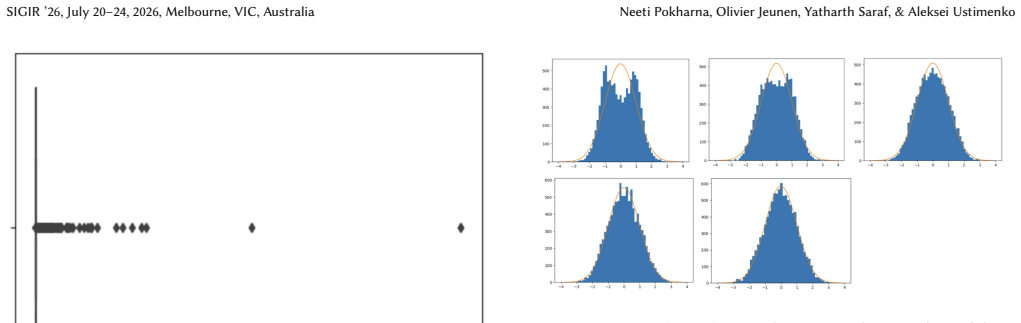
read the original abstract
Online evaluation of ranking and retrieval systems often relies on downstream monetization metrics such as app revenue or creator earnings. These metrics are typically heavy-tailed, with a small fraction of users dominating both mean and variance, leading to low statistical power and unreliable conclusions in A/B experiments -- especially under limited traffic. We present a practical framework for variance reduction in online experiments by combining post-stratification with CUPED. Our approach leverages pre-experiment covariates to improve the sensitivity of monetization experiments without requiring additional traffic. Deployed at ShareChat across ranking-driven monetization experiments, the method substantially reduces variance and improves decision stability, achieving equivalent statistical confidence with ~45\% less traffic than standard metrics. We further discuss practical design choices, guardrails, and limitations, providing guidance on when post-stratification is appropriate for real-world information retrieval and Recommendation systems.
Editorial analysis
A structured set of objections, weighed in public.
Referee Report
Summary. The manuscript proposes combining post-stratification with CUPED, using pre-experiment covariates, to reduce variance of heavy-tailed monetization metrics (e.g., revenue) in ranking A/B experiments. It reports a deployment at ShareChat in which the method yields equivalent statistical power with ~45% less traffic than unadjusted metrics and discusses design choices, guardrails, and limitations.
Significance. If the empirical traffic-reduction result holds under the stated conditions, the framework offers a deployable way to increase experiment sensitivity for heavy-tailed outcomes common in recommendation systems without requiring extra traffic. The real-world deployment at ShareChat supplies concrete evidence of improved decision stability, which is a positive feature for applied work in this area.
major comments (2)
- [Abstract / Results] Abstract and Results section: the central claim of equivalent confidence with ~45% less traffic is presented without the observed R² (or equivalent correlation measure) between the chosen pre-experiment covariates and the heavy-tailed monetization outcome, nor any sensitivity plot showing how the traffic saving changes as that correlation weakens. In heavy-tailed settings the variance is dominated by tail observations, so the reduction is load-bearing on this correlation; its absence prevents verification that the reported saving is consistent with the data.
- [§4] §4 (Empirical Evaluation): no table or figure reports the stratum-level variance contributions or the effective sample-size multiplier achieved by post-stratification, making it impossible to isolate how much of the 45% saving is attributable to stratification versus CUPED or to confirm that treatment-induced selection bias was avoided.
minor comments (2)
- [§3] The notation for the post-stratification weights and the CUPED adjustment could be unified in a single equation block to improve readability.
- [Figures] Figure captions should explicitly state the traffic volume and number of experiments underlying the 45% figure.
Simulated Author's Rebuttal
We thank the referee for their constructive comments, which help clarify the presentation of our empirical results. We address each major comment below and have revised the manuscript to incorporate the requested details.
read point-by-point responses
-
Referee: [Abstract / Results] Abstract and Results section: the central claim of equivalent confidence with ~45% less traffic is presented without the observed R² (or equivalent correlation measure) between the chosen pre-experiment covariates and the heavy-tailed monetization outcome, nor any sensitivity plot showing how the traffic saving changes as that correlation weakens. In heavy-tailed settings the variance is dominated by tail observations, so the reduction is load-bearing on this correlation; its absence prevents verification that the reported saving is consistent with the data.
Authors: We agree that the strength of the covariate-outcome relationship is central to interpreting variance reduction for heavy-tailed metrics. In the revised manuscript we report the observed R² between the pre-experiment covariates and the monetization metric in the Results section and add a sensitivity plot that shows how the traffic savings vary with weaker correlations. These additions allow readers to verify that the reported ~45% saving is consistent with the observed correlation under the heavy-tailed regime. revision: yes
-
Referee: [§4] §4 (Empirical Evaluation): no table or figure reports the stratum-level variance contributions or the effective sample-size multiplier achieved by post-stratification, making it impossible to isolate how much of the 45% saving is attributable to stratification versus CUPED or to confirm that treatment-induced selection bias was avoided.
Authors: We thank the referee for highlighting the need for greater decomposition of the variance reduction. We have added a table in Section 4 that reports stratum-level variance contributions and the effective sample-size multiplier attributable to post-stratification. This makes it possible to separate the contributions of stratification from CUPED. Because the strata are formed exclusively from pre-experiment covariates, treatment assignment remains randomized within strata and no selection bias is introduced; we have expanded the text to state this explicitly. revision: yes
Circularity Check
No significant circularity; derivation relies on standard post-stratification and CUPED techniques
full rationale
The paper applies established variance-reduction methods (post-stratification combined with CUPED) to heavy-tailed monetization metrics using pre-experiment covariates. No equations, fitted parameters, or predictions are presented that reduce by construction to the inputs. No self-citation chains, uniqueness theorems, or ansatzes are invoked as load-bearing steps. The ~45% traffic reduction claim is presented as an empirical outcome from deployment rather than a derived identity. The approach is self-contained against external benchmarks for these standard techniques.
Axiom & Free-Parameter Ledger
Reference graph
Works this paper leans on
-
[1]
Shubham Baweja, Neeti Pokharna, Aleksei Ustimenko, and Olivier Jeunen. 2024. Variance Reduction in Ratio Metrics for Efficient Online Experiments. InAdvances in Information Retrieval: 46th European Conference on Information Retrieval, ECIR 2024, Glasgow, UK, March 24–28, 2024, Proceedings, Part V(Glasgow, United Kingdom). Springer-Verlag, Berlin, Heidelbe...
-
[2]
G. E. P. Box and D. R. Cox. 1964. An Analysis of Transformations.Journal of the Royal Statistical Society: Series B (Methodological)26, 2 (1964), 211–252. doi:10. 1111/j.2517-6161.1964.tb00553.x arXiv:https://academic.oup.com/jrsssb/article- pdf/26/2/211/49099371/jrsssb_26_2_211.pdf
arXiv 1964
-
[3]
Aaron Clauset, Cosma Rohilla Shalizi, and M. E. J. Newman. 2009. Power-Law Distributions in Empirical Data.SIAM Rev.51, 4 (2009), 661–703
2009
-
[4]
Alex Deng, Ya Xu, Ron Kohavi, and Toby Walker. 2013. Improving the sensitivity of online controlled experiments by utilizing pre-experiment data. InProceedings of the Sixth ACM International Conference on Web Search and Data Mining(Rome, Italy)(WSDM ’13). Association for Computing Machinery, New York, NY, USA, 123–132. doi:10.1145/2433396.2433413
-
[5]
Olivier Jeunen. 2025. t-Testing the Waters: Empirically Validating Assumptions for Reliable A/B-Testing. InProceedings of the Nineteenth ACM Conference on Rec- ommender Systems (RecSys ’25). ACM, 1307–1310. doi:10.1145/3705328.3759307
-
[6]
Olivier Jeunen, Shubham Baweja, Neeti Pokharna, and Aleksei Ustimenko. 2024. Powerful A/B-Testing Metrics and Where to Find Them. InProceedings of the 18th ACM Conference on Recommender Systems(Bari, Italy)(RecSys ’24). Association for Computing Machinery, New York, NY, USA, 816–818. doi:10.1145/3640457. 3688036
-
[7]
Ron Kohavi, Roger Longbotham, Dan Sommerfield, and Randal Henne. 2009. Controlled experiments on the web: survey and practical guide.Data Mining and Knowledge Discovery18, 1 (2009), 140–181. doi:10.1007/s10618-008-0114-1
-
[8]
Winston Lin. 2013. Agnostic Notes on Regression Adjusted Estimators.The Annals of Applied Statistics7, 1 (2013), 295–318
2013
-
[9]
Luke W. Miratrix, Jasjeet S. Sekhon, and Bin Yu. 2013. Adjusting treatment effect estimates by post-stratification in randomized experiments.Journal of the Royal Statistical Society Series B75, 2 (March 2013), 369–396. doi:10.1111/rssb.2013.75. issue-2
-
[10]
Richard Valliant. 1993. Poststratification and Conditional Variance Estimation.J. Amer. Statist. Assoc.88, 421 (1993), 89–96. http://www.jstor.org/stable/2290701
arXiv 1993
-
[11]
Huizhi Xie and Juliette Aurisset. 2016. Improving the Sensitivity of Online Controlled Experiments: Case Studies at Netflix. InProceedings of the 22nd ACM SIGKDD International Conference on Knowledge Discovery and Data Mining (KDD ’16). ACM, 645–654. doi:10.1145/2939672.2939733
discussion (0)
Sign in with ORCID, Apple, or X to comment. Anyone can read and Pith papers without signing in.