REVIEW 4 major objections 4 minor 71 references
Nowcasting Solar Energetic Particle Events for Mars Missions
T0 review · 4 major / 4 minor · reviewed 2026-08-09 · deepseek-v4-flash
Pith's one-line read A 25% rise in local dose rate can warn Mars crews of solar particle storms at least 30 minutes ahead.
desk verdict A useful operational nowcast for Mars SEPs with open data, but the 30-minute and near-zero-FAR claims need qualification before the abstract matches the analysis. read the letter →
The pith
A machine-rendered reading of the paper's core claim, the machinery that carries it, and where it could break.
The reading
What carries the argument
The load-bearing object is the dose rate E, the tissue-equivalent absorbed dose rate recorded by the plastic scintillator in the Radiation Assessment Detector, which has a large geometric factor and is insensitive to the rover's radioisotope power source. The method couples two simple components: a rolling five-day linear background fit with a fixed 25% (1.25×) trigger threshold, and a two-consecutive-measurement confirmation that suppresses false triggers from heavy-ion outliers and post-Forbush-decrease recoveries. The paper's lead time is defined retrospectively as the interval from the trigger onset to the time when 10% of the background-removed total event dose has accumulated, which is the quantity that supports the 30-minute lower limit.
What would settle it
Find or record an SEP event with a significant total dose (comparable to the ones flagged as threatening, e.g., above roughly 100 µGy background-removed) whose lead time, measured from the 25%-above-background trigger to accumulation of 10% of the total SEP dose, is less than 30 minutes; or record any two-consecutive-measurement trigger above the 25% threshold that is not followed by a real SEP event, which would break the claimed zero false-alarm rate.
Extended reading notes
Core claim
The paper's central claim is that the onset of a dangerous SEP event can be nowcast, without any solar observation, from the local dose rate alone. Using the plastic-scintillator channel (dose rate E) of MSL/RAD, the authors define the background by a linear fit to the previous five days and trigger a warning when the current 15-minute dose rate exceeds 1.25 times that background; a second consecutive measurement converts a preliminary notice into a confirmed alert. Tested against five deep-space and sixteen surface SEP events, the two-measurement version achieves a zero false-alarm rate at the 25% threshold in both environments, and the authors state that a confirmed trigger means near-certainty of an ongoing SEP event. From the distribution of lead times, they propose a universal lower bound of about 30 minutes as the time a warned astronaut has to reach shelter while still avoiding the peak dose rate and more than 90% of the total SEP dose.
Load-bearing premise
The 30-minute guarantee assumes that a real-time warning sounded the moment dose rate rises 25% above background will always come at least 30 minutes before 10% of the eventual event dose has accumulated, because the authors derive that bound from the timing of 21 past events and set aside the several historical events with shorter lead times as too minor to matter.
Editorial extensions
If this is right
- A Mars mission can adopt an operational rule that astronauts on extravehicular activity or surface traversals remain within roughly 30 minutes of a shelter, because the nowcast is designed to give at least that much warning for dose-significant events.
- The system runs entirely on local dosimeter data, so it works in deep space and on the surface alike and serves as a fallback whenever solar-observation-based forecasts are unavailable or fail.
- Shelter duration can be communicated automatically: astronauts stay sheltered until the dose rate drops back below the 25% threshold, which the paper's Table 1 shows can range from about 1.5 hours to more than 3 days.
- For the largest recorded events, the avoided dose is operationally meaningful: about 8.9 mGy for the March 2012 deep-space event and about 1.56 mGy for the May 2024 surface event, the latter being roughly 1.6 times the annual public dose limit.
- The threshold can be lowered to 15% in deep space and 18% on Mars if the small increase in Mars false-alarm rate is accepted, or kept at 25% for a single uniform rule.
Reading between the lines
- The same thresholding logic should transfer to any tissue-equivalent dosimeter with low statistical noise; the paper's own comparison of dose rates B and E shows that the method fails when the detector has poor statistics, so the practical precondition is a detector with a large geometric factor.
- The two-measurement confirmation deliberately costs one 15-minute cadence of warning time; in a real deployment, a shorter measurement interval (e.g., one-minute data where available) could recover most of that lost time while keeping the false-alarm benefit.
- Because the lead-time metric is defined retrospectively from the total event dose, the 30-minute guarantee is a statement about the 21 historical events; a standalone prospective test on the next solar maximum would be needed to validate it in real time.
- The system is a nowcast, not a forecast: it cannot warn before particles arrive, so its role is complementary to solar-observatory-based predictions, and mission design should still plan shelter access time as the binding constraint.
Editorial analysis
A structured set of objections, weighed in public.
Referee Report
Summary. The manuscript describes a nowcasting system for solar energetic particle (SEP) events relevant to future Mars missions. The system uses the MSL/RAD dose rate E in 15-minute cadence: an event is triggered when the dose rate exceeds a five-day linear background fit by 25%. Using the 21 SEP events observed by RAD (5 during the 2011-2012 cruise, 16 on the Martian surface through September 2024), the authors compute shelter durations, times to peak, lead times (defined as the time from trigger to the accumulation of 10% of the total event dose), and total background-removed doses. They also simulate false alarm rates over the full dataset for single- and two-measurement triggers and for thresholds between 5% and 30%. The central claims are that the system can provide astronauts with at least 30 minutes to avoid the peak dose and the majority of the cumulative dose, and that it achieves a near-zero false alarm rate both in deep space and on the Martian surface.
Significance. If the claims were supported as stated, this would be a valuable, minimal-cost, last-resort warning layer for Mars missions, complementing forecast tools such as REleASE and ESPERTA that have not been validated for Mars. The strengths of the paper are real: it is built on 13 years of actual RAD flight data; the algorithm is simple and clearly specified, including a two-step confirmation logic; the false-alarm simulation is a systematic and appropriate test of the method; the negative result for dose rate B in Appendix 6 is honestly documented; the analysis data are openly provided on Zenodo; and the detector-specific scope limitation at the end of Section 5 is stated explicitly. However, the headline quantitative claims go beyond what the paper's own tables establish. The 30-minute lower bound is obtained after excluding detected events with 2-17 minute lead times; the near-zero false alarm rate requires a two-measurement confirmation that costs 15 minutes of warning time; the lead time is a retrospective quantity; and the 25% threshold is selected on the same in-sample data used to report the FAR.
major comments (4)
- [Abstract; Section 4, Table 1] The abstract's claim that the system 'can provide astronauts with at least 30 minutes' is not supported by Table 1 as presented. Four events that trigger the system have lead times of 17 minutes (2012-01-23), 2 minutes (2014-09-10), 5 minutes (2023-03-12), and 8 minutes (2024-09-02); the minimum among the events retained as prioritized is 33 minutes (2024-09-05 on the surface, with 35 minutes for 2012-03-13 in deep space). Section 4 excludes the four short-lead-time events as 'not prioritized' because of negligible dose, but the exclusion is not applied consistently by the tabulated doses: the excluded 2012-01-23 event has a total SEP dose of 12.71 µGy, which is larger than the retained 2013-04-10 event (9.22 µGy). The universal statement in Section 4 ('an astronaut should not move more than 30 minutes away from a shelter') is therefore obtained by removing the counterexamples, and it should be reformulated as conditional on a stated minimum event dose, or replaced by the empirical distribution of lead times.
- [Section 3, Figure 3 (right); Section 4] The lead time used in Table 1 and in the 30-minute claim is defined retrospectively: it is the interval from the 25%-threshold crossing to the time at which 10% of the event's final total SEP dose has accumulated. Because the final total is known only after the event has ended, a real-time system cannot know, at the moment of triggering, how much lead time a given event will provide. The sentence in Section 4 ('to propose a universal lower limit... we therefore assume the minimum lead time, which is approximately 30 minutes') is thus an empirical property of the selected historical events, not an operational guarantee, unless the manuscript states and defends an additional assumption about future dose-accumulation rates. The wording should distinguish the retrospective characterization of historical events from a forward-looking warning guarantee.
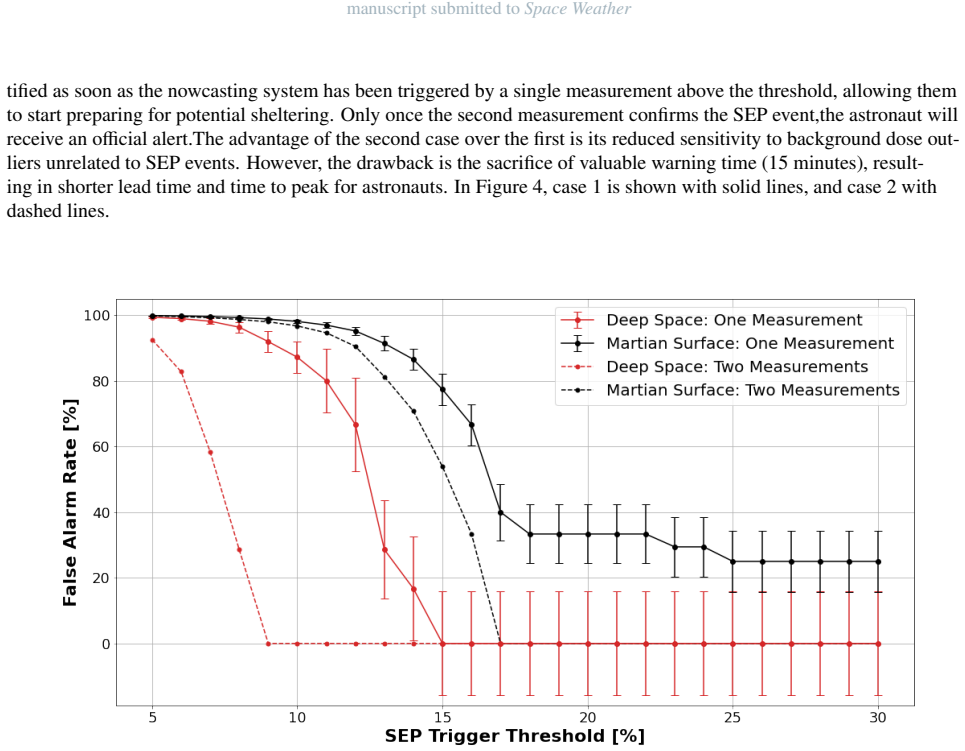
- [Section 4.1, Figure 4; Abstract; Section 5] The abstract's conjunction of 'at least 30 minutes' with 'near-zero false alarm rate' is internally inconsistent with the paper's own results. Figure 4 shows that with a single measurement at the 25% threshold the FAR is 25% on the Martian surface and zero in deep space; the zero FAR in both environments is reached only with the two-measurement confirmation, which the text states sacrifices 15 minutes of warning time. Subtracting 15 minutes from the tabulated lead times, the shortest retained surface lead time (2024-09-05, 33 minutes) becomes 18 minutes, and the shortest retained deep-space lead time (2012-03-13, 35 minutes) becomes 20 minutes, both below 30 minutes. The abstract and the Summary should state explicitly which claim belongs to which warning mode: the 30-minute lead time belongs to the immediate single-measurement notification (25% surface FAR), while the near-zero FAR belongs to the official alert delivered 15 minutes later.
- [Section 4.1, Figure 4] The near-zero FAR result is selected in-sample. The section scans trigger thresholds from 5% to 30% on the same 21-event dataset used to report the performance, and the uniform 25% threshold is justified by the FAR values obtained in that scan. With only 5 deep-space and 16 surface events, a zero-FAR outcome carries a wide binomial confidence interval; the error bars in Figure 4 acknowledge the statistical uncertainty, but the abstract's unqualified 'near-zero false alarm rate' should be presented as an in-sample property of this dataset with the small-sample caveat stated explicitly.
minor comments (4)
- [Table 4] Event identifications are inconsistent across tables: '2014-08-31' in Table 4 corresponds to '2014-09-02' in Table 1; the event described in the text as May 19, 2024 appears as 2024-05-20 in Table 1 and as 2023-05-19 in Table 4; and events dated 2024-10-05 and 2024-10-09 appear in Tables 3 and 4 but are absent from Table 1.
- [Section 4] The observation 'it can be observed that time to peak ≳ lead time' is violated by the largest surface event, 2024-05-20, which has a time to peak of 0h53m and a lead time of 0h57m; the sentence should be qualified.
- [Section 1; References] The citation for astronaut career dose limits appears in the text as '(?, ?)', and the reference list includes 'HandWiki' (a wiki) and 'Richardson et al., n.d.'; these are not acceptable as final references for a journal submission.
- [Section 3, Figure 3] The caption of Figure 3 and the surrounding text define lead time as 'the period in which an astronaut can avoid at least 90% of the total SEP dose'; this definition should state explicitly that the interval is measured from the 25%-threshold crossing, not from the physical onset of the event, so that the distinction is not left to the reader.
Circularity Check
The 'near-zero FAR' and 'at least 30 minutes' claims are in-sample, definitional summaries rather than independent predictions: the trigger threshold is tuned on the same events, lead time is defined from the event-final dose, and the 30-minute bound is the sample minimum after excluding short-lead events.
-
fitted input called prediction
[Section 4.1 (False Alarm Rate), Figure 4 and following paragraphs]
"In addition to the 25% above background threshold used in this study, we also test trigger thresholds ranging from 5% to 30% above background to determine the optimal threshold for nowcasting. ... At this threshold, our nowcasting system achieves a zero FAR in both deep space and on the Martian surface under the cross-checking assumption."
The threshold is selected by scanning the false-alarm rate over 5%-30% on the same 21-event dataset that is then used to report performance. The zero FAR at 25% is therefore an in-sample selection outcome, not an out-of-sample predictive result. The paper's headline 'near-zero false alarm rate' is a property of the threshold that was chosen to have that property on this dataset; no held-out events or prospective test are used.
-
self definitional
[Section 3 (Methodology, Figure 3 right) and Section 4 (Table 1, lead time results)]
"The lead time is defined as the period in which an astronaut can avoid at least 90% of the total SEP dose (time region marked in red) and would receive only 10% of the total SEP dose (time region marked in orange)."
The total SEP dose is the accumulated dose over the whole event, which is only known after the event ends. The tabulated 'lead time' is the time from trigger until 10% of that final total is accumulated, so the 30-minute warning values are retrospective quantities computed with knowledge of the event's complete dose profile. Calling this 'the time an astronaut has' turns a post-hoc integration result into a real-time warning horizon; the claimed warning time is built from the final event total by definition.
1 more flagged steps
-
other
[Section 4, paragraphs after Table 1 ('To propose a universal lower limit...')]
"However, these SEP events also result in negligible additional radiation exposure above the GCR background, as indicated in the total SEP dose in Table 1. ... Therefore, these SEP events are also not prioritized events that require specific avoidance. ... To propose a universal lower limit for the time an astronaut has to reach shelter, we therefore assume the minimum lead time, which is approximately 30 minutes."
The 'universal lower limit' is literally the minimum of the observed lead times in the retained sample, and the retained sample is obtained by excluding triggered events with 17, 2, 5 and 8 minute lead times (2012-01-23, 2014-09-10, 2023-03-12, 2024-09-02). The abstract's 'at least 30 minutes' is thus the sample minimum renamed as a guarantee, not a validated bound. The paper's own two-measurement confirmation later 'sacrifices' 15 minutes, which would move even the shortest retained lead time (33 min for 2024-09-05) below the advertised 30 minutes.
full rationale
The paper is largely transparent about its algorithm and uses publicly archived MSL/RAD data; the background fit, 25% trigger, and event tables can be re-computed independently, and the citations to prior RAD work are data/context references, not a load-bearing self-citation chain. However, the two headline performance claims do not come from an independent prediction. First, Section 4.1 tunes the trigger threshold by measuring FAR on the same events that are then used to report near-zero FAR, so that number is a selected, in-sample property. Second, the lead time is defined retrospectively from the event-final total SEP dose, so the 'warning time' values in Table 1 are not available in real time at the moment of trigger. Third, the 'at least 30 minutes' universal lower limit is the minimum of the retained historical lead times after explicitly excluding four events that did trigger the system with 2-17 minute lead times, and the 15-minute cost of the two-measurement confirmation is not subtracted from the quoted values. These are not external validations; the central claims partially reduce to the thresholds, exclusions, and retrospective definitions chosen by the authors. Score 6 reflects partial circularity: the system concept is independently implementable, but the headline numbers are by-construction summaries of the same fitting/evaluation dataset.
Assumptions & free parameters
free parameters (4)
- SEP trigger threshold =
25% above 5-day background
- Background fit window =
5 days
- Lead-time dose fraction =
90% of total SEP dose
- Confirmation rule =
two consecutive 15-minute measurements
assumptions (4)
- domain assumption The GCR background is constant over a five-day window; seasonal, solar modulation, and 27-day rotation effects are negligible.
- domain assumption The external SEP event list used as ground truth is complete and correct.
- domain assumption Dose rate E from MSL/RAD represents what a future astronaut dosimeter would measure.
- ad hoc to paper Events below the 25% threshold or with very short lead times can be classified as not relevant to nowcasting.
Cite this review
Pith. "Pith review of Nowcasting Solar Energetic Particle Events for Mars Missions." pith.science (2026). https://pith.science/paper/LPUFZQUF
@misc{pith2026250202469,
  author       = {Pith},
  title        = {Pith review of: Nowcasting Solar Energetic Particle Events for Mars Missions},
  year         = {2026},
  howpublished = {\url{https://pith.science/paper/LPUFZQUF}},
  note         = {Machine review of arXiv:2502.02469}
}
read the original abstract
In addition to the omnipresent Galactic Cosmic Rays (GCRs), sudden solar energetic particle (SEP) events present considerable health hazards for manned space missions. These events not only contribute to an increased long-term cancer risk, but can, in extreme cases, cause acute radiation syndromes. Forecasting their imminent occurrence could significantly reduce radiation exposure by warning astronauts to move to shelter. However, all currently available tools are primarily designed for the Earth or Earth-Moon system, which limits their applicability to future Mars missions. To address this, we developed a nowcasting system for SEP events applicable in deep space and on the Martian surface, which serves as a reliable last-resort backup when forecasts fail. The methodology of this system is based on dose rates measured by the Radiation Assessment Detector (RAD) onboard the Mars Science Laboratory (MSL), which recorded 5 SEP events during the seven-month flight to Mars and 16 since its landing on Mars on August 6, 2012. An SEP event is triggered, and an astronaut is warned as soon as dose rates exceed the omnipresent background level by at least 25%. This approach suggests that our system can provide astronauts with at least 30 minutes to avoid both peak radiation exposure and the majority of the cumulative dose from SEP events. Our nowcasting system is robust, easily implementable in real-life scenarios, and achieves a near-zero false alarm rate both in deep space and on the Martian surface.
Figures


Figures from the paper (6 more)


Reference graph
Works this paper leans on
-
[1]
apacite url apacite =6pt Acknowledgments. 6pt 1sp \@dates Received \@recvdate\@empty\@rcvaccrule \@recvdate \@revisedate\@empty ; revised \@revisedate; \@accptdate\@empty \@revisedate\@empty; accepted \@accptdate \@pubdate\@empty. ; published \@pubdate. -2pt \@authaddrs @list\@empty =.15in @list 1sp @list =9pt plus 2pt minus 6pt \@sluginfo width 4pc =3000...
2001
-
[2]
\@ifstar \@figbox \@figbox \@figbox#1#2#3 to !#1! #3 [#1][c] !#2!#3 \@tempdima#2 \@tempdima by2 \@tempdima by- \@tempdima by- \@height\@tempdima\@depth\@tempdima\@width @ to @ #3 Bib ??? ??? ??? =0 =0 = @figure=0 @table=0 #1 --#1 -24pt -2ex #1 0= #1 to 0 #1 I NDEX T ERMS: #1 #1 Citation: #1 Feb 9, 2009 Changed name and references to name from agu2001 to a...
arXiv 2009
-
[3]
o ehler, J. , Guo, J. , Ehresmann, B. , Zeitlin, C. , Matthi \
appel2018detecting APACrefauthors Appel, J. , K \"o ehler, J. , Guo, J. , Ehresmann, B. , Zeitlin, C. , Matthi \"a , D. others APACrefauthors \ 2018 . Detecting upward directed charged particle fluxes in the mars science laboratory radiation assessment detector Detecting upward directed charged particle fluxes in the mars science laboratory radiation asse...
-
[4]
Badhwar1994 APACrefauthors Badhwar, G D. \ O'Neill, P M. APACrefauthors \ 1994 10 . Long-term modulation of Galactic Cosmic Radiation and its model for space exploration Long-term modulation of galactic cosmic radiation and its model for space exploration . Advances in Space Research 14 10 749--757 . APACrefDOI doi:10.1016/0273-1177(94)90537-1 APACrefDOI
-
[5]
Barcellos-Hoff2015 APACrefauthors Barcellos-Hoff , M H. , Blakely , E A. , Burma , S e. , Fornace , A J. , Gerson , S. , Hlatky , L. Weil , M M. APACrefauthors \ 2015 Jul . Concepts and challenges in cancer risk prediction for the space radiation environment Concepts and challenges in cancer risk prediction for the space radiation environment . Life Scien...
-
[6]
Baselet2016 APACrefauthors Baselet, B. , Rombouts, C. , Benotmane, A M. , Baatout, S. \ Aerts, A. APACrefauthors \ 2016 . Cardiovascular diseases related to ionizing radiation: The risk of low-dose exposure (Review) Cardiovascular diseases related to ionizing radiation: The risk of low-dose exposure (review) . International Journal of Molecular Medicine 3...
-
[7]
Boerma2015 APACrefauthors Boerma, M. , Nelson, G A. , Sridharan, V. , Mao, X W. , Koturbash, I. \ Hauer-Jensen, M. APACrefauthors \ 2015 . Space radiation and cardiovascular disease risk Space radiation and cardiovascular disease risk . World Journal of Cardiology 7 12 882--888 . APACrefDOI doi:10.4330/wjc.v7.i12.882 APACrefDOI
-
[8]
COMESEP APACrefauthors Crosby, N. , Veronig, A. , Robbrecht, E. , Vrsnak, B. , Vennerstrom, S. , Malandraki, O. Consortium, C. APACrefauthors \ 2012 11 . Forecasting the space weather impact: The COMESEP project Forecasting the space weather impact: The comesep project . AIP Conference Proceedings 1500 159-164 . APACrefDOI doi:10.1063/1.4768760 APACrefDOI
Show all 71 references
-
[9]
, Wang, H
inbook APACrefauthors Cucinotta, F. , Wang, H. \ Huff, J. APACrefauthors \ 2009 05 . Risk of Acute or Late Central Nervous System Effects from Radiation Exposure Risk of acute or late central nervous system effects from radiation exposure . ( 191-212)
2009
-
[10]
, Alp , M
Cucinotta2014 APACrefauthors Cucinotta , F A. , Alp , M. , Sulzman , F M. \ Wang , M. APACrefauthors \ 2014 Jul . Space radiation risks to the central nervous system Space radiation risks to the central nervous system . Life Sciences and Space Research 2 54-69 . APACrefDOI doi...
2014 doi
-
[11]
\ Durante , M
Cucinotta2006 APACrefauthors Cucinotta , F A. \ Durante , M. APACrefauthors \ 2006 May . Cancer risk from exposure to galactic cosmic rays: implications for space exploration by human beings. Cancer risk from exposure to galactic cosmic rays: implications for space exploration...
2006 doi
-
[12]
cucinotta2003radiation APACrefauthors Cucinotta, F A. , Wu, H. , Shavers, M R. \ George, K. APACrefauthors \ 2003 . Radiation dosimetry and biophysical models of space radiation effects Radiation dosimetry and biophysical models of space radiation effects . Gravitational and S...
2003
-
[13]
\ Giacalone, J
Desai2016 APACrefauthors Desai, M. \ Giacalone, J. APACrefauthors \ 2016 09 . Large gradual solar energetic particle events Large gradual solar energetic particle events . Living Reviews in Solar Physics 13 1 3 . APACrefURL https://doi.org/10.1007/s41116-016-0002-5 APACrefURL ...
2016 doi
-
[14]
, Kuhlman, B M
10.3389/fspas.2023.1117811 APACrefauthors Diaz, J. , Kuhlman, B M. , Edenhoffer, N P. , Evans, A C. , Martin, K A. , Guida, P. Porada, C D. APACrefauthors \ 2023 . Immediate effects of acute Mars mission equivalent doses of SEP and GCR radiation on the murine gastrointestinal ...
2023
-
[15]
, Shprits, Y Y
https://doi.org/10.1029/2021SW002749 APACrefauthors Dobynde, M I. , Shprits, Y Y. , Drozdov, A Y. , Hoffman, J. \ Li, J. APACrefauthors \ 2021 . Beating 1 Sievert: Optimal Radiation Shielding of Astronauts on a Mission to Mars Beating 1 sievert: Optimal radiation shielding of ...
2021 doi
-
[16]
, Piro, A L
doi:10.1126/science.aaq0049 APACrefauthors Drout, M R. , Piro, A L. , Shappee, B J. , Kilpatrick, C D. , Simon, J D. , Contreras, C. Whitten, D D. APACrefauthors \ 2017 . Light curves of the neutron star merger GW170817/SSS17a: Implications for r-process nucleosynthesis Light ...
2017 doi
-
[17]
, Heber, B
Dumbovic_2018 APACrefauthors Dumbovic, M. , Heber, B. , Vršnak, B. , Temmer, M. \ Kirin, A. APACrefauthors \ 2018 jun . An Analytical Diffusion–Expansion Model for Forbush Decreases Caused by Flux Ropes An analytical diffusion–expansion model for forbush decreases caused by fl...
2018 doi
-
[18]
, Hassler, D
ehresmann2021natural APACrefauthors Ehresmann, B. , Hassler, D. , Zeitlin, C. , Guo, J. , Wimmer-Schweingruber, R. , Khaksari, S. \ Loeffler, S. APACrefauthors \ 2021 . Natural radiation shielding on Mars measured with the MSL/RAD instrument Natural radiation shielding on Mars...
2021 doi
-
[19]
, Hassler, D M
https://doi.org/10.1029/2018GL077801 APACrefauthors Ehresmann, B. , Hassler, D M. , Zeitlin, C. , Guo, J. , Wimmer-Schweingruber, R F. , Matthiä, D. Reitz, G. APACrefauthors \ 2018 . Energetic Particle Radiation Environment Observed by RAD on the Surface of Mars During the Sep...
2018 doi
-
[20]
, Zeitlin, C
https://doi.org/10.1002/2013JE004547 APACrefauthors Ehresmann, B. , Zeitlin, C. , Hassler, D M. , Wimmer-Schweingruber, R F. , Böhm, E. , Böttcher, S. Reitz, G. APACrefauthors \ 2014 . Charged particle spectra obtained with the Mars Science Laboratory Radiation Assessment Dete...
2014 doi
-
[21]
, Boynton, W
feldman2002global APACrefauthors Feldman, W. , Boynton, W. , Tokar, R. , Prettyman, T. , Gasnault, O. , Squyres, S. others APACrefauthors \ 2002 . Global distribution of neutrons from Mars: Results from Mars Odyssey Global distribution of neutrons from mars: Results from mars ...
2002
-
[22]
APACrefauthors \ 2018
gieseler2018 APACrefauthors Gieseler, J. APACrefauthors \ 2018 . \ Understanding Galactic Cosmic Ray Modulation: Observations and Theory Understanding galactic cosmic ray modulation: Observations and theory \ thesis
2018
-
[23]
\ Makwana, R
GOHEL2022110131 APACrefauthors Gohel, A. \ Makwana, R. APACrefauthors \ 2022 . Multi-layered shielding materials for high energy space radiation Multi-layered shielding materials for high energy space radiation . Radiation Physics and Chemistry 197 110131 . APACrefURL https://...
2022
-
[24]
, Crisp, J
Grotzinger2012 APACrefauthors Grotzinger, J P. , Crisp, J. , Vasavada, A R. , Anderson, R C. , Baker, C J. , Barry, R. Wiens, R C. APACrefauthors \ 2012 09 . Mars Science Laboratory Mission and Science Investigation Mars science laboratory mission and science investigation . S...
2012 doi
-
[25]
, Zeitlin, Cary , Simonson, Patrick , Rahmati, Ali Böttcher, Stephan APACrefauthors \ 2018
refId0 APACrefauthors Guo , Lillis, Robert , Wimmer-Schweingruber, Robert F. , Zeitlin, Cary , Simonson, Patrick , Rahmati, Ali Böttcher, Stephan APACrefauthors \ 2018 . Measurements of Forbush decreases at Mars: both by MSL on ground and by MAVEN in orbit Measurements of forb...
2018 doi
-
[26]
, Khaksarighiri, S
https://doi.org/10.1029/2021GL093912 APACrefauthors Guo, J. , Khaksarighiri, S. , Wimmer-Schweingruber, R F. , Hassler, D M. , Ehresmann, B. , Zeitlin, C. Calef, F. APACrefauthors \ 2021 . Directionality of the Martian Surface Radiation and Derivation of the Upward Albedo Radi...
2021 doi
-
[27]
https://doi.org/10.1029/2023GL103069 APACrefauthors Guo, J. , Li, X. , Zhang, J. , Dobynde, M I. , Wang, Y. , Xu, Z. Zhuang, B. APACrefauthors \ 2023 . The First Ground Level Enhancement Seen on Three Planetary Surfaces: Earth, Moon, and Mars The first ground level enhancement...
2023 doi
-
[28]
, Slaba, T C
https://doi.org/10.1002/2016JE005206 APACrefauthors Guo, J. , Slaba, T C. , Zeitlin, C. , Wimmer-Schweingruber, R F. , Badavi, F F. , Böhm, E. Rafkin, S. APACrefauthors \ 2017 . Dependence of the Martian radiation environment on atmospheric depth: Modeling and measurement Depe...
2017 doi
-
[29]
, Wimmer-Schweingruber, R F
Guo_2019_Cutoff APACrefauthors Guo, J. , Wimmer-Schweingruber, R F. , Grande, M. , Hannah Lee-Payne, Z. \ Matthia, D. APACrefauthors \ 2019 . Ready functions for calculating the Martian radiation environment Ready functions for calculating the martian radiation environment . J...
2019
-
[30]
, Zeitlin , C
2021A&ARv..29....8G APACrefauthors Guo , J. , Zeitlin , C. , Wimmer-Schweingruber , R F. , Hassler , D M. , Ehresmann , B. , Rafkin , S. Wang , Y. APACrefauthors \ 2021 12 . Radiation environment for future human exploration on the surface of Mars: the current understanding ba...
2021 doi
-
[31]
, Zeitlin, C
GUO201712 APACrefauthors Guo, J. , Zeitlin, C. , Wimmer-Schweingruber, R. , Hassler, D M. , Köhler, J. , Ehresmann, B. Brinza, D E. APACrefauthors \ 2017 . Measurements of the neutral particle spectra on Mars by MSL/RAD from 2015-11-15 to 2016-01-15 Measurements of the neutral...
2017
-
[32]
, Zeitlin, C
guo2015modeling APACrefauthors Guo, J. , Zeitlin, C. , Wimmer-Schweingruber, R F. , Rafkin, S. , Hassler, D M. , Posner, A. others APACrefauthors \ 2015 . Modeling the Variations of Dose Rate Measured by RAD during the First MSL M artian Year: 2012--2014 Modeling the variation...
2015 doi
-
[33]
, Zeitlin, R F., Cary Wimmer-Schweingruber , Hassler, D M
guo2021radiation APACrefauthors Guo, J. , Zeitlin, R F., Cary Wimmer-Schweingruber , Hassler, D M. , Ehresmann, B. , Rafkin, S. , Freiherr von Forstner, J L. Wang, Y. APACrefauthors \ 2021 . Radiation environment for future human exploration on the surface of Mars : the curren...
2021
-
[34]
, Armiens, C
Gomez-Elvira2012 APACrefauthors Gómez-Elvira, J. , Armiens, C. , Castañer, L. , Domínguez, M. , Genzer, M. , Gómez, F. Martín-Torres, J. APACrefauthors \ 2012 . REMS : The Environmental Sensor Suite for the Mars Science Laboratory Rover REMS : The environmental sensor suite fo...
2012 doi
-
[35]
APACrefauthors \ 2024
HandWiki2024 APACrefauthors HandWiki. APACrefauthors \ 2024 . Solar Storm of August 1972. Solar storm of august 1972. https://encyclopedia.pub/entry/36949 . Encyclopedia . Accessed: 2024-11-20
2024
-
[36]
, Balonov, M
harrison2021icrp APACrefauthors Harrison, J. , Balonov, M. , Bochud, F. , Martin, C. , Menzel, H. , Ortiz-Lopez, P. Wakeford, R. APACrefauthors \ 2021 . ICRP publication 147: use of dose quantities in radiological protection Icrp publication 147: use of dose quantities in radi...
2021 doi
-
[37]
, Zeitlin, C
hassler2012radiation APACrefauthors Hassler, D M. , Zeitlin, C. , Wimmer-Schweingruber, R. , B \"o ttcher, S. , Martin, C. , Andrews, J. others APACrefauthors \ 2012 . The Radiation Assessment Detector (RAD) investigation The Radiation Assessment Detector (RAD) investigation ....
2012 doi
-
[38]
transport
kallenrode1993neutral APACrefauthors Kallenrode, M B. APACrefauthors \ 1993 . Neutral lines and azimuthal “transport” of solar energetic particles Neutral lines and azimuthal “transport” of solar energetic particles . Journal of Geophysical Research: Space Physics 98 A4 5573--5591
1993
-
[39]
, Guo, J
khaksarighiri2021easy APACrefauthors Khaksarighiri, S. , Guo, J. , Wimmer-Schweingruber, R. \ Narici, L. APACrefauthors \ 2021 . An easy-to-use function to assess deep space radiation in human brains An easy-to-use function to assess deep space radiation in human brains . Scie...
2021 doi
-
[40]
, Guo, J
khaksarighiri2020calculation APACrefauthors Khaksarighiri, S. , Guo, J. , Wimmer-Schweingruber, R. , Narici, L. \ Lohf, H. APACrefauthors \ 2020 . Calculation of dose distribution in a realistic brain structure and the indication of space radiation influence on human brains Ca...
2020 doi
-
[41]
o ffler, S. , Ehresmann, B. , Matthi \
khaksarighiri2023zenith APACrefauthors Khaksarighiri, S. , Guo, J. , Wimmer-Schweingruber, R F. , L \"o ffler, S. , Ehresmann, B. , Matthi \"a , D. Berger, T. APACrefauthors \ 2023 . The Zenith-Angle Dependence of the Downward Radiation Dose Rate on the Martian Surface: Modeli...
2023
-
[42]
, Zeitlin, C
https://doi.org/10.1002/2013JE004539 APACrefauthors Köhler, J. , Zeitlin, C. , Ehresmann, B. , Wimmer-Schweingruber, R F. , Hassler, D M. , Reitz, G. Kortmann, O. APACrefauthors \ 2014 . Measurements of the neutron spectrum on the Martian surface with MSL/RAD Measurements of t...
2014 doi
-
[43]
, Alberti, T
Laurenza_2018 APACrefauthors Laurenza, M. , Alberti, T. \ Cliver, E W. APACrefauthors \ 2018 apr . A Short-term ESPERTA-based Forecast Tool for Moderate-to-extreme Solar Proton Events A short-term esperta-based forecast tool for moderate-to-extreme solar proton events . The As...
2018 doi
-
[44]
APACrefauthors \ 2025 02
loewe_2025_14801849 APACrefauthors Loewe, J L. APACrefauthors \ 2025 02 . Nowcasting Solar Energetic Particle Events for Mars Missions. Nowcasting solar energetic particle events for mars missions. Zenodo . APACrefURL https://doi.org/10.5281/zenodo.14801849 APACrefURL APACrefD...
2025 doi
-
[45]
, Pecaut , M J
2021hbba.book..263M APACrefauthors Mao , X W. , Pecaut , M J. \ Gridley , D S. APACrefauthors \ 2021 . Acute Risks of Space Radiation Acute Risks of Space Radiation . L R. Young \ J P. Sutton \ ( ), Handbook of Bioastronautics Handbook of bioastronautics \ ( 263-276). APACrefD...
2021 doi
-
[46]
, Jun, I
https://doi.org/10.1029/2022SW003344 APACrefauthors Martinez Sierra, L M. , Jun, I. , Ehresmann, B. , Zeitlin, C. , Guo, J. , Litvak, M. Loffler, S. APACrefauthors \ 2023 . Unfolding the Neutron Flux Spectrum on the Surface of Mars Using the MSL-RAD and Odyssey-HEND Data Unfol...
2023 doi
-
[47]
APACrefauthors \ 1994 Oct
Mewaldt1994 APACrefauthors Mewaldt, R A. APACrefauthors \ 1994 Oct . Galactic cosmic ray composition and energy spectra Galactic cosmic ray composition and energy spectra . Adv Space Res 14 10 737--747 . APACrefDOI doi:10.1016/0273-1177(94)90536-3 APACrefDOI
1994 doi
-
[48]
, Khalid, R
Montesinos2021 APACrefauthors Montesinos, C A. , Khalid, R. , Cristea, O. , Greenberger, J S. , Epperly, M W. , Lemon, J A. Jones, T A. APACrefauthors \ 2021 August . Space Radiation Protection Countermeasures in Microgravity and Planetary Exploration Space radiation protectio...
2021 doi
-
[49]
, Wong, M
Moreno-Villanueva2017 APACrefauthors Moreno-Villanueva, M. , Wong, M. , Lu, T. , Zhang, Y. \ Wu, H. APACrefauthors \ 2017 . Interplay of space radiation and microgravity in DNA damage and DNA damage response Interplay of space radiation and microgravity in dna damage and dna d...
2017 doi
-
[50]
APACrefauthors \ 2007
ICRP2007_new APACrefauthors on Radiological Protection (ICRP), I C. APACrefauthors \ 2007 . The 2007 Recommendations of the International Commission on Radiological Protection The 2007 recommendations of the international commission on radiological protection . Annals of the I...
2007
-
[51]
\ Townsend, L W
Parsons2000 APACrefauthors Parsons, J L. \ Townsend, L W. APACrefauthors \ 2000 Jun . Interplanetary Crew Dose Rates for the August 1972 Solar Particle Event Interplanetary crew dose rates for the august 1972 solar particle event . Radiation Research 153 6 729--733 . Research ...
2000 doi
-
[52]
, Rafkin, S
Peterson2013 APACrefauthors Peterson , J. , Rafkin, S. , Zeitlin, C. , Ehresmann, B. , Weigle, E. , S., Jeffers \ Hassler, D M o. APACrefauthors \ 2013 . MSL M ARS R ADIATION A SSESSMENT D ETECTOR RDR V1.0, MSL-M-RAD-3-RDR-V1.0 . MSL M ars R adiation A ssessment D etector RDR ...
2013 doi
-
[53]
, Rother, O
RELEASE APACrefauthors Posner, A. , Rother, O. , Heber, B. , Mueller-Mellin, R. \ Krause, A. APACrefauthors \ 2008 12 . The RELativistic Electron Alert System for Exploration (RELEASE): Scope, Verification and Validation Status, and Intended Future Use The relativistic electro...
2008
-
[54]
\ Strauss, R
https://doi.org/10.1029/2019SW002354 APACrefauthors Posner, A. \ Strauss, R. APACrefauthors \ 2020 . Warning Time Analysis From SEP Simulations of a Two-Tier REleASE System Applied to Mars Exploration Warning time analysis from sep simulations of a two-tier release system appl...
2020 doi
-
[55]
, Peterson, J
Rafkin2013 APACrefauthors Rafkin , S. , Peterson, J. , Zeitlin, C. , Ehresmann, B. , Weigle, E. \ Hassler, D M o. APACrefauthors \ 2013 . MSL M ARS R ADIATION A SSESSMENT D ETECTOR EDR V1.0, MSL-M-RAD-2-EDR-V1.0t . MSL M ars R adiation A ssessment D etector EDR V1.0, MSL-M-RAD...
2013 doi
-
[56]
, Zeitlin, C
rafkin2014diurnal APACrefauthors Rafkin, S C. , Zeitlin, C. , Ehresmann, B. , Hassler, D. , Guo, J. , K \"o hler, J. others APACrefauthors \ 2014 . Diurnal variations of energetic particle radiation at the surface of Mars as observed by the Mars Science Laboratory Radiation As...
2014
-
[57]
APACrefauthors \ 1999 10
Reames1999 APACrefauthors Reames, D V. APACrefauthors \ 1999 10 . Particle acceleration at the Sun and in the heliosphere Particle acceleration at the sun and in the heliosphere . Space Science Reviews 90 3 413-491 . APACrefURL https://doi.org/10.1023/A:1005105831781 APACrefUR...
1999 doi
-
[58]
, von Rosenvinge, T
richardson289labrador APACrefauthors Richardson, I. , von Rosenvinge, T. , Cane, H. , Christian, E. \ Cohen, C. APACrefauthors \ . Labrador, a. W.,... Stone, EC (2014, apr).> 25 MeV Proton Events Observed by the High Energy Telescopes on the STEREO A and B Spacecraft and/or at...
2014
-
[59]
, Guo , J
2020JGRE..12506246R APACrefauthors R \"o stel , L. , Guo , J. , Banjac , S. , Wimmer-Schweingruber , R F. \ Heber , B. APACrefauthors \ 2020 03 . Subsurface Radiation Environment of Mars and Its Implication for Shielding Protection of Future Habitats Subsurface Radiation Envir...
2020 doi
-
[60]
, Cucinotta, F A
saganti2004radiation APACrefauthors Saganti, P B. , Cucinotta, F A. , Wilson, J W. , Simonsen, L C. \ Zeitlin, C. APACrefauthors \ 2004 . Radiation climate map for analyzing risks to astronauts on the Mars surface from galactic cosmic rays Radiation climate map for analyzing r...
2004
-
[61]
APACrefauthors \ 1983
simpson1983 APACrefauthors Simpson, J. APACrefauthors \ 1983 . Elemental and isotopic composition of the galactic cosmic rays Elemental and isotopic composition of the galactic cosmic rays . Annual Review of Nuclear and Particle Science 33 1 323--382 . APACrefDOI doi:10.1146/a...
1983
-
[62]
APACrefauthors \ 2017 October
Smart2017 APACrefauthors Smart, D. APACrefauthors \ 2017 October . Radiation Toxicity in the Central Nervous System: Mechanisms and Strategies for Injury Reduction Radiation toxicity in the central nervous system: Mechanisms and strategies for injury reduction . Seminars in Ra...
2017 doi
-
[63]
APACrefauthors \ 1994
tranquille1994solar APACrefauthors Tranquille, C. APACrefauthors \ 1994 . Solar proton events and their effect on space systems Solar proton events and their effect on space systems . Radiation Physics and Chemistry 43 1-2 35--45
1994
-
[64]
, Bazilevskaya, G A
https://doi.org/10.1029/2010JA016105 APACrefauthors Usoskin, I G. , Bazilevskaya, G A. \ Kovaltsov, G A. APACrefauthors \ 2011 . Solar modulation parameter for cosmic rays since 1936 reconstructed from ground-based neutron monitors and ionization chambers Solar modulation para...
2011 doi
-
[65]
, Egeland, R
WHITMAN20235161 APACrefauthors Whitman, K. , Egeland, R. , Richardson, I G. , Allison, C. , Quinn, P. , Barzilla, J. Hosseinzadeh, P. APACrefauthors \ 2023 . Review of Solar Energetic Particle Prediction Models Review of solar energetic particle prediction models . Advances in...
2023
-
[66]
, Binns, W R
Wiedenbeck2007 APACrefauthors Wiedenbeck, M E. , Binns, W R. , Cummings, A C. , Davis, A J. , de Nolfo, G A. , Israel, M H. von Rosenvinge, T T. APACrefauthors \ 2007 Jun . An Overview of the Origin of Galactic Cosmic Rays as Inferred from Observations of Heavy Ion Composition...
2007 doi
-
[67]
APACrefauthors \ 2024
williams2024mars APACrefauthors Williams, D R. APACrefauthors \ 2024 . Mars Fact Sheet. Mars fact sheet. NSSDCA, Mail Code 690.1, NASA Goddard Space Flight Center, Greenbelt, MD 20771 . APACrefURL [ 2024-03-25 ]https://nssdc.gsfc.nasa.gov/planetary/factsheet/marsfact.html APAC...
2024
-
[68]
, Hassler, D M
doi:10.1126/science.1235989 APACrefauthors Zeitlin, C. , Hassler, D M. , Cucinotta, F A. , Ehresmann, B. , Wimmer-Schweingruber, R F. , Brinza, D E. Reitz, G. APACrefauthors \ 2013 . Measurements of Energetic Particle Radiation in Transit to Mars on the Mars Science Laboratory...
2013 doi
-
[69]
, Hassler, D M
Zeitlin2019_LET APACrefauthors Zeitlin, C. , Hassler, D M. , Ehresmann, B. , Rafkin, S C R. , Guo, J. , Wimmer-Schweingruber, R F. Matthiä, D. APACrefauthors \ 2019 08 . Measurements of radiation quality factor on Mars with the Mars Science Laboratory Radiation Assessment Dete...
2019 doi
-
[70]
, Hassler, D M
Zeitlin2016 APACrefauthors Zeitlin, C. , Hassler, D M. , Wimmer-Schweingruber, R F. , Ehresmann, B. , Appel, J. , Berger, T. Murakami, T. APACrefauthors \ 2016 . Calibration and Characterization of the Radiation Assessment Detector (RAD) on Curiosity Calibration and characteri...
2016 doi
-
[71]
, Guo, J
https://doi.org/10.1029/2021JE007157 APACrefauthors Zhang, J. , Guo, J. , Dobynde, M I. , Wang, Y. \ Wimmer-Schweingruber, R F. APACrefauthors \ 2022 . From the Top of Martian Olympus to Deep Craters and Beneath: Mars Radiation Environment Under Different Atmospheric and Regol...
2022 doi
Reviewed August 9, 2026 · model on record in the stance chip above.
Discussion (0). Continue with ORCID to comment.