REVIEW 5 major objections 6 minor 1 cited by
VAST 1.0: A Unified Framework for Controllable and Consistent Video Generation
T0 review · 5 major / 6 minor · reviewed 2026-08-11 · deepseek-v4-flash
Pith's one-line read By generating a storyboard before the video, the two-stage VAST framework claims the top VBench score of 89.71, with perfect marks on object classification and human action.
desk verdict Storyboard-as-intermediate-representation is a reasonable idea, but the paper's SOTA claim rests entirely on internally inconsistent, self-reported VBench numbers with no code or evaluation artifacts to back them. read the letter →
The pith
A machine-rendered reading of the paper's core claim, the machinery that carries it, and where it could break.
The reading
What carries the argument
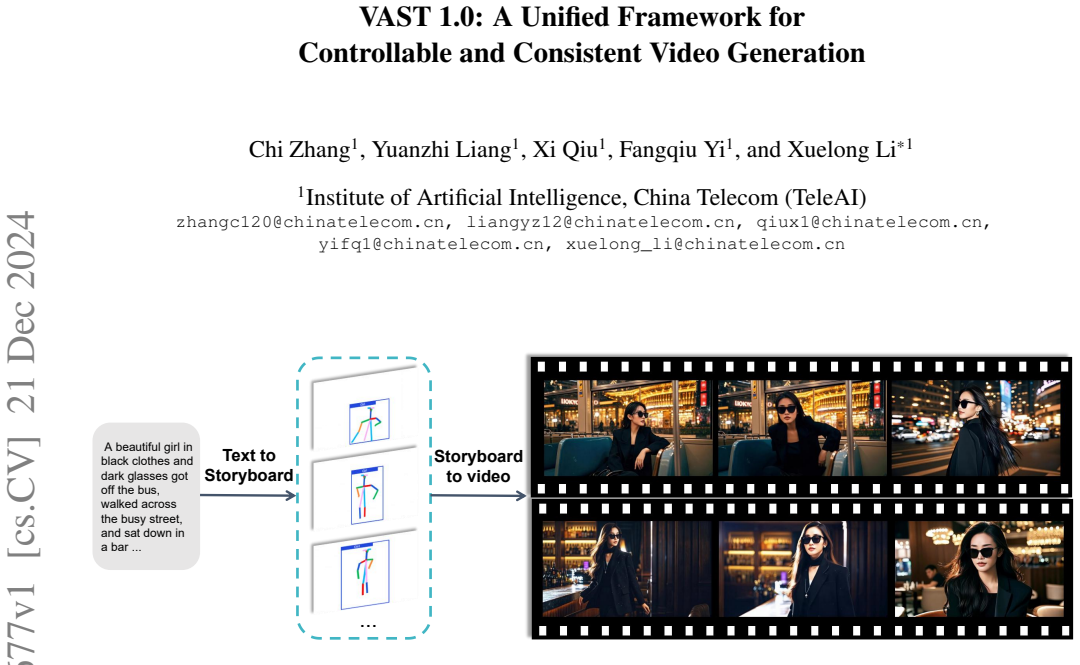
The central mechanism is the storyboard, an intermediate representation that captures human poses and object layouts as explicit control signals. In StoryForge, pose and layout autoencoders compress these signals into latent spaces, and a causal multimodal large language model predicts the next pose and layout features from text and prior timesteps. In VisionForge, those features are fused with text via a Storyboard Adapter using self-attention layers, then merged into a DiT-based diffusion transformer that renders the video. The storyboard thus carries spatial and temporal constraints from language to pixels, which is what the paper credits for temporal consistency, motion dynamics, and semantic accuracy.
What would settle it
Run the official VBench evaluation code on the VAST model (if released) with identical prompts and sampling parameters; if the reproduced overall score falls materially below 89.71 or the per-metric rankings change, the claim of state-of-the-art performance is falsified.
Extended reading notes
Core claim
The central discovery claimed is that introducing a storyboard as an explicit intermediate representation—a sequence of human poses and object layouts—between text and video substantially improves both visual quality and semantic fidelity. StoryForge, built on a causal multimodal LLM with pose and layout autoencoders, predicts latent pose and layout sequences that capture spatiotemporal structure. VisionForge, a DiT-based diffusion model with a storyboard adapter, fuses those features with text to synthesize video. The reported results on VBench show VAST achieving an overall score of 89.71, quality score of 88.98, and semantic score of 92.63, including perfect scores on object classification and human action, with high marks on subject and background consistency and temporal flickering. The paper interprets these numbers as evidence that decoupling text understanding from video generation through storyboard control sets a new standard for dynamic and coherent video synthesis.
Load-bearing premise
The reported VBench scores in the tables were produced by the described VAST system following the official protocol and are directly comparable to the listed competitor scores.
Editorial extensions
If this is right
- The two-stage design means each stage can be trained and improved separately, so gains in storyboard prediction or storyboard-to-video rendering can be developed independently.
- Because the storyboard explicitly encodes poses and object layouts, users gain fine-grained control over subject dynamics and scene composition without per-video fine-tuning.
- The near-perfect scores on temporal flickering, subject consistency, and background consistency indicate that the storyboard largely resolves inter-frame stability for the tested prompts.
- High semantic scores, including 100 on human action and 97.02 on spatial relationships, suggest the framework aligns generated content with textual descriptions more faithfully than one-stage baselines.
- The principle of using an interpretable intermediate structure for generative tasks could carry over to other settings, such as longer narratives or multi-shot generation where cross-shot continuity is a known failure mode.
Reading between the lines
- A fair independent re-run of VBench with the official code (or a released checkpoint) would test whether the reported 11-point semantic margin over the next-best method reflects a genuine advantage or a protocol difference in prompt selection and sampling.
- The modular split suggests a practical route to user control: editing the storyboard—moving a bounding box or changing a pose—should translate directly to edited video content, something one-stage models cannot offer without retraining.
- If the storyboard representation generalizes, a similar intermediate structure could be applied to image-to-video, 3D generation, or world-model training, where explicit layout and pose priors are also valuable.
Editorial analysis
A structured set of objections, weighed in public.
Referee Report
Summary. The paper proposes VAST, a two-stage text-to-video generation framework. In the first stage, StoryForge converts a textual prompt into a storyboard consisting of human poses and object layouts using a causal multimodal LLM and learned autoencoders; in the second stage, VisionForge uses a Diffusion Transformer (DiT) extended with a Storyboard Adapter Module to generate video conditioned on the storyboard and text. The authors claim that this decoupling of text understanding from video generation improves temporal consistency, motion dynamics, and semantic accuracy, and they report state-of-the-art VBench scores: total 89.71, quality 88.98, and semantic 92.63 (Tables 1–3). The paper does not provide code, model checkpoints, evaluation scripts, or a detailed evaluation protocol, and the reported numbers contain internal inconsistencies.
Significance. If the reported results were verified and artifacts were released, the storyboard-based intermediate representation would be a plausible and potentially valuable contribution to controllable video generation, particularly given the claimed margin of 11 points in semantic expression over the next-best method. The paper also names concrete strengths: a two-stage design that separates scene structure inference from video synthesis, and a large curated dataset. However, as submitted, the empirical claim is unverifiable: the manuscript supplies no code, checkpoints, or evaluation details, and its own tables do not add up consistently. The technical architecture is described only at a high level, with no ablations or statistical analysis. Therefore, the significance of the contribution cannot currently be assessed from the submitted evidence.
major comments (5)
- [Section 4.1, Table 1] The ranking in Table 1 is internally inconsistent: Gen-3 has a total score of 83.32 but is assigned rank 9, while Data-Juicer has a lower total score of 82.53 and is assigned rank 8. If the rows are intended to be sorted by total score, the ranks are wrong; if some other ordering is used, it must be explained. As printed, the table does not support claim that VAST 'achieves the highest overall score' relative to a correctly ordered list.
- [Section 1 vs. Table 1] The Introduction (Section 1) reports that VAST achieves a video quality score of 88.60%, while Table 1 lists the same quantity as 88.98. These values should be identical. The discrepancy indicates that the reported numbers have not been carefully cross-checked, and it is impossible to determine which value is correct, further eroding confidence in the leaderboard comparison.
- [Section 4.1, Tables 2 and 3] The per-dimension scores in Tables 2 and 3 do not aggregate to the totals shown in Table 1. For VAST, the seven quality dimensions in Table 2 average to approximately 90.30, not 88.98, and the nine semantic dimensions in Table 3 average to approximately 72.88, not 92.63. No aggregation rule, per-dimension weights, or sample sizes are stated. As a result, the headline total and sub-scores cannot be reproduced from the data provided, which directly undermines the central claim of state-of-the-art performance.
- [Sections 3 and 4] The evaluation protocol is not described. The paper does not specify the number of prompts per VBench dimension, the inference settings (sampling steps, guidance scale, resolution, video duration), random seeds, or the exact version of the VBench benchmark. It also provides no error bars or statistical tests. Without this information and without access to code, model checkpoints, or evaluation scripts, the reported VBench scores cannot be independently verified, so the statement that VAST 'outperforms existing methods in both visual quality and semantic expression' is not supportable as submitted.
- [Section 4.1 (overall)] The paper presents no ablation study. Because the entire motivation of the work is that the two-stage storyboard decomposition improves video quality and consistency (Section 1), an ablation is needed to attribute the reported performance to the storyboard mechanism. For example, one would need to compare VAST against a single-stage text-to-video model using identical data and compute, or against VisionForge trained with ground-truth versus generated storyboards. Without such evidence, the causal role of the proposed intermediate representation is unverified.
minor comments (6)
- [Section 3.2] The text says 'As shown in Fig. 3' when describing the StoryForge architecture, but Figure 3 is the VisionForge diagram; the StoryForge diagram appears to be Figure 2. This makes the description of the framework confusing.
- [Figure 4 caption] The caption contains the stray token 'final_moe_best', which appears to be a leftover from an internal experimental pipeline. It should be removed.
- [Section 3.3] The Storyboard Adapter Module is named but not described in any technical detail; its architecture, layer counts, input fusion method, and the manner in which its output is merged into the DiT backbone are not given, which hampers reproducibility.
- [Section 3.1] The dataset of 100 million images and 30 million video clips is described in a single sentence without details on the annotation pipeline, filtering criteria, or data sources, and the autoencoder training losses are only named, not defined.
- [Section 1 and Table 3] The Introduction refers to 'human movement' while Table 3 lists the corresponding dimension as 'Human Action'; the terminology should be made consistent.
- [Figure 5 caption] The phrase 'these examples highlight V AST's ability to intricate action sequences' is missing a verb; it should read 'ability to generate intricate action sequences' or similar.
Circularity Check
No circular derivation chain found; the central claims rest on external VBench evaluation, and the noted table inconsistencies are reproducibility concerns rather than circularity.
full rationale
The paper does not present a derivation chain in which an output is defined in terms of an input or in which a fitted parameter is renamed as a prediction. Its central claim is an empirical performance comparison against VBench, an external benchmark, and the reported scores are benchmark outcomes rather than consequences of the framework's definitions. The only self-citation is reference [18] in the related-work discussion, which is not load-bearing. The inconsistencies noted in the reader's take, such as the rank inversion in Table 1 and the mismatch between the abstract's quality score of 88.60 and the table's 88.98, are internal-consistency and reproducibility issues, not circularity: they do not show that any claimed result is equivalent to its own input by construction. The paper's future-work limitations likewise do not create circular reasoning. Therefore, under the hard rules, no circular step can be quoted or exhibited, and the correct finding is no significant circularity.
Assumptions & free parameters
free parameters (1)
- All neural network weights of StoryForge and VisionForge =
not reported
assumptions (4)
- domain assumption VBench is a valid proxy for video quality, temporal consistency, and semantic correctness.
- domain assumption Automatic pose and layout annotations on 30M videos and 100M images are accurate enough for training.
- domain assumption The causal MLLM can autoregressively predict future pose and layout latents from text and past timesteps.
- domain assumption No development feedback loop was used to tune the framework against VBench metrics.
invented entities (1)
-
Storyboard Adapter Module
Cite this review
Pith. "Pith review of VAST 1.0: A Unified Framework for Controllable and Consistent Video Generation." pith.science (2026). https://pith.science/paper/LPUQJCZG
@misc{pith2026241216677,
  author       = {Pith},
  title        = {Pith review of: VAST 1.0: A Unified Framework for Controllable and Consistent Video Generation},
  year         = {2026},
  howpublished = {\url{https://pith.science/paper/LPUQJCZG}},
  note         = {Machine review of arXiv:2412.16677}
}
read the original abstract
Generating high-quality videos from textual descriptions poses challenges in maintaining temporal coherence and control over subject motion. We propose VAST (Video As Storyboard from Text), a two-stage framework to address these challenges and enable high-quality video generation. In the first stage, StoryForge transforms textual descriptions into detailed storyboards, capturing human poses and object layouts to represent the structural essence of the scene. In the second stage, VisionForge generates videos from these storyboards, producing high-quality videos with smooth motion, temporal consistency, and spatial coherence. By decoupling text understanding from video generation, VAST enables precise control over subject dynamics and scene composition. Experiments on the VBench benchmark demonstrate that VAST outperforms existing methods in both visual quality and semantic expression, setting a new standard for dynamic and coherent video generation.
Figures


Figures from the paper (3 more)


Forward citations
Cited by 1 Pith paper
-
Beyond Generation: Unlocking Universal Editing via Self-Supervised Fine-Tuning
UES adds a self-supervised video condition to text-to-video diffusion models, enabling them to edit videos from delta prompts without paired supervision.
Reference graph
Works this paper leans on
-
[1]
Video generation models as world simulators
Tim Brooks, Bill Peebles, Connor Holmes, Will DePue, Yufei Guo, Li Jing, David Schnurr, Joe Taylor, Troy Luh- man, Eric Luhman, Clarence Ng, Ricky Wang, and Aditya Ramesh. Video generation models as world simulators
-
[2]
Data-juicer sand- box: A comprehensive suite for multimodal data-model co- development
Daoyuan Chen, Haibin Wang, Yilun Huang, Ce Ge, Yaliang Li, Bolin Ding, and Jingren Zhou. Data-juicer sand- box: A comprehensive suite for multimodal data-model co- development. arXiv preprint arXiv:2407.11784, 2024. 4, 5
arXiv 2024
-
[3]
Dreamllm: Synergistic multimodal com- prehension and creation
Runpei Dong, Chunrui Han, Yuang Peng, Zekun Qi, Zheng Ge, Jinrong Yang, Liang Zhao, Jianjian Sun, Hongyu Zhou, Haoran Wei, et al. Dreamllm: Synergistic multimodal com- prehension and creation. arXiv preprint arXiv:2309.11499, 6 Prompt: A person seated comfortably on a grey couch, along with a grey pillow behind them, engaged in a lively conversation. Prom...
-
[4]
Scaling recti- fied flow transformers for high-resolution image synthesis
Patrick Esser, Sumith Kulal, Andreas Blattmann, Rahim Entezari, Jonas Müller, Harry Saini, Yam Levi, Dominik Lorenz, Axel Sauer, Frederic Boesel, et al. Scaling recti- fied flow transformers for high-resolution image synthesis. In Forty-first International Conference on Machine Learn- ing, 2024. 1, 3
work page 2024
-
[5]
Diffit: Diffusion vision transformers for im- age generation
Ali Hatamizadeh, Jiaming Song, Guilin Liu, Jan Kautz, and Arash Vahdat. Diffit: Diffusion vision transformers for im- age generation. In European Conference on Computer Vi- sion, pages 37–55. Springer, 2025. 1
work page 2025
-
[6]
Slowfast-vgen: Slow- fast learning for action-driven long video generation
Yining Hong, Beide Liu, Maxine Wu, Yuanhao Zhai, Kai- Wei Chang, Lingjie Li, Kevin Lin, Chung-Ching Lin, Jian- feng Wang, Zhengyuan Yang, et al. Slowfast-vgen: Slow- fast learning for action-driven long video generation. arXiv preprint arXiv:2410.23277, 2024. 2
-
[7]
Vbench: Comprehensive bench- mark suite for video generative models
Ziqi Huang, Yinan He, Jiashuo Yu, Fan Zhang, Chenyang Si, Yuming Jiang, Yuanhan Zhang, Tianxing Wu, Qingyang Jin, Nattapol Chanpaisit, et al. Vbench: Comprehensive bench- mark suite for video generative models. In Proceedings of the IEEE/CVF Conference on Computer Vision and Pattern Recognition, pages 21807–21818, 2024. 1, 2
work page 2024
-
[8]
Hunyuanvideo: A systematic framework for large video generative models
Weijie Kong, Qi Tian, Zijian Zhang, Rox Min, Zuozhuo Dai, et al. Hunyuanvideo: A systematic framework for large video generative models. arXiv preprint arXiv:2412.03603, 2024. 4, 5
arXiv 2024
Show all 18 references
-
[9]
T2v- turbo-v2: Enhancing video generation model post-training through data, reward, and conditional guidance design.arXiv preprint arXiv:2410.05677, 2024
Jiachen Li, Qian Long, Jian Zheng, Xiaofeng Gao, Robinson Piramuthu, Wenhu Chen, and William Yang Wang. T2v- turbo-v2: Enhancing video generation model post-training through data, reward, and conditional guidance design.arXiv preprint arXiv:2410.05677, 2024. 4, 5
-
[10]
Dit-3d: Exploring plain diffusion transformers for 3d shape generation
Shentong Mo, Enze Xie, Ruihang Chu, Lanqing Hong, Matthias Niessner, and Zhenguo Li. Dit-3d: Exploring plain diffusion transformers for 3d shape generation. Advances in neural information processing systems, 36:67960–67971,
-
[11]
Scalable diffusion models with transformers
William Peebles and Saining Xie. Scalable diffusion models with transformers. In Proceedings of the IEEE/CVF Inter- national Conference on Computer Vision, pages 4195–4205,
-
[12]
Movie gen: A cast of media foundation models
Adam Polyak, Amit Zohar, Andrew Brown, Andros Tjandra, Animesh Sinha, Ann Lee, Apoorv Vyas, Bowen Shi, Chih- Yao Ma, Ching-Yao Chuang, et al. Movie gen: A cast of media foundation models. arXiv preprint arXiv:2410.13720,
-
[13]
Dreamfusion: Text-to-3d using 2d diffusion
Ben Poole, Ajay Jain, Jonathan T Barron, and Ben Milden- hall. Dreamfusion: Text-to-3d using 2d diffusion. arXiv preprint arXiv:2209.14988, 2022. 1
2022 arXiv
-
[14]
Motion-i2v: Consistent and controllable image-to-video generation with explicit motion 7 Prompt: Two Monkey Kings are locked in combat before the Heavenly Palace
Xiaoyu Shi, Zhaoyang Huang, Fu-Yun Wang, Weikang Bian, Dasong Li, Yi Zhang, Manyuan Zhang, Ka Chun Cheung, Simon See, Hongwei Qin, et al. Motion-i2v: Consistent and controllable image-to-video generation with explicit motion 7 Prompt: Two Monkey Kings are locked in combat befo...
2024
-
[15]
Mo- tionbooth: Motion-aware customized text-to-video genera- tion
Jianzong Wu, Xiangtai Li, Yanhong Zeng, Jiangning Zhang, Qianyu Zhou, Yining Li, Yunhai Tong, and Kai Chen. Mo- tionbooth: Motion-aware customized text-to-video genera- tion. NeurIPS, 2024. 2
2024
-
[16]
Cogvideox: Text-to-video diffusion models with an expert transformer
Zhuoyi Yang, Jiayan Teng, Wendi Zheng, Ming Ding, Shiyu Huang, Jiazheng Xu, Yuanming Yang, Wenyi Hong, Xiao- han Zhang, Guanyu Feng, et al. Cogvideox: Text-to-video diffusion models with an expert transformer. arXiv preprint arXiv:2408.06072, 2024. 3
2024 arXiv
-
[17]
From slow bidirectional to fast causal video generators
Tianwei Yin, Qiang Zhang, Richard Zhang, William T Free- man, Fredo Durand, Eli Shechtman, and Xun Huang. From slow bidirectional to fast causal video generators. arXiv preprint arXiv:2412.07772, 2024. 4, 5
2024
-
[18]
Is sora a world simulator? a comprehensive survey on general world models and beyond
Zheng Zhu, Xiaofeng Wang, Wangbo Zhao, Chen Min, Ni- anchen Deng, Min Dou, Yuqi Wang, Botian Shi, Kai Wang, Chi Zhang, et al. Is sora a world simulator? a comprehensive survey on general world models and beyond. arXiv preprint arXiv:2405.03520, 2024. 1 8
2024
Reviewed August 11, 2026 · model on record in the stance chip above.
Discussion (0). Continue with ORCID to comment.