REVIEW 4 major objections 4 minor 21 references
LLM Abstention Can Be a Prompt Artifact, in Addition to Genuine Uncertainty
T0 review · 4 major / 4 minor · reviewed 2026-08-06 · deepseek-v4-flash
Pith's one-line read Adding an 'Unknown' option makes LLMs falsely abstain even on questions they can answer, and renaming the option to a random word like 'Cerulean' changes nothing, showing abstention is partly a prompt artifact rather than genuine…
desk verdict The random-word ablation is a real and memorable result, but the 'can answer when forced' claim rests on a coercive rerun prompt, and the paper's own algebra caps the known share near 28%. read the letter →
The pith
A machine-rendered reading of the paper's core claim, the machinery that carries it, and where it could break.
The reading
What carries the argument
The load-bearing device is the contrast between two versions of the same question: one with a designated extra option and one without. Ten settings build a ladder on this contrast: S1–S2 baseline vs. added 'Unknown'; S3 format conversion; S4 word-content ablation ('Unknown' → 'Indeterminate' → 'Cerulean'); S5 forced rerun without the option; S6 self-diagnosis; S7 reasoning-trace F1 plus a DeBERTa NLI probe; S8 a logit-lens read of $\log P(\text{``Unknown''})$ across all 33 layers of an open-weight model in base, instruction-tuned, and RL variants; S9 persistence across three redraws; S10 temperature, difficulty, size, and alignment sweeps. The key comparison is the TFQ-vs-MCQ double dissociation: the same extra option moves abstention by tens of points on binary logic questions and by only small margins on four-option MCQs, which is what separates a structural trigger from a semantic or difficulty effect.
What would settle it
Re-run S5 with a neutral instruction that only removes the 'Unknown' option ('Please choose True or False') and measure accuracy on the formerly abstained items; if it falls to the 50% chance level, the recovery was compliance with the pressure wording and the C2 capability claim collapses. A second decisive check is a direct mid-layer probe reading the gold True/False label from hidden states of an abstaining model: if the label is absent before the final layers, the C3 override story fails.
Extended reading notes
Core claim
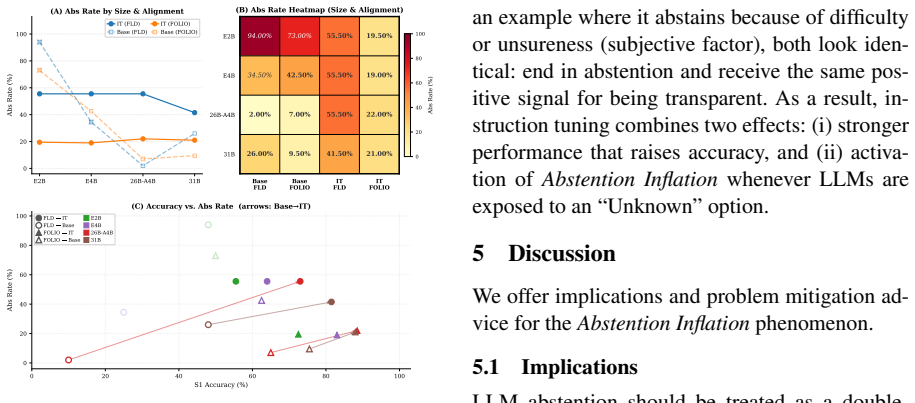
The central claim is that abstention behavior in LLMs is inflated by the structural presence of an extra response option, regardless of the option's meaning. The paper establishes four progressive propositions: (C1) the trigger is structural — 'Unknown' and 'Cerulean' behave identically, and almost nothing changes when the format is switched from True/False to letter-coded labels; (C2) the effect makes models deny knowledge they demonstrably have, since removing the option recovers 52–75% accuracy on the very items the model abstains on, while self-diagnosis denies any subjective incapability; (C3) the override happens at the output end of the network, with reasoning-trace quality essentially unchanged and the 'Unknown' logit rising only in the last layers; and (C4) the bias is stable across repeated draws and temperatures and is installed by instruction tuning, as base models show far lower abstention inflation than their instruction-tuned counterparts. The net position is that abstention is often a learned surface pattern, not a faithful uncertainty signal, and that benchmarks and routers should not take a single-format 'Unknown' label at face value.
Load-bearing premise
The S5 forced-rerun prompt urges the model to 'pay more attention', to overcome 'subjective ability limits', and states it 'must select one of the original labels', so the 52–75% recovery could be instruction-following rather than latent capability; the companion claim that mid-layer representations preserve the correct answer is inferred indirectly from a logit-lens contrast, not directly probed.
Editorial extensions
If this is right
- Downstream systems that route on abstention — abstention-based routers, confidence routers, multi-agent pipelines — will inherit the extra-option bias as if it were genuine epistemic uncertainty.
- Benchmark designers who include an 'Unknown' category should report Abs Rate beside accuracy and include a w/o-option rerun as a routine sanity check; otherwise the abstention number mixes inflated and genuine refusals.
- Reformatting binary questions away from a True/False-with-extra-option setup removes most of the inflation at no capability cost, according to the format-ablation results.
- Instruction tuning raises accuracy and false abstention together — the paper quantifies an 'abstention tax' near one point of extra abstention per point of accuracy gained in the vulnerable format.
- Models still distinguish answerable from truly-unknown items by a wide margin, so the bias is a directional over-trigger rather than a collapse of the model's ability to tell the two populations apart.
Reading between the lines
- This suggests the effect may be a general 'escape-hatch option' phenomenon: any extra, low-commitment option could act as an abstention slot, so a natural next test is whether 'None of the above' or a confidence scale triggers the same inflation on MCQ-style tasks — a comparison the paper does not run.
- The C3 claim is indirect: mid-layer preservation is inferred from the absence of a mid-layer Unknown-logit rise, not from reading the gold label out of those layers. A direct hidden-state probe for True/False would distinguish 'override at the output' from 'the answer never formed'.
- The abstention tax has a deployment corollary the authors leave implicit: if each point of instruction-tuning accuracy is bought with roughly a point of false abstention, then net delivered accuracy — answers users actually receive — may be roughly flat on TFQ-with-Unknown setups, making such channels costlier than headline Acc suggests.
- Because the S5 rerun prompt tells the model to 'pay more attention' and that it 'must select one of the original labels', part of the 52–75% recovery could be compliance. Re-running S5 with a neutral instruction is the cleanest way to separate capability from instruction-following, which would directly test the paper's C2.
Editorial analysis
A structured set of objections, weighed in public.
Referee Report
Summary. This paper studies the effect of adding an "Unknown" option to True/False and multiple-choice prompts. Across three commercial LLMs and six benchmarks, it reports that on TFQs the extra option produces large abstention rates and accuracy drops (average −15.75% accuracy, 32.9% abstention), that replacing "Unknown" with a random word preserves the effect, that rerunning abstained items without the option recovers 52–75% accuracy, that reasoning traces remain largely unchanged while final answers switch to "Unknown", and that the bias persists across temperature and emerges with instruction tuning. The authors organize the work around four claims (C1–C4) tracing the phenomenon from prompt structure to representation and training origin.
Significance. If the effect is real, the paper makes a valuable methodological point: abstention rates are not directly interpretable as epistemic uncertainty, and benchmarks that include "Unknown" labels need counterfactual controls. The design has notable strengths: the S2 effect is large and consistent across models; the random-word condition (S4) is an elegant control; S9 provides persistence evidence; S10 shows temperature invariance; the trace evaluation includes manual verification of 100 samples; and Appendix E.3 offers falsifiable predictions. The paper is not circular: the key quantities are measured against external datasets and baseline prompts, not fitted to the conclusion. However, the strongest reading ("the model denies it can answer even when it can") hinges on a capability probe whose prompt is coercive and whose label balance is unreported, so the central C2 claim needs repair.
major comments (4)
- [§4.2.1 / Appendix I (S5)] The S5 rerun is not a neutral test of whether the model can answer the abstained items. The prompt replays the prior S2 response ending in "Unknown" and instructs the model to "pay more attention", "overcome subjective ability limits", and "must select one of the original labels: True or False". That is an explicit command to reverse the abstention, so the 52–75% recovery rate may measure instruction-following under pressure rather than latent capability. The obvious control is to run the plain S1 prompt (no "Unknown" option, no follow-up turn) on the abstention subset; the paper does not report this control. Since C2 and the abstract's "denies it can answer even when it can" rest on S5, this is load-bearing.
- [§4.2.1 / Appendix C.4] The "above 50% random baseline" interpretation of S5 is not verifiable without the label distribution of the abstention subset. If the subset is imbalanced toward True or False, always predicting the majority label gives accuracy above 50% without any latent knowledge; the paper never reports this balance. Moreover, the paper's own decomposition in Appendix C.4 (alpha = 2*P(correct|forced) − 1) yields a pooled known share of about 28%, meaning most abstentions remain consistent with genuine uncertainty. The text should report the label balance, provide per-label accuracy, and soften claims that S5 proves the model "can" answer.
- [§4.3.2 / Appendix D.1 (S8)] C3 overstates what S8 shows. The logit-lens experiment tracks log P("Unknown") across layers and demonstrates that the Unknown logit rises only in later layers, but it does not directly read out a True/False prediction from mid-layer hidden states; the authors concede this in Appendix D.1 ("does not directly read out a True/False prediction from mid-layer hidden states"). The "mid-layer representations preserve the correct answer" part of C3 is therefore inferred from the absence of a mid-layer Unknown rise plus the behavioral S5 result. A direct mid-layer probe of the gold label is needed before claiming representation-level preservation.
- [§4.2.2 / Appendix I (S6)] The self-diagnosis prompt is leading. It asks the model to choose between "subjective incapability" and "the question is objectively unanswerable - the given information is genuinely insufficient", which offers a face-saving justification for the model's prior "Unknown" answer. Unsurprisingly, 95–100% of responses select option B. This does not establish that the model "sincerely believes" the abstention is warranted; it may simply be a post-hoc rationalization consistent with its own previous output. The introspective-gap claim would be stronger with a less leading prompt or an open-ended attribution.
minor comments (4)
- [Table 1 / §4.1.3] The "FLD MCQ" and "FOLIO MCQ" columns are S3 conversions, but the header "Acc (S2)" may confuse readers into thinking these are separate S2 runs; clarify in the caption that these are S3 runs with MCQ-style letter labels.
- [§4.1.3 / Appendix I (S3)] The S3 prompt includes an additional instruction ("Select 'C. Unknown' ONLY if the relationship is genuinely undeterminable... Do NOT select it simply because you feel uncertain") that is absent from S2, so the S3-versus-S2 comparison is not perfectly controlled; the conclusion that question format is not the root cause should acknowledge this confound explicitly.
- [Abstract / §4.1.4] The abstract says replacing "Unknown" with a random word produces an "identical effect"; the data show statistically indistinguishable rates, not numerically identical rates. Use "statistically indistinguishable" or report confidence intervals for the difference.
- [General / §3.5] The paper reports many proportions without confidence intervals (e.g., 32.9% Abs Rate, 52.4% 3/3 persistence, 42.3% NLI-recoverable). Adding bootstrap confidence intervals and releasing the code and data would materially strengthen the quantitative claims.
Circularity Check
No significant circularity: the four claims rest on independent prompt manipulations and measurements, not on fitted parameters or self-citations.
full rationale
The paper's derivation chain is self-contained against external benchmarks and baseline prompts. C1 is established by comparing S1 (no extra option) with S2 (Unknown added) and by S3/S4 ablations that replace the option word, an independent manipulation rather than a restatement of the definition. C2 uses an S5 rerun on abstained samples plus an S6 self-report; even though the S5 follow-up is coercive ('You must select one of the original labels: True or False'), the 52-75% recovery is a measured external quantity and is not constructed from the claim it supports. C3 relies on paired trace F1, an NLI probe, and a logit-lens comparison; Appendix D.1 explicitly acknowledges that mid-layer preservation is inferred indirectly rather than probed directly, which is a validity limitation, not a circular reduction. C4 is tested with repeated draws, temperature sweeps, and Base-versus-IT model families. Appendix C.4's known-share formula alpha = 2P(forced)-1 is algebra applied to a measured accuracy, not a fitted parameter relabeled as a prediction, and Appendix C.7's tax ratio is a descriptive quotient of measured deltas. No load-bearing self-citation or imported uniqueness theorem appears in the argument. The noted limitations affect robustness and interpretation, but not circularity.
Assumptions & free parameters
assumptions (4)
- domain assumption The S5 rerun prompt measures latent capability rather than compliance pressure.
- domain assumption The DeBERTa NLI probe on reasoning traces is a valid test of whether the trace reached the correct logical conclusion.
- domain assumption Logit-lens projections at the token before the answer reveal where the 'Unknown' decision is formed.
- ad hoc to paper The TFQ versus MCQ asymmetry is compatible with a purely structural extra-option trigger.
Cite this review
Pith. "Pith review of LLM Abstention Can Be a Prompt Artifact, in Addition to Genuine Uncertainty." pith.science (2026). https://pith.science/paper/LRYT26G6
@misc{pith2026250716199,
  author       = {Pith},
  title        = {Pith review of: LLM Abstention Can Be a Prompt Artifact, in Addition to Genuine Uncertainty},
  year         = {2026},
  howpublished = {\url{https://pith.science/paper/LRYT26G6}},
  note         = {Machine review of arXiv:2507.16199}
}
read the original abstract
Large Language Models (LLMs) are increasingly trained to abstain from answering questions they are unsure about. However, this ability is often misused: in real-world applications, input prompts sometimes contain uncertainty elements, and driven by this, LLMs are inclined to abstain even on problems they are capable of solving. We argue that LLM abstention is not only an expression of genuine uncertainty; it is also an artifact that can be largely influenced by prompts. We name this phenomenon *Abstention Inflation*. We add "Unknown" as an extra option for LLMs to choose from; experiments show serious accuracy drops on True/False Questions (TFQs). Replacing "Unknown" with an unrelated random word produces an identical effect. We argue that LLMs are trained to imitate the surface pattern of *abstention*, rather than to express genuine uncertainty. Based on ten experiments, we support four claims that form a progressive argument: **(C1)** *Abstention Inflation* is triggered by the structural presence of an extra option, not by genuine uncertainty; **(C2)** further, it makes the model deny it can answer even when it can; **(C3)** at the representation level, this manifests as a later-layer output override; **(C4)** finally, this bias is stable and emerges through instruction tuning, rather than stochastic noise.
Figures


Figures from the paper (5 more)


Reference graph
Works this paper leans on
-
[1]
From “All iPhones are cell phones” and “All cell phones are phones” and “All phones are things”, it follows that any iPhone is a thing
-
[2]
Jack is either an employee or a wage earner
We are not given that Jack is an iPhone. The premises only say: “Jack is either an employee or a wage earner”; “Jack is either a human or a phone.”
-
[3]
InAdvances in Neural Information Pro- cessing Systems (NeurIPS) 37
Perception of knowledge boundary for large language models through semi-open-ended question answering. InAdvances in Neural Information Pro- cessing Systems (NeurIPS) 37. Zhiyuan Weng, Guikun Chen, and Wenguan Wang
-
[4]
Do as we do, not as you think: the conformity of large language models.Preprint, arXiv:2501.13381. Mozhi Zhang, Mianqiu Huang, Rundong Shi, Linsen Guo, Chong Peng, Peng Yan, Yaqian Zhou, and Xipeng Qiu. 2024. Calibrating the confidence of large language models by eliciting fidelity.Preprint, arXiv:2404.02655. 10 A Dataset Details FLD (Formal Logical Deduc...
arXiv 2024
-
[5]
Its gold label set also includes Unknown (for conclusions neither true nor false given the premises)
is a human-annotated first-order-logic en- tailment dataset in which premises are expressed in natural language and conclusions are full FOL formulae. Its gold label set also includes Unknown (for conclusions neither true nor false given the premises). We use 500 answerable items (250 True + 250 False;n=500) per experimental setting, and 300 truly-Unknown...
-
[7]
Therefore, we cannot derive “Kendra is presidential” from the facts, nor is there a fact that contradicts it. Final answer:Unknown 23 Manual verdict.On the same item, S1 (no “Unknown” option) produces the complete proof chain (fact4→fact13 →fact8→fact6→fact19) and returnsTrue; S5 reaches the same conclusion through an alternate chain via fact5→fact7→fact8...
-
[9]
All employees are wage earners,
We also know “All employees are wage earners,” and “All wage earners are human,” so if Jack is an employee then Jack is a wage earner and hence human
-
[10]
But neither of the disjunctions (“either. . . or. . . ”) forces Jack to be an iPhone (or even a phone). For instance, Jack could be human without being a phone or iPhone
Show all 21 references
-
[11]
Jack is a thing
Therefore, “Jack is a thing” might be derivable only if we can show Jack is a phone; however the premises don’t guarantee that. 6.The hypothesis “Jack is a thing and an iPhone” requires Jack to be an iPhone, which is not entailed. Final answer:Uncertain NLI probe.Contradiction...
-
[12]
That eccentric waxes animalism and does not still Manzoni
From fact4: “That eccentric waxes animalism and does not still Manzoni.”
-
[13]
That eccentric is an adventure if that eccentric waxes animalism but it does not still Manzoni
From fact13: “That eccentric is an adventure if that eccentric waxes animalism but it does not still Manzoni.” Using (1), we infer: eccentric is an adventure
-
[14]
If some person is an adventure it entrenches meningoencephalitis
From fact8: “If some person is an adventure it entrenches meningoencephalitis.” Using (2), we infer: eccen- tric entrenches meningoencephalitis
-
[15]
If that eccentric entrenches meningoencephalitis then that greenbottle is a thirstiness
From fact6: “If that eccentric entrenches meningoencephalitis then that greenbottle is a thirstiness.” Using (3), we infer: greenbottle is a thirstiness
-
[16]
Kendra is presidential if that greenbottle is a thirstiness
From fact19: “Kendra is presidential if that greenbottle is a thirstiness.” Using (4), we infer:Kendra is presidential. Final answer:True S2 Chain-of-Thought (with “Unknown” option, verbatim, abridged)
-
[17]
That Kendra is a thirstiness is not invalid
Fact12 states: “That Kendra is a thirstiness is not invalid.”
-
[18]
Kendra is presidential if that greenbottle is a thirstiness
Fact19 states: “Kendra is presidential if that greenbottle is a thirstiness.”
-
[19]
That greenbottle is aphrodisiacal
Fact10 states: “That greenbottle is aphrodisiacal.” (does not imply thirstiness)
-
[20]
No fact in the list states that the greenbottle is a thirstiness
-
[2018]
Unknown” option. Provides the baseline accuracy. •S2 (“Unknown
is a 4-option science MCQ benchmark re- quiring knowledge-grounded reasoning. All items have a single correct answer; there is no truly- Unknown subset. We use 500 items (n=500) per model, sampled from the challenge partition. Baseline accuracy (S1) ranges from 95.4% to 97.0% ...
2022
-
[2024]
Jie Ren, Yao Zhao, Tu Vu, Peter J
Direct preference optimization: Your lan- guage model is secretly a reward model.Preprint, arXiv:2305.18290. Jie Ren, Yao Zhao, Tu Vu, Peter J. Liu, and Bal- aji Lakshminarayanan. 2023. Self-evaluation im- proves selective generation in large language mod- els.Preprint, arXiv:...
2023 arXiv
-
[2025]
Zhihua Wen, Zhiliang Tian, Zexin Jian, Zhen Huang, Pei Ke, Yifu Gao, Minlie Huang, and Dongsheng Li
Know your limits: A survey of abstention in large language models.Preprint, arXiv:2407.18418. Zhihua Wen, Zhiliang Tian, Zexin Jian, Zhen Huang, Pei Ke, Yifu Gao, Minlie Huang, and Dongsheng Li
Reviewed August 6, 2026 · model on record in the stance chip above.
Discussion (0). Continue with ORCID to comment.