REVIEW 3 major objections 6 minor 33 references
DeepClean -- self-supervised artefact rejection for intensive care waveform data using deep generative learning
T0 review · 3 major / 6 minor · reviewed 2026-08-14 · deepseek-v4-flash
Pith's one-line read A variational autoencoder trained only on clean ICU blood-pressure waveforms can detect artefactual 10-second samples with around 90% sensitivity and specificity, outperforming PCA.
desk verdict A solid prototype VAE artefact detector for ICU waveforms that misses a head-to-head comparison against the very preprocessing heuristics it leans on, so the headline numbers are promising but not yet proven. read the letter →
The pith
A machine-rendered reading of the paper's core claim, the machinery that carries it, and where it could break.
The reading
What carries the argument
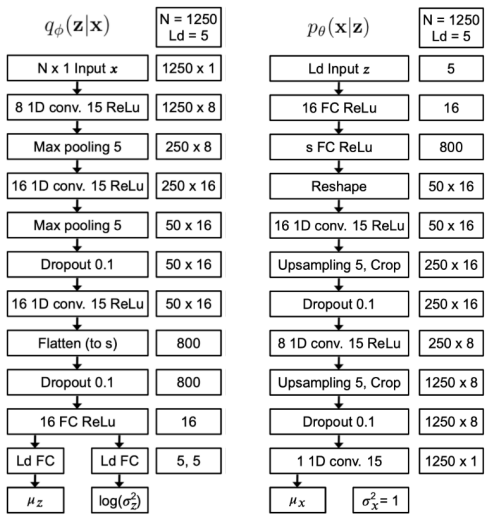
The load-bearing object is a convolutional variational autoencoder (VAE) with a low-dimensional Gaussian latent space. The encoder maps a 10-second waveform to the mean and variance of a variational distribution $q_\varphi(z|x)$, the decoder generates $p_\theta(x|z)$, and training optimises the evidence lower bound $\mathcal{L} = \mathbb{E}_{z\sim q}[\log p_\theta(x|z)] - \mathrm{KL}(q_\varphi(z|x)\|p(z))$. This objective both reconstructs clean waveforms and regularises the latent space toward a standard normal prior, so artefactual inputs are pushed to low-probability latent regions and reconstruct poorly. Artefact detection is carried by the reconstruction mean squared error against a threshold chosen from the training-set percentile; PCA lacks the regularisation mechanism that produces this separation.
What would settle it
Feed DeepClean 10-second windows containing no genuine artefact but displaying clinically plausible anomalous morphologies, such as heavily damped low-amplitude beats or under-damped resonant ringing, and measure their reconstruction MSE against the training-set 90th percentile; if these windows are classified as artefacts about as often as they are classified as clean, reconstruction error does not separate artefact from physiology.
Extended reading notes
Core claim
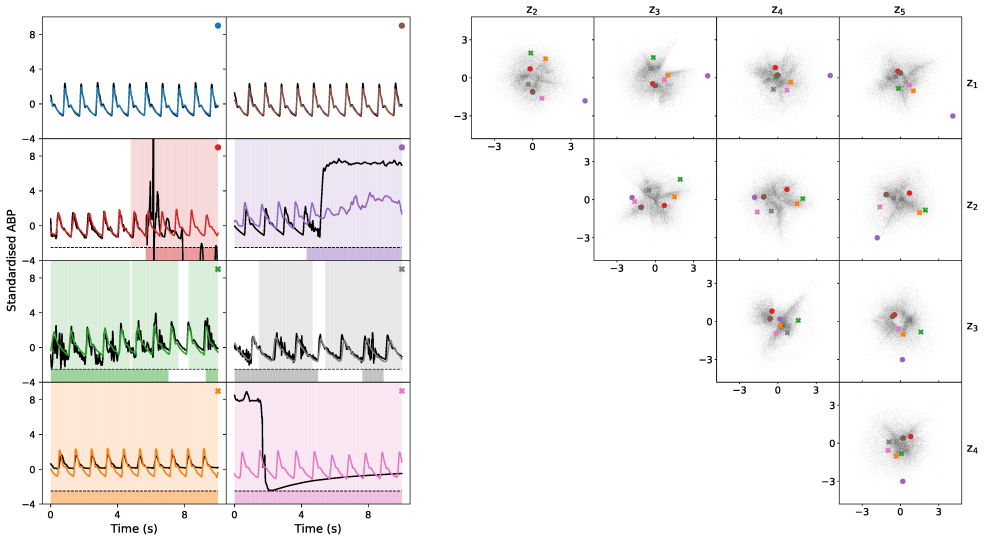
The central claim is that a convolutional variational autoencoder trained exclusively on substantially clean arterial blood pressure waveforms learns a generative model of normal physiology such that artefact-containing samples fall outside the learned latent distribution and therefore yield much larger reconstruction errors. Using the mean squared error between input and reconstruction, with a threshold set at the training data's 90th percentile, the model classifies 10-second samples as artefactual or clean; across latent dimensions from 2 to 100, mean sensitivity was 0.919, specificity 0.868, and ROC AUC 0.973. PCA, the linear baseline, achieved sensitivity 0.460 and ROC AUC 0.487, so it cannot separate artefacts from clean data by reconstruction error. DeepClean also localises artefacts within samples using 1-second sliding windows, correctly identifying on average 0.794 of each sample versus 0.525 for PCA, and because it is generative it can in principle replace artefactual regions with reconstructions, i.e. impute missing data.
Load-bearing premise
The load-bearing premise is that artefacts arise from mechanisms distinct enough from normal waveform physiology that a model trained on roughly cleaned data will reconstruct normal beats well but artefactual beats poorly, so reconstruction error cleanly separates the two.
Editorial extensions
If this is right
- Because prediction after training is cheap, artefact classification of a new 10-second sample can run in milliseconds, which makes a real-time ICU prefilter feasible.
- No clinician needs to label artefacts for training; coarse thresholding heuristics on the waveform suffice to build a clean training set, and even that preprocessing can be omitted at some cost.
- Artefactual regions within a sample can be localised to about one-second resolution using the same reconstruction error on sliding windows, allowing selective removal of bad segments rather than whole samples.
- The same generative model can replace artefactual or missing stretches with its reconstruction, offering an imputation method that preserves waveform statistics rather than simple interpolation.
- DeepClean reconstructs fine sub-pulse structure such as the dicrotic notch with a latent dimension as low as 5, where PCA reconstructions are still poor.
Reading between the lines
- If the latent-mechanism assumption holds across patients, a VAE trained on one patient's waveforms may flag artefacts for another patient after minimal fine-tuning; the paper does not test cross-patient transfer.
- The same self-supervised recipe is likely to transfer to other quasi-periodic ICU waveforms such as intracranial pressure and ECG, but waveforms dominated by arrhythmia could be misread as artefacts because their morphology lies outside a sinus-rhythm manifold.
- The scalar MSE threshold is a crude use of the generative model; the paper's discussion of using the decoder's full Gaussian output suggests a confidence-region classifier could give better within-sample localisation, but that variant is not evaluated.
- A stress test for the method would be to generate artefact-like but physiologically plausible waveforms, such as damped pulses or resonant ringing, and check whether they separate from clean data; the current test set relies on real artefacts that clinicians can clearly identify.
Signed reviews
Editorial analysis
A structured set of objections, weighed in public.
Referee Report
Summary. The paper introduces DeepClean, a convolutional variational autoencoder trained on 'clean' 10-second arterial blood pressure (ABP) waveform windows selected with thresholding heuristics. Artefacts are detected by thresholding reconstruction error, with the threshold derived from training-data percentiles rather than test labels. On a test set of 200 windows from a single ICU patient (130 expert-labelled as artefact-containing), the VAE is reported to achieve mean sensitivity 0.919, specificity 0.868, and ROC AUC 0.973, outperforming a PCA baseline, and it also localizes artefacts within samples using 1-second windows. The authors argue that the method is self-supervised, requiring no artefact labels for training, and suggest that the generative model could be used for imputation of missing data.
Significance. The contribution is a clearly described, reproducible proof-of-concept: the code is publicly available, the reconstruction-error threshold is chosen from training data rather than test labels, and the comparison to PCA is a useful sanity check. If the results hold beyond the single-patient setting, DeepClean would offer a practical way to flag ABP artefacts without manual annotation, with possible imputation benefits. However, the current evidence is limited by the single-patient design, the enriched test-set construction, the lack of a control for the preprocessing heuristics, and the absence of confidence intervals; the paper itself acknowledges in the Discussion that 'a good gold standard is lacking' and that cross-patient generalisation has not been determined.
major comments (3)
- [Data and preprocessing; Results, Table 1] The evaluation never reports the relationship between the preprocessing heuristics and the expert labels, even though those heuristics define the 'clean' training data and were used to enrich the test set. The test set was deliberately sampled 'with moderate bias towards regions marked as abnormal in preprocessing', and 130/200 windows were expert-labelled as artefact-containing, but the paper does not state how many of those 130 windows were also flagged by preprocessing, nor how well the preprocessing rule alone classifies the same 200 test windows. Because the preprocessing already identifies gross excursions (Figure 2, conditions i-iv), the reported VAE sensitivity of 0.919 and specificity of 0.868 may largely re-detect those same abnormalities, with the deep generative model acting as a nonlinear proxy for the heuristic. Please add (a) the contingency table between preprocessing flags and expert labels on the test set, (b) the sensitivity/specificity/AUC of the preprocessing rule alone, and (c) VAE performance stratified by whether a window was preprocessing-flagged, including artefacts that the heuristics do not flag. Without this control, the abstract's claim that the algorithm detects artefacts is not fully supported.
- [Results, Table 1] No uncertainty or significance measures accompany the reported metrics. The test set consists of 200 ten-second windows drawn from one patient's continuous recording, so neighbouring windows are likely autocorrelated and the effective sample size is smaller than 200. The point estimates (e.g., mean sensitivity 0.919, specificity 0.868, ROC AUC 0.973) have no confidence intervals, and the claims of 'significantly' higher ROC AUC and 'substantially outperformed' PCA are not supported by any statistical test. In addition, the mean row in Table 1 averages over eight latent-dimension models without a model-selection procedure, making it unclear what quantity the mean represents. Please provide confidence intervals (for example, cluster bootstrap over independent recording segments) and a paired comparison of VAE versus PCA AUC, or temper the statistical language and select a single model by a stated rule.
- [Discussion] The paper's own Discussion states that 'a good gold standard is lacking' and that generalisation to other patients 'has not been determined', which directly bound the central claim. All results come from a single patient in sinus rhythm, and the test set is enriched for abnormal regions; the reported sensitivity and specificity are therefore single-patient proof-of-concept estimates rather than general performance figures. The abstract's sentence 'we demonstrate that our algorithm can detect the presence of an artefact within a 10-second sample of data with sensitivity and specificity around 90%' should explicitly carry the single-patient scope, or the authors should add held-out patient data. This is important because the method's clinical utility depends on whether the learned manifold of normal waveforms transfers across patients and recording conditions.
minor comments (6)
- [Abstract] The phrase 'principle component analysis' should be 'principal component analysis'.
- [Methods, Variational autoencoder description] The sentence 'The weights of the encoder are variational parameters, φ, are the weights of the decoder are generative parameters, θ.' contains a duplicated verb; please rephrase.
- [Methods, Data and preprocessing] The notation such as 'p(z) =d N(0,I)' and 'qφ(z|x) =d N(μ(x),σ2(x)I)' is used without defining '=d'; please define it or use standard distributional notation.
- [Methods, Sample-wide and within-sample artefact detection] The sliding-window step size for the 1-second windows is not specified; please state whether the windows overlap and, if so, by how much.
- [Results, Table 1] Consider reporting the performance of a single selected latent dimension with its confidence interval rather than an unweighted mean over latent dimensions, since the mean mixes models with different hyperparameters and can be difficult to interpret clinically.
- [Figure 7 caption] The caption lists 'attenuation (left column, fourth row) and attenuation (right column, second and fourth row)'; if these are not both attenuation, please correct the labels, and please make the figure labels consistent with the Discussion's terminology.
Circularity Check
No significant circularity: DeepClean is an empirical VAE-based artefact detector evaluated against expert labels on independent test data.
full rationale
The paper's central claim is that a convolutional VAE trained on substantially clean ABP waveforms can detect artefacts via reconstruction error. The chain is empirical and self-contained: training data are selected by thresholding heuristics, a VAE is fit to those data, a decision threshold is set on the 90th/99th percentile of training-set reconstruction error, and performance is measured against separately expert-annotated test windows. The artefact label is not defined in terms of the reconstruction error, and the reconstruction error is not fitted to the test labels; the threshold is chosen from training data only, so the reported sensitivity/specificity is a genuine out-of-sample evaluation. The core assumption that artefacts are governed by different latent mechanisms is stated as a premise and supported by a citation to prior anomaly-detection work, but it is not smuggled in via the authors' own prior results. The few self-citations (e.g., [32] on attenuation, [5] on causality) are peripheral and not load-bearing for the artefact-detection claim. The enrichment of the test set with preprocessing-flagged regions is a legitimate evaluation-design concern—one could argue that the VAE may partly re-detect the preprocessing heuristics—but that is a missing control and a generalizability caveat, not a circular derivation. No equation, fitted parameter, or cited theorem forces the conclusion from its own inputs. Hence the circularity score is 0.
Assumptions & free parameters
free parameters (3)
- Reconstruction error threshold percentile =
90th percentile for sample-level; 99th percentile for within-sample
- Latent dimension =
Varied: 2, 3, 4, 5, 10, 20, 50, 100
- Preprocessing threshold heuristics =
Not specified numerically
assumptions (4)
- domain assumption Artefacts are driven by latent mechanisms distinct from normal ABP waveform physiology, so reconstruction error from a model trained on clean data separates artefacts from valid data.
- domain assumption The thresholding heuristics used in preprocessing produce a 'substantially clean' training set that is representative of the valid waveform generative process.
- domain assumption Expert manual annotation of the 200 test samples is a valid ground truth for artefact presence.
- standard math Standard VAE distributional assumptions: standard Gaussian prior, factorised Gaussian variational posterior, and Gaussian conditional distribution with identity covariance.
Cite this review
Pith. "Pith review of DeepClean -- self-supervised artefact rejection for intensive care waveform data using deep generative learning." pith.science (2026). https://pith.science/paper/LS45Z2GY
@misc{pith2026190803129,
  author       = {Pith},
  title        = {Pith review of: DeepClean -- self-supervised artefact rejection for intensive care waveform data using deep generative learning},
  year         = {2026},
  howpublished = {\url{https://pith.science/paper/LS45Z2GY}},
  note         = {Machine review of arXiv:1908.03129}
}
read the original abstract
Waveform physiological data is important in the treatment of critically ill patients in the intensive care unit. Such recordings are susceptible to artefacts, which must be removed before the data can be re-used for alerting or reprocessed for other clinical or research purposes. Accurate removal of artefacts reduces bias and uncertainty in clinical assessment, as well as the false positive rate of intensive care unit alarms, and is therefore a key component in providing optimal clinical care. In this work, we present DeepClean; a prototype self-supervised artefact detection system using a convolutional variational autoencoder deep neural network that avoids costly and painstaking manual annotation, requiring only easily-obtained 'good' data for training. For a test case with invasive arterial blood pressure, we demonstrate that our algorithm can detect the presence of an artefact within a 10-second sample of data with sensitivity and specificity around 90%. Furthermore, DeepClean was able to identify regions of artefact within such samples with high accuracy and we show that it significantly outperforms a baseline principle component analysis approach in both signal reconstruction and artefact detection. DeepClean learns a generative model and therefore may also be used for imputation of missing data.
Figures


Figures from the paper (4 more)


Reference graph
Works this paper leans on
-
[1]
The coming era of precision medicine for intensive care,
J.-L. Vincent, “The coming era of precision medicine for intensive care,” Crit. Care, vol. 21, p. 314, Dec. 2017
work page 2017
-
[2]
Continuous determination of optimal cerebral perfusion pressure in traumatic brain injury*,
M. J. H. Aries, M. Czosnyka, K. P. Budohoski,et al., “Continuous determination of optimal cerebral perfusion pressure in traumatic brain injury*,”Crit. Care Med., vol. 40, pp. 2456–2463, Aug. 2012
work page 2012
-
[3]
Heart rate variability in critical care medicine: a systematic review,
S. N. Karmali, A. Sciusco, S. M. May, and G. L. Ackland, “Heart rate variability in critical care medicine: a systematic review,”Intensive Care Med Exp, vol. 5, p. 33, Dec. 2017
work page 2017
-
[4]
S. M. Bishop, S. I. Yarham, V . U. Navapurkar, D. K. Menon, and A. Ercole, “Multifractal analysis of hemodynamic behavior: intraoperative instability and its pharmacological manipulation,”Anesthesiology, vol. 117, pp. 810–821, Oct. 2012
work page 2012
-
[5]
Early asymmetric Cardio-Cerebral causality and outcome after severe traumatic brain injury,
L. Gao, P. Smielewski, M. Czosnyka, and A. Ercole, “Early asymmetric Cardio-Cerebral causality and outcome after severe traumatic brain injury,”J. Neurotrauma, vol. 34, pp. 2743–2752, Oct. 2017
work page 2017
-
[6]
E. Beqiri, P. Smielewski, C. Robba, et al., “Feasibility of individualised severe traumatic brain injury management using an automated assessment of optimal cerebral perfusion pressure: the COGiTATE phase II study protocol,”BMJ Open, vol. 9, p. e030727, Sept. 2019
work page 2019
-
[7]
Reconstruction of missing physiological signals using artificial neural networks,
A. M. Sullivan, H. Xia, J. C. Mc Bride, and X. Zhao, “Reconstruction of missing physiological signals using artificial neural networks,”Comput. Cardiol., vol. 37, pp. 317–320, 2010
work page 2010
-
[8]
Semi-supervised detection of intracranial pressure alarms using waveform dynamics,
F. Scalzo and X. Hu, “Semi-supervised detection of intracranial pressure alarms using waveform dynamics,”Physiol. Meas., vol. 34, pp. 465–478, Apr. 2013
work page 2013
Show all 33 references
-
[9]
Alarms in the intensive care unit: how can the number of false alarms be reduced?,
M. C. Chambrin, “Alarms in the intensive care unit: how can the number of false alarms be reduced?,”Crit. Care, vol. 5, pp. 184–188, Aug. 2001
2001
-
[10]
A signal abnormality index for arterial blood pressure waveforms,
J. X. Sun, A. T. Reisner, and R. G. Mark, “A signal abnormality index for arterial blood pressure waveforms,” in 2006 Computers in Cardiology, pp. 13–16, 2006
2006
-
[11]
An active learning framework for enhancing identification of non-artifactual intracranial pressure waveforms,
M. Megjhani, A. Alkhachroum, K. Terilli,et al., “An active learning framework for enhancing identification of non-artifactual intracranial pressure waveforms,”Physiol. Meas., vol. 40, p. 015002, Jan. 2019
2019
-
[12]
Anomaly detection: A survey,
V . Chandola, A. Banerjee, and V . Kumar, “Anomaly detection: A survey,”ACM Comput. Surv., vol. 41, pp. 15:1–15:58, July 2009. 11
2009
-
[13]
On Calibration of Modern Neural Networks,
C. Guo, G. Pleiss, Y . Sun, and K. Q. Weinberger, “On Calibration of Modern Neural Networks,”arXiv, June 2017. Preprint at https://arxiv.org/abs/1706.04599
2017 arXiv
-
[14]
k-sparse autoencoders,
A. Makhzani and B. Frey, “k-sparse autoencoders,” arXiv, Dec. 2013. Preprint at https://arxiv.org/abs/1312.5663
2013 arXiv
-
[15]
Extracting and composing robust features with denoising autoencoders,
P. Vincent, H. Larochelle, Y . Bengio, and P.-A. Manzagol, “Extracting and composing robust features with denoising autoencoders,” inProceedings of the 25th International Conference on Machine Learning, ICML ’08, (New York, NY , USA), pp. 1096–1103, ACM, 2008
2008
-
[16]
Stacked denoising autoencoders: Learning useful representations in a deep network with a local denoising criterion,
P. Vincent, H. Larochelle, I. Lajoie, Y . Bengio, and P.-A. Manzagol, “Stacked denoising autoencoders: Learning useful representations in a deep network with a local denoising criterion,”J. Mach. Learn. Res., vol. 11, no. Dec, pp. 3371–3408, 2010
2010
-
[17]
Contractive auto-encoders: Explicit invariance during feature extraction,
S. Rifai, P. Vincent, X. Muller, X. Glorot, and Y . Bengio, “Contractive auto-encoders: Explicit invariance during feature extraction,” inProceedings of the 28th International Conference on International Conference on Machine Learning, ICML’11, (USA), pp. 833–840, Omnipress, 2011
2011
-
[18]
An introduction to variational autoencoders,
D. P. Kingma and M. Welling, “An introduction to variational autoencoders,” arXiv, June 2019. Preprint at https://arxiv.org/abs/1906.02691
2019 arXiv
-
[19]
Auto-Encoding Variational Bayes,
D. P. Kingma and M. Welling, “Auto-Encoding Variational Bayes,” arXiv, Dec. 2013. Preprint at https://arxiv.org/abs/1312.6114v10
2013 arXiv
-
[20]
Variational autoencoder based anomaly detection usingreconstruction probability,
J. An and S. Cho, “Variational autoencoder based anomaly detection usingreconstruction probability,”Special Lecture on IE, vol. 2, pp. 1–18, 2015
2015
-
[21]
Tutorial on variational autoencoders,
C. Doersch, “Tutorial on variational autoencoders,” arXiv, June 2016. Preprint at https://arxiv.org/abs/1606.05908
2016 arXiv
-
[22]
J. V . Stone,Artificial Intelligence Engines: A Tutorial Introduction to the Mathematics of Deep Learning. Sebtel Press, Apr. 2019
2019
-
[23]
Principal components analysis of images via back propagation,
G. W. Cottrell and P. Munro, “Principal components analysis of images via back propagation,” inVisual Communications and Image Processing ’88: Third in a Series, vol. 1001, pp. 1070–1077, International Society for Optics and Photonics, Oct. 1988
1988
-
[24]
Chollet and Others, “Keras,” 2015
F. Chollet and Others, “Keras,” 2015
2015
-
[25]
TensorFlow: Large-Scale machine learning on heterogeneous distributed systems,
M. Abadi, A. Agarwal, P. Barham, et al., “TensorFlow: Large-Scale machine learning on heterogeneous distributed systems,” arXiv, Mar. 2016. Preprint at https://arxiv.org/abs/1603.04467
2016 arXiv
-
[26]
Chollet, Deep Learning with Python
F. Chollet, Deep Learning with Python. Manning Publications Company, Oct. 2017
2017
-
[27]
Ladder variational autoencoders,
C. K. Sønderby, T. Raiko, L. Maaløe, S. K. Sønderby, and O. Winther, “Ladder variational autoencoders,”arXiv, Feb. 2016. Preprint at https://arxiv.org/abs/1602.02282
2016 arXiv
-
[28]
Density estimation: Variational autoencoders
R. Shu, “Density estimation: Variational autoencoders.”http://ruishu.io/2018/03/14/vae/, Mar. 2018. Accessed: Oct 2019
2018
-
[29]
ELBO surgery: yet another way to carve up the variational evidence lower bound,
M. D. Hoffman and M. J. Johnson, “ELBO surgery: yet another way to carve up the variational evidence lower bound,” in NIPS Workshop in Advances in Approximate Bayesian Inference, 2016
2016
-
[30]
Artifact removal from neurophysiological signals: impact on intracranial and arterial pressure monitoring in traumatic brain injury,
S.-B. Lee, H. Kim, Y .-T. Kim,et al., “Artifact removal from neurophysiological signals: impact on intracranial and arterial pressure monitoring in traumatic brain injury,”J. Neurosurg., pp. 1–9, May 2019
2019
-
[31]
b-V AE: Learning basic visual concepts with a constrained variational framework,
I. Higgins, L. Matthey, A. Pal, et al., “b-V AE: Learning basic visual concepts with a constrained variational framework,” ICLR, vol. 2, no. 5, p. 6, 2017
2017
-
[32]
Attenuation in invasive blood pressure measurement systems,
A. Ercole, “Attenuation in invasive blood pressure measurement systems,”Br. J. Anaesth., vol. 96, pp. 560–562, May 2006
2006
-
[33]
Tolerance regions for a multivariate normal population,
M. Slotani, “Tolerance regions for a multivariate normal population,”Ann. Inst. Stat. Math., vol. 16, pp. 135–153, Dec. 1964. 12
1964
Reviewed August 14, 2026 · model on record in the stance chip above.
Discussion (0). Continue with ORCID to comment.