REVIEW 2 major objections 5 minor 2 cited by
Towards Explainable AI Planning as a Service
T0 review · 2 major / 5 minor · reviewed 2026-08-14 · deepseek-v4-flash
Pith's one-line read Explainable Planning can be a service: a wrapper around an existing planner that compiles 'Why A rather than B?' into a hypothetical model, replans, validates, and returns the cost difference.
desk verdict A sincere, well-scoped prototype for explainable planning as a service, but the central example fails to demonstrate the main claim and the paper is best read as a roadmap with open problems. read the letter →
The pith
A machine-rendered reading of the paper's core claim, the machinery that carries it, and where it could break.
The reading
What carries the argument
The HModel and its compilation carry the argument. The service translates the formal contrastive question into a set of constraints, compiles them into a modified PDDL2.1 domain, and generates a hypothetical plan using the original planner. For the replacement question, the compilation cuts the original plan at the state where A occurs, replaces A with B, computes the new initial state using the VAL validator's happenings, adds timed-initial literals to simulate actions still executing, and lets the planner solve from that state. The redundancy post-processing, based on Fink and Yang's categories and Chrpa, McCluskey, and Osborne's detection algorithm, is the only mechanism proposed to make forced actions essential, and the paper states that guaranteeing causal essentiality is an open question.
What would settle it
Run the service on the paper's warehouse example with the question 'Why didn't Tom pick up the pallet?' and inspect whether the returned HPlan contains the forced load action in the causal support of a goal. If the compilation alone produces a plan where the forced action is redundant, and the only remedy is hand-adding nogood constraints or refining the question, then the promise of answering contrastive questions as a service is falsified.
Extended reading notes
Core claim
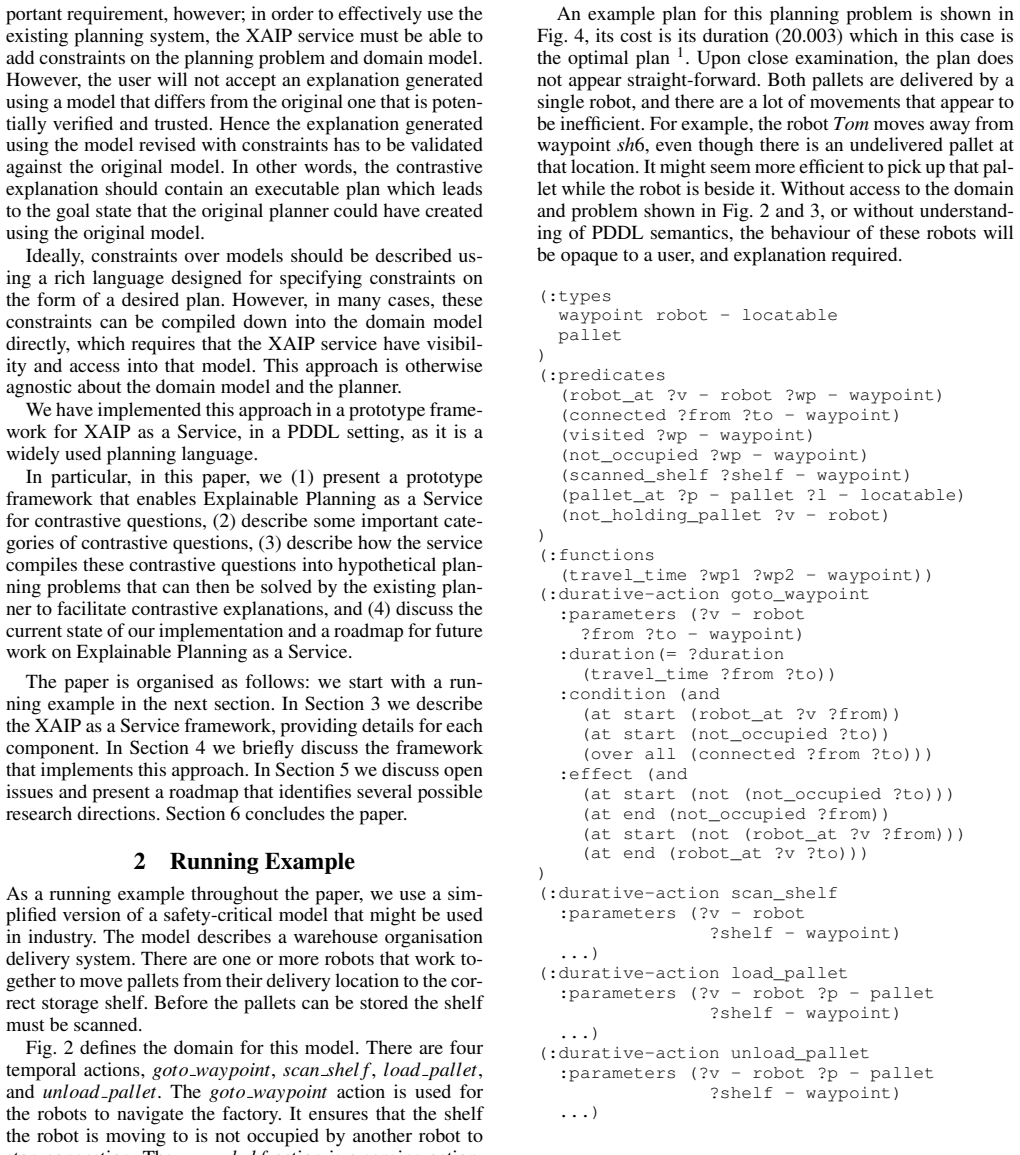
The central claim is that answering contrastive questions in planning does not require a new explainable planner; it can be layered as a service around any planner that speaks PDDL2.1. The service takes as input the original domain and problem, the plan, and a formalized question; it creates a revised domain model (HModel) that encodes the user's constraint, solves it with the same planner, validates the hypothetical plan against the original model, and forms a contrastive explanation as a tuple of existing, removed, added actions and cost difference. The paper demonstrates this on a warehouse delivery domain, where asking 'why didn't Tom pick up the pallet?' compiles into an HModel that forces the load action, and the planner returns an alternative plan with a small cost penalty. The authors stress that the explanation is only trustworthy because it is produced by the user's own planner and validated against the original model. They also identify a key limitation: forcing an action into a plan is not the same as making it causally necessary for the goals, and the paper shows a generated HPlan where the forced load is immediately undone.
Load-bearing premise
The user's contrastive question can be faithfully compiled into planning constraints that make the suggested action causally essential to the alternative plan, not merely present in it; the paper's own example (Figure 7) shows a forced action being immediately reversed and states that guaranteeing essentiality is an open question.
Editorial extensions
If this is right
- Users get explanations built from their own trusted planner and model, which matters in safety-critical settings such as oil-well drilling.
- The service supports several contrastive question types: forbid, force, replace, order, and time-window constraints, plus an iterative tree of follow-up questions.
- Because the framework is modular and PDDL2.1-based, it works with any conforming planner and can be integrated into robotics systems like ROSPlan.
- The hypothetical plan is validated against the original model, so inconsistencies introduced by model revision are caught before the explanation is shown.
- Forcing an action does not guarantee causal essentiality; the paper proposes redundancy detection plus nogood learning, but automating that refinement remains open.
Reading between the lines
- The service view could be extended beyond PDDL: any planner that can accept constraint-compiled models could be wrapped, suggesting a standard protocol for 'explanation-by-replanning' across planning systems.
- The redundancy problem might be attacked by compiling causal-support constraints directly, such as requiring that B supports a particular goal; the paper notes no current planning language expresses this cleanly.
- The cost-difference metric in the explanation assumes plan cost is the right comparison axis; in safety-critical domains, risk or robustness differences might be more meaningful and could be added to the contrast tuple.
- The iterative refinement tree suggests an automated explanation search driven by user feedback, turning a one-shot answer into a dialogue where the service proposes and the user critiques.
Signed reviews
Editorial analysis
A structured set of objections, weighed in public.
Referee Report
Summary. The paper proposes Explainable AI Planning as a Service: a wrapper around an existing PDDL2.1 planner that answers contrastive questions by (1) taking the original planning problem, the current plan, and a user question, (2) compiling the question into a hypothetical model (HModel), (3) invoking the existing planner to produce a hypothetical plan (HPlan), (4) validating the HPlan against the original model, and (5) presenting a comparison between the original plan and the HPlan. The authors categorize several formal question types, describe a modular prototype implementation, and walk through a warehouse running example. They explicitly discuss limitations, including the fact that their main compilation does not guarantee that the user-suggested action is essential to the causal structure of the resulting plan, and they identify several open research directions.
Significance. The paper addresses a timely topic and its core idea—using the user's own trusted planner and model to generate contrastive explanations—is practically appealing, especially for safety-critical domains. The framework's modularity and the use of existing validation tools (VAL) are strengths, as is the candid acknowledgment of the causal-relevance problem. However, the central demonstration fails on the running example: the HPlan in Figure 7 includes the user-suggested action but immediately reverses it, so the explanation does not answer the user's actual counterfactual question. Because the paper is explicitly positioned as early-stage work and identifies this as an open problem, the contribution is best seen as a roadmap and prototype rather than a fully validated solution. The paper does not provide formal correctness guarantees, user studies, or a released implementation, but it clearly names these as future work.
major comments (2)
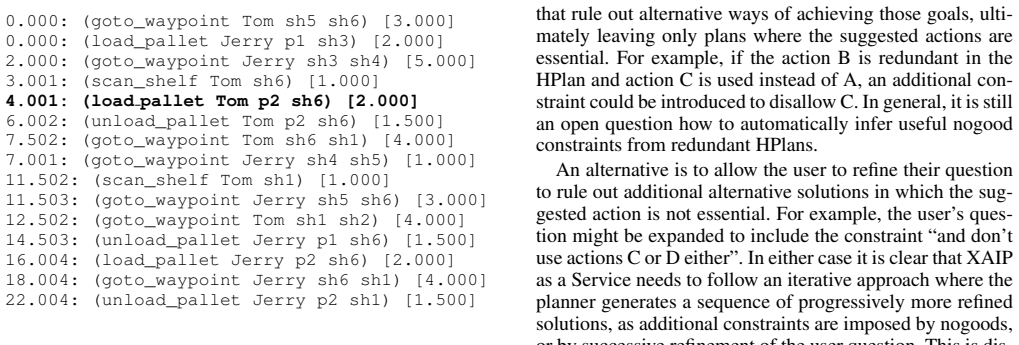
- [§3.2, Figure 7] The compilation for the paper's main question type (“Why is action A used in state S, rather than action B?”) produces an HPlan in which the user-suggested action B is immediately undone by (unload_pallet Tom p2 sh6). The paper itself notes that “This would not be a satisfactory explanation to the user” and states that guaranteeing the suggested action is essential to the causal structure is an open question. Since this is the paper's central mechanism and its only fully worked example, the claim that the service answers contrastive questions is not demonstrated. The authors should either provide a compilation that ensures causal relevance for at least this question type, or substantially reframe the contribution as an iterative framework in which the initial compilation is a heuristic and the absence of a causal-relevance guarantee is a core limitation rather than a peripheral one.
- [§3.2, HModel construction] The compilation step is described informally and its correctness is not specified. The paper does not define the semantics of “state S” in a temporal plan (e.g., which happenings are included, how simultaneous effects are handled), nor does it prove that the TIL times added in the new initial state are always well-defined and non-conflicting. Moreover, the HModel is introduced as a “revised domain model,” but in the example it is a modified initial state with TILs; the relationship between constraints compiled into the domain versus the problem instance is left unclear. Without a formal statement of what the compilation preserves (e.g., executability with respect to the original model, or a precise notion of “the user's intention”), it is difficult to assess whether the approach generalizes beyond the single example or to verify the validity claims made in Steps 4–5.
minor comments (5)
- [§3.2, TIL formula] In the definition of the timed-initial literals, the parenthetical in “where start (a j) (start (a j)) is the time at which the action a j (B) started execution” appears to be a typo; the second symbol should be start(B).
- [Figure 9] In the “removed” list, the action “9.001: (goto_waypoint Tom sh1 sh6)” does not appear in the original plan of Figure 4; the original plan at time 9.001 is (goto_waypoint Tom sh1 sh2). This discrepancy should be corrected.
- [Figure 7] The actions in Figure 7 are written with spaces (e.g., “load pallet Tom p2 sh6”), while the domain definition uses underscores (load_pallet). The figure should be made consistent with the PDDL syntax.
- [Abstract] The final sentence “we identify open questions for Explainable Planning as a service that identify several possible research directions” is redundant; consider rewording to “we identify open questions and several possible research directions.”
- [General] The paper does not state whether the prototype framework or the running-example files will be made available. A brief availability statement or link to a repository would improve reproducibility.
Circularity Check
No material circularity: the service architecture and compilations are independent of their inputs; the candid admission that causal relevance is not guaranteed is a correctness gap, not circularity.
full rationale
The paper proposes a service wrapper around an existing planner and demonstrates it with a prototype. Its derivation chain—formal question, constraints, HModel, replanning, validation, comparison—does not rely on fitting a parameter to the target result or on assuming the conclusion. The construction in Section 3.2 replaces action A with action B in the original plan prefix and replans from the resulting state; the HPlan is produced by an external planner and is not a restatement of the input. The paper explicitly concedes in Section 3.2 and Figure 7 that the forced action can be immediately reversed, that this 'would not be a satisfactory explanation,' and that ensuring the suggested action is essential to the causal structure 'is an open question as to whether it is possible to do this. We suspect not.' That is a candid limitation on the effectiveness of the central contribution, but it is not an input–output identity or a circular derivation. Self-citations such as Smith (2012) and Fox, Long, and Magazzeni (2017) motivate the iterative and contrastive framing, but they are not load-bearing theorems used to force the framework; the framework is implemented and checked with external tools (POPF, VAL). No prediction is a renamed fit, no uniqueness claim is imported from the authors' prior work, and no equation reduces to its own input. The score of 1 reflects only the presence of minor non-load-bearing self-citation, not circularity.
Assumptions & free parameters
assumptions (3)
- domain assumption The original planning model is correct and has no uncertainty.
- domain assumption The formal question type selected by the user faithfully matches the natural-language question.
- domain assumption The planner and VAL correctly solve and validate PDDL2.1 problems.
invented entities (1)
-
HModel (hypothetical model)
Cite this review
Pith. "Pith review of Towards Explainable AI Planning as a Service." pith.science (2026). https://pith.science/paper/LSA6SPWO
@misc{pith2026190805059,
  author       = {Pith},
  title        = {Pith review of: Towards Explainable AI Planning as a Service},
  year         = {2026},
  howpublished = {\url{https://pith.science/paper/LSA6SPWO}},
  note         = {Machine review of arXiv:1908.05059}
}
read the original abstract
Explainable AI is an important area of research within which Explainable Planning is an emerging topic. In this paper, we argue that Explainable Planning can be designed as a service -- that is, as a wrapper around an existing planning system that utilises the existing planner to assist in answering contrastive questions. We introduce a prototype framework to facilitate this, along with some examples of how a planner can be used to address certain types of contrastive questions. We discuss the main advantages and limitations of such an approach and we identify open questions for Explainable Planning as a service that identify several possible research directions.
Figures


Figures from the paper (10 more)




Forward citations
Cited by 2 Pith papers
-
Counterfactual Explanations as Plans
A formal account in modal situation calculus that defines counterfactual explanations as minimally distant alternative plans which toggle a goal, including reconciliation through added knowledge or corrected beliefs.
-
A Survey of Explainable Reinforcement Learning: Targets, Methods and Needs
A survey of 250+ explainable-reinforcement-learning papers proposes a What/How taxonomy and reports that sequence-level explanations are rare (11 works) compared with policy-level (175) and action-level (89) ones.
Reference graph
Works this paper leans on
-
[1]
write newline
" write newline "" before.all 'output.state := FUNCTION fin.entry add.period write newline FUNCTION new.block output.state before.all = 'skip after.block 'output.state := if FUNCTION new.sentence output.state after.block = 'skip output.state before.all = 'skip after.sentence 'output.state := if if FUNCTION not #0 #1 if FUNCTION and 'skip pop #0 if FUNCTIO...
-
[2]
A.; Bacchus, F.; and McIlraith, S
Baier, J. A.; Bacchus, F.; and McIlraith, S. A. 2009. A heuristic search approach to planning with temporally extended preferences. Artif. Intell. 173(5-6):593--618
work page 2009
-
[3]
Borgo, R.; Cashmore, M.; and Magazzeni, D. 2018. Towards providing explanations for AI planner decisions. IJCAI-18 Workshop on Explainable AI
work page 2018
-
[4]
Cashmore, M.; Fox, M.; Long, D.; Magazzeni, D.; Ridder, B.; Carrera, A.; Palomeras, N.; Hurtos, N.; and Carreras, M. 2015. Rosplan: Planning in the robot operating system. In ICAPS
work page 2015
-
[5]
Chakraborti, T.; Sreedharan, S.; Zhang, Y.; and Kambhampati, S. 2017. Plan explanations as model reconciliation: Moving beyond explanation as soliloquy. In IJCAI
work page 2017
-
[6]
P.; Talamadupula, K.; Dholakia, M.; Srivastava, B.; Kephart, J
Chakraborti, T.; Fadnis, K. P.; Talamadupula, K.; Dholakia, M.; Srivastava, B.; Kephart, J. O.; and Bellamy, R. K. E. 2018. Visualizations for an explainable planning agent. In IJCAI
work page 2018
-
[7]
Chrpa , L.; Mccluskey , T. L.; and Osborne , H. 2012. Determining redundant actions in sequential plans. In ICTAI
work page 2012
-
[8]
Coles, A.; Coles, A.; Fox, M.; and Long, D. 2010. Forward-chaining partial-order planning. In ICAPS
work page 2010
Show all 28 references
-
[9]
Cyras, K.; Letsios, D.; Misener, R.; and Toni, F. 2019. Argumentation for explainable scheduling. In https://arxiv.org/abs/1811.05437
2019 arXiv
-
[10]
Fink, E., and Yang, Q. 1992. Formalizing plan justifications. In Conference of the Canadian Society for Computational Studies of Intelligence , 9--14
1992
-
[11]
Fox, M.; Long, D.; and Magazzeni, D. 2017. Explainable planning. IJCAI-17 workshop on Explainable AI abs/1709.10256
2017 arXiv
-
[12]
Gerevini, A.; Saetti, A.; and Serina, I. 2006. An approach to temporal planning and scheduling in domains with predictable exogenous events. JAIR 25
2006
-
[13]
Howey , R.; Long , D.; and Fox , M. 2004. Val: automatic plan validation, continuous effects and mixed initiative planning using pddl. In 16th IEEE International Conference on Tools with Artificial Intelligence , 294--301
2004
-
[14]
Langley, P.; Meadows, B.; Sridharan, M.; and Choi, D. 2017. Explainable agency for intelligent autonomous systems. In AAAI
2017
-
[15]
Lindner, F.; Mattm\" u ller, R.; and Nebel, B. 2018. Moral permissibility of action plans. ICAPS-18 Workshop on Explainable Planning
2018
-
[16]
Long, D. 2018. Planning a way into a deep hole. In Invited talk at ICAPS Workshop on Planning and Scheduling Applications (SPARK)
2018
-
[17]
Mennatallah, E.-A.; Duen Horng, C.; Adam, P.; Hendrik, S.; and Fernanda, V. 2018. Workshop on visualization for AI explainability. In http://visxai.io/
2018
-
[18]
Miller, T. 2018. Contrastive explanation: A structural-model approach. arXiv preprint arXiv:1811.03163
2018 arXiv
-
[19]
Miller, T. 2019. Explanation in artificial intelligence: Insights from the social sciences. Artificial Intelligence 267
2019
-
[20]
Smith, D. 2012. Planning as an iterative process. In AAAI
2012
-
[21]
A.; and McIlraith, S
Sohrabi, S.; Baier, J. A.; and McIlraith, S. A. 2011. Preferred explanations: Theory and generation via planning. In AAAI
2011
-
[22]
Sreedharan, S.; Chakraborti, T.; and Kambhampati, S. 2018. Handling model uncertainty and multiplicity in explanations via model reconciliation. In ICAPS
2018
-
[23]
Sreedharan, S.; Srivastava, S.; and Kambhampati, S. 2018. Hierarchical expertise-level modeling for user specific contrastive explanations. In IJCAI
2018
-
[24]
van Fraassen, C. B. 1980. The Scientific Image . Oxford University Press
1980
-
[25]
XAI. 2017. IJCAI Workshop on Explainable AI . http://home.earthlink.net/dwaha/research/meetings/ijcai17-xai
2017
-
[26]
XAI. 2018. IJCAI Workshop on Explainable AI . http://home.earthlink.net/dwaha/research/meetings/faim18-xai
2018
-
[27]
XAIP. 2018. ICAPS Workshop on Explainable Planning . http://icaps18.icaps-conference.org/xaip
2018
-
[28]
Zhang, Y.; Sreedharan, S.; Kulkarni, A.; Chakraborti, T.; Zhuo, H.; and Kambhampati, S. 2017. Plan explicability and predictability for robot task planning. In ICRA
2017
Reviewed August 14, 2026 · model on record in the stance chip above.
Discussion (0). Continue with ORCID to comment.