Social World Model for Lifelong Social Intelligence
Pith reviewed 2026-06-26 14:27 UTC · model grok-4.3
The pith
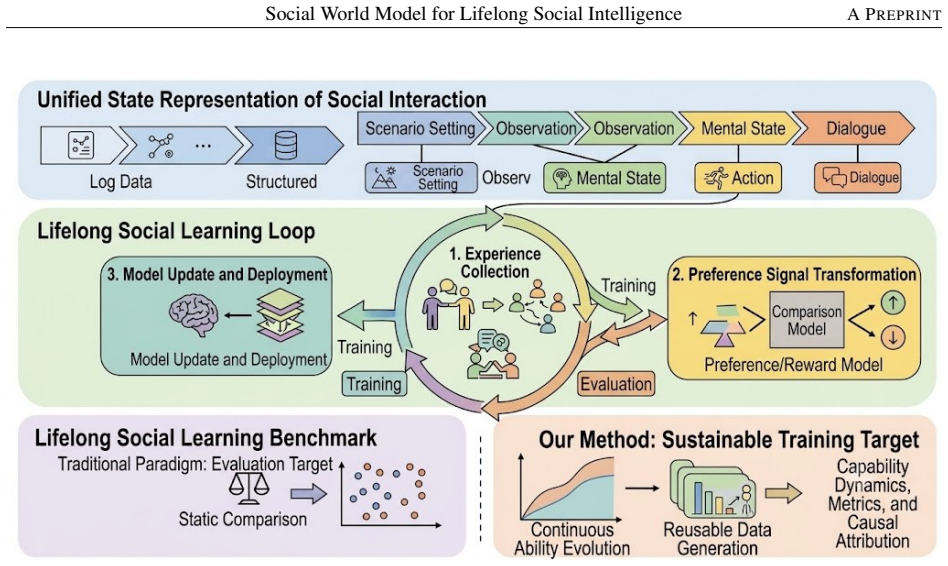
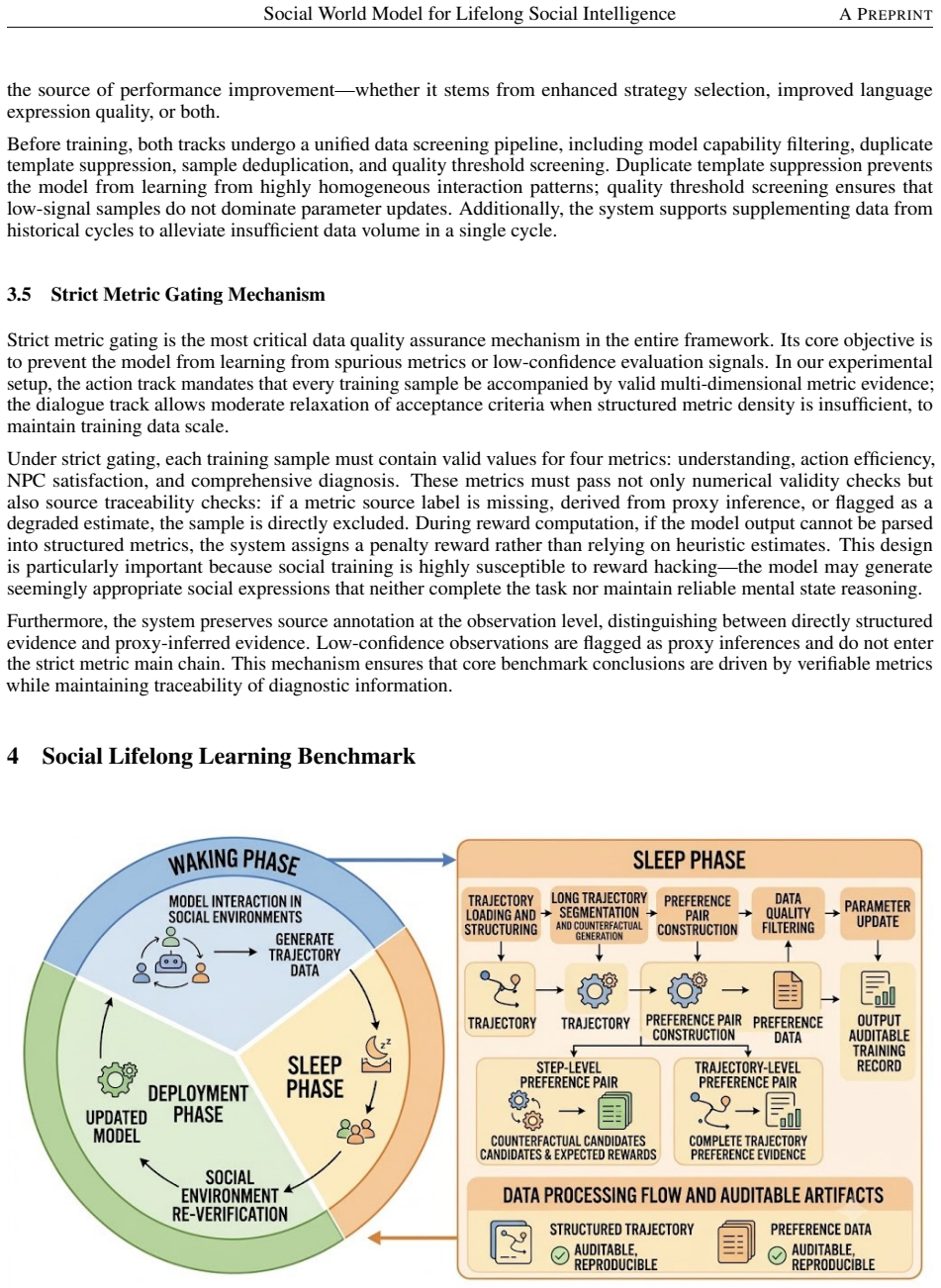
A five-dimension breakdown of social interactions creates a closed-loop framework that turns raw trajectories into preference signals for continuous model updating and retention.
A machine-rendered reading of the paper's core claim, the machinery that carries it, and where it could break.
Core claim
The Social World Model decomposes social interaction into five dimensions (scene setting, observation, mental state, action, and dialogue) to build a closed-loop learning framework. In this setup, agents collect interaction experiences, convert them into preference signals for model updating, and redeploy the updated policy for continued learning, with a reusable data synthesis mechanism and the ASCENT-Bench lifelong learning benchmark transforming social capabilities into an object of sustainable training.
What carries the argument
The five-dimension decomposition (scene setting, observation, mental state, action, and dialogue) that supplies a unified structured representation converting raw interaction trajectories into iterable preference signals for policy updating.
If this is right
- Agents can iteratively collect experiences, update policies, and redeploy without capability decay.
- Small open-source models achieve competitive or superior social coordination metrics compared to closed-source systems.
- Social capabilities shift from one-time evaluation targets to continuously trainable and retainable objects.
- The benchmark enables measurement of both improvement and retention across multiple difficulty levels in one setup.
Where Pith is reading between the lines
- Similar decomposition methods could apply to non-social agent skills such as planning or tool use by defining analogous dimensions.
- If the preference signals prove robust, the loop might support adaptation to changing social norms over long time horizons.
- The data synthesis mechanism could be tested for transfer to human-generated interaction data outside the benchmark.
- Failure of the loop on noisy real-world trajectories would indicate the decomposition needs additional dimensions or filtering steps.
Load-bearing premise
The five-dimension decomposition reliably converts raw interaction trajectories into usable preference signals that drive policy improvement without introducing noise or gaps.
What would settle it
Running the interactive training loop on ASCENT-Bench produces no gains over the baseline on the five core metrics or produces measurable forgetting on any difficulty level.
Figures
read the original abstract
Social intelligence is a core competency for language agents, yet current research primarily focuses on static capability evaluation rather than how these skills are continuously shaped and accumulated. This gap calls for a shift toward sustainable learning paradigms. Currently, two methodological pain points exist: social interaction trajectories lack unified structured representations to form iterable learning signals, and capability improvement and retention are typically studied in isolation, hindering the assessment of continuous evolution. To bridge this gap, we propose the Social World Model. We decompose social interaction into five dimensions (scene setting, observation, mental state, action, and dialogue) to build a closed-loop learning framework. In this setup, agents collect interaction experiences, convert them into preference signals for model updating, and redeploy the updated policy for continued learning. Additionally, we provide a reusable data synthesis mechanism and a lifelong learning benchmark, transforming social capabilities from an "object of evaluation" into an "object of sustainable training". Validating our framework on the ASCENT-Bench, the interactively trained Qwen2.5-7B model outperforms its baseline across all five core metrics. Notably, it matches the closed-source Gemini 3 Flash in completion rate, exceeds it in pass rate, and achieves zero forgetting across three difficulty levels. Unlike prior works that merely report static comparisons or capability decay, this end-to-end approach provides a trainable, verifiable, and retainable pathway, demonstrating that small open-source models can sustainably acquire competitive social coordination capabilities.
Editorial analysis
A structured set of objections, weighed in public.
Referee Report
Summary. The paper proposes the Social World Model, a closed-loop framework for lifelong social intelligence in language agents. Social interactions are decomposed into five dimensions (scene setting, observation, mental state, action, and dialogue) to convert trajectories into preference signals for iterative policy updating. The work supplies a reusable data synthesis pipeline and introduces the ASCENT-Bench lifelong learning benchmark. Experiments report that interactively trained Qwen2.5-7B outperforms its baseline on all five core metrics, matches Gemini 3 Flash in completion rate, exceeds it in pass rate, and exhibits zero forgetting across three difficulty levels.
Significance. If the empirical claims hold after verification, the framework would shift social-intelligence research from static capability snapshots to sustainable, retainable training, demonstrating that modest open-source models can reach competitive coordination performance without catastrophic forgetting.
major comments (2)
- [Framework and Experiments] The central claim that the five-dimension decomposition reliably converts raw trajectories into iterable preference signals for closed-loop updating is load-bearing for all reported gains and the zero-forgetting result, yet the manuscript supplies no ablation that removes or perturbs individual dimensions, no comparison against unstructured or alternative representations, and no analysis showing necessity versus sufficiency (see the framework description and experimental validation sections).
- [Abstract and Results] The headline performance numbers (outperformance of baseline, parity/exceedance of Gemini 3 Flash, zero forgetting) are presented without error bars, statistical tests, training-data exclusion rules, or details on how the five core metrics are computed, rendering the quantitative claims impossible to assess for reliability (Abstract and Results sections).
minor comments (2)
- [Abstract] The abstract refers to 'five core metrics' without naming them; the Results section should list the metrics explicitly with their definitions.
- [Method] Notation for the preference-signal conversion step is introduced without a formal equation or pseudocode; adding one would improve reproducibility.
Simulated Author's Rebuttal
We thank the referee for the constructive feedback. We address each major comment below and indicate the revisions we will make to strengthen the manuscript.
read point-by-point responses
-
Referee: [Framework and Experiments] The central claim that the five-dimension decomposition reliably converts raw trajectories into iterable preference signals for closed-loop updating is load-bearing for all reported gains and the zero-forgetting result, yet the manuscript supplies no ablation that removes or perturbs individual dimensions, no comparison against unstructured or alternative representations, and no analysis showing necessity versus sufficiency (see the framework description and experimental validation sections).
Authors: We acknowledge that the manuscript does not contain ablations or comparisons that isolate the contribution of the five dimensions versus unstructured representations. The framework section motivates the decomposition from social psychology principles as a means to generate structured preference signals. In the revision we will add an ablation study that removes or perturbs individual dimensions and compares the full model against unstructured trajectory baselines, thereby providing direct evidence of necessity and sufficiency for the reported gains and zero-forgetting result. revision: yes
-
Referee: [Abstract and Results] The headline performance numbers (outperformance of baseline, parity/exceedance of Gemini 3 Flash, zero forgetting) are presented without error bars, statistical tests, training-data exclusion rules, or details on how the five core metrics are computed, rendering the quantitative claims impossible to assess for reliability (Abstract and Results sections).
Authors: We agree that the current presentation lacks the statistical details required for reliable assessment. The revised manuscript will include error bars from multiple independent runs, appropriate statistical significance tests, explicit definitions and computation procedures for the five core metrics, and a clear statement of training-data exclusion rules. revision: yes
Circularity Check
No circularity: framework proposal with empirical evaluation on named benchmark
full rationale
The paper proposes the Social World Model by decomposing interactions into five dimensions to enable closed-loop preference-based updating and lifelong learning. It contributes a data synthesis mechanism and ASCENT-Bench, then reports that interactively trained Qwen2.5-7B outperforms its baseline and matches/exceeds Gemini 3 Flash with zero forgetting. No equations, fitted parameters, self-citations, or uniqueness theorems appear in the provided text that would reduce any performance claim to the inputs by construction. The five-dimension decomposition is presented as a proposed representation rather than derived from prior self-referential steps, and results are framed as evaluation outcomes on the benchmark rather than tautological predictions. This qualifies as a self-contained empirical framework contribution with no load-bearing circular reductions.
Axiom & Free-Parameter Ledger
axioms (1)
- domain assumption Social interaction trajectories can be reliably decomposed into scene setting, observation, mental state, action, and dialogue to form structured learning signals.
invented entities (1)
-
Social World Model
no independent evidence
Reference graph
Works this paper leans on
-
[1]
SOTOPIA: Interactive Evaluation for Social Intelligence in Language Agents
Xuhui Zhou, Hao Zhu, Leena Mathur, Ruohong Zhang, Haofei Yu, Zhengyang Qi, Louis-Philippe Morency, Yonatan Bisk, Daniel Fried, Graham Neubig, and Maarten Sap. SOTOPIA: Interactive Evaluation for Social Intelligence in Language Agents. arXiv preprint arXiv:2310.11667, 2023
arXiv 2023
-
[2]
ToMBench: Benchmarking Theory of Mind in Large Language Models
Zhuang Chen, Jincenzi Wu, Jinfeng Zhou, Bosi Wen, Guanqun Bi, Gongyao Jiang, Yaru Cao, Mengting Hu, Yunghwei Lai, Zexuan Xiong, and Minlie Huang. ToMBench: Benchmarking Theory of Mind in Large Language Models. arXiv preprint arXiv:2402.15052, 2024
arXiv 2024
-
[3]
HI-TOM: A Benchmark for Evaluating Higher-Order Theory of Mind Reasoning in Large Language Models
Yinghui He, Yufan Wu, Yilin Jia, Rada Mihalcea, Yulong Chen, and Naihao Deng. HI-TOM: A Benchmark for Evaluating Higher-Order Theory of Mind Reasoning in Large Language Models. arXiv preprint arXiv:2310.16755, 2023
arXiv 2023
-
[4]
Joon Sung Park, Joseph C. O'Brien, Carrie J. Cai, Meredith Ringel Morris, Percy Liang, and Michael S. Bernstein. Generative Agents: Interactive Simulacra of Human Behavior. arXiv preprint arXiv:2304.03442, 2023
Pith/arXiv arXiv 2023
-
[5]
David Ha and J\"urgen Schmidhuber. World Models. arXiv preprint arXiv:1803.10122, 2018
Pith/arXiv arXiv 2018
-
[6]
Hinton, Peter Dayan, Brendan J
Geoffrey E. Hinton, Peter Dayan, Brendan J. Frey, and Radford M. Neal. The Wake-Sleep Algorithm for Unsupervised Neural Networks. Science, 268(5214):1158--1161, 1995
1995
-
[7]
Haotian Goel and Hao Zhu. LIFELONG SOTOPIA: Evaluating Social Intelligence of Language Agents Over Lifelong Social Interactions. arXiv preprint arXiv:2506.12666, 2025
arXiv 2025
-
[8]
Voyager: An Open-Ended Embodied Agent with Large Language Models
Guanzhi Wang, Yuqi Xie, Yunfan Jiang, Ajay Mandlekar, Chaowei Xiao, Yuke Zhu, Linxi Fan, and Anima Anandkumar. Voyager: An Open-Ended Embodied Agent with Large Language Models. arXiv preprint arXiv:2305.16291, 2023
Pith/arXiv arXiv 2023
-
[9]
Parisi, Ronald Kemker, Jose L
German I. Parisi, Ronald Kemker, Jose L. Part, Christopher Kanan, and Stefan Wermter. Continual Lifelong Learning with Neural Networks: A Review. Neural Networks, 113:54--71, 2019
2019
-
[10]
Robert M. French. Catastrophic Forgetting in Connectionist Networks. Trends in Cognitive Sciences, 3(4):128--135, 1999
1999
-
[11]
Long Ouyang, Jeff Wu, Xu Jiang, Diogo Almeida, Carroll L. Wainwright, Pamela Mishkin, Chong Zhang, Sandhini Agarwal, Katarina Slama, Alex Ray, John Schulman, Jacob Hilton, Fraser Kelton, Luke Miller, Maddie Simens, Amanda Askell, Peter Welinder, Paul Christiano, Jan Leike, and Ryan Lowe. Training Language Models to Follow Instructions with Human Feedback....
Pith/arXiv arXiv 2022
-
[12]
Manning, Stefano Ermon, and Chelsea Finn
Rafael Rafailov, Archit Sharma, Eric Mitchell, Christopher D. Manning, Stefano Ermon, and Chelsea Finn. Direct Preference Optimization: Your Language Model is Secretly a Reward Model. arXiv preprint arXiv:2305.18290, 2023
Pith/arXiv arXiv 2023
-
[13]
Zhihong Shao, Peiyi Wang, Qihao Zhu, Runxin Xu, Junxiao Song, Xiao Bi, Haowei Zhang, Mingchuan Zhang, Y. K. Li, Y. Wu, and Daya Guo. DeepSeekMath: Pushing the Limits of Mathematical Reasoning in Open Language Models. arXiv preprint arXiv:2402.03300, 2024
Pith/arXiv arXiv 2024
discussion (0)
Sign in with ORCID, Apple, or X to comment. Anyone can read and Pith papers without signing in.