REVIEW 3 major objections 3 minor 29 references
Relation-Aware Entity Alignment for Heterogeneous Knowledge Graphs
T0 review · 3 major / 3 minor · reviewed 2026-08-14 · deepseek-v4-flash
Pith's one-line read This paper proposes RDGCN, a relation-aware dual-graph convolutional network, and reports that it outperforms six prior methods on three cross-lingual DBP15K datasets, while remaining robust when only 10% of pre-aligned pairs are used for…
desk verdict Solid engineering, honest ablations, but the central relation-aware claim rests on a thin and unreplicated margin; worth refereeing. read the letter →
The pith
A machine-rendered reading of the paper's core claim, the machinery that carries it, and where it could break.
The reading
What carries the argument
The load-bearing object is the dual relation graph $G^r$, whose vertices are relation types and whose weighted edges connect relations sharing head or tail entities, with edge weight $w^r_{ij}=H(r_i,r_j)+T(r_i,r_j)$. Attention layers alternate between this dual graph and the primal entity graph, using a proxy relation representation $c_i = [\frac{1}{|H_i|}\sum_{k\in H_i}\hat{x}^e_k \,\|\, \frac{1}{|T_i|}\sum_{l\in T_i}\hat{x}^e_l]$ to score dual attention, and the resulting entity representations then pass through two GCN layers with highway gates before $L_1$ distance ranking.
What would settle it
Replace the relation proxy $c_i$ in Eq. 5 with random vectors of the same shape (or shuffle the relation labels used to build $G^r$) and retrain RDGCN on DBP15K; if Hits@1 stays close to the reported values, the relation-aware dual-primal interaction is not the cause of the gains.
Extended reading notes
Core claim
The paper's central claim is that entity alignment improves when relation information is incorporated through repeated attentive interactions between the primal entity graph and a weighted dual relation graph, followed by gated GCN propagation. On DBP15K, RDGCN reports the best Hits@1 on ZH-EN (70.75), JA-EN (76.74), and FR-EN (88.64), and best Hits@10 on JA-EN (89.54) and FR-EN (95.72); only on ZH-EN Hits@10 does BootEA score marginally higher (84.75 vs 84.55). It also reports strong performance with 10% training seeds and better handling of triangular relation structures, which translation-based embeddings cannot satisfy consistently.
Load-bearing premise
The load-bearing premise is that the averaged entity embeddings assigned to each relation type are faithful enough proxies for relation meaning; if that proxy is noise, the dual attention scores become noise and the model's advantage over the gated-GCN baseline should shrink.
Editorial extensions
If this is right
- On the DBP15K datasets, RDGCN reports the highest Hits@1 on all three language pairs and the highest Hits@10 on JA-EN and FR-EN, edging out BootEA only on ZH-EN Hits@10.
- When training seeds shrink to 10% of pre-aligned pairs, RDGCN retains most of its accuracy; on FR-EN it reaches 86.35% Hits@1, higher than BootEA at 40% seeds.
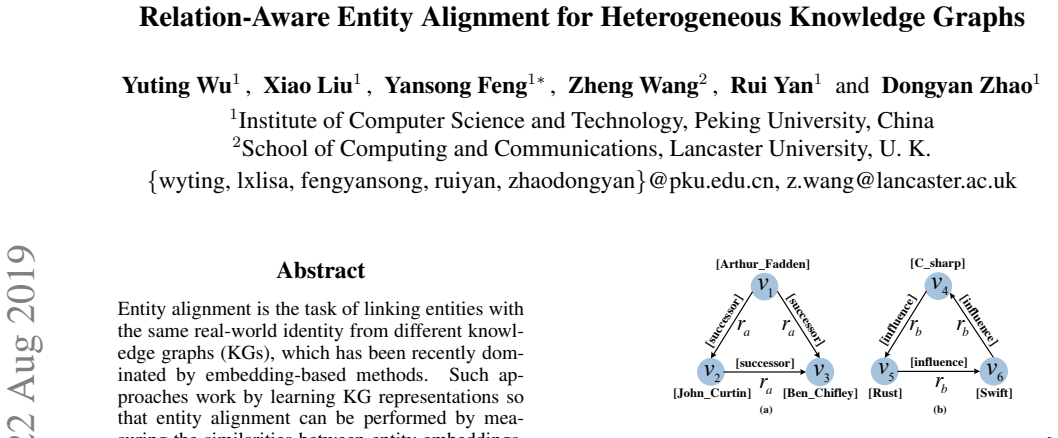
- Entities sitting in triangular relation structures are aligned better by RDGCN than by BootEA, suggesting the model captures compositional relation patterns that translation embeddings cannot represent.
- Both the dual-primal interaction and the gated GCN layers contribute: removing either component lowers Hits@1, so the two mechanisms are complementary.
Reading between the lines
- The same dual relation graph construction could be applied to other tasks requiring relation-sensitive node embeddings, such as link prediction or ontology alignment, though the paper does not test these.
- Because the relation proxy in Eq. 5 is built from entity-name embeddings, adding aligned entity supervision should let the model learn sharper relation representations; a testable extension is replacing the fixed proxy with learned relation embeddings once training data grows.
- The finding that GCN-s beats R-GCN-s hints that parameter-efficient relation sharing via structural co-occurrence may scale better to KGs with thousands of relations than per-relation parameter matrices; this is an extrapolation, not a paper claim.
- The 10%-seed result suggests entity alignment could be seeded from very few correspondences; an untested follow-up is measuring how RDGCN behaves with zero seed alignments using unsupervised name initialization.
Signed reviews
Editorial analysis
A structured set of objections, weighed in public.
Referee Report
Summary. The paper proposes RDGCN, an embedding-based entity alignment model for heterogeneous knowledge graphs. It constructs a dual relation graph from the input KGs, weights the dual edges by Jaccard overlap of head and tail entity sets (Eqs. 1–2), and alternately applies graph attention to the dual relation graph and the primal entity graph (Eqs. 3–8). Relation representations are approximated by concatenating the averaged head and tail entity embeddings (Eq. 5). The resulting entity representations are passed through highway-gated GCN layers (Eqs. 9–11) and trained with a margin-based ranking loss using hard negative sampling (Eq. 13). Experiments on the DBP15K ZH-EN, JA-EN, and FR-EN datasets compare against six baselines and four ablations. RDGCN reports the best Hits@1 and Hits@10 on all datasets except Hits@10 on ZH-EN, where BootEA is slightly higher.
Significance. If the reported gains are stable, RDGCN is a useful new architecture for entity alignment: the public release of code and data, the controlled ablation variants, and the demonstration that performance remains strong with only 10% of pre-aligned pairs are concrete strengths. The dual-primal interaction idea is a sensible adaptation of DPGCNN with potential applicability beyond this specific task. However, the paper's central causal claim—that relation-aware interactions drive the improvement—is currently supported only by small, unreplicated increments, so the significance is conditional on added statistical evidence.
major comments (3)
- [Section 6.2, Table 2] The manuscript attributes the main contribution to the dual-primal interaction modules, but the only controlled comparison for this component is RDGCN versus HGCN-s. The reported gains are +1.10/+2.02 on ZH-EN, +1.20/+1.67 on JA-EN, and +0.55/+0.45 on FR-EN for Hits@1/Hits@10. No variance, number of seeds, or significance test is reported, despite the word 'significantly' being used in Sections 1, 6.2, and 6.3. These margins are small relative to typical run-to-run variation in embedding models, so without multi-seed results the relation-aware claim is not established. Please report mean and standard deviation over at least five seeds and a paired significance test, or otherwise bound the noise.
- [Section 4.2, Eq. (5)] The relation representation c_i is an ad hoc proxy formed from averaged head and tail entity embeddings, and it is the only mechanism carrying relation semantics into the dual-primal attention in Eqs. (4) and (7). The input entity embeddings come from machine-translated names with roughly 20% translation errors (Section 5), so this proxy may encode translation noise rather than relation meaning. The paper provides no validation that these relation representations are meaningful, such as nearest-relation retrieval, correlation with human-judged relation similarity, or an ablation replacing c_i with random vectors. Without such evidence, the improvement from RDGCN over HGCN-s could stem from the extra residual use of name features in Eq. (8) rather than from relation-aware interaction.
- [Section 6.3, Figure 3(d)] The triangular-structure analysis claims that RDGCN is 'significantly higher' than BootEA, but no numbers, error bars, or significance tests are provided. This is ancillary to the main claim but should be quantified if it is retained.
minor comments (3)
- [Section 6.3] The sentence 'This result translates to a 17.79% higher Hits@1 score' should say '17.79 percentage points higher' to avoid ambiguity between relative and absolute improvement.
- [Section 4.1] The statement that the overhead for constructing the dual graph is 'proportional to the number of relation types' is not justified; computing Jaccard weights for all relation pairs that share head or tail entities can be quadratic in the number of relation types in the worst case.
- [Section 5, Table 1] The model variants GCN-s, R-GCN-s, HGCN-s, and RD are described only in the text; a short summary in a table or footnote would improve readability.
Circularity Check
No significant circularity: RDGCN's alignment scores are benchmark-measured against held-out pairs, and the dual-primal feedback loop is an architectural construction, not a self-validating derivation.
full rationale
The paper's central claim is an empirical benchmark result on DBP15K, evaluated with a fixed 30%/70% training/testing split against ground-truth alignments. No fitted parameter is later relabeled as a prediction, and no target quantity is defined in terms of the model's own outputs by construction. The relation representation in Eq. 5 is explicitly presented as an approximation ('We thus approximate the relation representation for ri by concatenating its averaged head and tail entity representations'), and its use inside the dual-primal attention loop (Eqs. 3-8) is an internal feature-extraction design rather than a circular argument: the final Hits@k scores come from held-out entity pairs, not from matching the training seeds through the attention weights. The paper does not rely on any load-bearing self-citation; its references to GCN, R-GCN, DPGCNN, and prior alignment methods are independent prior work, and the claimed novelty is an architectural extension rather than an imported uniqueness theorem. Concerns about small ablation margins, missing significance tests, and noisy translations are validity or robustness risks, not examples of the derivation reducing to its inputs. Accordingly, no circular step can be exhibited, and the appropriate finding is no significant circularity.
Assumptions & free parameters
free parameters (6)
- beta_1 and beta_2 =
0.1 and 0.3
- margin gamma =
1.0
- hidden dimensions d, d', GCN dim =
300, 600, 300
- negative samples K =
125 every 10 epochs
- learning rate =
0.001
- number of interaction modules =
2
assumptions (3)
- domain assumption Machine-translated entity names plus GloVe embeddings give a useful initialization for entities.
- ad hoc to paper Average head/tail entity embeddings approximate a relation's meaning (Eq. 5).
- ad hoc to paper Jaccard overlap of relation heads/tails measures relation relatedness (Eq. 1-2).
Cite this review
Pith. "Pith review of Relation-Aware Entity Alignment for Heterogeneous Knowledge Graphs." pith.science (2026). https://pith.science/paper/LSKXHY7N
@misc{pith2026190808210,
  author       = {Pith},
  title        = {Pith review of: Relation-Aware Entity Alignment for Heterogeneous Knowledge Graphs},
  year         = {2026},
  howpublished = {\url{https://pith.science/paper/LSKXHY7N}},
  note         = {Machine review of arXiv:1908.08210}
}
read the original abstract
Entity alignment is the task of linking entities with the same real-world identity from different knowledge graphs (KGs), which has been recently dominated by embedding-based methods. Such approaches work by learning KG representations so that entity alignment can be performed by measuring the similarities between entity embeddings. While promising, prior works in the field often fail to properly capture complex relation information that commonly exists in multi-relational KGs, leaving much room for improvement. In this paper, we propose a novel Relation-aware Dual-Graph Convolutional Network (RDGCN) to incorporate relation information via attentive interactions between the knowledge graph and its dual relation counterpart, and further capture neighboring structures to learn better entity representations. Experiments on three real-world cross-lingual datasets show that our approach delivers better and more robust results over the state-of-the-art alignment methods by learning better KG representations.
Figures


Figures from the paper (1 more)

Reference graph
Works this paper leans on
-
[1]
Diffusion-convolutional neural networks
[Atwood and Towsley, 2016] James Atwood and Don Towsley. Diffusion-convolutional neural networks. In NIPS, pages 1993–2001,
work page 2016
-
[6]
[Chen et al., 2018] Muhao Chen, Yingtao Tian, Kai-Wei Chang, Steven Skiena, and Carlo Zaniolo. Co-training embeddings of knowledge graphs and entity descriptions for cross-lingual entity alignment. In IJCAI, pages 3998– 4004,
work page 2018
-
[8]
Hamilton, Rex Ying, and Jure Leskovec
[Hamilton et al., 2017] William L. Hamilton, Rex Ying, and Jure Leskovec. Inductive representation learning on large graphs. In NIPS,
work page 2017
-
[9]
A joint embedding method for entity alignment of knowledge bases
[Hao et al., 2016] Yanchao Hao, Yuanzhe Zhang, Shizhu He, Kang Liu, and Jian Zhao. A joint embedding method for entity alignment of knowledge bases. In CCKS,
work page 2016
-
[10]
[Kipf and Welling, 2017] Thomas N. Kipf and Max Welling. Semi-supervised classification with graph convolutional networks. In ICLR,
work page 2017
-
[11]
A Structural Representation Learning for Multi-relational Networks
[Li et al., 2018b] Xin Li, Huiting Hong, Lin Liu, and William K Cheung. A structural representation learn- ing for multi-relational networks. arXiv preprint arXiv:1805.06197,
-
[12]
Modeling rela- tion paths for representation learning of knowledge bases
[Lin et al., 2015] Yankai Lin, Zhiyuan Liu, Huanbo Luan, Maosong Sun, Siwei Rao, and Song Liu. Modeling rela- tion paths for representation learning of knowledge bases. In ACL, pages 705–714,
work page 2015
-
[14]
Encoding sentences with graph convolutional networks for semantic role labeling
[Marcheggiani and Titov, 2017] Diego Marcheggiani and Ivan Titov. Encoding sentences with graph convolutional networks for semantic role labeling. In EMNLP,
work page 2017
Show all 29 references
-
[15]
Dual-primal graph convolu- tional networks
[Monti et al., 2018] Federico Monti, Oleksandr Shchur, Aleksandar Bojchevski, Or Litany, Stephan G ¨unnemann, and Michael M Bronstein. Dual-primal graph convolu- tional networks. arXiv preprint arXiv:1806.00770,
2018 arXiv
-
[16]
Semi-supervised user geolocation via graph convolutional networks
[Rahimi et al., 2018] Afshin Rahimi, Trevor Cohn, and Tim- othy Baldwin. Semi-supervised user geolocation via graph convolutional networks. In ACL, pages 2009–2019,
2018
-
[17]
[Sarasua et al., 2012] Cristina Sarasua, Elena Simperl, and Natalya F. Noy. Crowdmap: Crowdsourcing ontology alignment with microtasks. In ISWC,
2012
-
[19]
Highway networks
[Srivastava et al., 2015] Rupesh Kumar Srivastava, Klaus Greff, and J¨urgen Schmidhuber. Highway networks. arXiv preprint arXiv:1505.00387,
2015 arXiv
-
[20]
Cross-lingual entity alignment via joint attribute- preserving embedding
[Sun et al., 2017] Zequn Sun, Wei Hu, and Chengkai Li. Cross-lingual entity alignment via joint attribute- preserving embedding. In ISWC, pages 628–644,
2017
-
[21]
Bootstrapping entity alignment with knowl- edge graph embedding
[Sun et al., 2018] Zequn Sun, Wei Hu, Qingheng Zhang, and Yuzhong Qu. Bootstrapping entity alignment with knowl- edge graph embedding. In IJCAI, pages 4396–4402,
2018
-
[22]
Graph Attention Networks
[Veliˇckovi´c et al., 2018] Petar Veliˇckovi´c, Guillem Cucurull, Arantxa Casanova, Adriana Romero, Pietro Li `o, and Yoshua Bengio. Graph Attention Networks. In ICLR,
2018
-
[23]
Knowledge graph embedding by translating on hyperplanes
[Wang et al., 2014] Zhen Wang, Jianwen Zhang, Jianlin Feng, and Zheng Chen. Knowledge graph embedding by translating on hyperplanes. In AAAI,
2014
-
[24]
Text classification with heterogeneous information network kernels
[Wang et al., 2016] Chenguang Wang, Yangqiu Song, Hao- ran Li, Ming Zhang, and Jiawei Han. Text classification with heterogeneous information network kernels. InAAAI,
2016
-
[25]
Multi-source knowledge bases entity alignment by leveraging semantic tags
[Wang et al., 2017] Xuepeng Wang, Kang Liu, Shizhu He, Shulin Liu, Yuanzhe Zhang, and Jun Zhao. Multi-source knowledge bases entity alignment by leveraging semantic tags. Chinese Journal of Computers, 40(3):701–711,
2017
-
[26]
Cross-lingual knowledge graph align- ment via graph convolutional networks
[Wang et al., 2018] Zhichun Wang, Qingsong Lv, Xiaohan Lan, and Yu Zhang. Cross-lingual knowledge graph align- ment via graph convolutional networks. In EMNLP, pages 349–357,
2018
-
[27]
Collaborative knowledge base embedding for recommender systems
[Zhang et al., 2016] Fuzheng Zhang, Nicholas Jing Yuan, Defu Lian, Xing Xie, and Wei-Ying Ma. Collaborative knowledge base embedding for recommender systems. In ACM SIGKDD, pages 353–362,
2016
-
[28]
Variational reasoning for question answering with knowledge graph
[Zhang et al., 2018] Yuyu Zhang, Hanjun Dai, Zornitsa Kozareva, Alexander J Smola, and Le Song. Variational reasoning for question answering with knowledge graph. In AAAI,
2018
-
[29]
Iterative entity alignment via joint knowl- edge embeddings
[Zhu et al., 2017] Hao Zhu, Ruobing Xie, Zhiyuan Liu, and Maosong Sun. Iterative entity alignment via joint knowl- edge embeddings. In IJCAI, pages 4258–4264, 2017
2017
-
[2012]
Modeling relational data with graph convo- lutional networks
[Schlichtkrull et al., 2018] Michael Schlichtkrull, Thomas N Kipf, Peter Bloem, Rianne Van Den Berg, Ivan Titov, and Max Welling. Modeling relational data with graph convo- lutional networks. In European Semantic Web Conference, pages 593–607. Springer,
2018
-
[2013]
Spectral networks and locally connected networks on graphs
[Bruna et al., 2014] Joan Bruna, Wojciech Zaremba, Arthur Szlam, and Yann Lecun. Spectral networks and locally connected networks on graphs. In ICLR,
2014
-
[2014]
Multilingual knowledge graph embeddings for cross-lingual knowledge alignment
[Chen et al., 2017] Muhao Chen, Yingtao Tian, Mohan Yang, and Carlo Zaniolo. Multilingual knowledge graph embeddings for cross-lingual knowledge alignment. In IJ- CAI,
2017
-
[2015]
Yago3: A knowledge base from multilingual wikipedias
[Mahdisoltani et al., 2013] Farzaneh Mahdisoltani, Joanna Biega, and Fabian M Suchanek. Yago3: A knowledge base from multilingual wikipedias. In CIDR,
2013
-
[2016]
Graph convolutional encoders for syntax-aware neural machine translation
[Bastings et al., 2017] Joost Bastings, Ivan Titov, Wilker Aziz, Diego Marcheggiani, and Khalil Simaan. Graph convolutional encoders for syntax-aware neural machine translation. In EMNLP, pages 1957–1967,
2017
-
[2017]
Translating embeddings for modeling multi-relational data
[Bordes et al., 2013] Antoine Bordes, Nicolas Usunier, Alberto Garcia-Duran, Jason Weston, and Oksana Yakhnenko. Translating embeddings for modeling multi-relational data. In NIPS, pages 2787–2795,
2013
-
[2018]
Convolutional neural net- works on graphs with fast localized spectral filtering
[Defferrard et al., 2016] Micha¨el Defferrard, Xavier Bres- son, and Pierre Vandergheynst. Convolutional neural net- works on graphs with fast localized spectral filtering. In NIPS,
2016
Reviewed August 14, 2026 · model on record in the stance chip above.
Discussion (0). Continue with ORCID to comment.