Short-range order in the CoCrFeMnNi high-entropy alloy from cluster expansion
Pith reviewed 2026-05-20 09:52 UTC · model grok-4.3
The pith
Strong Cr-Cr repulsion sets the primary short-range order in equiatomic CoCrFeMnNi alloy.
A machine-rendered reading of the paper's core claim, the machinery that carries it, and where it could break.
Core claim
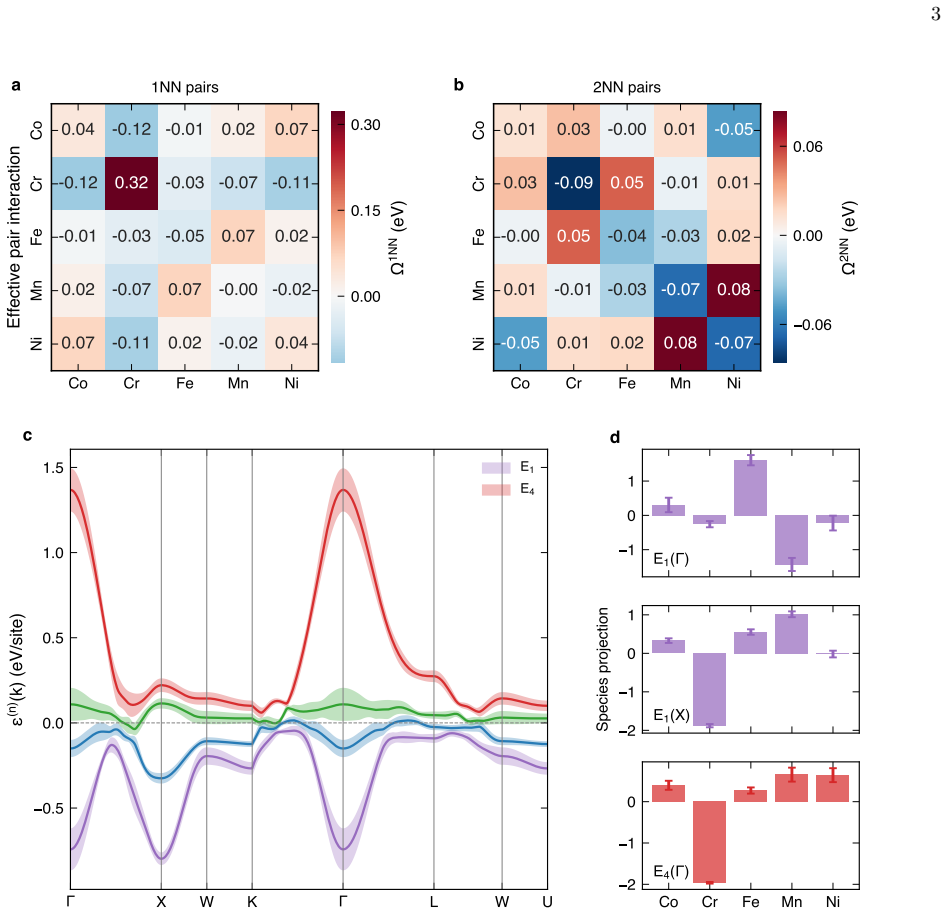
The primary ordering behavior is determined by strong Cr-Cr repulsive interactions, complemented by attractive heteroatomic Cr-X pairs in the first nearest-neighbor shell. This chemical affinity is consistent with the emergence of ordered local environments and appears to be a major contributor to the primary order-disorder transition. At lower temperatures, the spectral SRO analysis suggests two additional lower-temperature instabilities: a collective ordering instability and an Fe-rich local clustering instability.
What carries the argument
Cluster expansion Hamiltonian fitted to a limited set of configurations and combined with eigen-decomposition of short-range order parameters.
Load-bearing premise
A cluster expansion truncated at a fixed interaction range and fitted to limited configurations captures the dominant short-range order tendencies without important contributions from longer-range or many-body terms.
What would settle it
Experimental short-range order parameters measured by diffuse scattering or similar techniques that show dominant interactions other than Cr-Cr repulsion or lack attractive Cr-X pairs in the first shell would refute the central claim.
Figures


read the original abstract
We investigate the short-range order (SRO) and phase stability of the equiatomic CoCrFeMnNi high-entropy alloy using cluster expansion supplemented by an eigen-decomposition analysis of the SRO parameters. Our results reveal that the primary ordering behavior is determined by strong Cr-Cr repulsive interactions, complemented by attractive heteroatomic Cr-$X$ pairs in the first nearest-neighbor shell. This chemical affinity is consistent with the emergence of ordered local environments and appears to be a major contributor to the primary order-disorder transition. At lower temperatures, the spectral SRO analysis suggests two additional lower-temperature instabilities: a collective ordering instability and an Fe-rich local clustering instability.
Editorial analysis
A structured set of objections, weighed in public.
Referee Report
Summary. The paper investigates the short-range order (SRO) and phase stability of the equiatomic CoCrFeMnNi high-entropy alloy using cluster expansion supplemented by an eigen-decomposition analysis of the SRO parameters. The primary claim is that the ordering behavior is determined by strong Cr-Cr repulsive interactions complemented by attractive heteroatomic Cr-X pairs in the first nearest-neighbor shell, contributing to the primary order-disorder transition. At lower temperatures, two additional instabilities are suggested: a collective ordering instability and an Fe-rich local clustering instability.
Significance. If the cluster expansion model is robust, this work provides useful microscopic insight into the pair interactions that drive SRO in the Cantor alloy, which may help rationalize its observed phase stability and mechanical properties. The eigen-decomposition of SRO parameters is a constructive approach for extracting dominant ordering modes from the effective Hamiltonian.
major comments (2)
- [Cluster expansion methodology] Cluster expansion methodology: The manuscript provides no convergence data on how the extracted effective interactions or the leading eigenmode of the SRO matrix change when the interaction range cutoff is increased. This directly affects the central claim that first-NN Cr-Cr repulsion dominates the primary instability, because longer-range or many-body terms could shift the spectral weights if they are not demonstrably negligible.
- [Results and discussion] Validation of predicted instabilities: No cross-validation scores, training-set size, or uncertainty estimates on the ordering temperatures are reported, and there is no comparison of the CE-derived SRO to either large-scale Monte Carlo simulations or experimental diffuse-scattering data. These omissions are load-bearing for the identification of the three distinct instabilities.
minor comments (2)
- [Figures] Figure captions for the spectral SRO plots would benefit from explicit labeling of which pair interactions correspond to the plotted modes and the temperature scale used.
- [Notation] Notation for the effective cluster interaction parameters should be defined once in the methods and used consistently in all subsequent equations and text.
Simulated Author's Rebuttal
We thank the referee for the constructive feedback on our manuscript investigating short-range order in the CoCrFeMnNi alloy via cluster expansion and eigen-decomposition. We address each major comment below and indicate planned revisions to strengthen the presentation of our results.
read point-by-point responses
-
Referee: [Cluster expansion methodology] Cluster expansion methodology: The manuscript provides no convergence data on how the extracted effective interactions or the leading eigenmode of the SRO matrix change when the interaction range cutoff is increased. This directly affects the central claim that first-NN Cr-Cr repulsion dominates the primary instability, because longer-range or many-body terms could shift the spectral weights if they are not demonstrably negligible.
Authors: We agree that explicit convergence tests with respect to interaction range are valuable for supporting the dominance of first-NN Cr-Cr repulsion. In the revised manuscript we will add a supplementary analysis (including a new figure) that recomputes the effective interactions and the leading eigenmode of the SRO matrix when the cutoff is successively extended to second- and third-nearest-neighbor shells. This will demonstrate that the spectral weight of the primary mode remains overwhelmingly concentrated on the first-NN Cr-Cr repulsive term, with longer-range contributions remaining small and not altering the identified instability. revision: yes
-
Referee: [Results and discussion] Validation of predicted instabilities: No cross-validation scores, training-set size, or uncertainty estimates on the ordering temperatures are reported, and there is no comparison of the CE-derived SRO to either large-scale Monte Carlo simulations or experimental diffuse-scattering data. These omissions are load-bearing for the identification of the three distinct instabilities.
Authors: We will revise the methods and results sections to report the training-set size, cross-validation scores for the cluster-expansion fit, and uncertainty estimates on the ordering temperatures obtained from the eigenvalues of the SRO matrix. These additions will provide quantitative support for the robustness of the three identified instabilities. Large-scale Monte Carlo simulations and direct comparison to experimental diffuse-scattering data lie outside the scope of the present study; performing them would require substantial new computational and experimental work. We will, however, expand the discussion to explicitly acknowledge this limitation and to clarify how the eigen-decomposition of the effective Hamiltonian already furnishes a self-consistent identification of the instabilities without those additional validations. revision: partial
- Direct comparison of the CE-derived SRO to experimental diffuse-scattering data
Circularity Check
No significant circularity detected; derivation is self-contained
full rationale
The paper constructs a cluster expansion Hamiltonian by fitting effective cluster interactions to first-principles energies of a finite set of atomic configurations, then applies eigen-decomposition to the resulting SRO parameters to identify dominant ordering modes such as Cr-Cr repulsion. This workflow derives the reported instabilities from the fitted model rather than reducing them to the input data or prior results by construction. No self-definitional loops, fitted parameters renamed as independent predictions, load-bearing self-citations, or ansatz smuggling appear in the abstract or described methods. The central claims rest on the CE truncation and fitting procedure, which are externally falsifiable against additional DFT benchmarks and do not collapse to tautology.
Axiom & Free-Parameter Ledger
free parameters (1)
- Effective cluster interaction parameters
axioms (1)
- domain assumption Pairwise cluster expansion truncated at a finite interaction range is adequate to describe the dominant ordering tendencies
Lean theorems connected to this paper
-
IndisputableMonolith/Cost/FunctionalEquation.leanwashburn_uniqueness_aczel unclear?
unclearRelation between the paper passage and the cited Recognition theorem.
E(σ) = J0 + Σ Jα Φα(σ) … effective cluster interactions (ECIs) … eigen-decomposition of the pair ECIs in reciprocal space … Warren-Cowley SRO parameter αn_ij
-
IndisputableMonolith/Foundation/Atomicity.leanatomic_tick unclear?
unclearRelation between the paper passage and the cited Recognition theorem.
pair clusters up to the sixth nearest-neighbor … triplet clusters within the first two NN shells … canonical MC simulations
What do these tags mean?
- matches
- The paper's claim is directly supported by a theorem in the formal canon.
- supports
- The theorem supports part of the paper's argument, but the paper may add assumptions or extra steps.
- extends
- The paper goes beyond the formal theorem; the theorem is a base layer rather than the whole result.
- uses
- The paper appears to rely on the theorem as machinery.
- contradicts
- The paper's claim conflicts with a theorem or certificate in the canon.
- unclear
- Pith found a possible connection, but the passage is too broad, indirect, or ambiguous to say the theorem truly supports the claim.
Reference graph
Works this paper leans on
- [1]
-
[2]
T. J. Ziehl, D. Morris, and P. Zhang, Detection and im- pact of short-range order in medium/high-entropy alloys, iScience26, 10.1016/j.isci.2023.106209 (2023)
-
[3]
M. L. Taheri, E. Anber, A. Barnett, S. Billinge, N. Bir- bilis, B. DeCost, D. L. Foley, E. Holcombe, J. Hollen- bach, H. Joress, G. Leigh, Y. Rakita, J. M. Rondinelli, N. Smith, M. J. Waters, and C. Wolverton, Understand- ing and leveraging short-range order in compositionally complex alloys, MRS Bull.48, 1280 (2023)
work page 2023
-
[4]
Y. Cao, K. Sheriff, and R. Freitas, Capturing short-range order in high-entropy alloys with machine learning poten- tials, npj Comput. Mater.11, 268 (2025)
work page 2025
- [5]
-
[6]
J. Sanchez, F. Ducastelle, and D. Gratias, Generalized cluster description of multicomponent systems, Physica A128, 334 (1984)
work page 1984
-
[7]
A. Van der Ven, J. Thomas, B. Puchala, and A. Natara- jan, First-principles statistical mechanics of multicompo- nent crystals, Annu. Rev. Mater. Res.48, 27 (2018)
work page 2018
-
[8]
G. Kresse and J. Furthm¨ uller, Efficient iterative schemes for ab initio total-energy calculations using a plane-wave basis set, Phys. Rev. B54, 11169 (1996)
work page 1996
-
[9]
G. Kresse and J. Furthm¨ uller, Efficiency of ab-initio total energy calculations for metals and semiconductors using a plane-wave basis set, Nato. Sc. S. Ss. Iii. C. S.6, 15 (1996)
work page 1996
-
[10]
G. Kresse and D. Joubert, From ultrasoft pseudopoten- tials to the projector augmented-wave method, Phys. Rev. B59, 1758 (1999)
work page 1999
-
[11]
J. P. Perdew, K. Burke, and M. Ernzerhof, Generalized gradient approximation made simple, Phys. Rev. Lett. 77, 3865 (1996)
work page 1996
-
[12]
Khachatryan,Theory of Structural Transformation in Solids(Wiley, New York, 1983)
A. Khachatryan,Theory of Structural Transformation in Solids(Wiley, New York, 1983)
work page 1983
- [13]
-
[14]
C. D. Woodgate and J. B. Staunton, Compositional phase stability in medium-entropy and high-entropy Cantor-Wu alloys from an ab initio all-electron landau- type theory and atomistic modeling, Phys. Rev. B105, 115124 (2022)
work page 2022
-
[15]
B. Sch¨ onfeld, C. R. Sax, J. Zemp, M. Engelke, P. Boesecke, T. Kresse, T. Boll, T. Al-Kassab, O. E. Peil, and A. V. Ruban, Local order in Cr-Fe-Co-Ni: Experi- ment and electronic structure calculations, Phys. Rev. B 99, 014206 (2019)
work page 2019
- [16]
-
[17]
M. Laurent-Brocq, A. Akhatova, L. Perri` ere, S. Chebini, X. Sauvage, E. Leroy, and Y. Champion, Insights into the phase diagram of the CrMnFeCoNi high entropy alloy, Acta Mater.88, 355 (2015)
work page 2015
-
[18]
F. Otto, Y. Yang, H. Bei, and E. George, Relative ef- fects of enthalpy and entropy on the phase stability of equiatomic high-entropy alloys, Acta Mater.61, 2628 (2013)
work page 2013
-
[19]
F. Otto, A. Dlouh´ y, K. Pradeep, M. Kubˇ enov´ a, D. Raabe, G. Eggeler, and E. George, Decomposition of the single-phase high-entropy alloy CrMnFeCoNi af- ter prolonged anneals at intermediate temperatures, Acta Mater.112, 40 (2016)
work page 2016
- [20]
-
[21]
A. Tamm, A. Aabloo, M. Klintenberg, M. Stocks, and A. Caro, Atomic-scale properties of Ni-based FCC ternary, and quaternary alloys, Acta Mater.99, 307 (2015)
work page 2015
-
[22]
F. X. Zhang, S. Zhao, K. Jin, H. Xue, G. Velisa, H. Bei, R. Huang, J. Y. P. Ko, D. C. Pagan, J. C. Neuefeind, W. J. Weber, and Y. Zhang, Local structure and short- range order in a NiCoCr solid solution alloy, Phys. Rev. Lett.118, 205501 (2017)
work page 2017
-
[23]
J. Ding, Q. Yu, M. Asta, and R. O. Ritchie, Tunable stacking fault energies by tailoring local chemical order in CrCoNi medium-entropy alloys, Proc. Natl. Acad. Sci. 115, 8919 (2018)
work page 2018
- [24]
-
[25]
Q. Ding, Y. Zhang, X. Chen, X. Fu, D. Chen, S. Chen, L. Gu, F. Wei, H. Bei, Y. Gao, M. Wen, J. Li, Z. Zhang, T. Zhu, R. O. Ritchie, and Q. Yu, Tuning element distri- bution, structure and properties by composition in high- entropy alloys, Nature574, 223 (2019)
work page 2019
-
[26]
B. L. Averbach, X-ray detection of long-range order in Ni3Mn, J. Appl. Phys.22, 1088 (1951)
work page 1951
-
[27]
J. Liu, L. Riddiford, C. Floristean, F. Goncalves-Neto, M. Rezaeeyazdi, L. Lewis, and K. Barmak, Kinetics of order-disorder transformation of L1 2 FeNi3 in the Fe-Ni system, J. Alloy. Compd.689, 593 (2016)
work page 2016
-
[28]
N. Bordeaux, A. Montes-Arango, J. Liu, K. Barmak, and L. Lewis, Thermodynamic and kinetic parameters of 10 the chemical order–disorder transformation in L1 0 FeNi (tetrataenite), Acta Mater.103, 608 (2016)
work page 2016
- [29]
-
[30]
L. Zhu, H. He, M. Naeem, X. Sun, J. Qi, P. Liu, S. Harjo, K. Nakajima, B. Li, and X.-L. Wang, Antiferromag- netism and phase stability of CrMnFeCoNi high-entropy alloy, Phys. Rev. Lett.133, 126701 (2024)
work page 2024
discussion (0)
Sign in with ORCID, Apple, or X to comment. Anyone can read and Pith papers without signing in.