REVIEW 3 major objections 4 minor 1 cited by
Better early than never: A new test for superluminal gravitational wave polarizations
T0 review · 3 major / 4 minor · reviewed 2026-08-10 · deepseek-v4-flash
Pith's one-line read A new test seeks gravitational-wave polarizations that arrive before the main signal, using data already collected around known detections.
desk verdict A sound, genuinely new search proposal for superluminal non-tensor GW polarizations, but 'feasible with current detectors' overstates what is demonstrated. read the letter →
The pith
A machine-rendered reading of the paper's core claim, the machinery that carries it, and where it could break.
The reading
What carries the argument
The load-bearing object is the arrival-time lead $\Delta t_N = t_T - t_N = D_L/c - D_L/v_N$ between the tensor and non-tensor polarizations of the same source, together with its re-expression as a fractional speed excess $\delta v_N = v_N/c - 1 = c\Delta t_N/(D_L - c\Delta t_N)$. This identity turns a calendar of searched data into a two-dimensional exclusion region in the plane of propagation speed and amplitude: the searched time $T_{\rm Obs}$ fixes the minimum measurable lead, the source distance $D_L$ fixes how that lead maps to speed, and the detector noise floor fixes the minimum detectable amplitude. The search is made tractable by using the tensor-signal analysis to fix sky location and intrinsic source parameters, reducing the template bank to the small set of modified-gravity waveforms that are sensitive to the extra polarizations.
What would settle it
Run the proposed template bank over real pre-event data for nearby catalog events with simulated scalar and vector modes injected at known speeds and amplitudes; if injections with amplitudes near the detector noise floor are not recovered, the feasibility claim fails. A non-tensor polarization observed arriving after the tensor modes would likewise falsify the underlying premise that all extra polarizations are superluminal.
Extended reading notes
Core claim
The central claim is that a practical, model-agnostic test for superluminal non-tensor polarizations is obtained by anchoring to a detected tensor-mode event and searching backward in time. Because gravitational Cherenkov constraints require $v_S,V \ge c$ and the joint gravitational-wave/gamma-ray observation pins tensor modes to $v_T \approx c$ within $O(10^{-15})$, any scalar or vector polarization from the same source must arrive with or before the tensor modes. The paper's key relation is $\Delta t_N = D_L/c - D_L/v_N$, so a non-detection over an observing time $T_{\rm Obs}$ translates, via $\delta v_N = c\Delta t_N/(D_L - c\Delta t_N)$, into a lower bound on the fractional speed excess for polarizations with detectable amplitude, and an upper bound on amplitude for speeds that would have placed the signal inside the searched window. The authors then show that gaps in detector observing schedules can be filled by stacking events at different times and distances, that sensitivity changes across runs can be handled by sub-threshold searches or by restricting to nearby sources, and that existing upper limits on stochastic backgrounds and scalar-mode amplitudes do not rule out detectable extra polarizations.
Load-bearing premise
The test only works if non-tensor polarizations can have amplitudes large enough for current detectors to see, and the paper does not prove that any available or proposed search actually reaches that sensitivity.
Editorial extensions
If this is right
- A non-detection of extra polarizations in one year of data before a source at 50 Mpc would place a lower bound $v > (1 + 6\times10^{-9})c$, enough to make tensor and non-tensor arrivals from distant sources differ by years.
- Existing polarization-content studies that assumed equal propagation speeds for all modes do not rule out faster non-tensor polarizations, so this search covers parameter space those analyses missed.
- Stacking events that arrive at different times or from different distances fills gaps left by detector downtime, so the test does not require a continuous observing record.
- A direct detection of early non-tensor polarizations would be immediate evidence of physics beyond general relativity.
- In Einstein-æther theory, speed constraints translate only weakly to coupling constants because the relevant couplings are already small, so the main payoff of the test is model-agnostic rather than theory-specific.
Reading between the lines
- The same search-back strategy could be extended to next-generation detector networks, where longer observation baselines and access to closer, louder sources would make the speed lower bounds several orders of magnitude tighter than the $O(10^{-9})$ example quoted here.
- If a non-tensor burst is ever seen without an associated tensor trigger, the multi-detector timing argument in Appendix B could be applied to place an upper bound on its speed, complementing the lower bounds from the search-back method.
- The amplitude-speed degeneracy in the exclusion region could be partially broken by comparing multiple events at different distances, since both tensor and non-tensor amplitudes fall as $1/D_L$ while the speed-dependent arrival lead grows with $D_L$.
- Before claiming a detection, the search would need noise-background calibration on long stretches of real data, using time-shifted or injected signals to establish the false-alarm rate over the same observation periods.
Editorial analysis
A structured set of objections, weighed in public.
Referee Report
Summary. The paper proposes a new, model-agnostic test for superluminal non-tensor gravitational-wave polarizations. Building on the facts that Cherenkov constraints require extra polarizations to propagate at or above the speed of light and that GW170817 pins the tensor speed to c, the authors argue that any non-tensor modes from a given source must arrive at the detector no later than the tensor modes. Starting from an already-detected merger event, one can therefore search backward through the earlier data for non-tensor polarization signals using source parameters inferred from the tensor analysis. The paper derives the kinematic relation between arrival-time difference and propagation-speed difference, analyzes how observing-time gaps affect the parameter space that a non-detection could exclude, discusses stacking of multiple events and changing detector sensitivity, and considers existing amplitude constraints. It concludes that the test is physically well motivated and feasible with current detectors, while noting that constructing the template bank and assessing its performance are left to future work.
Significance. If implemented, the proposed search would open a new window on non-tensor polarizations that arrive before the tensor signal, a region missed by standard coincident matched-filter searches and null-stream tests. The kinematic derivation in Sec. IIB is simple and correct, and the use of real events and duty-cycle data to illustrate gap filling is concrete and useful. The paper is also admirably transparent: it explicitly identifies the main open questions, such as template-bank construction and parameter bias, and it does not overclaim the reach of existing amplitude constraints. The main weakness is that the abstract's central claim of feasibility with current detectors is not supported by a quantitative sensitivity demonstration; no injections, minimum detectable amplitudes, or search-efficiency estimates are given. This gap is fixable and does not invalidate the underlying idea, but it is load-bearing for the paper's headline conclusion.
major comments (3)
- [Sec. IV / Sec. IIIC] The central claim that the proposed test is 'feasible with current detectors' (abstract and Sec. IV) is not supported by a sensitivity demonstration. The paper presents no injections, no template-bank construction, no minimum detectable amplitude, and no false-alarm or search-efficiency estimate; Sec. IV explicitly says that these questions are left to future work. The GWB upper limits quoted in Eq. (3.2) bound the stochastic background, not the single-event non-tensor amplitude from a particular source, so they do not establish that detectable amplitudes are allowed. To support the feasibility claim, the authors should compute, for at least one existing event such as GW170817, the expected SNR of non-tensor polarizations as a function of their amplitude and speed, or perform an injection study into O3 data with a concrete search pipeline.
- [Sec. IIB, Fig. 1] The search window preceding t_merger is not empty: it contains the tensor inspiral of the same source. The paper does not explain how the proposed search for non-tensor polarizations handles this known foreground—for example, by masking the final seconds or minutes of the window, subtracting the best-fit tensor waveform, or using templates that are exactly orthogonal to the tensor modes. Without such a procedure, the false-alarm behavior of the search and the interpretation of a non-detection are ambiguous, which is directly relevant to the feasibility claim.
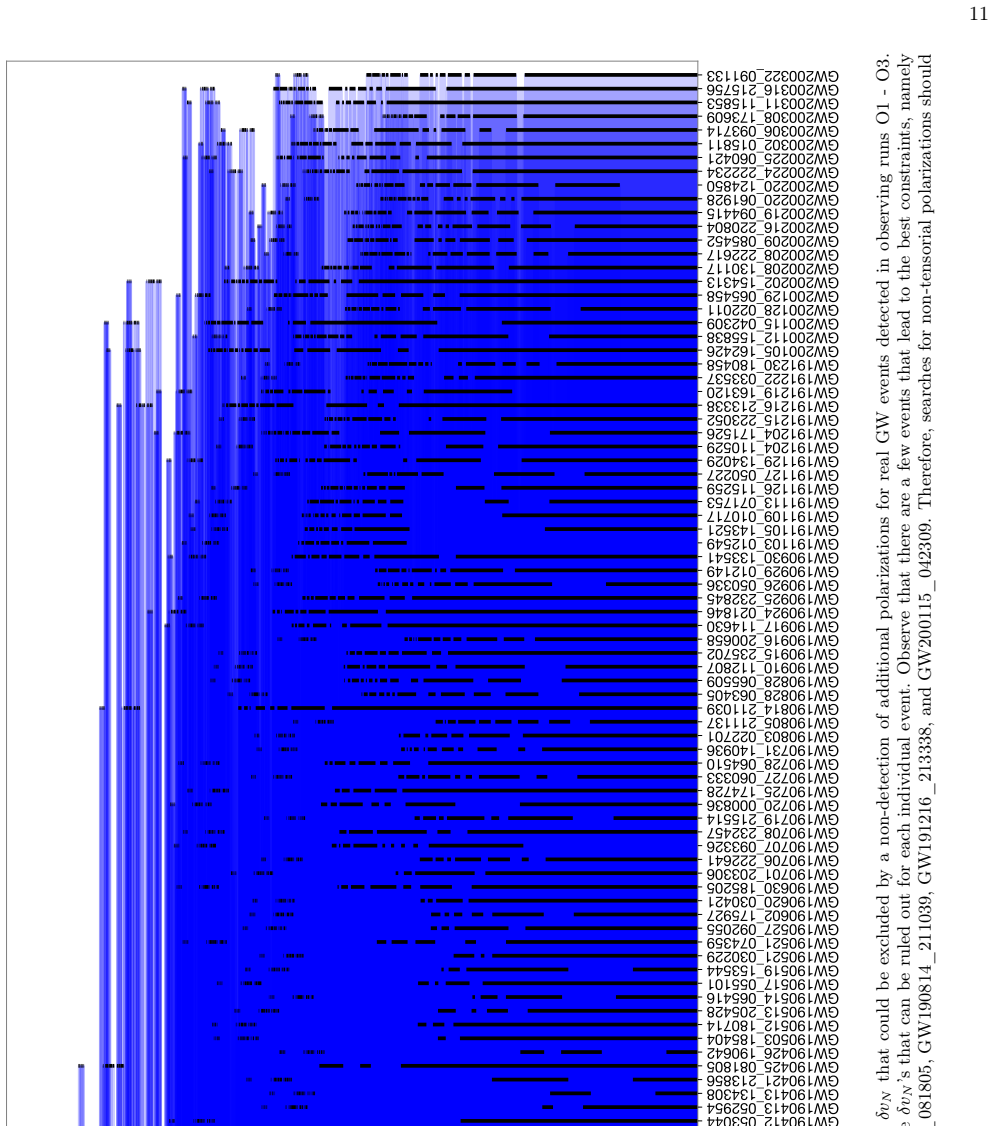
- [Sec. IIIA, Figs. 7-9] The regions in Figs. 7-9 are computed under the implicit assumption that any non-tensor signal with Δt inside a searched data segment would be detected. Since no detection efficiency is presented, these shaded regions are prospective upper limits on constraining power, not actual exclusions. The text should state this more prominently, particularly in the caption of Fig. 9, where 'the regions ... that could be excluded' could be misread as a demonstrated result.
minor comments (4)
- [Sec. IIB, Fig. 5] The statement that a non-detection places a 'lower bound on the speed' is correct only for polarizations with amplitude above the detection threshold. The text says this, but it would help to repeat it when interpreting Fig. 5, where the 'best-case' curves might be mistaken for unconditional constraints.
- [Sec. IIIA, footnote 6] The stacking argument assumes that the extra-polarization propagation speed is the same for all events. This assumption should be stated in the main text as well, since a theory with energy-dependent speeds would not allow the gap-filling shown in Figs. 7-8.
- [Appendix A] The conclusion that parameter bias from energy loss through additional polarizations is negligible relies on the assumption that all non-GR deviations scale with a single coupling ζ and that O(ζ^2) terms vanish. This assumption is strong and should be flagged as such; it is not a general theorem.
- [Fig. 9] The five events highlighted in the text as giving the best constraints are hard to identify in the dense figure; adding labels or markers would improve readability.
Circularity Check
No significant circularity: the constraints follow from elementary arrival-time kinematics, and the acknowledged feasibility gap is an evidence gap, not a circular reduction.
full rationale
The paper's derivation chain is kinematic and self-contained. The central relation Eqs. (2.1)-(2.3) is just the travel-time difference Δt_N = D_L/c − D_L/v_N, rearranged as δv_N = cΔt_N/(D_L − cΔt_N). No parameter is fitted to data and then renamed a prediction; the quoted 'best-case' bound (v > (1 + 6×10^−9)c for D_L = 50 Mpc, T_obs = 1 yr) is Eq. (2.3) evaluated at the explicitly labeled idealization Δt_N,max = T_obs (Eq. 3.1). The non-detection logic (an upper bound on amplitude for modes with detectable propagation speeds, and a lower bound on speed for modes with detectable amplitudes) is the standard null-search dichotomy, and the paper explicitly conditions it on a 'large enough non-tensorial amplitude to be detectable' (Sec. IIIC). Sec. IIIC then appeals to external stochastic-background upper limits [54] only to argue that such amplitudes are not already ruled out; this is an external-data comparison, not a circular one. The paper cites the same authors' earlier work ([3], [27]), but these self-citations are not load-bearing in a circular way: [3] motivates that speed differences move non-tensor modes outside standard search windows, and that claim is independently re-derived here in Eq. (2.1), while [27] is offered only as an optional template source whose theory-specific constraints the paper itself says would not justify the search. The main acknowledged limitation, stated in Sec. IV ('We leave the study of these questions to future work'), is that no injections, template-bank construction, minimum detectable amplitude, or search-efficiency study is provided; this is a genuine gap in support of the 'feasible with current detectors' claim, but it is a missing demonstration, not a reduction of the conclusion to its inputs. No circular step is identifiable.
Assumptions & free parameters
assumptions (4)
- domain assumption Non-tensor polarizations in modified gravity propagate at speeds satisfying v_S,V >= c, while the tensor speed is v_T ~ c to O(10^-15).
- domain assumption The source parameters inferred from the tensor signal are approximately the same for the non-tensor signal.
- ad hoc to paper All deviations from GR scale with the same small coupling constant zeta in the energy-loss estimate.
- ad hoc to paper Stacking events assumes the propagation speed of extra polarizations is the same for all events.
Cite this review
Pith. "Pith review of Better early than never: A new test for superluminal gravitational wave polarizations." pith.science (2026). https://pith.science/paper/LT22UHN4
@misc{pith2026250118125,
  author       = {Pith},
  title        = {Pith review of: Better early than never: A new test for superluminal gravitational wave polarizations},
  year         = {2026},
  howpublished = {\url{https://pith.science/paper/LT22UHN4}},
  note         = {Machine review of arXiv:2501.18125}
}
read the original abstract
In some beyond-Einstein theories of gravity, gravitational waves can contain up to six polarizations, which are allowed to propagate at different speeds faster than light. These different propagation speeds imply that polarizations generated by the same source will not arrive simultaneously at the detector. Current constraints on the speed of propagation of transverse-traceless polarizations, however, indicate that any additional polarizations must arrive with or before the transverse-traceless ones. We propose a new technique to test for the existence of superluminal, non-transverse-traceless polarizations that arrive in the data before a gravitational-wave observation of transverse-traceless modes. We discuss the circumstances in which these non-transverse-traceless polarizations would be detectable and what constraints could be placed if they are not detected. To determine whether this new test of general relativity with gravitational wave observations is practical, we outline and address many of the challenges it might face. Our arguments lead us to conclude that this new test is not only physically well-motivated but also feasible with current detectors.
Figures


Figures from the paper (6 more)



Forward citations
Cited by 1 Pith paper
-
Testing General Relativity with Individual Supermassive Black Hole Binaries
Beyond-GR polarization modes in a single supermassive black hole binary show up linearly (not quadratically) in pulsar-timing cross-correlations, massive-graviton dispersion shifts antenna patterns and pulsar-term pha...
Reference graph
Works this paper leans on
-
[1]
Berti et al., Testing General Relativity with Present and Future Astrophysical Observations, Class
E. Berti et al., Testing General Relativity with Present and Future Astrophysical Observations, Class. Quant. Grav. 32, 243001 (2015), arXiv:1501.07274 [gr-qc]
arXiv 2015
-
[2]
N. Yunes and X. Siemens, Gravitational-Wave Tests of General Relativity with Ground-Based Detectors and Pulsar Timing-Arrays, Living Rev. Rel. 16, 9 (2013), arXiv:1304.3473 [gr-qc]
arXiv 2013
-
[3]
K. Schumacher, N. Yunes, and K. Yagi, Gravitational Wave Polarizations with Different Propagation Speeds, (2023), arXiv:2308.05589 [gr-qc]
arXiv 2023
-
[4]
B. S. Sathyaprakash and S. V. Dhurandhar, Choice of filters for the detection of gravitational waves from coa- lescing binaries, Phys. Rev. D44, 3819 (1991)
1991
-
[5]
L. Blanchet, Gravitational Radiation from Post- Newtonian Sources and Inspiralling Compact Binaries, Living Rev. Rel.17, 2 (2014), arXiv:1310.1528 [gr-qc]
arXiv 2014
-
[6]
S. A. Usmanet al., The PyCBC search for gravitational waves from compact binary coalescence, Class. Quant. Grav. 33, 215004 (2016), arXiv:1508.02357 [gr-qc]
arXiv 2016
-
[7]
Y. Guersel and M. Tinto, Near optimal solution to the inverse problem for gravitational wave bursts, Phys. Rev. D 40, 3884 (1989)
work page 1989
-
[8]
K. Chatziioannou, N. Yunes, and N. Cornish, Model- Independent Test of General Relativity: An Extended post-Einsteinian Framework with Complete Polarization Content, Phys. Rev. D 86, 022004 (2012), [Erratum: Phys.Rev.D 95, 129901 (2017)], arXiv:1204.2585 [gr-qc]
arXiv 2012
Show all 69 references
-
[9]
P. T. H. Pang, R. K. L. Lo, I. C. F. Wong, T. G. F. Li, and C. Van Den Broeck, Generic searches for alternative gravitational wave polarizations with networks of inter- 16 ferometric detectors, Phys. Rev. D101, 104055 (2020), arXiv:2003.07375 [gr-qc]
2020 arXiv
-
[10]
I. C. F. Wong, P. T. H. Pang, R. K. L. Lo, T. G. F. Li, and C. Van Den Broeck, Null-stream-based Bayesian Unmodeled Framework to Probe Generic Gravitational- wave Polarizations, (2021), arXiv:2105.09485 [gr-qc]
2021 arXiv
-
[11]
G. D. Moore and A. E. Nelson, Lower bound on the prop- agation speed of gravity from gravitational Cherenkov radiation, JHEP 09, 023, arXiv:hep-ph/0106220
-
[12]
Kiyota and K
S. Kiyota and K. Yamamoto, Constraint on modified dispersion relations for gravitational waves from gravi- tational Cherenkov radiation, Phys. Rev. D92, 104036 (2015), arXiv:1509.00610 [gr-qc]
2015 arXiv
-
[13]
B. P. Abbott et al. (LIGO Scientific, Virgo, Fermi- GBM, INTEGRAL), Gravitational Waves and Gamma- rays from a Binary Neutron Star Merger: GW170817 and GRB 170817A, Astrophys. J. Lett.848, L13 (2017), arXiv:1710.05834 [astro-ph.HE]
2017 arXiv
-
[14]
A. K. Y. Li, R. K. L. Lo, S. Sachdev, J. C. L. Chan, E. T. Lin, T. G. F. Li, and A. J. Weinstein (LIGO Scientific, Virgo), Targeted subthreshold search for strongly lensed gravitational-wave events, Phys. Rev. D 107, 123014 (2023), arXiv:1904.06020 [gr-qc]
2023 arXiv
-
[15]
McIsaac, D
C. McIsaac, D. Keitel, T. Collett, I. Harry, S. Mozzon, O.Edy,andD.Bacon,Searchforstronglylensedcounter- part images of binary black hole mergers in the first two LIGO observing runs, Phys. Rev. D102, 084031 (2020), arXiv:1912.05389 [gr-qc]
2020 arXiv
-
[16]
A. K. Y. Li, J. C. L. Chan, H. Fong, A. H. Y. Chong, A. J. Weinstein, and J. M. Ezquiaga, TESLA-X: An ef- fective method to search for sub-threshold lensed gravita- tional waves with a targeted population model, (2023), arXiv:2311.06416 [gr-qc]
2023
-
[17]
(LIGOScientific, Virgo),Testsofgeneral relativity with binary black holes from the second LIGO- Virgo gravitational-wave transient catalog, Phys
R.Abbott et al. (LIGOScientific, Virgo),Testsofgeneral relativity with binary black holes from the second LIGO- Virgo gravitational-wave transient catalog, Phys. Rev. D 103, 122002 (2021), arXiv:2010.14529 [gr-qc]
2021 arXiv
-
[18]
B. P. Abbottet al. (LIGO Scientific, Virgo), GW170814: A Three-Detector Observation of Gravitational Waves from a Binary Black Hole Coalescence, Phys. Rev. Lett. 119, 141101 (2017), arXiv:1709.09660 [gr-qc]
2017 arXiv
-
[19]
(LIGOScientific, Virgo),TestsofGen- eral Relativity with GW170817, Phys
B.P.Abbott et al. (LIGOScientific, Virgo),TestsofGen- eral Relativity with GW170817, Phys. Rev. Lett.123, 011102 (2019), arXiv:1811.00364 [gr-qc]
2019 arXiv
-
[20]
B. P. Abbott et al. (LIGO Scientific, Virgo), Tests of General Relativity with the Binary Black Hole Signals from the LIGO-Virgo Catalog GWTC-1, Phys. Rev. D 100, 104036 (2019), arXiv:1903.04467 [gr-qc]
2019 arXiv
-
[21]
Isi and A
M. Isi and A. J. Weinstein, Probing gravitational wave polarizations with signals from compact binary coales- cences, (2017), arXiv:1710.03794 [gr-qc]
2017 arXiv
-
[22]
M. Isi, A. J. Weinstein, C. Mead, and M. Pitkin, Detecting Beyond-Einstein Polarizations of Continuous Gravitational Waves, Phys. Rev. D91, 082002 (2015), arXiv:1502.00333 [gr-qc]
2015 arXiv
-
[23]
M. Isi, M. Pitkin, and A. J. Weinstein, Probing Dy- namical Gravity with the Polarization of Continuous Gravitational Waves, Phys. Rev. D96, 042001 (2017), arXiv:1703.07530 [gr-qc]
2017 arXiv
-
[24]
Jacobson and D
T. Jacobson and D. Mattingly, Einstein-Aether waves, Phys. Rev. D70, 024003 (2004), arXiv:gr-qc/0402005
2004 arXiv
-
[25]
Mattingly, Modern tests of Lorentz invariance, Living Rev
D. Mattingly, Modern tests of Lorentz invariance, Living Rev. Rel. 8, 5 (2005), arXiv:gr-qc/0502097
2005 arXiv
-
[26]
Jacobson, Einstein-aether gravity: A Status report, PoS QG-PH, 020 (2007), arXiv:0801.1547 [gr-qc]
T. Jacobson, Einstein-aether gravity: A Status report, PoS QG-PH, 020 (2007), arXiv:0801.1547 [gr-qc]
2007 arXiv
-
[27]
Schumacher, S
K. Schumacher, S. E. Perkins, A. Shaw, K. Yagi, and N. Yunes, Gravitational wave constraints on Einstein-æther theory with LIGO/Virgo data, (2023), arXiv:2304.06801 [gr-qc]
2023 arXiv
-
[28]
S. M. Carroll and E. A. Lim, Lorentz-violating vector fields slow the universe down, Phys. Rev. D70, 123525 (2004), arXiv:hep-th/0407149
2004 arXiv
-
[29]
Muller, J
J. Muller, J. G. Williams, and S. G. Turyshev, Lunar laser ranging contributions to relativity and geodesy, Astrophys. Space Sci. Libr. 349, 457 (2008), arXiv:gr- qc/0509114
2008
-
[30]
Nordtvedt, Probing gravity to the second post- newtonian order and to one part in107 using the spin axis of the sun., Astrophys
K. Nordtvedt, Probing gravity to the second post- newtonian order and to one part in107 using the spin axis of the sun., Astrophys. Journal320, 871 (1987)
1987
-
[31]
Gupta, M
T. Gupta, M. Herrero-Valea, D. Blas, E. Barausse, N. Cornish, K. Yagi, and N. Yunes, New binary pulsar constraints on Einstein-æther theory after GW170817, Class. Quant. Grav.38, 195003 (2021), arXiv:2104.04596 [gr-qc]
2021 arXiv
-
[32]
Geroch, Faster Than Light?, AMS/IP Stud
R. Geroch, Faster Than Light?, AMS/IP Stud. Adv. Math. 49, 59 (2011), arXiv:1005.1614 [gr-qc]
2011 arXiv
-
[33]
Dong, Y.-Q
Y.-Q. Dong, Y.-Q. Liua, and Y.-X. Liu, Polarization modes of gravitational waves in general modified grav- ity: General metric theory and general scalar-tensor the- ory, Phys. Rev. D109, 044013 (2024), arXiv:2310.11336 [gr-qc]
2024 arXiv
-
[34]
Zhang, X
C. Zhang, X. Zhao, A. Wang, B. Wang, K. Yagi, N. Yunes, W. Zhao, and T. Zhu, Gravitational waves from the quasicircular inspiral of compact binaries in Einstein-aether theory, Phys. Rev. D 101, 044002 (2020), [Erratum: Phys.Rev.D 104, 069905 (2021)], arXiv:1911.10278 [gr-qc]
2020 arXiv
-
[35]
E.Sagi,Propagationofgravitationalwavesingeneralized TeVeS, Phys. Rev. D81, 064031 (2010), arXiv:1001.1555 [gr-qc]
2010 arXiv
-
[36]
Liang, R
D. Liang, R. Xu, X. Lu, and L. Shao, Polarizations of gravitational waves in the bumblebee gravity model, Phys. Rev. D106, 124019 (2022), arXiv:2207.14423 [gr- qc]
2022 arXiv
-
[37]
Rastall, A Theory of Gravity, Can
P. Rastall, A Theory of Gravity, Can. J. Phys.54, 66 (1976)
1976
-
[38]
Rosen, Theory of gravitation, Phys
N. Rosen, Theory of gravitation, Phys. Rev. D3, 2317 (1971)
1971
-
[39]
Rosen, A theory of gravitation, Annals Phys.84, 455 (1974)
N. Rosen, A theory of gravitation, Annals Phys.84, 455 (1974)
1974
-
[40]
A. P. Lightman and D. L. Lee, New Two-Metric Theory of Gravity with Prior Geometry, Phys. Rev. D8, 3293 (1973)
1973
-
[41]
stacking
reports that during O3b, the duty cycle was 79% for advanced LIGO Hanford, 79% for advanced LIGO Livingston, and 76% for Virgo. All three detectors were running simultaneously only 51% of the time, but at least one detector was observing 96.6% of the time. This creates further...
-
[42]
Abbott et al
R. Abbott et al. (KAGRA, VIRGO, LIGO Scien- tific), GWTC-3: Compact Binary Coalescences Observed by LIGO and Virgo during the Second Part of the Third Observing Run, Phys. Rev. X13, 041039 (2023), arXiv:2111.03606 [gr-qc]
2023 arXiv
-
[43]
LVK Collaboration, LIGO/Virgo/KAGRA to Resume O4 After Mid-Run Break
-
[44]
Abbott et al
R. Abbott et al. (LIGO Scientific, VIRGO, KAGRA), Tests of General Relativity with GWTC-3, (2021), arXiv:2112.06861 [gr-qc]
2021 arXiv
-
[45]
(LIGOScientific, Virgo),BinaryBlack HoleMergersinthefirstAdvancedLIGOObservingRun, Phys
B.P.Abbott et al. (LIGOScientific, Virgo),BinaryBlack HoleMergersinthefirstAdvancedLIGOObservingRun, Phys. Rev. X6, 041015 (2016), [Erratum: Phys.Rev.X 8, 039903 (2018)], arXiv:1606.04856 [gr-qc]
2016 arXiv
-
[46]
B. P. Abbottet al. (LIGO Scientific, Virgo), GW170817: 17 Observation of Gravitational Waves from a Binary Neu- tron Star Inspiral, Phys. Rev. Lett.119, 161101 (2017), arXiv:1710.05832 [gr-qc]
2017 arXiv
-
[47]
Abbott et al
R. Abbott et al. (LIGO Scientific, VIRGO), GWTC-2.1: Deep extended catalog of compact binary coalescences observed by LIGO and Virgo during the first half of the third observing run, Phys. Rev. D109, 022001 (2024), arXiv:2108.01045 [gr-qc]
2024 arXiv
-
[48]
Shoemaker, A
D. Shoemaker, A. Rocchi, and S. Miyoki,LIGO Docu- ment G2002127-v23 , Tech. Rep. (2024)
2024
-
[49]
Essick, Semianalytic sensitivity estimates for cata- logs of gravitational-wave transients, Phys
R. Essick, Semianalytic sensitivity estimates for cata- logs of gravitational-wave transients, Phys. Rev. D108, 043011 (2023), arXiv:2307.02765 [gr-qc]
2023 arXiv
-
[50]
B. P. Abbott et al. (KAGRA, LIGO Scientific, Virgo, VIRGO), Prospects for observing and localizing gravitational-wave transients with Advanced LIGO, Ad- vancedVirgoandKAGRA,LivingRev.Rel. 21,3(2018), arXiv:1304.0670 [gr-qc]
2018 arXiv
-
[51]
J. D. Romano and N. J. Cornish, Detection meth- ods for stochastic gravitational-wave backgrounds: a unified treatment, Living Rev. Rel. 20, 2 (2017), arXiv:1608.06889 [gr-qc]
2017 arXiv
-
[52]
Callister, A
T. Callister, A. S. Biscoveanu, N. Christensen, M. Isi, A. Matas, O. Minazzoli, T. Regimbau, M. Sakellariadou, J. Tasson, and E. Thrane, Polarization-based Tests of Gravity with the Stochastic Gravitational-Wave Back- ground, Phys. Rev. X7, 041058 (2017), arXiv:1704.08373 [gr-qc]
2017 arXiv
-
[53]
B. P. Abbottet al. (LIGO Scientific, Virgo), Search for Tensor, Vector, andScalarPolarizationsintheStochastic Gravitational-Wave Background, Phys. Rev. Lett.120, 201102 (2018), arXiv:1802.10194 [gr-qc]
2018 arXiv
-
[54]
B. P. Abbottet al. (LIGO Scientific, Virgo), Directional limits on persistent gravitational waves using data from Advanced LIGO’s first two observing runs, Phys. Rev. D 100, 062001 (2019), arXiv:1903.08844 [gr-qc]
2019 arXiv
-
[55]
Abbott et al
R. Abbott et al. (KAGRA, Virgo, LIGO Scientific), Upper limits on the isotropic gravitational-wave back- ground from Advanced LIGO and Advanced Virgo’s third observing run, Phys. Rev. D104, 022004 (2021), arXiv:2101.12130 [gr-qc]
2021
-
[56]
Arzoumanian et al
Z. Arzoumanian et al. (NANOGrav), The NANOGrav 12.5-year Data Set: Search for Non-Einsteinian Polariza- tion Modes in the Gravitational-wave Background, As- trophys. J. Lett.923, L22 (2021), arXiv:2109.14706 [gr- qc]
2021 arXiv
-
[57]
Agazie et al
G. Agazie et al. (NANOGrav), The NANOGrav 15 yr Data Set: Search for Transverse Polarization Modes in the Gravitational-wave Background, Astrophys. J. Lett. 964, L14 (2024), arXiv:2310.12138 [gr-qc]
2024 arXiv
-
[58]
Takeda, S
H. Takeda, S. Morisaki, and A. Nishizawa, Search for scalar-tensor mixed polarization modes of grav- itational waves, Phys. Rev. D 105, 084019 (2022), arXiv:2105.00253 [gr-qc]
2022 arXiv
-
[59]
Chatziioannou, M
K. Chatziioannou, M. Isi, C.-J. Haster, and T. B. Lit- tenberg, Morphology-independent test of the mixed po- larization content of transient gravitational wave signals, Phys. Rev. D104, 044005 (2021), arXiv:2105.01521 [gr- qc]
2021 arXiv
-
[60]
Takeda, Y
H. Takeda, Y. Manita, H. Omiya, and T. Tanaka, Scalar polarization window in gravitational-wave signals, PTEP 2023, 073E01 (2023), arXiv:2304.14430 [gr-qc]
2023 arXiv
-
[61]
Jacobson, Undoing the twist: The Hořava limit of Einstein-aether theory, Phys
T. Jacobson, Undoing the twist: The Hořava limit of Einstein-aether theory, Phys. Rev. D 89, 081501(R) (2014), arXiv:1310.5115 [gr-qc]
2014 arXiv
-
[62]
C. W. Misner, K. S. Thorne, and J. A. Wheeler,Gravi- tation (Princeton University Press, 1973)
1973
-
[63]
R. A. Isaacson, Gravitational radiation in the limit of high frequency. ii. nonlinear terms and the effective stress tensor, Phys. Rev.166, 1272 (1968)
1968
-
[64]
Cornish, D
N. Cornish, D. Blas, and G. Nardini, Bounding the speed of gravity with gravitational wave observations, Phys. Rev. Lett. 119, 161102 (2017), arXiv:1707.06101 [gr-qc]
2017 arXiv
-
[65]
Poisson and C
E. Poisson and C. M. Will,Gravity: Newtonian, Post- Newtonian, Relativistic (Cambridge University Press,
-
[66]
B. P. Abbottet al. (LIGO Scientific, Virgo), GW150914: First results from the search for binary black hole coa- lescence with Advanced LIGO, Phys. Rev. D93, 122003 (2016), arXiv:1602.03839 [gr-qc]
2016 arXiv
-
[67]
B. F. Schutz, Networks of gravitational wave detectors andthreefiguresofmerit,Class.Quant.Grav. 28,125023 (2011), arXiv:1102.5421 [astro-ph.IM]
2011 arXiv
-
[69]
A. G. Sullivanet al., Timing system of LIGO discover- ies, Phys. Rev. D108, 022003 (2023), arXiv:2304.01188 [astro-ph.IM]
2023 arXiv
-
[2014]
540–546 and 733–736
pp. 540–546 and 733–736
Reviewed August 10, 2026 · model on record in the stance chip above.
Discussion (0). Continue with ORCID to comment.