REVIEW 3 major objections 5 minor 58 references
Can quasars, triggered by mergers, account for NANOGrav's stochastic gravitational wave background?
T0 review · 3 major / 5 minor · reviewed 2026-08-11 · deepseek-v4-flash
Pith's one-line read A quasar-driven scenario, with nearly every bright quasar tied to a merging supermassive black hole binary, can reproduce the measured pulsar-timing gravitational wave background.
desk verdict A transparent, well-executed consistency check between quasars and the NANOGrav GWB; the amplitude match is partly fitted, and the contemporaneity assumption is the load-bearing caveat. read the letter →
The pith
A machine-rendered reading of the paper's core claim, the machinery that carries it, and where it could break.
The reading
What carries the argument
The machinery is the quasar luminosity function used as a stand-in for the supermassive black hole binary merger rate. A mass-luminosity relation with Eddington ratio $f_{\rm Edd}$ converts the observed quasar number density $\Phi(M,z)$ into a black hole number density $\Psi(M,z)$; dividing by the quasar lifetime $t_Q$ turns it into a merger rate. The chirp mass $\mathcal{M}=(m_1m_2)^{3/5}/(m_1+m_2)^{1/5}$ then fixes both the emitted gravitational-wave energy and the residence time per logarithmic frequency interval, so the characteristic strain $h_c(f)$ follows from an integral over mass, mass ratio, and redshift. A second route, integrating the gravitational-wave luminosity density over cosmic time, is shown to be mathematically identical, and environmental hardening appears only as a low-frequency correction.
What would settle it
Measure the Eddington-ratio distribution of the redshifts 2 to 3 quasars that dominate this model directly from virial black hole masses: if the typical value is well above the assumed log-normal peak of 0.25, the inferred black hole masses, and therefore the predicted strain, drop by a factor of several and miss the measured pulsar-timing amplitude.
Extended reading notes
Core claim
The central claim is that a scenario with binary fraction $f_{\rm bin} \sim 1$ — essentially every bright quasar marking a galaxy merger whose supermassive black holes are already coalescing — is quantitatively consistent with the pulsar-timing background. Starting from the empirical quasar luminosity function, the authors derive a merger rate density by dividing the quasar number density by the quasar lifetime, then compute the characteristic strain both by summing individual inspiraling binaries and by integrating their gravitational-wave energy output, showing the two routes are identical. Their fiducial model yields $h_c(f)=2.4\times10^{-15}(f/\mathrm{yr}^{-1})^{-2/3}$, matching the measured amplitude, and the match is robust to reasonable parameter choices because lower Eddington ratios, higher mass ratios, and shorter quasar lifetimes all raise the predicted strain. The implied sources are distant, roughly $10^9\,M_\odot$ binaries at $z\approx 2{-}3$, near the peak of quasar activity. The authors emphasize the main physical caveat: the calculation assumes quasar activity and the binary's passage through the pulsar-timing frequency band happen at the same time.
Load-bearing premise
The load-bearing premise is that every bright quasar is caught during the same short episode in which its supermassive black hole binary is also emitting gravitational waves in the pulsar-timing band, so the observed quasar count directly equals the binary merger rate.
Editorial extensions
If this is right
- The gravitational-wave background can be predicted directly from the observed quasar census, with no need for galaxy merger simulations or semi-analytic models.
- The dominant sources are distant, roughly $10^9\,M_\odot$ binaries at $z\approx 2{-}3$, so the background is built from a larger and more distant population than in most previous models.
- Because the sources are numerous and distant, the background should be smoother in frequency and lower in angular anisotropy, and individual binaries should be harder for pulsar timing arrays to resolve.
- The fit constrains only a degenerate combination of quasar lifetime, Eddington ratio, and mass ratio; many combinations of these three parameters match the data.
- Discreteness of the brightest sources produces only a mild high-frequency steepening, leaving the spectrum compatible with current errors.
Reading between the lines
- Beyond the paper: if quasar activity and pulsar-timing-band inspiral are separated by even a few quasar lifetimes, the predicted strain would drop substantially, so the match found here is best read as an upper limit on how many quasars can be tied to merging binaries.
- Beyond the paper: the same construction could be applied to deeper future quasar luminosity functions; a measured change in the bright-end slope would shift the predicted gravitational-wave background in a knowable direction.
- Beyond the paper: the model implies a quantitative variability rate for wide-field time-domain surveys, roughly $t_Q/t_{\rm GW}\sim10^{-3}$ of quasars should show year-scale periodic modulation if the one-to-one quasar-binary correspondence is real.
Editorial analysis
A structured set of objections, weighed in public.
Referee Report
Summary. The paper proposes that the stochastic gravitational wave background (GWB) detected by NANOGrav and other PTAs can be explained by supermassive black hole binaries associated with quasars, under the assumptions that all luminous quasars are activated by galaxy mergers and that each such merger produces a promptly coalescing SMBH binary. Starting from the observed quasar luminosity function (QLF) of Kulkarni et al. 2019, the authors convert the quasar space density into a merger rate using a quasar lifetime t_Q (Eq. 6), then compute the GWB in two independent ways: by summing the strain of individual inspiraling binaries (Eq. 16) and by integrating the GW energy injected by past mergers (Eq. 24), showing the two methods are mathematically equivalent. The fiducial model adopts a log-normal Eddington ratio distribution with peak f_Edd = 0.25, a log-normal mass ratio distribution with peak q = 1, and t_Q = 2.7e7 yr, and reproduces the NANOGrav best-fit power-law h_c(f) = 2.4e-15 (f/yr^-1)^(-2/3). The paper explores parameter degeneracies using PTArcade, identifies the mass and redshift ranges that dominate the background, and examines the effects of environmental inspiral and source discreteness on the spectrum. The central claim is that the observed QLF, together with reasonable parameter choices, can make the quasar-merger scenario consistent with the measured GWB.
Significance. If the scenario holds, this paper provides a direct empirical link between the quasar population and the GWB, bypassing detailed galaxy-formation simulations. The derived predictions are falsifiable: the GWB would be dominated by ~1e9 Msun SMBHs at z~2-3, the spectrum would be smoother than in lower-redshift models, the angular anisotropy would be lower, and individual sources would be harder to resolve. The explicit proof that the two standard computational routes to h_c (source summation and energy injection) are algebraically equivalent is a useful pedagogical and cross-checking contribution. The treatment of discreteness effects and the use of a public MCMC package to map parameter degeneracies are also strengths, and the paper is transparent about the role of fitting in the fiducial choice of t_Q. The main weakness is that the consistency claim depends critically on an assumption—contemporaneity of the quasar phase and the PTA-band inspiral—that the authors themselves flag as unresolved, and whose violation by a time delay longer than t_Q would suppress the predicted amplitude below the observed value.
major comments (3)
- [Section 2.1 and Section 4] The conversion from quasar space density to merger rate (Eq. 6) and the residence-time weighting (Eq. 11) both assume that every quasar corresponds to a binary that passes through the nHz band within its t_Q-long active phase. As the authors note in Section 4, it is not clear whether the bright quasar phase and the PTA-band inspiral are contemporaneous, and either could precede the other. If the typical delay Delta_t between peak quasar activity and entry into the nHz band exceeds t_Q, the effective number of contributing binaries is suppressed by roughly t_Q/Delta_t, and h_c would fall below the NANOGrav best-fit value. Because t_Q = 2.7e7 yr is already at the short end of observationally inferred quasar lifetimes, absorbing such a delay by shortening t_Q further is not obviously possible. The paper should quantify this effect, even with a simple parameterization of the delay, and show how the inferred parameters (t_Q/f_bin, f_Edd, q) shift when contemporaneity is relaxed. This is the single most load-bearing assumption for the paper's central consistency claim.
- [Abstract and Section 3] The abstract states that the GWB is computed under the assumption t_Q ~ 10^8 yr, while the fiducial model in Section 3 uses t_Q = 2.7e7 yr, a factor of roughly four smaller. The amplitude match is achieved with this smaller value, which was explicitly 'chosen to fit the NANOGrav data' (Section 3). The abstract thus presents as an assumed parameter a value that is actually the fitted one, and it overstates the degree to which the match follows from the stated assumptions. Please reconcile the abstract and the fiducial model, either by quoting the fitted t_Q in the abstract or by presenting the match as a posterior constraint rather than an assumption.
- [Section 3.1 and Section 5] The GWB amplitude in the fiducial model is not an independent prediction: t_Q (and to some extent the peaks of the f_Edd and q distributions) are adjusted to match NANOGrav's A_yr. The paper is transparent about this in Section 3, but the abstract and conclusions say the model 'reproduces' and 'is consistent' without emphasizing the fitting step. Please add a sentence in the abstract and conclusions clarifying that the match is obtained by fitting these parameters, and that the falsifiable content lies in the shape of the spectrum, the source redshift/mass distribution, and the implied joint parameter constraints, not in the absolute normalization.
minor comments (5)
- [Section 2.1] The word 'actived' should be 'activated' in the sentence 'all quasars we see on the sky have been actived by a merger event.'
- [Section 3.4] Typo: 'Thesese panels' should be 'These panels', and 'lever of angular anisotropy' should be 'level of angular anisotropy'.
- [Section 4] Typo: 'correspondance' should be 'correspondence', and 'parameteric' should be 'parametric'.
- [Section 3.2] The uncertainties from the QLF itself (Kulkarni et al. 2019) are not propagated into the PTArcade posteriors. A sentence stating that only the model parameters were varied, and that QLF errors were neglected, would set expectations for the reported confidence regions.
- [Figure 3 caption] The notation 'log(f_Edd) ~ N(-0.6, 0.3)' is concise but could be clarified as a log-normal distribution with mean -0.6 in log10 and dispersion 0.3 dex, to match the text in Section 3.
Circularity Check
The GWB amplitude is fitted, not predicted: the quasar lifetime t_Q (or equivalently t_Q/f_bin) is chosen to match the NANOGrav amplitude, so the central claim of reproducing the measured GWB is partly by construction.
-
fitted input called prediction
[Section 3, opening of Results (fiducial-model paragraph); Eq. (16) and Eq. (24)]
"The quasar lifetime in the fiducial model is a constant tQ ≃ 2.7 × 10^7 yr, consistent with expectations from observations [24], and chosen to fit the NANOGrav data (see below)."
In both equivalent expressions for the GWB, Eq. (16) and Eq. (24), the characteristic strain satisfies h_c^2(f) ∝ (1/t_Q) ∫ Ψ_q M^{5/3} ... / [E(z)(1+z)^{4/3}]. The QLF and the mass-magnitude mapping fix everything except t_Q (and f_bin, which enters linearly and is set to 1). Because t_Q is explicitly 'chosen to fit the NANOGrav data', the subsequent statement that the fiducial model 'reproduces this best-fit power-law GWB' is a normalization fit rather than an independent prediction. The paper itself notes the degeneracy: 'we constrain only their ratio tQ/fbin', confirming that the amplitude match is absorbed by a free parameter.
full rationale
The paper's derivation chain from the observed quasar luminosity function to the GWB is otherwise self-contained: the two methods (Eqs. 14-16 and Eqs. 17-24) are shown to be mathematically identical, and the input QLF (Kulkarni et al. 2019 / Xin & Haiman 2021) is an external empirical dataset, not derived from the NANOGrav signal. The log-normal distributions for f_Edd and q are also taken from independent or only partially overlapping literature and are not shaped by the GWB data. The central circular element is the amplitude normalization: t_Q is a free parameter explicitly adjusted to match NANOGrav, and f_bin is degenerate with it, so the headline consistency of the amplitude is partly by construction. However, the paper is transparent about this and does make predictions that were not fitted: the f^{-2/3} spectral slope in the GW-driven case, the redshift/mass distribution peaking at z~2-3 and M~10^9 M_sun, the relative smoothness of the spectrum, reduced anisotropy, and reduced resolvability of individual sources. These give the model independent falsifiable content. The contemporaneity assumption (bright quasar phase overlapping the nHz-band inspiral) is explicitly flagged as uncertain in Section 4; it is a physical limitation affecting the predicted normalization, not an additional circular step. On balance, one central fitted parameter makes the amplitude claim partly circular, but the model retains independent content, so a score of 6 is appropriate.
Assumptions & free parameters
free parameters (4)
- quasar lifetime t_Q =
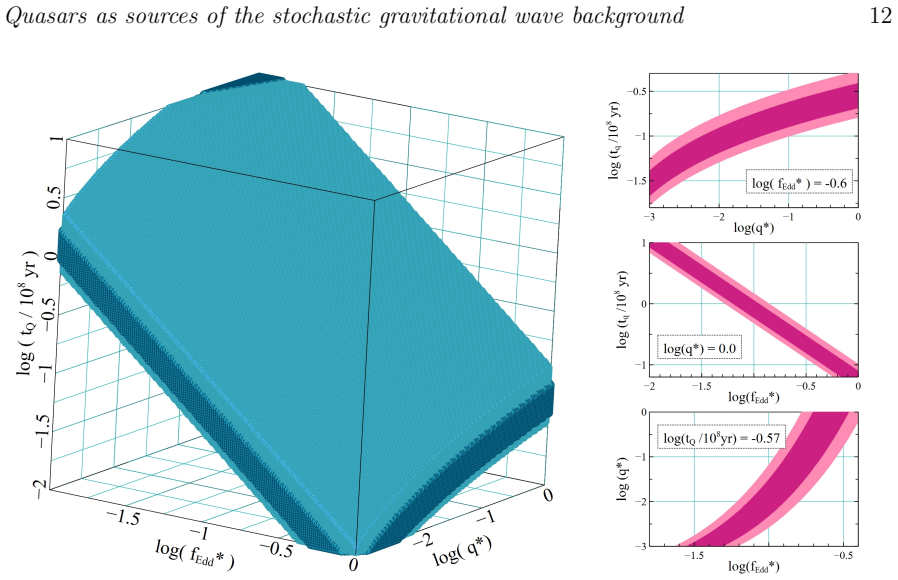
2.7e7 yr (fiducial); log(t_Q/1e8 yr) in [-2,1] in MCMC
- Eddington ratio distribution peak f_Edd* =
log f_Edd* = -0.6 (fiducial); [-2,0] in MCMC
- Binary mass ratio distribution peak q* =
log q* = 0 (fiducial); [-3,0] in MCMC
- Binary fraction f_bin =
1 (assumed)
assumptions (6)
- domain assumption The Kulkarni+19 QLF, as parameterized by Xin & Haiman 21, is a complete census of luminous quasars.
- domain assumption Quasar luminosity maps to SMBH mass through Eq (4) with constant bolometric correction and Eddington ratio.
- ad hoc to paper Every quasar is activated by a merger and hosts a coalescing SMBH binary contemporaneously with the quasar phase; f_bin = 1.
- domain assumption The quasar population is in steady state, so the merger rate density equals the quasar number density divided by t_Q.
- domain assumption Binaries are circular and their orbital evolution is driven by GW emission, plus the parametric environmental model of Agazie+23.
- standard math Standard flat LCDM cosmology is used for distances and volume elements.
Cite this review
Pith. "Pith review of Can quasars, triggered by mergers, account for NANOGrav's stochastic gravitational wave background?." pith.science (2026). https://pith.science/paper/LTDHGWOL
@misc{pith2026241212726,
  author       = {Pith},
  title        = {Pith review of: Can quasars, triggered by mergers, account for NANOGrav's stochastic gravitational wave background?},
  year         = {2026},
  howpublished = {\url{https://pith.science/paper/LTDHGWOL}},
  note         = {Machine review of arXiv:2412.12726}
}
abstract
The stochastic gravitational wave background (GWB) recently discovered by several pulsar timing array (PTA) experiments is consistent with arising from a population of coalescing super-massive black hole binaries (SMBHBs). The amplitude of the background is somewhat higher than expected in most previous population models or from the local mass density of SMBHs. SMBHBs are expected to be produced in galaxy mergers, which are also thought to trigger bright quasar activity. Under the assumptions that (i) a fraction $f_{bin} \sim 1$ of all quasars are associated with SMBHB mergers, (ii) the typical quasar lifetime is $t_{Q} \sim 10^{8} yr$, and (iii) adopting Eddington ratios $f_{Edd} \sim 0.3$ for the luminosity of bright quasars, we compute the GWB associated directly with the empirically measured quasar luminosity function (QLF). This approach bypasses the need to model the cosmological evolution of SMBH or galaxy mergers from simulations or semi-analytical models. We find a GWB amplitude approximately matching the value measured by NANOGrav. Our results are consistent with most quasars being associated with SMBH binaries and being the sources of the GWB, and imply a joint constraint on $t_{Q}$, $f_{Edd}$ and the typical mass ratio $q \equiv M_{2}/M_{1}$. The GWB in this case would be dominated by relatively distant $\sim 10^{9} M_{\odot}$ SMBHs at $z \approx 2 - 3$, at the peak of quasar activity. Similarly to other population models, our results remain in tension with the local SMBH mass density.
Figures


Figures from the paper (4 more)



Reference graph
Works this paper leans on
-
[1]
Introduction Several different pulsar timing array (PTA) campaigns have recently reported the discovery of a stochastic gravitational background (GWB) at nano-Hz frequencies, including the North American Nanohertz Observatory for Gravitational Waves (NANOGrav; [1]), the joint European PTA and Indian PTA (EPTA and InPTA; [2]), the Australian Parkes PTA (PP...
work page Pith review arXiv 2024
-
[2]
Methods In this section, we first describe the quasar luminosity function (QLF) we adopted, and then discuss how we use it to produce an estimate of the mass function of binary SMBHs and the stochastic GWB. For pedagogical reasons, we present two different ways to construct the latter estimate - versions of both of these appear in the literature, and here...
-
[3]
We define a fiducial model by the chosen values (or distributions) of the parameters fEdd, q and tQ
Results In this section we present our results for the characteristic strain (hc) of the gravitational wave background, based on the assumption that all quasars have been activated by a Quasars as sources of the stochastic gravitational wave background 9 merger event. We define a fiducial model by the chosen values (or distributions) of the parameters fEd...
-
[4]
Discussion Our main results in this study is that associating SMBH binaries with quasars, with very simple assumptions, yields good fits to the observed GWB. Quasars have been connected to modeling the GWB in the PTA bands in the past, both directly as well as indirectly. As an example of the latter, ref. [36] used a semi-analytical model to populate the ...
-
[5]
Conclusions In this paper, we hypothesized that there is a one-to-one correspondance between luminous quasars and coalescing SMBH binaries. Using a simple model to codify this connection, we used the empirically measured quasar luminosity function (QLF) to predict the present-day stochastic gravitational wave background (GWB). This approach bypasses the n...
-
[6]
Agazie G, Anumarlapudi A, Archibald A M, Arzoumanian Z, Baker P T, B´ ecsy B, Blecha L, Brazier A, Brook P R, Burke-Spolaor S, Burnette R, Case R, Charisi M, Chatterjee S, Chatziioannou K, Cheeseboro B D, Chen S, Cohen T, Cordes J M, Cornish N J, Crawford F, Cromartie H T, Crowter K, Cutler C J, Decesar M E, Degan D, Demorest P B, Deng H, Dolch T, Drachle...
arXiv 2023
-
[7]
EPTA Collaboration, InPTA Collaboration, Antoniadis J, Arumugam P, Arumugam S, Babak S, Bagchi M, Bak Nielsen A S, Bassa C G, Bathula A, Berthereau A, Bonetti M, Bortolas E, Brook P R, Burgay M, Caballero R N, Chalumeau A, Champion D J, Chanlaridis S, Chen S, Quasars as sources of the stochastic gravitational wave background 19 Cognard I, Dandapat S, Deb ...
arXiv 2023
-
[8]
Reardon D J, Zic A, Shannon R M, Hobbs G B, Bailes M, Di Marco V, Kapur A, Rogers A F, Thrane E, Askew J, Bhat N D R, Cameron A, Cury lo M, Coles W A, Dai S, Goncharov B, Kerr M, Kulkarni A, Levin Y, Lower M E, Manchester R N, Mandow R, Miles M T, Nathan R S, Os lowski S, Russell C J, Spiewak R, Zhang S and Zhu X J 2023 Astrophys. J. Lett.951 L6 (Preprint...
arXiv 2023
Show all 58 references
-
[9]
Xu H, Chen S, Guo Y, Jiang J, Wang B, Xu J, Xue Z, Nicolas Caballero R, Yuan J, Xu Y, Wang J, Hao L, Luo J, Lee K, Han J, Jiang P, Shen Z, Wang M, Wang N, Xu R, Wu X, Manchester R, Qian L, Guan X, Huang M, Sun C and Zhu Y 2023 Research in Astronomy and Astrophysics 23 075024 (...
2023 arXiv
-
[10]
Agazie G, Anumarlapudi A, Archibald A M, Baker P T, B´ ecsy B, Blecha L, Bonilla A, Brazier A, Brook P R, Burke-Spolaor S, Burnette R, Case R, Casey-Clyde J A, Charisi M, Chatterjee S, Chatziioannou K, Cheeseboro B D, Chen S, Cohen T, Cordes J M, Cornish N J, Crawford F, Croma...
2023 arXiv
-
[11]
Kormendy J and Ho L C 2013 Annual Review of Astronomy and Astrophysics51 511–653 (Preprint 1304.7762)
2013 arXiv
-
[12]
Springel V, Di Matteo T and Hernquist L 2005 Astrophys. J. Lett.620 L79–L82
2005
-
[13]
Robertson B, Cox T J, Hernquist L, Franx M, Hopkins P F, Martini P and Springel V 2006 Astrophys. J. 641 21–40 (Preprint arXiv:astro-ph/0511053)
2006 arXiv
-
[14]
Barnes J E and Hernquist L 1992 ARAA 30 705–742
1992
-
[15]
Begelman M C, Blandford R D and Rees M J 1980 Nature 287 307–309
1980
-
[16]
Bogdanovi´ c T, Miller M C and Blecha L 2022 Living Reviews in Relativity 25 3 ( Preprint 2109.03262)
2022 arXiv
-
[17]
Kauffmann G and Haehnelt M 2000 MNRAS 311 576–588 (Preprint astro-ph/9906493)
2000 arXiv
-
[18]
Menci N, Gatti M, Fiore F and Lamastra A 2014 A&A 569 A37 (Preprint 1406.7740)
2014 arXiv
-
[19]
Sharma R S, Choi E, Somerville R S, Snyder G F, Jhee H, Kocevski D D, Hirschmann M, Moster B P, Naab T, Narayanan D, Ostriker J P and Rosario D J 2024MNRAS 527 9461–9479 (Preprint Quasars as sources of the stochastic gravitational wave background 20 2101.01729)
-
[20]
Haiman Z, Kocsis B and Menou K 2009 Astrophys. J. 700 1952–1969 (Preprint 0904.1383)
2009 arXiv
-
[21]
J.856 42 (Preprint 1703.10611)
Sesana A, Haiman Z, Kocsis B and Kelley L Z 2018 Astrophys. J.856 42 (Preprint 1703.10611)
2018 arXiv
-
[22]
Casey-Clyde J A, Mingarelli C M F, Greene J E, Pardo K, Na˜ nez M and Goulding A D 2022 Astrophys. J. 924 93 (Preprint 2107.11390)
2022 arXiv
-
[23]
J., submitted; e-print arXiv:2405.19406
Casey-Clyde J A, Mingarelli C M F, Greene J E, Goulding A D, Chen S and Trump J R 2024 Astrophys. J., submitted; e-print arXiv:2405.19406
2024 arXiv
-
[24]
Xin C and Haiman Z 2021 MNRAS 506 2408–2417 (Preprint 2105.00005)
2021 arXiv
-
[25]
Kulkarni G, Worseck G and Hennawi J F 2019 MNRAS 488 1035–1065 (Preprint 1807.09774)
2019 arXiv
-
[26]
Inayoshi K, Visbal E and Haiman Z 2020 ARAA 58 27–97 (Preprint 1911.05791)
2020 arXiv
-
[27]
J.648 128–139 (Preprint astro-ph/0508657)
Kollmeier J A, Onken C A, Kochanek C S, Gould A, Weinberg D H, Dietrich M, Cool R, Dey A, Eisenstein D J, Jannuzi B T, Le Floc’h E and Stern D 2006 Astrophys. J.648 128–139 (Preprint astro-ph/0508657)
2006 arXiv
-
[28]
Phinney E S 2001 A Practical Theorem on Gravitational Wave Backgrounds (Preprint astro-ph/0108028)
2001 arXiv
-
[29]
Martini P 2004 QSO Lifetimes Coevolution of Black Holes and Galaxiesed Ho L C p 169 (Preprint astro-ph/0304009)
2004 arXiv
-
[30]
Haiman Z and Hui L 2001 Astrophys. J. 547 27–38 (Preprint astro-ph/0002190)
2001 arXiv
-
[31]
Martini P and Weinberg D H 2001 Astrophys. J. 547 12–26 (Preprint astro-ph/0002384)
2001 arXiv
-
[32]
Mitridate A 2023 10.5281/zenodo.7876430
2023 doi
-
[33]
Mitridate A, Wright D, von Eckardstein R, Schr¨ oder T, Nay J, Olum K, Schmitz K and Trickle T 2023 PTArcade (Preprint 2306.16377)
2023 arXiv
-
[34]
Richards G T, Strauss M A, Fan X, Hall P B, Jester S, Schneider D P, Vanden Berk D E, Stoughton C, Anderson S F, Brunner R J, Gray J, Gunn J E, Ivezi´ cˇZ, Kirkland M K, Knapp G R, Loveday J, Meiksin A, Pope A, Szalay A S, Thakar A R, Yanny B, York D G, Barentine J C, Brewingt...
2006 arXiv
-
[35]
Sesana A, Vecchio A and Colacino C N 2008 MNRAS 390 192–209 (Preprint 0804.4476)
2008 arXiv
-
[36]
Kocsis B and Sesana A 2011 MNRAS 411 1467–1479 (Preprint 1002.0584)
2011 arXiv
-
[37]
Dvorkin I and Barausse E 2017 MNRAS 470 4547–4556 (Preprint 1702.06964)
2017 arXiv
-
[38]
Soltan A 1982 MNRAS 200 115–122
1982
-
[39]
Yu Q and Tremaine S 2002 MNRAS 335 965–976 (Preprint astro-ph/0203082)
2002 arXiv
-
[40]
Haiman Z, Jimenez R and Bernardi M 2007 Astrophys. J. 658 721–730 ( Preprint astro-ph/0610723)
2007 arXiv
-
[41]
Izquierdo-Villalba D, Sesana A, Bonoli S and Colpi M 2022 MNRAS 509 3488–3503 ( Preprint 2108.11671)
2022 arXiv
-
[42]
Barausse E, Dey K, Crisostomi M, Panayada A, Marsat S and Basak S 2023 PRD 108 103034 (Preprint 2307.12245)
2023 arXiv
-
[43]
Hopkins P F, Hernquist L, Cox T J, Di Matteo T, Robertson B and Springel V 2006 Astrophys. J. Supp. 163 1–49 (Preprint astro-ph/0506398)
2006 arXiv
-
[44]
Hopkins P F, Richards G T and Hernquist L 2007 Astrophys. J. 654 731–753 ( Preprint astro-ph/0605678)
2007 arXiv
-
[45]
Arzoumanian Z, Baker P T, Blumer H, B´ ecsy B, Brazier A, Brook P R, Burke-Spolaor S, Chatterjee S, Chen S, Cordes J M, Cornish N J, Crawford F, Cromartie H T, Decesar M E, Demorest P B, Dolch T, Ellis J A, Ferrara E C, Fiore W, Fonseca E, Garver-Daniels N, Gentile P A, Good D...
2020 arXiv
-
[46]
Westernacher-Schneider J R, Zrake J, MacFadyen A and Haiman Z 2022 PRD 106 103010 (Preprint 2111.06882)
2022 arXiv
-
[47]
D’Orazio D J, Haiman Z and Schiminovich D 2015 Nature 525 351–353 (Preprint 1509.04301)
2015 arXiv
-
[48]
Haiman Z 2017 PRD 96 023004 (Preprint 1705.06765)
2017 arXiv
-
[49]
D’Orazio D J and Di Stefano R 2018 Monthly Notices of the Royal Astronomical Society474 2975–2986
2018
-
[50]
Pihajoki P, Mannerkoski M, N¨ attil¨ a J and Johansson P H 2018The Astrophysical Journal863 8 ISSN 0004-637X
-
[51]
Ingram A, Motta S E, Aigrain S and Karastergiou A 2021 MNRAS 503 1703–1716 ( Preprint 2103.00017)
2021 arXiv
-
[52]
Davelaar J and Haiman Z 2022 PhRD 105 103010
2022
-
[53]
Graham M J, Djorgovski S G, Stern D, Drake A J, Mahabal A A, Donalek C, Glikman E, Larson S and Christensen E 2015 MNRAS 453 1562–1576 (Preprint 1507.07603)
2015 arXiv
-
[54]
Charisi M, Bartos I, Haiman Z, Price-Whelan A M, Graham M J, Bellm E C, Laher R R and M´ arka S 2016MNRAS 463 2145–2171 (Preprint 1604.01020)
-
[55]
Chen Y J, Zhai S, Liu J R, Guo W J, Peng Y C, Li Y R, Songsheng Y Y, Du P, Hu C and Wang J M 2024 MNRAS 527 12154–12177 (Preprint 2206.11497)
2024 arXiv
-
[56]
Vaughan S, Uttley P, Markowitz A G, Huppenkothen D, Middleton M J, Alston W N, Scargle J D and Farr W M 2016 MNRAS 461 3145–3152 (Preprint 1606.02620)
2016 arXiv
-
[57]
Rubin Observatory’s Legacy Survey of Space and Time (LSST) for Solar System Science Bulletin of the American Astronomical Societyvol 53 p 236
Vera C Rubin Observatory LSST Solar System Science Collaboration, Jones R L, Bannister M T, Bolin B T, Chandler C O, Chesley S R, Eggl S, Greenstreet S, Holt T R, Hsieh H H, Ivezic Z, Juric M, Kelley M S P, Knight M M, Malhotra R, Oldroyd W J, Sarid G, Schwamb M E, Snodgrass C...
2021
-
[58]
Assef R J, Eisenhardt P R M, Stern D, Tsai C W, Wu J, Wylezalek D, Blain A W, Bridge C R, Donoso E, Gonzales A, Griffith R L and Jarrett T H 2015 Astrophys. J. 804 27 ( Preprint 1408.1092)
2015 arXiv
Reviewed August 11, 2026 · model on record in the stance chip above.
Discussion (0). Continue with ORCID to comment.