Role of radon as a precursor to earthquakes:An appraisal
Pith reviewed 2026-05-25 13:42 UTC · model grok-4.3
The pith
Radon concentration changes in soil gas are attributed to pre-seismic strain and reported as earthquake precursors.
A machine-rendered reading of the paper's core claim, the machinery that carries it, and where it could break.
Core claim
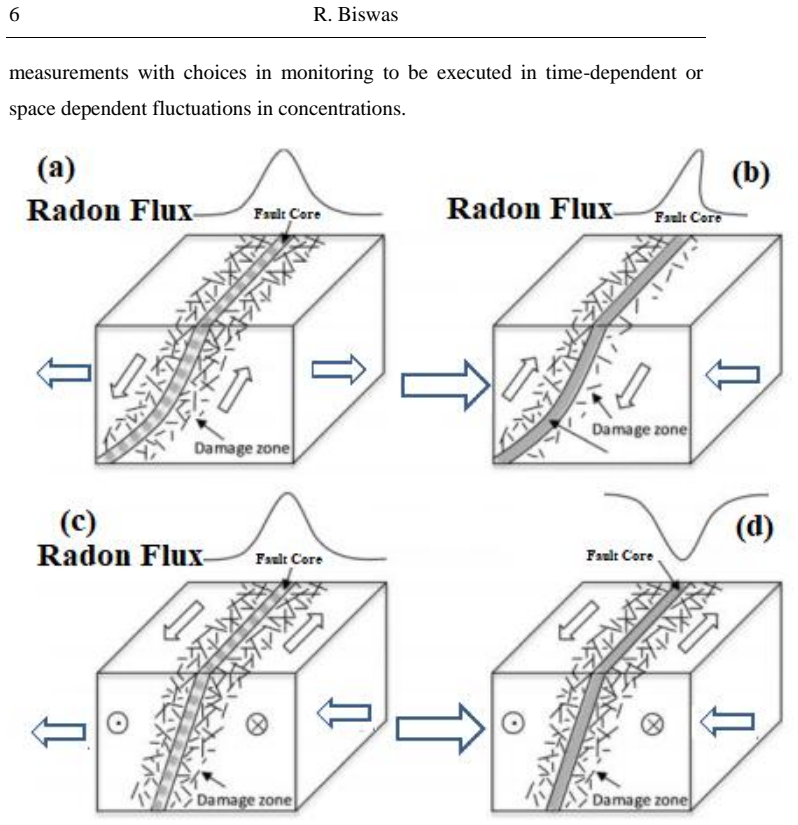
Radon monitoring has recently gained extensive attention among seismologists. It is now widely reported as a precursory signal prior to occurrence of a seismic event. The enhanced estimation of radon in soil gas is basically attributed to the strain changes which arise within the earth surface. In this chapter, the role of radon as a precursor is elaborated, accompanied by the anomalies which come across during observation. Additionally, the recent studies done in Himalayan Belt is also reviewed along with future perspectives in radon estimation.
What carries the argument
The direct attribution of increased radon emanation from soil gas to pre-seismic strain changes within the Earth's crust.
If this is right
- Radon monitoring gains attention as a potential precursory signal for seismic events.
- Strain changes in the crust are presented as the physical cause of elevated soil-gas radon.
- Anomalies encountered in field observations must be addressed when using the method.
- Recent studies in the Himalayan belt provide specific cases for evaluating the approach.
- Future work should focus on refining radon estimation techniques.
Where Pith is reading between the lines
- Combining radon readings with other ground measurements could help isolate true strain signals from noise.
- Extending similar monitoring networks beyond the Himalayan region would test whether the pattern holds in different tectonic settings.
- Accounting for seasonal cycles in data processing might reduce false positives in precursor identification.
Load-bearing premise
Observed radon concentration changes can be causally attributed to pre-seismic strain and reliably distinguished from meteorological, seasonal, or instrumental effects.
What would settle it
A long-term record at a monitored site showing repeated radon anomalies without subsequent earthquakes, or major earthquakes without preceding radon changes, would challenge the claimed causal link.
Figures
read the original abstract
Radon monitoring has recently gained extensive attention among seismologists. It is now widely reported as a precursssory signal prior to occurrence of a seismic event. The enhanced estimation of radon in soil gas is basically attributed to the strain changes which arise within the earth surface. In this chapter, the role of radon as a precurssor is eleborated, acompanied by the anomalies which come across during observation. Additionally, the recent studies done in Himalayan Belt is also reviewd along with future perspectives in radon estimation.
Editorial analysis
A structured set of objections, weighed in public.
Referee Report
Summary. The manuscript is a literature review appraising radon monitoring as an earthquake precursor. It claims that radon is now widely reported as a precursory signal, with enhanced soil-gas radon basically attributed to pre-seismic strain changes within the earth surface. The paper elaborates the role of radon, discusses anomalies encountered during observation, reviews recent studies in the Himalayan Belt, and outlines future perspectives.
Significance. If the review critically synthesizes the literature while addressing how cited studies isolate pre-seismic radon signals from meteorological and seasonal confounders, it could provide a useful overview for researchers studying geochemical precursors. The manuscript supplies no new data, quantitative meta-analysis, or machine-checked elements, so its significance rests on the quality of the appraisal rather than novel results.
major comments (2)
- [Abstract] Abstract: The central claim that enhanced radon estimation 'is basically attributed to the strain changes which arise within the earth surface' is asserted without any indication that the reviewed Himalayan or other studies apply controls sufficient to rule out temperature, pressure, rainfall, or instrumental drift; this attribution is load-bearing for the precursor interpretation yet remains an unexamined assumption carried forward from primary reports.
- [Abstract] Abstract: The text flags 'anomalies which come across during observation' but supplies no description of how these anomalies were identified, quantified, or distinguished from non-seismic effects, preventing evaluation of whether the cited reports actually support the causal precursor claim.
minor comments (1)
- [Abstract] Abstract: Multiple spelling and typographical errors ('precurssory', 'eleborated', 'acompanied', 'precurssor', 'reviewd') should be corrected for clarity.
Simulated Author's Rebuttal
We thank the referee for these comments on our literature review. The points raised highlight opportunities to strengthen the critical appraisal of the cited studies. We address each major comment below and commit to revisions that will make the synthesis more rigorous without introducing new data.
read point-by-point responses
-
Referee: [Abstract] Abstract: The central claim that enhanced radon estimation 'is basically attributed to the strain changes which arise within the earth surface' is asserted without any indication that the reviewed Himalayan or other studies apply controls sufficient to rule out temperature, pressure, rainfall, or instrumental drift; this attribution is load-bearing for the precursor interpretation yet remains an unexamined assumption carried forward from primary reports.
Authors: We agree that the abstract presents the strain-change attribution as reported in the primary literature without explicitly evaluating the controls applied in those studies. As this is a review rather than an original analysis, the manuscript summarizes published claims. In revision we will expand the abstract and add a dedicated subsection that examines the extent to which the cited Himalayan and other studies report controls for meteorological variables, pressure, temperature, rainfall, and instrumental drift. This addition will allow readers to assess the robustness of the precursor interpretation. revision: yes
-
Referee: [Abstract] Abstract: The text flags 'anomalies which come across during observation' but supplies no description of how these anomalies were identified, quantified, or distinguished from non-seismic effects, preventing evaluation of whether the cited reports actually support the causal precursor claim.
Authors: The current text references anomalies as described in the reviewed studies but does not detail the identification and quantification methods used in those works. We will revise the manuscript to include a concise summary of the anomaly-detection approaches commonly employed in the cited radon-monitoring literature (e.g., deviation from baseline statistics, multi-parameter comparisons) and will note the documented challenges in separating seismic signals from non-seismic influences. This will directly address the concern about evaluating support for the causal claim. revision: yes
Circularity Check
No circularity: literature review with no derivation chain or fitted predictions
full rationale
The paper is an appraisal/review summarizing prior reports on radon anomalies as earthquake precursors. It contains no equations, parameter fitting, or original derivation steps. The central attribution of radon changes to pre-seismic strain is presented as a summary of existing literature rather than a result derived within the manuscript. No self-citation load-bearing, self-definitional, or renaming patterns apply because there is no mathematical or predictive chain to inspect. This is the expected outcome for a non-derivational review.
Axiom & Free-Parameter Ledger
axioms (1)
- domain assumption Enhanced radon in soil gas is attributable to strain changes within the earth surface prior to seismic events.
Reference graph
Works this paper leans on
-
[1]
Zoran, M. 1979. “Anomalous high concentrations of radon and its alpha active descendents in the lower atmosphere afterward strong Romanian earthquake from March 4, 1977 .” In: Cornea C, Radu I (eds .) Seismological researches for Romanian earthquakes from March 4, 1977 , 447 – 452
work page 1979
-
[2]
Zoran, M., Savastru, R., Savastru, D., Chitaru, C., Baschir, L., Tautan, M
-
[3]
Monitoring of radon anomalies in South -Eastern part of Romania for earthquake surveillance
“Monitoring of radon anomalies in South -Eastern part of Romania for earthquake surveillance.” J Radioanal Nucl Chem 293(3):769–781
-
[4]
Radon in soil variations for Vrancea seismic area
Zoran, M. 2002. “Radon in soil variations for Vrancea seismic area. ” Revue Roumanie de Geophysique 46:111–118
work page 2002
-
[5]
Radon as seismic precursor: new data with well water of Jalpaiguri, India
Ghosh, D., Deb, A., Sahoo, S.R., Haldar, S., Sengupta, R. 2011. “Radon as seismic precursor: new data with well water of Jalpaiguri, India .” Natural Haz 58(3):877–889
work page 2011
-
[6]
Earthquake prediction: a physical basis
Scholz, C.H ., Sykes, L.R. and Aggarwal, YP.1973 . “Earthquake prediction: a physical basis.” Science 181:803-810
work page 1973
-
[7]
Temporal variation of radon in soil related to earthquakes
Planinic, J., Radolic, V., Lazanin, Z. 2001. “Temporal variation of radon in soil related to earthquakes.” Applied Radiation and Isotopes 55:267-272
work page 2001
-
[8]
Stress corrosion theory of crack propagation with application to geophysics
Anderson, O.L., and Grew, P.C. 1977. “Stress corrosion theory of crack propagation with application to geophysics. ” Rev. Geophys. Space Phys 15:77- 104
work page 1977
-
[9]
Radon emanation on San Andreas Fault
King, C.Y. 1978. “Radon emanation on San Andreas Fault ”. Nature 271: 576-519
work page 1978
- [10]
-
[11]
“Radon and thoron emission from lithophysae -rich tuff under increasing deformation: An experimental study.” Geophys. Res. Lett. 37:L05305. R. Biswas 14
-
[12]
Sun, X., Yang, P., Xiang, Y ., Si, X., & Liu, D. 2018. Across -fault distributions of radon concentrations in soil gas for different tectonic environments. Geosciences Journal 22(2): 227–239
work page 2018
-
[13]
Increase in radon emission due to rock failure: An experimental study
Mollo, S., Tuccimei, P., Heap, M. J. , Vinciguerra, S., Soligo, M., Castelluccio, M., Scarlato, P., and Dingwell , D. B. 2011. “Increase in radon emission due to rock failure: An experimental study .” Geophys. Res. Lett. 38: L14304
work page 2011
-
[14]
Tuccimei, P., Mollo, S., Soligo, M, Scarlato, P., Castelluccio, M. (2015), “Real-time setup to measure radon emission during rock deformation: implications for geochemical surveillance .” Geosci. Instrum. Method. Data Syst 4(1): 111-119
work page 2015
-
[15]
Pronounced soil radon anomaly- Precursor of recent earthquake in India
Ghosh, D., Deb , A., Sengupta , R., Patra, K.K., Bera , S. 2007. “Pronounced soil radon anomaly- Precursor of recent earthquake in India. ” Radiation measurement 42: 466-471
work page 2007
-
[16]
Fault delineation study using soil-gas method in Dharamshala area, NW Himalayas, India
Walia V., Mahajan S., Kumar A., Singh S., Bajwa B.S., Dhar S., Yang T. F. 2008. “Fault delineation study using soil-gas method in Dharamshala area, NW Himalayas, India.” Radiat. Meas. 43: S337-S342
work page 2008
-
[17]
Cinti, D., Pizzine L., Voltattorni N., Quattrocchi F., Walia V., (2009) “Geochmistry of thermal fluids along faults segments in the Beas and Parvati alley (north -west Himalaya Himachal Pradesh) and Sohana town (Haryana), India.” Geochemical Journal 43:65-76
work page 2009
-
[18]
Singh, S., Kumar, A., Bajwa , B.S., Mahajan , S., Kumar, V., Dhar , S
-
[19]
Radon Monitoring in Soil Gas and Ground Water for Earthquake Prediction study in NW Himalaya, India
“Radon Monitoring in Soil Gas and Ground Water for Earthquake Prediction study in NW Himalaya, India.” Terr. Atmos. Ocean Sci 21(4 ): 685 - 695
-
[20]
Soil-gas radon/helium surveys in some neotectonic areas o f NW Himalayan foothills, India
Mahajan, S. , Walia, V., Bajwa, B. S. , Kumar, A., Singh, S. , Seth, N. , Dhar, S. , Gill, G. S. and Yang, T. F. 2010. “Soil-gas radon/helium surveys in some neotectonic areas o f NW Himalayan foothills, India.” Natural Hazards and Earth System Sciences 10(6):1221—1227. Role of radon as a precursor to earthquakes: An appraisal 15
work page 2010
-
[21]
Singh, S., Jaishi, H.P., Tiwari, R.P. et al. 2017. “Time Series Analysis of Soil Radon Data Using Multiple Linear Regression and Artificial Neural Network in Seismic Precursory Studies.” Pure Appl. Geophys 174: 2793
work page 2017
-
[22]
Influence of meteorological parameters on the soil radon (Rn222) emanation in Kutch, Gujarat, India
Sahoo, S.K., Katlamudi, M., Shaji, J.P. et al. 2018. “Influence of meteorological parameters on the soil radon (Rn222) emanation in Kutch, Gujarat, India.” Environ Monit Assess (2018) 190:111
work page 2018
-
[23]
Chowdhury, S., Barman, C., Deb, A. et al. 2019. “Study of variation of soil radon exhalation rate with meteorological parameters in Bakreswar –Tantloi geothermal region of West Bengal and Jharkhand, India.” J Radioanal Nucl Chem (2019) 319: 23
work page 2019
discussion (0)
Sign in with ORCID, Apple, or X to comment. Anyone can read and Pith papers without signing in.