REVIEW 2 major objections 4 minor 1 cited by
Nulling at short wavelengths: theoretical performance constraints and a demonstration of faint companion detection inside the diffraction limit with a rotating-baseline interferometer
T0 review · 2 major / 4 minor · reviewed 2026-08-14 · deepseek-v4-flash
Pith's one-line read A rotating fiber nuller detected a 1.08% companion at 30 mas—inside the 88 mas diffraction limit—by fitting the second harmonic of the null-depth rotation curve.
desk verdict First real on-sky demonstration of companion detection by rotating-baseline nulling inside the diffraction limit, with a clean one-parameter fit and a credible but not fully characterized null-floor calibration. read the letter →
The pith
A machine-rendered reading of the paper's core claim, the machinery that carries it, and where it could break.
The reading
What carries the argument
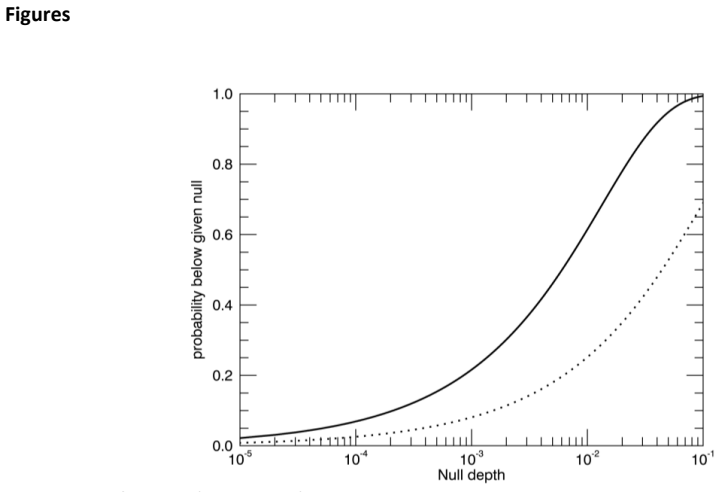
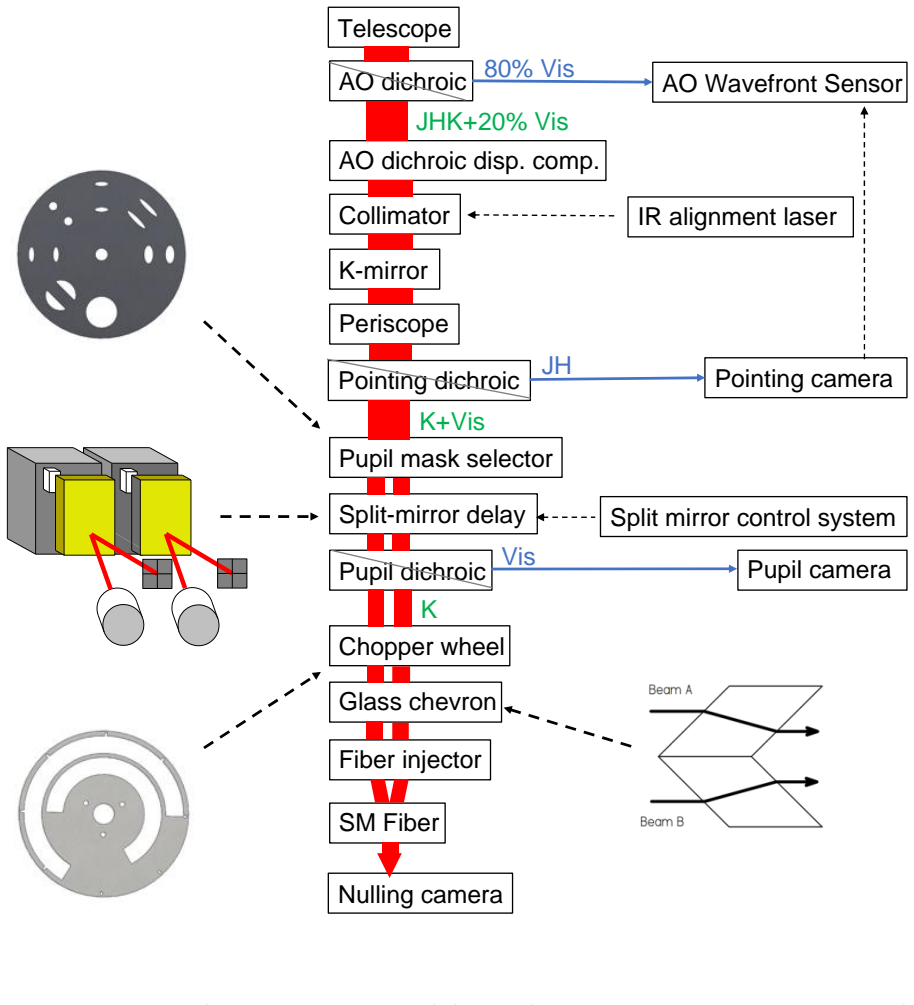
The load-bearing mechanism is the rotating-baseline cross-aperture nuller: two sub-apertures within one telescope pupil are combined on a single-mode fiber with an achromatic $\pi$ phase shift, so the anti-symmetric stellar field cannot propagate in the fiber while off-axis light passes through the sinusoidal transmission fringe. Rotating an image of the pupil rotates the baseline on the sky, and for a companion at small angle $\theta_p$ the transmitted intensity goes as $\cos^2\alpha_p$, placing the companion signal at the second harmonic of the rotation angle, with amplitude proportional to $(k b \theta_p)^2 I_p$. The other load-bearing element is the nulling self-calibration (NSC) algorithm, which fits the probability density of the fluctuating null-depth stream and recovers the astrophysical null even when phase fluctuations are large; this relaxes the phase-stabilization requirement from about $\lambda/300$ to about $\lambda/4$.
What would settle it
Re-observe eta Peg or a comparable binary with an independently known companion flux ratio, interleaving at least two calibrator stars at matched airmass on multiple nights; if the recovered flux ratio shifts by more than the formal $0.06 \times 10^{-2}$ error, or the recovered primary diameter moves outside $3.23 \pm 0.07$ mas, the single measured null floor does not transfer between targets.
Extended reading notes
Core claim
The central discovery is that the null-depth rotation curve of a single-baseline nuller cleanly separates two astrophysical signals that both live inside the diffraction limit. For the binary eta Peg, with known separation 30 mas and position angle 170°, the calibrated null depths follow the expected $\cos^2$ pattern of a companion well inside the first constructive fringe; with the binary geometry fixed, the best fit gives a Ks-band secondary-to-primary flux ratio of $(1.08 \pm 0.06) \times 10^{-2}$, corresponding to a Ks magnitude difference of $4.92 \pm 0.06$ mag. The two minima of the curve, where the null fringe extinguishes both stars, do not reach zero: their average, $(4.8 \pm 1.6) \times 10^{-4}$, is the leakage from the primary's finite disk and translates to a stellar diameter of $3.66^{+0.56}_{-0.68}$ mas, consistent with the independent long-baseline value of $3.23 \pm 0.07$ mas. Because the secondary lay inside the diffraction-limited beam and inside typical coronagraphic inner working angles, this is a direct realization of the rotating-nuller concept proposed for space-based exoplanet detection.
Load-bearing premise
The instrumental null-depth floor, measured as an average of 34 null depths on eight other stars ($6.3 \pm 0.7 \times 10^{-4}$), is assumed to be identical for eta Peg and is subtracted from every calibrated point; if that floor is target-dependent—through residual dispersion, pointing drift, or a faint unresolved source—the recovered flux ratio and primary diameter would be systematically biased.
Editorial extensions
If this is right
- Companions and stellar disks can be measured at separations below the classical diffraction limit, down to about $0.2$–$0.3\,\lambda/D$, with null-depth accuracies of several $10^{-4}$.
- The baseline length needed for a given stellar-diameter accuracy shrinks as the square root of the null-depth accuracy; a $10^{-4}$ nuller needs roughly ten times shorter baselines than a $10^{-2}$ visibility measurement for the same diameter accuracy.
- Because the nulling self-calibration algorithm reconstructs the astrophysical null from the statistics of the fluctuations, the hardware requirement relaxes from holding a $\sim\lambda/300$ fringe to simply avoiding fringe hops of more than about $\lambda/4$.
- On 30–40 m telescopes the same technique would provide H- and K-band inner working angles of a few milliarcseconds and contrasts of $10^{-4}$ to $10^{-5}$, reaching the innermost hot Jupiters, inner exozodiacal dust, and long-term-trend radial-velocity companion candidates.
- Nulling and coronagraphic dark-speckle techniques can be viewed as opposite ends of a single family of measurement methods, differing mainly in the number of sub-apertures contributing to the dark field.
Reading between the lines
- A natural extension is to use two simultaneous baselines or two wavelengths to break the brightness–separation degeneracy in the product $I_p\theta_p^2$, which remains when neither the companion flux nor its separation is known independently.
- The assumption of a star-independent null floor could be tested by interleaving calibrators at matched airmass on the same night; if the floor varies, the single $6.3 \times 10^{-4}$ correction would need to be replaced by a per-target model.
- Because the second-harmonic signature is achromatic in form, the same rotation-curve analysis could be applied at shorter wavelengths, where the diffraction limit and inner working angle scale down but the phase-stability requirement tightens.
- Paving a large telescope pupil with many small nulling sub-apertures would let a single observation sample several baselines and orientations, replacing physical rotation with instantaneous rotation-curve coverage for snapshot surveys.
Signed reviews
Editorial analysis
A structured set of objections, weighed in public.
Referee Report
Summary. The paper describes the Palomar Fiber Nuller (PFN), a rotating-baseline nulling interferometer operating in the near-infrared on the Palomar 5 m telescope. It derives theoretical performance constraints for high-accuracy NIR nulling, including a statistical treatment of phase fluctuations (Sections 2–3), and reports the first demonstration of faint-companion detection via active baseline rotation, using the known spectroscopic binary η Peg. The measured Ks-band null-depth rotation curve is fit with one free parameter (companion flux ratio), yielding a secondary-to-primary flux ratio of 1.08 ± 0.06 × 10^-2, and the two null-depth minima provide a stellar diameter of 3.66 (+0.56/−0.68) mas, consistent with the long-baseline interferometric value of 3.23 ± 0.07 mas. The paper also discusses the nulling self-calibration (NSC) algorithm and prospects for applying cross-aperture nulling on larger telescopes.
Significance. If the results hold, this is a significant instrument demonstration: it is the first implementation of the rotating-baseline nulling concept originally proposed for space-based exoplanet detection, and it extends nulling to the near-infrared (Ks band) with null-depth accuracies of a few × 10^-4. The theoretical derivation of the null-depth estimate, especially the use of the measured null-depth variance to correct the mean null (Eqs. 2–13), is clearly presented and appears correct. The η Peg fit is good, with reduced chi2 = 0.49, and the companion separation and position angle are taken from an external catalog, avoiding circularity in the detection claim. The stellar diameter derived from two null-depth points is consistent with the independent LBI measurement. The paper also provides a detailed error budget and a thoughtful discussion of future applications on 30 m class telescopes.
major comments (2)
- [Section 4] The instrumental null-depth floor is subtracted as a scalar constant (6.3 ± 0.7 × 10^-4) from all η Peg measurements, and the 0.7 × 10^-4 rms is added to the per-point error bars; however, the companion signal itself is a cos(2α) modulation of the null depth versus baseline angle, so a baseline-angle-dependent component of the floor at that frequency is degenerate with the companion flux ratio and would not be removed by the scalar subtraction. The paper does not report the floor as a function of baseline position angle nor demonstrate that the 34 survey measurements sample a range of angles, and the rms scatter does not bound a coherent floor harmonic. I request that the authors either present the floor measurements versus baseline angle, provide an argument that the survey geometry covers the full angle range, or add an explicit systematic uncertainty to the derived companion flux ratio and stellar diameter that accounts for a plausible floor harmonic amplitude.
- [Section 4 and Fig. 3] The text is internally inconsistent about the baseline orientation that nulls the companion. The text states that null depths range from ~10^-2 with the baseline perpendicular to the binary separation vector to 3.7 × 10^-4 with the baseline parallel, and later identifies the two lowest null-depth points as being for baseline orientations parallel to the separation; this contradicts Eq. 15, in which the companion transmission vanishes when the baseline is perpendicular to the separation (cos α = 0). The figure caption, labeling 170° as the null-depth maximum and 260° as the minimum, is consistent with Eq. 15. The numerical analysis may be unaffected, but the text must be corrected so that the description of which data points correspond to the companion null is unambiguous.
minor comments (4)
- [Section 4] Please specify whether the model fit uses the exact sinusoidal response (Eq. 15) or the small-angle approximation (Eq. 17); at η Peg's separation k b θ / 2 ≈ 0.72 rad, the two differ by up to about 20% near the peak, and if Eq. 17 is used the resulting systematic bias on the derived flux ratio should be quantified.
- [Eq. (14a)] The word 'were' in the enumeration of the variance terms should be 'where'.
- [Section 4] With 7 data points and one fitted parameter, the reduced chi2 of 0.49 corresponds to chi2 ≈ 2.9 for 6 degrees of freedom; the statement that the error bars 'may be slightly overestimated' is acceptable but could be made more quantitative by citing the corresponding chi2 probability.
- [Acknowledgements] The word 'Tedchnology' should be 'Technology'.
Circularity Check
No significant circularity: companion detection and diameter estimate are calibrated against external data and first-principles model.
full rationale
The paper's derivation chain is self-contained rather than circular. The eta Peg companion separation and position angle are taken from the external 6th Catalog of visual binary stars (Hartkopf, Mason & Rafferty 2008), and the Ks-band flux ratio is the single free parameter fitted to the null-depth rotation curve; it is not an input to the model. The stellar-diameter contribution is estimated from the two lowest null-depth points and then compared with the independent LBI diameter of Nordgren et al. (2001), so the external benchmark is not used to force the result. The companion-response and diameter equations (Eqs. 15-22) are derived in the text from basic fringe and geometric arguments, not assumed from the eta Peg data. The instrumental null floor is a scalar calibration derived from 34 null-depth measurements on eight other stars; subtracting it is a standard calibration step, and any possible baseline-angle dependence of that floor is a systematic-error concern, not circularity. The NSC algorithm is cited to prior same-author work, but the present paper itself derives the relevant null-depth statistics (Eqs. 2-13), and NSC functions as a data-extraction tool rather than as an input that defines the astrophysical signal. No fitted parameter is renamed as a prediction, and no equation reduces to its own input by construction.
Assumptions & free parameters
free parameters (3)
- Companion flux ratio of eta Peg B =
1.08 ± 0.06 x 10^-2
- Instrumental null depth floor =
6.3 ± 0.7 x 10^-4
- Primary stellar diameter leakage =
4.8 ± 1.6 x 10^-4 (3.66 +0.56 -0.68 mas)
assumptions (6)
- domain assumption Phase fluctuations are Gaussian
- domain assumption Null-depth error terms are small and independent
- domain assumption Stellar disk is uniform
- standard math Small-angle point-source response
- domain assumption Catalog astrometry for eta Peg is accurate
- domain assumption Instrumental null floor is stable across targets
Cite this review
Pith. "Pith review of Nulling at short wavelengths: theoretical performance constraints and a demonstration of faint companion detection inside the diffraction limit with a rotating-baseline interferometer." pith.science (2026). https://pith.science/paper/LTFGEGFN
@misc{pith2026190805977,
  author       = {Pith},
  title        = {Pith review of: Nulling at short wavelengths: theoretical performance constraints and a demonstration of faint companion detection inside the diffraction limit with a rotating-baseline interferometer},
  year         = {2026},
  howpublished = {\url{https://pith.science/paper/LTFGEGFN}},
  note         = {Machine review of arXiv:1908.05977}
}
read the original abstract
The Palomar Fiber Nuller (PFN) is a rotating-baseline nulling interferometer that enables high-accuracy near-infrared (NIR) nulling observations with full azimuth coverage. To achieve NIR null-depth accuracies of several x 10-4, the PFN uses a common-mode optical system to provide a high degree of symmetry, single-mode-fiber beam combination to reduce sensitivity to pointing and wavefront errors, extreme adaptive optics to stabilize the fiber coupling and the cross-aperture fringe phase, rapid signal calibration and camera readout to minimize temporal effects, and a statistical null-depth fluctuation analysis to relax the phase stabilization requirement. Here we describe the PFN final design and performance, and provide a demonstration of faint-companion detection by means of nulling-baseline rotation, as originally envisioned for space-based nulling interferometry. Specifically, the Ks-band null-depth rotation curve measured on the spectroscopic binary eta Peg reflects both a secondary star 1.08 +/- 0.06 x 10⁻² as bright as the primary, and a null-depth contribution of 4.8 +/- 1.6 x 10⁻⁴ due to the size of the primary star. With a 30 mas separation at the time, eta Peg B was well inside both the telescope diffraction-limited beam diameter (88 mas) and typical coronagraphic inner working angles. Finally, we discuss potential improvements that can enable a number of small-angle nulling observations on larger telescopes.
Figures
Forward citations
Cited by 1 Pith paper
-
Super-resolution wavefront reconstruction in adaptive-optics with pyramid sensors
Offset sampling grids in a pyramid wavefront sensor double the number of reconstructable wavefront modes and, with full-rank intensity processing, allow simultaneous phase and amplitude sensing.
Reference graph
Works this paper leans on
-
[1]
Direct Imaging of Exoplanets: Science and Techniques,
Absil, O., Karlsson, A. & Kaltenegger, L., 2003, Proc. SPIE, 4852, 431 Absil, O. et al., 2011, A&A, 535, A68 Absil, O. et al., 2013, A&A, 555, A104 Angel, J. R. P. 1990, in The Next Generation Space Telescope, ed. P. Bely & C. J. Burrows (Baltimore : Space Telescope Science Institute), p. 81 Angel, J. R. P & Wolf, N. J. 1997, ApJ, 475, 373 Atkinson, D., H...
2003
-
[2]
Single beam signal from zeta Aql (K_mag = 2.9) on 2015 June 28, showing the stability of the stellar signal injected into our SM fiber (under 1.4” seeing conditions ). This data was taken during a normal observing sequence, alternating between the two indiv idual beams, the dark and the combined beam, but the other three states have been removed here. Eac...
work page 2015
Reviewed August 14, 2026 · model on record in the stance chip above.
Discussion (0). Continue with ORCID to comment.