REVIEW 1 major objections 5 minor 64 references
Hilbert subspace ergodicity
T0 review · 1 major / 5 minor · reviewed 2026-08-12 · deepseek-v4-flash
Pith's one-line read When scars or fragmentation split Hilbert space, generic aperiodic drives still become ergodic inside each decoupled subspace, a property the authors call Hilbert subspace ergodicity.
desk verdict Defines a sensible generalization of CHSE to decoupled subspaces, with clean analytic bounds and consistent low-moment numerics; the all-moments claim outruns the evidence, so treat it as a well-posed conjecture rather than an established theorem. read the letter →
The pith
A machine-rendered reading of the paper's core claim, the machinery that carries it, and where it could break.
The reading
What carries the argument
The load-bearing objects are the Krylov subspaces $K_\alpha$ (the dynamically decoupled blocks generated by evolving simple initial states), the subspace Haar measure and its moments, and the Fibonacci-word brickwork circuit built from two generic local unitaries. Projectors of the form $\hat P = \hat I - |00\rangle\langle 00|$ in the scarred construction force target scar states to remain invariant while leaving the complementary subspace generic; pair-flip gates, which let neighboring qudits change only when they already occupy the same state, produce exponentially many fragments for local dimension $d\ge 3$. The commutant algebra of each model organizes the decomposition of the Hilbert space into blocks and explains why the moments cannot reach the full Haar ensemble, while the analytic distances between full-space and subspace Haar moments give the saturation levels seen in the numerics. Together these pieces replace one global Haar average by a Haar average per block, with the aperiodic drive supplying enough randomness to fill each block uniformly.
What would settle it
Take the N=4 scarred brickwork circuit of Sec. VI or the N=5 qutrit pair-flip circuit of Sec. VII, run the Fibonacci drive to T ~ $10^{4}$, and compute the Hilbert-Schmidt distance between the $k=3$ (or $k=4$) temporal moment and the corresponding subspace-Haar moment. If that distance fails to decay toward zero and instead saturates at a positive value, the claimed convergence to subspace Haar randomness for all moments is wrong; if it decays, the heuristic universality argument gains support beyond the tested $k=1,2$ cases.
Extended reading notes
Core claim
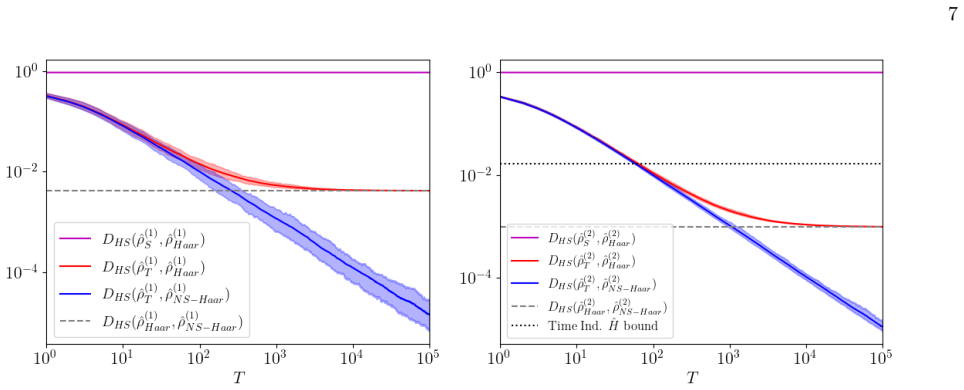
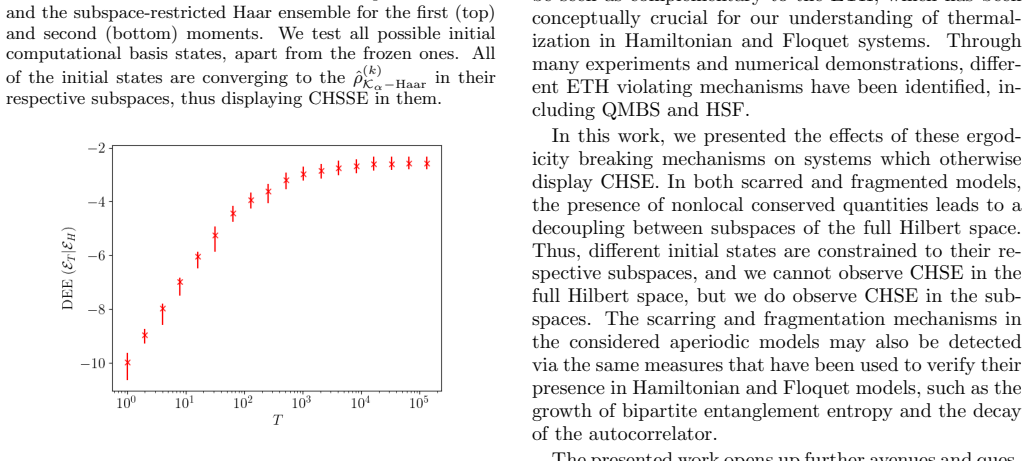
The central claim is that complete Hilbert space ergodicity does not simply disappear when scars or fragmentation are introduced; it is inherited by each decoupled block. In a brickwork circuit driven by a Fibonacci word of two generic unitaries, the authors embed a projector that leaves designated scar states invariant, and in the pair-flip model with qutrits they realize strong fragmentation. In both settings the Hilbert space splits into Krylov subspaces, so the dynamics cannot converge to the full-space Haar ensemble. Yet the $k$-th moment of the temporal ensemble converges to the subspace-restricted Haar moment for $k=1,2$, while the distance to the full-Haar moment saturates at the analytic bounds set by the difference between the full and subspace Haar ensembles, given in Eqs. (20) and (21). The discretized ensemble entropy also saturates at values consistent with sampling only the available subspace. The authors introduce the term complete Hilbert subspace ergodicity for this behavior and argue, through a universality and Trotterization heuristic in Appendix A and the commutant-algebra structure in Appendix B, that it is the generic fate of aperiodic many-body circuits with nonlocal conserved quantities, so that long-time dynamics forms approximate t-designs within each subspace.
Load-bearing premise
The central assumption is that inside each Krylov subspace the aperiodic drive is generic enough that the long-time temporal ensemble converges to the subspace Haar ensemble for every moment; the authors support this only heuristically in Appendix A and check only the first two moments on systems as small as N=4.
Editorial extensions
If this is right
- In a scarred or fragmented aperiodic circuit, initial states in the same Krylov subspace generate long-time temporal ensembles indistinguishable from Haar-random states within that subspace, so each subspace becomes a source of approximate t-designs.
- Conventional symmetries are not obstacles: every symmetry sector displays the same subspace ergodicity as a scar or fragment block, so CHSSE holds across scarred, fragmented, and symmetric models alike.
- The saturation levels of the moment distances are computable from subspace dimensions, giving a quantitative diagnostic for detecting scars and fragmentation in aperiodic quantum circuits.
- The discretized ensemble entropy acts as a witness: it tends to zero for full CHSE, saturates at an intermediate value fixed by the subspace fraction for CHSSE, and stays near its minimum for frozen scar or fragmented states.
- The authors note that this subspace t-design protocol could be adapted to decoherence-free subspaces, pointing toward applications in fault-tolerant quantum information processing.
Reading between the lines
- Editorial inference: if CHSSE holds for all moments, then any subspace selected by a commutant-algebra block—not just the scar and pair-flip examples—can serve as a platform for approximate Haar-random state generation, suggesting a general design-by-commutant prescription.
- Editorial inference: the scarred and fragmented models saturate their full-space moment distances at different rates as system size grows, so the size dependence of these bounds offers a finite-size probe that distinguishes weak from strong ergodicity breaking without directly counting subspaces.
- Editorial inference: a numerical check of third- and fourth-order moments or frame potentials on the small circuits used here would test whether the heuristic universality argument survives beyond low moments; if it does, CHSSE becomes a practical tool for randomized benchmarking and state-design construction within symmetry sectors.
Editorial analysis
A structured set of objections, weighed in public.
Referee Report
Summary. The paper introduces 'complete Hilbert subspace ergodicity' (CHSSE), a generalization of complete Hilbert space ergodicity (CHSE) to systems whose Hilbert space decomposes into dynamically decoupled Krylov subspaces due to quantum many-body scars, Hilbert space fragmentation, or conventional symmetries. The authors define CHSSE as equality, at long times, of the temporal ensemble's k-th moments with the Haar moments restricted to each Krylov subspace, and they derive analytic formulas for the distances between full-space and subspace Haar moments. They present numerical evidence from Fibonacci-driven brickwork circuits: generic circuits show CHSE, while circuits with an embedded scar, with pair-flip gates (fragmentation), and with a U(1) symmetry show saturation to the predicted subspace bounds for the first and second moments. They also use a coarse-grained discretized ensemble entropy as an additional diagnostic, and they conclude that such systems form approximate t-designs in the corresponding subspaces.
Significance. If the central claim is fully established, the paper gives a coherent dynamical notion of ergodicity in symmetry- or constraint-restricted Hilbert spaces and identifies a concrete circuit protocol for constructing approximate unitary designs within decoherence-free or fragmented subspaces. The analytic formulas in Eqs. (20)-(21) and Appendix D are parameter-free and appear correct, and the numerical checks for k=1,2 are consistent with those formulas. The systematic test of all computational-basis initial states in the pair-flip model (Sec. VII) is a strength. However, the advertised conclusion that the systems are CHSSE in the sense of all moments rests on evidence limited to low moments and small system sizes, so the significance is conditional on closing that gap.
major comments (1)
- [Sec. III and Secs. VI–VIII] The definition of CHSSE applies to any initial state in K_alpha, but the numerical tests use only computational-basis product states (e.g., |0>^N, |1>^N, and all product states in Sec. VII). No superpositions within a Krylov subspace are tested. Since the whole point of the definition is that subspace Haar-uniformity should be independent of the initial state in the subspace, the evidence is incomplete even for k=1,2. This is not a criticism of the numerics actually performed, but it is a further reason why the claim should be stated conditionally until either more initial states or a theory argument is supplied.
minor comments (5)
- [Sec. VII (paragraph after Fig. 8)] The statement that the k=1 bound 'reduces to 2/D_alpha' in the large-N limit is inconsistent with Eq. (20), which gives (D-D_alpha)/(D_alpha D) ~ 1/D_alpha; the accompanying k=2 statement, 2/(D_alpha(D_alpha+1)), is correct.
- [Fig. 7 caption] There is a typo in the legend: 'blue]' should be 'blue'.
- [Appendix I] 'birckwork' should be 'brickwork'.
- [Sec. IV (Fibonacci word)] The short example sequence in Eq. (15) could be easier to follow if the first few Fibonacci words were written out explicitly, since the recursive definition W_{j+1}=W_j W_{j-1} and the mapping to U^(A)/U^(B) are otherwise easy to misread.
- [Appendix C] The filtering criterion 'remove states if their overlap is large with any other state, i.e. if |<Phi_j|Phi_k>| > 1 - epsilon' is described but the paper does not state the value of epsilon used in the numerics; reporting it would improve reproducibility.
Circularity Check
No significant circularity: the CHSSE claims are tested against independently generated temporal ensembles and analytic subspace-Haar bounds, with no fitted parameter relabeled as a prediction.
full rationale
The central derivation chain is self-contained and not circular. CHSSE is defined in Sec. III by convergence of temporal-ensemble moments to subspace-Haar moments, and the paper verifies this by comparing Fibonacci-driven brickwork-circuit time evolution against fixed subspace-Haar reference moments (Secs. V-VIII). The lower bounds used to diagnose subspace restriction, Eqs. (20)-(21) and Appendix D, are computed analytically from the subspace dimensions D and D_alpha alone, with no parameters fitted to the evolved data. The temporal ensembles are generated independently by the Fibonacci word construction, and no fitted input is later relabeled as a prediction. The reliance on Ref. [29] for the unscarred CHSE baseline and the time-independent-moment lower bound is external, not a self-citation. The self-citations that appear (e.g., Ref. [20] for adapting projector embedding to quantum circuits, and background citations) are not load-bearing: the projector embedding is explicitly constructed in Eq. (16) and verified numerically, and the pair-flip subspace counting is cited to external works. The paper's own caveat that conclusive numerical evidence would require k>2 moments and longer times is an evidentiary limitation, not a circular reduction of the conclusion to its inputs; the argument in Appendix A supplies a heuristic universality justification rather than a definitional identity. No uniqueness theorem is imported from the authors' prior work, and no known result is merely renamed as a new prediction.
Assumptions & free parameters
assumptions (5)
- domain assumption Haar measure is the correct measure of 'equal probability' on Hilbert space.
- domain assumption Generic Fibonacci-word aperiodic drives exhibit CHSE in the full Hilbert space.
- ad hoc to paper The unitaries restricted to each Krylov subspace are generic enough to explore that subspace Haar-uniformly.
- domain assumption Projector embedding creates exactly L+1 dynamically decoupled subspaces with no inter-subspace transitions.
- standard math The subspace counting and dimensions for the pair-flip model are correct as imported from prior literature.
Cite this review
Pith. "Pith review of Hilbert subspace ergodicity." pith.science (2026). https://pith.science/paper/LTOK25PF
@misc{pith2026241114359,
  author       = {Pith},
  title        = {Pith review of: Hilbert subspace ergodicity},
  year         = {2026},
  howpublished = {\url{https://pith.science/paper/LTOK25PF}},
  note         = {Machine review of arXiv:2411.14359}
}
read the original abstract
Ergodicity has been one of the fundamental concepts underpinning our understanding of thermalization in isolated systems since the first developments in classical statistical mechanics. Recently, a similar notion has been introduced for quantum systems, termed complete Hilbert space ergodicity (CHSE), in which the evolving quantum state explores all of the available Hilbert space. This contrasts with the eigenstate thermalisation hypothesis (ETH), in which thermalisation is formulated via the properties of matrix elements of local operators in the energy eigenbasis. In this work we explore how ETH-violation mechanisms, including quantum many-body scars and Hilbert space fragmentation can affect complete Hilbert space ergodicity. We find that the presence of these mechanisms leads to CHSE in decoupled subspaces, a phenomenon we call Hilbert Subspace Ergodicity, and which represents a protocol for constructing t-designs in subspaces.
Figures


Figures from the paper (14 more)






Reference graph
Works this paper leans on
-
[1]
Ludwig Boltzmann, Vorlesungen ¨ uber Gastheorie (Leipzig, J. A. Barth, 1896)
-
[2]
Quantum statistical mechanics in a closed system,
J. M. Deutsch, “Quantum statistical mechanics in a closed system,” Phys. Rev. A 43, 2046–2049 (1991)
1991
-
[3]
Chaos and quantum thermalization,
Mark Srednicki, “Chaos and quantum thermalization,” Physical Review E 50, 888–901 (1994)
work page 1994
-
[4]
Thermalization and its mechanism for generic isolated quantum systems,
Marcos Rigol, Vanja Dunjko, and Maxim Olshanii, “Thermalization and its mechanism for generic isolated quantum systems,” Nature 452, 854–858 (2008)
2008
-
[5]
Eigenstate thermalization hypothe- sis,
Joshua M Deutsch, “Eigenstate thermalization hypothe- sis,” Reports on Progress in Physics 81, 082001 (2018)
2018
-
[6]
Introduction to ‘quantum integrability in out of equilibrium systems’,
Pasquale Calabrese, Fabian H.L. Essler, and Giuseppe Mussardo, “Introduction to ‘quantum integrability in out of equilibrium systems’,” J. Stat. Mech. , 064001 (2016)
work page 2016
-
[7]
Many-body localization and thermalization in quantum statistical mechanics,
Rahul Nandkishore and David A Huse, “Many-body localization and thermalization in quantum statistical mechanics,” Annu. Rev. Condens. Matter Phys. 6, 15 (2015)
work page 2015
-
[8]
Colloquium: Many-body localization, thermalization, and entanglement,
Dmitry A. Abanin, Ehud Altman, Immanuel Bloch, and Maksym Serbyn, “Colloquium: Many-body localization, thermalization, and entanglement,” Rev. Mod. Phys. 91, 021001 (2019)
2019
Show all 64 references
-
[9]
Ergodicity breaking arising from hilbert space fragmentation in dipole- conserving hamiltonians,
Pablo Sala, Tibor Rakovszky, Ruben Verresen, Michael Knap, and Frank Pollmann, “Ergodicity breaking arising from hilbert space fragmentation in dipole- conserving hamiltonians,” Physical Review X 10 (2020), 10.1103/physrevx.10.011047
2020 doi
-
[10]
Hilbert space fragmentation and commutant algebras,
Sanjay Moudgalya and Olexei I. Motrunich, “Hilbert space fragmentation and commutant algebras,” Physical Review X 12 (2022), 10.1103/physrevx.12.011050
2022 doi
-
[11]
Quantum many-body scars and hilbert space fragmentation: a review of exact results,
Sanjay Moudgalya, B Andrei Bernevig, and Nicolas Regnault, “Quantum many-body scars and hilbert space fragmentation: a review of exact results,” Rep. Prog. in Phys. 85, 086501 (2022)
2022
-
[12]
Exponentially slow thermalization and the robustness of hilbert space fragmentation,
Yiqiu Han, Xiao Chen, and Ethan Lake, “Exponentially slow thermalization and the robustness of hilbert space fragmentation,” (2024), arXiv:2401.11294 [quant-ph]
2024 arXiv
-
[13]
Weak ergodicity breaking from quantum many-body scars,
C. J. Turner, A. A. Michailidis, D. A. Abanin, M. Serbyn, and Z. Papi´ c, “Weak ergodicity breaking from quantum many-body scars,” Nat. Phys. 14, 745 (2018)
2018
-
[14]
Weak ergodicity breaking through the lens of quantum entanglement,
Zlatko Papi´ c, “Weak ergodicity breaking through the lens of quantum entanglement,” in Entanglement in Spin Chains: From Theory to Quantum Technology Applica- tions (Springer, New York, 2022) pp. 341–395
2022
-
[15]
Quantum many-body scars: A quasiparticle perspective,
Anushya Chandran, Thomas Iadecola, Vedika Khemani, and Roderich Moessner, “Quantum many-body scars: A quasiparticle perspective,” Annu. Rev. Condens. Matter Phys. 14, 443 (2023)
2023
-
[16]
Quantum many-body scars and weak breaking of ergod- icity,
Maksym Serbyn, Dmitry A. Abanin, and Zlatko Papi´ c, “Quantum many-body scars and weak breaking of ergod- icity,” Nature Physics 17, 675–685 (2021)
2021
-
[17]
Extensive multipartite entanglement from su(2) quantum many- body scars,
Jean-Yves Desaules, Francesca Pietracaprina, Zlatko Papi´ c, John Goold, and Silvia Pappalardi, “Extensive multipartite entanglement from su(2) quantum many- body scars,” Phys. Rev. Lett. 129, 020601 (2022)
2022
-
[18]
Robust quantum sensing in strongly in- teracting systems with many-body scars,
Shane Dooley, “Robust quantum sensing in strongly in- teracting systems with many-body scars,” PRX Quan- tum 2, 020330 (2021)
2021
-
[19]
En- tanglement enhanced metrology with quantum many- body scars,
Shane Dooley, Silvia Pappalardi, and John Goold, “En- tanglement enhanced metrology with quantum many- body scars,” Phys. Rev. B 107, 035123 (2023)
2023
-
[20]
Quantum many-body scars in dual-unitary circuits,
Leonard Logari´ c, Shane Dooley, Silvia Pappalardi, and John Goold, “Quantum many-body scars in dual-unitary circuits,” Phys. Rev. Lett. 132, 010401 (2024)
2024
-
[22]
Confinement and entanglement dynamics on a digital quantum computer,
Joseph Vovrosh and Johannes Knolle, “Confinement and entanglement dynamics on a digital quantum computer,” Scientific Reports 11 (2021), 10.1038/s41598-021-90849- 5
2021 doi
-
[23]
Observing ground-state properties of the fermi- hubbard model using a scalable algorithm on a quan- tum computer,
Stasja Stanisic, Jan Lukas Bosse, Filippo Maria Gambetta, Raul A. Santos, Wojciech Mruczkiewicz, Thomas E. O’Brien, Eric Ostby, and Ashley Monta- naro, “Observing ground-state properties of the fermi- hubbard model using a scalable algorithm on a quan- tum computer,” Nature Co...
2022 doi
-
[24]
Calculating the many-body density of states on a digital quantum computer,
Alessandro Summer, Cecilia Chiaracane, Mark T. Mitchison, and John Goold, “Calculating the many-body density of states on a digital quantum computer,” Phys. Rev. Res. 6, 013106 (2024)
2024
-
[25]
Evidence of kardar- parisi-zhang scaling on a digital quantum simulator,
Nathan Keenan, Niall F. Robertson, Tara Murphy, Sergiy Zhuk, and John Goold, “Evidence of kardar- parisi-zhang scaling on a digital quantum simulator,” npj Quantum Information 9 (2023), 10.1038/s41534-023- 00742-4
2023 doi
-
[26]
Exact spectral form factor in a minimal model of many-body quantum chaos,
Bruno Bertini, Pavel Kos, and Toma ˇ z Prosen, “Exact spectral form factor in a minimal model of many-body quantum chaos,” Phys. Rev. Lett. 121, 264101 (2018)
2018
-
[27]
Exact correlation functions for dual-unitary lattice models in 1 + 1 dimensions,
Bruno Bertini, Pavel Kos, and Toma ˇ z Prosen, “Exact correlation functions for dual-unitary lattice models in 1 + 1 dimensions,” Phys. Rev. Lett. 123, 210601 (2019)
2019
-
[28]
Anomalous transport in u(1)-symmetric quantum circuits,
Alessandro Summer, Alex Nico-Katz, Shane Dooley, and John Goold, “Anomalous transport in u(1)-symmetric quantum circuits,” (2024), in preparation
2024
-
[30]
The church of the symmetric sub- space,
Aram W. Harrow, “The church of the symmetric sub- space,” (2013), arXiv:1308.6595 [quant-ph]
2013 arXiv
-
[31]
[29] used the trace distance instead of the Hilbert-Schmidt distance in Eq
We note that Ref. [29] used the trace distance instead of the Hilbert-Schmidt distance in Eq. (5). The trace dis- tance has the the advantage of a clear operational mean- 13 ing in quantum state discrimination. However, to calcu- late it requires matrix diagonalisation while t...
-
[32]
shatters
and is significantly computationally cheaper to com- pute we will use the former. Now, the system is CHSE if ∆(k) ∞ = 0 for all k and for all initial states |ψ(0)⟩. Furthermore, in the case of a time-independent Hamil- tonian, one can show that for k ≥ 2 the trace distance to ...
-
[33]
Strong bound between trace distance and hilbert-schmidt dis- tance for low-rank states,
Patrick J. Coles, M. Cerezo, and Lukasz Cincio, “Strong bound between trace distance and hilbert-schmidt dis- tance for low-rank states,” Physical Review A 100 (2019), 10.1103/physreva.100.022103
2019 doi
-
[34]
A maximum entropy principle in deep thermalization and in hilbert-space ergodicity,
Daniel K. Mark, Federica Surace, Andreas Elben, Adam L. Shaw, Joonhee Choi, Gil Refael, Manuel En- dres, and Soonwon Choi, “A maximum entropy principle in deep thermalization and in hilbert-space ergodicity,” (2024), arXiv:2403.11970 [quant-ph]
2024 arXiv
-
[35]
Eigenstate thermalization in a locally perturbed integrable system,
Marlon Brenes, Tyler LeBlond, John Goold, and Marcos Rigol, “Eigenstate thermalization in a locally perturbed integrable system,” Phys. Rev. Lett. 125, 070605 (2020)
2020
-
[37]
Probing the relaxation towards equilibrium in an isolated strongly correlated one-dimensional bose gas,
S. Trotzky, Y-A. Chen, A. Flesch, I. P. McCulloch, U. Schollw¨ ock, J. Eisert, and I. Bloch, “Probing the relaxation towards equilibrium in an isolated strongly correlated one-dimensional bose gas,” Nature Physics 8, 325–330 (2012)
2012
-
[38]
Time-resolved observation of thermalization in an isolated quantum system,
Govinda Clos, Diego Porras, Ulrich Warring, and Tobias Schaetz, “Time-resolved observation of thermalization in an isolated quantum system,” Physical Review Letters 117 (2016), 10.1103/physrevlett.117.170401
2016 doi
-
[39]
Quantum thermalization through entanglement in an isolated many-body system,
Adam M. Kaufman, M. Eric Tai, Alexander Lukin, Matthew Rispoli, Robert Schittko, Philipp M. Preiss, and Markus Greiner, “Quantum thermalization through entanglement in an isolated many-body system,” Science 353, 794–800 (2016)
2016
-
[40]
Thermalization near integrability in a dipolar quantum newton’s cradle,
Yijun Tang, Wil Kao, Kuan-Yu Li, Sangwon Seo, Krish- nanand Mallayya, Marcos Rigol, Sarang Gopalakrishnan, and Benjamin L. Lev, “Thermalization near integrability in a dipolar quantum newton’s cradle,” Physical Review X 8 (2018), 10.1103/physrevx.8.021030
2018 doi
-
[41]
Prob- ing many-body dynamics on a 51-atom quantum simula- tor,
Hannes Bernien, Sylvain Schwartz, Alexander Keesling, Harry Levine, Ahmed Omran, Hannes Pichler, Soon- won Choi, Alexander S. Zibrov, Manuel Endres, Markus Greiner, Vladan Vuleti´ c, and Mikhail D. Lukin, “Prob- ing many-body dynamics on a 51-atom quantum simula- tor,” Nature ...
2017
-
[42]
Many-body hilbert space scarring on a supercon- ducting processor,
Pengfei Zhang, Hang Dong, Yu Gao, Liangtian Zhao, Jie Hao, Jean-Yves Desaules, Qiujiang Guo, Jiachen Chen, Jinfeng Deng, Bobo Liu, Wenhui Ren, Yunyan Yao, Xu Zhang, Shibo Xu, Ke Wang, Feitong Jin, Xuhao Zhu, Bing Zhang, Hekang Li, Chao Song, Zhen Wang, Fangli Liu, Zlatko Papi´...
2022
-
[43]
Obser- vation of many-body scarring in a bose-hubbard quan- tum simulator,
Guo-Xian Su, Hui Sun, Ana Hudomal, Jean-Yves De- saules, Zhao-Yu Zhou, Bing Yang, Jad C. Halimeh, Zhen- Sheng Yuan, Zlatko Papi´ c, and Jian-Wei Pan, “Obser- vation of many-body scarring in a bose-hubbard quan- tum simulator,” Physical Review Research 5 (2023), 10.1103/physrev...
2023 doi
-
[44]
Systematic construc- tion of counterexamples to the eigenstate thermalization hypothesis,
Naoto Shiraishi and Takashi Mori, “Systematic construc- tion of counterexamples to the eigenstate thermalization hypothesis,” Phys. Rev. Lett. 119, 030601 (2017)
2017
-
[45]
η-pairing in hubbard models: From spectrum generating algebras to quantum many-body scars,
Sanjay Moudgalya, Nicolas Regnault, and B. Andrei Bernevig, “η-pairing in hubbard models: From spectrum generating algebras to quantum many-body scars,” Phys. Rev. B 102, 085140 (2020)
2020
-
[46]
Localization in fractonic random circuits,
Shriya Pai, Michael Pretko, and Rahul M. Nandkishore, “Localization in fractonic random circuits,” Phys. Rev. X 9, 021003 (2019)
2019
-
[47]
Localization from hilbert space shattering: From theory to physical realizations,
Vedika Khemani, Michael Hermele, and Rahul Nandk- ishore, “Localization from hilbert space shattering: From theory to physical realizations,” Phys. Rev. B 101, 174204 (2020)
2020
-
[48]
Exhaus- tive characterization of quantum many-body scars using commutant algebras,
Sanjay Moudgalya and Olexei I. Motrunich, “Exhaus- tive characterization of quantum many-body scars using commutant algebras,” (2022), arXiv:2209.03377 [cond- mat.str-el]
2022 arXiv
-
[49]
Nonergodic quan- tum dynamics from deformations of classical cellular au- tomata,
Thomas Iadecola and Sagar Vijay, “Nonergodic quan- tum dynamics from deformations of classical cellular au- tomata,” Physical Review B 102 (2020), 10.1103/phys- revb.102.180302
2020 doi
-
[50]
Quantum circuits for exact unitary t-designs and applications to higher-order randomized benchmarking,
Yoshifumi Nakata, Da Zhao, Takayuki Okuda, Ei- ichi Bannai, Yasunari Suzuki, Shiro Tamiya, Kentaro Heya, Zhiguang Yan, Kun Zuo, Shuhei Tamate, Yu- taka Tabuchi, and Yasunobu Nakamura, “Quantum circuits for exact unitary t-designs and applications to higher-order randomized ben...
2021
-
[51]
The pair-flip model: a very entangled translationally invariant spin chain,
Libor Caha and Daniel Nagaj, “The pair-flip model: a very entangled translationally invariant spin chain,” (2018), arXiv:1805.07168 [quant-ph]
2018 arXiv
-
[52]
Embedding quantum many-body scars into decoherence-free sub- spaces,
He-Ran Wang, Dong Yuan, Shun-Yao Zhang, Zhong Wang, Dong-Ling Deng, and L.-M. Duan, “Embedding quantum many-body scars into decoherence-free sub- spaces,” Phys. Rev. Lett. 132, 150401 (2024)
2024
-
[53]
Almost any quantum logic gate is univer- sal,
Seth Lloyd, “Almost any quantum logic gate is univer- sal,” Phys. Rev. Lett. 75, 346–349 (1995)
1995
-
[54]
Average entropy of a subsystem,
Don N. Page, “Average entropy of a subsystem,” Phys. Rev. Lett. 71, 1291–1294 (1993). 14 Appendix A: Universality of Local Hamiltonians and Brickwork Circuits
1993
-
[55]
Universality of k-local Hamiltonians Suppose we have a quantum system with L sites, with a d-dimensional qudit at each site, resulting in a D- dimensional Hilbert space H, with D = dL. Now we can apply one of two k-local Hamiltonians at a time, either ˆHA or ˆHB, which we can ...
-
[56]
The Hamiltonians ˆHA and ˆHB do not share any eigenstates and/or symmetries
-
[57]
We assume that the first condition is satisfied, as generic Hamiltonians (with arbitrary terms ˆhX,j ) will have differ- ent eigenstates and will not contain any symmetries
Eigenphases of ˆUX are irrational multiples of π. We assume that the first condition is satisfied, as generic Hamiltonians (with arbitrary terms ˆhX,j ) will have differ- ent eigenstates and will not contain any symmetries. The second condition can be guaranteed, by using a su...
-
[58]
bond algebra
Universality of brickwork circuits Now, building upon the previous argument, we can construct a similar argument for the universality of uni- taries corresponding to one odd and one even layer in a brickwork layer, as described in Eq. (14). Suppose we have a 2 −local Hamiltoni...
-
[59]
VI, all of the 2-local unitaries have the form as written in Eq
Commutant algebra of the QMBS model In Sec. VI, all of the 2-local unitaries have the form as written in Eq. (16). By construction, all of the target states, {|ψSi ⟩} commute with the 2-local unitaries used to construct the circuit model, i.e.: [ ˆU n,n+1 t,e/o , |ψSi ⟩⟨ψSi |]...
-
[60]
counting operator
Commutant algebra of the pair-flip model For a more in depth discussion of the pair-flip model commutant algebra see Ref. [47], where they provide an in-depth diagrammatic model and explanation. To con- struct the commutant algebras, we define the following operators: ˆN α i =...
-
[61]
T and M should be chosen such that T ≫ M , to minimize the fluc- tuations in probabilities
Pick T , M and ϵ, with ϵ ∈ [0, 1). T and M should be chosen such that T ≫ M , to minimize the fluc- tuations in probabilities
-
[62]
Sample T states generated by the time evolution of chosen aperiodic drive, {|ΨT i ⟩}, as well as T states from the Haar ensemble, {|ΨH j ⟩}
-
[63]
Sample M states from Haar ensemble, {|ΦR j ⟩}, which will form a set of reference states used to estimate the probabilities
-
[64]
filtering
Remove states from the second set if their overlap is large with any other state, i.e. if |⟨Φj|Φk⟩| > 1 − ϵ, resulting in M ′ states. This “filtering” step is performed to ensure numerical stability
-
[65]
We will “bin” the states from these two sets into M ′ bins, depending on which state they have the largest overlap with
Now, the filtered second set will form a refer- ence set for the two sets of states {|ΨT i ⟩} and 16 {|ΨH i ⟩}. We will “bin” the states from these two sets into M ′ bins, depending on which state they have the largest overlap with. That is, we will as- sign the i-th state sta...
-
[66]
Using these in Eq
This will give us two sets of probabilities for the temporal and discretized haar ensembles as: pT j = nT j / PM ′ j=1 nT j and pH j = nH j / PM ′ j=1 nH j . Using these in Eq. (10) we obtain the discretized ensemble en- tropy estimate. Note that the discretized ensemble entro...
-
[67]
However, if the system is initialized in any state in the largest subspace, then it will quickly increase to the Page value and oscillate around it. 18 FIG. 13. Growth of bipartition entanglement entropy for the generic brickwork model, starting from two initial states: |ψ(0)⟩...
Reviewed August 12, 2026 · model on record in the stance chip above.
Discussion (0). Continue with ORCID to comment.