REVIEW 4 major objections 7 minor 4 references
Industrial Artificial Intelligence
T0 review · 4 major / 7 minor · reviewed 2026-08-14 · deepseek-v4-flash
Pith's one-line read This paper argues that Industrial AI becomes a reliable discipline only when data, analytics, platform, and operations technologies are deployed together along a five-level cyber-physical production systems architecture.
desk verdict A useful, readable position paper that repackages existing smart-manufacturing ideas under 'Industrial AI,' but the core roadmap claim is asserted, not demonstrated. read the letter →
The pith
A machine-rendered reading of the paper's core claim, the machinery that carries it, and where it could break.
The reading
What carries the argument
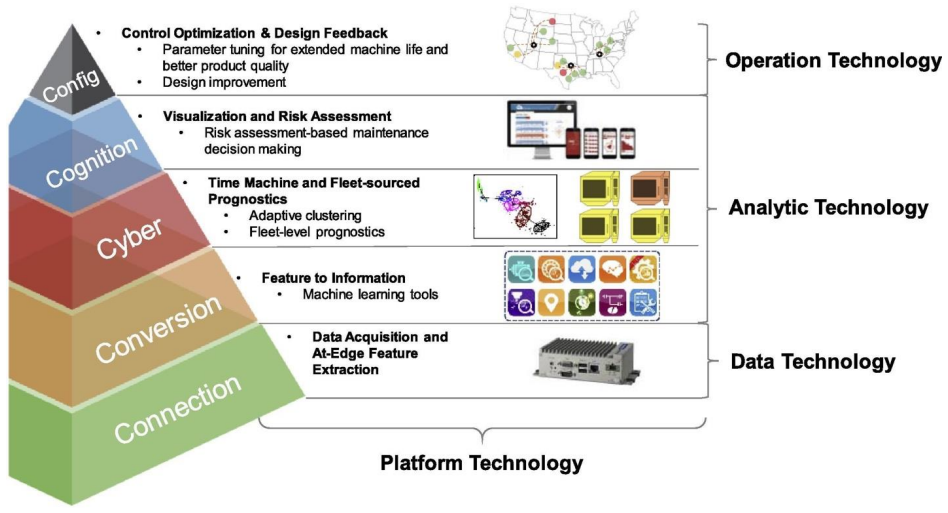
The central mechanism is the five-level Cyber-Physical Production Systems architecture, a ladder that runs from initial data collection to final value creation. The paper's argument is that the four enabling technologies—data, analytics, platform, and operations—fit onto successive rungs of that ladder, turning AI deployment from ad hoc projects into a sequential, repeatable engineering discipline with closed-loop feedback to equipment designers.
What would settle it
A retrospective study of the 16 recognized lighthouse factories would settle it: if their AI deployments do not map onto the five-level architecture with all four enabling technologies, the claim that this roadmap is the path to lighthouse status is false.
Extended reading notes
Core claim
On the paper's own terms, the central claim is that Industrial AI is a distinct discipline: a systematic focus on developing, validating, and deploying machine learning algorithms for industrial applications with sustainable performance. The paper claims that the way out of stalled AI pilots is to organize all work along four enabling technologies—data, analytics, platform, and operations—understood through the five-level cyber-physical production systems architecture. That combination is what separates lighthouse factories from manufacturers still in pilot purgatory: lighthouse factories use AI as a core asset across the entire closed loop, from sensing and data collection to enterprise control, rather than as isolated point solutions.
Load-bearing premise
The whole roadmap depends on the five-level cyber-physical production systems architecture being the correct, general skeleton for smart-factory AI; if that skeleton is wrong or too narrow, the four enabling technologies have no fixed place to stand.
Editorial extensions
If this is right
- Manufacturers can use the four enabling technologies as a checklist: an AI pilot that fails to scale can be traced to a missing data, analytics, platform, or operations layer.
- Predictive maintenance and prognostics become the lead application for Industrial AI, followed by demand forecasting, quality control, and robotics.
- Lighthouse status becomes a reachable target defined by unified implementation of all four enablers rather than by any single algorithm or device.
- AI-equipped machines shift from following fixed rules to recognizing patterns in data, enabling self-configure, self-adjust, and self-optimize behavior across the production system.
- The closed-loop design allows analytics results to feed back to equipment designers, supporting lifecycle redesign instead of one-time optimization.
Reading between the lines
- An implication the paper leaves implicit is that failed pilots become diagnosable: if the roadmap is right, the failing layer can be identified before changing algorithms or adding more sensors.
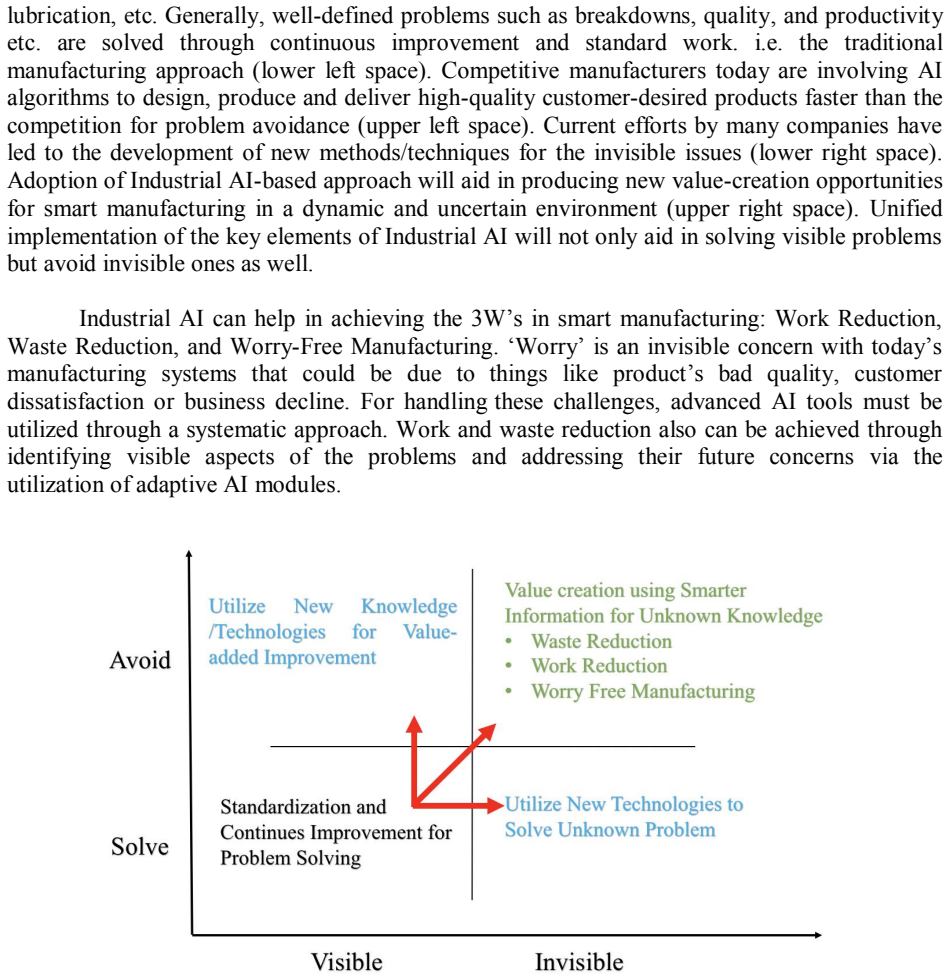
- The paper's visible-versus-invisible problem map suggests a progression—solve visible problems first, then avoid invisible degradation—that could be tested by tracking whether lighthouse factories follow that order.
- If the roadmap becomes standard practice, lighthouse status could evolve into an audited certification built around the four enablers, a step the paper does not propose but its framework supports.
Signed reviews
Editorial analysis
A structured set of objections, weighed in public.
Referee Report
Summary. This manuscript is a short position/roadmap paper that defines 'Industrial AI' as a systematic discipline for developing and deploying AI algorithms in manufacturing with repeated, consistent success. It reviews the evolution of Manufacturing 4.0/IoT/cloud/fog computing, identifies adoption barriers ('pilot purgatory'), and proposes four enabling technologies: data, analytic, platform, and operations technologies. These are presented in the context of the authors' own 5C-CPPS architecture. The paper then discusses 'Lighthouse Factories' as exemplars of Industrial AI implementation, citing several companies including Foxconn, and concludes the framework will guide researchers and industries toward real-world implementation.
Significance. If fully substantiated, the proposed taxonomy and roadmap could provide a useful organizing structure for practitioners and researchers entering the field. The paper's clear articulation of the 'pilot purgatory' problem is valuable, as is its effort to connect Industry 4.0 concepts to the concrete 'lighthouse factory' designation from the WEF/McKinsey report. The four-technology categorization is intuitively sensible and may serve as a communication device. However, the manuscript is a programmatic perspective, not a validated technical contribution: it contains no data, no systematic case analyses, and no derivations. Its central promise of 'repeating and consistent successes' is unsupported, and its main architectural reference is the authors' own prior work. The value of the paper as published would depend on a clear framing as a viewpoint and on substantial revision to support or qualify its factual and architectural claims.
major comments (4)
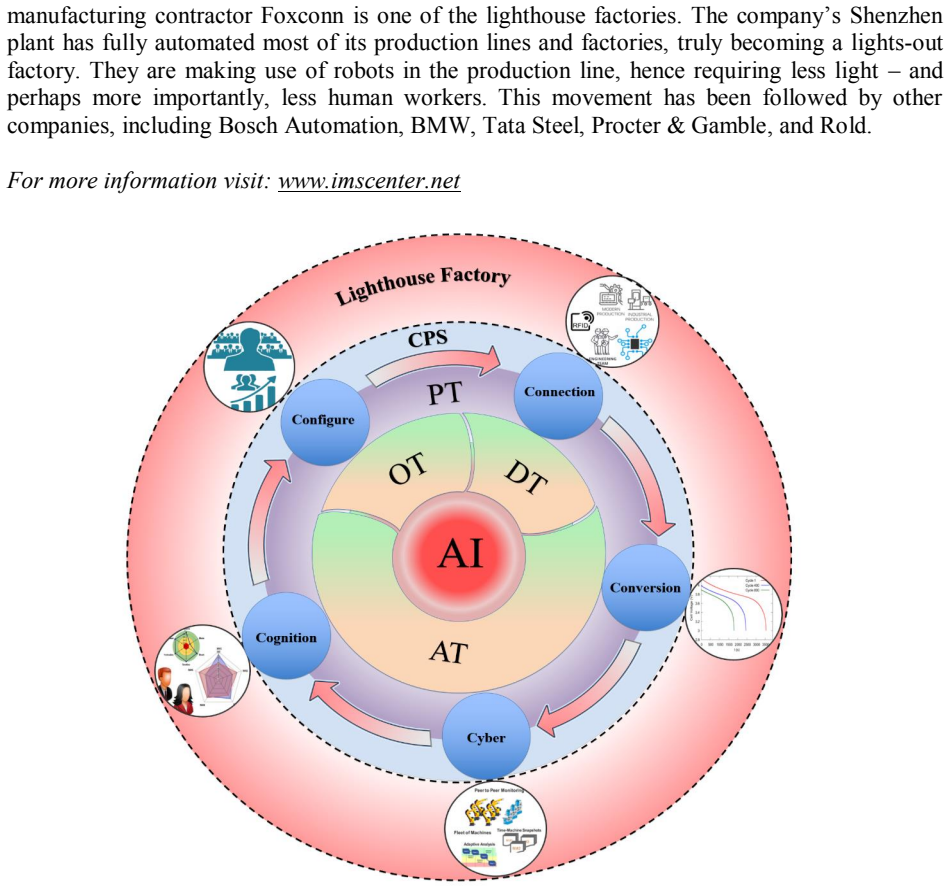
- [Section 5, Figure 2] The load-bearing claim that the four enabling technologies 'can be better understood when put in the context of the IMS 5C-CPPS architecture' is asserted, not demonstrated. The text does not explain how each technology maps to the five C levels, why this mapping is complete, or why the 5C-CPPS architecture (the authors' own prior proposal, reference [2]) should be taken as the canonical foundation. This is a self-referential premise, and the roadmap would lose its claimed generality if the architecture is not independently validated. The authors should either provide a detailed mapping with justifications for each C-level relation, or frame the architecture as one possible example rather than the basis of the discipline.
- [Section 6, Foxconn example] The concrete example of Foxconn as a lighthouse factory with a 'lights-out' Shenzhen plant is given without any citation. Because this is one of the few factual anchors for the paper's central argument, it must be verifiable; the authors should cite a specific source, ideally the WEF white paper [1] or a reputable news article, and should specify which Foxconn unit and what evidence supports the claim that Industrial AI, rather than conventional automation, drove the benefits. If the example is not drawn from the referenced WEF list, this is a factual error.
- [Section 4 vs. Section 5] The paper lists five concrete barriers to AI deployment in manufacturing (lack of success evidence, lack of systematic approach, non-standardized data, missing failure data, dynamic contexts requiring human intervention) but never explains how the proposed four-enabler Industrial AI framework overcomes each barrier. In particular, the first barrier ('Not enough evidence in terms of industrial successes') is directly contradicted by the paper's own lack of evidence, and the fourth barrier (non-availability of failure data) is not addressed by any of the four enablers as described. The roadmap would be more compelling if Section 5 explicitly revisited these barriers and showed how each is resolved.
- [Section 7, Conclusions] The conclusion states that the 'key enabling technologies are described in details' and implies the paper provides 'guidelines... towards industry 4.0.' In its current form, however, the descriptions are qualitative lists of functions and the only validating evidence is an unreferenced mention of Foxconn and similar companies. The abstract's promise of 'repeating and consistent successes' requires at least some empirical or documented evidence; if none is available, the claim should be scaled back to a proposal or research agenda.
minor comments (7)
- [Abstract] Grammar: 'is a cognitive science to enables human' should be 'is a cognitive science that enables humans'; please proofread throughout for subject-verb agreement.
- [Section 1] The terms 'Manufacturing 4.0' and 'Industry 4.0' are used interchangeably; please choose one nomenclature and define it consistently.
- [Section 2, reference [4]] Reference [4] is cited as 'House, W., 2016'; the correct author is the Executive Office of the President of the United States. Please fix the citation.
- [Figure 2] The figure caption is minimal and does not identify the source of the 5C-CPPS diagram or explain the axes/color coding; if the figure is reproduced from reference [2], proper attribution and permission are needed.
- [Section 6] The phrase 'For more information visit: www.imscenter.net' is promotional and not appropriate for an archival paper; remove it or replace with a footnote to prior published work.
- [Section 6] The company name 'Proctor & Gamble' is misspelled; it should be 'Procter & Gamble'.
- [Section 6, Figure 3] The two-by-two visible/invisible and problem-solving/problem-avoidance matrix is interesting but the axes are not labeled in the text; please define them explicitly so the figure is self-contained.
Circularity Check
No circularity: the paper's roadmap is conceptual and its self-cited architecture is an organizing frame, not a derived prediction.
full rationale
This is a programmatic review/roadmap paper with no equations, no fitted parameters, and no quantitative predictions that could reduce to inputs. Industrial AI is introduced by stipulative definition ('Industrial AI is a systematic discipline...'), and the four enabling technologies are presented as categories rather than derived from that definition. The only self-citations are [2], the authors' 5C-CPPS architecture, and [3], a blockchain architecture paper. Section 5 asserts that the enabling technologies 'can be better understood when put in the context of the IMS 5C-CPPS architecture,' and Figure 2 maps them onto that architecture. This is a presentational and organizational choice, not a computational or logical derivation; the roadmap is not made true or false by the architecture by construction. No predicted quantity is equivalent to an input, no uniqueness theorem is imported, and no fitted parameter is renamed as a finding. The lighthouse-factory discussion is external illustrative evidence rather than a model prediction. Concerns about whether 5C-CPPS is the right or only foundation are questions of generality and empirical support, not circularity under the stated criteria.
Assumptions & free parameters
assumptions (4)
- ad hoc to paper 5C-CPPS architecture is a valid general roadmap for cyber-physical production systems.
- domain assumption AI algorithms can deliver repeating and consistent successes in industrial settings.
- domain assumption WEF/McKinsey lighthouse selection identifies the most advanced production sites and is a valid proxy for successful Industrial AI deployment.
- domain assumption More data leads to smarter decisions.
invented entities (1)
-
Industrial AI as a systematic discipline
Cite this review
Pith. "Pith review of Industrial Artificial Intelligence." pith.science (2026). https://pith.science/paper/LTUJPNEQ
@misc{pith2026190802150,
  author       = {Pith},
  title        = {Pith review of: Industrial Artificial Intelligence},
  year         = {2026},
  howpublished = {\url{https://pith.science/paper/LTUJPNEQ}},
  note         = {Machine review of arXiv:1908.02150}
}
read the original abstract
Artificial Intelligence (AI) is a cognitive science to enables human to explore many intelligent ways to model our sensing and reasoning processes. Industrial AI is a systematic discipline to enable engineers to systematically develop and deploy AI algorithms with repeating and consistent successes. In this paper, the key enablers for this transformative technology along with their significant advantages are discussed. In addition, this research explains Lighthouse Factories as an emerging status applying to the top manufacturers that have implemented Industrial AI in their manufacturing ecosystem and gained significant financial benefits. It is believed that this research will work as a guideline and roadmap for researchers and industries towards the real-world implementation of Industrial AI.
Figures

Figures from the paper (1 more)
Reference graph
Works this paper leans on
-
[2]
Lee, J., Bagheri, B. and Kao, H.A., 2015. A cyber-physical systems architecture for industry 4.0-based manufacturing systems. Manufacturing letters, 3, pp.18-23
work page 2015
-
[3]
A Blockchain Enabled Cyber-Physical System Architecture for Industry 4.0 Manufacturing Systems
Lee J, Azamfar M, Singh J. A Blockchain Enabled Cyber-Physical System Architecture for Industry 4.0 Manufacturing Systems. Manuf Lett 2019. doi:10.1016/j.mfglet.2019.05.003
-
[1]
Fourth Industrial Revolution Beacons of Technology and Innovation in Manufacturing
Leurent, H., Boer, E. D., “Fourth Industrial Revolution Beacons of Technology and Innovation in Manufacturing” White Paper, January 10, 2019. https://www.weforum.org/whitepapers/fourth-industrial-revolution-beacons-of-technology-and- innovation-in-manufacturing
work page 2019
-
[4]
Artificial intelligence, automation, and the economy
House, W., 2016. Artificial intelligence, automation, and the economy. Executive office of the President. https://obamawhitehouse.archives.gov/sites/whitehouse.gov/files/documents/Artificial- Intelligence-Automation-Economy. PDF
work page 2016
Reviewed August 14, 2026 · model on record in the stance chip above.
Discussion (0). Continue with ORCID to comment.