A Magnetized Black Hole Envelope Model for Little Red Dots
Pith reviewed 2026-05-22 09:21 UTC · model grok-4.3
The pith
A magnetized black hole envelope produces the broad lines and X-ray quietness seen in little red dots.
A machine-rendered reading of the paper's core claim, the machinery that carries it, and where it could break.
Core claim
Assuming spherical free-fall accretion onto a rotating, magnetized black hole envelope whose structure resembles the atmospheres of convective stars near the Hayashi limit, the model accounts for the key observational properties of little red dots. The Doppler component of broad emission lines originates from plasma clumps co-rotating within the envelope magnetosphere; additional broadening from electron scattering produces line profiles that combine a Gaussian core with an exponential tail and can reach a few thousand km/s. Conventional virial black hole mass estimates may therefore be erroneous. X-ray luminosities from the post-shock region and a magnetically heated corona stay below 10^41
What carries the argument
The magnetized black hole envelope, an optically thick structure formed by dense circum-nuclear gas that resembles convective stellar atmospheres and hosts co-rotating plasma clumps in its magnetosphere.
If this is right
- The model reproduces Doppler components of broad lines up to a few thousand km/s.
- Conventional virial black hole mass estimates for these objects may give incorrect values.
- X-ray luminosities remain below 10^41 erg/s for black hole masses from 10^5 to 10^7 solar masses and a wide range of accretion rates.
- The envelope provides an optically thick environment that hides the central engine while allowing the observed red colors and line widths.
Where Pith is reading between the lines
- If the envelope picture holds, rapid accretion in gas-rich environments around lower-mass black holes may commonly produce similar magnetized structures.
- Higher-resolution spectroscopy could search for the specific Gaussian-core-plus-exponential-tail shape as a direct test.
- The link to stellar atmospheres raises the possibility that magnetic field generation mechanisms studied in stars apply to these galactic-scale envelopes.
- The model suggests that some fraction of other obscured active galaxies might be explained by analogous magnetized gas configurations rather than dust tori alone.
Load-bearing premise
The envelope forms under spherical free-fall accretion and generates magnetic fields because its structure matches the atmospheres of cool convective stars near the Hayashi limit.
What would settle it
Spectroscopic observations that fail to show a Gaussian-plus-exponential line profile, or X-ray detections from a little red dot exceeding 10^41 erg/s across the stated black hole mass and accretion range.
Figures




read the original abstract
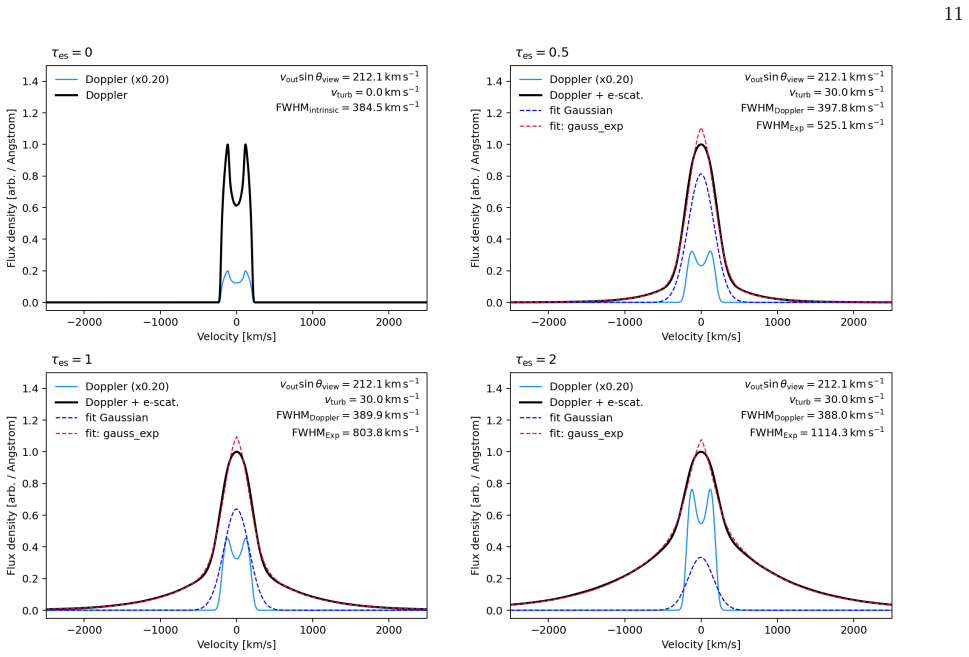
Recent observations have revealed a unique class of active galactic nuclei (AGNs), termed little red dots (LRDs). These objects are hypothesized to be powered by massive black holes rapidly accreting in dense gaseous environments. Theoretical studies suggest that the circum-nuclear gas can form an optically thick black hole envelope (BHE), whose structure resembles the atmospheres of convective stars near the Hayashi limit. Given that such cool stars typically generate magnetic fields, we propose a dynamical and spectral model for an LRD enshrouded by a magnetized BHE. Assuming spherical free-fall accretion onto a rotating, magnetized BHE, our model accounts for key observational properties of LRDs. We propose that the Doppler component of broad emission lines originates from plasma clumps co-rotating within the BHE magnetosphere. Including additional broadening due to electron scattering allows the resulting line profile to be fitted by a combination of a Gaussian core and an exponential tail. This model can reproduce Doppler components up to a few thousand ${\rm km~s^{-1}}$. We suggest that conventional black hole mass estimation methods based on the virial relation may yield erroneous results. Furthermore, our model is consistent with X-ray non-detections in LRDs. We evaluate the X-ray luminosities of two potential sources: the post-shock region of accretion shocks and a magnetically heated corona. We find that these X-ray luminosities are constrained to $\lesssim 10^{41}~{\rm erg~s^{-1}}$ across a wide range of black hole masses ($10^5 M_\odot \lesssim M_{\rm BH}\lesssim 10^7M_\odot$) and accretion rates, consistent with current upper limits on X-ray emission.
Editorial analysis
A structured set of objections, weighed in public.
Referee Report
Summary. The manuscript proposes a dynamical and spectral model for little red dots (LRDs) as AGNs powered by massive black holes accreting via a magnetized black hole envelope (BHE) whose structure resembles convective stellar atmospheres near the Hayashi limit. Assuming spherical free-fall onto a rotating magnetized BHE, the authors attribute the Doppler component of broad emission lines to co-rotating plasma clumps in the magnetosphere, with additional electron scattering producing Gaussian-core plus exponential-tail profiles that can reach a few thousand km s^{-1}. They further claim that X-ray luminosities from post-shock accretion regions and a magnetically heated corona remain ≲10^{41} erg s^{-1} for 10^5 M_⊙ ≲ M_BH ≲ 10^7 M_⊙ across a range of accretion rates, consistent with current upper limits, and suggest that conventional virial mass estimates may therefore be erroneous.
Significance. If the missing quantitative derivations and fits can be supplied and validated, the model would offer a physically motivated alternative to standard virial interpretations of LRD line widths and would provide a concrete mechanism for their observed X-ray faintness. By linking magnetic fields, envelope structure, and spherical accretion, the work could influence interpretations of dense, obscured accretion flows around intermediate-mass black holes and highlight limitations of virial methods in such environments.
major comments (2)
- [Abstract and §3] Abstract and §3 (Doppler broadening): the statement that the model 'can reproduce Doppler components up to a few thousand km s^{-1}' is not supported by any explicit relation connecting the magnetosphere truncation radius, magnetic field strength, or angular velocity to M_BH or accretion rate. Without this mapping the velocity scale remains adjustable rather than a model prediction, weakening the central claim that the BHE framework accounts for observed line widths independently of virial assumptions.
- [§4] §4 (X-ray constraints): the assertion that post-shock and coronal X-ray luminosities are constrained to ≲10^{41} erg s^{-1} across the quoted mass and accretion-rate range is presented without visible derivations, scaling relations, or error analysis. The absence of these calculations makes it impossible to verify that the limit holds under the stated spherical free-fall and magnetic-heating assumptions.
minor comments (2)
- Notation for black hole mass should be unified (M_BH vs. M_{BH} vs. M_⊙) throughout the text and figures.
- A figure showing representative line profiles (Gaussian core + exponential tail) for a few representative parameter combinations would help readers assess the claimed fit quality.
Simulated Author's Rebuttal
We thank the referee for their careful and constructive review of our manuscript on the magnetized black hole envelope model for little red dots. We appreciate the identification of areas where quantitative support can be strengthened and will revise the paper to address these points directly.
read point-by-point responses
-
Referee: [Abstract and §3] Abstract and §3 (Doppler broadening): the statement that the model 'can reproduce Doppler components up to a few thousand km s^{-1}' is not supported by any explicit relation connecting the magnetosphere truncation radius, magnetic field strength, or angular velocity to M_BH or accretion rate. Without this mapping the velocity scale remains adjustable rather than a model prediction, weakening the central claim that the BHE framework accounts for observed line widths independently of virial assumptions.
Authors: We agree that the manuscript would benefit from an explicit derivation linking the truncation radius, magnetic field, and angular velocity to black hole mass and accretion rate. In the revised version, we will add a quantitative mapping in §3 based on equating magnetic pressure to the ram pressure of spherical free-fall accretion. This will show that co-rotating velocities naturally reach up to a few thousand km s^{-1} for BHE parameters consistent with the model, without arbitrary adjustment. The abstract will be updated to reflect this derivation. revision: yes
-
Referee: [§4] §4 (X-ray constraints): the assertion that post-shock and coronal X-ray luminosities are constrained to ≲10^{41} erg s^{-1} across the quoted mass and accretion-rate range is presented without visible derivations, scaling relations, or error analysis. The absence of these calculations makes it impossible to verify that the limit holds under the stated spherical free-fall and magnetic-heating assumptions.
Authors: We acknowledge that explicit derivations and scaling relations for the X-ray limits are needed. In the revision, we will include in §4 the full calculations for post-shock luminosity (using free-fall velocity and shock temperature) and for the magnetically heated corona (via reconnection heating), along with scaling relations and a basic error analysis over the 10^5–10^7 M_⊙ and relevant accretion-rate range. This will confirm the L_X ≲ 10^{41} erg s^{-1} bound under the model's assumptions. revision: yes
Circularity Check
No significant circularity; derivation remains self-contained under stated physical assumptions
full rationale
The paper constructs its model from explicit assumptions of spherical free-fall accretion onto a rotating, magnetized black hole envelope whose structure is motivated by analogy to convective stellar atmospheres. Black hole mass and accretion rate are explored parametrically over wide ranges rather than fitted to match specific observational targets, and the resulting X-ray luminosities and possible Doppler velocity scales are shown to be consistent with limits without reducing to tautological reparameterization of the inputs. No load-bearing step equates a claimed prediction to a fitted quantity or prior self-citation by construction.
Axiom & Free-Parameter Ledger
free parameters (2)
- Black hole mass
- Accretion rate
axioms (2)
- domain assumption Spherical free-fall accretion onto a rotating, magnetized BHE
- domain assumption BHE structure resembles atmospheres of convective stars near the Hayashi limit
invented entities (1)
-
Magnetized black hole envelope (BHE)
no independent evidence
Lean theorems connected to this paper
-
IndisputableMonolith/Cost/FunctionalEquation.leanwashburn_uniqueness_aczel unclear?
unclearRelation between the paper passage and the cited Recognition theorem.
Assuming spherical free-fall accretion onto a rotating, magnetized BHE... plasma clumps co-rotating within the BHE magnetosphere... f_rot defined as Ω_ph = f_rot Ω_K(r_ph) ... 0 ≤ f_rot ≤ 1
-
IndisputableMonolith/Foundation/DimensionForcing.leanalexander_duality_circle_linking unclear?
unclearRelation between the paper passage and the cited Recognition theorem.
B_surf = B_eq = sqrt(8π p_surf) ... r_mag = k (B_surf^4 r_ph^12 / (2 G M_BH ˙M_ISM^2))^{1/7}
What do these tags mean?
- matches
- The paper's claim is directly supported by a theorem in the formal canon.
- supports
- The theorem supports part of the paper's argument, but the paper may add assumptions or extra steps.
- extends
- The paper goes beyond the formal theorem; the theorem is a base layer rather than the whole result.
- uses
- The paper appears to rely on the theorem as machinery.
- contradicts
- The paper's claim conflicts with a theorem or certificate in the canon.
- unclear
- Pith found a possible connection, but the passage is too broad, indirect, or ambiguous to say the theorem truly supports the claim.
Reference graph
Works this paper leans on
-
[1]
2018, ApJ, 866, 84, doi: 10.3847/1538-4357/aadc11
Aoyama, Y., Ikoma, M., & Tanigawa, T. 2018, ApJ, 866, 84, doi: 10.3847/1538-4357/aadc11
-
[2]
Asada, Y., Inayoshi, K., Fei, Q., Fujimoto, S., & Willott, C. 2026, arXiv e-prints, arXiv:2601.10573, doi: 10.48550/arXiv.2601.10573 Auri` ere, M., Konstantinova-Antova, R., Charbonnel, C., et al. 2015, A&A, 574, A90, doi: 10.1051/0004-6361/201424579
work page internal anchor Pith review Pith/arXiv arXiv doi:10.48550/arxiv.2601.10573 2026
-
[3]
Begelman, M. C., & Dexter, J. 2026, ApJ, 996, 48, doi: 10.3847/1538-4357/ae274a
-
[4]
Begelman, M. C., Rossi, E. M., & Armitage, P. J. 2008, MNRAS, 387, 1649, doi: 10.1111/j.1365-2966.2008.13344.x
-
[5]
Bentz, M. C., Denney, K. D., Grier, C. J., et al. 2013, ApJ, 767, 149, doi: 10.1088/0004-637X/767/2/149
work page internal anchor Pith review doi:10.1088/0004-637x/767/2/149 2013
-
[6]
2020, A&A, 643, A39, doi: 10.1051/0004-6361/202037693
Cang, T.-Q., Petit, P., Donati, J.-F., et al. 2020, A&A, 643, A39, doi: 10.1051/0004-6361/202037693
-
[7]
2026, MNRAS, 545, staf2131, doi: 10.1093/mnras/staf2131
Chang, S.-J., Gronke, M., Matthee, J., & Mason, C. 2026, MNRAS, 545, staf2131, doi: 10.1093/mnras/staf2131
-
[8]
2025, arXiv e-prints, arXiv:2510.00112, doi: 10.48550/arXiv.2510.00112
Comastri, A., Lanzuisi, G., Vito, F., et al. 2025, arXiv e-prints, arXiv:2510.00112, doi: 10.48550/arXiv.2510.00112
-
[9]
Daley-Yates, S., & Jardine, M. M. 2024, MNRAS, 534, 621, doi: 10.1093/mnras/stae2131 de Graaff, A., Rix, H.-W., Naidu, R. P., et al. 2025a, A&A, 701, A168, doi: 10.1051/0004-6361/202554681 de Graaff, A., Hviding, R. E., Naidu, R. P., et al. 2025b, arXiv e-prints, arXiv:2511.21820, doi: 10.48550/arXiv.2511.21820 Del Zanna, G., Dere, K. P., Young, P. R., & ...
-
[10]
2025, arXiv e-prints, arXiv:2509.07100, doi: 10.48550/arXiv.2509.07100
Delvecchio, I., Daddi, E., Magnelli, B., et al. 2025, arXiv e-prints, arXiv:2509.07100, doi: 10.48550/arXiv.2509.07100
-
[11]
Elsner, R. F., & Lamb, F. K. 1977, ApJ, 215, 897, doi: 10.1086/155427
-
[12]
J., Labb´ e, I., Zitrin, A., et al
Furtak, L. J., Labb´ e, I., Zitrin, A., et al. 2024, Nature, 628, 57, doi: 10.1038/s41586-024-07184-8
-
[13]
Greene, J. E., & Ho, L. C. 2005, ApJ, 630, 122, doi: 10.1086/431897
work page internal anchor Pith review doi:10.1086/431897 2005
-
[14]
Greene, J. E., Labbe, I., Goulding, A. D., et al. 2024, ApJ, 964, 39, doi: 10.3847/1538-4357/ad1e5f G¨ udel, M. 2004, A&A Rv, 12, 71, doi: 10.1007/s00159-004-0023-2
-
[15]
2016, ARA&A, 54, 135, doi: 10.1146/annurev-astro-081915-023347
Hartmann, L., Herczeg, G., & Calvet, N. 2016, ARA&A, 54, 135, doi: 10.1146/annurev-astro-081915-023347
-
[16]
2015, SSRv, 191, 441, doi: 10.1007/s11214-015-0174-7
Tchekhovskoy, A. 2015, SSRv, 191, 441, doi: 10.1007/s11214-015-0174-7
-
[17]
1961, PASJ, 13, 450, doi: 10.1093/pasj/13.4.450
Hayashi, C. 1961, PASJ, 13, 450, doi: 10.1093/pasj/13.4.450
-
[18]
1961, PASJ, 13, 442, doi: 10.1093/pasj/13.4.442
Hayashi, C., & H¯ oshi, R. 1961, PASJ, 13, 442, doi: 10.1093/pasj/13.4.442
-
[19]
Hviding, R. E., de Graaff, A., Miller, T. B., et al. 2025, A&A, 702, A57, doi: 10.1051/0004-6361/202555816
-
[20]
2025, ApJL, 988, L22, doi: 10.3847/2041-8213/adea66
Inayoshi, K. 2025, ApJL, 988, L22, doi: 10.3847/2041-8213/adea66
-
[21]
Inayoshi, K., & Ho, L. C. 2025, arXiv e-prints, arXiv:2512.03130, doi: 10.48550/arXiv.2512.03130 20
-
[22]
2025, ApJL, 980, L27, doi: 10.3847/2041-8213/adaebd
Inayoshi, K., & Maiolino, R. 2025, ApJL, 980, L27, doi: 10.3847/2041-8213/adaebd
-
[23]
Inayoshi, K., Murase, K., & Kashiyama, K. 2025a, arXiv e-prints, arXiv:2509.19422, doi: 10.48550/arXiv.2509.19422
work page internal anchor Pith review Pith/arXiv arXiv doi:10.48550/arxiv.2509.19422
-
[24]
The Emergence of Little Red Dots from Binary Massive Black Holes
Haiman, Z. 2025b, arXiv e-prints, arXiv:2505.05322, doi: 10.48550/arXiv.2505.05322
work page internal anchor Pith review Pith/arXiv arXiv doi:10.48550/arxiv.2505.05322
-
[25]
2025a, arXiv e-prints, arXiv:2501.13082, doi: 10.48550/arXiv.2501.13082
Ji, X., Maiolino, R., ¨Ubler, H., et al. 2025, arXiv e-prints, arXiv:2501.13082, doi: 10.48550/arXiv.2501.13082
-
[26]
Ji, X., Pezzulli, G., D’Eugenio, F., et al. 2026, arXiv e-prints, arXiv:2604.03370, doi: 10.48550/arXiv.2604.03370
work page internal anchor Pith review Pith/arXiv arXiv doi:10.48550/arxiv.2604.03370 2026
-
[27]
Johns-Krull, C. M. 2007, ApJ, 664, 975, doi: 10.1086/519017
-
[28]
Joss, P. C., Salpeter, E. E., & Ostriker, J. P. 1973, ApJ, 181, 429, doi: 10.1086/152060
-
[29]
Kido, D., Ioka, K., Hotokezaka, K., Inayoshi, K., & Irwin, C. M. 2025, MNRAS, 544, 3407, doi: 10.1093/mnras/staf1898
-
[30]
Kocevski, D. D., Finkelstein, S. L., Barro, G., et al. 2025, ApJ, 986, 126, doi: 10.3847/1538-4357/adbc7d
-
[31]
Kokorev, V., Chisholm, J., Naidu, R. P., et al. 2025, arXiv e-prints, arXiv:2511.07515, doi: 10.48550/arXiv.2511.07515
-
[32]
Kulkarni, A. K., & Romanova, M. M. 2008, MNRAS, 386, 673, doi: 10.1111/j.1365-2966.2008.13094.x Labb´ e, I., Greene, J. E., Matthee, J., et al. 2024, arXiv e-prints, arXiv:2412.04557, doi: 10.48550/arXiv.2412.04557 Labb´ e, I., Greene, J. E., Bezanson, R., et al. 2025, ApJ, 978, 92, doi: 10.3847/1538-4357/ad3551
-
[33]
Lamb, F. K., Pethick, C. J., & Pines, D. 1973, ApJ, 184, 271, doi: 10.1086/152325
-
[34]
2024, ApJ, 974, 147, doi: 10.3847/1538-4357/ad6565
Lin, X., Wang, F., Fan, X., et al. 2024, ApJ, 974, 147, doi: 10.3847/1538-4357/ad6565
-
[35]
2026b, ApJ, 997, 364, doi: 10.3847/1538-4357/ae2bdf
Lin, X., Fan, X., Cai, Z., et al. 2026, ApJ, 997, 364, doi: 10.3847/1538-4357/ae2bdf
-
[36]
Linsky, J. L. 2017, ARA&A, 55, 159, doi: 10.1146/annurev-astro-091916-055327
-
[37]
Liu, H., Jiang, Y.-F., Quataert, E., Greene, J. E., & Ma, Y. 2025, ApJ, 994, 113, doi: 10.3847/1538-4357/ae0c19
-
[38]
Lyu, J., Alberts, S., Rieke, G. H., et al. 2024, ApJ, 966, 229, doi: 10.3847/1538-4357/ad3643
-
[39]
2024, A&A, 691, A145, doi: 10.1051/0004-6361/202347640
Maiolino, R., Scholtz, J., Curtis-Lake, E., et al. 2024, A&A, 691, A145, doi: 10.1051/0004-6361/202347640
-
[40]
2025, MNRAS, 538, 1921, doi: 10.1093/mnras/staf359
Maiolino, R., Risaliti, G., Signorini, M., et al. 2025, MNRAS, 538, 1921, doi: 10.1093/mnras/staf359
-
[41]
Matthee, J., Naidu, R. P., Brammer, G., et al. 2024, ApJ, 963, 129, doi: 10.3847/1538-4357/ad2345
-
[42]
2026, arXiv e-prints, arXiv:2603.17667, doi: 10.48550/arXiv.2603.17667
Matthee, J., Torralba, A., Pezzulli, G., et al. 2026, arXiv e-prints, arXiv:2603.17667, doi: 10.48550/arXiv.2603.17667
-
[43]
Mayer, M., & Duschl, W. J. 2005, MNRAS, 358, 614, doi: 10.1111/j.1365-2966.2005.08826.x
-
[44]
A "Black Hole Star" Reveals the Remarkable Gas-Enshrouded Hearts of the Little Red Dots
Naidu, R. P., Matthee, J., Katz, H., et al. 2025, arXiv e-prints, arXiv:2503.16596, doi: 10.48550/arXiv.2503.16596
work page internal anchor Pith review Pith/arXiv arXiv doi:10.48550/arxiv.2503.16596 2025
-
[45]
2015, PASJ, 67, 33, doi: 10.1093/pasj/psv002
Notsu, Y., Honda, S., Maehara, H., et al. 2015, PASJ, 67, 33, doi: 10.1093/pasj/psv002
-
[46]
Osterbrock, D. E., & Ferland, G. J. 2006, Astrophysics of gaseous nebulae and active galactic nuclei
work page 2006
-
[47]
Parker, E. N. 1978, ApJ, 221, 368, doi: 10.1086/156035 P´ erez-Gonz´ alez, P. G., Barro, G., Rieke, G. H., et al. 2024, ApJ, 968, 4, doi: 10.3847/1538-4357/ad38bb
-
[48]
Pevtsov, A. A., Fisher, G. H., Acton, L. W., et al. 2003, ApJ, 598, 1387, doi: 10.1086/378944
-
[49]
2005, ApJS, 160, 401, doi: 10.1086/432891
Preibisch, T., Kim, Y.-C., Favata, F., et al. 2005, ApJS, 160, 401, doi: 10.1086/432891
-
[50]
2012, Living Reviews in Solar Physics, 9, 1, doi: 10.12942/lrsp-2012-1
Reiners, A. 2012, Living Reviews in Solar Physics, 9, 1, doi: 10.12942/lrsp-2012-1
-
[51]
Reines, A. E., Greene, J. E., & Geha, M. 2013, ApJ, 775, 116, doi: 10.1088/0004-637X/775/2/116
work page internal anchor Pith review doi:10.1088/0004-637x/775/2/116 2013
-
[52]
Romanova, M. M., & Owocki, S. P. 2015, SSRv, 191, 339, doi: 10.1007/s11214-015-0200-9
-
[53]
Lovelace, R. V. E. 2004, ApJ, 610, 920, doi: 10.1086/421867
-
[54]
Rosner, R., Tucker, W. H., & Vaiana, G. S. 1978, ApJ, 220, 643, doi: 10.1086/155949
-
[55]
Rusakov, V., Watson, D., Nikopoulos, G. P., et al. 2025, arXiv e-prints, arXiv:2503.16595, doi: 10.48550/arXiv.2503.16595
-
[56]
G., Orlando, S., Argiroffi, C., et al
Sacco, G. G., Orlando, S., Argiroffi, C., et al. 2010, A&A, 522, A55, doi: 10.1051/0004-6361/201014950
-
[57]
Safier, P. N. 1999, ApJL, 510, L127, doi: 10.1086/311807
-
[58]
2026, arXiv e-prints, arXiv:2603.22277, doi: 10.48550/arXiv.2603.22277
Scholtz, J., D’Eugenio, F., Maiolino, R., et al. 2026, arXiv e-prints, arXiv:2603.22277, doi: 10.48550/arXiv.2603.22277
-
[59]
J., Cote, J., Zwaan, C., & Saar, S
Schrijver, C. J., Cote, J., Zwaan, C., & Saar, S. H. 1989, ApJ, 337, 964, doi: 10.1086/167168
-
[60]
Setton, D. J., Greene, J. E., Spilker, J. S., et al. 2025, ApJL, 991, L10, doi: 10.3847/2041-8213/ade78b
-
[61]
Sneppen, A., Watson, D., Matthews, J. H., et al. 2026, arXiv e-prints, arXiv:2601.18864, doi: 10.48550/arXiv.2601.18864
-
[62]
1956, Physics of Fully Ionized Gases
Spitzer, L. 1956, Physics of Fully Ionized Gases
work page 1956
-
[63]
Spruit, H. C. 1976, SoPh, 50, 269, doi: 10.1007/BF00155292
-
[64]
Stahler, S. W., Palla, F., & Salpeter, E. E. 1986, ApJ, 302, 590, doi: 10.1086/164018 21
-
[65]
Sun, W. Q., Naidu, R. P., Matthee, J., et al. 2026, arXiv e-prints, arXiv:2601.20929, doi: 10.48550/arXiv.2601.20929
-
[66]
2025, ApJ, 980, 111, doi: 10.3847/1538-4357/ada364
Tomida, K. 2025, ApJ, 980, 111, doi: 10.3847/1538-4357/ada364
-
[67]
2020, ApJ, 901, 70, doi: 10.3847/1538-4357/abad34
Takasao, S., Mitsuishi, I., Shimura, T., et al. 2020, ApJ, 901, 70, doi: 10.3847/1538-4357/abad34
-
[68]
Takasao, S., Tomida, K., Iwasaki, K., & Suzuki, T. K. 2022, ApJ, 941, 73, doi: 10.3847/1538-4357/ac9eb1
-
[69]
Tang, M., Stark, D. P., Plat, A., et al. 2025, ApJ, 991, 217, doi: 10.3847/1538-4357/adfd57
-
[70]
Tang, M., Stark, D. P., Mason, C. A., et al. 2026, arXiv e-prints, arXiv:2604.03563, doi: 10.48550/arXiv.2604.03563
work page internal anchor Pith review Pith/arXiv arXiv doi:10.48550/arxiv.2604.03563 2026
-
[71]
Taylor, A. J., Kokorev, V., Kocevski, D. D., et al. 2025, ApJL, 989, L7, doi: 10.3847/2041-8213/ade789
-
[72]
2017, A&A, 603, A129, doi: 10.1051/0004-6361/201730473
Tessore, B., L` ebre, A., Morin, J., et al. 2017, A&A, 603, A129, doi: 10.1051/0004-6361/201730473
-
[73]
Lovelace, R. V. E. 2005, Mem. Soc. Astron. Italiana, 76, 508
work page 2005
-
[74]
Ud-Doula, A., Owocki, S. P., & Townsend, R. H. D. 2008, MNRAS, 385, 97, doi: 10.1111/j.1365-2966.2008.12840.x
-
[75]
2026, ApJ, 999, 183, doi: 10.3847/1538-4357/ae4101
Umeda, H., Inayoshi, K., Harikane, Y., & Murase, K. 2026, ApJ, 999, 183, doi: 10.3847/1538-4357/ae4101
-
[76]
Vlemmings, W. H. T., van Langevelde, H. J., & Diamond, P. J. 2005, A&A, 434, 1029, doi: 10.1051/0004-6361:20042488
-
[77]
The Missing Hard Photons of Little Red Dots: Their Incident Ionizing Spectra Resemble Massive Stars
Wang, B., Leja, J., Katz, H., et al. 2025, arXiv e-prints, arXiv:2508.18358, doi: 10.48550/arXiv.2508.18358
work page internal anchor Pith review Pith/arXiv arXiv doi:10.48550/arxiv.2508.18358 2025
discussion (0)
Sign in with ORCID, Apple, or X to comment. Anyone can read and Pith papers without signing in.