REVIEW 2 major objections 4 minor 92 references
PG 1553+113's ~2.1-year oscillation is a broad activity envelope whose internal shape changes from cycle to cycle and band to band—not a single repeating wave.
Reviewed by Pith at T0; open to challenge. T0 means a machine referee read the full paper against a public rubric. the ladder, T0–T4 →
The ~2.1-year oscillations of blazar PG 1553+113 are broad, structured envelopes with non-repeating substructure, not a single self-similar wave.
T0 review reviewed 2026-08-05 challenge →
load-bearing objection Useful empirical census of the PG 1553+113 oscillation shapes, but the headline X-ray M6 result rests on sparse sampling and needs an injection-recovery check. the 2 major comments →
Profile Analysis of the Multiwavelength 2.1-year Oscillations of PG 1553+113
The pith
A machine-rendered reading of the paper's core claim, the machinery that carries it, and where it could break.
The reading
Core claim
Fitting each ~2.1-yr cycle of blazar PG 1553+113 with thirteen empirical profile templates ranked by BIC, the authors find every cycle is a broad activity envelope with substructure that varies by cycle and band: neither sinusoidal nor self-similar. X-rays are decisive: all five cycles uniquely prefer the triple exponential profile M6, no competitor within ΔBIC<2, so X-ray emission is structured flare complexes; gamma-ray cycles often admit several equivalent profiles. Bands agree on main peaks but not on subpeaks, implying a common long-term modulation with intrinsic variability on top. New dominant-peak-plus-twin-peaks cycles keep the binary black hole scenario viable, not proven.
What carries the argument
The central tool is a menu of thirteen empirical profile templates (five single-peaked, eight multi-peaked), fit to each oscillation and ranked by the Bayesian Information Criterion with a ΔBIC<2 comparability threshold. The workhorse is the triple-exponential rise–decay profile (M6), whose components carry independent rise and decay times; it is the most frequent winner overall and the unique choice in every X-ray cycle. Because BIC penalizes free parameters, M6's repeated victory turns 'the cycles have substructure' from visual impression into statistical claim—though the same flexibility that fits sub-flares can also bridge gaps in sparse light curves.
Load-bearing premise
That the fitted profile shapes are genuine emission structure, and not flexible multi-component functions bridging the gaps of the sparse, irregularly sampled X-ray and UV light curves.
What would settle it
Dense-cadence X-ray monitoring over one full 2.1-yr cycle (daily or better Swift/XRT sampling): if the light curve resolves into a single smooth pulse rather than the triple-exponential three-component structure, the all-M6 X-ray result is a sampling artifact. Independently, inject simulated single-peaked flares into the actual sparse X-ray and UV sampling patterns and count how often the triple-exponential model wins the BIC ranking; if flexible templates routinely win on fabricated single pulses, the fitted morphology carries no physical information.
If this is right
- Periodicity searches in blazars should be rebuilt around profile-aware templates: a complex, asymmetric oscillation spreads signal power from the fundamental into harmonics, so sine-based periodograms understate the significance of recurrences like this one.
- A global cross-correlation lag of zero between bands no longer implies strictly simultaneous variability; agreement is at the envelope level, with each band's subpeaks arriving at their own times and strengths.
- X-ray monitoring becomes the discriminating window: the consistent triple-exponential structure in all five X-ray cycles predicts that future dense X-ray campaigns will keep resolving multiple, asymmetric flare components rather than a single pulse.
- The reappearance of dominant-peak-plus-twin-peaks morphologies in cycles observed after the original 2008–2018 study extends the empirical basis of the supermassive-black-hole-binary scenario for PG 1553+113 and argues for continued multiwavelength monitoring through future cycles.
Where Pith is reading between the lines
- A direct injection test, not run in the paper, would settle the sampling worry: simulate single-peaked flares, place them under the real sparse X-ray/UV cadences, and count how often the triple-exponential model wins on BIC; if it wins often, the all-M6 X-ray result is an artifact of function flexibility rather than source structure.
- If the long-term envelope is genuinely geometric (line-of-sight alignment changing Doppler boosting), then the substructure's timing relative to the 2.1-yr phase should stay roughly constant while its amplitude varies; a phase-folded stack of many cycles is a testable prediction of that picture.
- The same cycle-by-cycle profile decomposition could be applied to other periodic blazar candidates, turning 'is this periodicity real?' into 'does the period repeat a shape or just an epoch?', which separates clock-like binary modulation from recurring jet-plasma activity.
- In the binary interpretation, the intermittency of the twin peaks becomes a feature: if binary-driven instabilities ignite sub-flares only in some orbits, the presence or absence of twin peaks in each cycle should correlate with cycle number or phase, a pattern future monitoring can look for.
Editorial analysis
A structured set of objections, weighed in public.
Referee Report
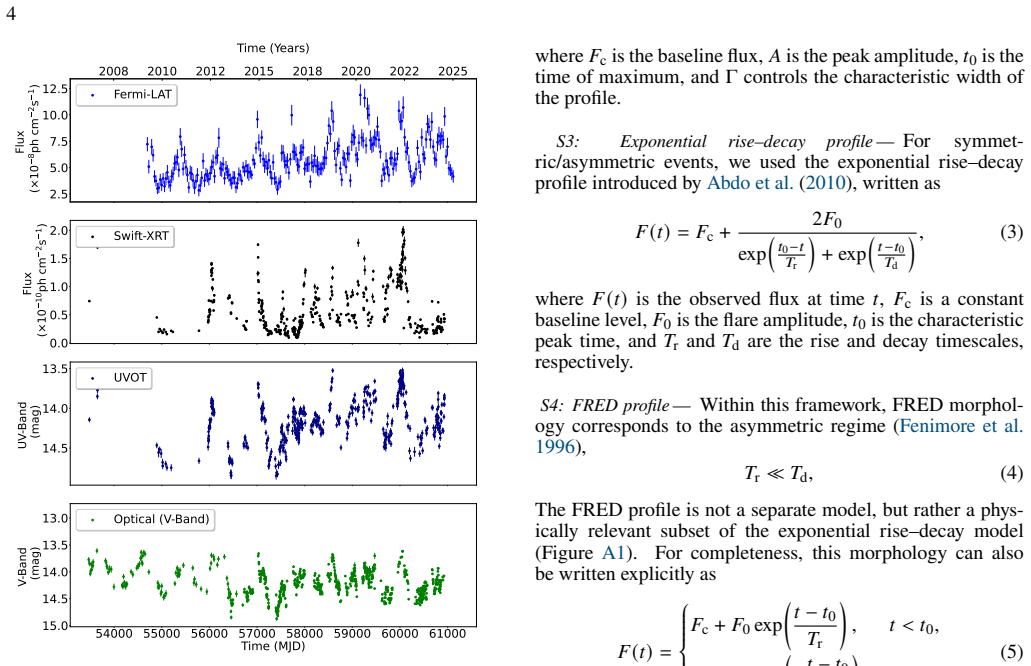
Summary. The paper analyzes the multiwavelength variability of the blazar PG 1553+113 in the context of its reported ~2.1 yr periodicity. For gamma-ray, X-ray, UV, and optical light curves, the authors identify individual cycles, fit a set of single- and multi-component analytical profile models (S1–S5, M1–M8), and rank the fits using BIC with a ΔBIC<2 comparability threshold. They report that the oscillations are generally best described as a broad activity envelope with shorter-timescale substructure rather than as strictly sinusoidal or self-similar pulses; that the preferred morphology varies across cycles and bands, with X-rays formally preferring the triple-exponential M6 model in all five analyzed cycles; and that contemporaneous multiwavelength oscillations show broadly aligned envelopes but non-repeating internal substructure. They also identify cycles with dominant peaks accompanied by weaker twin-peak-like features, which they argue keeps a supermassive-black-hole-binary scenario viable. The analysis is entirely empirical and rests on public datasets, with extensive appendix tables and figures.
Significance. If the morphological results are robust, this is a useful contribution to the long-standing debate on periodic blazar variability: it moves beyond a periodicity claim to the shape of the oscillation, shows that the 2.1-yr signal is not a clean sinusoid, and motivates physically grounded templates for future periodicity searches. The paper is transparent about its modeling choices, applies a consistent BIC criterion, uses public data, and explicitly cautions against over-interpretation of sparse-sampling bands. Its main limitations are that the quantitative claims—especially the X-ray morphology and the tuple-level component correspondences—are not backed by uncertainty estimates or simulated-cadence tests, and the number of cycles per band is small. As a result, the significance is conditional on those gaps being closed; the qualitative, hedged statements are largely defensible.
major comments (2)
- [§4.2, Table A2, Eq. (13)] The claim that X-ray oscillations are 'systematically structured' rests on the universal preference for the 12-parameter triple-exponential M6 model, with no competitor within ΔBIC<2 in any of the five cycles. The manuscript itself concedes (last paragraph of §4.2; also §4.3 and §5.2) that exponential multi-component functions are flexible enough to reproduce structured events while remaining smooth across poorly sampled intervals. No injection-recovery test is presented, so the formal BIC margins of hundreds to thousands are not calibrated against the observed irregular cadence and gaps. For example, Cycle 2 in Table A2 gives ΔBIC ≈ 2995 for the next-best model, but it is not shown that a truly single smooth component would not be overtaken by M6 when sampled with the same sparse X-ray pattern. I request simulated-cadence and noise-level injections with underlying S1/S2/S4/M1/M4/M6 prof
- [§5.1, Table A5; Tables A1–A4] The quantitative support for the claimed component-by-component correspondences is not assessable because no uncertainties are reported for any morphological parameter. The text reports offsets such as X-ray +87 d in Tuple 4 (Fig. 4) and component times in Table A5 to the day (e.g., gamma 59987/60078/60169; X-ray 59996/60075/60168), yet the X-ray light curve is sparse and irregularly sampled (Fig. 1). The 'close component-by-component correspondence' and the twin-peak-like recurrences are therefore statements about point estimates only. I ask for bootstrap or MCMC/covariance uncertainties on component centroids, amplitudes, widths, rise/decay times, and structure fractions, together with the number of points in each cycle and the local sampling windows. This is needed to judge whether the reported peak offsets and amplitude ratios are consistent with zero/with each other within errors, e
minor comments (4)
- [Figure 4] The panel titles show 'T uple 1', 'T uple 2', etc., with an erroneous space and nonstandard formatting. Please fix to 'Tuple 1', etc.
- [§3.2, S5] The phrase 'he Gaussian-rise plus exponential-decay profile' should be 'The Gaussian-rise plus exponential-decay profile'.
- [§4.5, Figure 2] The text describes the distribution of log10(1+ΔBIC), while the figure axis label reads 'log10 (1 + BIC)' in the extracted version. Clarify whether the plotted quantity is based on ΔBIC or the raw BIC, and make label and caption consistent.
- [§4.6] The interband comparison of morphological parameters (Fig. 3) uses only five X-ray and five UV cycles; the medians and interquartile ranges are likely unstable. The text is appropriately cautious, but consider stating explicitly that these distributions are illustrative rather than statistically comparable.
Circularity Check
No material circularity: the profile morphology is an empirical BIC-based fit to public light curves; self-citations supply inputs (periodicity, data reduction) but the morphological derivation is not reduced to them.
full rationale
The paper's derivation chain is an empirical model-selection analysis. The profile models are defined in §3.2 as mathematical functions (Eqs. 1–16) and fitted to each pre-identified oscillation; the BIC rankings in Tables A1–A4 are computed from those fits. The headline result—oscillations are broad envelopes with shorter-timescale substructure rather than strictly sinusoidal—is a descriptive output of those fits, not a quantity obtained by fitting a parameter to a subset and then predicting the same subset. The X-ray all-M6 preference is a formal BIC result, and the paper itself cautions that 'the frequent preference for exponential multi-component profiles may partly reflect the fact that such functions are flexible enough to reproduce structured events while remaining smooth across poorly sampled intervals' (§4.3, echoed in §4.2 and §5.2). That is an important validity caveat—it weakens the inference that X-ray substructure is real—but it is not a circular reduction: the BIC comparison is not defined in terms of the conclusion. Reliance on prior same-team works (e.g., Peñil et al. 2026b for cycle associations and the MJD 60000 monitoring campaign; Marcotulli & Torres-Albà 2026 for the Swift pipeline) supplies inputs such as the 2.1-yr periodicity and the reduced light curves. Those inputs are not re-derived here, and the profile fitting is performed independently on them. The SMBHB and dual-variability discussions in §6 are explicitly interpretive and do not feed back into the fits. No equation in the paper reduces to a fitted quantity by construction, and no uniqueness theorem is imported from self-citations. Hence no specific circular step can be exhibited; the moderate self-referentiality does not make the central claim circular.
Axiom & Free-Parameter Ledger
free parameters (4)
- Per-component model parameters (amplitude, centroid, width, rise/decay times) for templates S1-S5 and M1-M8 =
Reported per cycle in Tables A1-A5
- Baseline level F_c per cycle and band
- Cycle window boundaries
- DeltaBIC < 2 comparability threshold =
2
axioms (4)
- domain assumption The ~2.1-yr periodicity of PG 1553+113 is real and the segments analyzed are its oscillation cycles
- domain assumption The analytical templates are adequate and distinguishable descriptions of the true variability
- standard math BIC model comparison is valid on small, unevenly sampled windows
- domain assumption The public datasets and the same-team SAPLE reduction of Swift data are correct as used
Cite this review
Pith. "Pith review of Profile Analysis of the Multiwavelength 2.1-year Oscillations of PG 1553+113." pith.science (2026). https://pith.science/paper/LUGJ4DUO
@misc{pith2026260803947,
  author       = {Pith},
  title        = {Pith review of: Profile Analysis of the Multiwavelength 2.1-year Oscillations of PG 1553+113},
  year         = {2026},
  howpublished = {\url{https://pith.science/paper/LUGJ4DUO}},
  note         = {Machine review of arXiv:2608.03947}
}
abstract
We investigate the morphology of the oscillation profiles of the blazar PG~1553+113 in relation to its well-known $\sim$2.1 yr periodicity. We identify individual cycles in the $\gamma$-ray, X-ray, UV, and optical light curves and characterize their temporal profiles using analytical models for single- and multi-peaked events. We find that the oscillations are generally described by a broad activity envelope with shorter-timescale substructure, showing that the $\sim$2.1 yr signal is not a strictly sinusoidal or self-similar modulation. The internal morphology varies across cycles and energy bands. This is particularly evident in X-rays, where all analyzed cycles show a strong formal preference for multi-component profiles, unlike the $\gamma$-ray band, where several cycles admit statistically comparable empirical descriptions. The contemporaneous MWL oscillations show broadly aligned activity episodes, but the timing and relative amplitudes of secondary components are not systematically repeated. This suggests that a common long-term modulation affects the broadband emission, while additional local or energy-dependent processes shape individual cycles. Such a picture is compatible with a geometric, jet-related contribution to the broad recurrent envelope, with intrinsic variability superimposed on it. We also identify new cycles with a dominant peak accompanied by weaker twin-peak-like features, similar to structures previously discussed in a supermassive black hole binary scenario for PG~1553+113. Although our results do not provide definitive evidence for this interpretation, the recurrence of comparable morphologies in newly analyzed cycles keeps this scenario viable.
Figures


Reference graph
Works this paper leans on
-
[1]
Multiwavelength Evidence for Quasi-periodic Modulation in the Gamma-Ray Blazar PG 1553+113. , keywords =. doi:10.1088/2041-8205/813/2/L41 , archivePrefix =. 1509.02063 , primaryClass =
Pith/arXiv arXiv 2041
-
[2]
The variability patterns of the TeV blazar PG 1553 + 113 from a decade of MAGIC and multiband observations. , keywords =. doi:10.1093/mnras/stae649 , archivePrefix =. 2403.02159 , primaryClass =
-
[3]
Multiwavelength Variability Analysis of Fermi-LAT Blazars
Multiwavelength variability analysis of Fermi-LAT blazars. , keywords =. doi:10.1093/mnras/stae594 , archivePrefix =. 2403.01520 , primaryClass =
work page internal anchor Pith review Pith/arXiv arXiv
-
[4]
Multiwavelength analysis of Fermi-LAT blazars with high-significance periodicity: detection of a long-term rising emission in PG 1553+113. , keywords =. doi:10.1093/mnras/stad3246 , archivePrefix =. 2310.12754 , primaryClass =
work page internal anchor Pith review Pith/arXiv arXiv
-
[5]
Distortions in Periodicity Analysis of Blazars: The Impact of Flares
Distortions in periodicity analysis of blazars: the impact of flares. , keywords =. doi:10.1093/mnras/staf482 , archivePrefix =. 2504.05092 , primaryClass =
work page internal anchor Pith review Pith/arXiv arXiv
-
[6]
Distortions in periodicity analysis of blazars ─ II: the impact of gaps. , keywords =. doi:10.1093/mnras/staf1842 , archivePrefix =. 2510.19610 , primaryClass =
-
[7]
Search for periodic variability in -ray blazars Using Fermi-LAT. , keywords =. doi:10.1093/mnras/staf1108 , archivePrefix =. 2211.01894 , primaryClass =
-
[8]
Extensive analysis of -ray periodicity in jetted AGNs from the 4FGL catalogue using Fermi-LAT observations. , keywords =. doi:10.1093/mnras/staf1598 , archivePrefix =. 2509.14013 , primaryClass =
-
[9]
Search for Kink Events in Variable Fermi-LAT Blazars
Search for Kink Events in Variable Fermi-LAT Blazars. , keywords =. doi:10.3847/1538-4357/adcbab , archivePrefix =. 2504.10308 , primaryClass =
work page internal anchor Pith review Pith/arXiv arXiv
-
[10]
Testing X-ray Periodicity and Long-Term Trend in PG 1553+113 via Targeted Swift-XRT Monitoring. , keywords =. doi:10.1051/0004-6361/202659801 , archivePrefix =. 2604.05905 , primaryClass =
-
[11]
The Open Journal of Astrophysics , keywords =
Transient QPOs of Fermi-LAT blazars with Linearly Multiplicative Oscillations. The Open Journal of Astrophysics , keywords =. doi:10.33232/001c.154123 , archivePrefix =. 2507.13906 , primaryClass =
-
[12]
Gamma-Ray Periodicity in Jetted AGN: Revisiting Periodicity Candidates with >17 years of Fermi-LAT Data. , keywords =. doi:10.1093/mnras/stag1141 , archivePrefix =. 2606.15676 , primaryClass =
-
[13]
The Fermi-LAT Lightcurve Repository. , keywords =. doi:10.3847/1538-4365/acbb6a , archivePrefix =. 2301.01607 , primaryClass =
-
[14]
Blazar Jets Perturbed by Magneto-Gravitational Stresses in Supermassive Binaries
Blazar Jets Perturbed by Magneto-gravitational Stresses in Supermassive Binaries. , keywords =. doi:10.3847/1538-4357/836/2/220 , archivePrefix =. 1701.05350 , primaryClass =
work page internal anchor Pith review Pith/arXiv arXiv
-
[15]
The X-Ray Outburst of PG 1553+113: A Precession Effect of Two Jets in the Supermassive Black Hole Binary System. , keywords =. doi:10.3847/1538-4357/ac2d98 , archivePrefix =. 2110.01769 , primaryClass =
work page internal anchor Pith review Pith/arXiv arXiv
-
[16]
Fermi Observations of the Very Hard Gamma-ray Blazar PG 1553+113
Fermi Observations of the Very Hard Gamma-ray Blazar PG 1553+113. , keywords =. doi:10.1088/0004-637X/708/2/1310 , archivePrefix =. 0911.4252 , primaryClass =
work page internal anchor Pith review Pith/arXiv arXiv
-
[17]
Gamma-ray Light Curves and Variability of Bright Fermi-detected Blazars. , keywords =. doi:10.1088/0004-637X/722/1/520 , archivePrefix =. 1004.0348 , primaryClass =
-
[18]
Systematic Search for -Ray Periodicity in Active Galactic Nuclei Detected by the Fermi Large Area Telescope. , keywords =. doi:10.3847/1538-4357/ab910d , archivePrefix =. 2002.00805 , primaryClass =
work page internal anchor Pith review Pith/arXiv arXiv 2002
-
[19]
arXiv e-prints , keywords =
Singular Spectrum Analysis of Fermi-LAT Blazar Light Curves: A Systematic Search for Periodicity and Trends in the Time Domain. arXiv e-prints , keywords =
-
[20]
Constraining the PG 1553+113 binary hypothesis: interpreting hints of a new, 22-year period
Constraining the PG 1553+113 Binary Hypothesis: Interpreting Hints of a New, 22 yr Period. , keywords =. doi:10.3847/1538-4357/ad310a , archivePrefix =. 2307.11696 , primaryClass =
work page internal anchor Pith review Pith/arXiv arXiv
-
[21]
Decade-long periodicity study of 2FHL blazars with historical optical data
Decade-long periodicity study of 2FHL blazars with historical optical data. , keywords =. doi:10.1093/mnras/staf783 , archivePrefix =. 2409.18334 , primaryClass =
work page internal anchor Pith review Pith/arXiv arXiv
-
[22]
Unveiling the periodic variability patterns of the X-ray emission from the blazar PG 1553+113
Unveiling the periodic variability patterns of the X-ray emission from the blazar PG 1553+113. , keywords =. doi:10.1051/0004-6361/202449515 , archivePrefix =. 2404.07089 , primaryClass =
work page internal anchor Pith review Pith/arXiv arXiv
-
[23]
The Physical Origins of the Identified and Still Missing Components of the Warm-Hot Intergalactic Medium: Insights from Deep Surveys in the Field of Blazar 1ES1553+113. , keywords =. doi:10.3847/2041-8213/ab479a , archivePrefix =. 1909.11667 , primaryClass =
work page internal anchor Pith review Pith/arXiv arXiv 2041
-
[24]
Improving blazar redshift constraints with the edge of the Ly forest: 1ES 1553+113 and implications for observations of the WHIM. , keywords =. doi:10.1093/mnras/stab3331 , archivePrefix =. 2111.06927 , primaryClass =
work page internal anchor Pith review Pith/arXiv arXiv
-
[25]
Jet Precession Driven by a Supermassive Black Hole Binary System in the BL Lac Object PG 1553+113. , keywords =. doi:10.3847/2041-8213/aa9fea , archivePrefix =. 1712.06881 , primaryClass =
Pith/arXiv arXiv 2041
-
[26]
The Blazar PG 1553+113 as a Binary System of Supermassive Black Holes. , keywords =. doi:10.3847/1538-4357/aaa3f4 , archivePrefix =. 1801.03335 , primaryClass =
-
[27]
A model for periodic blazars. , keywords =. doi:10.1093/mnras/stw2684 , archivePrefix =. 1610.04709 , primaryClass =
-
[28]
A Geometric Model to Interpret the -Ray Quasiperiodic Oscillation of PG 1553+113. , keywords =. doi:10.3847/1538-4357/acbe3e , adsurl =
-
[29]
A geometric originof intraday variability
The lighthouse effect of relativistic jets in blazars. A geometric originof intraday variability. , keywords =
-
[30]
Lense-Thirring precession around supermassive black holes during tidal disruption events. , keywords =. doi:10.1093/mnras/stv2417 , archivePrefix =. 1510.04879 , primaryClass =
-
[31]
Tidal Disruption Event Disks around Supermassive Black Holes: Disk Warp and Inclination Evolution
Tidal disruption event discs around supermassive black holes: disc warp and inclination evolution. , keywords =. doi:10.1093/mnras/stz1610 , archivePrefix =. 1902.09546 , primaryClass =
work page internal anchor Pith review Pith/arXiv arXiv 1902
-
[32]
Helical jets in blazars. I. The case of MKN 501. , keywords =
-
[33]
Multi-band light curves from eccentric accreting supermassive black hole binaries
Multiband light curves from eccentric accreting supermassive black hole binaries. , keywords =. doi:10.1103/PhysRevD.106.103010 , archivePrefix =. 2111.06882 , primaryClass =
work page internal anchor Pith review Pith/arXiv arXiv
-
[34]
Binary Black Hole Accretion from a Circumbinary Disk: Gas Dynamics inside the Central Cavity. , keywords =. doi:10.1088/0004-637X/783/2/134 , archivePrefix =. 1310.0492 , primaryClass =
-
[35]
Quasi-periodic oscillations in the $\gamma$-ray light curves of bright active galactic nuclei
Quasi-periodic oscillations in the -ray light curves of bright active galactic nuclei. , keywords =. doi:10.1051/0004-6361/202244754 , archivePrefix =. 2204.13051 , primaryClass =
work page internal anchor Pith review Pith/arXiv arXiv
-
[36]
Monthly Notices of the Royal Astronomical Society , volume =
Covino, S and Sandrinelli, A and Treves, A , title = ". Monthly Notices of the Royal Astronomical Society , volume =. 2018 , month =. doi:10.1093/mnras/sty2720 , url =
-
[37]
A reduced orbital period for the supermassive black hole binary candidate in the quasar PG 1302-102?
A reduced orbital period for the supermassive black hole binary candidate in the quasar PG 1302-102?. , keywords =. doi:10.1093/mnras/stv1457 , archivePrefix =. 1502.03112 , primaryClass =
work page internal anchor Pith review Pith/arXiv arXiv
-
[38]
Periodic Gamma-Ray Modulation of the Blazar PG 1553+113 Confirmed by Fermi-LAT and Multiwavelength Observations. , keywords =. doi:10.3847/1538-4357/ad64c5 , archivePrefix =. 2501.08015 , primaryClass =
-
[39]
Gracia, J. and Peitz, J. and Keller, Ch. and Camenzind, M. , title = ". Monthly Notices of the Royal Astronomical Society , volume =. 2003 , month =. doi:10.1046/j.1365-8711.2003.06832.x , url =
-
[40]
Wavelets for period analysis of unevenly sampled time series. , keywords =. doi:10.1086/118137 , adsurl =
-
[41]
Singular Spectrum Analysis for astronomical time series: constructing a parsimonious hypothesis test
Singular Spectrum Analysis for Astronomical Time Series: Constructing a Parsimonious Hypothesis Test. The Universe of Digital Sky Surveys , year = 2016, editor =. doi:10.1007/978-3-319-19330-4_16 , archivePrefix =. 1509.03342 , primaryClass =
work page internal anchor Pith review Pith/arXiv arXiv 2016
-
[42]
Singular Spectrum Analysis for Time Series , year =
Nina Golyandina, Anatoly Zhigljavsky , publisher =. Singular Spectrum Analysis for Time Series , year =
-
[44]
[arXiv:1305.0304] Light Curve Simulation Algorithm
A Python Code for the Emmanoulopoulos et al. [arXiv:1305.0304] Light Curve Simulation Algorithm. arXiv e-prints , keywords =
-
[45]
A new formalism for the floating-mean and Keplerian periodograms
The generalised Lomb-Scargle periodogram. A new formalism for the floating-mean and Keplerian periodograms. , keywords =. doi:10.1051/0004-6361:200811296 , archivePrefix =. 0901.2573 , primaryClass =
-
[46]
Least-Squares Frequency Analysis of Unequally Spaced Data. , keywords =. doi:10.1007/BF00648343 , adsurl =
-
[47]
Studies in astronomical time series analysis. II. Statistical aspects of spectral analysis of unevenly spaced data. , keywords =. doi:10.1086/160554 , adsurl =
-
[48]
Period determination using phase dispersion minimization. , keywords =. doi:10.1086/156444 , adsurl =
-
[49]
Improved AGN light curve analysis with the z-transformed discrete correlation function. arXiv e-prints , keywords =. doi:10.48550/arXiv.1302.1508 , archivePrefix =. 1302.1508 , primaryClass =
-
[50]
Systematic Search for Long-Term Trends in Fermi-LAT Jetted Active Galactic Nuclei
Systematic Search for Long-term Trends in Fermi-LAT Jetted Active Galactic Nuclei. , keywords =. doi:10.3847/1538-4357/ada4b3 , archivePrefix =. 2501.01310 , primaryClass =
work page internal anchor Pith review Pith/arXiv arXiv
-
[51]
Hair, J.F. and Ringle, C.M. and Sarstedt, M. , title =. Journal of Marketing Theory and Practice , volume =. 2011 , publisher =. doi:10.2753/MTP1069-6679190202 , URL =
-
[52]
Photometric calibration of the Swift ultraviolet/optical telescope. , keywords =. doi:10.1111/j.1365-2966.2007.12563.x , archivePrefix =. 0708.2259 , primaryClass =
-
[53]
2008 Nanjing Gamma-ray Burst Conference , year = 2008, editor =
UV/Optical Properties of GRBs with the Swift UVOT. 2008 Nanjing Gamma-ray Burst Conference , year = 2008, editor =. doi:10.1063/1.3027964 , adsurl =
-
[54]
Gamma Ray Bursts 2010 , year = 2011, editor =
An Updated Ultraviolet Calibration for the Swift/UVOT. Gamma Ray Bursts 2010 , year = 2011, editor =. doi:10.1063/1.3621807 , archivePrefix =. 1102.4717 , primaryClass =
Pith/arXiv arXiv 2010
-
[55]
Radio to gamma-ray variability study of blazar S5 0716+714
Radio to gamma-ray variability study of blazar S5 0716+714. , keywords =. doi:10.1051/0004-6361/201321058 , archivePrefix =. 1301.7087 , primaryClass =
work page internal anchor Pith review Pith/arXiv arXiv
-
[56]
Studies in astronomical time series analysis. VI. Bayesian block representations , author=. The Astrophysical Journal , volume=. 2013 , publisher=
2013
-
[57]
, volume=
Systematic Physical Characterization of the -Ray Spectra of 2FHL Blazars , author=. , volume=. 2019 , publisher=
2019
-
[58]
, volume=
Correlation between optical and -ray flux variations in BL Lacs , author=. , volume=. 2021 , publisher=
2021
-
[59]
First Results from the Catalina Real-Time Transient Survey. , keywords =. doi:10.1088/0004-637X/696/1/870 , archivePrefix =. 0809.1394 , primaryClass =
-
[60]
The Man behind the Curtain: X-Rays Drive the UV through NIR Variability in the 2013 Active Galactic Nucleus Outburst in NGC 2617. , keywords =. doi:10.1088/0004-637X/788/1/48 , archivePrefix =. 1310.2241 , primaryClass =
Pith/arXiv arXiv 2013
-
[61]
The All-Sky Automated Survey for Supernovae (ASAS-SN) Light Curve Server v1.0. , keywords =. doi:10.1088/1538-3873/aa80d9 , archivePrefix =. 1706.07060 , primaryClass =
-
[62]
The Zwicky Transient Facility: Data Processing, Products, and Archive. , keywords =. doi:10.1088/1538-3873/aae8ac , archivePrefix =. 1902.01872 , primaryClass =
Pith/arXiv arXiv 1902
-
[63]
On the Reliability of Cross-Correlation Function Lag Determinations in Active Galactic Nuclei. , keywords =. doi:10.1086/316457 , archivePrefix =. astro-ph/9911112 , primaryClass =
-
[64]
On the Bardeen-Petterson effect in black hole accretion discs. , keywords =. doi:10.1093/mnras/stv014 , archivePrefix =. 1501.01687 , primaryClass =
-
[65]
Multi-band Variability of the TeV Blazar PG 1553+113 with XMM-Newton
Multiband variability of the TeV blazar PG 1553+113 with XMM-Newton. , keywords =. doi:10.1093/mnras/stab1743 , archivePrefix =. 2106.08514 , primaryClass =
work page internal anchor Pith review Pith/arXiv arXiv
-
[66]
Synchrotron emission from the blazar PG 1553+113. An analysis of its flux and polarization variability. , keywords =. doi:10.1093/mnras/stw3333 , archivePrefix =. 1612.07000 , primaryClass =
work page internal anchor Pith review Pith/arXiv arXiv
-
[67]
Bulletin of the American Meteorological Society , year = 1998, month = jan, volume = 79, pages =
A Practical Guide to Wavelet Analysis. Bulletin of the American Meteorological Society , year = 1998, month = jan, volume = 79, pages =. doi:10.1175/1520-0477(1998)079<0061:APGTWA>2.0.CO;2 , adsurl =
-
[68]
Coexistence of chromatic flares and an achromatic quasi-periodic oscillation in the gamma-ray blazar PG 1553+113. , keywords =. doi:10.1051/0004-6361/202659239 , archivePrefix =. 2603.04527 , primaryClass =
-
[69]
Time correlation between the radio and gamma-ray activity in blazars and the production site of the gamma-ray emission. , keywords =. doi:10.1093/mnras/stu1749 , archivePrefix =. 1408.6264 , primaryClass =
work page internal anchor Pith review Pith/arXiv arXiv
-
[70]
On the geometrical origin of periodicity in blazar-type sources
On the Geometrical Origin of Periodicity in Blazar-type Sources. , keywords =. doi:10.1086/426018 , archivePrefix =. astro-ph/0410188 , primaryClass =
work page internal anchor Pith review Pith/arXiv arXiv
-
[71]
Probing the Jets of Blazars Using the Temporal Symmetry of Their Multi-Wavelength Outbursts
Probing the jets of blazars using the temporal symmetry of their multiwavelength outbursts. , keywords =. doi:10.1093/mnras/sty2748 , archivePrefix =. 1810.06585 , primaryClass =
work page internal anchor Pith review Pith/arXiv arXiv
- [72]
-
[73]
Statistical analysis of variability properties of the Kepler blazar W2R 1926+42
Statistical analysis of variability properties of the Kepler blazar W2R 1926+42. , keywords =. doi:10.1093/mnras/sty1082 , archivePrefix =. 1804.10245 , primaryClass =
work page internal anchor Pith review Pith/arXiv arXiv 1926
-
[74]
Sarkar, Arkadipta and Gupta, Alok C and Chitnis, Varsha R and Wiita, Paul J , title =. , volume =. 2021 , month =. doi:10.1093/mnras/staa3211 , url =
-
[75]
Nalewajko, Krzysztof , title =. , volume =. 2013 , month =. doi:10.1093/mnras/sts711 , url =
-
[76]
Bhatta, Gopal and Zola, Staszek and Drozdz, M and Reichart, Daniel and Haislip, Joshua and Kouprianov, Vladimir and Matsumoto, Katsura and Sonbas, Eda and Caton, D and Pajdosz-Śmierciak, Urszula and Simon, A and Provencal, J and Góra, Dariusz and Stachowski, Grzegorz , title =. , volume =. 2023 , month =. doi:10.1093/mnras/stad280 , url =
-
[77]
and Pavlidou, V
Blinov, D. and Pavlidou, V. and Papadakis, I. and Kiehlmann, S. and Liodakis, I. and Panopoulou, G. V. and Angelakis, E. and Baloković, M. and Hovatta, T. and King, O. G. and Kus, A. and Kylafis, N. and Mahabal, A. and Maharana, S. and Myserlis, I. and Paleologou, E. and Papamastorakis, I. and Pazderski, E. and Pearson, T. J. and Ramaprakash, A. and Readh...
2018
-
[78]
Expanding Relativistic Shells and Gamma-Ray Burst Temporal Structure. , keywords =. doi:10.1086/178210 , archivePrefix =. astro-ph/9607163 , primaryClass =
-
[79]
Monthly Notices of the Royal Astronomical Society , volume =
Yan, Zhen and Xie, Fu-Guo , title =. Monthly Notices of the Royal Astronomical Society , volume =. 2018 , month =. doi:10.1093/mnras/stx3259 , url =
-
[80]
Total Flux Density Variations in Extragalactic Radio Sources. I. Decomposition of Variations into Exponential Flares. , keywords =. doi:10.1086/313170 , adsurl =
-
[81]
Multiwavelength variability of the blazar AO 0235+164. , keywords =. doi:10.1093/mnras/stae2491 , archivePrefix =. 2411.01497 , primaryClass =
This paper was first reviewed by deepseek-v4-flash on August 5, 2026.
discussion (0)
Sign in with ORCID, Apple, or X to comment. Anyone can read and Pith papers without signing in.