Tulczyjew's derivations and intrinsic field equations in classical field theories
Pith reviewed 2026-05-24 22:23 UTC · model grok-4.3
The pith
Tulczyjew derivations provide intrinsic Euler-Lagrange equations for singular Lagrangians in field theories
A machine-rendered reading of the paper's core claim, the machinery that carries it, and where it could break.
Core claim
Tulczyjew's derivations can be extended to classical field theories to obtain intrinsic versions of the implicit and non-holonomic Euler-Lagrange field equations that remain valid even for singular Lagrangians, with the variational and intrinsic forms not requiring regularity of the Lagrangian functions.
What carries the argument
Extension of Tulczyjew's derivations to provide intrinsic field equations via variational principles.
If this is right
- The classical Euler-Lagrange field equations admit intrinsic forms applicable to singular Lagrangians.
- Implicit Euler-Lagrange field equations and their non-holonomic versions can be formulated intrinsically without regularity assumptions.
- Navier's equations serve as an example where this method applies to a singular Lagrangian case.
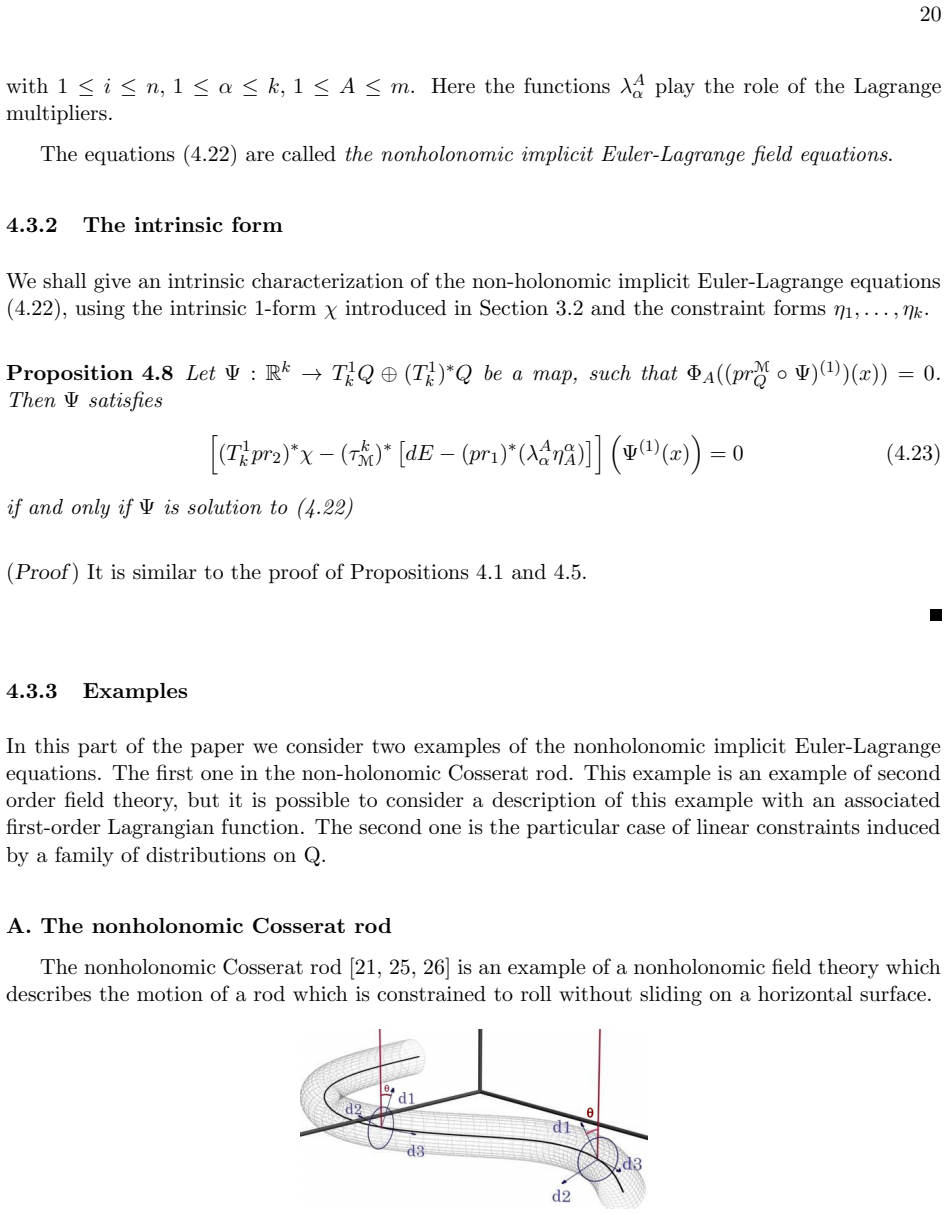
- The non-holonomic Cosserat rod provides another demonstration of the approach.
- The Hamiltonian case is addressed when the Lagrangian is hyperregular.
Where Pith is reading between the lines
- This suggests that similar extensions could handle other singular systems in continuum mechanics.
- Connections to geometric mechanics might be explored for broader applications in field theories.
- Further work could test the method on additional examples with non-holonomic constraints.
Load-bearing premise
The derivations from mechanics extend validly to field theories for singular Lagrangians.
What would settle it
Finding a singular Lagrangian field theory where the extended Tulczyjew intrinsic equations do not match the expected physical behavior would disprove the extension.
Figures
read the original abstract
This work presents the variational principles and the intrinsic versions of several equations in field theories, in particular, for the Classical Euler-Lagrange field equations, the implicit Euler-Lagrange field equations and the non-holonomic implicit Euler-Lagrange field equations. The advantages of the variational and intrinsic versions of these equations is that the Lagrangians functions are not necessary regular Lagrangians. We present two examples of this situation: Navier's equations and the non-holonomic Cosserat rod. Finally we comment the Hamiltonian case when the Lagrangian is a hyperregular function.
Editorial analysis
A structured set of objections, weighed in public.
Referee Report
Summary. The paper extends Tulczyjew's geometric constructions via Tulczyjew triples on jet bundles to obtain variational principles and intrinsic formulations of the classical Euler-Lagrange field equations, the implicit Euler-Lagrange field equations, and the non-holonomic implicit Euler-Lagrange field equations. It claims these formulations remain valid without requiring regular Lagrangians, supplies explicit derivations for the field-theoretic setting, and illustrates the approach with Navier's equations (treated implicitly) and the non-holonomic Cosserat rod; a brief comment addresses the Hamiltonian side restricted to the hyperregular case.
Significance. If the derivations hold, the work supplies a geometric framework that handles singular Lagrangians in classical field theory, a setting common in applications. Credit is due for the explicit field-theoretic derivations and the two concrete examples, which directly support the central claim that the constructions do not presuppose regularity.
minor comments (2)
- [Introduction] The introduction would benefit from an explicit statement of the main result (e.g., a numbered theorem summarizing the intrinsic non-holonomic equations) to make the logical structure clearer before the examples.
- Notation for the jet-bundle constructions and the Tulczyjew triple should be collected in a short preliminary section or table to aid readers unfamiliar with the mechanics case.
Simulated Author's Rebuttal
We thank the referee for the positive summary, recognition of the significance for singular Lagrangians in field theory, and the recommendation of minor revision. No specific major comments were provided in the report.
Circularity Check
No significant circularity detected
full rationale
The manuscript extends Tulczyjew's established geometric constructions (Tulczyjew triples on jet bundles) to derive intrinsic variational formulations of the implicit and non-holonomic Euler-Lagrange field equations. These derivations are presented as direct mathematical extensions without any self-definitional loops, fitted parameters renamed as predictions, or load-bearing self-citations that reduce the central claims to unverified inputs. The examples (Navier's equations and Cosserat rod) serve as concrete applications rather than circular validations. The Hamiltonian discussion is explicitly restricted and non-load-bearing. The work is self-contained against external benchmarks from prior independent literature, consistent with the default expectation of no circularity for such theoretical extensions.
Axiom & Free-Parameter Ledger
axioms (1)
- standard math Standard axioms of differential geometry and variational calculus are assumed to hold for the intrinsic formulations.
Reference graph
Works this paper leans on
-
[1]
S.S. Antman. Non-linear Problems of Elasticity. Appl. Math. Sci. , vol. 107, Springer-Verlag, New York, 1995
work page 1995
-
[2]
A. Awane. k-symplectic structures. J. Math. Phys. 33 (1992), no.12, 4046–4052
work page 1992
-
[3]
J.F. Cari˜ nena, M. Crampin and L.A. Ibort. On the multisymplectic formalism for first order field theories. Differential Geom. Appl. 1 (1991), no. 4, 345–374
work page 1991
-
[4]
M. de Le´ on, D. Mart´ ın de Diego, M. Salgado and S. Vilari˜ no. Non-holonomic constraints in k-symplectic classical field theories. Int. J. Geom. Methods Mod. Phys. vol 5, no 5. (2008), 799-830. 28
work page 2008
-
[5]
M. de Le´ on, E. Merino and M. Salgado.k-cosymplectic manifolds and Lagrangian field theories. J. Math. Phys. 42 (2001), no. 5, 2092–2104
work page 2001
-
[6]
M. de Le´ on, M. Salgado and S. Vilari˜ no.Methods of Differential Geometry in Classical Field Theories: k-symplectic and k-cosymplectic Approaches . World Scientific, 2015
work page 2015
-
[7]
A. Echeverr´ ıa-Enr´ ıquez, M.C. Mu˜ noz-Lecanda and N. Rom´ an-Roy. Geometry of Lagrangian first-order Classical Field Theories. Fortschr. Phys. 44 (1996), no. 3, 235–280
work page 1996
- [8]
- [9]
- [10]
-
[11]
M.E. Gurtin. An Introduction to Continuum Mechanics . Academic Press, New York, 1981
work page 1981
-
[12]
I.V. Kanatchikov. Canonical structure of classical field theory in the polymomentum phase space. Rep. Math. Phys. 41 (1998), no. 1, 49–90
work page 1998
-
[13]
J. Kijowski and W.M. Tulczyjew. A symplectic framework for field theories . Lecture Notes in Physics, 107. Springer-Verlag, Berlin-New York, 1979
work page 1979
-
[14]
F. Munteanu, A.M. Rey and M. Salgado. The G¨ unther’s formalism in classical field theory: momentum map and reduction. J. Math. Phys. 45 (2004), no. 5, 1730–1751
work page 2004
-
[15]
L.K. Norris. n-symplectic algebra of observables in covariant Lagrangian field theory. J. Math. Phys. 42 (2001), no. 10, 4827–4845
work page 2001
-
[16]
A.M. Rey, N. Rom´ an-Roy, M. Salgado and S. Vilari˜ no. k-Cosymplectic Classical Field Theories: Tulczyjew and Skinner-Rusk Formulations. Math. Phys. Anal. Geom. Vol. 15 , 2012
work page 2012
-
[17]
N. Rom´ an-Roy, M. Salgado and S. Vilari˜ no. Symmetries and conservation laws in the G¨ unther k-symplectic formalism of field theory. Rev. Math. Phys. 19 (2007), no. 10, 1117–1147
work page 2007
-
[18]
P. Olver. Lecture Notes: The Calculus of Variations . http://www-users.math.umn.edu/ ~olver/ln_/cv.pdf
-
[19]
G. Sardanashvily. Gauge theory in jet manifolds. Hadronic Press Monographs in Applied Math- ematics. Hadronic Press, Inc., Palm Harbor, FL, 1993
work page 1993
- [20]
-
[21]
J. Spillmann and M. Teschner. CORDE: Cosserat Rod Elements for the Dynamic Simulation of One-Dimensional Elastic Object, Eurographics/ ACM SIG- GRAPH Symposium on Computer Animation (2007), pp. 110 29
work page 2007
- [22]
- [23]
- [24]
-
[25]
J. Vankerschaver. Euler-Poincar´ e reduction for discrete field theories.J. Math. Phys. 48 (2007), no. 3, 032902, 17 pp
work page 2007
-
[26]
J. Vankerschaver and D. Mart´ ın de Diego, Symmetry aspects of nonholo-nomic field theories. J. Phys. A: Math. Theor. 41 (3) (2008), 035401
work page 2008
-
[27]
J. Vankerschaver, H. Yoshimura and M. Leok. The Hamilton-Pointryagin principle and multi- Dirac structures for classical field theories. J. Math. Phys. 53 (2012), 072903
work page 2012
-
[28]
H. Yoshimura and J.E. Marsden. Dirac Structures in Lagrangian Mechanics. Part I: Implicit Lagrangian Systems. J. Geom. Phys. 57,(2006), 133–156
work page 2006
-
[29]
H. Yoshimura and J.E. Marsden. Dirac Structures in Lagrangian Mechanics. Part II: Varia- tional Structures. J. Geom. Phys. 57,(2006), 209–250
work page 2006
discussion (0)
Sign in with ORCID, Apple, or X to comment. Anyone can read and Pith papers without signing in.