REVIEW 3 major objections 4 minor 51 references
Topological phase control in Mn1-xGexBi2Te4 via spin-orbit coupling and magnetic configuration engineering
T0 review · 3 major / 4 minor · reviewed 2026-08-07 · deepseek-v4-flash
Pith's one-line read Local Mn/Ge substitution can turn AFM MnBi2Te4 into a Weyl semimetal at zero field
desk verdict Solid systematic DFT mapping of Mn1−xGexBi2Te4 phases, but the 'AFM WSM' headline overstates the ferrimagnetic supercell the calculations actually simulate. read the letter →
The pith
A machine-rendered reading of the paper's core claim, the machinery that carries it, and where it could break.
The reading
What carries the argument
The load-bearing object is the local spin-orbital crossing along the $Z'\Gamma Z$ high-symmetry line. The bands that form the Weyl nodes are dominated by Te $p_z$ and Bi $p_z$ states; their relative orbital character, parity, and out-of-plane spin polarization determine whether the crossing is gapless and topologically protected. The second mechanism is the local asymmetric Mn/Ge substitution pattern, which produces the paper's proposed Mn$\downarrow$/Ge/Mn$\downarrow$ ferromagnetic motif between septuple layers, disrupting the AFM background without requiring full ferromagnetic order. Spin-orbit coupling strength $\lambda_{\mathrm{SOC}}$ and uniaxial strain $\gamma_c$ act as the control parameters: compression behaves like stronger SOC and tension like weaker SOC, and either tuning can move the system between Weyl, topological-insulator, and normal-insulator phases through intermediate Dirac-cone stages.
What would settle it
A concrete check: compute or measure the electronic structure of a realistic disordered Mn$_{0.625}$Ge$_{0.375}$Bi$_2$Te$_4$ sample—for example, using random or special-quasirandom supercells while keeping global AFM order—and look for gapless band crossings with opposite $s_z$ spin projections along $\Gamma Z$. If such crossings, and the accompanying Weyl nodes, are absent or washed out under configurational averaging, or if ARPES and zero-field transport in bulk AFM samples at this composition show a gapped spectrum and no anomalous Hall signal, the central claim fails.
Extended reading notes
Core claim
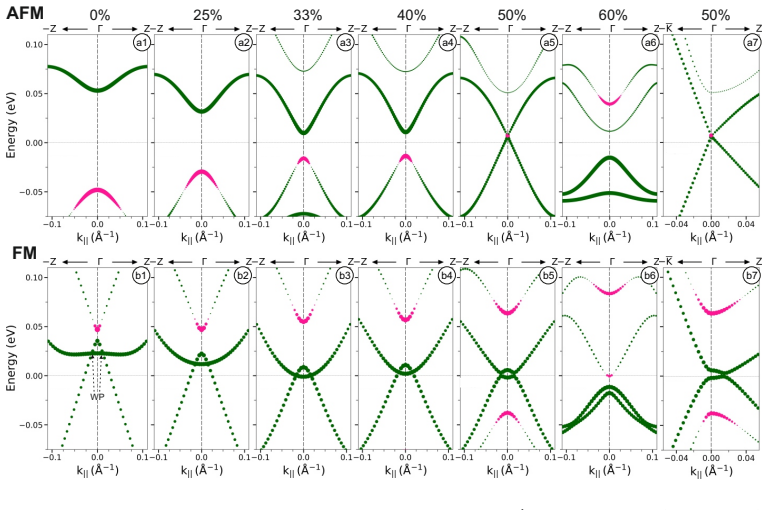
The paper's central discovery, stated on its own terms, is that the Weyl semimetal phase in the MnBi$_2$Te$_4$ family is stabilized by spin-selective band crossings along the $Z'\Gamma Z$ direction: the necessary condition is a gapless crossing between bands with opposite $s_z$ spin projections, and the phase is destroyed when bands of the same spin orientation hybridize and open a gap. In the ferromagnetically coupled phase this condition is already met in pristine MnBi$_2$Te$_4$, and Ge doping at 50% or 33% (depending on substitution arrangement) moves the system through the Weyl phase and eventually into a trivial insulator. In the antiferromagnetic phase, uniform substitution drives a topological-insulator-to-normal-insulator transition through an intermediate Dirac semimetal, but when Mn/Ge substitution is locally uncompensated—all substitution sites in one Mn layer, or inequivalent doping in neighbouring septuple layers—at 37.5% Ge the interlayer Mn$\downarrow$/Mn$\uparrow$/Mn$\downarrow$ stacking is locally replaced by Mn$\downarrow$/Ge/Mn$\downarrow$ ferromagnetic-like couplings, and the system realizes a Weyl semimetal with Weyl nodes along $\Gamma Z$ even without external remagnetization. At 50% Ge the same motif is lost and the Weyl crossings disappear.
Load-bearing premise
The load-bearing premise is that the ordered, uncompensated Mn/Ge substitution patterns used in the $2\times2$ supercells actually occur in real disordered bulk crystals near 37.5% Ge; the paper only asserts these arrangements 'may locally occur,' and if real disorder averages them away, the zero-field Weyl phase would not form.
Editorial extensions
If this is right
- If the 37.5% Ge uncompensated substitution motif is present, a zero-field Weyl semimetal should be observable in AFM Mn$_{1-x}$Ge$_x$Bi$_2$Te$_4$ without first applying a magnetic field to flip the layers.
- Weyl-point separation, and with it the three-dimensional anomalous Hall conductivity proportional to $\Delta k_W$, can be increased by Fe substitution and by choosing Se concentrations in the 3–9% range.
- The same spin-selective hybridization rule predicts that strain and SOC changes can annihilate Weyl nodes and switch the material between Weyl, topological-insulator, and normal-insulator phases, giving two independent tuning knobs.
- The 50% composition should not be Weyl-active despite maximal Mn dilution, because complete substitution removes the local FM-like motif; material growth can target 35–45% Ge instead.
Reading between the lines
- The paper's supercell motifs are idealized; whether real disordered bulk actually hosts enough uncompensated Mn/Ge arrangements to form a coherent zero-field Weyl phase is a statistical question. Sampling many random configurations in large supercells and tracking the Weyl-node survival fraction would test this directly.
- If the local ferromagnetic Mn$\downarrow$/Ge/Mn$\downarrow$ pockets exist inside an AFM background, magnetization measurements at 37.5% Ge should show signatures of local uncompensated moments—for example, remanence, cluster-glass behaviour, or a distinct field-history dependence—even when bulk Néel order persists.
- The Fe- and Se-substitution predictions suggest a tunable compositional series, for example (Mn,Fe)$_{1-x}$Ge$_x$Bi$_2$Te$_{4-y}$Se$_y$, in which the Weyl-point separation could be adjusted continuously; synthesizing such a series and measuring the anomalous Hall angle as a function of composition would provide a direct check.
- Because the paper treats SOC and strain separately, a natural next step is a joint $\lambda_{\mathrm{SOC}}$–$\gamma_c$ phase diagram with phase boundaries in two dimensions; the same spin-orientation criterion should predict where the Weyl phase survives.
Editorial analysis
A structured set of objections, weighed in public.
Referee Report
Summary. The paper uses DFT+U with spin-orbit coupling to study topological phase transitions in Mn1−xGexBi2Te4 as functions of Ge concentration, SOC strength λSOC, and c-axis strain γc, for both AFM and FM interlayer couplings. It reports that the FM phase hosts Weyl points along ΓZ, whose annihilation under SOC/strain tuning drives transitions to trivial or topological insulating phases, and that a WSM can be stabilized in nominally AFM systems at 37.5% Ge via uncompensated Mn/Ge substitution that disrupts interlayer AFM coupling. It further proposes Fe and Se substitution as handles to enlarge the Weyl-point separation and enhance the anomalous Hall effect.
Significance. If correct, the central claim would be notable: a zero-field Weyl semimetal in the MnBi2Te4 family achieved through compositional disorder rather than an external magnetic field would offer a practical route to AHE-based spintronic devices. The paper contains extensive band-structure calculations, parity analyses, spin-resolved dispersions, and systematic phase-boundary maps, and the FM-phase results are consistent with earlier work in this family. However, the zero-field AFM-WSM claim is not yet supported by the presented calculations, for the reasons detailed below; the Weyl identification also lacks topological verification.
major comments (3)
- [§3.3, Figs. 4 and 5] The central 'globally AFM' WSM claim is not actually tested by the calculations. The systems that show Weyl-like crossings are 2×2×2 supercells in which, as the text states, 'substitutions are uncompensated so that there is a nonzero average total magnetization for any pair of adjacent magnetic layers.' A collinear magnetic state with a nonzero net moment per unit cell is ferrimagnetic, not globally antiferromagnetic, and periodic repetition of the supercell imposes long-range ferrimagnetic order. The sentence that such arrangements 'may locally occur in real bulk crystals' does not close this gap: local defects in a translationally invariant AFM host cannot produce coherent Bloch-Weyl nodes, and they do not globally remove the combined P·T symmetry that protects degeneracy in pristine AFM MnBi2Te4. To support the abstract claim, the authors would need to model genuinely compensated AFM configurations and show Weyl points, or explicitly demonstrate that ferrimagnetic domains of this type form percolating ordered regions in the bulk; as written, the novelty claim overstates what the supercell calculation demonstrates.
- [§3.2, §3.3, Figs. 3–5] The identification of Weyl points rests entirely on band crossings along ΓZ with opposite sz spin projections; no Berry-curvature or chiral-charge calculation is presented anywhere in the manuscript. These crossings could be accidental degeneracies or parts of nodal lines, particularly in a system where spin is not a good quantum number. Since the WSM designation and the AHE estimates depend on the nodes being topologically protected, the authors should compute the Berry curvature flux through a small sphere around each node (or otherwise verify a ±1 chirality) and search the full Brillouin zone for additional nodes. The reliance on the authors' own Ref. [22] for the 'opposite chirality' assignment in Fig. 4(a6) is not a substitute for this verification.
- [Abstract and §3.4] The abstract claims a WSM 'even in globally AFM systems, without external remagnetization,' but the supporting calculations are ferrimagnetic ordered supercells, and the proposed Fe/Se substitutions are likewise studied only in these ordered supercells. The conclusion that composition can replace the magnetic field as a route to the WSM is therefore conditional on an unverified assumption about disorder averaging in the real material. This should be stated clearly as a limitation in the abstract and conclusions, or the claim should be narrowed to 'locally uncompensated ordered regions.'
minor comments (4)
- [General] There are several typos and grammatical errors, including 'charactesictic' in §3.2, 'mininum bang gap' in §4, and 'It can done' in §3.4; a careful proofreading pass is needed.
- [§2 and Data Availability] The computational details do not explain how λSOC was numerically scaled in OpenMX, and the Data Availability statement only says data will be available on request; providing the supercell geometries, U values, and input parameters would substantially aid reproducibility.
- [Fig. 5 caption] The caption describes the system as 'P-configuration,' but the text describes an asymmetric 2×2×2 supercell with different substitution concentrations in neighboring SLs; please clarify the geometry to avoid confusion.
- [§3.4] The ΔkW versus magnetic-moment curves in Fig. 6(a4, b4) contain only five data points each; adding intermediate values or convergence checks would make the monotonic trend more convincing.
Circularity Check
Mostly self-contained DFT study; one minor self-citation supplies the WSM chiral-charge confirmation for the central 37.5% Ge AFM case.
-
self citation load bearing
[Section 3.3, Fig. 4 discussion (paragraph beginning 'Confirmation that this dispersion corresponds to the Weyl state...')]
"Confirmation that this dispersion corresponds to the Weyl state is given in Fig. 4(a6) (adapted from [22]), which shows that the branches forming the Weyl points arise from crossings of CB and VB branches, resulting in Weyl nodes with opposite chiralities in the Z′Γ and ΓZ directions. ... As shown in [22], at a Ge concentration of 25%, the Weyl phase does not yet form; it is observed only at 37.5%."
The central 37.5% Ge WSM identification relies on the authors' own prior Ref. [22] for the statement that the observed crossings are Weyl nodes of opposite chirality and for the concentration threshold at which the Weyl phase appears. No chiral-charge or Berry-curvature calculation is presented in this paper to independently confirm the topological character of the crossings. This is a self-citation that completes the WSM labeling, although the band crossings themselves are newly computed here and are not fitted to the target claim.
full rationale
The main derivation chain is not circular: DFT band structures are computed for ordered supercells, the Weyl-point separations ΔkW and spin-resolved crossings are calculated outputs, and the AHE estimate uses the published Burkov formula σ_{xy}^{3D} = (e^2/h)(ΔkW/2π), an external standard relation. The SOC-strain phase boundaries and the Fe/Se substitution trends are parameter sweeps, not fits to the target WSM claim. The only circularity-adjacent element is the reliance on the authors' earlier Ref. [22] to confirm the opposite-chirality Weyl character of the 37.5% Ge crossings and to set the concentration threshold; this is a supporting self-citation rather than an equation-level reduction. The separate concern that the 'globally AFM' wording conflicts with the net-moment ferrimagnetic supercells is a modeling/correctness issue, not a circularity of the derivation.
Assumptions & free parameters
free parameters (5)
- U(Mn) =
5.4 eV
- U(Fe) =
4.5 eV
- Mn/Fe magnetic moment scaling =
3.5 to 5.1 μB
- λSOC multiplier =
0.92 to 1.10
- γc strain ratio =
0.95 to 1.04
assumptions (4)
- domain assumption GGA-PBE+U with the chosen U values correctly describes the correlated Mn/Fe 3d states and band topology of MnBi2Te4-family materials.
- domain assumption Band crossings with opposite sz spin projections along ΓZ are Weyl points with opposite chirality and are topologically protected.
- ad hoc to paper Ordered P/X/asymmetric supercell substitution patterns are representative of the local atomic arrangements in real disordered Mn1-xGexBi2Te4 crystals.
- domain assumption The bulk AHE conductivity is given by σ3D_xy = (e^2/h)(ΔkW/2π).
Cite this review
Pith. "Pith review of Topological phase control in Mn1-xGexBi2Te4 via spin-orbit coupling and magnetic configuration engineering." pith.science (2026). https://pith.science/paper/LUUV3F7T
@misc{pith2026250600511,
  author       = {Pith},
  title        = {Pith review of: Topological phase control in Mn1-xGexBi2Te4 via spin-orbit coupling and magnetic configuration engineering},
  year         = {2026},
  howpublished = {\url{https://pith.science/paper/LUUV3F7T}},
  note         = {Machine review of arXiv:2506.00511}
}
read the original abstract
Magnetic topological systems based on MnBi2Te4 have recently attracted significant attention due to their rich interplay between magnetism and topological electronic states. In this work, using density functional theory (DFT), we investigate topological phase transitions (TPTs) in Mn1-xGexBi2Te4 compounds with both ferromagnetic (FM) and antiferromagnetic (AFM) ordering under variations of spin-orbit coupling (SOC) strength and uniaxial strain along the c axis. We show that the emergence of a Weyl semimetal (WSM) phase requires the crossing of bands with opposite sz spin projections along the {\Gamma}Z direction. Modulation of SOC and strain can annihilate Weyl points via spin-selective hybridization, driving transitions into trivial or topological insulating phases. Furthermore, we demonstrate that local asymmetry in Mn/Ge substitution, particularly at 37.5% Ge concentration (Mn0.625Ge0.375Bi2Te4) can locally disrupt AFM interlayer coupling and induce a WSM state even in globally AFM systems, without external remagnetization. To optimize Weyl point separation and enhance the anomalous Hall effect (AHE), we propose partial substitution of Mn by Fe and Te by Se.
Figures


Figures from the paper (4 more)


Reference graph
Works this paper leans on
-
[22]
A. M. Shikin, N. L. Zaitsev, T. P. Estyunina, D. A. Estyunin, A. G. Rybkin, D. A. Glazkova, I. I. Klimovskikh, A. V. Eryzhenkov, K. A. Kokh, V. A. Golyashov, O. E. Tereshchenko, S. Ideta, Y. Miyai, Y. Ku- mar, T. Iwata, T. Kosa, K. Kuroda, K. Shimada, and A. V. Tarasov, Phase transitions, dirac and weyl semimetal states inMn1−xGexBi2Te4, Sci. Rep.15, 1741 (2025)
work page 2025
- [1]
-
[2]
C. Liu, Y. Wang, H. Li, Y. Wu, Y. Li, J. Li, K. He, Y. Xu, J. Zhang, and Y. Wang, Robust axion insulator and chern insulator phases in a two- dimensional antiferromagnetic topological insulator, Nat. Mater.19, 522 (2020). 24
work page 2020
-
[3]
P. Wang, J. Ge, J. Li, Y. Liu, Y. Xu, and J. Wang, Intrinsic magnetic topological insulators, The Innovation2(2021)
work page 2021
-
[4]
S. Li, T. Liu, C. Liu, Y. Wang, H.-Z. Lu, and X. C. Xie, Progress on the antiferromagnetic topological insulatorMnBi2Te4, National Science Review11, nwac296 (2024)
work page 2024
-
[5]
M. M. Otrokov, I. I. Klimovskikh, H. Bentmann, D. Estyunin, A. Zeugner, Z. S. Aliev, S. Gaß, A. Wolter, A. Koroleva, A. M. Shikin, et al., Prediction and observation of an antiferromagnetic topological insulator, Nature576, 416 (2019)
work page 2019
-
[6]
J.Li, Y.Li, S.Du, Z.Wang, B.-L.Gu, S.-C.Zhang, K.He, W.Duan,and Y. Xu, Intrinsic magnetic topological insulators in van der Waals layered MnBi2Te4-family materials, Science Advances5, eaaw5685 (2019)
work page 2019
- [7]
Show all 51 references
-
[8]
J. Li, C. Wang, Z. Zhang, B.-L. Gu, W. Duan, and Y. Xu, Magnetically controllable topological quantum phase transitions in the antiferromag- netic topological insulatorMnBi2Te4, Phys. Rev. B100, 121103 (2019)
2019
-
[9]
Y. Gong, J. Guo, J. Li, K. Zhu, M. Liao, X. Liu, Q. Zhang, L. Gu, L. Tang, X. Feng,et al., Experimental realization of an intrinsic mag- netic topological insulator, Chinese Physics Letters36, 076801 (2019)
2019
-
[10]
Y. Chen, L. Xu, J. Li, Y. Li, H. Wang, C. Zhang, H. Li, Y. Wu, A. Liang, C. Chen,et al., Topological electronic structure and its temperature evolution in antiferromagnetic topological insulator MnBi2Te4, Physical Review X9, 041040 (2019)
2019
-
[11]
Estyunin, I
D. Estyunin, I. I. Klimovskikh, A. M. Shikin, E. Schwier, M. Otrokov, A. Kimura, S. Kumar, S. Filnov, Z. S. Aliev, M. Babanly,et al., Signa- turesoftemperaturedrivenantiferromagnetictransitionintheelectronic structure of topological insulator MnBi2Te4, APL Materials8, 021105 (...
2020
-
[12]
A. M. Shikin, D. Estyunin, I. I. Klimovskikh, S. Filnov, E. Schwier, S. Kumar, K. Miyamoto, T. Okuda, A. Kimura, K. Kuroda,et al., Na- ture of the Dirac gap modulation and surface magnetic interaction in axion antiferromagnetic topological insulator MnBi2Te4, Scientific Re- po...
2020
-
[13]
Shikin, T
A. Shikin, T. Makarova, A. Eryzhenkov, D. Y. Usachov, D. Estyunin, D. Glazkova, I. Klimovskikh, A. Rybkin, and A. Tarasov, Routes for the topological surface state energy gap modulation in antiferromagnetic MnBi2Te4, Physica B: Condensed Matter649, 414443 (2023)
2023
-
[14]
A. M. Shikin, D. Estyunin, N. L. Zaitsev, D. Glazkova, I. I. Klimovskikh, S. Filnov, A. G. Rybkin, E. Schwier, S. Kumar, A. Kimura,et al., Sample-dependent Dirac-point gap in MnBi2Te4 and its response to ap- plied surface charge: A combined photoemission andab initiostudy, Phy...
2021
-
[15]
Y. Deng, Y. Yu, M. Z. Shi, Z. Guo, Z. Xu, J. Wang, X. H. Chen, and Y. Zhang, Quantum anomalous Hall effect in intrinsic magnetic topological insulator MnBi2Te4, Science367, 895 (2020)
2020
-
[16]
Qian, Y.-T
T. Qian, Y.-T. Yao, C. Hu, E. Feng, H. Cao, I. I. Mazin, T.-R. Chang, and N. Ni, Magnetic dilution effect and topological phase transitions in (Mn1−xPbx)Bi2Te4, Physical Review B106, 045121 (2022)
2022
-
[17]
Changdar, S
S. Changdar, S. Ghosh, K. Vijay, I. Kar, S. Routh, P. Maheshwari, S. Ghorai, S. Banik, and S. Thirupathaiah, Nonmagnetic Sn doping ef- fect on the electronic and magnetic properties of antiferromagnetic topo- logical insulator MnBi2Te4, Physica B: Condensed Matter657, 414799 (2023)
2023
-
[18]
J. Zhu, M. Naveed, B. Chen, Y. Du, J. Guo, H. Xie, and F. Fei, Mag- netic and electrical transport study of the antiferromagnetic topological insulator Sn-doped MnBi2Te4, Physical Review B103, 144407 (2021)
2021
-
[19]
A. V. Tarasov, T. P. Makarova, D. A. Estyunin, A. V. Eryzhenkov, I. I. Klimovskikh, V. A. Golyashov, K. A. Kokh, O. E. Tereshchenko, and A. M. Shikin, Topological phase transitions driven by Sn doping in Mn1−xSnxBi2Te4, Symmetry15, 469 (2023). 26
2023
-
[20]
T. P. Estyunina, A. M. Shikin, D. A. Estyunin, A. V. Eryzhenkov, I. I. Klimovskikh, K. A. Bokai, V. A. Golyashov, K. A. Kokh, O. E. Tereshchenko, S. Kumar,et al., Evolution of Mn1−xGexBi2Te4 electronic structure under variation of Ge content, Nanomaterials13, 2151 (2023)
2023
-
[21]
A. S. Frolov, D. Y. Usachov, A. V. Tarasov, A. V. Fedorov, K. A. Bokai, I. Klimovskikh, V. S. Stolyarov, A. I. Sergeev, A. N. Lavrov, V. A. Golyashov,et al., Magnetic Dirac semimetal state of (Mn, Ge)Bi2Te4, Communications Physics7, 180 (2024)
2024
-
[23]
D. A. Estyunin, T. P. Estyunina, I. I. Klimovskikh, K. A. Bokai, V. A. Golyashov, K. A. Kokh, O. E. Tereshchenko, S. Ideta, Y. Miyai, Y. Kumar, T. Iwata, T. Kosa, T. Okuda, K. Miyamoto, K. Kuroda, K. Shimada, and A. M. Shikin, The electronic structure ofMn 1−xPbxBi2Te4: Experi...
2024 arXiv
-
[24]
D. A. Estyunin, A. A. Rybkina, K. A. Kokh, O. E. Tereshchenko, M. V. Likholetova, I. I. Klimovskikh, and A. M. Shikin, Comparative study of magnetic properties of Mn1−xaIV x Bi2Te4 (aIV =Ge,Pb,Sn), Magne- tochemistry9, 210 (2023)
2023
-
[25]
N. P. Armitage, E. J. Mele, and A. Vishwanath, Weyl and Dirac semimetals in three-dimensional solids, Reviews of Modern Physics90, 015001 (2018)
2018
-
[26]
B. Q. Lv, T. Qian, and H. Ding, Experimental perspective on three- dimensional topological semimetals, Reviews of Modern Physics93, 025002 (2021)
2021
-
[27]
M. Z. Hasan, G. Chang, I. Belopolski, G. Bian, S.-Y. Xu, and J.-X. Yin, Weyl, dirac and high-fold chiral fermions in topological quantum matter, Nat. Rev. Mater.6, 784 (2021). 27
2021
-
[28]
Yan and C
B. Yan and C. Felser, Topological materials: Weyl semimetals, Annu. Rev. Condens. Matter Phys.8, 337 (2017)
2017
-
[29]
Shen, Topological dirac and weyl semimetals, inTopological In- sulators: Dirac Equation in Condensed Matter, edited by S.-Q
S.-Q. Shen, Topological dirac and weyl semimetals, inTopological In- sulators: Dirac Equation in Condensed Matter, edited by S.-Q. Shen (Springer, Singapore, 2017) pp. 207–229
2017
-
[30]
Kar and A
S. Kar and A. M. Jayannavar, A primer on weyl semimetals: Down the discovery of topological phases, Asian J. Res. Rev. Phys. , 34 (2021)
2021
-
[31]
Belopolski, R
I. Belopolski, R. Watanabe, Y. Sato, R. Yoshimi, M. Kawamura, S. Na- gahama, Y. Zhao, S. Shao, Y. Jin, Y. Kato, Y. Okamura, X.-X. Zhang, Y. Fujishiro, Y. Takahashi, M. Hirschberger, A. Tsukazaki, K. S. Taka- hashi, C.-K. Chiu, G. Chang, M. Kawasaki, N. Nagaosa, and Y. Tokura, ...
2025
-
[32]
Wang, Chemical requirements for stabilizing type-II weyl points in MnBi2−xSbxTe4 (2021), arXiv:2103.12730 [cond-mat]
Y. Wang, Chemical requirements for stabilizing type-II weyl points in MnBi2−xSbxTe4 (2021), arXiv:2103.12730 [cond-mat]
2021 arXiv
-
[33]
Chowdhury, K
S. Chowdhury, K. F. Garrity, and F. Tavazza, Prediction of Weyl semimetal and antiferromagnetic topological insulator phases in Bi2MnSe4, npj Computational Materials5, 33 (2019)
2019
-
[34]
Zhang, W
H. Zhang, W. Yang, Y. Wang, and X. Xu, Tunable topological states in layered magnetic materials of MnSb2Te4, MnBi2Se4, and MnSb2Se4, Physical Review B103, 094433 (2021)
2021
-
[35]
L. Zhou, Z. Tan, D. Yan, Z. Fang, Y. Shi, and H. Weng, Topological phase transition in the layered magnetic compound MnSb2Te4: Spin- orbit coupling and interlayer coupling dependence, Physical Review B 102, 085114 (2020)
2020
-
[36]
P. Li, J. Yu, Y. Wang, and W. Luo, Electronic structure and topo- logical phases of the magnetic layered materialsMnBi2Te4,MnBi 2Se4, MnSb2Te4, Physical Review B103, 155118 (2021)
2021
-
[37]
W.-T. Guo, N. Yang, Z. Huang, and J.-M. Zhang, Novel magnetic topo- logical insulatorFeBi 2Te4 with controllable topological quantum phase, J. Mater. Chem. C11, 12307 (2023). 28
2023
-
[38]
Ozaki, Variationally optimized atomic orbitals for large-scale elec- tronic structures, Physical Review B67, 155108 (2003)
T. Ozaki, Variationally optimized atomic orbitals for large-scale elec- tronic structures, Physical Review B67, 155108 (2003)
2003
-
[39]
Ozaki and H
T. Ozaki and H. Kino, Numerical atomic basis orbitals from H to Kr, Physical Review B69, 195113 (2004)
2004
-
[40]
Ozaki and H
T. Ozaki and H. Kino, Efficient projector expansion for theab initio LCAO method, Physical Review B72, 045121 (2005)
2005
-
[41]
Troullier and J
N. Troullier and J. L. Martins, Efficient pseudopotentials for plane-wave calculations, Physical Review B43, 8861 (1991)
1991
-
[42]
J. P. Perdew, K. Burke, and M. Ernzerhof, Generalized gradient approx- imation made simple, Physical Review Letters77, 3865 (1996)
1996
-
[43]
M. J. Han, T. Ozaki, and J. Yu,O(n)LDA+uelectronic structure calcu- lation method based on the nonorthogonal pseudoatomic orbital basis, Phys. Rev. B73, 45110 (2006)
2006
-
[44]
S. L. Dudarev, G. A. Botton, S. Y. Savrasov, C. J. Humphreys, and A. P. Sutton, Electron-energy-loss spectra and the structural stability of nickel oxide: An lsda+ustudy, Physical Review B57, 1505 (1998)
1998
-
[45]
R. Yang, X. Man, J. Peng, J. Zhang, F. Wang, F. Wang, H. Zhang, and X. Xu, SeptupleXBi 2Te4 (X=Ge, Sn, Pb) intercalatedMnBi 2Te4 for realizing interlayer ferromagnetism and quantum anomalous hall effect, npj Quantum Mater.10, 1 (2025)
2025
-
[46]
A. V. Tarasov, D. A. Estyunin, A. G. Rybkin, A. S. Frolov, A. I. Sergeev, A. V. Eryzhenkov, V. V. Anferova, T. P. Estyunina, D. A. Glazkova, K. A. Kokh, V. A. Golyashov, O. E. Tereshchenko, S. Ideta, Y. Miyai, Y. Kumar, K. Shimada, and A. M. Shikin, Probing the interaction be-...
2025
-
[47]
Shikin, T
A. Shikin, T. Estyunina, A. Eryzhenkov, N. Zaitsev, and A. Tarasov, Topological phase transition in the antiferromagnetic topological insu- lator MnBi2Te4 from the point of view of axion-like state realization, Scientific Reports13, 16343 (2023). 29
2023
-
[48]
Shikin, T
A. Shikin, T. Estyunina, A. Eryzhenkov, N. Zaitsev, and A. Tarasov, Study of the relationship between topological phase transition, axion- like state, and magnetoelectric effect in an antiferromagnetic topological insulator MnBi2Te4, JETP (russian)165, 544 (2024)
2024
-
[49]
A. A. Burkov, Anomalous hall effect in weyl metals, Physical Review Letters113, 187202 (2014)
2014
-
[50]
I. I. Klimovskikh, M. M. Otrokov, D. Estyunin, S. V. Eremeev, S. O. Filnov, A. Koroleva, E. Shevchenko, V. Voroshnin, A. G. Rybkin, I. P. Rusinov, M. Blanco-Rey, M. Hoffmann, Z. S. Aliev, M. B. Babanly, I. R. Amiraslanov, N. A. Abdullayev, V. N. Zverev, A. Kimura, O. E. Teresh...
2020
-
[51]
Šmejkal, Y
L. Šmejkal, Y. Mokrousov, B. Yan, and A. H. MacDonald, Topological antiferromagnetic spintronics, Nature Physics14, 242 (2018). 30
2018
Reviewed August 7, 2026 · model on record in the stance chip above.
Discussion (0). Sign in to comment.