REVIEW 4 major objections 6 minor 6 references
From Global to Local: Learning Context-Aware Graph Representations for Document Classification and Summarization
T0 review · 4 major / 6 minor · reviewed 2026-08-03 · deepseek-v4-flash
Pith's one-line read Document graphs built from sliding-window attention match or beat full-attention graphs at a fraction of the computational cost, with unfiltered local edges working best on medium-length documents.
desk verdict SWA graph construction is a modest but real win on medium-length documents; the computational-efficiency claim is not supported by the paper's own numbers. read the letter →
The pith
A machine-rendered reading of the paper's core claim, the machinery that carries it, and where it could break.
The reading
What carries the argument
The load-bearing object is the sliding-window attention (SWA) module, a multi-head self-attention layer where each sentence embedding attends only to sentences within a window defined as a percentage of document length. The attention weights, optionally transformed by a nonlinear activation (softmax, ReLU, sigmoid, or annealed softmax) and optionally pruned by row-wise mean-bound or max-bound thresholds, become edge weights of an undirected sentence graph; sentence nodes with identical embeddings are merged, and self-loops are redistributed to neighbors. A Graph Attention Network trained from scratch on that graph performs classification or sentence labeling. The window converts global quadr
What would settle it
Run the same sliding-window attention graph construction and GAT training on BBC, HND, and AX under the exact splits and preprocessing used for the baselines, and compare with independently reproduced full-attention graphs. If unfiltered SWA graphs do not beat or match the best full-attention graphs on BBC/HND, or if the gap on AX grows well beyond the reported 0.3 F1, the paper's central claim is falsified.
Extended reading notes
Core claim
The central claim is that a data-driven document graph can be induced from local, sliding-window attention rather than global self-attention without sacrificing, and in some settings improving, task performance. Concretely, on BBC News and Hyperpartisan News Detection, unfiltered sliding-window attention graphs give the best GAT classification results, outperforming both heuristic graphs and full-attention graphs; on arXiv classification they remain competitive, trailing the strongest full-attention graph by 0.3 F1 while beating all heuristics. On summarization, the induced graphs identify sentences near the semantic center of document clusters but over-predict summary-worthy sentences, so t
Load-bearing premise
The central comparison assumes that the previously reported full-attention and heuristic baseline results were obtained under exactly the same dataset splits, preprocessing, and evaluation protocol; if that assumption fails, the improvements claimed on the three classification datasets could be smaller or disappear.
Editorial extensions
If this is right
- On BBC and HND, unfiltered sliding-window attention graphs give the best classification accuracy, outperforming both heuristic graphs and full-attention-induced graphs; the improvement on HND is roughly 1–3 points.
- Replacing full self-attention with sliding-window attention changes graph construction from quadratic to linear cost in sentence count, and the resulting GAT models are shallow, reducing computational requirements.
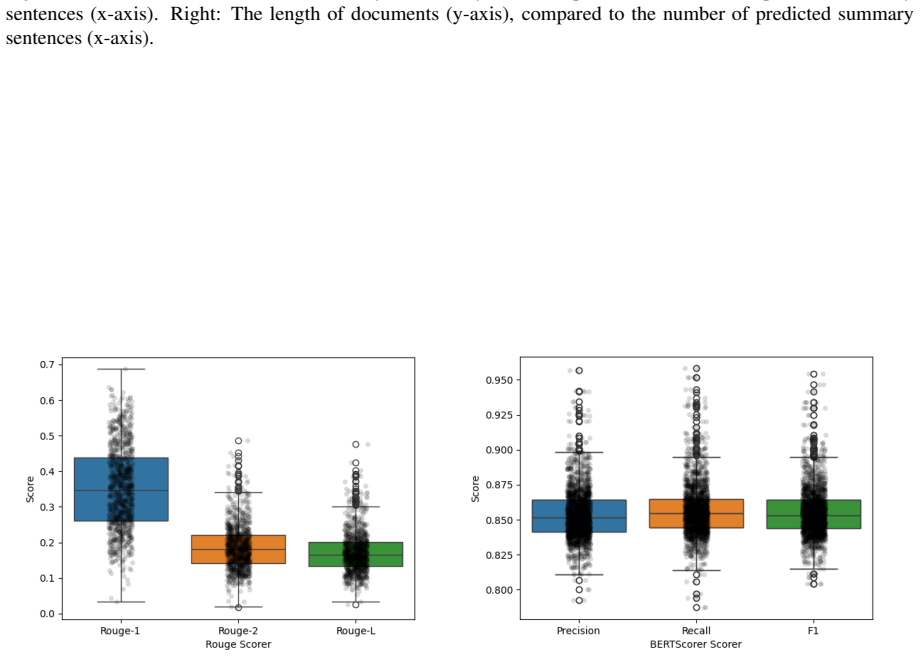
- The same induced graphs, used for extractive summarization, achieve high BERTScore to reference summaries but lower oracle-label F1 than order-based baselines, indicating the graphs capture semantic centrality, not the precise oracle selection pattern.
- GAT classifiers trained on the induced graphs consistently outperform the standalone sliding-window attention classifiers used to produce the graphs, so converting attention to graph structure adds value beyond the transformer representation alone.
- Window size matters only mildly: on HND, 10% and 50% windows are statistically indistinguishable, so the method does not hinge on a precisely tuned context width.
Reading between the lines
- Because unfiltered local edges help on medium-length documents, an adaptive sparsifier that keeps weak local edges while pruning weak global ones may outperform both all-or-nothing filtering regimes used here; this is directly testable on the same datasets.
- The linear complexity of sliding-window graph construction suggests the approach could scale to documents of thousands of sentences where full attention is infeasible; a natural test is the same pipeline on a long-document benchmark with 500+ sentences per document.
- The summarization result implies that the same graphs could support extractive summarization better with a redundancy-aware, ranking-based, or calibrated-threshold objective; replacing the binary sentence classifier is a concrete next experiment.
- The paper's comparisons to prior full-attention graphs reuse previously reported numbers; independent reproduction under identical splits and preprocessing would be the cleanest way to confirm the magnitude of the claimed gains.
Editorial analysis
A structured set of objections, weighed in public.
Referee Report
Summary. This paper extends the graph-structure-learning framework of Bugueño and de Melo (2025) by replacing full self-attention with dynamic sliding-window attention. Sentence embeddings are fed to a multi-head SWA model, the resulting attention weights are thresholded (or not) to build document graphs, and GAT models are trained on these graphs for document classification (BBC, HND, AX) and, exploratorily, extractive summarization (GovReport). The authors report that SWA-induced graphs outperform heuristic and full-attention baselines on two medium-length datasets, are competitive on a long-document dataset, and claim lower computational resource requirements. They also study activation functions, statistical filtering, window size, and provide an analysis of the summarization setup.
Significance. If the efficiency and accuracy claims were fully supported, the paper would offer a practical simplification of learned graph construction for document classification, with a useful analysis of local versus global attention. The strengths include a public implementation, multiple independent runs (five per configuration), statistical tests for internal variant comparisons (ANOVA/Tukey HSD), a window-size ablation, and an honest exploratory summarization evaluation that does not overstate its findings. However, the central efficiency claim is contradicted by the paper's own structural statistics, and the comparisons against prior work rely on previously published point estimates without significance testing or explicit verification of identical protocols. The empirical contribution is therefore real but currently overstated.
major comments (4)
- [Abstract; §5.1; §5.2; Table 2] The claim that the method 'require[s] lower computational resources than previous approaches' is not supported—and in the best-performing configurations is contradicted—by the reported data. On BBC and HND, the best SWA configurations are the unfiltered graphs, with average degrees of 27.8 and 41.6 and 540.8/842.7 edges, versus 9.5/8.9 and 245.8/329.6 for the best full-attention baselines; the BBC disk size is also larger (109 M vs 90 M). On AX, the best SWA result (mean-bound) has 14,662.3 edges and 40 GB storage versus 1,092.2 edges and 25 GB for the full-attention max-bound baseline, and is 0.3 F1 lower. Only the mean-bound SWA graphs on BBC/HND are cheaper, but they are not the best-performing variants. The paper reports no wall-clock time or peak-memory measurements, so graph edge/disk counts are an incomplete proxy. The efficiency claim should be either removed, substantially weake
- [§5.1; Table 2; Appendix C] The reported gains over the full-attention and heuristic baselines are point estimates without confidence intervals or significance tests. The text states that the unfiltered SWA graphs yield 'statistically significant gains (p < 0.05)', but the ANOVA/Tukey analyses in Appendix C compare only the SWA variants among themselves; they do not include the Bugueño and de Melo (2025) baseline runs. Without per-run results for the baselines, or a paired test under identical conditions, the significance claim cannot be verified. Please either provide the baseline runs with the same protocol and perform a proper statistical comparison, or report effect sizes/error bars for all entries in Table 2.
- [§4.1; Table 2] The comparison to Bugueño and de Melo (2025) reuses published numbers from that paper. Section 4.1 states that the datasets are reused to ensure 'direct comparability', but it does not specify that the train/validation/test splits, preprocessing (e.g., sentence tokenization, embedding model, truncation), and evaluation protocol are identical to those used in the cited work. If any of these differ, the claimed improvements over the baselines could disappear. Please state the exact split and preprocessing protocol, or rerun the baselines in the same codebase.
- [§5.3; Table 3; Table 5] The main experiments use a window size of 30%, but the ablation on HND shows that window size 30 is consistently and statistically significantly worse than window sizes 10, 20, 40, and 50. The paper interprets this as making the main results 'conservative', yet it also means the headline improvements were obtained with a suboptimal hyperparameter while better settings exist. This does not invalidate the approach, but it should be made more prominent in the main text and reflected in the interpretation of the absolute gains.
minor comments (6)
- [§3.1, Eq. (3)] The definition 'd = dim(A − 1)' is confusing. Presumably d is the last dimension of A (i.e., A.shape[-1]). Please clarify the notation.
- [§5.4] The text refers to 'the results in Table 10' but the main-text GR results appear in Table 4. Table 10 is the appendix table. Please correct the cross-reference.
- [References] The citation 'Waswani et al. (2017)' should be 'Vaswani et al. (2017)'.
- [§3.1] The method operates on sentences, but the text repeatedly says 'tokens within the window'. Please use consistent terminology.
- [§5.1] There is a typo: 'These results exreveal' should be 'These results reveal'.
- [§5.1] The sentence 'The main limitation of these locally-aware graphs is that it cannot directly model dependencies' has a subject-verb agreement issue.
Circularity Check
No circular derivation; the method is an empirical evaluation with self-cited baselines that constitute independent evidence.
full rationale
This paper does not contain a derivation chain in which an output is defined in terms of its own input. The core pipeline is: sentence embeddings are encoded, sliding-window attention (SWA) weights are learned, graphs are built from thresholded attention weights, and GATs are trained on those graphs and evaluated on held-out test data. The attention weights are used to construct graph structure, not to directly produce the final classification, so the GAT evaluation is not a renaming of the SWA outputs. No parameter is fitted to a target quantity and then reported as a prediction of that same quantity. The reuse of Bugueño and de Melo (2025) full-attention and heuristic baseline numbers is a self-citation, but it is not load-bearing in the circularity sense: these are external empirical results independently produced in prior work, and the current paper's own Table 2 and statistical tests provide new evidence for its claims. The efficiency claim may be weakened by the density figures in Table 2 and the absence of runtime measurements, but that is an evidence-strength and correctness concern, not a circularity concern. The paper also honestly reports limitations, including the summary evaluation being against oracle labels only and the absence of broad domain coverage. No circular step meeting the required evidentiary standard was found.
Assumptions & free parameters
free parameters (3)
- attention window size =
30% of document length (main experiments); ablated 10-50%
- tolerance degree δ =
0.5 (all settings), 1.0 for AX mean-bound
- annealing rate λ =
0.0004 per batch
assumptions (4)
- domain assumption Sentence embeddings from frozen paraphrase-MiniLM-L6-v2 capture sufficient semantic information for sentence-level attention.
- domain assumption Attention weights from a shallow task-trained SWA model express meaningful semantic dependencies between sentences.
- domain assumption The datasets, splits, and evaluation protocol are identical to Bugueño and de Melo (2025) for the reused baselines.
- domain assumption Row-wise mean-bound and max-bound filtering with a tolerance degree generalizes from prior work.
Cite this review
Pith. "Pith review of From Global to Local: Learning Context-Aware Graph Representations for Document Classification and Summarization." pith.science (2026). https://pith.science/paper/LV4EMN7C
@misc{pith2026260300021,
  author       = {Pith},
  title        = {Pith review of: From Global to Local: Learning Context-Aware Graph Representations for Document Classification and Summarization},
  year         = {2026},
  howpublished = {\url{https://pith.science/paper/LV4EMN7C}},
  note         = {Machine review of arXiv:2603.00021}
}
read the original abstract
Recent NLP systems commonly represent documents as linear token sequences. Although this captures sequential order, it can hinder modeling long-range dependencies and global document structure, especially for long texts. This paper proposes a data-driven method to automatically construct graph-based document representations. Building upon the recent work of Bugue\~no and de Melo (2025), we leverage the dynamic sliding-window attention module to effectively capture local and mid-range semantic dependencies between sentences, as well as structural relations within documents. Graph Attention Networks (GATs) trained on our learned graphs achieve competitive results on document classification while requiring lower computational resources than previous approaches. We further present an exploratory evaluation of the proposed graph construction method for extractive document summarization, highlighting both its potential and current limitations. The implementation of this project can be found on GitHub.
Figures


Figures from the paper (5 more)



Reference graph
Works this paper leans on
-
[6]
Dongsheng Wang, Zhiqiang Ma, Armineh Nourbakhsh, Kang Gu, and Sameena Shah
Graph attention networks.arXiv preprint arXiv:1710.10903. Dongsheng Wang, Zhiqiang Ma, Armineh Nourbakhsh, Kang Gu, and Sameena Shah. 2023. Docgraphlm: Documental graph language model for information extraction. InProceedings of the 46th International ACM SIGIR Conference on Research and Develop- ment in Information Retrieval, pages 1944–1948. Kunze Wang,...
arXiv 2023
-
[2007]
Jun He, Liqun Wang, Liu Liu, Jiao Feng, and Hao Wu
Random walk term weighting for improved text classification.International Journal of Semantic Computing, 1(04):421–439. Jun He, Liqun Wang, Liu Liu, Jiao Feng, and Hao Wu
-
[2017]
Activation functions in neural networks.To- wards Data Sci, 6(12):310–316. John W Tukey. 1949. Comparing individual means in the analysis of variance.Biometrics, pages 99–114. Aaron Van Den Oord, Sander Dieleman, Heiga Zen, Karen Simonyan, Oriol Vinyals, Alex Graves, Nal Kalchbrenner, Andrew Senior, Koray Kavukcuoglu, and 1 others. 2016. Wavenet: A genera...
arXiv 1949
-
[2019]
Yilun Hua, Zhaoyuan Deng, and Kathleen McKeown
Long document classification from local word glimpses via recurrent attention learning.IEEE Ac- cess, 7:40707–40718. Yilun Hua, Zhaoyuan Deng, and Kathleen McKeown
-
[2022]
InProceedings of the 29th international conference on computational linguis- tics, pages 1163–1168
Contexting: granting document-wise contex- tual embeddings to graph neural networks for induc- tive text classification. InProceedings of the 29th international conference on computational linguis- tics, pages 1163–1168. G Thomas Hudson and Noura Al Moubayed. 2022. Muld: The multitask long document benchmark. arXiv preprint arXiv:2202.07362. Johannes Kies...
arXiv 2022
-
[2023]
InFindings of the As- sociation for Computational Linguistics: ACL 2023, pages 13851–13883
Improving long dialogue summarization with semantic graph representation. InFindings of the As- sociation for Computational Linguistics: ACL 2023, pages 13851–13883. Luyang Huang, Shuyang Cao, Nikolaus Parulian, Heng Ji, and Lu Wang. 2021. Efficient attentions for long document summarization.arXiv preprint arXiv:2104.02112. Yen-Hao Huang, Yi-Hsin Chen, an...
arXiv 2023
Reviewed August 3, 2026 · model on record in the stance chip above.
Discussion (0). Sign in to comment.