Fractional excitations in Kitaev quasi-one-dimensional chain
Pith reviewed 2026-06-26 15:27 UTC · model grok-4.3
The pith
A truncated honeycomb geometry produces a Kitaev spin chain whose Majorana bands host a topological transition to a chiral phase with protected edge modes and fractional excitations.
A machine-rendered reading of the paper's core claim, the machinery that carries it, and where it could break.
Core claim
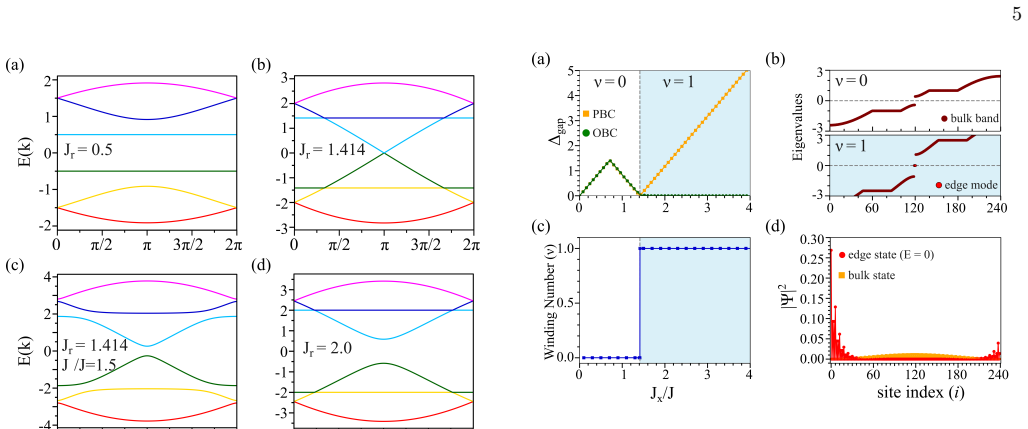
The model derived from a truncated honeycomb geometry realizes a Kitaev-like chain whose Majorana spectrum features flat and dispersive bands separated by a gap-closing transition; under open boundaries the topological phase supports chiral-symmetry-protected zero modes and its dynamical correlations display signatures of fractionalized excitations together with edge-mode weight.
What carries the argument
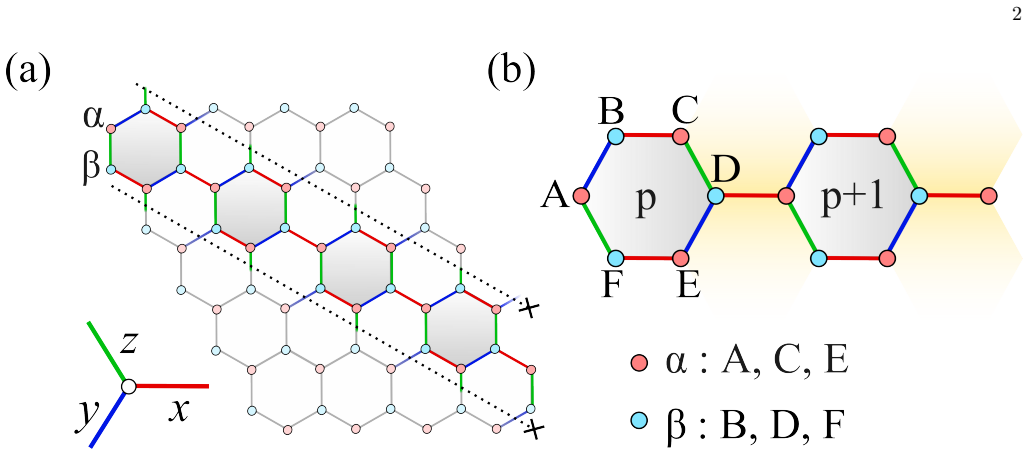
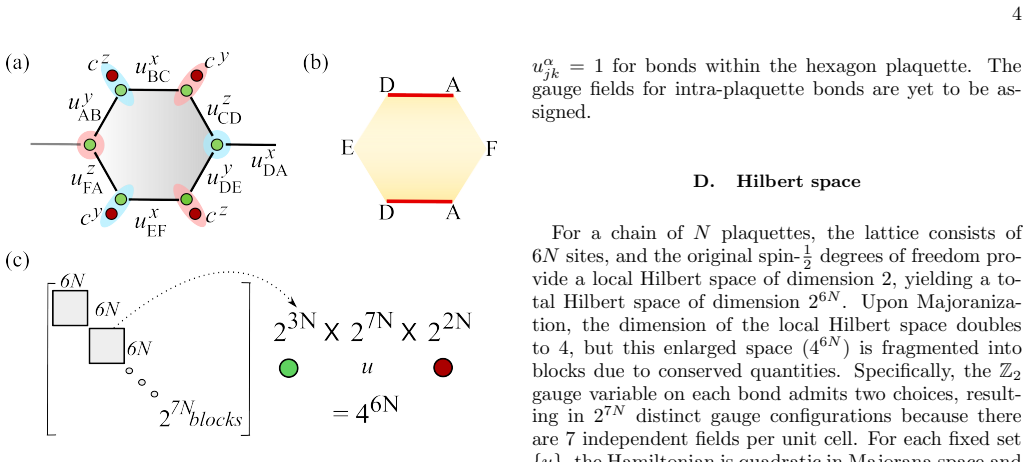
The mapping of the truncated honeycomb lattice onto a one-dimensional Kitaev spin chain that retains the Majorana representation and chiral symmetry.
If this is right
- The topological phase is placed in the BDI symmetry class with a quantized winding number.
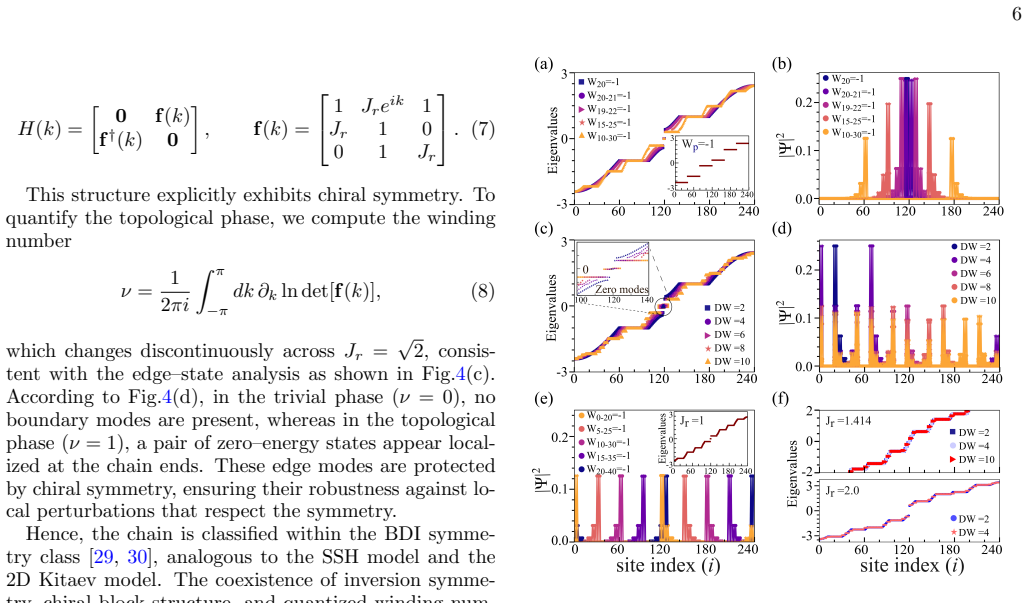
- Localized plaquette modes appear near zero energy and can be tuned by domains of negative plaquettes.
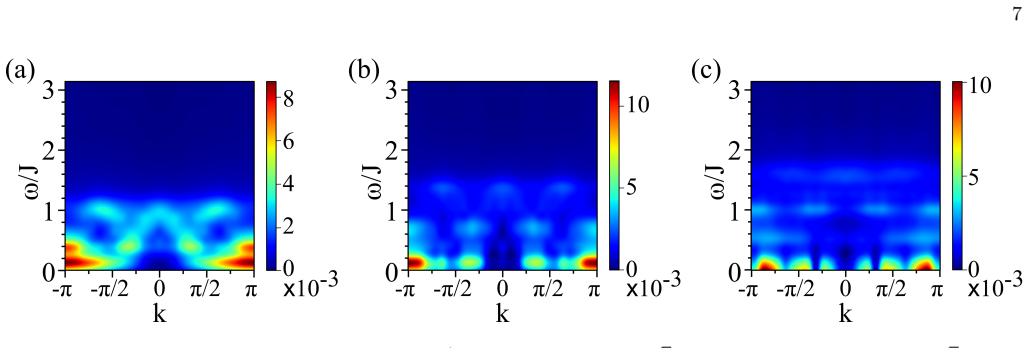
- Dynamical spin correlations exhibit broad continua from fractionalized excitations plus distinct low-energy spectral weight from edge Majorana modes.
- These response features distinguish the system from conventional Heisenberg spin chains.
Where Pith is reading between the lines
- The flat-band component may produce enhanced density of states that could be probed by specific-heat or susceptibility measurements.
- Introducing longer-range couplings while keeping the truncation might shift the location of the gap-closing point or change the symmetry class.
- The plaquette-mode tunability suggests a route to engineer domain-wall states whose energy can be controlled by local anisotropy flips.
Load-bearing premise
The truncated honeycomb geometry can be faithfully mapped onto a Kitaev-like spin chain that preserves the Majorana representation, chiral symmetry, and essential interaction structure.
What would settle it
Absence of zero-energy edge modes under open boundaries in the regime identified as topological, or absence of broad continua in the dynamical spin correlation function.
Figures
read the original abstract
The Kitaev honeycomb model has attracted significant interest due to its quantum spin liquid ground state, fractionalized Majorana excitations, and topological properties. Motivated by these features, we introduce a quasi-one-dimensional Kitaev-like spin chain derived from a truncated honeycomb geometry. The resulting Majorana band structure contains both dispersive and flat bands, with a gap closing at a critical anisotropy that separates trivial and chiral topological phases. Under open boundary conditions, the topological regime hosts zero-energy edge modes protected by chiral symmetry, placing the system in the BDI symmetry class with a quantized winding number. In the excited spectrum, localized plaquette modes emerge near zero energy and can be tuned by introducing domains of negative plaquettes. The dynamical spin correlation function reveals broad continua associated with fractionalized excitations, together with characteristic low-energy spectral weight from edge Majorana modes. These features distinguish the present system from conventional Heisenberg spin chains and provide experimentally relevant fingerprints of chiral topological order. Our model thus establishes a conceptual bridge between the two-dimensional Kitaev spin liquid and Kitaev's one-dimensional quantum wire.
Editorial analysis
A structured set of objections, weighed in public.
Referee Report
Summary. The manuscript introduces a quasi-one-dimensional Kitaev-like spin chain obtained by truncating the honeycomb lattice. It derives the corresponding Majorana representation, identifies dispersive and flat bands with a gap-closing transition at a critical anisotropy value that separates trivial and topological phases, demonstrates zero-energy edge modes under open boundaries protected by chiral symmetry (placing the system in class BDI with quantized winding number), discusses tunable localized plaquette modes, and computes the dynamical spin correlation function showing broad continua from fractionalized excitations plus low-energy weight from edge Majorana modes.
Significance. If the mapping and symmetry analysis hold, the work supplies a concrete bridge between the 2D Kitaev spin liquid and 1D topological wires, together with falsifiable dynamical signatures (fractional continua and edge spectral weight) that could be tested in candidate materials. The explicit construction of a geometry-derived chain with both flat bands and tunable plaquette modes is a concrete strength.
major comments (2)
- [Model definition and phase analysis] The central topological claims (BDI classification, quantized winding number, and protected zero-energy edge modes) rest on the truncated-honeycomb to Kitaev-chain mapping preserving the local Majorana bilinear structure and the anticommutation of the chiral operator with the full Hamiltonian. The manuscript states that this mapping occurs but supplies neither the explicit lattice-to-chain reduction nor a verification that next-nearest-neighbor terms or truncation-induced interactions are absent; without this step the symmetry class and invariant are not guaranteed.
- [Dynamical correlations] The dynamical spin correlation function is asserted to reveal broad continua associated with fractionalized excitations and characteristic low-energy weight from edge modes. No explicit expression for the spin operator in the Majorana basis, no cutoff or convergence checks, and no comparison to the Heisenberg chain limit are provided, making it impossible to assess whether the reported continua are robust or artifacts of the truncation.
minor comments (2)
- [Introduction] The abstract and introduction use the phrase 'Kitaev-like' without a precise definition of which bond terms are retained after truncation; a short paragraph or equation listing the retained and discarded interactions would clarify the construction.
- Notation for the anisotropy parameter and the plaquette sign domains is introduced without a dedicated table or figure caption; readers must infer the parameter range from the text.
Simulated Author's Rebuttal
We thank the referee for the positive assessment of the work's significance and for the constructive major comments. We address each point below and will revise the manuscript to incorporate the requested clarifications and details.
read point-by-point responses
-
Referee: [Model definition and phase analysis] The central topological claims (BDI classification, quantized winding number, and protected zero-energy edge modes) rest on the truncated-honeycomb to Kitaev-chain mapping preserving the local Majorana bilinear structure and the anticommutation of the chiral operator with the full Hamiltonian. The manuscript states that this mapping occurs but supplies neither the explicit lattice-to-chain reduction nor a verification that next-nearest-neighbor terms or truncation-induced interactions are absent; without this step the symmetry class and invariant are not guaranteed.
Authors: We agree that an explicit derivation of the lattice-to-chain mapping is necessary to rigorously establish the Majorana bilinear form, the absence of extraneous interactions, and the resulting chiral symmetry. In the revised manuscript we will add a dedicated section (or appendix) presenting the step-by-step reduction from the truncated honeycomb geometry, the explicit Majorana representation of the Hamiltonian, and a direct verification that the chiral operator anticommutes with the full Hamiltonian while no next-nearest-neighbor or truncation-induced terms appear. This will confirm the BDI classification and the quantization of the winding number. revision: yes
-
Referee: [Dynamical correlations] The dynamical spin correlation function is asserted to reveal broad continua associated with fractionalized excitations and characteristic low-energy weight from edge modes. No explicit expression for the spin operator in the Majorana basis, no cutoff or convergence checks, and no comparison to the Heisenberg chain limit are provided, making it impossible to assess whether the reported continua are robust or artifacts of the truncation.
Authors: We acknowledge that the current presentation lacks the technical details required to fully substantiate the dynamical results. In the revision we will (i) supply the explicit expression of the spin operator in the Majorana basis, (ii) document the numerical cutoff and finite-size convergence checks performed, and (iii) include a side-by-side comparison with the corresponding Heisenberg-chain limit to demonstrate that the broad continua and edge-mode weight are genuine signatures of fractionalization rather than truncation artifacts. revision: yes
Circularity Check
No circularity: model construction and symmetry classification are independent
full rationale
The paper defines the quasi-1D chain explicitly via truncation of the honeycomb lattice, applies standard Majorana representation to obtain the band structure, and classifies the topological phase using the resulting Hamiltonian's chiral symmetry and winding number. These steps follow from the constructed model without reducing to self-citations, fitted parameters renamed as predictions, or self-definitional loops. Dynamical correlations are likewise computed from the explicit spectrum. The derivation chain remains self-contained against external benchmarks such as standard BDI classification techniques.
Axiom & Free-Parameter Ledger
free parameters (1)
- anisotropy parameter
axioms (1)
- domain assumption Spin operators admit a valid Majorana fermion representation that yields the described band structure and symmetries
invented entities (1)
-
quasi-one-dimensional Kitaev-like spin chain from truncated honeycomb
no independent evidence
Reference graph
Works this paper leans on
-
[1]
the flat bands become the closest bands to the chemical potential as in Fig. 3(a). SinceJ y andJ z correspond to equivalent bonds, they produce identical effects on the band structure. Staying at the gapless value ofJ r, ifJ y is deviated fromJ, the spectrum opens up gaps at all the band crossing points. As described in Fig. 3(c), the system becomes gappe...
-
[2]
Numerical diago- nalization shows that forJ r > √ 2, the bulk gap closes and two isolated zero–energy states emerge, as shown in Fig
To probe the topo- logical character of this transition, we examined the spec- trum under open boundary conditions (OBC) for chains with commensurate sub-lattice sites. Numerical diago- nalization shows that forJ r > √ 2, the bulk gap closes and two isolated zero–energy states emerge, as shown in Fig. 4(a-b). Their corresponding eigenfunctions are ex- pon...
-
[3]
C. Broholm, R. J. Cava, S. A. Kivelson, D. G. Nocera, M. R. Norman, and T. Senthil, Quan- tum spin liquids, Science367, eaay0668 (2020), https://www.science.org/doi/pdf/10.1126/science.aay0668
-
[4]
P. W. Anderson, The resonating valence bond state in la2cuo4 and superconductivity, Science235, 1196 (1987), https://www.science.org/doi/pdf/10.1126/science.235.4793.1196
-
[5]
G. Baskaran, Resonating valence bond theory of super- conductivity: Beyond cuprates (2017), arXiv:1709.10070 [cond-mat.supr-con]
Pith/arXiv arXiv 2017
-
[6]
Kitaev, Anyons in an exactly solved model and be- yond, Annals of Physics321, 2 (2006), january Special Issue
A. Kitaev, Anyons in an exactly solved model and be- yond, Annals of Physics321, 2 (2006), january Special Issue
2006
-
[7]
Nayak, S
C. Nayak, S. H. Simon, A. Stern, M. Freedman, and S. Das Sarma, Non-abelian anyons and topological quan- tum computation, Rev. Mod. Phys.80, 1083 (2008)
2008
-
[8]
Mandal, S
S. Mandal, S. Bhattacharjee, K. Sengupta, R. Shankar, and G. Baskaran, Confinement-deconfinement transition and spin correlations in a generalized kitaev model, Phys. Rev. B84, 155121 (2011)
2011
-
[9]
Baskaran, S
G. Baskaran, S. Mandal, and R. Shankar, Exact results for spin dynamics and fractionalization in the kitaev model, Phys. Rev. Lett.98, 247201 (2007)
2007
-
[10]
Sanyal, K
S. Sanyal, K. Damle, J. T. Chalker, and R. Moessner, Emergent moments and random singlet physics in a ma- jorana spin liquid, Phys. Rev. Lett.127, 127201 (2021)
2021
-
[11]
Yoshida, Exotic topological order in fractal spin liq- uids, Physical Review B—Condensed Matter and Mate- rials Physics88, 125122 (2013)
B. Yoshida, Exotic topological order in fractal spin liq- uids, Physical Review B—Condensed Matter and Mate- rials Physics88, 125122 (2013)
2013
-
[12]
Wen, Mean-field theory of spin-liquid states with finite energy gap and topological orders, Physical Review B44, 2664 (1991)
X.-G. Wen, Mean-field theory of spin-liquid states with finite energy gap and topological orders, Physical Review B44, 2664 (1991)
1991
-
[13]
Wen, Quantum orders and symmetric spin liquids, Phys
X.-G. Wen, Quantum orders and symmetric spin liquids, Phys. Rev. B65, 165113 (2002)
2002
-
[14]
A. A. Patel and D. Chowdhury, Two-dimensional spin liquids with𭟋 2 topological order in an array of quantum wires, Phys. Rev. B94, 195130 (2016)
2016
-
[15]
Savary and L
L. Savary and L. Balents, Quantum spin liquids: a re- view, Reports on Progress in Physics80, 016502 (2016)
2016
-
[16]
Kitaev, Fault-tolerant quantum computation by anyons, Annals of Physics303, 2 (2003)
A. Kitaev, Fault-tolerant quantum computation by anyons, Annals of Physics303, 2 (2003)
2003
-
[17]
Jackeli and G
G. Jackeli and G. Khaliullin, Mott insulators in the strong spin-orbit coupling limit: From heisenberg to a quantum compass and kitaev models, Phys. Rev. Lett. 102, 017205 (2009)
2009
-
[18]
Trebst, Kitaev materials (2017), arXiv:1701.07056 [cond-mat.str-el]
S. Trebst, Kitaev materials (2017), arXiv:1701.07056 [cond-mat.str-el]
Pith/arXiv arXiv 2017
-
[19]
S. M. Winter, A. A. Tsirlin, M. Daghofer, J. van den Brink, Y. Singh, P. Gegenwart, and R. Valent´ ı, Models and materials for generalized kitaev magnetism, Journal of Physics: Condensed Matter29, 493002 (2017)
2017
-
[20]
Banerjee, J
A. Banerjee, J. Yan, J. Knolle, C. A. Bridges, M. B. Stone, M. J. O’Malley, D. G. Mandrus, D. A. Tennant, R. Moessner, and S. E. Nagler, Proximate kitaev quan- tum spin liquid behaviour in a honeycomb magnet, Na- ture Materials15, 733 (2016)
2016
-
[21]
Matsuda, T
Y. Matsuda, T. Shibauchi, and H.-Y. Kee, Kitaev quan- tum spin liquids, Rev. Mod. Phys.97, 045003 (2025). 9
2025
-
[22]
Kasahara, Y
Y. Kasahara, Y. Shiomi, T. Ohnishi, and et al., Majorana quantization and half-integer thermal quantum hall effect in a kitaev spin liquid, Nature Physics13, 1079 (2017)
2017
-
[23]
Kasahara, T
Y. Kasahara, T. Ohnishi, Y. Mizukami, and et al., Majo- rana quantization and half-integer thermal quantum hall effect, Nature559, 227 (2018)
2018
-
[24]
Zhang, X
Y. Zhang, X. Li, F. Wang, and et al., Probing chiral kitaev spin liquids via dangling boundary fermions, npj Quantum Materials10, 46 (2025)
2025
-
[25]
I. Lee, F. G. Utermohlen, D. Weber, K. Hwang, C. Zhang, J. van Tol, J. E. Goldberger, N. Trivedi, and P. C. Hammel, Fundamental spin interactions underlying the magnetic anisotropy in the kitaev ferromagnet cri 3, Phys. Rev. Lett.124, 017201 (2020)
2020
-
[26]
Hermanns, I
M. Hermanns, I. Kimchi, and J. Knolle, Physics of the ki- taev model: Fractionalization, dynamic correlations, and material connections, Annual Review of Condensed Mat- ter Physics9, 17 (2018)
2018
-
[27]
K. Wang, S. Feng, P. Zhu, R. Chi, H.-J. Liao, N. Trivedi, and T. Xiang, Fractionalization signatures in the dy- namics of quantum spin liquids, Physical Review B111, L100402 (2025)
2025
-
[28]
Th´ eveniaut and M
H. Th´ eveniaut and M. Vojta, Bound states of fractional- ized excitations in a modulated kitaev spin liquid, Phys- ical Review B96, 054401 (2017)
2017
-
[29]
Knolle, G.-W
J. Knolle, G.-W. Chern, D. L. Kovrizhin, R. Moessner, and N. B. Perkins, Raman scattering signatures of kitaev spin liquids inA 2iro3 iridates witha= Na or li, Phys. Rev. Lett.113, 187201 (2014)
2014
-
[30]
Knolle, D
J. Knolle, D. L. Kovrizhin, J. T. Chalker, and R. Moess- ner, Dynamics of a two-dimensional quantum spin liquid: Signatures of emergent majorana fermions and fluxes, Phys. Rev. Lett.112, 207203 (2014)
2014
-
[31]
Altland and M
A. Altland and M. R. Zirnbauer, Nonstandard symme- try classes in mesoscopic normal-superconducting hybrid structures, Phys. Rev. B55, 1142 (1997)
1997
-
[32]
Cornfeld and S
E. Cornfeld and S. Carmeli, Tenfold topology of crystals: Unified classification of crystalline topological insulators and superconductors, Phys. Rev. Res.3, 013052 (2021)
2021
-
[33]
W. P. Su, J. R. Schrieffer, and A. J. Heeger, Solitons in polyacetylene, Phys. Rev. Lett.42, 1698 (1979)
1979
-
[34]
A. Y. Kitaev, Unpaired majorana fermions in quantum wires, Physics-Uspekhi44, 131 (2001)
2001
-
[35]
S. Ryu, A. P. Schnyder, A. Furusaki, and A. W. W. Lud- wig, Topological insulators and superconductors: tenfold way and dimensional hierarchy, New Journal of Physics 12, 065010 (2010)
2010
-
[36]
Laurell, G
P. Laurell, G. Alvarez, and E. Dagotto, Spin dynamics of the generalized quantum spin compass chain, Phys. Rev. B107, 104414 (2023)
2023
-
[37]
Greiter, V
M. Greiter, V. Schnells, and R. Thomale, The 1d ising model and the topological phase of the kitaev chain, An- nals of Physics351, 1026 (2014)
2014
-
[38]
Saket, S
A. Saket, S. R. Hassan, and R. Shankar, Manipulating unpaired majorana fermions in a quantum spin chain, Phys. Rev. B82, 174409 (2010)
2010
-
[39]
C. E. Agrapidis, J. van den Brink, and S. Nishimoto, Ordered states in the kitaev-heisenberg model: From 1d chains to 2d honeycomb, Scientific Reports8, 1815 (2018)
2018
-
[40]
S. Pujari, A theorem on extensive ground state en- tropy, spin liquidity and some related models (2025), arXiv:2407.06236 [cond-mat.stat-mech]
arXiv 2025
-
[41]
Y. Yamazaki, S. Kobayashi, and A. Furusaki, Majorana-assisted nonlocal spin correlation in quasi-one- dimensional kitaev spin liquids (2026), arXiv:2603.25647 [cond-mat.str-el]
arXiv 2026
-
[42]
Catuneanu, Y
A. Catuneanu, Y. Yamaji, G. Wachtel, and et al., Path to stable quantum spin liquids in spin-orbit coupled cor- related materials, npj Quantum Materials3, 23 (2018)
2018
-
[43]
Yao and S
H. Yao and S. A. Kivelson, Exact chiral spin liquid with non-abelian anyons, Phys. Rev. Lett.99, 247203 (2007)
2007
-
[44]
Pelegr´ ı, S
G. Pelegr´ ı, S. Flannigan, and A. J. Daley, Few-body bound topological and flat-band states in a creutz lad- der, Phys. Rev. B109, 235412 (2024)
2024
-
[45]
M. N. Huda, S. Kezilebieke, and P. Liljeroth, Designer flat bands in quasi-one-dimensional atomic lattices, Phys- ical Review Research2, 043426 (2020)
2020
-
[46]
Mart´ ınez-Strasser, M
C. Mart´ ınez-Strasser, M. Herrera, A. Garc´ ıa-Etxarri, G. Palumbo, F. Kunst, and D. Bercioux, Topological properties of a non-hermitian quasi-1d chain with a flat band, Advanced Quantum Technologies7, 2300225 (2024)
2024
-
[47]
Huang, P
Y. Huang, P. Hosur, and H. K. Pal, Quasi-flat-band physics in a two-leg ladder model and its relation to magic-angle twisted bilayer graphene, Physical Review B102, 155429 (2020)
2020
-
[48]
S. Mandal and A. M. Jayannavar, An introduction to kitaev model-i (2020), arXiv:2006.11549 [cond-mat.str- el]
arXiv 2020
-
[49]
Jones, P
B. Jones, P. Varughese, I. Olejniczak, J. Pigos, J. Mus- feldt, C. Landee, M. Turnbull, and G. Carr, Vibrational properties of the one-dimensional, s= 1/2, heisenberg antiferromagnet copper pyrazine dinitrate, Chemistry of materials13, 2127 (2001)
2001
-
[50]
Lancaster, S
T. Lancaster, S. Blundell, M. Brooks, P. Baker, F. Pratt, J. L. Manson, C. Landee, and C. Baines, Magnetic order in the quasi-one-dimensional spin-1/ 2 molecular chain compound copper pyrazine dinitrate, Physical Review B—Condensed Matter and Materials Physics73, 020410 (2006)
2006
-
[51]
Z. Zhuang and W. Yang, Gapless and ordered phases in spin-1/2 kitaev-xx-gamma chain (2025), arXiv:2509.21901 [cond-mat.str-el]
arXiv 2025
-
[52]
Mondal, S
S. Mondal, S. Bandyopadhyay, S. Bhattacharjee, and A. Dutta, Detecting topological phase transitions through entanglement between disconnected partitions in a kitaev chain with long-range interactions, Phys. Rev. B105, 085106 (2022)
2022
-
[53]
W. Yang, C. Xu, S. Ma, A. Nocera, and I. Affleck, Left-left-right-right magnetic order in spin- 1 2 kitaev- heisenberg chain, Phys. Rev. B112, 035104 (2025)
2025
discussion (0)
Sign in with ORCID, Apple, or X to comment. Anyone can read and Pith papers without signing in.