REVIEW 1 major objections 4 minor 2 references
Non-volatile rewritable frequency tuning of a nanoelectromechanical resonator using photoinduced doping
T0 review · 1 major / 4 minor · reviewed 2026-08-14 · deepseek-v4-flash
Pith's one-line read Photodoping tunes graphene nanomechanical resonators by up to 550%
desk verdict Photodoping gives a genuinely new non-volatile tuning knob for NEMS, and the core demonstration holds up; the main caveat is that the written state drifts enough to blur the more ambitious multilevel-memory claims. read the letter →
The pith
A machine-rendered reading of the paper's core claim, the machinery that carries it, and where it could break.
The reading
What carries the argument
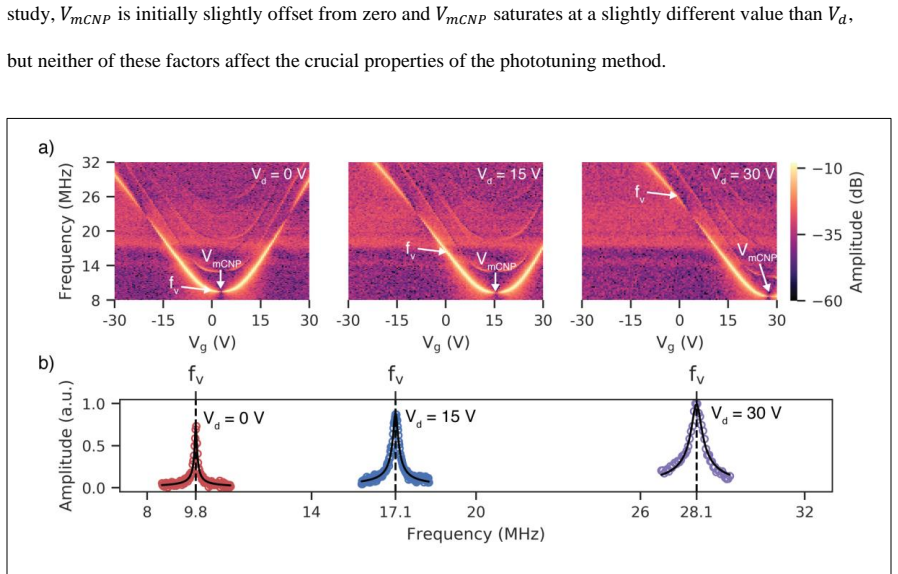
The central object is the mechanical charge neutrality point $V_\mathrm{mCNP}$, the gate voltage at which the membrane's electrostatic tension (and thus its frequency) is minimized. Phototuning uses a focused laser plus a back-gate bias to ionize defects in the SiO2/hBN dielectric stack; the resulting trapped charge shifts $V_\mathrm{mCNP}$ toward the applied $V_d$. After the fields are removed the membrane feels an effective voltage $V_\mathrm{eff} = -V_\mathrm{mCNP}$, so its frequency is $f_V = f_0(-V_\mathrm{mCNP})$ with $f_0(V_g) \propto (V_g - V_\mathrm{mCNP})^2$. The dynamics are described by a saturation curve $V_\mathrm{mCNP}(t) = \Delta V(1 - e^{-\alpha t}) + V_0$, with doping rate $\alpha$ that grows superlinearly with laser power and strongly with photon energy.
What would settle it
Measure the local surface potential or trapped charge density of a phototuned membrane with Kelvin probe force microscopy; if the inferred $V_\mathrm{mCNP}$ shift does not match the charge-induced voltage, or if a device without the SiO2 trapping layer still phototunes, the trapped-charge tension model is wrong.
Extended reading notes
Core claim
The central claim is that photodoping can permanently shift the effective electrostatic tension of a suspended graphene or graphene/hBN membrane, thereby tuning its resonance frequency in a way that is persistent, reversible, fast, and local. The authors show that after photodoping with a gate voltage $V_d$, the mechanical charge neutrality point $V_\mathrm{mCNP}$ moves toward $V_d$; with the gate removed the resonator sits at $f_V = f_0(-V_\mathrm{mCNP})$. In one gr/hBN device $f_V$ rose from 9.8 to 28.1 MHz (~200%), in another from 7 to 45 MHz (~550%), and five devices on one chip were aligned to within 0.2% of 15 MHz with no external bias. The mechanism is assigned to trapped charge in the SiO2/hBN stack that persists after the optical and electrostatic fields are removed.
Load-bearing premise
The persistent frequency change is attributed to trapped charge in the SiO2/hBN stack that pulls on the membrane electrostatically, but the paper infers this from the shift of the tuning-curve minimum and from similarity to ordinary gate tuning rather than from a direct measurement of trapped charge.
Editorial extensions
If this is right
- Phototuning can replace patterned gate electrodes for frequency tuning in NEMS arrays, since one global gate and a steerable laser address any resonator.
- The demonstrated tuning range (up to ~550%, or roughly 500 resonance linewidths) is an order of magnitude larger than earlier hybrid persistent-and-rewritable methods.
- The frequency state persists for days without power and can be rewritten over hundreds of cycles with ~99.5% repeatability, enabling binary or multi-level mechanical memory.
- The tuning rate (a full linewidth in about 100 microseconds at moderate power) is fast enough for feedback stabilization or high-bandwidth reprogramming.
- Because the effect is localized to the laser spot (~1 micrometer), it can pattern arbitrary strain landscapes across a single resonator or across an array.
Reading between the lines
- If the mechanism is general, the same laser-plus-gate recipe should work in other 2D heterostructures or graphene-coated high-Q beams, giving persistent tuning without sacrificing quality factor.
- A testable extension is to use the trapped-charge pattern to excite or couple specific mechanical modes, effectively writing a phononic circuit in situ rather than by lithography.
- The observed drift (2% initially, then ~0.05% per hour) suggests a feedback loop that uses the probe laser itself to correct frequency drift in real time, a possibility the paper mentions only in passing.
- Because the doping rate depends superlinearly on optical power, pulsed writing with high peak power could push state-switching times toward microseconds, limited mainly by the device RC time constant.
Signed reviews
Editorial analysis
A structured set of objections, weighed in public.
Referee Report
Summary. The manuscript reports a method for non-volatile, rewritable frequency tuning of graphene-based nanoelectromechanical (NEMS) resonators using a focused laser and a global gate voltage. The authors show that photodoping shifts the mechanical charge neutrality point (V_mCNP) and thereby tunes the resonance frequency persistently after the optical and electrical fields are removed. They demonstrate frequency increases of ~200% and ~550% in two device types, multi-day persistence with a slow logarithmic-like drift, 919 write/erase cycles with ~99.5% repeatability, spatial localization of the effect to ~1 μm, and alignment of five separate devices to within 0.2%. The photodoping rate is characterized as a function of laser power and wavelength, supporting an electrostatic-tension mechanism via trapped charge. The central experimental finding—reversible, persistent phototuning of suspended graphene resonators—is well supported by the data.
Significance. If the persistence and scalability claims are properly qualified, this work offers a practical route to individually addressable frequency tuning in NEMS arrays without per-device gate electrodes. The method is simple, fast, and exhibits a large tuning range, and the paper includes direct measurements of V_mCNP shifts and rigid gate-curve translation, which are strong evidence for an electrostatic mechanism. The demonstration of 919 write/erase cycles and multi-device alignment is a solid proof of concept. The main significance lies in the potential for programmable NEMS lattices and analog mechanical memory, though the current data do not yet support all of the extrapolations made in the abstract and discussion.
major comments (1)
- [Fig. 3c and 'The frequency phototuning method is persistent' paragraph] The paper acknowledges that the frequency decays at ~0.05%/hour, but then concludes that 'this long-lived state does not require an external power supply or gate bias.' This conclusion is not supported by the data for precise frequency memory; the drift means the state is not truly static. The authors should reconcile these statements, for example by defining 'persistence' in terms of the binary state or by demonstrating feedback-stabilized operation.
minor comments (4)
- [Main text, 'The phototuning method can achieve a high degree...' paragraph] The text says 'Figure 3c shows the results after 919 erase/write cycles,' but the cycling data and histogram appear in Figure 3d; Figure 3c is the stability plot. Please correct the cross-reference.
- [Fig. 4 caption] The caption reports the fit parameter α = 124 s⁻¹, while the main text gives α = 129 s⁻¹ for the same data. Please make these consistent.
- [Main text, persistence paragraph] The statement 'the mechanical linewidth for our devices is ~2% of the resonance frequency (shaded region of Figure 3b)' refers to a gray band that appears in Figure 3c, not Figure 3b. Please correct the figure reference.
- [Throughout] The subscripts in V_mCNP are sometimes rendered inconsistently (e.g., 'V_mCNP' vs 'V_mCNP' in different places). Please unify the notation.
Circularity Check
No circularity: the frequency shifts, V_mCNP extraction, and five-device alignment are direct measurements, with only a standard electrostatic model used for interpretation.
full rationale
The paper's central results are direct measurements: f_V is tracked by fitting resonance spectra after each photodoping step (Fig. 3a-b), V_mCNP is extracted from independent gate sweeps (Fig. 2a), and the five-device alignment is a direct spectral measurement (Fig. 5b). The only model used is the standard electrostatic relation f0(Vg) proportional to (Vg - V_mCNP)^2, cited to Bunch et al. and Chen et al.; the phototuning claim does not presuppose this model's conclusion, and V_mCNP is used as a fitted description of the measured gate curve rather than as the source of a predicted f_V. Eq. 1 is an exponential fit to the measured V_mCNP(t) used only to characterize the doping rate; the simultaneously measured f_V(t) (Fig. 4a) provides independent confirmation, and the inferred R_f = alpha |Delta V| df0/dVg is a derived characterization, not a prediction of unmeasured data. No parameter is fitted to a subset and then called a prediction of a closely related quantity. The photodoping references (Ju, Kim, Choi, Neumann, Velasco) are external to the present authors and are used for the known phenomenon, not to justify the frequency-tuning result. The paper's own Fig. 3c data showing ~0.05%/hour drift and ~40 hours to cross a linewidth is a limitation on the strength of the persistence claim, but that is a measurement-versus-claim gap, not a circular derivation. The derivation chain is therefore self-contained and non-circular.
Assumptions & free parameters
free parameters (2)
- ΔV and α in V_mCNP(t) saturation fit (Eq. 1) =
ΔV = 8.94 V, α = 129 s^-1 (example device)
- Power-law exponent γ in α(P) = α0 P^γ =
γ = 1.63 (fit); range 1.2-1.7 across devices
assumptions (3)
- domain assumption Resonance frequency follows the electrostatic tension model f0(V_g) with V_eff = V_g - V_mCNP.
- domain assumption Photodoping creates persistent trapped charge in the SiO2 and hBN layers.
- domain assumption V_mCNP(t) saturates exponentially with rate α (Eq. 1).
Cite this review
Pith. "Pith review of Non-volatile rewritable frequency tuning of a nanoelectromechanical resonator using photoinduced doping." pith.science (2026). https://pith.science/paper/LV6P3M5L
@misc{pith2026190807609,
  author       = {Pith},
  title        = {Pith review of: Non-volatile rewritable frequency tuning of a nanoelectromechanical resonator using photoinduced doping},
  year         = {2026},
  howpublished = {\url{https://pith.science/paper/LV6P3M5L}},
  note         = {Machine review of arXiv:1908.07609}
}
read the original abstract
Tuning the frequency of a resonant element is of vital importance in both the macroscopic world, such as when tuning a musical instrument, as well as at the nanoscale. In particular, precisely controlling the resonance frequency of isolated nanoelectromechanical resonators (NEMS) has enabled innovations such as tunable mechanical filtering and mixing as well as commercial technologies such as robust timing oscillators. Much like their electronic device counterparts, the potential of NEMS grows when they are built up into large-scale arrays. Such arrays have enabled neutral-particle mass spectroscopy and have been proposed for ultralow-power alternatives to traditional analog electronics as well as nanomechanical information technologies like memory, logic, and computing. A fundamental challenge to these applications is to precisely tune the vibrational frequency and coupling of all resonators in the array, since traditional tuning methods, like patterned electrostatic gating or dielectric tuning, become intractable when devices are densely packed. Here, we demonstrate a persistent, rewritable, scalable, and high-speed frequency tuning method for graphene-based NEMS. Our method uses a focused laser and two shared electrical contacts to photodope individual resonators by simultaneously applying optical and electrostatic fields. After the fields are removed, the trapped charge created by this process persists and applies a local electrostatic tension to the resonators, tuning their frequencies. By providing a facile means to locally address the strain of a NEMS resonator, this approach lays the groundwork for fully programmable large-scale NEMS lattices and networks.
Figures
Reference graph
Works this paper leans on
-
[28]
A 633 nm HeNe laser was focused onto the devices (held at room temperature at 10 -6 torr) using a 40 ×, 0.6 NA objective. The reflected light was detected using a high-sensitivity photodiode (Thorlabs APD 130A) and the voltage signal was demodulated using a Zurich Instruments HFLI2 Lock-In amplifier. The incident laser was scanned with a two-axis galvomet...
work page 2008
-
[1625]
(37) Hatanaka, D.; Bachtold, A.; Yamaguchi, H. Phys. Rev. Appl. 2019, 11 (2), 024024. (38) Schedin, F.; Geim, A. K.; Morozov, S. V.; Hill, E. W.; Blake, P.; Katsnelson, M. I.; Novoselov, K. S. Nat. Mater. 2007, 6 (9), 652–655. (39) Mahboob, I.; Yamaguchi, H. Nat. Nanotechnol. 2008, 3 (5), 275–279. (40) Lee, J.; Krupcale, M. J.; Feng, P. X. L. Appl. Phys. ...
work page 2019
Reviewed August 14, 2026 · model on record in the stance chip above.
Discussion (0). Continue with ORCID to comment.