REVIEW 4 major objections 5 minor 52 references
Capillary action in scalar active matter
T0 review · 4 major / 5 minor · reviewed 2026-08-14 · deepseek-v4-flash
Pith's one-line read In a minimal model of scalar active matter with purely repulsive interactions, a dense phase rises in thin tubes against gravity, wets vertical plates, and invades porous media; the rise height is set by the active sedimentation length.
desk verdict A credible first demonstration of capillary action in repulsive active matter, with quantitative scaling laws that should be treated as provisional until error bars or independent data appear. read the letter →
The pith
A machine-rendered reading of the paper's core claim, the machinery that carries it, and where it could break.
The reading
What carries the argument
The central object is the active lattice gas (ALG), a lattice model in which particles of four species drift left, right, up, or down and also diffuse, sediment, and tumble, with at most one particle per site. Excluded-volume interactions make particles slow down during collisions, producing an effective attraction that yields wall accumulation and a dense phase with liquid-like wetting behavior. The load-bearing quantity is the active sedimentation length $\lambda$, extracted by fitting the exponential tail of the bulk density profile $\rho(y)\propto \exp(-y/\lambda)$; all reported scaling relations are collapses of simulation data plotted against this length.
What would settle it
Measure the meniscus rise in the same active lattice gas at fixed activity and gravity while systematically enlarging the box and the bulk-fit region; if the inferred $\lambda$ shifts enough to break the $\Delta h \propto \lambda^{0.9}$ collapse, the scaling is an artifact of the fit. Alternatively, an off-lattice active Brownian particle simulation with the same control parameters should reproduce the exponents 0.9, 1.3, and the $\phi_m$-linear law if the mechanism is generic.
Extended reading notes
Core claim
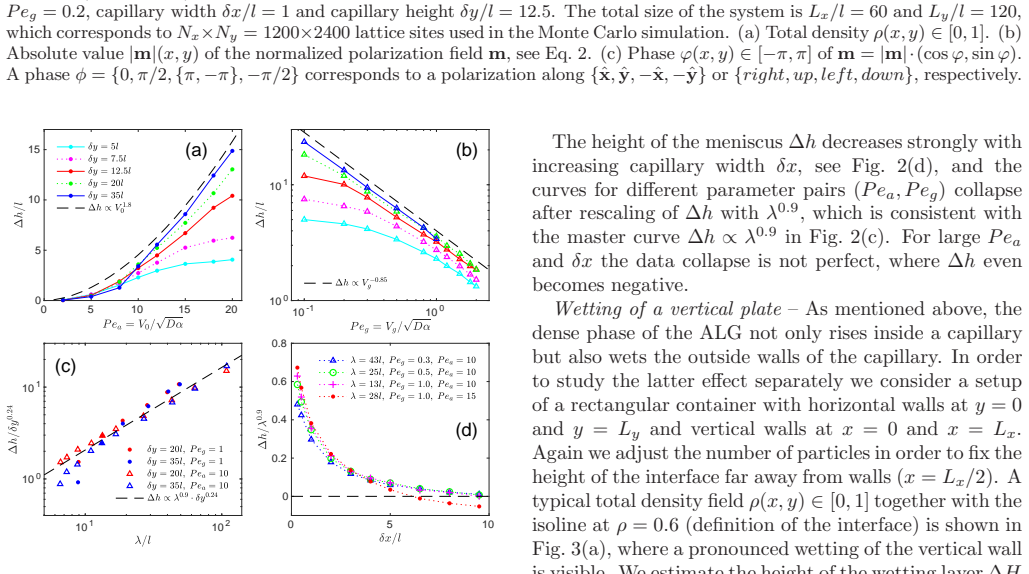
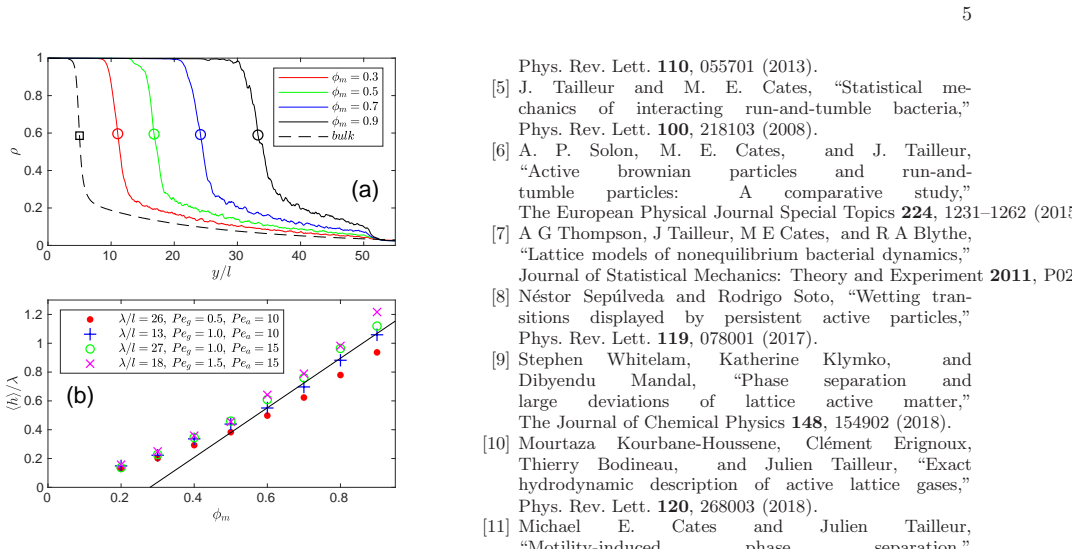
The central claim is that scalar active matter with purely repulsive interactions exhibits capillary action against gravity. The mechanism is an emergent effective attraction: active particles slow down when they collide with each other or with walls, so hard-core repulsion produces wall accumulation and a dense phase that behaves like a wetting liquid. In the active lattice gas model, the paper reports that the meniscus rise in a tube scales approximately linearly with the active sedimentation length ($\Delta h \propto \lambda^{0.9}$), the wetting height on a vertical plate grows superlinearly ($\Delta H \propto \lambda^{1.3}$), and spontaneous imbibition into a disordered porous medium follows $\langle h\rangle \propto \lambda\phi_m$. These master curves collapse simulation data across different activities and gravitational strengths, so the scaling in $\lambda$ replaces the classical surface-tension balance.
Load-bearing premise
The scaling laws stand or fall with the fitted active sedimentation length $\lambda$, which is extracted from an exponential fit to the bulk density profile in the same simulation run; if those fits carry systematic errors, or if the collapse procedure is what creates the exponents, the quantitative claims do not follow.
Editorial extensions
If this is right
- A tube whose width is set by the persistence length will fill with the dense phase up to a height controlled by the active sedimentation length, so activity can pump or position colloids against gravity without any chemical attraction.
- In a porous bed, the invasion depth grows linearly with the packing fraction, meaning denser matrices pull the active fluid higher.
- Flat vertical walls should be wetted by repulsive active suspensions, so self-propelled particles can coat surfaces they cannot chemically bind to.
- The master-curve scalings give direct experimental targets: measuring meniscus rise against activity and gravity in microfluidic channels tests whether the exponents survive beyond the lattice model.
Reading between the lines
- If the $\Delta h\propto\lambda^{0.9}$ scaling holds in off-lattice models, the capillary rise of repulsive active fluids is universal across microscopic details and $\lambda$ is the single control parameter; the paper only hints at this by mentioning preliminary active-Brownian-particle simulations.
- The data showing $\Delta h$ turning negative at large activity and width suggest a regime where activity suppresses filling; deciding whether this is a genuine drying transition would extend the phase diagram beyond what the paper states.
- In zero gravity, $\lambda$ diverges, so the scaling implies a confined repulsive active fluid should fill any connected void completely; this is a testable limit the paper does not report.
Signed reviews
Editorial analysis
A structured set of objections, weighed in public.
Referee Report
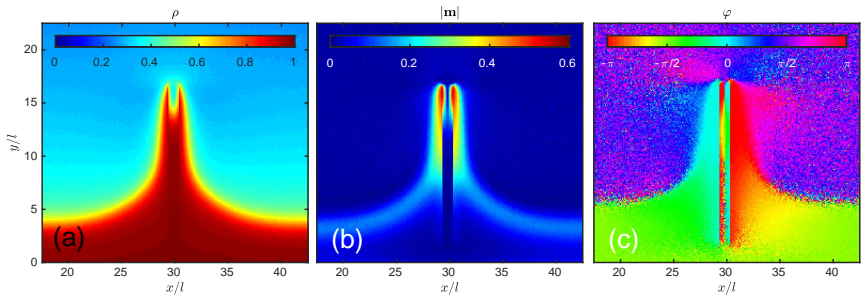
Summary. The paper studies capillary action in a minimal scalar active matter model, an active lattice gas with purely repulsive interactions. By inserting vertical tubes, vertical plates, and disordered porous media into a phase-separated system under gravity, the authors observe that the dense phase rises against gravity, wets walls, and invades porous matrices. The mechanism is attributed to wall accumulation and effective cohesion from activity-induced slowdown. Quantitatively, the paper reports Δh ∝ λ^0.9 for capillary rise, ΔH ∝ λ^1.3 for wetting of a vertical plate, and ⟨h⟩ ∝ λ φ_m for imbibition into a porous medium, where λ is the active sedimentation length obtained from exponential fits of the bulk density profile. The qualitative phenomenon is demonstrated with density fields and polarization maps, and the paper claims a first proof of concept for active capillarity.
Significance. If the central phenomenon holds, the paper is significant: it shows that attractive intermolecular forces are not necessary for capillary action, with activity alone sufficing in a minimal scalar active matter model. The qualitative observation of dense-phase rise in tubes, wetting of vertical walls, and imbibition into porous media is well supported by the presented density fields and is mechanistically plausible via wall accumulation and slowdown-induced effective attraction. The paper also benefits from using an exactly hydrodynamically describable lattice model and from checking grid-resolution convergence (n=10 vs n=20) against finite-element solutions. However, the quantitative scaling laws, which are a central part of the abstract, rest on fitted λ values and on data collapses that are acknowledged to be imperfect in parts of the parameter space. The quantitative claims are therefore provisional until the fitting and collapse procedure is made robust and independently verified.
major comments (4)
- [Capillary rise, Fig. 2(c), Eq. (3)] The master curve leading to Δh ∝ λ^0.9 uses λ obtained from exponential fits of the bulk density profile in the same simulations, and the ordinate is additionally rescaled by a fitted exponent δy^0.24. Because λ is not an externally imposed control but a fitted quantity, and because the same data are used to determine the abscissa, the exponent 0.9 and the collapse exponent 0.24 could be artifacts of the collapse procedure. Please provide error bars on λ and Δh, test the sensitivity of the exponent to the fitting range and to the interface definition ρ=0.6, and, if possible, cross-check the scaling using λ from Eq. (1) rather than from fits of the same runs.
- [Capillary rise, Fig. 2(d)] The text states that for large Pea and δx the data collapse is not perfect and that Δh even becomes negative. This is a direct caveat on Eq. (3), since the negative values presumably belong to the same dataset used for the power-law fit. Please quantify the deviation, state explicitly which data points are included in the fit, and clarify whether the negative-Δh regime is excluded and why.
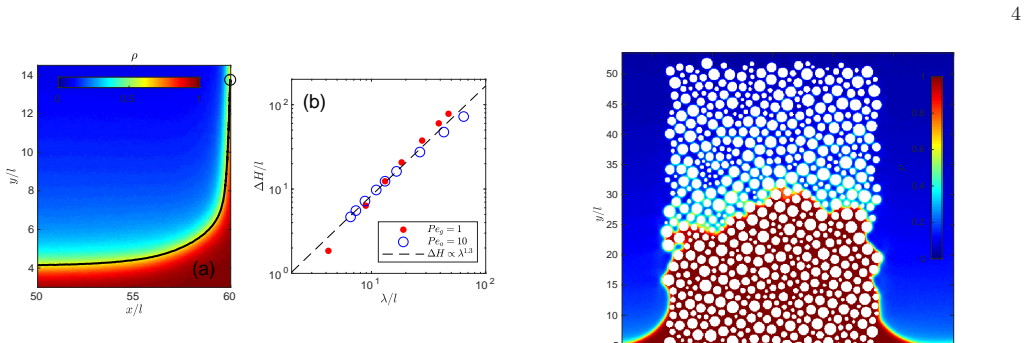
- [Wetting of a vertical plate, Eq. (4)] The superlinear law ΔH ∝ λ^1.3 is based on two datasets (varying Pea at fixed Peg and varying Peg at fixed Pea) with no error bars and no statement of the number of points or the fit range. Since the wetting height is defined through the same ρ=0.6 isodensity and λ is again fitted from the bulk profile, the exponent 1.3 is not yet robustly established. Please report the raw data, fit residuals, and sensitivity to the fitting procedure.
- [Imbibition of a porous matrix, Eq. (5)] The claim ⟨h⟩ ∝ λ φ_m is vulnerable for the same reason as Eqs. (3) and (4): λ is fitted, and the collapse in Fig. 5(b) is presented without error bars or a measure of scatter. In addition, the observation in Fig. 5(a) that the dilute-phase density above the front is significantly larger than the bulk density suggests that a single isodensity height may not fully characterize the invasion front. Please provide error estimates, report the fit quality, and justify the isodensity-height definition for the porous-matrix geometry.
minor comments (5)
- [Throughout] There are multiple typographical errors and unfinished placeholders, e.g., 'Biophysic s' and 'Saarbrcken' in the author affiliations, 'Bla' in the PACS line, 'obtaine' in the wetting section, and 'ia a superposition' in the wetting discussion. These should be corrected.
- [Model, Eq. (1)] The theoretical scaling λ ∝ V0^2/(α Vg) is given but not used to independently verify the fitted λ values. Given the central role of λ, a direct comparison of fitted λ with Eq. (1) would strengthen the paper.
- [References] Reference [40] is cited as 'Private Communication' for the critical Peclet number Pec_a=8. This should be replaced by a published source or by the authors' own data.
- [Fig. 4 caption] The caption states 'system size Lx/l = 60 and Ly/l = 100' while the text uses 'Ly/l = 120' elsewhere; please check the consistency of system dimensions.
- [Model, Eq. (2)] The polarization field m is normalized by ρ, which can be small in the dilute phase; the figures show |m| for ρ down to 0, so it would be helpful to state how the normalization is handled in regions where ρ is near zero.
Circularity Check
No significant circularity: the capillary and imbibition effects are observed directly, and the scaling laws are empirical fits using an independently measured bulk length scale, not constructions from the target quantities.
full rationale
The paper's central claim—that repulsive scalar active particles rise in capillaries, wet vertical plates, and imbibe porous media—is established by direct observation of steady-state density fields in Monte Carlo simulations, not by an equation that assumes the conclusion. The scaling laws Δh ∝ λ^0.9, ΔH ∝ λ^1.3, and ⟨h⟩ ∝ λ φ_m are obtained by collapsing simulation data with λ measured from exponential fits of the bulk density profile in the same runs (Fig. 2(c), Fig. 3(b), Fig. 5(b)). This is an empirical fitting procedure, not a derivation from first principles, and the paper does not claim otherwise: it says 'Simulations indicate' and presents the relations as observed scalings. λ is an independently defined observable (the bulk density decay length) and is not defined in terms of the capillary height, so the scaling is not circular by construction. The acknowledged imperfection 'for large Pea and δx the data collapse is not perfect, where Δh even becomes negative' weakens the quantitative exponents but is a robustness concern, not circularity. No load-bearing self-citation or imported uniqueness theorem is used; references to the authors' prior work are background only. Thus no significant circularity is found.
Assumptions & free parameters
free parameters (6)
- Active sedimentation length λ =
Fit to exp(-y/λ) for each (Pe_a, Pe_g); values not tabulated
- Capillary height rescaling exponent for δy =
0.24
- Growth exponent for capillary rise vs λ =
0.9
- Growth exponent for wetting height vs λ =
1.3
- Imbibition scaling with packing fraction =
1 (linear in φ_m)
- Interface density threshold =
0.6
assumptions (4)
- standard math ALG has an exact hydrodynamic description in the diffusive scaling limit (n→∞), with diffusion D, tumbling α, propulsion V0, and sedimentation Vg.
- domain assumption The bulk density profile decays exponentially as ρ(y) ∝ exp(-y/λ), with λ ∝ V0^2/(α Vg) for large Pe_a.
- domain assumption A lattice resolution of n=10 reproduces n=20 results and the continuum finite-element solutions of the hydrodynamic equations.
- ad hoc to paper The isodensity line ρ=0.6 accurately identifies the dense-dilute interface and bulk interface height y_bulk=4l is representative.
Cite this review
Pith. "Pith review of Capillary action in scalar active matter." pith.science (2026). https://pith.science/paper/LVJHM7CU
@misc{pith2026190803368,
  author       = {Pith},
  title        = {Pith review of: Capillary action in scalar active matter},
  year         = {2026},
  howpublished = {\url{https://pith.science/paper/LVJHM7CU}},
  note         = {Machine review of arXiv:1908.03368}
}
abstract
We study the capacity of active matter to rise in thin tubes against gravity and other related phenomena, like, wetting of vertical plates and spontaneous imbibition, where a wetting liquid is drawn into a porous medium. This capillary action or capillarity is well known in classical fluids and originates from attractive interactions between the liquid molecules and the container walls, and from the attraction of the liquid molecules among each other. We observe capillarity in a minimal model for scalar active matter with purely repulsive interactions, where an effective attraction emerges due to slowdown during collisions between active particles and between active particles and walls. Simulations indicate that the capillary rise in thin tubes is approximately proportional to the active sedimentation length $\lambda$ and that the wetting height of a vertical plate grows superlinear with $\lambda$. In a disordered porous medium the imbibition height scales as $\langle h\rangle\propto\lambda\phi_m$, where $\phi_m$ is its packing fraction.
Figures
Figures from the paper (1 more)
Reference graph
Works this paper leans on
-
[1]
Hydrodynamics of soft active matter,
M. C. Marchetti, J. F. Joanny, S. Ramaswamy, T. B. Liverpool, J. Prost, Madan Rao, and R. Aditi Simha, “Hydrodynamics of soft active matter,” Rev. Mod. Phys. 85, 1143–1189 (2013)
work page 2013
-
[2]
Physics of microswimmers–single particle motion and collective be- havior: a review,
J Elgeti, R G Winkler, and G Gompper, “Physics of microswimmers–single particle motion and collective be- havior: a review,” Rep. Prog. Phys. 78, 056601 (2015)
work page 2015
-
[3]
Athermal phase separation of self-propelled particles with no alignment,
Yaouen Fily and M. Cristina Marchetti, “Athermal phase separation of self-propelled particles with no alignment, ” Phys. Rev. Lett. 108, 235702 (2012)
work page 2012
-
[4]
Structure and dynamics of a phase-separating active colloidal fluid,
Gabriel S. Redner, Michael F. Hagan, and Aparna Baskaran, “Structure and dynamics of a phase-separating active colloidal fluid,” Phys. Rev. Lett. 110, 055701 (2013)
work page 2013
-
[5]
Statistical me- chanics of interacting run-and-tumble bacteria,
J. Tailleur and M. E. Cates, “Statistical me- chanics of interacting run-and-tumble bacteria,” Phys. Rev. Lett. 100, 218103 (2008)
work page 2008
-
[6]
Active brownian particles and run-and- tumble particles: A comparative study,
A. P. Solon, M. E. Cates, and J. Tailleur, “Active brownian particles and run-and- tumble particles: A comparative study,” The European Physical Journal Special Topics 224, 1231–1262 (2015)
work page 2015
-
[7]
Lattice models of nonequilibrium bacterial dynamics,
A G Thompson, J Tailleur, M E Cates, and R A Blythe, “Lattice models of nonequilibrium bacterial dynamics,” Journal of Statistical Mechanics: Theory and Experiment 2011, P02029 (2011)
work page 2011
-
[8]
Wetting tran- sitions displayed by persistent active particles,
N´ estor Sep´ ulveda and Rodrigo Soto, “Wetting tran- sitions displayed by persistent active particles,” Phys. Rev. Lett. 119, 078001 (2017)
work page 2017
Show all 52 references
-
[9]
Phase separation and large deviations of lattice active matter,
Stephen Whitelam, Katherine Klymko, and Dibyendu Mandal, “Phase separation and large deviations of lattice active matter,” The Journal of Chemical Physics 148, 154902 (2018)
2018
-
[10]
Exact hydrodynamic description of active lattice gases,
Mourtaza Kourbane-Houssene, Cl´ ement Erignoux, Thierry Bodineau, and Julien Tailleur, “Exact hydrodynamic description of active lattice gases,” Phys. Rev. Lett. 120, 268003 (2018)
2018
-
[11]
Motility-induced phase separation,
Michael E. Cates and Julien Tailleur, “Motility-induced phase separation,” Annu. Rev. Condens. Matter Phys. 6, 219–244 (2015)
2015
-
[12]
Effective interactions in active brownian suspensions,
T. F. F. Farage, P. Krinninger, and J. M. Brader, “Effective interactions in active brownian suspensions,” Phys. Rev. E 91, 042310 (2015)
2015
-
[13]
Phase behaviour of ac- tive brownian particles: the role of dimensionality,
Joakim Stenhammar, Davide Marenduzzo, Rosalind J. Allen, and Michael E. Cates, “Phase behaviour of ac- tive brownian particles: the role of dimensionality,” Soft Matter 10, 1489–1499 (2014)
2014
-
[14]
Cooperative motion of active brow- nian spheres in three-dimensional dense suspensions,
Adam Wysocki, Roland G. Winkler, and Ger- hard Gompper, “Cooperative motion of active brow- nian spheres in three-dimensional dense suspensions,” Europhys. Lett. 105, 48004 (2014)
2014
-
[15]
Active particles under confinement: ag- gregation at the wall and gradient formation inside a channel,
Chiu Fan Lee, “Active particles under confinement: ag- gregation at the wall and gradient formation inside a channel,” New Journal of Physics 15, 055007 (2013)
2013
-
[16]
Wall accumulation of self-propelled spheres,
Jens Elgeti and Gerhard Gompper, “Wall accumulation of self-propelled spheres,” EPL (Europhysics Letters) 101, 48003 (2013)
2013
-
[17]
Pierre-Gilles De Gennes, Fran¸ coise Brochard-Wyart, and David Qu´ er´ e,Capillarity and wetting phenomena: drops, bubbles, pearls, waves (Springer Science & Busi- ness Media, 2013)
2013
-
[18]
Rowlinson and B
J.S. Rowlinson and B. Widom, Molecular Theory of Capillarity , Dover Books on Chemistry (Dover Publications, 2013)
2013
-
[19]
How far from equilibrium is active matter?
´Etienne Fodor, Cesare Nardini, Michael E. Cates, Julien Tailleur, Paolo Visco, and Fr´ ed´ eric van Wi- jland, “How far from equilibrium is active matter?” Phys. Rev. Lett. 117, 038103 (2016)
2016
-
[20]
Pressure is not a state function for generic active fluids,
Alexandre P Solon, Y Fily, Aparna Baskaran, Mickael E Cates, Y Kafri, M Kardar, and J Tailleur, “Pressure is not a state function for generic active fluids,” Nature Physics 11, 673 (2015)
2015
-
[21]
Pressure and phase equilibria in interacting active brownian spheres,
Alexandre P. Solon, Joakim Stenhammar, Raphael Wittkowski, Mehran Kardar, Yariv Kafri, Michael E. Cates, and Julien Tailleur, “Pressure and phase equilibria in interacting active brownian spheres,” Phys. Rev. Lett. 114, 198301 (2015)
2015
-
[22]
Local stress and pressure in an inhomogeneous sys- tem of spherical active brownian particles,
Shibananda Das, Gerhard Gompper, and Roland G Win- 6 kler, “Local stress and pressure in an inhomogeneous sys- tem of spherical active brownian particles,” Scientific re- ports 9, 6608 (2019)
2019
-
[23]
Negative interfacial ten- sion in phase-separated active brownian particles,
Julian Bialk´ e, Jonathan T. Siebert, Hartmut L¨ owen, and Thomas Speck, “Negative interfacial ten- sion in phase-separated active brownian particles,” Phys. Rev. Lett. 115, 098301 (2015)
2015
-
[24]
Curvature-dependent tension and tangential flows at the interface of motility-induced phases,
Adam Patch, Daniel M. Sussman, David Yllanes, and M. Cristina Marchetti, “Curvature-dependent tension and tangential flows at the interface of motility-induced phases,” Soft Matter 14, 7435–7445 (2018)
2018
-
[25]
Generalized thermodynamics of motility-induced phase separation: phase equilibria, laplace pressure, and change of ensem- bles,
Alexandre P Solon, Joakim Stenhammar, Michael E Cates, Yariv Kafri, and Julien Tailleur, “Generalized thermodynamics of motility-induced phase separation: phase equilibria, laplace pressure, and change of ensem- bles,” New Journal of Physics 20, 075001 (2018)
2018
-
[26]
Surface tensions between active fluids and solid interfaces: bare vs dressed,
Ruben Zakine, Yongfeng Zhao, Miloˇ s Kneˇ zevi´ c, Adrian Daerr, Yariv Kafri, Julien Tailleur, and Fr´ ed´ eric van Wijland, “Surface tensions between active fluids and solid interfaces: bare vs dressed,” arXiv preprint arXiv:1907.07738 (2019)
2019 arXiv
-
[27]
Optimal noise maxi- mizes collective motion in heterogeneous media,
Oleksandr Chepizhko, Eduardo G. Altmann, and Fernando Peruani, “Optimal noise maxi- mizes collective motion in heterogeneous media,” Phys. Rev. Lett. 110, 238101 (2013)
2013
-
[28]
Active mat- ter transport and jamming on disordered landscapes,
C. Reichhardt and C. J. Olson Reichhardt, “Active mat- ter transport and jamming on disordered landscapes,” Phys. Rev. E 90, 012701 (2014)
2014
-
[29]
Disorder-mediated crowd control in an active matter system,
Er¸ ca˘ g Pin¸ ce, Sabareesh KP Velu, Agnese Callegari, Parviz Elahi, Sylvain Gigan, Giovanni Volpe, and Gior- gio Volpe, “Disorder-mediated crowd control in an active matter system,” Nature communications 7, 10907 (2016)
2016
-
[30]
Transport and dispersion of active particles in periodic porous media,
Roberto Alonso-Matilla, Brato Chakrabarti, and David Saintillan, “Transport and dispersion of active particles in periodic porous media,” Phys. Rev. Fluids 4, 043101 (2019)
2019
-
[31]
Imbibition in disordered media,
Mikko Alava, Martin Dub, and Mar- tin Rost, “Imbibition in disordered media,” Advances in Physics 53, 83–175 (2004)
2004
-
[32]
Anomalous front broadening during spontaneous imbibition in a matrix with elongated pores,
Simon Gruener, Zeinab Sadjadi, Helen E. Her- mes, Andriy V. Kityk, Klaus Knorr, Stefan U. Egelhaaf, Heiko Rieger, and Patrick Huber, “Anomalous front broadening during spontaneous imbibition in a matrix with elongated pores,” Proceedings of the National Academy of Sciences 109...
2012
-
[33]
See the Supplemental Material at XXX for the sketch il- lustrating the stochastic process and for the correspond- ing microscopic equations for the average occupation number and macroscopic equations for the density
-
[34]
Optimized dif- fusion of run-and-tumble particles in crowded environ- ments,
Thibault Bertrand, Yongfeng Zhao, Olivier B´ enichou, Julien Tailleur, and Rapha¨ el Voituriez, “Optimized dif- fusion of run-and-tumble particles in crowded environ- ments,” Phys. Rev. Lett. 120, 198103 (2018)
2018
-
[35]
A new al- gorithm for monte carlo simulation of ising spin systems,
A.B. Bortz, M.H. Kalos, and J.L. Lebowitz, “A new al- gorithm for monte carlo simulation of ising spin systems,” Journal of Computational Physics 17, 10 – 18 (1975)
1975
-
[36]
Rigor- ous derivation of reaction-diffusion equations with fluc- tuations,
A. De Masi, P. A. Ferrari, and J. L. Lebowitz, “Rigor- ous derivation of reaction-diffusion equations with fluc- tuations,” Phys. Rev. Lett. 55, 1947–1949 (1985)
1985
-
[37]
Sedimentation, trapping, and rectification of dilute bacteria,
J. Tailleur and M. E. Cates, “Sedimentation, trapping, and rectification of dilute bacteria,” EPL (Europhysics Letters) 86, 60002 (2009)
2009
-
[38]
Active col- loidal suspensions exhibit polar order under gravity,
Mihaela Enculescu and Holger Stark, “Active col- loidal suspensions exhibit polar order under gravity,” Phys. Rev. Lett. 107, 058301 (2011)
2011
-
[39]
Sedimentation of self- propelled janus colloids: polarization and pressure,
Felix Ginot, Alexandre Solon, Yariv Kafri, Christophe Ybert, Julien Tailleur, and Ce- cile Cottin-Bizonne, “Sedimentation of self- propelled janus colloids: polarization and pressure,” New Journal of Physics 20, 115001 (2018)
2018
-
[40]
Matthieu Mangeat, Private Communication (2019)
2019
-
[41]
New development in freefem++,
F. Hecht, “New development in freefem++,” J. Numer. Math. 20, 251–265 (2012)
2012
-
[42]
Curvature- guided motility of microalgae in geometric confinement,
Tanya Ostapenko, Fabian Jan Schwarzendahl, Thomas J. B¨ oddeker, Christian Titus Kreis, Jan Cammann, Marco G. Mazza, and Oliver B¨ aumchen, “Curvature- guided motility of microalgae in geometric confinement,” Phys. Rev. Lett. 120, 068002 (2018)
2018
-
[43]
Tunable long range forces me- diated by self-propelled colloidal hard spheres,
Ran Ni, Martien A. Cohen Stuart, and Pe- ter G. Bolhuis, “Tunable long range forces me- diated by self-propelled colloidal hard spheres,” Phys. Rev. Lett. 114, 018302 (2015)
2015
-
[44]
Active brown- ian particles at interfaces: An effective equilibrium ap- proach,
Ren´ e Wittmann and Joseph M. Brader, “Active brown- ian particles at interfaces: An effective equilibrium ap- proach,” EPL (Europhysics Letters) 114, 68004 (2016)
2016
-
[45]
Fluid dynamics and noise in bac- terial cell–cell and cell–surface scattering,
Knut Drescher, J¨ orn Dunkel, Luis H. Cis- neros, Sujoy Ganguly, and Raymond E. Goldstein, “Fluid dynamics and noise in bac- terial cell–cell and cell–surface scattering,” Proceedings of the National Academy of Sciences 108, 10940–10945 (2011)
2011
-
[46]
Ciliary contact interactions dominate surface scattering of swimming eukaryotes,
Vasily Kantsler, J¨ orn Dunkel, Marco Polin, and Raymond E. Goldstein, “Ciliary contact interactions dominate surface scattering of swimming eukaryotes,” Proceedings of the National Academy of Sciences 110, 1187–1192 (2013)
2013
-
[47]
Capillary rise in nanopores: Molecular dynam- ics evidence for the lucas-washburn equation,
D. I. Dimitrov, A. Milchev, and K. Binder, “Capillary rise in nanopores: Molecular dynam- ics evidence for the lucas-washburn equation,” Phys. Rev. Lett. 99, 054501 (2007)
2007
-
[48]
Reentrant phase behavior in active colloids with attraction,
Gabriel S. Redner, Aparna Baskaran, and Michael F. Hagan, “Reentrant phase behavior in active colloids with attraction,” Phys. Rev. E 88, 012305 (2013)
2013
-
[49]
Bacterial hydrodynamics,
Eric Lauga, “Bacterial hydrodynamics,” Annual Review of Fluid Mechanics 48, 105–130 (2016)
2016
-
[50]
Green algae as model organisms for biological fluid dynamics,
Raymond E. Goldstein, “Green algae as model organisms for biological fluid dynamics,” Annual Review of Fluid Mechanics 47, 343–375 (2015)
2015
-
[51]
Living crystals of light-activated colloidal surfers,
Jeremie Palacci, Stefano Sacanna, Asher Preska Stein- berg, David J. Pine, and Paul M. Chaikin, “Living crystals of light-activated colloidal surfers,” Science 339, 936–940 (2013)
2013
-
[52]
Dynamical clustering and phase separation in suspensions of self-propelled colloidal particles,
Ivo Buttinoni, Julian Bialk´ e, Felix K¨ ummel, Hart- mut L¨ owen, Clemens Bechinger, and Thomas Speck, “Dynamical clustering and phase separation in suspensions of self-propelled colloidal particles,” Phys. Rev. Lett. 110, 238301 (2013)
2013
Reviewed August 14, 2026 · model on record in the stance chip above.
Discussion (0). Continue with ORCID to comment.