REVIEW 2 major objections 4 minor 131 references
The Forward Neutrino Flux and its Secondaries at a 10 TeV Muon Collider
T0 review · 2 major / 4 minor · reviewed 2026-08-15 · deepseek-v4-flash
Pith's one-line read Realistic beam optics, not decay kinematics, set the size and shape of the forward neutrino beam at a 10 TeV muon collider, and this determines what a forward detector can measure.
desk verdict First beam-dynamics-aware forward neutrino flux for a 10 TeV muon collider, with a robust headline rate and a real but curable soft spot in the single private lattice input. read the letter →
The pith
A machine-rendered reading of the paper's core claim, the machinery that carries it, and where it could break.
The reading
What carries the argument
The central engine is MINT, a Monte Carlo that places muon decays along the central orbit of the supplied collider lattice, samples transverse offsets and angles from Gaussian envelopes set by the local optics parameters (beta functions, emittance, dispersion), and propagates the decay neutrinos to detector planes. Beam divergence enters through the local angular width of the muon beam, so the neutrino profile is the convolution of the intrinsic 1/gamma decay cone with the muon angular spread; an accompanying semi-analytic convolution in the appendix gives the same picture. The same machinery, extended with deep-inelastic-scattering kinematics, charm production, muon propagation with energy loss and multiple Coulomb scattering, and heavy-neutral-lepton upscattering cross sections, produces all the secondary and new-physics rates.
What would settle it
Measure the transverse profile and energy-radius correlation of the forward neutrino beam at a 5 km detector in a real 10 TeV muon collider. If the neutrino spot turns out to be set by the intrinsic 1/gamma opening angle (about a few centimeters at 5 km) rather than by the 0.1-1 mrad muon-beam divergence (about a meter), and if the energy-angle prism correlation survives, then the claim that beam dynamics dominate the forward flux is wrong. A cheaper check: replace the hybrid lattice with a hypothetical straight-section lattice with 100 times larger beta function at the interaction point and recompute the radial flux; the paper's own argument predicts the prism effect would reappear.
Extended reading notes
Core claim
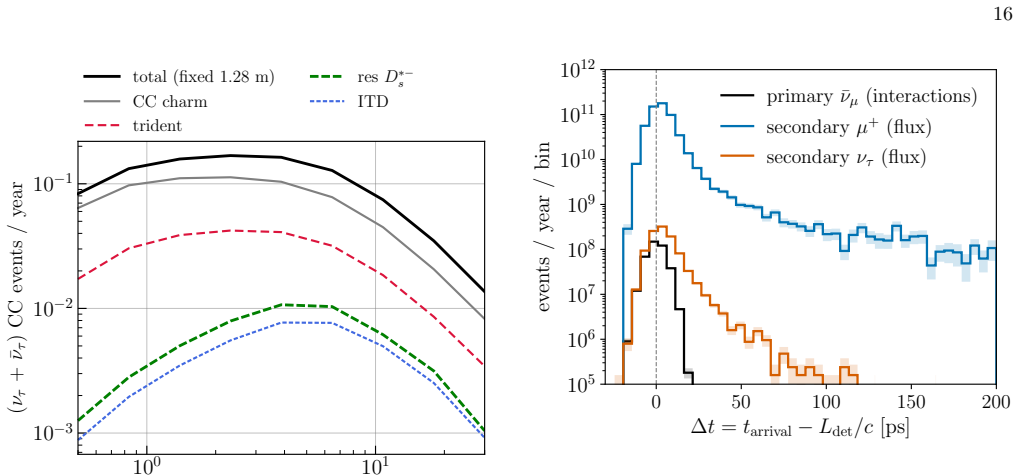
The paper establishes that the forward neutrino beam from muon decays in the 10 TeV muon collider ring is shaped more by the accelerator lattice than by the decay kinematics. Because the muon beam is strongly focused at the interaction point, its angular divergence reaches 0.1-1 mrad, far above the intrinsic 1/gamma ~ 0.02 mrad opening angle of the decay, so the neutrino spot at a 5 km detector is about a meter wide and the energy-angle 'prism' correlation is washed out. With a 3.2 tonne fiducial volume (a compact vertex tracker plus gaseous argon TPCs), the benchmark detector records roughly $10^{9}$ neutrino-nucleus interactions per year from about 7 x $10^{18}$ neutrinos crossing its face. Neutrino interactions in the upstream rock generate about two highly polarized (>0.999) TeV secondary muons crossing the detector per bunch crossing, a secondary tau-neutrino flux of roughly 0.2 charged-current events per year across both detectors, and wrong-sign neutrino rates at the $10^{-9}$ level relative to the primary beam. The same neutrino-on-target exposure gives event-yield targets for heavy neutral leptons produced by mixing or dipole-portal upscattering that can reach unexplored parameter space at masses up to tens of GeV.
Load-bearing premise
The load-bearing premise is that the specific arrangement of magnets and straight sections used to model the beam is representative of the eventual 10 TeV muon collider; that arrangement was supplied privately and is not varied in the study, so a different final design could change the neutrino spot size, the loss of the energy-angle correlation, and every downstream rate.
Editorial extensions
If this is right
- A 5 km forward detector with a 3.2 tonne fiducial volume will record about 10^9 neutrino-nucleus interactions per year, with roughly 5 x 10^5 neutrino-electron scattering events, opening precision electroweak and QCD measurements.
- The neutrino spot size is set by the 0.1-1 mrad muon beam divergence rather than by 1/gamma, so detector apertures must match a roughly meter-scale beam and the energy-angle prism correlation cannot be used to tag neutrino energies.
- About two high-energy, highly polarized (P > 0.999) secondary muons cross each detector per bunch crossing, so vetoes must reject them event by event rather than bunch by bunch.
- Secondary tau neutrinos from neutrino interactions in the rock give only about 0.2 charged-current events per year across both detectors at 5 km, making tau-appearance studies from rock interactions likely out of reach.
- A ten-year exposure yields event-yield targets for heavy neutral leptons, reaching mixings as low as |U_muN|^2 ~ 2 x 10^-11 near m_N ~ 15 GeV and dipole couplings down to roughly 4 x 10^-10 GeV^-1 near m_N ~ 6 GeV, before detector backgrounds are applied.
Reading between the lines
- Beyond the paper: if the prism effect is as thoroughly washed out as claimed, forward detectors will need tracking calorimetry or other energy estimators rather than radial position to reconstruct neutrino energy, a consequence the paper leaves implicit.
- Beyond the paper: the same beam-optics sensitivity makes the neutrino spot a design lever; a dedicated straight section with much larger beta function could shrink the spot and restore the energy-angle correlation, at the cost of larger apertures, and the paper explicitly leaves that feasibility study to future work.
- Beyond the paper: the highly polarized, roughly 1.2 TeV secondary muon beam, about 10^12 muons per year, is itself a physics resource, effectively a fixed-target polarized muon source, though the paper only notes the comparison and does not develop an experimental program around it.
- Beyond the paper: since wrong-sign neutrino rates are at most 10^-9 of the primary rate, any observed excess of wrong-sign flavor would be a sharp new-physics indicator, a conclusion the paper does not draw explicitly.
Signed reviews
Editorial analysis
A structured set of objections, weighed in public.
Referee Report
Summary. This paper computes the forward neutrino flux produced by muon decays in the straight section and nearby arcs of a 10 TeV muon collider, using a new Monte Carlo code MINT that combines a MAD-X/IMCC lattice description of the muon orbit and optics with standard muon-decay kinematics. The central results are: at a 5 km benchmark detector, the neutrino spot is set by the muon-beam divergence (0.1-1 mrad) rather than by 1/gamma, so the energy-angle "prism" effect is washed out; the benchmark detector with a 3.2 t fiducial volume accumulates about 10^9 neutrino-nucleus interactions per year; roughly two high-energy secondary muons per bunch crossing reach each detector from neutrino interactions in the upstream rock; secondary tau-neutrino and wrong-sign neutrino fluxes are small; and neutrino upscattering in rock or detector can give interesting event-yield targets for heavy neutral leptons with mixing or dipole couplings. The paper includes appendices on the neutrino angular distribution, the Courant-Snyder beam dynamics used in MINT, and validation of the muon energy-loss treatment with nuPyProp.
Significance. If the quoted rates hold, this is a useful quantitative basis for the forward-physics program of a 10 TeV muon collider. The paper has clear strengths: MINT is made public; the Standard Model calculation is parameter-free in the sense that no fitted quantity enters the flux or rate; the cross sections use CT18NNLO PDFs and standard CC/NC formulas; and the muon propagation is validated against nuPyProp in Appendix C. The identification of beam-divergence-dominated spot size and the washout of the prism effect is a concrete, falsifiable prediction that goes beyond earlier simplified flux estimates. The secondary-muon, wrong-sign neutrino, and tau-neutrino calculations are useful reference predictions, and the HNL event-yield maps are explicitly framed as targets for future detector and background studies. The main caveat is that the numerical results are anchored to a single non-public, unvaried IMCC lattice, and a few secondary claims rest on estimates that are less fully developed than the primary flux calculation.
major comments (2)
- [Sec. II.A; Figs. 3 and 7; Ref. [15]] The headline numbers - the ~1 m neutrino spot, the 60% detector acceptance, the O(10^9) interactions/year, the washout of the prism effect in Fig. 7, and the roughly two secondary muons per bunch crossing - all depend on a single hybrid v0.6+v0.9 IMCC lattice supplied as a private communication (Ref. [15]). The lattice file is not released with MINT and no variation over beta*, emittance, chicane bending angles, or straight-section length is presented. The constant-divergence curves in Fig. 5 are useful for understanding the role of divergence, but they are not an optics scan: they replace the full lattice by a single Gaussian width rather than perturbing the actual lattice parameters. Because the beam divergence and chicane/arc geometry set the angular profile, a factor-of-two change in the straight-section divergence would change both the spot area and the accepted flux, and a substantially larger beta* could partially restore the energy-angle correlation that Fig. 7 uses to demonstrate washout. I ask the authors to either release the lattice input (or a parameterized surrogate) together with MINT, or add a systematic scan over the relevant optics parameters and report how the event rate, acceptance, spot size, and secondary-muon rate vary. Without this, the numerical claims are tied to a single unverifiable external input.
- [Sec. III.A; Fig. 12; Appendix C] The paper advertises the secondary muons as "highly polarized" in the abstract and concludes |P_mu| > 0.999, but the supporting estimate is a single sentence: folding the Highland angle over the rock column gives a flux-averaged depolarization of ~2 x 10^-4. No formula for the spin precession, no treatment of energy-dependent depolarization during stochastic energy losses, and no uncertainty estimate are given, and the text itself concedes that a dedicated simulation would be needed. Since the polarization enters the abstract, the conclusions, and the positron spectrum in Fig. 12, this claim should either be backed by a quantitative spin-depolarization calculation or softened to "expected to remain highly polarized, pending a dedicated simulation study."
minor comments (4)
- [Figures 6, 10, 13 and text] Several labels render the mu-minus symbol as "mu box" (e.g., Figs. 6, 10, 13 and the "mu box beam" labels); please fix the glyph encoding throughout.
- [Sec. II.A, p. 3] The sentence "The lattice accounts for about 1.5 km of the entire ring, which we assume to be total circumference of 10 km" is ambiguous: clarify that MINT propagates the 1.5 km lattice segment and that the multi-turn storage and 85% decay fraction are folded in through the stated normalization, or describe the alternative procedure explicitly.
- [Eq. (25)] The integration measure in Eq. (25) uses dPi and dL without definitions; please define the phase-space and propagation-length variables, or simplify the notation.
- [Fig. 7 caption] The two panels use different x-axis ranges and color scales; the caption notes this, but a common scale or an inset would help readers compare the prism effect before and after including beam dynamics.
Circularity Check
No significant circularity: the forward-flux prediction follows from standard decay kinematics, external lattice optics, and public SM calculators, with no fitted parameter renamed as a prediction.
full rationale
The paper's central result — O(10^9) neutrino-nucleus interactions per year in a 3.2 t fiducial volume at 5 km with an O(1) m spot — is obtained by simulating muon decays along the IMCC hybrid lattice (Ref. [15], an external private communication) and convolving the resulting flux with SM cross sections. No parameter is fitted to the headline rates; the detector aperture (1.3 m radius) is explicitly set to contain about 60% of the simulated flux, which is a transparent design choice rather than a hidden fit. The washing out of the energy-angle prism effect is a derived consequence of the lattice optics (Figs. 2 and 7) and is independently captured by the analytic convolution in Appendix A. The secondary-muon and tau-neutrino fluxes use standard DIS/IMD cross sections and the public nuPyProp propagation tool, with the Highland multiple-scattering supplement validated in Appendix C. The HNL and dipole estimates use the public DarkNews and NEPTUNE calculators (whose authors include paper co-authors) and are explicitly labeled as event-yield targets before detector efficiencies and backgrounds, not as sensitivity projections. Self-citations such as Ref. [14] are contextual and not load-bearing. The only material caveat is that the unvaried private IMCC lattice is an external input whose representativeness affects the exact rates and spot size; that is a correctness and robustness risk, not circularity.
Assumptions & free parameters
free parameters (6)
- Muon beam intensity (N_mu, rate, duty factor) =
N_mu=2e12/bunch, 5 Hz, 1e7 s/year
- Normalized transverse emittance and beta* =
epsilon_N=25e-6 m rad, beta*=1.5 mm
- Charm fragmentation pT width parameter beta =
1.21 GeV^-2
- Charm fragmentation parameter epsilon_P =
0.20
- Upstream rock integration length =
2.5 km
- Benchmark detector aperture radius and column density =
1.3 m radius, 43 g/cm2
assumptions (7)
- standard math Standard Model neutrino cross sections with CT18NNLO PDFs describe TeV scattering (Eqs. 4-8, 13-18).
- domain assumption The IMCC hybrid v0.6+v0.9 lattice is a representative design for the 10 TeV muon collider interaction region.
- domain assumption The muon beam is described by Courant-Snyder envelopes with Gaussian transverse distributions, neglecting individual particle tracking and transverse correlations.
- domain assumption The rock upstream of the detector is uniform standard rock (rho=2.65 g/cm3), and secondary muon production is dominated by CC DIS and inverse muon decay; hadronic and electromagnetic cascades are neglected.
- domain assumption Muon beams are unpolarized for the analytic angular distribution; MINT uses boosted decay kinematics without beam polarization.
- domain assumption Heavy neutral leptons are described by the minimal type-I seesaw mixing model and the dimension-5 dipole operator (Eqs. 22 and 27).
- standard math Charm hadronization and fragmentation are described by the Peterson function and hadronization fractions from Ref [65].
Cite this review
Pith. "Pith review of The Forward Neutrino Flux and its Secondaries at a 10 TeV Muon Collider." pith.science (2026). https://pith.science/paper/LVMRJ4EY
@misc{pith2026260802718,
  author       = {Pith},
  title        = {Pith review of: The Forward Neutrino Flux and its Secondaries at a 10 TeV Muon Collider},
  year         = {2026},
  howpublished = {\url{https://pith.science/paper/LVMRJ4EY}},
  note         = {Machine review of arXiv:2608.02718}
}
abstract
Muon decays in a muon collider ring would produce TeV neutrino and antineutrino beams of electron and muon flavor. We study this flux in the forward $\mu^+$ and $\mu^-$ beam directions at a 10 TeV muon collider, introducing MINT, a dedicated Monte Carlo simulation to model neutrino fluxes including the muon beam dynamics. We find that a benchmark detector at 5 km from the interaction point would see about $\mathcal{O}(10^{9})$ neutrino interactions per year in a $\sim3$ tonne fiducial volume with a beam spot size of $\mathcal{O}(1)$ meter. We calculate the number of secondary muons and neutrinos generated by neutrino interactions in the rock upstream of the forward detectors and find that about two secondary high-energy and highly polarized muons from the rock would cross each detector per bunch crossing. Neutrino productions of charmed mesons and taus in the rock generate a small $\nu_\tau+\bar\nu_\tau$ secondary flux, with $\mathcal{O}(0.2)$ events per year in the detectors, likely too small to be observed. Wrong-sign neutrinos from similar processes, such as $\nu_e+\bar\nu_\mu$ in the $\mu^-$ beam, are more numerous but still of $\mathcal{O}(10^{-9})$ of the number of TeV neutrino interactions. Finally, we outline how the large forward neutrino exposure can be used to search for beyond-the-Standard-Model particles produced in neutrino interactions, with examples of heavy neutral leptons coupled to electron and muon flavors through mixing or electromagnetic dipole operators.
Figures


Figures from the paper (17 more)




Reference graph
Works this paper leans on
-
[15]
C. Accetturaet al., Eur. Phys. J. C83, 864 (2023), [Er- ratum: Eur.Phys.J.C 84, 36 (2024)], arXiv:2303.08533 [physics.acc-ph]
arXiv 2023
-
[1]
We neglect the smaller contribution from NC charm produc- tion [59]
Charm production followed by leptonic decays of charmed mesons and taus, c→D ± (s) → (−) ντ +τ ±.(9) The tau lepton subsequently decays to produce a second tau neutrino,τ ± → (−) ντ +X. We neglect the smaller contribution from NC charm produc- tion [59]
-
[2]
10□11 10□9 10□7 dN/dEe [e+ / year / GeV] Pµ+ = +1 Pµ+ = 0 101 102 103 Ee [GeV] 1 2pol
Inverse tau decay, ¯νee− →τ − ¯ντ ,(10) giving two tau neutrinos per event, one from the primary interaction and one from the tau decay. 10□11 10□9 10□7 dN/dEe [e+ / year / GeV] Pµ+ = +1 Pµ+ = 0 101 102 103 Ee [GeV] 1 2pol. / unpolarized FIG. 12. The energy spectrum of the positrons from sec- ondaryµ + decays that happen between the rock and the back of t...
-
[3]
We neglect di-tau production, which has a much smaller cross section (see Figs
Neutrino trident production of taus, ναA→ℓ − α τ +ντ A, α=e, µ,(11) and the corresponding antineutrino processes. We neglect di-tau production, which has a much smaller cross section (see Figs. 9 and 10)
-
[4]
InverseD ∗ s decay, ¯νee− →D ∗− s →γ(D − s →τ − ¯ντ ).(12) The correspondingD ∗ production can be safely ne- glected. Secondary tau neutrino production in the rock is a sim- ilar physical mechanism behind ultra-high-energy tau- neutrino appearance during propagation through the Earth [60], adapted here to the TeV energies and short baselines of a muon-col...
-
[5]
Charm production The largest secondary tau-neutrino flux is produced by CC charm production. We account for both theD ± andD s contributions, but the latter dominates theν τ flux due to the larger branching fractionB(D s →τ ντ )≃ 13 −4 −2 0 2 4 x [m] −4 −2 0 2 4 y [m] µ+ beam (z = 5 km) −4 −2 0 2 4 x [m] µ□ beam (z = −5 km) 0.00 0.01 0.02 0.03 0.04 µ± / b...
-
[6]
(8) withℓ=τ
Inverse Tau Decay The cross section is given by Eq. (8) withℓ=τ. At the 10 TeV MuC, only the high-energy fraction of the ¯νe flux is above the thresholdE ν >3.09 TeV. The two- body production kinematics are sampled in the center-of- mass frame with the amplitude|M| 2 ∝(k ¯νe ·k ¯ντ )(pe ·p τ ), followed by a polarizedτ − decay withP=−1. The large Lorentz ...
-
[7]
Despite being sup- pressed byα 2 and the multi-body phase space, trident events produce two tau neutrinos per event, one from the primary interaction and one from the tau decay
Neutrino Trident Tau Production Neutrino trident production of taus via CC is another source of secondary tau neutrinos. Despite being sup- pressed byα 2 and the multi-body phase space, trident events produce two tau neutrinos per event, one from the primary interaction and one from the tau decay. The prompt tau neutrino is typically harder than the neutr...
Show all 131 references
-
[8]
neutrinos-on-target
InverseD ∗ s Decay Resonant production ofD ∗ s mesons in ¯νee− scattering is yet another source of secondaryτ. Following Ref. [52], we consider the vector mesonD ∗ s , which decays toD sγ, followed byD s →τ ντ . Resonant pseudoscalarD s pro- duction is helicity suppressed and ...
-
[8]
neutrinos-on-target
InverseD ∗ s Decay Resonant production ofD ∗ s mesons in ¯νee− scattering is yet another source of secondaryτ. Following Ref. [52], we consider the vector mesonD ∗ s, which decays toD sγ, followed byD s→τν τ. Resonant pseudoscalarD s pro- duction is helicity suppressed and neg...
-
[9]
Acciarriet al.(DUNE), (2016), arXiv:1601.05471 [physics.ins-det]
R. Acciarriet al.(DUNE), (2016), arXiv:1601.05471 [physics.ins-det]
2016
-
[10]
Al Aliet al., Rept
H. Al Aliet al., Rept. Prog. Phys.85, 084201 (2022), arXiv:2103.14043 [hep-ph]
2022 arXiv
-
[11]
K. M. Blacket al., JINST19, T02015 (2024), arXiv:2209.01318 [hep-ex]
2024 arXiv
-
[12]
Adolphsenet al., CERN Yellow Rep
C. Adolphsenet al., CERN Yellow Rep. Monogr.1, 1 (2022), arXiv:2201.07895 [physics.acc-ph]
2022
-
[13]
Stratakiset al.(Muon Collider), (2022), 10.2172/1881942, arXiv:2203.08033 [physics.acc-ph]
D. Stratakiset al.(Muon Collider), (2022), 10.2172/1881942, arXiv:2203.08033 [physics.acc-ph]
2022 arXiv
-
[14]
Hamada, R
Y. Hamada, R. Kitano, R. Matsudo, H. Takaura, and M. Yoshida, PTEP2022, 053B02 (2022), arXiv:2201.06664 [hep-ph]
2022 arXiv
-
[16]
Accetturaet al.(International Muon Collider), CERN Yellow Rep
C. Accetturaet al.(International Muon Collider), CERN Yellow Rep. Monogr.2/2024, 176 (2024), arXiv:2407.12450 [physics.acc-ph]
2024
-
[17]
Abeet al.(T2K, J-PARC Neutrino Facility Group), (2019), arXiv:1908.05141 [physics.ins-det]
K. Abeet al.(T2K, J-PARC Neutrino Facility Group), (2019), arXiv:1908.05141 [physics.ins-det]
2019
-
[18]
D. A. Harris and K. S. McFarland, AIP Conf. Proc.435, 376 (1998), arXiv:hep-ex/9804009
1998 arXiv
-
[19]
Abeet al.(Hyper-Kamiokande Working Group) (2014) arXiv:1412.4673 [physics.ins-det]
K. Abeet al.(Hyper-Kamiokande Working Group) (2014) arXiv:1412.4673 [physics.ins-det]
2014 arXiv
-
[20]
J. P. Delahaye, C. M. Ankenbrandt, S. A. Bogacz, P. Huber, H. G. Kirk, D. Neuffer, M. A. Palmer, R. Ryne, and P. V. Snopok, JINST13, T06003 (2018), arXiv:1803.07431 [physics.acc-ph]
2018 arXiv
-
[21]
B. J. King, AIP Conf. Proc.530, 165 (2000), arXiv:hep- ex/0005006
2000
-
[22]
Mokhov and A
N. Mokhov and A. Van Ginneken, J. Nucl. Sci. Tech. 37, 172 (2000)
2000
-
[23]
Bojorquez-Lopez, M
L. Bojorquez-Lopez, M. Hostert, C. A. Arg¨ uelles, and Z. Liu, Phys. Rev. Lett.135, 091803 (2025), arXiv:2412.14115 [hep-ph]
2025 arXiv
-
[24]
Vanwelde, private communication
M. Vanwelde, private communication
-
[25]
Geer, Phys
S. Geer, Phys. Rev. D57, 6989 (1998), [Erratum: Phys.Rev.D 59, 039903 (1999)], arXiv:hep-ph/9712290
1998 arXiv
-
[26]
B. J. King, AIP Conf. Proc.435, 334 (1998), arXiv:hep- ex/9907033
1998
-
[27]
N. W. Kamp and G. Putnam, (2025), arXiv:2508.09249 [hep-ph]
2025 arXiv
-
[28]
D. A. Harris and K. S. McFarland, AIP Conf. Proc.435, 505 (1998), arXiv:hep-ex/9804010
1998 arXiv
-
[29]
Quigg, AIP Conf
C. Quigg, AIP Conf. Proc.435, 242 (1998), arXiv:hep- ph/9803326
1998
-
[30]
B. J. King, AIP Conf. Proc.530, 142 (2000), arXiv:hep- ex/0005007
2000
-
[31]
I. I. Y. Bigiet al., Phys. Rept.371, 151 (2002), arXiv:hep-ph/0106177
2002 arXiv
-
[32]
M. L. Manganoet al., , 185 (2001), arXiv:hep- ph/0105155
2001
- [33]
-
[34]
Adhikary, K
J. Adhikary, K. J. Kelly, F. Kling, and S. Trojanowski, Phys. Rev. D111, 075019 (2025), arXiv:2412.10315 [hep-ph]
2025 arXiv
- [35]
-
[36]
H. T. Klest, Phys. Rev. D112, L051504 (2025), arXiv:2506.19301 [nucl-ex]
2025
-
[37]
Accetturaet al.(International Muon Collider), (2025), arXiv:2504.21417 [physics.acc-ph]
C. Accetturaet al.(International Muon Collider), (2025), arXiv:2504.21417 [physics.acc-ph]
2025
-
[38]
de Gouvˆ ea and A
A. de Gouvˆ ea and A. Thompson, JHEP12, 098 (2025), arXiv:2505.00152 [hep-ph]
2025
-
[39]
Kling, Y
F. Kling, Y. Ma, K. Mekala, J. Reuter, and Z. Tabrizi, JHEP05, 050 (2026), arXiv:2508.00761 [hep-ph]
2026 arXiv
-
[40]
Marzocca, F
D. Marzocca, F. Montagno, M. Morales-Alvarado, and A. Wulzer, JHEP05, 069 (2026), arXiv:2511.23288 [hep-ph]
2026
-
[41]
Cesarotti, S
C. Cesarotti, S. Homiller, R. K. Mishra, and M. Reece, Phys. Rev. Lett.130, 071803 (2023), arXiv:2202.12302 [hep-ph]
2023 arXiv
-
[42]
Cesarotti and R
C. Cesarotti and R. Gambhir, JHEP05, 283 (2024), arXiv:2310.16110 [hep-ph]
2024 arXiv
-
[43]
Batell, H
B. Batell, H. Davoudiasl, R. Marcarelli, E. T. Neil, and S. Trojanowski, Phys. Rev. D110, 075039 (2024), arXiv:2407.15942 [hep-ph]
2024 arXiv
-
[44]
Davoudiasl, H
H. Davoudiasl, H. Liu, R. Marcarelli, Y. Soreq, and S. Trifinopoulos, JHEP03, 046 (2025), arXiv:2412.13289 [hep-ph]
2025 arXiv
-
[45]
Adhikaryet al., Eur
J. Adhikaryet al., Eur. Phys. J. C85, 430 (2025), arXiv:2411.04175 [hep-ex]
2025 arXiv
-
[46]
Sakaki and D
Y. Sakaki and D. Ueda, (2026), arXiv:2603.05086 [hep- ph]
2026
-
[47]
S. Das, L. Kupari, M. H. Reno, and S. Trojanowski, (2026), arXiv:2606.05406 [hep-ph]
2026 arXiv
-
[48]
P. B. Denton and J. Gehrlein, Nucl. Phys. B1012, 116818 (2025), arXiv:2407.02572 [hep-ph]
2025 arXiv
-
[49]
Kitano, J
R. Kitano, J. Sato, and S. Sugama, JHEP12, 014 (2024), arXiv:2407.05807 [hep-ph]
2024 arXiv
-
[50]
P. B. Denton, J. Gehrlein, and C.-F. Kong, Nucl. Phys. B1018, 117040 (2025), arXiv:2502.14027 [hep-ph]
2025 arXiv
-
[51]
Abreuet al.(FASER), Eur
H. Abreuet al.(FASER), Eur. Phys. J. C80, 61 (2020), arXiv:1908.02310 [hep-ex]. 26
2020 arXiv
-
[52]
Acamporaet al.(SND@LHC), JINST19, P05067 (2024), arXiv:2210.02784 [hep-ex]
G. Acamporaet al.(SND@LHC), JINST19, P05067 (2024), arXiv:2210.02784 [hep-ex]
2024 arXiv
-
[53]
J. L. Fenget al., J. Phys. G50, 030501 (2023), arXiv:2203.05090 [hep-ex]
2023 arXiv
-
[54]
Houet al., Phys
T.-J. Houet al., Phys. Rev. D103, 014013 (2021), arXiv:1912.10053 [hep-ph]
2021 arXiv
-
[55]
Calzolari, C
D. Calzolari, C. Ahdida, C. Carli, H. Guerin, A. Lech- ner, G. Lerner, J. Manczak, D. Schulte, M. Vanwelde, and D. Lucchesi, inProceedings of the 17th Interna- tional Particle Accelerator Conference (IPAC’26)(JA- CoW Publishing, Deauville, France, 2026) pp. 161–164
2026
-
[56]
F. M. Burk, T. Han, W. Kilian, F. Kling, J. Kopp, and Z. Tabrizi, on arXiv (2026), Aug 04, 2026
2026
-
[57]
“MINT,” https://github.com/jchoi55/MINT
-
[58]
Grote and F
H. Grote and F. Schmidt, inProceedings of the 20th IEEE Particle Accelerator Conference (PAC 2003) (IEEE, Portland, OR, USA, 2003) pp. 3497–3499, re- port No. CERN-AB-2003-024-ABP
2003
-
[59]
Update about IR lattice design and re- maining challenges,
M. Vanwelde, “Update about IR lattice design and re- maining challenges,” Talk at the IMCC and MuCol An- nual Meeting 2026, CERN, Geneva, Switzerland (2026), Presented June 23, 2026
2026
-
[60]
Bogaczet al., inSnowmass 2021(2022) arXiv:2203.08094 [hep-ph]
A. Bogaczet al., inSnowmass 2021(2022) arXiv:2203.08094 [hep-ph]
2022 arXiv
-
[61]
Brdar, A
V. Brdar, A. de Gouvˆ ea, P. A. N. Machado, and R. Plestid, Phys. Rev. D105, 093004 (2022), arXiv:2112.03283 [hep-ph]
2022 arXiv
-
[62]
Gandhi, C
R. Gandhi, C. Quigg, M. H. Reno, and I. Sarcevic, Phys. Rev. D58, 093009 (1998), arXiv:hep-ph/9807264
1998 arXiv
-
[63]
De Lellis, P
G. De Lellis, P. Migliozzi, and P. Santorelli, Phys. Rept. 399, 227 (2004), [Erratum: Phys.Rept. 411, 323–324 (2005)]
2004
-
[64]
P. L. R. Weigel, J. M. Conrad, and A. Garcia-Soto, Phys. Rev. D111, 043044 (2025), arXiv:2408.05866 [hep-ph]
2025 arXiv
-
[65]
Tomalak, K
O. Tomalak, K. Borah, R. J. Hill, K. S. McFarland, and D. Ruterbories, Phys. Rev. D107, 093005 (2023), arXiv:2211.15947 [hep-ph]
2023 arXiv
-
[66]
Garget al., JCAP01, 041 (2023), arXiv:2209.15581 [astro-ph.HE]
D. Garget al., JCAP01, 041 (2023), arXiv:2209.15581 [astro-ph.HE]
2023 arXiv
-
[67]
V. L. Highland, Nucl. Instrum. Meth.129, 497 (1975)
1975
-
[68]
Altonet al.(NuTeV), Phys
A. Altonet al.(NuTeV), Phys. Rev. D64, 012002 (2001), arXiv:hep-ex/0008068
2001 arXiv
-
[69]
A. G. Soto, P. Zhelnin, I. Safa, and C. A. Arg¨ uelles, Phys. Rev. Lett.128, 171101 (2022), arXiv:2112.06937 [hep-ph]
2022 arXiv
-
[70]
A. O. Bazarkoet al.(CCFR), Z. Phys. C65, 189 (1995), arXiv:hep-ex/9406007
1995 arXiv
-
[71]
Kretzer, D
S. Kretzer, D. Mason, and F. Olness, Phys. Rev. D65, 074010 (2002), arXiv:hep-ph/0112191
2002 arXiv
-
[72]
Ballett, T
P. Ballett, T. Boschi, and S. Pascoli, JHEP03, 111 (2020), arXiv:1905.00284 [hep-ph]
2020 arXiv
-
[73]
Peterson, D
C. Peterson, D. Schlatter, I. Schmitt, and P. M. Zerwas, Phys. Rev. D27, 105 (1983)
1983
-
[74]
De Lellis, F
G. De Lellis, F. Di Capua, and P. Migliozzi, Phys. Lett. B550, 16 (2002), arXiv:hep-ph/0210383
2002 arXiv
-
[75]
T. K. Gaisser, R. Engel, and E. Resconi,Cosmic Rays and Particle Physics: 2nd Edition(Cambridge Univer- sity Press, 2016)
2016
-
[76]
Ballett, M
P. Ballett, M. Hostert, S. Pascoli, Y. F. Perez-Gonzalez, Z. Tabrizi, and R. Zukanovich Funchal, JHEP01, 119 (2019), arXiv:1807.10973 [hep-ph]
2019 arXiv
-
[77]
Neptune: Neutrino leptonic and semilep- tonic scattering processes,
M. Hostert, “Neptune: Neutrino leptonic and semilep- tonic scattering processes,” (2026), gitHub repository, accessed July 26, 2026
2026
-
[78]
de Gouvea and J
A. de Gouvea and J. Jenkins, Phys. Rev. D74, 033004 (2006), arXiv:hep-ph/0603036
2006 arXiv
-
[79]
Fern´ andez-Mart´ ınez, M
E. Fern´ andez-Mart´ ınez, M. Gonz´ alez-L´ opez, J. Hern´ andez-Garc´ ıa, M. Hostert, and J. L´ opez- Pav´ on, JHEP09, 001 (2023), arXiv:2304.06772 [hep-ph]
2023 arXiv
-
[80]
J. M. Berryman, A. de Gouvea, P. J. Fox, B. J. Kayser, K. J. Kelly, and J. L. Raaf, JHEP02, 174 (2020), arXiv:1912.07622 [hep-ph]
2020 arXiv
-
[81]
S. R. Mishraet al., Phys. Rev. Lett.59, 1397 (1987)
1987
-
[82]
Coloma, E
P. Coloma, E. Fern´ andez-Mart´ ınez, M. Gonz´ alez-L´ opez, J. Hern´ andez-Garc´ ıa, and Z. Pavlovic, Eur. Phys. J. C 81, 78 (2021), arXiv:2007.03701 [hep-ph]
2021 arXiv
-
[83]
Breitbach, L
M. Breitbach, L. Buonocore, C. Frugiuele, J. Kopp, and L. Mittnacht, JHEP01, 048 (2022), arXiv:2102.03383 [hep-ph]
2022 arXiv
-
[84]
Albaneseet al.(SHiP),BDF/SHiP at the ECN3 high-intensity beam facility, Tech
R. Albaneseet al.(SHiP),BDF/SHiP at the ECN3 high-intensity beam facility, Tech. Rep. (CERN, Geneva, 2023)
2023
-
[85]
A. M. Abdullahiet al., J. Phys. G50, 020501 (2023), arXiv:2203.08039 [hep-ph]
2023 arXiv
-
[86]
Minkowski, Phys
P. Minkowski, Phys. Lett. B67, 421 (1977)
1977
-
[87]
Yanagida, Conf
T. Yanagida, Conf. Proc. C7902131, 95 (1979)
1979
-
[88]
Gell-Mann, P
M. Gell-Mann, P. Ramond, and R. Slansky, Conf. Proc. C790927, 315 (1979), arXiv:1306.4669 [hep-th]
1979 arXiv
-
[89]
R. N. Mohapatra and G. Senjanovic, Phys. Rev. Lett. 44, 912 (1980)
1980
-
[90]
Ovchynnikov, T
M. Ovchynnikov, T. Schwetz, and J.-Y. Zhu, Phys. Rev. D107, 055029 (2023), arXiv:2210.13141 [hep-ph]
2023 arXiv
-
[91]
Vilainet al.(CHARM II), Phys
P. Vilainet al.(CHARM II), Phys. Lett. B343, 453 (1995)
1995
-
[92]
A. M. Abdullahiet al.(MicroBooNE), Phys. Rev. Lett. 136, 121804 (2026), arXiv:2502.10900 [hep-ex]
2026 arXiv
-
[93]
P. Li, Z. Liu, and K.-F. Lyu, JHEP03, 231 (2023), arXiv:2301.07117 [hep-ph]
2023 arXiv
-
[94]
Mekala, J
K. Mekala, J. Reuter, and A. F. ˙Zarnecki, Phys. Lett. B841, 137945 (2023), arXiv:2301.02602 [hep-ph]
2023 arXiv
-
[95]
T. H. Kwok, L. Li, T. Liu, and A. Rock, Phys. Rev. D 110, 075009 (2024), arXiv:2301.05177 [hep-ph]
2024 arXiv
-
[96]
Q.-H. Cao, K. Cheng, and Y. Liu, Phys. Rev. Lett. 134, 021801 (2025), arXiv:2403.06561 [hep-ph]
2025 arXiv
-
[97]
A. M. Abdullahi, J. Hoefken Zink, M. Hostert, D. Mas- saro, and S. Pascoli, Comput. Phys. Commun.297, 109075 (2024), arXiv:2207.04137 [hep-ph]
2024 arXiv
-
[98]
Schwetz, A
T. Schwetz, A. Zhou, and J.-Y. Zhu, JHEP21, 200 (2020), arXiv:2105.09699 [hep-ph]
2020 arXiv
-
[99]
Ismail, S
A. Ismail, S. Jana, and R. M. Abraham, Phys. Rev. D 105, 055008 (2022), arXiv:2109.05032 [hep-ph]
2022 arXiv
-
[100]
Magill, R
G. Magill, R. Plestid, M. Pospelov, and Y.-D. Tsai, Phys. Rev. D98, 115015 (2018), arXiv:1803.03262 [hep- ph]
2018 arXiv
-
[101]
R. A. Gustafson, R. Plestid, and I. M. Shoemaker, Phys. Rev. D106, 095037 (2022), arXiv:2205.02234 [hep-ph]
2022 arXiv
-
[102]
Brdar, A
V. Brdar, A. Greljo, J. Kopp, and T. Opferkuch, JCAP 01, 039 (2021), arXiv:2007.15563 [hep-ph]
2021 arXiv
-
[103]
S. N. Gninenko and N. V. Krasnikov, Phys. Lett. B450, 165 (1999), arXiv:hep-ph/9808370
1999 arXiv
-
[104]
S. N. Gninenko, Phys. Rev. D83, 015015 (2011), arXiv:1009.5536 [hep-ph]
2011 arXiv
-
[105]
Coloma, P
P. Coloma, P. A. N. Machado, I. Martinez-Soler, and I. M. Shoemaker, Phys. Rev. Lett.119, 201804 (2017), 27 arXiv:1707.08573 [hep-ph]
2017 arXiv
-
[106]
Jod lowski and S
K. Jod lowski and S. Trojanowski, JHEP05, 191 (2021), arXiv:2011.04751 [hep-ph]
2021 arXiv
-
[107]
C. A. Arg¨ uelles, N. Foppiani, and M. Hostert, Phys. Rev. D105, 095006 (2022), arXiv:2109.03831 [hep-ph]
2022 arXiv
-
[108]
Ballett, M
P. Ballett, M. Hostert, and S. Pascoli, Phys. Rev. D 101, 115025 (2020), arXiv:1903.07589 [hep-ph]
2020 arXiv
-
[109]
Ovchynnikov and J.-Y
M. Ovchynnikov and J.-Y. Zhu, JHEP07, 039 (2023), arXiv:2301.08592 [hep-ph]
2023 arXiv
-
[110]
Barducci and A
D. Barducci and A. Dondarini, JHEP10, 165 (2024), arXiv:2404.09609 [hep-ph]
2024 arXiv
-
[111]
Beltr´ an, P
R. Beltr´ an, P. D. Bolton, F. F. Deppisch, C. Hati, and M. Hirsch, JHEP07, 153 (2024), arXiv:2405.08877 [hep- ph]
2024 arXiv
-
[112]
for a review). The transverse coordinates of a muon areu(s) andu ′(s), wheresthe position along the central reference orbit,u=x, yare the transverse position, and u′ =du/ds= tanθtheir rate of change withs. The an- gleθis the angle of a given muon trajectory with respect to the...
-
[112]
for a review). The transverse coordinates of a muon areu(s) andu ′(s), wheresthe position along the central reference orbit,u=x,yare the transverse position, and u′ =du/ds= tanθtheir rate of change withs. The an- gleθis the angle of a given muon trajectory with respect to the ...
-
[113]
Duarte, D
L. Duarte, D. C. Maisian, and T. Urruzola, J. Phys. G 52, 065001 (2025), arXiv:2501.07618 [hep-ph]
2025 arXiv
-
[114]
Brdar, Y.-Y
V. Brdar, Y.-Y. Li, S. R. Mir, and Y.-L. Wang, JHEP 10, 230 (2025), arXiv:2502.07024 [hep-ph]
2025
-
[115]
Batell, M
B. Batell, M. Pospelov, and B. Shuve, JHEP08, 052 (2016), arXiv:1604.06099 [hep-ph]
2016 arXiv
-
[116]
Bertuzzo, S
E. Bertuzzo, S. Jana, P. A. N. Machado, and R. Zukanovich Funchal, Phys. Rev. Lett.121, 241801 (2018), arXiv:1807.09877 [hep-ph]
2018 arXiv
-
[117]
Ballett, S
P. Ballett, S. Pascoli, and M. Ross-Lonergan, Phys. Rev. D99, 071701 (2019), arXiv:1808.02915 [hep-ph]
2019 arXiv
-
[118]
Abbonet al.(COMPASS), Nucl
P. Abbonet al.(COMPASS), Nucl. Instrum. Meth. A 577, 455 (2007), arXiv:hep-ex/0703049
2007 arXiv
-
[119]
M. R. Adamset al.(E665), Nucl. Instrum. Meth. A291, 533 (1990)
1990
-
[120]
E. D. Courant and H. S. Snyder, Annals Phys.3, 1 (1958)
1958
-
[121]
Wiedemann,Particle Accelerator Physics, Graduate Texts in Physics (Springer, Berlin, Germany, 2015)
H. Wiedemann,Particle Accelerator Physics, Graduate Texts in Physics (Springer, Berlin, Germany, 2015)
2015
-
[122]
Lipari and T
P. Lipari and T. Stanev, Phys. Rev. D44, 3543 (1991)
1991
-
[123]
Gutjahret al., Eur
P. Gutjahret al., Eur. Phys. J. C82, 1143 (2022), [Er- ratum: Eur.Phys.J.C 83, 12 (2023)], arXiv:2208.11902 [astro-ph.IM]
2022 arXiv
Reviewed August 15, 2026 · model on record in the stance chip above.
Discussion (0). Continue with ORCID to comment.