REVIEW 4 major objections 6 minor 48 references
Adaptive Part Learning for Fine-Grained Generalized Category Discovery: A Plug-and-Play Enhancement
T0 review · 4 major / 6 minor · reviewed 2026-08-06 · deepseek-v4-flash
Pith's one-line read This paper claims that replacing the global CLS token with pooled, adaptively learned part features resolves the discriminability-versus-generalization trade-off in fine-grained generalized category discovery, and supports this with…
desk verdict A solid plug-and-play part-level enhancement for GCD with plausible gains, but reproducibility gaps and a vague negative-sampling rule keep the central claim from being fully verified. read the letter →
The pith
A machine-rendered reading of the paper's core claim, the machinery that carries it, and where it could break.
The reading
What carries the argument
The load-bearing object is the set of shared learnable part queries $Q \in \mathbb{R}^{T \times C}$, which act as bridges that give the same index to corresponding parts in different images. The DINO prior $F_{\text{prior}}$ from thresholded attention-head features (Eq. 3) steers these queries; the Gumbel-Softmax hard assignment $\mathbf{H}_{\text{part}}$ (Eq. 4) converts patch-query similarities into binary part masks while preserving gradients; the all-min contrastive loss (Eq. 5) performs the adaptive selection of discriminative parts; and the diversity loss (Eq. 6) prevents query collapse. Together these turn an image into $T$ corresponding parts whose pooled features replace the CLS token.
What would settle it
Take a set of fine-grained images, apply strong random cropping or occlusion, and compare APL's hard assignment $\mathbf{H}_{\text{part}}$ of the same image across augmentations: if a large fraction of patches switch part queries, the claimed consistency and correspondence are not present. The same test can be run as an ablation over the threshold $\epsilon$ in Eq. (3) and the query count $T$; if no setting both stabilizes assignments and preserves accuracy, the part prior is not carrying the gain.
Extended reading notes
Core claim
The paper's central claim is that object parts, rather than global image semantics, are the right unit for GCD: discriminative parts such as the head separate similar species, while shared parts such as legs keep common structure transferable. Concretely, the method extracts DINO part priors by thresholding the final-layer attention maps, transforms a set of $T$ shared learnable part queries into image-specific queries by cross-attention, hard-assigns image patches to queries through a differentiable Gumbel-Softmax step, and treats the patches assigned to each query as one consistent part. An all-min contrastive loss (Eq. 5) makes all corresponding parts of positive pairs similar and only the least-similar corresponding part of negative pairs dissimilar, so discriminative parts are sharpened while the rest stay shareable; a diversity loss (Eq. 6) keeps queries from collapsing. The pooled part feature replaces the CLS token in SimGCD, SPTNet, and CMS, yielding average gains of 3.7, 2.9, and 3.7 accuracy points across four fine-grained datasets, with larger gains generally on novel classes.
Load-bearing premise
The method depends on DINO's attention maps pointing at coherent, reusable object parts, and on the shared queries keeping those parts aligned across different images even when parts are occluded or cropped out; if that alignment fails, the hard part assignments are noise and the all-min loss is constraining random clusters.
Editorial extensions
If this is right
- Plugging APL into SimGCD raises average accuracy by 3.7 points across CUB-200, Stanford Cars, FGVC-Aircraft, and Herbarium-19, with the largest single gain of 6.3 points on Stanford Cars.
- Novel-class accuracy improves more than known-class accuracy in most fine-grained settings, for example +6.2 novel versus +5.7 known on Stanford Cars with SimGCD, which is the signature of better knowledge transfer from known to novel classes.
- Because only the pooled part feature is swapped in, the same APL module attaches to parametric frameworks (SimGCD, SPTNet) and to the mean-shift framework (CMS) without changing their host losses beyond adding the all-min and diversity losses.
- On generic datasets the gains shrink, for example +0.7 novel points on ImageNet-100, consistent with the claim that part sharing matters most when classes are visually similar and share components.
Reading between the lines
- If the all-min mechanism is the real driver, the same 'hardest corresponding part only' negative constraint could transfer to other part- or prototype-based fine-grained recognition methods, which typically push all negative parts apart.
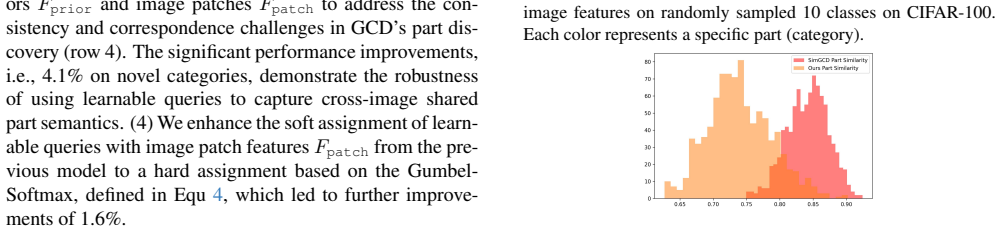
- The paper does not measure part consistency quantitatively; a natural extension is to test APL's hard assignments across augmented or occluded views and check whether accuracy tracks the assignment-stability rate.
- Because DINO part attention is treated as a frozen prior, a domain shift away from natural images could break the part prior; per-domain adaptation of the queries or the threshold $\epsilon$ in Eq. (3) is a concrete testable extension.
- The interpretability claim could be validated directly by evaluating the discovered part masks against human part annotations, such as CUB part keypoints, even though training is unsupervised; the paper's t-SNE visualizations suggest semantic parts but do not quantify alignment.
Editorial analysis
A structured set of objections, weighed in public.
Referee Report
Summary. The paper proposes APL, a plug-and-play part-learning module for Generalized Category Discovery (GCD). It uses DINO's final-layer attention heads as a part prior, a set of shared learnable part queries to obtain consistent image-specific part features, and a hard-assignment mechanism with Gumbel-Softmax to decompose each image into parts. The part features replace the CLS token representation in existing GCD frameworks. A new "all-min" contrastive loss is introduced to constrain only the least similar part of negative pairs while keeping all corresponding parts of positive pairs similar, and a diversity loss prevents part-query collapse. Experiments on four fine-grained benchmarks and three generic datasets report consistent improvements over SimGCD, SPTNet, and CMS, with ablations attributing the gains to learnable queries, hard assignment, and the all-min loss.
Significance. If the method is correctly specified, APL addresses a real limitation of global-CLS-token GCD methods and offers a practically valuable plug-and-play enhancement. The empirical evidence is coherent and consistent: Table 1 shows gains across all four fine-grained datasets for three different host frameworks, and Table 4 attributes the improvement to the proposed all-min loss rather than to the host GCD loss alone. The idea of sharing generalizable parts while highlighting discriminative parts is well motivated. However, the implementation details of the central equations and the unlabeled negative-sampling rule are not yet precise enough to validate the claimed mechanism or to reproduce the experiments.
major comments (4)
- [§3.2, Eq. (3)] Equation (3) is dimensionally inconsistent as written. Fprior is defined as [ϵ(A1)*Fpatch, ..., ϵ(AM)*Fpatch], so it has shape M×C, and Q is T×C. The expression ProjQ(Q) * ProjK(Fpart)^⊤ / √C then yields a T×M matrix if Fpart=Fprior, or a T×N matrix if Fpart=Fpatch, not the claimed T×C image-specific query QI. In addition, the symbol Fpart is undefined. Since this equation is the foundation of the part-query construction, the authors should give the correct formula with explicit tensor shapes.
- [§3.2, Eq. (4)] The hard-assignment mechanism in Eq. (4) selects a single patch for each query: one_hot(arg max_N(...)) returns exactly one nonzero entry per query in the forward pass, so each part feature Ppart equals the feature of one patch token. This contradicts the text's description that "patches within the same query constitute a potential object part" and the visualization in Figure 3c, which shows multi-patch regions. Unless a soft weighted aggregation is intended, the method does not discover multi-patch object parts as claimed. Please clarify whether each part is a single patch or a region, and if a region, specify how the binary assignment is formed.
- [§3.3, Eq. (5)] The negative-sampling rule for unlabeled images is underspecified. The text states that for unlabeled Ia the authors "randomly sample some images from B as negative samples, ensuring that not all parts of these images are similar to each corresponding part of Ia, and use the similarity of all positive pairs in the batch as the threshold for sampling negative images." This is not a precise algorithm: it does not define the threshold mathematically, does not state how many negatives are sampled, does not specify how to handle cases where no image passes the threshold, and does not state whether augmentations of the same image are excluded. Because Table 4 attributes a gain of about 2.4–2.7 points to the all-min loss over its alternatives, this missing specification is load-bearing for the paper's central claim and must be provided.
- [§3.2–§3.3, Tables 3–4] The paper reports no sensitivity analysis over the key hyperparameters of the proposed module: the number of part queries T, the threshold filter ϵ in Eq. (3), the Gumbel temperature τ in Eq. (4), and the negative-sampling threshold in Eq. (5). The authors acknowledge that DINO's part perception "is too sensitive to variations among different images" and claim that the learnable queries stabilize it, but no quantitative consistency or correspondence metric is reported, and no ablation shows how performance varies with T or ϵ. Without these, the central mechanism of adaptive part discovery is asserted rather than directly demonstrated.
minor comments (6)
- [§4.2, Table 1] The main results are reported for a single run; please add standard deviations or at least a multi-seed evaluation to assess the significance of the reported improvements.
- [§4.3, Table 4] The comparison method "min-max contrastive loss" in row 3 is never defined in the main text; provide its equation or a precise reference so the ablation is interpretable.
- [§3.3, Eq. (6)] In the diversity loss, the use of max(0, sim(Pt, P̂t)) means that negative cosine similarities do not contribute; please clarify whether this is intended and whether the part features are normalized before computing the cosine similarity.
- [References] References [10] and [11] are the same paper (Dosovitskiy et al.); merge them into one entry to avoid duplication.
- [Throughout] There are several typographical errors, including "unlabled" in §3.1, "created auklet" in §1, and "gneralized" in §4.2; these should be corrected.
- [Appendix] The manuscript refers to an Appendix for dataset details and additional ablations, but no appendix is included in the submitted text; please ensure the appendix is present and that the main text is self-contained regarding the negative-sampling algorithm.
Circularity Check
No significant circularity: APL is benchmarked against external GCD frameworks on standard held-out splits, and the reported gains do not reduce to any fitted or self-cited quantity.
full rationale
The paper's derivation chain is self-contained relative to external benchmarks. APL augments existing GCD frameworks (SimGCD, SPTNet, CMS) by discovering object parts via DINO priors and shared learnable queries, then replacing the CLS-token feature with averaged part features (Sec. 3.2, Sec. 3.4). The part-learning objectives in Eq. 5 and Eq. 6 are trained on the same labeled/unlabeled GCD splits used by the host frameworks, and evaluation is performed on standard benchmarks (SSB, Herbarium-19, CIFAR, ImageNet-100) using published comparison numbers. The reported improvements are measured against external methods, not against any quantity fitted to the test labels. The only self-referential element is the negative-sampling heuristic in Sec. 3.3, where the threshold for unlabeled negatives is derived from in-batch positive similarities; this calibrates the contrastive loss but does not define the evaluation target or manufacture the reported accuracy. Even though this sampling rule is underspecified and could be a correctness or reproducibility risk, it is not a circular reduction of the central claim. There are no apparent author self-citations, no imported uniqueness theorems, and no fitted parameter renamed as a prediction. The central claim therefore has independent content verified against external benchmarks.
Assumptions & free parameters
free parameters (5)
- Number of part queries T
- Gumbel-Softmax temperature tau (Eq. 4)
- Attention threshold filter epsilon (Eq. 3)
- Negative-sample similarity threshold (Eq. 5)
- Loss balance factor lambda (Eq. 8)
assumptions (5)
- domain assumption DINO final-layer MSA attention heads localize semantically meaningful object parts
- domain assumption Hard assignment of patches to T shared queries yields consistent, corresponding parts across images, with missing parts absorbed by degenerate queries
- standard math Gumbel-Softmax straight-through estimator is a faithful differentiable surrogate of the hard assignment
- domain assumption Cluster accuracy with Hungarian matching on the unlabeled set faithfully measures GCD performance
- domain assumption Positive-pair-similarity thresholding yields informative negative samples for the all-min loss
invented entities (1)
-
Shared learnable part queries Q in R^(T x C)
Cite this review
Pith. "Pith review of Adaptive Part Learning for Fine-Grained Generalized Category Discovery: A Plug-and-Play Enhancement." pith.science (2026). https://pith.science/paper/LVPS7O6L
@misc{pith2026250706928,
  author       = {Pith},
  title        = {Pith review of: Adaptive Part Learning for Fine-Grained Generalized Category Discovery: A Plug-and-Play Enhancement},
  year         = {2026},
  howpublished = {\url{https://pith.science/paper/LVPS7O6L}},
  note         = {Machine review of arXiv:2507.06928}
}
read the original abstract
Generalized Category Discovery (GCD) aims to recognize unlabeled images from known and novel classes by distinguishing novel classes from known ones, while also transferring knowledge from another set of labeled images with known classes. Existing GCD methods rely on self-supervised vision transformers such as DINO for representation learning. However, focusing solely on the global representation of the DINO CLS token introduces an inherent trade-off between discriminability and generalization. In this paper, we introduce an adaptive part discovery and learning method, called APL, which generates consistent object parts and their correspondences across different similar images using a set of shared learnable part queries and DINO part priors, without requiring any additional annotations. More importantly, we propose a novel all-min contrastive loss to learn discriminative yet generalizable part representation, which adaptively highlights discriminative object parts to distinguish similar categories for enhanced discriminability while simultaneously sharing other parts to facilitate knowledge transfer for improved generalization. Our APL can easily be incorporated into different GCD frameworks by replacing their CLS token feature with our part representations, showing significant enhancements on fine-grained datasets.
Figures


Figures from the paper (1 more)
Reference graph
Works this paper leans on
-
[1]
PDiscoFormer: Relaxing Part Discovery Constraints with Vision Transformers
Ananthu Aniraj, Cassio F Dantas, Dino Ienco, and Diego Marcos. Pdiscoformer: Relaxing part discovery constraints with vision transformers. arXiv preprint arXiv:2407.04538,
-
[2]
k-means++: The advantages of careful seeding
David Arthur, Sergei Vassilvitskii, et al. k-means++: The advantages of careful seeding. In Soda, pages 1027–1035,
-
[3]
Open-world semi-supervised learning
Kaidi Cao, Maria Brbic, and Jure Leskovec. Open-world semi-supervised learning. arXiv preprint arXiv:2102.03526,
-
[4]
Emerg- ing properties in self-supervised vision transformers
Mathilde Caron, Hugo Touvron, Ishan Misra, Herv ´e J´egou, Julien Mairal, Piotr Bojanowski, and Armand Joulin. Emerg- ing properties in self-supervised vision transformers. In Pro- ceedings of the IEEE/CVF international conference on com- puter vision, pages 9650–9660, 2021. 1, 3, 4
work page 2021
-
[5]
This looks like that: deep learn- ing for interpretable image recognition
Chaofan Chen, Oscar Li, Daniel Tao, Alina Barnett, Cynthia Rudin, and Jonathan K Su. This looks like that: deep learn- ing for interpretable image recognition. Advances in neural information processing systems, 32, 2019. 3
work page 2019
-
[6]
Parametric information max- imization for generalized category discovery
Florent Chiaroni, Jose Dolz, Ziko Imtiaz Masud, Amar Mitiche, and Ismail Ben Ayed. Parametric information max- imization for generalized category discovery. InProceedings of the IEEE/CVF International Conference on Computer Vi- sion, pages 1729–1739, 2023. 7
work page 2023
-
[7]
Contrastive Mean-Shift Learning for Generalized Category Discovery
Sua Choi, Dahyun Kang, and Minsu Cho. Contrastive mean- shift learning for generalized category discovery. arXiv preprint arXiv:2404.09451, 2024. 3, 6, 7
work page Pith review arXiv 2024
-
[8]
Unsupervised part discovery from con- trastive reconstruction
Subhabrata Choudhury, Iro Laina, Christian Rupprecht, and Andrea Vedaldi. Unsupervised part discovery from con- trastive reconstruction. Advances in Neural Information Pro- cessing Systems, 34:28104–28118, 2021. 3, 4
work page 2021
Show all 48 references
-
[9]
Imagenet: A large-scale hierarchical image database
Jia Deng, Wei Dong, Richard Socher, Li-Jia Li, Kai Li, and Li Fei-Fei. Imagenet: A large-scale hierarchical image database. In 2009 IEEE conference on computer vision and pattern recognition, pages 248–255. Ieee, 2009. 1, 6
2009
-
[11]
An image is worth 16x16 words: Trans- formers for image recognition at scale
Alexey Dosovitskiy, Lucas Beyer, Alexander Kolesnikov, Dirk Weissenborn, Xiaohua Zhai, Thomas Unterthiner, Mostafa Dehghani, Matthias Minderer, Georg Heigold, Syl- vain Gelly, et al. An image is worth 16x16 words: Trans- formers for image recognition at scale. arXiv preprint a...
2010 arXiv
-
[12]
A unified objective for novel class discovery
Enrico Fini, Enver Sangineto, St ´ephane Lathuili `ere, Zhun Zhong, Moin Nabi, and Elisa Ricci. A unified objective for novel class discovery. InProceedings of the IEEE/CVF Inter- national Conference on Computer Vision, pages 9284–9292,
-
[13]
Statistical theory of extreme values and some practical applications: a series of lectures
Emil Julius Gumbel. Statistical theory of extreme values and some practical applications: a series of lectures . US Gov- ernment Printing Office, 1954. 5
1954
-
[14]
Noise-contrastive estimation: A new estimation principle for unnormalized statistical models
Michael Gutmann and Aapo Hyv ¨arinen. Noise-contrastive estimation: A new estimation principle for unnormalized statistical models. In Proceedings of the thirteenth inter- national conference on artificial intelligence and statistics , pages 297–304. JMLR Workshop and Conferen...
2010
-
[15]
Automatically discov- ering and learning new visual categories with ranking statis- tics
Kai Han, Sylvestre-Alvise Rebuffi, Sebastien Ehrhardt, An- drea Vedaldi, and Andrew Zisserman. Automatically discov- ering and learning new visual categories with ranking statis- tics. arXiv preprint arXiv:2002.05714, 2020. 7
2002 arXiv
-
[16]
Cipr: An efficient framework with cross-instance positive rela- tions for generalized category discovery
Shaozhe Hao, Kai Han, and Kwan-Yee K Wong. Cipr: An efficient framework with cross-instance positive rela- tions for generalized category discovery. arXiv preprint arXiv:2304.06928, 2023. 7
2023 arXiv
-
[17]
Deep residual learning for image recognition
Kaiming He, Xiangyu Zhang, Shaoqing Ren, and Jian Sun. Deep residual learning for image recognition. In Proceed- ings of the IEEE conference on computer vision and pattern recognition, pages 770–778, 2016. 1
2016
-
[18]
Deep residual learning for image recognition
Kaiming He, Xiangyu Zhang, Shaoqing Ren, and Jian Sun. Deep residual learning for image recognition. In CVPR,
-
[19]
Momentum contrast for unsupervised visual rep- resentation learning
Kaiming He, Haoqi Fan, Yuxin Wu, Saining Xie, and Ross Girshick. Momentum contrast for unsupervised visual rep- resentation learning. In Proceedings of the IEEE/CVF con- ference on computer vision and pattern recognition , pages 9729–9738, 2020. 3
2020
-
[20]
Interpretable and accurate fine- grained recognition via region grouping
Zixuan Huang and Yin Li. Interpretable and accurate fine- grained recognition via region grouping. In Proceedings of the IEEE/CVF conference on computer vision and pattern recognition, pages 8662–8672, 2020. 3
2020
-
[21]
Scops: Self-supervised co-part segmentation
Wei-Chih Hung, Varun Jampani, Sifei Liu, Pavlo Molchanov, Ming-Hsuan Yang, and Jan Kautz. Scops: Self-supervised co-part segmentation. In Proceedings of the IEEE/CVF Conference on Computer Vision and Pattern Recognition, pages 869–878, 2019. 3
2019
-
[22]
3d object representations for fine-grained categorization
Jonathan Krause, Michael Stark, Jia Deng, and Li Fei-Fei. 3d object representations for fine-grained categorization. In Proceedings of the IEEE international conference on com- puter vision workshops, pages 554–561, 2013. 6
2013
-
[23]
Learning multiple layers of features from tiny images
Alex Krizhevsky, Geoffrey Hinton, et al. Learning multiple layers of features from tiny images. 2009. 6
2009
-
[24]
Panoptic-partformer: Learning a unified model for panoptic part segmentation
Xiangtai Li, Shilin Xu, Yibo Yang, Guangliang Cheng, Yun- hai Tong, and Dacheng Tao. Panoptic-partformer: Learning a unified model for panoptic part segmentation. In European Conference on Computer Vision , pages 729–747. Springer,
-
[25]
Microsoft coco: Common objects in context
Tsung-Yi Lin, Michael Maire, Serge Belongie, James Hays, Pietro Perona, Deva Ramanan, Piotr Doll´ar, and C Lawrence Zitnick. Microsoft coco: Common objects in context. In Computer Vision–ECCV 2014: 13th European Conference, Zurich, Switzerland, September 6-12, 2014, Proceeding...
2014
-
[26]
A* sam- pling
Chris J Maddison, Daniel Tarlow, and Tom Minka. A* sam- pling. Advances in neural information processing systems , 27, 2014. 5
2014
-
[27]
Fine-grained visual classi- 9 fication of aircraft
Subhransu Maji, Esa Rahtu, Juho Kannala, Matthew Blaschko, and Andrea Vedaldi. Fine-grained visual classi- 9 fication of aircraft. arXiv preprint arXiv:1306.5151 , 2013. 6
2013 arXiv
-
[28]
Gmnet: Graph matching network for large scale part semantic segmentation in the wild
Umberto Michieli, Edoardo Borsato, Luca Rossi, and Pietro Zanuttigh. Gmnet: Graph matching network for large scale part semantic segmentation in the wild. InComputer Vision– ECCV 2020: 16th European Conference, Glasgow, UK, Au- gust 23–28, 2020, Proceedings, Part VIII 16, page...
2020
-
[29]
Dinov2: Learning robust visual features without supervision
Maxime Oquab, Timoth ´ee Darcet, Th ´eo Moutakanni, Huy V o, Marc Szafraniec, Vasil Khalidov, Pierre Fernandez, Daniel Haziza, Francisco Massa, Alaaeldin El-Nouby, et al. Dinov2: Learning robust visual features without supervision. arXiv preprint arXiv:2304.07193, 2023. 2, 3, 4
2023 arXiv
-
[30]
Dynamic conceptional contrastive learning for generalized category discovery
Nan Pu, Zhun Zhong, and Nicu Sebe. Dynamic conceptional contrastive learning for generalized category discovery. In Proceedings of the IEEE/CVF Conference on Computer Vi- sion and Pattern Recognition, pages 7579–7588, 2023. 1, 3, 7
2023
-
[31]
Learn to categorize or categorize to learn? self-coding for general- ized category discovery
Sarah Rastegar, Hazel Doughty, and Cees Snoek. Learn to categorize or categorize to learn? self-coding for general- ized category discovery. Advances in Neural Information Processing Systems, 36, 2024. 1, 7
2024
-
[32]
Selex: Self-expertise in fine-grained generalized category discovery
Sarah Rastegar, Mohammadreza Salehi, Yuki M Asano, Hazel Doughty, and Cees GM Snoek. Selex: Self-expertise in fine-grained generalized category discovery. arXiv preprint arXiv:2408.14371, 2024. 7
2024 arXiv
-
[33]
Particle: Part discov- ery and contrastive learning for fine-grained recognition
Oindrila Saha and Subhransu Maji. Particle: Part discov- ery and contrastive learning for fine-grained recognition. In Proceedings of the IEEE/CVF International Conference on Computer Vision, pages 167–176, 2023. 3
2023
-
[34]
Very deep convo- lutional networks for large-scale image recognition
Karen Simonyan and Andrew Zisserman. Very deep convo- lutional networks for large-scale image recognition. arXiv preprint arXiv:1409.1556, 2014. 1
2014 arXiv
-
[35]
Going denser with open-vocabulary part segmentation
Peize Sun, Shoufa Chen, Chenchen Zhu, Fanyi Xiao, Ping Luo, Saining Xie, and Zhicheng Yan. Going denser with open-vocabulary part segmentation. In Proceedings of the IEEE/CVF International Conference on Computer Vision , pages 15453–15465, 2023. 3
2023
-
[36]
The herbarium challenge 2019 dataset
Kiat Chuan Tan, Yulong Liu, Barbara Ambrose, Melissa Tulig, and Serge Belongie. The herbarium challenge 2019 dataset. arXiv preprint arXiv:1906.05372, 2019. 6
2019 arXiv
-
[37]
Con- trastive multiview coding
Yonglong Tian, Dilip Krishnan, and Phillip Isola. Con- trastive multiview coding. In Computer Vision–ECCV 2020: 16th European Conference, Glasgow, UK, August 23–28, 2020, Proceedings, Part XI 16 , pages 776–794. Springer,
2020
-
[38]
Pdisconet: Semantically consistent part discovery for fine-grained recognition
Robert van der Klis, Stephan Alaniz, Massimiliano Mancini, Cassio F Dantas, Dino Ienco, Zeynep Akata, and Diego Mar- cos. Pdisconet: Semantically consistent part discovery for fine-grained recognition. In Proceedings of the IEEE/CVF International Conference on Computer Vision,...
2023
-
[39]
Attention is all you need
Ashish Vaswani, Noam Shazeer, Niki Parmar, Jakob Uszko- reit, Llion Jones, Aidan N Gomez, Łukasz Kaiser, and Illia Polosukhin. Attention is all you need. Advances in neural information processing systems, 30, 2017. 3
2017
-
[40]
Generalized category discovery
Sagar Vaze, Kai Han, Andrea Vedaldi, and Andrew Zisser- man. Generalized category discovery. In Proceedings of the IEEE/CVF Conference on Computer Vision and Pattern Recognition, pages 7492–7501, 2022. 1, 3, 6, 7
2022
-
[41]
The caltech-ucsd birds-200-2011 dataset
Catherine Wah, Steve Branson, Peter Welinder, Pietro Per- ona, and Serge Belongie. The caltech-ucsd birds-200-2011 dataset. 2011. 6
2011
-
[42]
Sptnet: An efficient alternative framework for generalized category discovery with spatial prompt tuning
Hongjun Wang, Sagar Vaze, and Kai Han. Sptnet: An efficient alternative framework for generalized category discovery with spatial prompt tuning. arXiv preprint arXiv:2403.13684, 2024. 1, 3, 4, 6, 7
2024 arXiv
-
[43]
Parametric classification for generalized category discovery: A baseline study
Xin Wen, Bingchen Zhao, and Xiaojuan Qi. Parametric classification for generalized category discovery: A baseline study. In Proceedings of the IEEE/CVF International Con- ference on Computer Vision, pages 16590–16600, 2023. 1, 2, 3, 4, 6, 7
2023
-
[44]
Decompose novel into known: Part concept learning for 3d novel class discovery
Tingyu Weng, Jun Xiao, and Haiyong Jiang. Decompose novel into known: Part concept learning for 3d novel class discovery. Advances in Neural Information Processing Sys- tems, 36:54282–54299, 2023. 3
2023
-
[45]
Prompt- cal: Contrastive affinity learning via auxiliary prompts for generalized novel category discovery
Sheng Zhang, Salman Khan, Zhiqiang Shen, Muzammal Naseer, Guangyi Chen, and Fahad Shahbaz Khan. Prompt- cal: Contrastive affinity learning via auxiliary prompts for generalized novel category discovery. In Proceedings of the IEEE/CVF Conference on Computer Vision and Pattern R...
2023
-
[46]
Novel visual category discov- ery with dual ranking statistics and mutual knowledge distil- lation
Bingchen Zhao and Kai Han. Novel visual category discov- ery with dual ranking statistics and mutual knowledge distil- lation. Advances in Neural Information Processing Systems, 34:22982–22994, 2021. 3
2021
-
[47]
Learning semi- supervised gaussian mixture models for generalized category discovery
Bingchen Zhao, Xin Wen, and Kai Han. Learning semi- supervised gaussian mixture models for generalized category discovery. In Proceedings of the IEEE/CVF International Conference on Computer Vision, pages 16623–16633, 2023. 7
2023
-
[48]
Multi- class part parsing with joint boundary-semantic awareness
Yifan Zhao, Jia Li, Yu Zhang, and Yonghong Tian. Multi- class part parsing with joint boundary-semantic awareness. In Proceedings of the IEEE/CVF International Conference on Computer Vision, pages 9177–9186, 2019. 3
2019
-
[49]
Learn- ing multi-attention convolutional neural network for fine- grained image recognition
Heliang Zheng, Jianlong Fu, Tao Mei, and Jiebo Luo. Learn- ing multi-attention convolutional neural network for fine- grained image recognition. In Proceedings of the IEEE inter- national conference on computer vision , pages 5209–5217,
Reviewed August 6, 2026 · model on record in the stance chip above.
Discussion (0). Continue with ORCID to comment.