REVIEW 5 major objections 6 minor 42 references
From Novice to Expert: Cost-Aware Bandits for Evolving Worker Performance in Crowdsensing
T0 review · 5 major / 6 minor · reviewed 2026-08-02 · deepseek-v4-flash
Pith's one-line read When crowd workers improve with experience, a cost-aware bandit algorithm can keep total regret logarithmic in the budget.
desk verdict New problem formulation and a clean offline characterization, but Theorem 1's proof has a 256x constant error in N0 and the imported [28] guarantees are used under resets without proof—both need fixing before acceptance. read the letter →
The pith
A machine-rendered reading of the paper's core claim, the machinery that carries it, and where it could break.
The reading
What carries the argument
The central object is the converged reward-to-cost ratio ρ_i = μ_i*/c_i. The algorithm maintains for each worker a piecewise linear model of the early reward trend, a running average cost, and a two-window comparison that fires a reset when the sliding-window means diverge. Selection uses the ratio of an optimistic reward estimate to a pessimistic cost estimate, with confidence terms of order sqrt(log(1/δ)/N_{i,t}). This ratio-symmetric optimism is what lets the algorithm concentrate budget on the worker with the best long-term efficiency.
What would settle it
The most direct check is to take the two-worker instance used in the experiments, with one fast-learner and one slow-learner, and compute the regret of CATI-UCB for budgets up to 10^5. If the regret, after subtracting constant terms, does not stay within a slowly growing O(log B) envelope — or if it matches a power law — the central claim is refuted. A sharper check is to examine the proof of the imported concentration inequality and verify that it still holds when N_{i,t} is reset to 1 at saturation; if it needs N_{i,t} to be monotonically increasing, the theorem is invalid.
Extended reading notes
Core claim
On the paper's own terms, the central discovery is that an increasing-then-converging reward trajectory, combined with unknown worker-specific costs, does not destroy the tractability of budgeted online recruitment. Lemma 1 shows that the optimal offline expected reward R*(B) satisfies ρ*B − C0 ≤ R*(B) ≤ ρ*B, where ρ* is the largest converged reward-per-cost ratio, so the single-worker policy that spends the whole budget on the worker achieving ρ* is optimal up to an additive constant. Theorem 1 states that the CATI-UCB policy — online least-squares fitting of the early linear trend, two-window change-point detection to reset after saturation, and selection by the ratio of reward UCB to cost
Load-bearing premise
The logarithmic regret proof relies on confidence-interval and change-detection bounds taken from an earlier paper, and the algorithm resets a worker's sample count to 1 whenever it thinks the worker has plateaued. If those earlier bounds require a continuously growing sample count without such resets, the proof collapses. Separately, the threshold N0 used in the theorem is about 256 times too small to make the proof's inequalities hold, so the proof as written would need a l
Editorial extensions
If this is right
- If the logarithmic regret bound holds, a crowdsensing platform can run online recruitment with learning workers and unknown costs and lose only O(log B) in cumulative quality compared with an oracle that knows every worker's future trajectory.
- The offline optimum result means that, asymptotically, only one worker matters: the one with the highest converged reward-per-cost ratio; all other workers contribute only a constant to the best possible utility.
- The same machinery carries over to multiple task types, at the cost of slower estimation per (worker, task type) pair, and to combinatorial selection of up to m workers per round, because suboptimal subsets must contain at least one suboptimal worker.
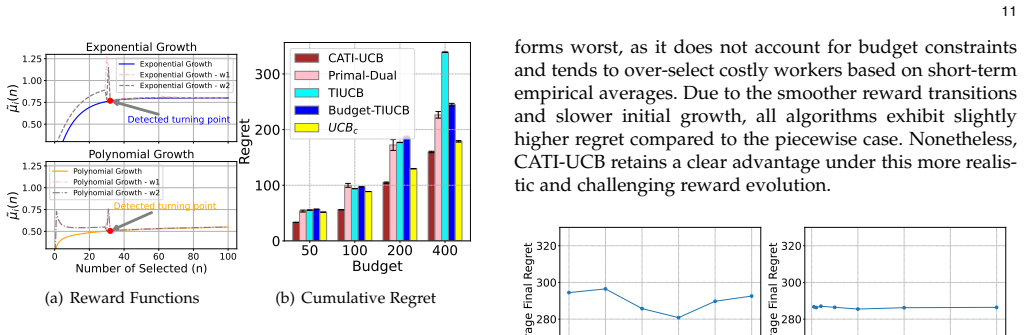
- Empirically, the algorithm outperforms baselines that ignore experience-driven dynamics or assume known costs on piecewise linear, negative exponential, and trace-driven data derived from a real crowdsourcing platform.
Reading between the lines
- Implicitly, the analysis suggests that once worker costs are known, the learning-then-plateau structure reduces recruitment to estimating one scalar per worker — the converged ratio — so a simpler successive-elimination scheme might achieve similar regret without change-point detection; this is a testable conjecture the paper does not pursue.
- The paper's sensitivity experiments show regret is non-monotonic in the detection window, so the constant C0 and the pre-plateau budget waste depend on how well the detector is tuned; one could derive a lower bound linking regret to the learning rate and noise variance, which the paper leaves open.
- Because the denominator of the ratio uses a lower confidence bound of cost, the algorithm is sensitive to very cheap workers; a robust extension would be to treat costs as log-normal or to use a regularized ratio, though such extensions lie outside the paper's analysis.
Editorial analysis
A structured set of objections, weighed in public.
Referee Report
Summary. The paper studies a budget-constrained sequential worker recruitment problem in mobile crowdsensing. Each worker's expected reward is modeled as an unknown increasing-then-converging function of the number of assigned tasks, and each worker has an unknown expected cost. The authors formulate the problem as a structured bandit, prove in Lemma 1 that the offline optimum is rho* B + O(1) where rho* is the maximum converged reward-to-cost ratio, and propose CATI-UCB, which combines a piecewise-linear reward model, a cost-aware optimistic selection rule, and change-point detection to reset learning after saturation. They claim an O(log B) regret bound in Theorem 1 and support the method with extensive synthetic and trace-driven experiments. The main theoretical result, however, is not established as written due to specific gaps in the proof of Theorem 1.
Significance. If the logarithmic regret bound is established, the paper makes a useful contribution: it extends time-increasing bandits to a budget-constrained setting with unknown costs, and the offline characterization in Lemma 1 is a clean and correct simplification that justifies focusing on the highest converged reward-to-cost ratio. The algorithmic design is well motivated, and the experimental study is unusually broad for a theory paper, covering piecewise-linear and negative-exponential reward dynamics, 12-worker settings, heterogeneous task types, hyperparameter sensitivity, and trace-driven data based on Topcoder. I also credit the authors for giving a self-contained offline-optimality lemma rather than only an asymptotic statement. However, the proof of Theorem 1 contains concrete, checkable gaps: the stated N0 is too small by a factor of 256, one of the key probability bounds uses the wrong tails, and the imported guarantees from [28] are used without verifying their validity under the algorithm's reset mechanism. These issues are local and likely fixable while preserving the O(log B) claim, but they block acceptance in the current form.
major comments (5)
- [Theorem 1 proof, step (c)] The proof asserts that N_{i,t} >= N0 ensures both 2 eps_{i,t} <= 0.5 c_i and eps_{i,t} <= Delta_i (c_i)^2 / [8(mu*_i + c_i)], where eps_{i,t} = 16 sqrt(2 ln B / N_{i,t}). Solving these inequalities gives N_{i,t} >= 8192 ln B / c_i^2 and N_{i,t} >= 32768 ln B (mu*_i+c_i)^2 / (Delta_i^2 c_i^4), respectively. The stated N0 = 2 ln B / min^2{ Delta_i c_i^2/[8(mu*_i+c_i)], c_i/4 } is at most 32 ln B / c_i^2 in the first case and at most 128 ln B (mu*_i+c_i)^2/(Delta_i^2 c_i^4) in the second case. In both cases N0 is 256 times too small to imply the two displayed inequalities. Consequently, the inequality labeled (c) in the proof does not follow, and the bound P(E2_t) <= 2/B^2 is not established. The theorem's conclusion can likely be repaired by enlarging N0, but the proof as written is invalid.
- [Theorem 1 proof, event E1_t] The proof bounds P(E1_t) by 2/B^2 using the statements P(hat mu_{i^dagger} > mu*_{i^dagger} | ...) >= 1 - 1/B^2 and P(hat c_{i^dagger} < c_{i^dagger} | ...) >= 1 - 1/B^2. These are the wrong tails for E1_t: E1_t is the event that the optimistic ratio is below the true ratio by Delta_i/2, whereas upper bounds on the reward estimator and lower bounds on the cost estimator make the ratio larger, not smaller. Bounding E1_t would require a lower tail for the reward estimator and an upper tail for the cost estimator, neither of which is supplied by Eq. (4) or the cited Proposition 1. Without a valid bound on P(E1_t), the decomposition of E[N_{i,T}] into E1_t/E2_t does not yield the advertised number of suboptimal pulls.
- [Section 4.2 and Theorem 1] The concentration bound in Eq. (4) and the change-detection guarantee in Proposition 1 are imported from [28]. Algorithm 1, however, resets N_{i,t} to 1 on every detected saturation and refits the linear model on the post-change plateau segment. No argument is given that the imported inequalities remain valid under these resets. The citation itself is inconsistent: Eq. (4) refers to "Proposition 1 of [28]", while the displayed Proposition 1 is labeled "Proposition 2 of [28]". Because Lemma 3 and the proof of Theorem 1 rely on these imported guarantees, the applicability under the algorithm's reset mechanism is load-bearing and must be explicitly established.
- [Section 3 vs. Algorithm 1] N_{i,t} is defined in Section 3 as the cumulative number of times worker i has been selected, equal to sum_{s=1}^t 1{A_s = i}. Algorithm 1 line 11, however, sets N_{A_t,t} = 1 upon change-point detection, making N_{i,t} a local post-reset count. The regret proof mixes the two interpretations: quantities such as N_{i,T_{C,B}} and tau_i are cumulative, while confidence radii and the event N_{i,t} >= N0 + tau_i appear to use the local count. This notational collision makes the event definitions in the proof of Theorem 1 ill-posed. The authors should introduce separate notation (e.g., m_i(t) for the segment-local count and n_i(t) for the cumulative count) and rewrite the affected arguments.
- [Algorithm 1, line 5 vs. Section 4.2.2] Section 4.2.2 defines hat mu_{i,t} = bar mu_{i,t} + eps_{i,t} and hat c_{i,t} = bar c_{i,t} - eps_{i,t}, and states that the algorithm selects the worker maximizing hat mu_{i,t} / hat c_{i,t}. Algorithm 1 line 5 instead selects arg max_i (hat mu_{i,t} + eps_{i,t}) / max(hat c_{i,t} - eps_{i,t}, 0.001), which adds eps a second time in the numerator and subtracts it a second time in the denominator. The regret proof analyzes the once-padded ratio. The algorithm, Eq. (4), and the proof must be reconciled; otherwise the theoretical guarantee is for a different selection rule than the one implemented.
minor comments (6)
- [Lemma 2] The summation in the last term is written as sum_{i in [N]} but the worker set is [K]; this appears to be a typo.
- [Theorem 1] The constant N0 depends on i through Delta_i, c_i, and mu*_i but is written without an index. It should be N0^{(i)} or defined per worker to avoid confusion.
- [Lemma 3] The line P(F_i D_i) = P(v_i < tau_1 < v_i + omega) has a typo: it should be tau_i. In addition, the threshold used in Algorithm 1 line 10 is not the same as the gamma defined in Lemma 3; please reconcile the constants.
- [Section 4.2.2 / Algorithm 1] The constant 0.001 in the denominator of line 5 is never defined in the text; the proof later refers to it as eta. Define eta and state any assumption relating it to c_min.
- [Section 6.6] The trace-driven experiments are said to be shown in "Fig. 7(a)" and "Fig. 7(b)", but the actual trace-driven figures are Fig. 10(a) and Fig. 10(b). The cross-references should be fixed.
- [Eq. (2) and Lemma 2] The notation for the expected reward of a worker on a given pull alternates between mu_{i,s} in Eq. (2) and mu_i(l) in the proof of Lemma 2. Use one consistent notation.
Circularity Check
No circularity: the derivation learns unknown quantities from feedback, imports external concentration results, and contains no fitted prediction or self-citation chain carrying the main claim.
full rationale
CATI-UCB estimates unknown reward trajectories and costs from online feedback and defines regret against an external offline oracle R*(B) in Eq. (1) that knows the true model; the oracle is not constructed from the algorithm's fitted values. The regret decomposition in Lemma 2 and the suboptimal-pull bound in Theorem 1 rely on concentration and change-detection inequalities imported from [28], an external work by different authors (Xia et al., WWW 2024), so this is independent support, not a self-citation chain. Eq. (4) and Proposition 1 explicitly attribute the confidence and detection bounds to [28]; Lemma 1 is proved directly from the piecewise-linear increasing-then-converging model and is not defined in terms of CATI-UCB's outputs. No fitted parameter is later relabeled as a prediction, and the experiments compare against baselines and an oracle rather than claiming to predict values used as inputs. The manuscript does contain an internal proof gap: the N0 in Theorem 1 appears too small by roughly a factor of 256 to imply the epsilon-smallness conditions used in the displayed step labeled (c), and the imported [28] propositions are invoked inside a loop that resets N_{i,t} to 1, without a proof that those propositions remain valid under resets. These are correctness or robustness concerns, not circularity: the claimed O(log B) bound is not equivalent to its inputs by construction, and none of the load-bearing steps reduces to a self-citation or a fitted-input-as-prediction. Accordingly, the honest finding is no significant circularity, score 0.
Assumptions & free parameters
free parameters (3)
- window size ω =
16 in all experiments
- detection threshold γ =
0.2 in experiments
- noise range =
Uniform [-0.05,0.05]
assumptions (6)
- domain assumption Each worker's expected reward is exactly a nondecreasing piecewise-linear increasing-then-converging function µ_i(n), with plateau after ν_i pulls.
- domain assumption Observed rewards are independent sub-Gaussian draws around µ_i(n), with support [0,1]; costs are independent draws around c_i with support [0,1] and c_i ≥ c_min > 0.
- ad hoc to paper Concentration bound µ_i(t) ≤ ¯µ_i(t)+16√(2 ln(1/δ)/N_{i,t}) holds w.p. ≥1-δ, imported as Proposition 1 of [28] without proof.
- ad hoc to paper Change-point detection guarantee from Proposition 2 of [28]: if |window averages| > γ/2 with γ ≤ sqrt(2/ω(14+12/|ω-1|)² 2ln(2/δ)), detection is valid w.p. ≥1-δ.
- domain assumption The optimal offline benchmark R*(B) can be attained by a deterministic allocation; switching between workers is free; expected budget constraint Σ c_i q_i ≤ B.
- standard math Hoeffding and standard concentration inequalities apply to rewards and costs in [0,1].
Cite this review
Pith. "Pith review of From Novice to Expert: Cost-Aware Bandits for Evolving Worker Performance in Crowdsensing." pith.science (2026). https://pith.science/paper/LVUO34MZ
@misc{pith2026260713546,
  author       = {Pith},
  title        = {Pith review of: From Novice to Expert: Cost-Aware Bandits for Evolving Worker Performance in Crowdsensing},
  year         = {2026},
  howpublished = {\url{https://pith.science/paper/LVUO34MZ}},
  note         = {Machine review of arXiv:2607.13546}
}
read the original abstract
Mobile crowdsensing (MC) recruits mobile users to perform sensing tasks using their smartphones, enabling large-scale applications such as traffic monitoring and environmental sensing. A fundamental challenge is online worker recruitment under uncertainty, where the platform must learn workers' sensing performance while operating with a limited budget. Existing learning-based MC recruitment methods typically assume that each worker's sensing quality is stationary with a fixed mean over time. In practice, however, worker performance often improves with experience and eventually stabilizes, while the incurred sensing cost can be unknown in advance due to time-varying device and context states. In this paper, we study a budget-constrained online recruitment problem in which the platform selects one worker in each round, observes the sensing quality and incurred cost, where the expected sensing quality of each worker increases with experience and eventually converges to a plateau, and repeats until the budget is exhausted. We formulate this problem as a structured bandit model where each worker's expected reward evolves according to an unknown increasing-then-converging function of its participation count, and each worker has an unknown expected cost. We develop a cost-aware online learning framework that jointly learns evolving reward trajectories and heterogeneous costs, detects performance saturation, and allocates the limited budget to maximize long-term sensing utility. We provide theoretical performance guarantees and validate the proposed approach through extensive experiments, demonstrating consistent improvements over baselines that ignore experience-driven dynamics or assume known costs.
Figures


Figures from the paper (5 more)


Reference graph
Works this paper leans on
-
[28]
Which llm to play? convergence-aware online model selection with time- increasing bandits,
Y. Xia, F. Kong, T. Yu, L. Guo, R. A. Rossi, S. Kim, and S. Li, “Which llm to play? convergence-aware online model selection with time- increasing bandits,” inProceedings of the ACM on Web Conference 2024, 2024, pp. 4059–4070
2024
-
[1]
Opportunities in mobile crowd sensing,
H. Ma, D. Zhao, and P . Yuan, “Opportunities in mobile crowd sensing,”IEEE Communications Magazine, vol. 52, no. 8, pp. 29–35, 2014
2014
-
[2]
Recommending crowdsourced software developers in consideration of skill improvement,
Z. Wang, H. Sun, Y. Fu, and L. Ye, “Recommending crowdsourced software developers in consideration of skill improvement,” in Proceedings of the 32nd IEEE/ACM International Conference on Auto- mated Software Engineering (ASE). IEEE, 2017, pp. 717–728
2017
-
[3]
Learning for crowdsourcing: Online dispatch for video analytics with guarantee,
Y. Chen, S. Zhang, Y. Jin, Z. Qian, M. Xiao, N. Chen, and Z. Ma, “Learning for crowdsourcing: Online dispatch for video analytics with guarantee,” inIEEE INFOCOM 2022-IEEE Conference on Computer Communications. IEEE, 2022, pp. 1908–1917
2022
-
[4]
Crowdsensing for emergency response in unknown envi- ronments: A rapid strategic sensing approach,
S. Su, L. Wang, Z. Yu, X. Xia, L. Ma, F. Xiong, Y. Zhang, and B. Guo, “Crowdsensing for emergency response in unknown envi- ronments: A rapid strategic sensing approach,”IEEE Transactions on Mobile Computing, 2025
2025
-
[5]
Unknown worker recruitment with long-term incentive in mobile crowdsensing,
Q. Zhou, X. Zhang, and Z. Yang, “Unknown worker recruitment with long-term incentive in mobile crowdsensing,”IEEE Transac- tions on Mobile Computing, 2024
2024
-
[6]
Consensus-based group task assignment with social impact in spatial crowdsourcing,
X. Li, Y. Zhao, X. Zhou, and K. Zheng, “Consensus-based group task assignment with social impact in spatial crowdsourcing,” Data Science and Engineering, vol. 5, no. 4, pp. 375–390, 2020
2020
-
[7]
By the people, for the people: The crowdsourcing of
F. Carrera, S. Guerin, and J. Thorp, “By the people, for the people: The crowdsourcing of” streetbump”: An automatic pothole map- ping app,”The International Archives of the Photogrammetry, Remote Sensing and Spatial Information Sciences, vol. 40, pp. 19–23, 2013
2013
Show all 42 references
-
[8]
Noisetube: Measuring and mapping noise pollution with mobile phones,
N. Maisonneuve, M. Stevens, M. E. Niessen, and L. Steels, “Noisetube: Measuring and mapping noise pollution with mobile phones,” inInformation Technologies in Environmental Engineering: Proceedings of the 4th International ICSC Symposium Thessaloniki, Greece, May 28-29, 2009. ...
2009
-
[9]
Online mobile micro-task allocation in spatial crowdsourcing,
Y. Tong, J. She, B. Ding, L. Wang, and L. Chen, “Online mobile micro-task allocation in spatial crowdsourcing,” in2016 IEEE 32Nd international conference on data engineering (ICDE). IEEE, 2016, pp. 49–60
2016
-
[10]
Unknown worker recruitment with budget and covering constraints for mobile crowdsensing,
G. Gao, J. Wu, Z. Yan, M. Xiao, and G. Chen, “Unknown worker recruitment with budget and covering constraints for mobile crowdsensing,” in2019 IEEE 25th International Conference on Paral- lel and Distributed Systems (ICP ADS). IEEE, 2019, pp. 539–547
2019
-
[11]
Budgeted unknown worker recruitment for heterogeneous crowdsensing using cmab,
G. Gao, H. Huang, M. Xiao, J. Wu, Y.-E. Sun, and Y. Du, “Budgeted unknown worker recruitment for heterogeneous crowdsensing using cmab,”IEEE Transactions on Mobile Computing, vol. 21, no. 11, pp. 3895–3911, 2021
2021
-
[12]
Differentially private unknown worker recruitment for mobile crowdsensing using multi-armed bandits,
H. Zhao, M. Xiao, J. Wu, Y. Xu, H. Huang, and S. Zhang, “Differentially private unknown worker recruitment for mobile crowdsensing using multi-armed bandits,”IEEE Transactions on Mobile Computing, vol. 20, no. 9, pp. 2779–2794, 2020
2020
-
[13]
Btv-cmab: A bi-directional trust verification-based combinatorial multiarmed bandit scheme for mobile crowdsourcing,
J. Tang, K. Fan, W. Xie, F. Han, Z. Qu, A. Liu, N. N. Xiong, S. Zhang, and T. Wang, “Btv-cmab: A bi-directional trust verification-based combinatorial multiarmed bandit scheme for mobile crowdsourcing,”IEEE Internet of Things Journal, vol. 11, no. 2, pp. 1925–1938, 2023
1925
-
[14]
Mwrs: A mab-based worker recruitment scheme with tripartite stackel- berg game for reliable mobile crowdsensing,
Y. Ouyang, F. Zeng, N. N. Xiong, A. Liu, and W. Pedrycz, “Mwrs: A mab-based worker recruitment scheme with tripartite stackel- berg game for reliable mobile crowdsensing,”IEEE Transactions on Mobile Computing, vol. 24, no. 7, pp. 5665–5680, 2025
2025
-
[15]
Unknown task selection and worker recruitment using two-stage multi-armed bandit in crowdsensing,
H. Song, P . Li, R. Du, H. Yu, W. Huang, L. Nie, H. Bao, and Q. Liu, “Unknown task selection and worker recruitment using two-stage multi-armed bandit in crowdsensing,”IEEE Internet of Things Journal, 2025
2025
-
[16]
Social- recruiter: Dynamic incentive mechanism for mobile crowdsourc- ing worker recruitment with social networks,
Z. Wang, Y. Huang, X. Wang, J. Ren, Q. Wang, and L. Wu, “Social- recruiter: Dynamic incentive mechanism for mobile crowdsourc- ing worker recruitment with social networks,”IEEE Transactions on Mobile Computing, vol. 20, no. 5, pp. 2055–2066, 2020
-
[17]
Adversarial group linear bandits and its application to collaborative edge inference,
Y. Huang, L. Zhang, and J. Xu, “Adversarial group linear bandits and its application to collaborative edge inference,” inIEEE INFO- COM 2023-IEEE Conference on Computer Communications. IEEE, 2023, pp. 1–10
2023
-
[18]
Learning the optimal path and dnn partition for collabora- tive edge inference,
——, “Learning the optimal path and dnn partition for collabora- tive edge inference,”IEEE Transactions on Mobile Computing, 2025. 14
2025
-
[19]
On upper-confidence bound poli- cies for switching bandit problems,
A. Garivier and E. Moulines, “On upper-confidence bound poli- cies for switching bandit problems,” inInternational conference on algorithmic learning theory. Springer, 2011, pp. 174–188
2011
-
[20]
Nearly optimal adaptive procedure with change detection for piecewise-stationary bandit,
Y. Cao, Z. Wen, B. Kveton, and Y. Xie, “Nearly optimal adaptive procedure with change detection for piecewise-stationary bandit,” inThe 22nd International Conference on Artificial Intelligence and Statistics. PMLR, 2019, pp. 418–427
2019
-
[21]
Stochastic multi-armed-bandit problem with non-stationary rewards,
O. Besbes, Y. Gur, and A. Zeevi, “Stochastic multi-armed-bandit problem with non-stationary rewards,”Advances in neural infor- mation processing systems, vol. 27, 2014
2014
-
[22]
Weighted linear bandits for non-stationary environments,
Y. Russac, C. Vernade, and O. Capp ´e, “Weighted linear bandits for non-stationary environments,”Advances in Neural Information Processing Systems, vol. 32, 2019
2019
-
[23]
Online learning of rested and restless bandits,
C. Tekin and M. Liu, “Online learning of rested and restless bandits,”IEEE Transactions on Information Theory, vol. 58, no. 8, pp. 5588–5611, 2012
2012
-
[24]
A single algo- rithm for both restless and rested rotting bandits,
J. Seznec, P . Menard, A. Lazaric, and M. Valko, “A single algo- rithm for both restless and rested rotting bandits,” inInternational Conference on Artificial Intelligence and Statistics. PMLR, 2020, pp. 3784–3794
2020
-
[25]
Rotting bandits,
N. Levine, K. Crammer, and S. Mannor, “Rotting bandits,”Ad- vances in neural information processing systems, vol. 30, 2017
2017
-
[26]
Tight policy regret bounds for improving and decaying bandits
H. Heidari, M. J. Kearns, and A. Roth, “Tight policy regret bounds for improving and decaying bandits.” inIJCAI, 2016, pp. 1562– 1570
2016
-
[27]
Stochastic rising bandits,
A. M. Metelli, F. Trovo, M. Pirola, and M. Restelli, “Stochastic rising bandits,” inInternational Conference on Machine Learning. PMLR, 2022, pp. 15 421–15 457
2022
-
[29]
Learning on a budget: posted price mechanisms for online procurement,
A. Badanidiyuru, R. Kleinberg, and Y. Singer, “Learning on a budget: posted price mechanisms for online procurement,” in Proceedings of the 13th ACM conference on electronic commerce, 2012, pp. 128–145
2012
-
[30]
Bandits with knapsacks,
A. Badanidiyuru, R. Kleinberg, and A. Slivkins, “Bandits with knapsacks,”Journal of the ACM (JACM), vol. 65, no. 3, pp. 1–55, 2018
2018
-
[31]
Adversarial combinatorial bandits with switching cost and arm selection constraints,
Y. Huang, Q. Liu, and J. Xu, “Adversarial combinatorial bandits with switching cost and arm selection constraints,” inIEEE INFO- COM 2024-IEEE Conference on Computer Communications. IEEE, 2024, pp. 371–380
2024
-
[32]
Dynamic pricing with limited supply,
M. Babaioff, S. Dughmi, R. Kleinberg, and A. Slivkins, “Dynamic pricing with limited supply,” 2015
2015
-
[33]
Truthful incentives in crowdsourcing tasks using regret minimization mechanisms,
A. Singla and A. Krause, “Truthful incentives in crowdsourcing tasks using regret minimization mechanisms,” inProceedings of the 22nd international conference on World Wide Web, 2013, pp. 1167– 1178
2013
-
[34]
Bandits with budgets: Re- gret lower bounds and optimal algorithms,
R. Combes, C. Jiang, and R. Srikant, “Bandits with budgets: Re- gret lower bounds and optimal algorithms,”ACM SIGMETRICS Performance Evaluation Review, vol. 43, no. 1, pp. 245–257, 2015
2015
-
[35]
Bandits with concave rewards and convex knapsacks,
S. Agrawal and N. R. Devanur, “Bandits with concave rewards and convex knapsacks,” inProceedings of the fifteenth ACM confer- ence on Economics and computation, 2014, pp. 989–1006
2014
-
[36]
An efficient algorithm for contextual bandits with knapsacks, and an extension to concave objectives,
S. Agrawal, N. R. Devanur, and L. Li, “An efficient algorithm for contextual bandits with knapsacks, and an extension to concave objectives,” inConference on Learning Theory. PMLR, 2016, pp. 4–18
2016
-
[37]
The symmetry between arms and knapsacks: A primal-dual approach for bandits with knapsacks,
X. Li, C. Sun, and Y. Ye, “The symmetry between arms and knapsacks: A primal-dual approach for bandits with knapsacks,” inInternational Conference on Machine Learning. PMLR, 2021, pp. 6483–6492
2021
-
[38]
Adversarial bandits with knapsacks,
N. Immorlica, K. Sankararaman, R. Schapire, and A. Slivkins, “Adversarial bandits with knapsacks,”Journal of the ACM, vol. 69, no. 6, pp. 1–47, 2022
2022
-
[39]
Unifying the stochastic and the adversarial bandits with knapsack,
A. Rangi, M. Franceschetti, and L. Tran-Thanh, “Unifying the stochastic and the adversarial bandits with knapsack,”arXiv preprint arXiv:1811.12253, 2018
2018 arXiv
-
[40]
Non-stationary bandits with knap- sacks,
S. Liu, J. Jiang, and X. Li, “Non-stationary bandits with knap- sacks,”Advances in Neural Information Processing Systems, vol. 35, pp. 16 522–16 532, 2022
2022
-
[41]
Flexible budgets in restless bandits: a primal-dual algorithm for efficient budget allocation,
P . R. Diaz, J. A. Killian, L. Xu, A. S. Suggala, A. Taneja, and M. Tambe, “Flexible budgets in restless bandits: a primal-dual algorithm for efficient budget allocation,” inProceedings of the AAAI Conference on Artificial Intelligence, vol. 37, no. 10, 2023, pp. 12 103–12 111
2023
-
[42]
Budgeted multi-armed bandits with asymmetric confidence intervals,
M. Heyden, V . Arzamasov, E. Fouch ´e, and K. B ¨ohm, “Budgeted multi-armed bandits with asymmetric confidence intervals,” in Proceedings of the 30th ACM SIGKDD Conference on Knowledge Discovery and Data Mining, 2024, pp. 1073–1084
2024
Reviewed August 2, 2026 · model on record in the stance chip above.
Discussion (0). Continue with ORCID to comment.