REVIEW 4 major objections 3 minor 62 references
Optimal Fluctuations for Nonlinear Chemical Reaction Systems with General Rate Law
T0 review · 4 major / 3 minor · reviewed 2026-08-07 · deepseek-v4-flash
Pith's one-line read For large-volume chemical reaction systems, rare fluctuations concentrate on the deterministic time-reversed optimal path, with asymptotically Gaussian spread around it.
desk verdict New time-reversal construction for prehistory probabilities, but the global Gaussian claim is mathematically untenable as stated. read the letter →
The pith
A machine-rendered reading of the paper's core claim, the machinery that carries it, and where it could break.
The reading
What carries the argument
The central object is the time reversal of a given family of probability distributions, realized as a Markov jump process with reversed rates $\bar{r}_{\pm i}(Vx,V,t)=p_V(x\pm V^{-1}\nu_i,T-t)\,r_{\mp i}(Vx\pm\nu_i,V)/p_V(x,T-t)$ (and the stationary analogue using $\pi_V$ in place of $p_V$). The identity that carries the argument is the exponential-tilt limit from Lemma II.7: under the prefactor-regularity assumption, $p_V(x\pm V^{-1}\nu_i,T-t|x_0)/p_V(x,T-t|x_0)\to e^{\mp\nu_i\cdot\nabla_x S(x,T-t|x_0)}$ as $V\to\infty$. Substituting this limit into the reversed rates gives the deterministic drift $G(x,t)=-\sum_i\nu_i\left(R^+_i(x)e^{\nu_i\cdot\nabla_x S(x,T-t|x_0)}-R^-_i(x)e^{-\nu_i\cdot\nabla_x S(x,T-t|x_0)}\right)$, whose solution is exactly $\varphi_{NOP}(T-t;x_T,T;x_0)$ on the relevant interval; the stationary mechanism with $S(x)$ and $\pi_V$ produces the OP. The prehistory probability $q^{NPP}_V=p_V(x,t|x_0)p_V(x_T,T-t|x)/p_V(x_T,T|x_0)$ is shown to be the law of this reversed process, so its concentration follows from the law of large numbers.
What would settle it
Take a reaction network satisfying the paper's large-deviation assumptions and compute the ratio $p_V(x+V^{-1}\nu_i,T-t|x_0)/p_V(x,T-t|x_0)$ along a candidate NOP for increasing $V$. If this ratio does not converge to $e^{-\nu_i\cdot\nabla_x S(x,T-t|x_0)}$, or if the prefactor $k_{\varepsilon,V}$ develops singular or oscillatory behavior instead of converging to a positive twice-differentiable function, then Proposition IV.1's concentration on the NOP fails. Equivalently, simulate the reversed jump process for a bistable network and measure the sup-norm distance from $\varphi_{NOP}$; it should go to zero at the law-of-large-numbers rate while the covariance of the rescaled fluctuations follows the Lyapunov equation.
Extended reading notes
Core claim
The central claim is Proposition IV.1 together with Corollary IV.5(a): under the paper's regularity hypotheses, the non-stationary prehistory probability $q^{NPP}_V(x,t;x_T,T;x_0)$ concentrates on the NOP $\varphi_{NOP}(t;x_T,T;x_0)$ uniformly in $t\in[0,T]$ as $V\to\infty$, and the associated reversed Markov jump process obeys a law of large numbers with deterministic limit $\hat{x}_\infty(t)=\varphi_{NOP}(T-t;x_T,T;x_0)$. The stationary analogue, Proposition V.1 with Corollary V.3, gives the same concentration of the stationary prehistory probability on the OP $\varphi_{OP}(t-T;x_T)$. In both settings, a central limit theorem describes the $O(V^{-1/2})$ deviations around the optimal path as Gaussian, with covariance governed by a Lyapunov matrix differential equation whose drift uses the gradient of the rate function $S$ and whose diffusion matrix is $J(x,t)=\sum_i \nu_i\nu_i^\top\left(R^+_i e^{\nu_i\cdot\nabla_x S(x,T-t|x_0)} + R^-_i e^{-\nu_i\cdot\nabla_x S(x,T-t|x_0)}\right)$ (with the analogous stationary form). On the authors' reading, the optimal fluctuation path is exactly the deterministic limit of a time-reversed chemical reaction process, which generalizes the prehistorical approach to optimal fluctuations from Langevin dynamics to Markov jump chemical kinetics.
Load-bearing premise
The load-bearing premise is that the normalized probability prefactor $k_{\varepsilon,V}(x,t|x_0)=P_{x_0}(x_V(t)\in B_\varepsilon(x))\exp(V\inf_{y\in B_\varepsilon(x)}S(y,t|x_0))$ is continuous and converges, as $V\to\infty$ and $\varepsilon\to0$, to a positive twice-differentiable function $K(x,t|x_0)$; this regularity is assumed rather than proved, and without it the exponential tilts in the reversed rates and the concentration on the NOP or OP do not follow.
Editorial extensions
If this is right
- The optimal path can be found by time-reversing the chemical reaction process: as $V\to\infty$, the deterministic limit of the reversed process is the NOP or OP, giving a dynamical route to the most probable fluctuation path instead of solving a Hamilton-Jacobi boundary-value problem.
- The central limit theorem turns the prehistory probability into an explicit Gaussian description: in an $O(V^{-1/2})$ neighborhood of the optimal path, the logarithm of the probability is quadratic, with the covariance matrix given by the Lyapunov equation.
- The same construction covers both finite-time transitions and infinite-time stationary escapes, so rare events over long time intervals inherit the deterministic structure of the OP.
- The extension from Langevin dynamics to Markov jump chemical kinetics means the prehistory description now applies to the Poisson-driven, discrete-molecule models that are standard in chemical reaction network theory.
- Because the reversed process is a Markov jump process of the same family as the original, the optimal fluctuation path has a dynamical interpretation as a time reversal, not only a variational characterization.
Reading between the lines
- Inference: a practical consequence the paper leaves implicit is a Monte-Carlo route to optimal paths, since simulating the reversed process and conditioning on the rare event could locate the NOP or OP without solving the two-point boundary-value problem; the paper's own Remark E.1 warns, however, that direct computation of prehistory probabilities is practical only in low-dimensional systems.
- Inference: in repeated single-cell or microfluidic chemical transitions, conditioning trajectories on the rare event and locating the empirical density peak should reproduce the NOP or OP, with the spread shrinking like $V^{-1/2}$ according to the Lyapunov covariance; this is a statement about conditioned trajectory data rather than stationary distributions.
- Inference: the tilt factors $e^{\mp\nu_i\cdot\nabla_x S}$ resemble a fluctuation-dissipation relation written in stoichiometric coordinates, suggesting that the same factors should appear in prefactor corrections to escape rates and could be combined with exit-time asymptotics to refine prefactor estimates for chemical networks.
- Inference: because increments are confined to the image of the stoichiometric matrix, the concentration statement should hold separately on each stoichiometric compatibility class, and a natural check is that the CLT covariance is degenerate in conserved directions.
Editorial analysis
A structured set of objections, weighed in public.
Referee Report
Summary. The paper develops a prehistory-probability description of optimal fluctuations for density-dependent Markov jump chemical reaction models. It defines non-stationary and stationary prehistory probabilities q_NPP and q_SPP, identifies them with laws of time-reversed jump processes (Sections III.C and III.D), and states law-of-large-numbers and central-limit-theorem results for those reversed processes (Propositions IV.1, IV.2, IV.4, V.1, V.2). The advertised consequences are that, as the volume V tends to infinity, the prehistory probability concentrates on the non-stationary optimal path phi_NOP and on the stationary optimal path phi_OP, with Gaussian fluctuations whose covariance solves a Lyapunov equation (Corollaries IV.3, IV.5, V.3). One-dimensional monostable and bistable examples are simulated to illustrate the focusing effect.
Significance. The conceptual idea is attractive: if correct, it identifies the optimal fluctuation path with the deterministic limit of a time-reversed chemical reaction process and extends Dykman's prehistory approach from Langevin dynamics to Markov jump processes. The exact master-equation manipulations in Section III, especially the explicit reversed-rate formulas (35), (41), (54), (59), and (66), are a genuine strength and appear to be checked correctly. The numerical examples also give a useful demonstration of the claimed concentration phenomenon. However, the main quantitative claims depend on unproved prefactor regularity in Lemmas II.7 and II.10 and on assumed rate-convergence conditions such as (61), and Corollary IV.5(b) contains a global covariance statement that is inconsistent with the diffusion limit proved in Proposition IV.4. In its present form the central theorem is therefore not established.
major comments (4)
- [Corollary IV.5(b)] The covariance kappa(t) is asserted to solve the Lyapunov equation dkappa/dt = grad Q kappa + kappa grad Q^T + W on [0,T] with both endpoint constraints kappa(0)=0 and kappa(T)=0. Let C(t) = E[upsilon_infty(t) upsilon_infty(t)^T] be the covariance of the CLT limit in Proposition IV.4. Since upsilon_infty(0)=0 and the diffusion matrix W is positive along the non-degenerate optimal path, C satisfies the same Lyapunov equation with C(0)=0, so C'(0)=W(x_infty(0),0)>0 and hence C(t)>0 for every t>0. Under a regular drift grad Q the covariance therefore cannot return to zero at t=T. The attempted relation kappa(t)=bar_kappa(T-t) only transfers the condition bar_kappa(0)=0 from Corollary IV.3(b), but that corollary is proved only on [0,T*] with T*<T. The h-transform rates in (66) contain the quotient p_V(x_T,T-t|x +/- V^{-1} nu_i)/p_V(x_T,T-t|x), which becomes singular as t approaches T because the denominator vanishes unless x=x_T; the CLT is proved only away from this singularity. Thus the global Gaussian formula with both endpoint constraints is not a consequence of the proved theorems and is mathematically untenable as stated.
- [Lemma II.7 and Lemma II.10] The prefactor k_epsilon,V(x,t|x0) = P(x_V(t) in B_epsilon(x)) exp(V inf S) is assumed to be continuous and to converge, after normalization by f_epsilon,V, to a positive twice-differentiable function K(x,t|x0) as V tends to infinity and epsilon tends to zero. This assumption is used to derive the exponential tilt e^{pm nu_i . grad S} in equations (23)-(24) and (32)-(33), and those tilts are the only mechanism by which the reversed processes acquire the limiting drift in Propositions IV.1 and V.1. The assumption is not proved or derived from the stated large deviation principle; it is a separate regularity and positivity hypothesis. The prefactor need not be smooth or positive at caustics or when the minimizer is not unique, so this is not a harmless technicality. The main concentration result is therefore conditional on an unverified ansatz rather than a proved consequence of the model assumptions.
- [Proposition IV.2, condition (61), and Proposition IV.4(c)] The central limit theorem for the reversed process is stated under the extra hypothesis that sqrt(V) |G_V(x,t) - G(x,t)| tends to zero uniformly on the relevant cylinder. This is precisely the rate of convergence of the reversed generator that is needed for the CLT, and it is not derived from Lemma II.7 or from the LDP; Lemma II.7 gives only the leading-order O(1) convergence of V^{-1} r-hat. The analogous condition (b) in Proposition IV.4, a uniform limit for ratios of transition probabilities, is also assumed rather than proved. Since the CLT is one of the two main quantitative outputs, these hypotheses are load-bearing. The paper would need either to prove (61) and its analogue under explicit conditions on the rates, or to state clearly that the CLT is conditional on a separate unverified rate condition.
- [Corollary V.3(b)] The stationary Gaussian formula asserts that bar_kappa(t) satisfies the Lyapunov equation with the initial condition d bar_kappa(0)/dt = 0. For the process of Proposition V.2, the CLT limit mu_infty satisfies mu_infty(0)=0 and its covariance C(t) obeys C'(0) = J(hat_x_infty(0)) = J(x_T), which is positive under the same non-degeneracy of the noise. Hence d bar_kappa(0)/dt = 0 contradicts the Lyapunov equation unless J(x_T)=0. This appears to be an endpoint-condition error, but as written it invalidates the displayed stationary Gaussian statement and reinforces the concern that the endpoint constraints in the Gaussian approximations are not justified by the proved CLT.
minor comments (3)
- [Appendix E] The definition of N_x as floor((x_l - x_r)V/nu) has the endpoints in the wrong order; for the stated domain D=[x_l,x_r] with x_l<x_r this quantity is negative and should be floor((x_r - x_l)V/nu).
- [Remark III.1 and Section III] The convention 0/0=0 is stated for the reversed rates, but the state-space support of the reversed processes is not described precisely; since the ratios in (35), (41), and (54) can vanish or blow up near the conditioning endpoint, a precise description of the domain of each reversed generator would improve readability.
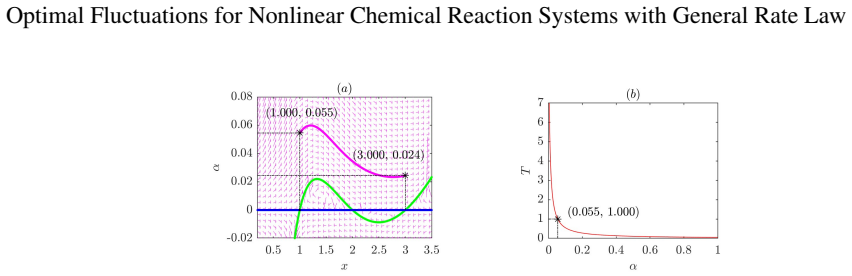
- [Section VI] The statement that the numerical profiles T(alpha) versus alpha show that each T corresponds to a unique NOP is an empirical observation for the two examples, not a proof of uniqueness; the text should distinguish the numerical evidence from the analytic uniqueness assumptions used in Proposition II.6(e).
Circularity Check
No significant circularity: the concentration result is derived from the LDP and transition-probability ratios under explicit regularity assumptions, not assumed or fitted.
full rationale
The central chain is: q_NPP is defined in Eq. (50) directly from the transition probabilities of the original jump process; the reversed generators (35), (41), (54), (59), (66), (72) are Doob-style h-transforms built from those same transition probabilities. The LLN (Propositions IV.1 and IV.4) and CLT (Propositions IV.2 and IV.4) are proved by martingale estimates in Appendices C and D, with limiting drifts Q and G and noise matrices W and J containing the gradient of the LDP action S through Lemma II.7/II.10. Lemma II.7 assumes, rather than proves, the pre-exponential regularity k_{eps,V}/f -> K > 0; this is a genuine unproved regularity hypothesis and a correctness risk, but it is not the target conclusion and does not make the concentration theorem equivalent to its input by construction. No parameter is fitted and no fitted quantity is renamed as a prediction. The only self-citation is Ref. [28], used in the introduction as background motivation; Section III reproves the time-reversal relation directly, so the citation is not load-bearing. Corollary IV.5(b)'s double endpoint condition kappa(0)=kappa(T)=0 is mathematically questionable for a positive-noise Lyapunov equation, but that is a correctness flaw, not a circular reduction. The numerical examples are checks, not inputs. Hence no circular step can be exhibited with the required Eq.-to-Eq. reduction.
Assumptions & free parameters
assumptions (7)
- domain assumption Freidlin-Wentzell LDP for density-dependent Markov chains (Theorem II.4) holds under bounded Lipschitz log-rates.
- domain assumption Kurtz limit theorems (Theorems II.1-II.3) for the density-dependent Markov chain hold.
- domain assumption Day-Darden regularity: the quasi-potential S is C^{k+1} and NOP/OP are unique under proper-subarc assumptions (Prop II.6(e), II.9(f)).
- ad hoc to paper Prefactor regularity for the LDP: k_epsilon,V(x,t|x0) is continuous and has a positive twice-differentiable limit K(x,t|x0) (Lemma II.7 and II.10).
- ad hoc to paper CLT rate condition: sqrt(V) |G_V - G| tends to 0 uniformly (condition (61)).
- domain assumption Stationary process is positive recurrent and the deterministic system has a unique global attracting equilibrium satisfying the conditions of Theorem II.8.
- domain assumption Rank(nu) = N, so the stoichiometric increment space is full-dimensional.
Cite this review
Pith. "Pith review of Optimal Fluctuations for Nonlinear Chemical Reaction Systems with General Rate Law." pith.science (2026). https://pith.science/paper/LWNM6JDS
@misc{pith2026250606974,
  author       = {Pith},
  title        = {Pith review of: Optimal Fluctuations for Nonlinear Chemical Reaction Systems with General Rate Law},
  year         = {2026},
  howpublished = {\url{https://pith.science/paper/LWNM6JDS}},
  note         = {Machine review of arXiv:2506.06974}
}
read the original abstract
This paper investigates optimal fluctuations for chemical reaction systems with N species, M reactions, and general rate law. In the limit of large volume, large fluctuations for such models occur with overwhelming probability in the vicinity of the so-called optimal path, which is a basic consequence of the Freidlin-Wentzell theory, and is vital in biochemistry as it unveils the almost deterministic mechanism concealed behind rare noisy phenomena such as escapes from the attractive domain of a stable state and transitions between different metastable states. In this study, an alternative description for optimal fluctuations is proposed in both non-stationary and stationary settings by means of a quantity called prehistory probability in the same setting, respectively. The evolution law of each of them is derived, showing their relationship with the time reversal of a specified family of probability distributions respectively. The law of large numbers and the central limit theorem for the reversed processes are then proved. In doing so, the prehistorical approach to optimal fluctuations for Langevin dynamics is naturally generalized to the present case, thereby suggesting a strong connection between optimal fluctuations and the time reversal of the chemical reaction model.
Figures


Figures from the paper (2 more)

Reference graph
Works this paper leans on
-
[28]
author author F. Zhao , author Y. Li , \ and\ author X. Liu ,\ title title A prehistorical approach to optimal fluctuations for general langevin dynamics with weak gaussian white noises , \ 10.3390/app12178569 journal journal Applied Sciences \ volume 12 ( year 2022 ),\ 10.3390/app12178569 NoStop
-
[1]
author author D. M. \ Roma , author R. A. \ O'Flanagan , author A. E. \ Ruckenstein , author A. M. \ Sengupta , \ and\ author R. Mukhopadhyay ,\ title title Optimal path to epigenetic switching , \ 10.1103/PhysRevE.71.011902 journal journal Phys. Rev. E \ volume 71 ,\ pages 011902 ( year 2005 ) NoStop
-
[2]
author author E. W. \ Larsen \ and\ author Z. Schuss ,\ title title Diffusion tensor for atomic migration in crystals , \ 10.1103/PhysRevB.18.2050 journal journal Phys. Rev. B \ volume 18 ,\ pages 2050--2058 ( year 1978 ) NoStop
-
[3]
author author Z. Schuss \ and\ author B. J. \ Matkowsky ,\ title title The exit problem: a new approach to diffusion across potential barriers , \ 10.1137/0136043 journal journal SIAM Journal on Applied Mathematics \ volume 36 ,\ pages 604--623 ( year 1979 ) NoStop
-
[4]
author author X. Zhang , author H. Qian , \ and\ author M. Qian ,\ title title Stochastic theory of nonequilibrium steady states and its applications. part i , \ https://doi.org/10.1016/j.physrep.2011.09.002 journal journal Physics Reports \ volume 510 ,\ pages 1--86 ( year 2012 ) NoStop
-
[5]
author author F. Schlögl ,\ title title Chemical reaction models for nonequilibrium phase transitions , \ 10.1007/BF01379769 journal journal Zeitschrift für Physik \ volume 253 ,\ pages 147--161 ( year 1972 ) NoStop
-
[6]
author author H. Ge \ and\ author H. Qian ,\ title title Nonequilibrium phase transition in mesoscopic biochemical systems: from stochastic to nonlinear dynamics and beyond , \ 10.1098/rsif.2010.0202 journal journal Journal of The Royal Society Interface \ volume 8 ,\ pages 107--116 ( year 2011 ) NoStop
-
[7]
author author M. I. \ Freidlin ,\ title title Quasi-deterministic approximation, metastability and stochastic resonance , \ https://doi.org/10.1016/S0167-2789(99)00191-8 journal journal Physica D: Nonlinear Phenomena \ volume 137 ,\ pages 333--352 ( year 2000 ) NoStop
Show all 62 references
-
[8]
author author M. I. \ Freidlin ,\ title title On stable oscillations and equilibriums induced by small noise , \ 10.1023/A:1004827921214 journal journal Journal of Statistical Physics \ volume 103 ,\ pages 283--300 ( year 2001 ) NoStop
-
[9]
author author C. B. \ Muratov , author E. Vanden-Eijnden , \ and\ author W. E ,\ title title Self-induced stochastic resonance in excitable systems , \ https://doi.org/10.1016/j.physd.2005.07.014 journal journal Physica D: Nonlinear Phenomena \ volume 210 ,\ pages 227--240 ( y...
2005 doi
-
[10]
author author R. S. \ Maier \ and\ author D. L. \ Stein ,\ title title Transition-rate theory for nongradient drift fields , \ 10.1103/PhysRevLett.69.3691 journal journal Phys. Rev. Lett. \ volume 69 ,\ pages 3691--3695 ( year 1992 ) NoStop
-
[11]
author author V. A. \ Chinarov , author M. I. \ Dykman , \ and\ author V. N. \ Smelyanskiy ,\ title title Dissipative corrections to escape probabilities of thermal-nonequilibrium systems , \ 10.1103/PhysRevE.47.2448 journal journal Phys. Rev. E \ volume 47 ,\ pages 2448--2461...
-
[12]
Holcman \ and\ author Z
author author D. Holcman \ and\ author Z. Schuss ,\ @noop title Asymptotics of Elliptic and Parabolic PDEs \ ( publisher Springer ,\ address Switzerland ,\ year 2018 ) NoStop
2018
-
[13]
author author A. J. \ Bray \ and\ author A. J. \ McKane ,\ title title Instanton calculation of the escape rate for activation over a potential barrier driven by colored noise , \ 10.1103/PhysRevLett.62.493 journal journal Phys. Rev. Lett. \ volume 62 ,\ pages 493--496 ( year ...
-
[14]
author author M. I. \ Dykman ,\ title title Large fluctuations and fluctuational transitions in systems driven by colored gaussian noise: A high-frequency noise , \ 10.1103/PhysRevA.42.2020 journal journal Phys. Rev. A \ volume 42 ,\ pages 2020--2029 ( year 1990 ) NoStop
2020 doi
-
[15]
author author M. I. \ Dykman , author R. Mannella , author P. V. E. \ McClintock , author N. D. \ Stein , \ and\ author N. G. \ Stocks ,\ title title Probability distributions and escape rates for systems driven by quasimonochromatic noise , \ 10.1103/PhysRevE.47.3996 journal ...
-
[16]
Freidlin \ and\ author A
author author M. Freidlin \ and\ author A. Wentzell ,\ @noop title Random Perturbations of Dynamical Systems \ ( publisher Springer ,\ address Berlin, Heidelberg ,\ year 2012 ) NoStop
2012
-
[17]
author author R. Graham ,\ title title Path integral formulation of general diffusion processes , \ 10.1007/BF01312935 journal journal Zeitschrift für Physik B Condensed Matter \ volume 26 ,\ pages 281--290 ( year 1977 ) NoStop
1977 doi
-
[18]
author author A. J. \ McKane , author H. C. \ Luckock , \ and\ author A. J. \ Bray ,\ title title Path integrals and non-markov processes. i. general formalism , \ 10.1103/PhysRevA.41.644 journal journal Phys. Rev. A \ volume 41 ,\ pages 644--656 ( year 1990 ) NoStop
-
[19]
author author A. J. \ Bray , author A. J. \ McKane , \ and\ author T. J. \ Newman ,\ title title Path integrals and non-markov processes. ii. escape rates and stationary distributions in the weak-noise limit , \ 10.1103/PhysRevA.41.657 journal journal Phys. Rev. A \ volume 41 ...
-
[20]
Naeh , author M
author author T. Naeh , author M. M. \ K osek , author B. J. \ Matkowsky , \ and\ author Z. Schuss ,\ title title A direct approach to the exit problem , \ 10.1137/0150036 journal journal SIAM Journal on Applied Mathematics \ volume 50 ,\ pages 595--627 ( year 1990 ) NoStop
-
[21]
author author R. S. \ Maier \ and\ author D. L. \ Stein ,\ title title Limiting exit location distributions in the stochastic exit problem , \ 10.1137/S0036139994271753 journal journal SIAM Journal on Applied Mathematics \ volume 57 ,\ pages 752--790 ( year 1997 ) NoStop
-
[22]
author author D. G. \ Luchinsky , author R. S. \ Maier , author R. Mannella , author P. V. E. \ McClintock , \ and\ author D. L. \ Stein ,\ title title Observation of saddle-point avoidance in noise-induced escape , \ 10.1103/PhysRevLett.82.1806 journal journal Phys. Rev. Lett...
-
[23]
author author R. S. \ Maier \ and\ author D. L. \ Stein ,\ title title Effect of focusing and caustics on exit phenomena in systems lacking detailed balance , \ 10.1103/PhysRevLett.71.1783 journal journal Phys. Rev. Lett. \ volume 71 ,\ pages 1783--1786 ( year 1993 ) NoStop
-
[24]
author author M. I. \ Dykman , author M. M. \ Millonas , \ and\ author V. N. \ Smelyanskiy ,\ title title Observable and hidden singular features of large fluctuations in nonequilibrium systems , \ 10.1016/0375-9601(94)90426-X journal journal Physics Letters A \ volume 195 ,\ ...
-
[25]
author author M. I. \ Dykman , author D. G. \ Luchinsky , author P. V. E. \ McClintock , \ and\ author V. N. \ Smelyanskiy ,\ title title Corrals and critical behavior of the distribution of fluctuational paths , \ 10.1103/PhysRevLett.77.5229 journal journal Phys. Rev. Lett. \...
-
[26]
author author V. N. \ Smelyanskiy , author M. I. \ Dykman , \ and\ author R. S. \ Maier ,\ title title Topological features of large fluctuations to the interior of a limit cycle , \ 10.1103/PhysRevE.55.2369 journal journal Phys. Rev. E \ volume 55 ,\ pages 2369--2391 ( year 1...
-
[27]
author author M. I. \ Dykman , author P. V. E. \ McClintock , author V. N. \ Smelyanski , author N. D. \ Stein , \ and\ author N. G. \ Stocks ,\ title title Optimal paths and the prehistory problem for large fluctuations in noise-driven systems , \ 10.1103/PhysRevLett.68.2718 ...
-
[29]
author author V. S. \ Anishchenko , author I. A. \ Khovanov , author N. A. \ Khovanov , author D. G. \ Luchinsky , \ and\ author P. V. E. \ McClintock ,\ title title Noise-induced escape from the lorenz attractor , \ 10.1142/S0219477501000111 journal journal Fluctuation and No...
-
[30]
author author D. T. \ Gillespie ,\ title title Stochastic simulation of chemical kinetics , \ https://doi.org/10.1146/annurev.physchem.58.032806.104637 journal journal Annual Review of Physical Chemistry \ volume 58 ,\ pages 35--55 ( year 2007 ) NoStop
-
[31]
Horn \ and\ author R
author author F. Horn \ and\ author R. Jackson ,\ title title General mass action kinetics , \ 10.1007/BF00251225 journal journal Archive for Rational Mechanics and Analysis \ volume 47 ,\ pages 81--116 ( year 1972 ) NoStop
1972 doi
-
[32]
Ge \ and\ author H
author author H. Ge \ and\ author H. Qian ,\ title title Mathematical formalism of nonequilibrium thermodynamics for nonlinear chemical reaction systems with general rate law , \ 10.1007/s10955-016-1678-6 journal journal Journal of Statistical Physics \ volume 166 ,\ pages 190...
-
[33]
author author T. G. \ Kurtz ,\ title title The relationship between stochastic and deterministic models for chemical reactions , \ 10.1063/1.1678692 journal journal The Journal of Chemical Physics \ volume 57 ,\ pages 2976--2978 ( year 1972 a ) NoStop
-
[34]
author author D. T. \ Gillespie ,\ title title Exact stochastic simulation of coupled chemical reactions , \ 10.1021/j100540a008 journal journal The Journal of Physical Chemistry \ volume 81 ,\ pages 2340--2361 ( year 1977 ) NoStop
1977 doi
-
[35]
Ge \ and\ author H
author author H. Ge \ and\ author H. Qian ,\ title title Nonequilibrium thermodynamic formalism of nonlinear chemical reaction systems with waage–guldberg’s law of mass action , \ https://doi.org/10.1016/j.chemphys.2016.03.026 journal journal Chemical Physics \ volume 472 ,\ p...
2016 doi
-
[36]
author author D. F. \ Anderson \ and\ author T. G. \ Kurtz ,\ @noop title Stochastic Analysis of Biochemical Systems \ ( publisher Springer ,\ address Switzerland ,\ year 2015 ) NoStop
2015
-
[37]
author author D. F. \ Anderson , author G. Craciun , author M. Gopalkrishnan , \ and\ author C. Wiuf ,\ title title Lyapunov functions, stationary distributions, and non-equilibrium potential for reaction networks , \ 10.1007/s11538-015-0102-8 journal journal Bulletin of Mathe...
-
[38]
author author M. I. \ Dykman , author E. Mori , author J. Ross , \ and\ author P. M. \ Hunt ,\ title title Large fluctuations and optimal paths in chemical kinetics , \ 10.1063/1.467139 journal journal The Journal of Chemical Physics \ volume 100 ,\ pages 5735--5750 ( year 199...
-
[39]
Shwartz \ and\ author A
author author A. Shwartz \ and\ author A. Weiss ,\ @noop title Large Deviations for Performance Analysis: Queues, Communication and Computing \ ( publisher CRC Press ,\ address New York ,\ year 1995 ) NoStop
1995
-
[40]
Knessl , author M
author author C. Knessl , author M. Mangel , author B. J. \ Matkowsky , author Z. Schuss , \ and\ author C. Tier ,\ title title Solution of kramers-moyal equations for problems in chemical physics , \ 10.1063/1.447815 journal journal The Journal of Chemical Physics \ volume 81...
-
[41]
Pakdaman , author M
author author K. Pakdaman , author M. Thieullen , \ and\ author G. Wainrib ,\ title title Diffusion approximation of birth–death processes: Comparison in terms of large deviations and exit points , \ https://doi.org/10.1016/j.spl.2010.03.006 journal journal Statistics and Prob...
-
[42]
author author T. G. \ Kurtz ,\ title title Strong approximation theorems for density dependent markov chains , \ https://doi.org/10.1016/0304-4149(78)90020-0 journal journal Stochastic Processes and their Applications \ volume 6 ,\ pages 223--240 ( year 1978 ) NoStop
-
[43]
author author N. G. \ Kampen ,\ title title A power series expansion of the master equation , \ 10.1139/p61-056 journal journal Canadian Journal of Physics \ volume 39 ,\ pages 551--567 ( year 1961 ) NoStop
1961 doi
-
[44]
author author D. T. \ Gillespie ,\ title title The chemical langevin equation , \ 10.1063/1.481811 journal journal The Journal of Chemical Physics \ volume 113 ,\ pages 297--306 ( year 2000 ) NoStop
-
[45]
Dykman , author X
author author M. Dykman , author X. Chu , \ and\ author J. Ross ,\ title title Stationary probability distribution near stable limit cycles far from hopf bifurcation points , \ 10.1103/PhysRevE.48.1646 journal journal Phys. Rev. E \ volume 48 ,\ pages 1646--1654 ( year 1993 ) NoStop
-
[46]
Gang ,\ title title Stationary solution of master equations in the large-system-size limit , \ 10.1103/PhysRevA.36.5782 journal journal Phys
author author H. Gang ,\ title title Stationary solution of master equations in the large-system-size limit , \ 10.1103/PhysRevA.36.5782 journal journal Phys. Rev. A \ volume 36 ,\ pages 5782--5790 ( year 1987 ) NoStop
1987 doi
-
[47]
Ge \ and\ author H
author author H. Ge \ and\ author H. Qian ,\ title title Mesoscopic kinetic basis of macroscopic chemical thermodynamics: A mathematical theory , \ 10.1103/PhysRevE.94.052150 journal journal Phys. Rev. E \ volume 94 ,\ pages 052150 ( year 2016 b ) NoStop
-
[48]
author author M. V. \ Day \ and\ author T. A. \ Darden ,\ title title Some regularity results on the ventcel-freidlin quasi-potential function , \ 10.1007/BF01442211 journal journal Applied Mathematics and Optimization \ volume 13 ,\ pages 259--282 ( year 1985 ) NoStop
-
[49]
author author M. V. \ Day ,\ title title The exterior sphere condition for the ventcel-freidlin quasi-potential function , \ 10.1007/BF01442227 journal journal Applied Mathematics and Optimization \ volume 14 ,\ pages 49--54 ( year 1986 ) NoStop
-
[50]
author author U. G. \ Haussmann \ and\ author E. Pardoux ,\ title title Time reversal of diffusions , \ http://www.jstor.org/stable/2243859 journal journal The Annals of Probability \ volume 14 ,\ pages 1188--1205 ( year 1986 ) NoStop
1986
-
[51]
Cattiaux , author G
author author P. Cattiaux , author G. Conforti , author I. Gentil , \ and\ author C. L \'e onard ,\ title title Time reversal of diffusion processes under a finite entropy condition , \ 10.1214/22-AIHP1320 journal journal Annales de l'Institut Henri Poincaré, Probabilités et S...
-
[52]
Conforti \ and\ author C
author author G. Conforti \ and\ author C. Léonard ,\ title title Time reversal of markov processes with jumps under a finite entropy condition , \ https://doi.org/10.1016/j.spa.2021.10.002 journal journal Stochastic Processes and their Applications \ volume 144 ,\ pages 85--1...
2021 doi
-
[53]
author author A. D. \ Ventsel’ ,\ title title Rough limit theorems on large deviations for markov stochastic processes. i , \ 10.1137/1121030 journal journal Theory of Probability & Its Applications \ volume 21 ,\ pages 227--242 ( year 1977 a ) NoStop
-
[54]
author author R. T. \ Rockafellar ,\ @noop title Convex analysis \ ( publisher Princeton university press ,\ address Princeton, New Jersey ,\ year 1997 ) NoStop
1997
-
[55]
Cesari ,\ @noop title Optimization—Theory and Applications: Problems with Ordinary Differential Equations \ ( publisher Springer New York ,\ address New York ,\ year 1983 ) NoStop
author author L. Cesari ,\ @noop title Optimization—Theory and Applications: Problems with Ordinary Differential Equations \ ( publisher Springer New York ,\ address New York ,\ year 1983 ) NoStop
1983
-
[56]
author author A. D. \ Ventsel’ ,\ title title Rough limit theorems on large deviations for markov stochastic processes, ii , \ 10.1137/1121062 journal journal Theory of Probability & Its Applications \ volume 21 ,\ pages 499--512 ( year 1977 b ) NoStop
-
[57]
author author T. G. \ Kurtz ,\ title title Limit theorems for sequences of jump markov processes approximating ordinary differential processes , \ 10.2307/3211904 journal journal Journal of Applied Probability \ volume 8 ,\ pages 344–356 ( year 1971 ) NoStop
-
[58]
author author T. G. \ Kurtz ,\ title title Inequalities for the law of large numbers , \ @noop journal journal The Annals of Mathematical Statistics \ volume 43 ,\ pages 1874--1883 ( year 1972 b ) NoStop
1972
-
[59]
Jacod \ and\ author A
author author J. Jacod \ and\ author A. Shiryaev ,\ @noop title Limit Theorems for Stochastic Processes \ ( publisher Springer Science and Business Media ,\ address Germany ,\ year 2013 ) NoStop
2013
-
[60]
author author I. I. \ Gikhman \ and\ author A. V. \ Skorokhod ,\ @noop title Introduction to The Theory of Random Processes \ ( publisher Nauka Press ,\ address Moscow ,\ year 1969 ) NoStop
1969
-
[61]
Weinan , author W
author author E. Weinan , author W. Ren , \ and\ author E. Vanden-Eijnden ,\ title title Minimum action method for the study of rare events , \ @noop journal journal Communications on Pure and Applied Mathematics \ volume 57 ,\ pages 637--656 ( year 2004 ) NoStop
2004
-
[62]
Heymann \ and\ author E
author author M. Heymann \ and\ author E. Vanden-Eijnden ,\ title title The geometric minimum action method: A least action principle on the space of curves , \ https://doi.org/10.1002/cpa.20238 journal journal Communications on Pure and Applied Mathematics \ volume 61 ,\ page...
Reviewed August 7, 2026 · model on record in the stance chip above.
Discussion (0). Sign in to comment.