REVIEW 5 major objections 5 minor 2 cited by
Interactions among binary black holes in star clusters: Eccentric gravitational wave captures and triple formation
T0 review · 5 major / 5 minor · reviewed 2026-08-10 · deepseek-v4-flash
Pith's one-line read Three-body binaries, not stellar binaries, drive black-hole interactions in clusters, and the paper shows that this channel produces a predictable eccentric merger rate.
desk verdict The ID-based origin classification is the real result; the rate predictions are conditional on an unquantified capture criterion. read the letter →
The pith
A machine-rendered reading of the paper's core claim, the machinery that carries it, and where it could break.
The reading
What carries the argument
The engine is the three-body binary: a BBH assembled dynamically from three unbound BHs in the cluster core, sitting near the hard-soft boundary and interacting with a long-lived hardened binary. In each BBH-BBH scattering, the ratio $\alpha = a_{\max}/a_{\min}$ of the two semimajor axes divides the encounter into resonant chaos (roughly $\alpha < 500$) and direct fly-bys, and the capture probability is computed through a chain of hierarchical intermediate states, each characterized by a critical eccentricity $e_{\rm crit}$ at which a single pericentre passage radiates enough gravitational-wave energy to bind the pair. The paper extends the binary-single intermediate-state counting to four bodies with a correction factor $f(\alpha)$ fitted to the simulations, $p_{\rm merge} = f(\alpha)(1-e_{\rm crit}^{2N_{\rm IMS}})$, with the fit $f(\alpha)=3.4(1+(\alpha/8.6)^2)^{-0.83}$. Around this machinery, the cluster model supplies the interaction rate from the three-body binary formation rate $C(x)$, and the triple stability criterion seeds the von Zeipel-Lidov-Kozai channel.
What would settle it
Run full numerical relativity scattering experiments for equal-mass BBH-BBH encounters with pericentre at exactly ten Schwarzschild radii and measure what fraction inspiral to merger; if a non-negligible fraction emerge as unbound hyperbolic encounters, the capture criterion overcounts and the predicted rate and eccentricity distribution both shift downward.
Extended reading notes
Core claim
The paper sets out to show that the binary-black-hole pairs that collide inside globular clusters are almost never the binaries that formed with the stellar population. In the public cluster catalogue, fewer than 0.1% of strong BBH-BBH encounters involve two primordial BBHs, while 84% involve two dynamically assembled three-body binaries and 15% involve at least one exchange binary. Because three-body binaries form near the hard-soft boundary and are immediately ionised by the one long-lived stable BBH, BBH formation and disruption occur at roughly equal rates, which explains the single dynamically active BBH seen in N-body models. Using a 3.5PN few-body integrator on the sampled encounters, the paper obtains a capture probability per BBH-BBH interaction that is about three times higher than per binary-single interaction. With a population weighting over cluster masses, radii, metallicities, and formation redshifts, it predicts a local GW capture rate $R(z\simeq 0) = 0.9\,\mathrm{Gpc}^{-3}\,\mathrm{yr}^{-1}$, about 10% of which retain $e>0.1$ at $f_{22}=10$ Hz, and a rate that peaks near $z\simeq 3.7$. It also confirms that stable triples are a common outcome (about 21% of resolved interactions) but that their von Zeipel-Lidov-Kozai mergers contribute only about 0.3 Gpc$^{-3}$ yr$^{-1}$, below the direct capture rate.
Load-bearing premise
The paper treats any approach closer than ten Schwarzschild radii as a guaranteed merger, even though the post-Newtonian equations used to simulate that close approach are not strictly valid there.
Editorial extensions
If this is right
- The population of interacting BBHs in globular clusters is dominated by three-body binaries, so GW capture and triple formation rates are essentially independent of the uncertain primordial binary fraction and binary stellar evolution assumptions.
- A single dynamically active BBH is the expected steady state because three-body BBH formation is balanced by disruption in BBH-BBH interactions.
- BBH-BBH encounters produce a local GW capture rate of about 0.9 Gpc$^{-3}$ yr$^{-1}$, roughly 4% of the total BBH merger rate, with about 10% of captures having $e>0.1$ at $f_{22}=10$ Hz.
- The redshift distribution of these captures peaks near $z\simeq 3.7$, later than the star-formation-rate peak of the isolated channel, so eccentric merger detections can help separate dynamical from isolated origins.
- Stable triples form in about one fifth of BBH-BBH interactions, but ZLK-driven mergers in them are subdominant (about 0.3 Gpc$^{-3}$ yr$^{-1}$) compared with direct GW captures.
Reading between the lines
- An editorial extension: the authors note that soft-soft binary encounters were excluded; scaling their stated Saha-like creation rate with the capture probability suggests those encounters could push the local capture rate above 0.9 Gpc$^{-3}$ yr$^{-1}$.
- Because the claimed rates do not depend on primordial binary properties, the same argument should transfer to any dense stellar system that reaches the one-dynamical-BBH equilibrium, including galactic nuclei, predicting that the eccentric-capture contribution scales with the number of black holes rather than with the initial binary fraction.
- The nearly flat distribution of $\log_{10} e$ between $-2.5$ and $0$ implies that matched-filter searches for mildly eccentric mergers ($e\sim 0.01$--$0.1$) should catch more events than searches aimed only at highly eccentric ones.
- A direct observational test is to stack ground-based detector events by eccentricity: the predicted roughly 0.09 Gpc$^{-3}$ yr$^{-1}$ of highly eccentric captures ($e>0.1$) from this channel alone should be reachable with near-future observing runs.
Editorial analysis
A structured set of objections, weighed in public.
Referee Report
Summary. The paper investigates binary-black-hole (BBH) encounters in globular clusters using the public CMC catalogue and 3.5PN tsunami scattering simulations. Based on direct tracking of BH IDs in CMC, it finds that fewer than 0.1% of strong BBH-BBH interactions involve two primordial BBHs, while 84% are between two three-body binaries; it also finds that BBH formation and disruption balance, explaining the presence of a single dynamically active BBH. The authors then construct an analytical model for the merger probability in BBH-BBH interactions, calibrate a correction factor f(alpha), and combine it with a cluster population synthesis to predict a local GW capture rate R(z=0)=0.9 Gpc^-3 yr^-1, an eccentric merger fraction of about 10% at e>0.1, and a subdominant merger rate from ZLK-induced mergers in dynamically assembled triples.
Significance. If the central claims hold, the paper reframes the dynamical channel for BBH mergers: the BBHs that dominate BBH-BBH interactions are dynamically assembled three-body binaries, so the resulting merger rates are insensitive to uncertain primordial-binary properties. The paper also provides useful falsifiable predictions for eccentric GW mergers and their redshift evolution, and it proposes a resolution of a known discrepancy between fast cluster codes and N-body models. Strengths include the direct ID-based classification of binary origins, the large ensemble of approximately 2e6 scattering experiments, and the transparent analytic framework for capture probabilities. The quantitative parts of the paper are nevertheless less secure: the headline rate and eccentricity distribution rest on a capture criterion acknowledged to lie beyond PN validity, and several fitted quantities are calibrated on the very simulations they are used to predict.
major comments (5)
- [Appendix A / Sect. 6.1] The operational definition of a GW capture—any pair of BHs reaching a separation below 10 times the sum of their Schwarzschild radii—enters every quantitative result: pmerge (Eq. 17), Nm (Eq. 24), R(z=0) (Eq. 26), the eccentric fraction (Fig. 9), and the ZLK comparison (Sect. 5). The paper itself concedes in Sect. 6.1 that the 3.5PN equations are invalid at this separation and that a definitive treatment requires Numerical Relativity; the only supporting evidence is a sentence citing 'limited simulations in Numerical Relativity' without a reference, a quantified fraction, or a convergence test. Because a non-negligible fraction of borderline high-eccentricity or hyperbolic encounters inside 10 r_s may not actually merge, the authors should supply the NR validation, quantify the sensitivity of every headline number to the cutoff, or state the quantitative results as conditional on this ansatz.
- [Sect. 4.1-4.2, Eqs. (12), (16), (17)] The correction factor f(alpha) is obtained by fitting Eq. (16) to the same tsunami sample whose merger probability Eq. (17) is then claimed to reproduce (Fig. 6). The agreement therefore demonstrates internal consistency of the fit, not independent predictive power. The subsequent statement that a BBH-BBH interaction is about 3 times more likely to merge than a BBH-BH interaction is based on this calibration. I ask for a cross-validation or an explicit statement that Eq. (17) is a fit rather than a prediction; the same caveat applies to the theoretical curves in Fig. 9.
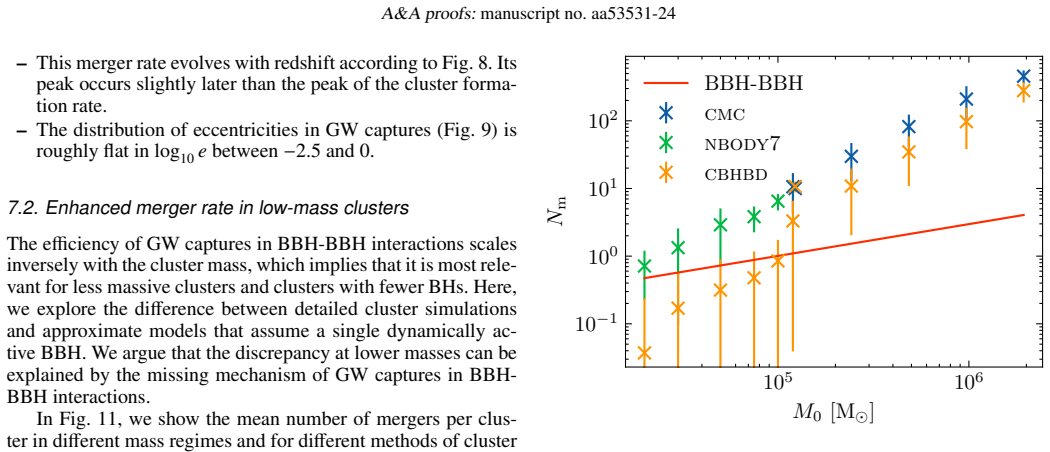
- [Sect. 4.4, Eqs. (24)-(26), Fig. 7] The headline local rate R(z=0)=0.9 Gpc^-3 yr^-1 is quoted without an uncertainty. The underlying Nm-M0 relation (Eq. 24) is a power-law fit whose scatter is visible in Fig. 7; no fit uncertainty is reported, and the text notes the result depends on Mmin. The population weighting also depends on nGC,0, the GC mass-function cutoff MS, and the metallicity and radius distributions (Eqs. 18-23). Please propagate these uncertainties through Eq. (25) and report the sensitivity of R(z=0), the redshift peak, and the ~10% eccentric fraction to the assumed Mmin and MS.
- [Sect. 6.2 and Sect. 4.2] Soft-soft BBH scatterings are explicitly excluded, yet the scaling argument in Sect. 6.2 gives a soft-soft interaction rate proportional to a^(3/2) and a merger rate proportional to a^(11/14), which formally diverges at large a and suggests a non-negligible contribution; the authors defer this to a follow-up study. Because the rate claim is global, this omission should at least be quantified with a firm upper limit, or the rate statement should be labeled as excluding soft-soft encounters.
- [Sect. 4.2 and Appendix A] 11% of the approximately 2x10^6 scattering experiments are classified as unresolved (t > 0.16 Myr). The outcome fractions quoted in Sect. 4.2 and the merger counts feeding Nm appear to be computed from resolved runs only. If unresolved states preferentially lead to late mergers or triples, the rates and eccentricity distribution are biased. Please report the outcome sensitivity to the time cutoff, or treat unresolved runs with their expected merger probability rather than discarding them.
minor comments (5)
- [Sect. 3.1] The definition of the three categories 'primordial', 'three-body', and 'exchange' should clarify the overlap: the 15% of interactions involving at least one exchange binary presumably includes the ~1% with two exchange binaries; the current wording could be read as implying disjoint categories.
- [Fig. 6 caption] The displayed fitting function appears corrupted with a placeholder symbol ('(1 + (□ α/8.6)^2)^{-0.8}') and should be replaced by the λ notation of Eq. (16), with λ1=3.4, λ2=8.6, λ3=1.7.
- [Abstract and Eq. (26)] The abstract quotes R=1 Gpc^-3 yr^-1 while Eq. (26) gives R(z=0)=0.9 Gpc^-3 yr^-1; please harmonize the rounding or report the value consistently.
- [Sect. 4.5] The phrase 'f22 is computed as ... in 3PN approximation as Memmesheimer et al. (2004, their equations 25c,k)' would be clearer if the quasi-Keplerian eccentricity et were defined in the main text before it is used, rather than only in Appendix B.
- [Sect. 4.2, Fig. 4] The transition at alpha_crit ~ 500 is identified visually from Fig. 4; please state how alpha_crit was defined and whether its uncertainty was estimated.
Circularity Check
Central origin claim is independent, but the analytic eccentricity model is calibrated to the same tsunami simulations it is said to reproduce.
-
fitted input called prediction
[Section 4.5, Fig. 9 (with Sect. 4.2, Eq. 16 and Eq. 17)]
"In Fig. 9 we show these results, weighted both according to their pmerge (equation 17) and their parameter distribution (Sect. 4.3). As can be seen, the distribution of eccentricities is roughly flat in log10 e between −2.5 and 0, with ∼ 10% of mergers having e > 0.1; and the simple model can roughly reproduce the simulations."
The pmerge used to weight the analytic curve (Eq. 17) contains f(α)=3.4(1+(α/8.6)^2)^{-0.83}, and Sect. 4.2 states 'we compute f (α) by substituting the merger probability, obtained in the tsunami simulations, in equation 12.' The analytic curve in Fig. 9 is therefore weighted by a merger probability fitted to the very tsunami simulations that it is then said to 'roughly reproduce'; the overall amplitude and the total eccentric-merger fraction in the model curve are calibrated to the same data. Only the eccentricity shape (thermal sampling plus 2.5PN circularisation) is an independent prediction. This does not affect the 84% three-body fraction, which is an ID-based CMC measurement.
full rationale
The paper's headline claim — that most BBH-BBH interactions in GCs are between three-body binaries (84%) — is an empirical ID check on CMC snapshots ('checking whether the IDs of the BHs involved in the interaction were in binaries in the first snapshot'), so it is not derived from the fitted model. The balance between BBH formation and disruption, and the interaction-rate ratio Γbb/Γbs, are tested against CMC (Figs. 2-3), so the self-citations to Marín Pina & Gieles (2024) are cross-validated rather than load-bearing in a circular way. The population-weighted rate R(0)=0.9 Gpc^-3 yr^-1 is a semi-empirical normalization: Nm is fit to the CMC catalogue (Eq. 24) and Eq. 25 imposes the integral to equal ⟨Nm⟩ n_GC,0, with independent cluster population weights (mass function, metallicity, CFR); this is calibration, not a reduction to its own target. The one genuinely circular element is the analytic eccentricity curve of Fig. 9, whose pmerge weight contains f(α) fitted to the same tsunami merger probabilities; the 'roughly reproduces the simulations' statement is therefore a consistency check rather than an independent test. Separately, the 10 r_s capture criterion (Sect. 6.1) is load-bearing for every quantitative merger rate and eccentricity prediction; the authors explicitly state the 3.5PN equations are not valid there and cite only 'limited simulations in Numerical Relativity' with no reference or quantified fraction. This is a correctness/robustness risk, not a circularity, and it conditions all numerical rates without undermining the 84% origin claim.
Assumptions & free parameters
free parameters (8)
- f(alpha) fit parameters lambda1, lambda2, lambda3 =
lambda1=3.4, lambda2=8.6, lambda3=1.7
- NIMS (number of intermediate states) =
20
- Nm power-law exponent and normalization =
Nm = (M0/1e5 M_sun)^(1/2)
- Strong-interaction cutoff X =
2
- GW capture cutoff =
10 times sum of Schwarzschild radii
- Semimajor-axis ratio power-law index b =
b = 1.1
- GC mass function low-mass cutoff M_min =
1e4 M_sun
- GC population weighting inputs (n_GC,0, M_S, M_max, sigma_Z, mu_rv, sigma_rv) =
rho_GC,0=2.4e16 M_sun Gpc^-3, M_S=10^6.2 M_sun, M_max=2e7 M_sun, sigma_Z=0.25, mu_rv=2 pc, sigma_rv=2 pc
assumptions (8)
- domain assumption The Kremer et al. (2020) CMC catalogue faithfully represents the population of strong BBH-BBH interactions in globular clusters.
- domain assumption Re-simulating each CMC interaction ten times with randomized phases and orientations yields unbiased outcome statistics without re-running cluster evolution.
- ad hoc to paper Capture is inevitable when separation is below 10 times the sum of Schwarzschild radii.
- domain assumption Soft binaries and scatterings with rp larger than 2(a0+a1) can be neglected for the merger-rate analysis.
- domain assumption Intermediate states in resonant interactions have a thermal eccentricity distribution p(e)=2e.
- domain assumption At any time a cluster hosts one dynamically active three-body BBH, following Marín Pina & Gieles (2024).
- domain assumption The GC population weighting distributions (Schechter mass function, log-normal metallicity, normal virial radius, El-Badry et al. cluster formation rate) are correct.
- domain assumption The 3.5PN equations of motion are accurate up to the chosen capture cutoff.
Cite this review
Pith. "Pith review of Interactions among binary black holes in star clusters: Eccentric gravitational wave captures and triple formation." pith.science (2026). https://pith.science/paper/LXFNS43K
@misc{pith2026250102907,
  author       = {Pith},
  title        = {Pith review of: Interactions among binary black holes in star clusters: Eccentric gravitational wave captures and triple formation},
  year         = {2026},
  howpublished = {\url{https://pith.science/paper/LXFNS43K}},
  note         = {Machine review of arXiv:2501.02907}
}
abstract
Numerical simulations of star clusters with black holes find that there is only a single dynamically active binary black hole (BBH), at odds with the theoretical expectation of ~5 dynamically formed - or, commonly referred to as three-body - BBHs in clusters with a few hundred BHs. We test the recent suggestion that this tension is because interactions among three-body BBHs were neglected in the theory. We use the public catalogue of Cluster Monte Carlo models to obtain a sample of strong BBH-BBH interactions, which we integrate using post-Newtonian equations of motion up to 3.5PN. We explore the nature of the BBHs involved in BBH-BBH interactions in star clusters, as well as the various outcomes: gravitational wave (GW) captures and the associated eccentricities at the frequencies of ground-based GW detectors, as well as BH triple formation and their contribution to BBH mergers via the ZLK mechanism. We find that almost all BBHs involved in BBH-BBH interactions are indeed three-body binaries and that BBH formation and disruption in BBH-BBH interactions occur at approximately the same rate, providing an explanation for the finding of a single dynamically active BBH in N-body models. An important implication is that the resulting rates of GW capture and triple formation are independent of uncertain initial binary properties. With the use of a population synthesis model for BBH-BBH interactions in globular clusters, we obtain a local rate of GW captures of $R=1Gpc^{-3}yr^{-1}$ as well as their eccentricity distribution and redshift dependence. We find that a BBH-BBH interaction is more likely to trigger a GW merger than a BH-BBH interaction. We also confirm that stable triples that are assembled in BBH-BBH interactions can merge via ZLK oscillations, although their merger rate is lower than GW captures. Our results will help with the interpretation of future GW signals from eccentric BBHs
Figures


Figures from the paper (7 more)


Forward citations
Cited by 2 Pith papers
-
Inferring the stochastic gravitational-wave background from eccentric stellar-mass binary black holes with spaceborne detectors
Eccentric black-hole-binary backgrounds from globular clusters and isolated evolution would look like power-law noise for TianQin/LISA/Taiji, but AGN-formed binaries produce a turnover that LISA and Taiji can distinguish.
-
Detection of Intermediate-Mass Ratio Inspirals in Globular Clusters: Revealing the Brownian Motion with Gravitational Waves
Brownian motion from stellar encounters in globular clusters imprints Doppler and aberrational phase shifts on IMRI gravitational waves that should be detectable for most sources loud enough for TianQin, LISA, or AION to see.
Reference graph
Works this paper leans on
-
[1]
Aarseth , S. J. 2003, Gravitational N-Body Simulations
2003
-
[2]
Aarseth , S. J. 2012, , 422, 841
2012
-
[3]
Aarseth , S. J. & Heggie , D. C. 1976, , 53, 259
1976
-
[4]
D., Acernese , F., et al
Abbott , R., Abbott , T. D., Acernese , F., et al. 2023 a , Physical Review X, 13, 041039
2023
-
[5]
D., Acernese , F., et al
Abbott , R., Abbott , T. D., Acernese , F., et al. 2023 b , Physical Review X, 13, 011048
2023
-
[6]
Antognini , J. M. O. & Thompson , T. A. 2016, , 456, 4219
2016
-
[7]
& Gieles , M
Antonini , F. & Gieles , M. 2020, , 492, 2936
2020
-
[8]
2023, , 522, 466
Antonini , F., Gieles , M., Dosopoulou , F., & Chattopadhyay , D. 2023, , 522, 466
2023
Show all 110 references
-
[9]
2019, , 486, 5008
Antonini , F., Gieles , M., & Gualandris , A. 2019, , 486, 5008
2019
-
[10]
M., & Callister , T
Antonini , F., Romero-Shaw , I. M., & Callister , T. 2025, , 134, 011401
2025
-
[11]
C., Trani , A
Atallah , D., Weatherford , N. C., Trani , A. A., & Rasio , F. A. 2024, , 970, 112
2024
-
[12]
2017, , 467, 524
Banerjee , S. 2017, , 467, 524
2017
-
[13]
2018 a , , 473, 909
Banerjee , S. 2018 a , , 473, 909
2018
-
[14]
2018 b , , 481, 5123
Banerjee , S. 2018 b , , 481, 5123
2018
-
[15]
2021, , 503, 3371
Banerjee , S. 2021, , 503, 3371
2021
-
[16]
& Antonini , F
Barber , J. & Antonini , F. 2025, , 538, 639
2025
-
[17]
2017, , 835, 165
Bartos , I., Kocsis , B., Haiman , Z., & M \'a rka , S. 2017, , 835, 165
2017
-
[18]
E., Bulik , T., & O'Shaughnessy , R
Belczynski , K., Holz , D. E., Bulik , T., & O'Shaughnessy , R. 2016, , 534, 512
2016
-
[19]
E., Kalogera , V., Rasio , F
Belczynski , K., Taam , R. E., Kalogera , V., Rasio , F. A., & Bulik , T. 2007, , 662, 504
2007
-
[20]
& Geralico, A
Bini, D. & Geralico, A. 2021, Phys. Rev. D, 104, 104019
2021
-
[21]
2024, Phys
Bini, S., Tiwari, S., Xu, Y., et al. 2024, Phys. Rev. D, 109, 042009
2024
-
[22]
Breen , P. G. & Heggie , D. C. 2013, , 432, 2779
2013
-
[23]
2008, Mod
Capozziello, S., De Laurentis, M., De Paolis, F., Ingrosso, G., & Nucita, A. 2008, Mod. Phys. Lett. A, 23, 99
2008
-
[24]
2024, , 683, A186
Dall'Amico , M., Mapelli , M., Torniamenti , S., & Arca Sedda , M. 2024, , 683, A186
2024
-
[25]
& Deruelle , N
Damour , T. & Deruelle , N. 1985, Annales de L'Institut Henri Poincare Section (A) Physique Theorique, 43, 107
1985
-
[26]
2014, Phys
Damour, T., Guercilena, F., Hinder, I., et al. 2014, Phys. Rev. D, 89, 081503
2014
-
[27]
2012, Phys
De Vittori, L., Jetzer, P., & Klein, A. 2012, Phys. Rev. D, 86, 044017
2012
-
[28]
R., Choksi , N., & Boylan-Kolchin , M
El-Badry , K., Quataert , E., Weisz , D. R., Choksi , N., & Boylan-Kolchin , M. 2019, , 482, 4528
2019
-
[29]
& Fragione , G
Fishbach , M. & Fragione , G. 2023, , 522, 5546
2023
-
[30]
2012, Fewbody: Numerical toolkit for simulating small-N gravitational dynamics , Astrophysics Source Code Library, record ascl:1208.011
Fregeau , J. 2012, Fewbody: Numerical toolkit for simulating small-N gravitational dynamics , Astrophysics Source Code Library, record ascl:1208.011
2012
-
[31]
Fregeau , J. M. & Rasio , F. A. 2007, , 658, 1047
2007
-
[32]
Gallegos-Garcia , M., Berry , C. P. L., Marchant , P., & Kalogera , V. 2021, , 922, 110
2021
-
[33]
& Nesseris, S
Garc\' a-Bellido, J. & Nesseris, S. 2018, Phys. Dark Univ., 21, 61
2018
-
[34]
Ginat , Y. B. & Perets , H. B. 2024, , 531, 739
2024
-
[35]
1984, , 280, 298
Goodman , J. 1984, , 280, 298
1984
-
[36]
& Hut , P
Goodman , J. & Hut , P. 1993, , 403, 271
1993
-
[37]
2020, Class
Gr\"obner, M., Jetzer, P., Haney, M., Tiwari, S., & Ishibashi, W. 2020, Class. Quant. Grav., 37, 067002
2020
-
[38]
Hansen , R. O. 1972, , 5, 1021
1972
-
[39]
A., & Suto , Y
Hayashi , T., Trani , A. A., & Suto , Y. 2022, , 939, 81
2022
-
[40]
A., & Suto , Y
Hayashi , T., Trani , A. A., & Suto , Y. 2023, , 943, 58
2023
-
[41]
& Hut , P
Heggie , D. & Hut , P. 2003, The Gravitational Million-Body Problem: A Multidisciplinary Approach to Star Cluster Dynamics
2003
-
[42]
Heggie , D. C. 1975, , 173, 729
1975
-
[43]
Heggie , D. C. & Rasio , F. A. 1996, , 282, 1064
1996
-
[44]
1961, Annales d'Astrophysique, 24, 369
H \'e non , M. 1961, Annales d'Astrophysique, 24, 369
1961
-
[45]
H \'e non , M. H. 1971, , 14, 151
1971
-
[46]
Hills , J. G. & Day , C. A. 1976, , 17, 87
1976
-
[47]
2018, , 480, 5645
Hong , J., Vesperini , E., Askar , A., et al. 2018, , 480, 5645
2018
-
[48]
2023, Phys
Hopper, S., Nagar, A., & Rettegno, P. 2023, Phys. Rev. D, 107, 124034
2023
-
[49]
R., Pols , O
Hurley , J. R., Pols , O. R., & Tout , C. A. 2000, , 315, 543
2000
-
[50]
R., Tout , C
Hurley , J. R., Tout , C. A., & Pols , O. R. 2002, , 329, 897
2002
-
[51]
& Bahcall , J
Hut , P. & Bahcall , J. N. 1983, , 268, 319
1983
-
[52]
2017, , 468, 5020
Inayoshi , K., Hirai , R., Kinugawa , T., & Hotokezaka , K. 2017, , 468, 5020
2017
-
[53]
& Garcia-Bellido, J
Jaraba, S. & Garcia-Bellido, J. 2021, Phys. Dark Univ., 34, 100882
2021
-
[54]
J., Rasio , F
Joshi , K. J., Rasio , F. A., & Portegies Zwart , S. 2000, , 540, 969
2000
-
[55]
King , I. R. 1966, , 71, 64
1966
-
[56]
1962, , 67, 591
Kozai , Y. 1962, , 67, 591
1962
-
[57]
2020, , 903, 45
Kremer , K., Spera , M., Becker , D., et al. 2020, , 903, 45
2020
-
[58]
& Trani , A
Lalande , F. & Trani , A. A. 2022, , 938, 18
2022
-
[59]
Lidov , M. L. 1962, , 9, 719
1962
-
[60]
Liu , S., Wang , L., Hu , Y.-M., Tanikawa , A., & Trani , A. A. 2024, , 533, 2262
2024
-
[61]
& Dickinson , M
Madau , P. & Dickinson , M. 2014, , 52, 415
2014
-
[62]
& Fragos , T
Madau , P. & Fragos , T. 2017, , 840, 39
2017
-
[63]
& Broekgaarden , F
Mandel , I. & Broekgaarden , F. S. 2022, Living Reviews in Relativity, 25, 1
2022
-
[64]
A., & Mandel , I
Mangipudi , A., Grishin , E., Trani , A. A., & Mandel , I. 2022, , 934, 44
2022
-
[65]
Mardling , R. A. & Aarseth , S. J. 2001, , 321, 398
2001
-
[66]
& Gieles , M
Mar \' n Pina , D. & Gieles , M. 2024, , 527, 8369
2024
-
[67]
Martinez , M. A. S., Fragione , G., Kremer , K., et al. 2020, , 903, 67
2020
-
[68]
2004, , 70, 104011
Memmesheimer , R.-M., Gopakumar , A., & Sch \"a fer , G. 2004, , 70, 104011
2004
-
[69]
& Tanikawa , K
Mikkola , S. & Tanikawa , K. 1999 a , , 310, 745
1999
-
[70]
& Tanikawa , K
Mikkola , S. & Tanikawa , K. 1999 b , Celestial Mechanics and Dynamical Astronomy, 74, 287
1999
-
[71]
2022, Phys
Morr\'as, G., Garc\' a-Bellido, J., & Nesseris, S. 2022, Phys. Dark Univ., 35, 100932
2022
-
[72]
2016, , 54, 441
Naoz , S. 2016, , 54, 441
2016
-
[73]
& Aarseth , S
Nitadori , K. & Aarseth , S. J. 2012, , 424, 545
2012
-
[74]
Peters , P. C. 1964, Physical Review, 136, 1224
1964
-
[75]
2020, , 641, A6
Planck Collaboration , Aghanim , N., Akrami , Y., et al. 2020, , 641, A6
2020
-
[76]
Portegies Zwart , S. F. & McMillan , S. L. W. 2000, , 528, L17
2000
-
[77]
Postnov , K. A. & Yungelson , L. R. 2014, Living Reviews in Relativity, 17, 3
2014
-
[78]
2022, , 105, 044035
Ramos-Buades , A., Buonanno , A., Khalil , M., & Ossokine , S. 2022, , 105, 044035
2022
-
[79]
2025, , 697, A118
Rando Forastier , B., Mar \' n Pina , D., Gieles , M., Portegies Zwart , S., & Antonini , F. 2025, , 697, A118
2025
-
[80]
2019, , 483, 1233
Rastello , S., Amaro-Seoane , P., Arca-Sedda , M., et al. 2019, , 483, 1233
2019
-
[81]
Retterer , J. M. 1980, , 85, 249
1980
-
[82]
L., Weatherford , N
Rodriguez , C. L., Weatherford , N. C., Coughlin , S. C., et al. 2022, , 258, 22
2022
-
[83]
L., Zevin , M., Pankow , C., Kalogera , V., & Rasio , F
Rodriguez , C. L., Zevin , M., Pankow , C., Kalogera , V., & Rasio , F. A. 2016, , 832, L2
2016
-
[84]
M., Kremer , K., Lasky , P
Romero-Shaw , I. M., Kremer , K., Lasky , P. D., Thrane , E., & Samsing , J. 2021, , 506, 2362
2021
-
[85]
J., et al
Samsing , J., Bartos , I., D'Orazio , D. J., et al. 2022, , 603, 237
2022
-
[86]
J., Kremer , K., Rodriguez , C
Samsing , J., D'Orazio , D. J., Kremer , K., Rodriguez , C. L., & Askar , A. 2020, , 101, 123010
2020
-
[87]
J., & Liu , B
Samsing , J., Hendriks , K., Zwick , L., D'Orazio , D. J., & Liu , B. 2024, arXiv e-prints, arXiv:2403.05625
2024 arXiv
-
[88]
2014, , 784, 71
Samsing , J., MacLeod , M., & Ramirez-Ruiz , E. 2014, , 784, 71
2014
-
[89]
2020, , 898, 152
Santoliquido , F., Mapelli , M., Bouffanais , Y., et al. 2020, , 898, 152
2020
-
[90]
1976, , 203, 297
Schechter , P. 1976, , 203, 297
1976
-
[91]
A., Varma , V., Pfeiffer , H
Shaikh , M. A., Varma , V., Pfeiffer , H. P., Ramos-Buades , A., & van de Meent , M. 2023, , 108, 104007
2023
-
[92]
& Phinney , E
Sigurdsson , S. & Phinney , E. S. 1993, , 415, 631
1993
-
[93]
A., & Mencagli , M
Spera , M., Trani , A. A., & Mencagli , M. 2022, Galaxies, 10, 76
2022
-
[94]
& Bulirsch , R
Stoer , J. & Bulirsch , R. 1980, 430
1980
-
[95]
2020, , 898, 25
Tagawa , H., Haiman , Z., & Kocsis , B. 2020, , 898, 25
2020
-
[96]
2012, , 17, 272
Tanikawa , A., Hut , P., & Makino , J. 2012, , 17, 272
2012
-
[97]
A., Leigh , N
Trani , A. A., Leigh , N. W. C., Boekholt , T. C. N., & Portegies Zwart , S. 2024 a , , 689, A24
2024
-
[98]
A., Quaini , S., & Colpi , M
Trani , A. A., Quaini , S., & Colpi , M. 2024 b , , 683, A135
2024
-
[99]
A., Rastello , S., Di Carlo , U
Trani , A. A., Rastello , S., Di Carlo , U. N., et al. 2022, , 511, 1362
2022
-
[100]
A., Spera , M., Leigh , N
Trani , A. A., Spera , M., Leigh , N. W. C., & Fujii , M. S. 2019, , 885, 135
2019
-
[101]
A., Tanikawa , A., Fujii , M
Trani , A. A., Tanikawa , A., Fujii , M. S., Leigh , N. W. C., & Kumamoto , J. 2021, , 504, 910
2021
-
[102]
van Son , L. A. C., de Mink , S. E., Callister , T., et al. 2022 a , , 931, 17
2022
-
[103]
van Son , L. A. C., de Mink , S. E., Renzo , M., et al. 2022 b , , 940, 184
2022
-
[104]
G., & Zevin , M
Vijaykumar , A., Hanselman , A. G., & Zevin , M. 2024, , 969, 132
2024
-
[105]
1910, Astronomische Nachrichten, 183, 345
von Zeipel , H. 1910, Astronomische Nachrichten, 183, 345
1910
-
[106]
2003, , 598, 419
Wen , L. 2003, , 598, 419
2003
-
[107]
Ye , C. S. & Fishbach , M. 2024, , 967, 62
2024
-
[108]
2019, , 871, 91
Zevin , M., Samsing , J., Rodriguez , C., Haster , C.-J., & Ramirez-Ruiz , E. 2019, , 871, 91
2019
-
[109]
, " * write output.state after.block = add.period write newline
ENTRY address archiveprefix author booktitle chapter edition editor howpublished institution eprint journal key month note number organization pages publisher school series title type volume year label extra.label sort.label short.list INTEGERS output.state before.all mid.sent...
-
[110]
write newline
" write newline "" before.all 'output.state := FUNCTION n.dashify 't := "" t empty not t #1 #1 substring "-" = t #1 #2 substring "--" = not "--" * t #2 global.max substring 't := t #1 #1 substring "-" = "-" * t #2 global.max substring 't := while if t #1 #1 substring * t #2 gl...
Reviewed August 10, 2026 · model on record in the stance chip above.
Discussion (0). Continue with ORCID to comment.