REVIEW 3 major objections 5 minor 1 cited by
Spaceborne detectors can distinguish a stochastic gravitational-wave background from eccentric black holes born in active galactic nuclei, because its spectrum turns over where a pure power law would not.
Reviewed by Pith at T0; open to challenge. T0 means a machine referee read the full paper against a public rubric. the ladder, T0–T4 →
T0 review · deepseek-v4-flash
2026-08-04 07:30 UTC pith:W7H3GP6C
load-bearing objection Useful forecast with a solid power-law-degeneracy result, but the AGN-turnover claim rests on one unvalidated eccentricity model and the Bayes factors are flattered by a narrow prior. the 3 major comments →
Inferring the stochastic gravitational-wave background from eccentric stellar-mass binary black holes with spaceborne detectors
The pith
A machine-rendered reading of the paper's core claim, the machinery that carries it, and where it could break.
Core claim
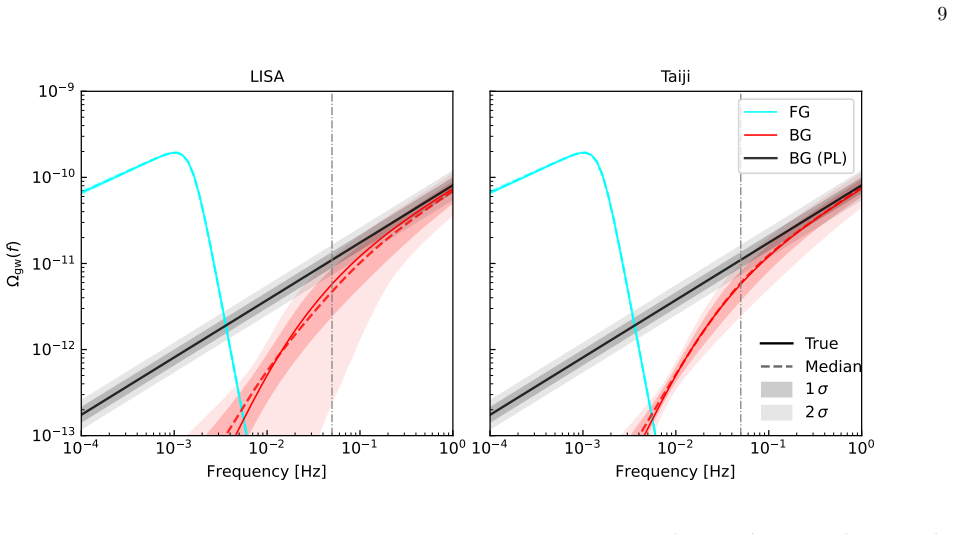
The central claim is that eccentricity leaves a measurable spectral scar on the background: AGN-formed SBBHs, which retain eccentricities between about 10^-3 and 0.1 at frequencies near 10 Hz, produce an SGWB that deviates from the f^(2/3) power law, turning over and declining sharply below roughly 0.1 Hz. The paper models this with a modified power law characterized by a drop-off frequency f_d and a tilt beta, and shows with Bayesian model selection on simulated 4-year data that LISA and Taiji prefer this model over a pure power law with log Bayes factors of 30.1 and 82.2, respectively. For field and globular-cluster binaries, the background is detectable (SNRs of about 10, 60, and 170 for
What carries the argument
The central object is the modified power-law energy spectral density, Omega_gw(f) = Omega_ast (f/f_ref)^(2/3) / ((f/f_d)^beta + 1), which adds a drop-off frequency f_d and a tilt beta to the standard f^(2/3) inspiral spectrum. This correction term is what lets the Bayesian analysis distinguish an eccentric AGN background from a plain power law. The other load-bearing pieces are the eccentricity distributions for the three formation channels, the harmonic summation up to n_max = 1000 in the single-source energy spectrum, and a simplified likelihood that replaces the full multi-year data stream with 11,680 three-hour segments while preserving the statistical content.
Load-bearing premise
The paper's headline distinction rests entirely on the assumed eccentricity distribution of AGN binaries: if real AGN binaries are less eccentric than the adopted population model, or if the observed background blends several formation channels, the spectral turnover washes out and the 'clear distinction' claim collapses.
What would settle it
Inject a simulated AGN population with eccentricities uniformly capped at 10^-3 at 10 Hz and re-run the LISA and Taiji model selection; if the log Bayes factor ln(B21) no longer exceeds 5, the turnover-based distinguishability is an artifact of the assumed distribution. A future resolved mHz detection of even a handful of AGN-disk binaries with measured eccentricities would directly test whether the assumed eccentricity distribution is realistic.
If this is right
- LISA and Taiji, with four years of data, would confidently detect the background from field and globular-cluster SBBHs even with the Galactic foreground present, reaching SNRs around 64 and 171 for LISA and Taiji in the field case.
- The background from field and globular-cluster binaries, if detected, will look exactly like a power law, so no eccentricity information can be extracted from its spectrum alone.
- The AGN background, despite being fainter, is clearly distinguishable: log Bayes factors above 30 for LISA and Taiji mean a measured turnover would be direct evidence of eccentric binaries in AGN disks.
- TianQin's sensitivity below 0.01 Hz is too low to see the turnover, so it can detect the loud backgrounds but cannot tell eccentric from circular.
- The simplified likelihood developed here makes full Bayesian model selection and parameter estimation computationally feasible for future mHz-band SGWB searches.
Where Pith is reading between the lines
- Beyond the paper: if the real background is a superposition of field, globular-cluster, and AGN populations, the composite eccentricity distribution may be diluted enough to erase the turnover, so the separate-channel results may overstate the AGN diagnostic.
- Beyond the paper: because the null-channel analysis assumes perfect knowledge of detector noise, the reported Bayes factors are upper bounds; a LISA-plus-Taiji cross-correlation search, which the paper points to, would test whether the turnover survives realistic noise uncertainties.
- Beyond the paper: the turnover frequency f_d, if measured, could be inverted to constrain the typical eccentricity of AGN binaries at formation, turning the background into a population-level eccentricity probe.
- Beyond the paper: the same modified-power-law template could be applied to other hypothesized eccentric populations, such as hierarchical mergers in star clusters, to search for analogous turnover features.
Editorial analysis
A structured set of objections, weighed in public.
Referee Report
Summary. The paper computes the stochastic gravitational-wave background (SGWB) from eccentric stellar-mass binary black holes (SBBHs) formed via three channels—isolated field evolution, globular clusters (GCs), and active galactic nuclei (AGNs)—and assesses detectability with the spaceborne detectors TianQin, LISA, and Taiji. Using a Bayesian framework with a simplified null-channel likelihood and a modeled Galactic foreground, the authors compute SNRs, Bayes factors for model selection, and posterior reconstructions. They report that the field and GC backgrounds are detectable but spectrally degenerate with a power-law SGWB, while the AGN background, having a spectral turnover from high eccentricity, can be clearly distinguished from a power-law by LISA and Taiji (ln B21 = 30.1 and 82.2 in Table III). Limitations acknowledged in Sec. V include the neglect of a superposition of multiple populations and the assumption of perfect noise knowledge.
Significance. If the central claim holds, the paper is a useful contribution to SGWB science with spaceborne detectors: it demonstrates a computationally efficient likelihood for null-channel analyses and provides a quantitative comparison of three detectors under a common foreground model. The SNR calculation is transparent and follows from standard inputs, and the inclusion of the Galactic foreground is an important practical step. However, the headline result—that the AGN eccentric-SBBH background can be clearly distinguished from a power-law—is not yet robust. It depends on the specific Tagawa et al. (2021) AGN eccentricity distribution, on a narrow Gaussian prior for log10 Omega_ast centered on the injected value, and on the absence of mixed-population backgrounds. The paper explicitly acknowledges these dependencies in Sec. V but does not test their impact. The technical machinery is sound, but the astrophysical conclusion requires additional robustness work before it can be considered established.
major comments (3)
- [Sec. IV.B, Table III] The decisive Bayes factors ln B21 = 30.1 (LISA) and 82.2 (Taiji) are computed with a Gaussian prior on log10 Omega_ast whose 90% interval [-12.2,-12.0] is centered on the injected value (footnote 5). Since both H1 and H2 share this prior, the evidence ratio is essentially an in-sample comparison conditioned on the population model used to generate the data. This can substantially inflate the evidence for H2. The authors should repeat the model selection with a wider, less informative prior (e.g., log-uniform over several decades) or marginalize over population-model parameters, and report how ln B21 changes. Without this, the 'clear distinction' claim is overstated.
- [Sec. IV.A, Fig. 2, Sec. V] The AGN spectral turnover is inherited entirely from the eccentricity distribution of Tagawa et al. (2021), not from a generic property of eccentric SBBHs. The paper itself states in Sec. V that the observed background will likely be a superposition of multiple populations, which would 'modify the spectral transition features.' However, no robustness test is performed against alternative AGN eccentricity distributions (e.g., stronger gas damping producing lower eccentricities) or against mixed field+GC+AGN injections. Because the central distinguishability claim rests on this single unvalidated assumption, the authors should add such tests and show whether the turnover and the large ln B21 values survive. If they do not, the conclusions must be softened.
- [Table I and footnote 4] The SNR values in Table I appear to use a 4-year observation time for TianQin, despite footnote 4 noting that TianQin has a half-time duty cycle, effectively halving its data-collection period. For the field case the quoted SNR of 12.9 would become about 9.1 if the effective observation time is 2 years; the GC case 11.2 would become about 7.9. This directly affects the abstract's claim that TianQin can detect the isolated and GC backgrounds after four years. Please clarify whether the effective observation time was used, and correct Table I and the abstract if necessary.
minor comments (5)
- [Table II caption] The caption appears to reverse the hypotheses: it says 'comparing hypothesis H0 (presence of SGWB) against H1 (absence of SGWB)', but the text defines H0 as foreground-only and H1 as foreground plus power-law SGWB. The caption should read H0 (absence) vs H1 (presence).
- [Sec. III.B, Eq. (27)] The sentence 'without compromising statistical information' is too strong: segmenting the data and treating the response as stationary within each segment does discard some information relative to a fully time-varying analysis. The statement should be qualified.
- [Sec. IV.B] The priors on detector-noise and foreground parameters are stated as spanning 'two units above and below their true values.' This is a strong, injection-informed prior; the model-selection results may be sensitive to this choice. A brief sensitivity study or a justification would be helpful.
- [Abstract / Introduction] The phrase 'For the first time, we employ a Bayesian framework' is an overclaim. There are prior Bayesian SGWB studies with spaceborne detectors; the novelty should be stated more precisely as the first application to eccentric SBBH populations from all three channels.
- [General] No code or data availability statement is provided. Given the reproducibility interest of this kind of projection study, a public implementation of the likelihood and spectrum calculation would be valuable.
Circularity Check
No significant circularity: the SGWB spectra and Bayes factors are forward-model outputs from external population inputs, not re-derivations of those inputs.
full rationale
The paper's derivation chain is a standard forward-model forecast. The SGWB spectrum is computed from Eqs. (29)-(33) using merger rates and eccentricity distributions taken from external population models (Kremer+ 2019 for field, Rodriguez+ 2018 for GC, Tagawa+ 2021 for AGN); it does not define those inputs in terms of its outputs. The SNR values (Table I) and Bayes factors (Tables II-III) are evaluated on simulated data whose injections use the same model spectra; this injection-recovery protocol is standard and does not make the detection claim circular. The Gaussian prior on log Omega_ast matching the predicted amplitude (footnote 5) is an informed prior in a sensitivity study, not a parameter fitted to the data being analyzed; it may inflate absolute evidence values but is not a reduction of the prediction to its inputs. The 'modified power-law' template (Eq. 34) is an ad hoc fitting form, but it is not the generating function of the injection, and the model comparison H2 vs H1 is a legitimate fit comparison. The paper explicitly flags the main model-dependence in Sec. V: 'the observed background will likely comprise a superposition of multiple populations. This integration would alter the effective eccentricity distribution of the binaries and consequently modify the spectral transition features of the composite SGWB.' This is a robustness limitation, not a circular step. Self-citations to prior null-channel/foreground papers are methodological references, not load-bearing derivations of the present claims. No step reduces by construction to its own input; score 0.
Axiom & Free-Parameter Ledger
free parameters (3)
- Local merger rate Rm(0) =
19 Gpc^-3 yr^-1 (90% CI +7/-5)
- Galactic foreground parameters {A1, A2, alpha1, alpha2} =
{3.98e-16, 4.79e-7, -5.7, -6.2}
- Gaussian prior center log10 Omega_ast =
90% CI [-12.2, -12.0] at 1 mHz
axioms (7)
- domain assumption SGWB is Gaussian, stationary, unpolarized, and isotropic
- domain assumption The A/E/T TDI channels have diagonal covariance: no cross-channel signal or noise correlations
- domain assumption Detector noise is perfectly known in the null-channel analysis
- domain assumption Baseline SGWB spectral index is fixed to 2/3
- domain assumption The eccentricity distributions of field, GC, and AGN SBBHs are correctly given by Refs. [79], [87], and [101]
- ad hoc to paper The modified power-law Omega_gw(f)=Omega_ast (f/f_ref)^{2/3} / ((f/f_d)^beta + 1) captures the eccentric SGWB shape
- domain assumption The cosmic merger rate follows the Madau-Dickinson star formation rate with z_max=10 and local normalization Rm(0)=19 Gpc^-3 yr^-1
read the original abstract
The stochastic gravitational-wave background (SGWB) from eccentric stellar-mass binary black holes (SBBHs) holds crucial clues to their origins. For the first time, we employ a Bayesian framework to assess the detectability and distinguishing features of such an SGWB with spaceborne detectors, while accounting for contamination from the Galactic foreground. Our analysis covers eccentric SBBHs from three formation channels: isolated binary evolution, dynamical assembly in globular clusters (GCs), and in active galactic nuclei (AGNs). We find that TianQin, Laser Interferometry Space Antenna (LISA), and Taiji can detect the SGWBs from both isolated and GC-formed SBBHs after four years of operation, with the corresponding SNRs of around 10, 60, and 170. However, these backgrounds are spectrally degenerate with a strictly power-law SGWB. Furthermore, highly eccentric SBBHs formed in AGNs yield an SGWB marked by a spectral turnover and sharp decline. While this feature lowers the SNR by approximately an order of magnitude, it can enable a clear distinction from the strictly power-law background using LISA and Taiji.
Figures


Forward citations
Cited by 1 Pith paper
-
Implications of the LISA stochastic signal from eccentric stellar mass black hole binaries in vacuum
High initial eccentricities in stellar-mass black hole binaries produce a stochastic gravitational wave background distinguishable by LISA from quasi-circular models, enabling upper bounds on eccentricity and separati...
Reference graph
Works this paper leans on
-
[1]
N. Christensen, Rept. Prog. Phys.82, 016903 (2019), arXiv:1811.08797 [gr-qc]
Pith/arXiv arXiv 2019
-
[2]
A. I. Renzini, B. Goncharov, A. C. Jenkins, and P. M. Meyers, Galaxies10, 34 (2022), arXiv:2202.00178 [gr- qc]
Pith/arXiv arXiv 2022
-
[3]
T. Regimbau, Res. Astron. Astrophys.11, 369 (2011), arXiv:1101.2762 [astro-ph.CO]
Pith/arXiv arXiv 2011
-
[4]
N. Bellomo, D. Bertacca, A. C. Jenkins, S. Matar- rese, A. Raccanelli, T. Regimbau, A. Ricciar- done, and M. Sakellariadou, JCAP06, 030 (2022), arXiv:2110.15059 [gr-qc]
Pith/arXiv arXiv 2022
-
[5]
A. Torres-Orjuela, S.-J. Huang, Z.-C. Liang, S. Liu, H.-T. Wang, C.-Q. Ye, Y.-M. Hu, and J. Mei, Sci. China Phys. Mech. Astron.67, 259511 (2024), arXiv:2307.16628 [gr-qc]
Pith/arXiv arXiv 2024
-
[6]
E.-K. Liet al., Rept. Prog. Phys.88, 056901 (2025), arXiv:2409.19665 [astro-ph.GA]
Pith/arXiv arXiv 2025
-
[7]
K. Nakayama, S. Saito, Y. Suwa, and J. Yokoyama, JCAP06, 020 (2008), arXiv:0804.1827 [astro-ph]
Pith/arXiv arXiv 2008
-
[8]
R. Caldwellet al., Gen. Rel. Grav.54, 156 (2022), arXiv:2203.07972 [gr-qc]
Pith/arXiv arXiv 2022
-
[9]
F. Schulze, L. Valbusa Dall’Armi, J. Lesgourgues, A. Ricciardone, N. Bartolo, D. Bertacca, C. Fidler, and S. Matarrese, JCAP10, 025 (2023), arXiv:2305.01602 [gr-qc]
Pith/arXiv arXiv 2023
-
[10]
Hellings and G
R. Hellings and G. Downs, Astrophys. J. Lett.265, L39 (1983)
1983
-
[11]
P. F. Michelson, Monthly Notices of the Royal Astro- nomical Society227, 933 (1987)
1987
-
[12]
Christensen, Phys
N. Christensen, Phys. Rev.D46, 5250 (1992)
1992
-
[13]
E. E. Flanagan, Phys. Rev.D48, 2389 (1993), arXiv:astro-ph/9305029 [astro-ph]
Pith/arXiv arXiv 1993
-
[14]
B. Allen and J. D. Romano, Phys. Rev. D59, 102001 (1999), arXiv:gr-qc/9710117
Pith/arXiv arXiv 1999
-
[15]
Tinto, J
M. Tinto, J. W. Armstrong, and F. B. Estabrook, Phys. Rev. D63, 021101 (2001)
2001
-
[16]
C. J. Hogan and P. L. Bender, Phys. Rev. D64, 062002 (2001), arXiv:astro-ph/0104266
Pith/arXiv arXiv 2001
-
[17]
T. L. Smith and R. Caldwell, Phys. Rev. D100, 104055 (2019), arXiv:1908.00546 [astro-ph.CO]
Pith/arXiv arXiv 2019
-
[18]
M. Muratore, D. Vetrugno, S. Vitale, and O. Hartwig, Phys. Rev. D105, 023009 (2022), arXiv:2108.02738 [gr- qc]
Pith/arXiv arXiv 2022
-
[19]
B. P. Abbottet al.(LIGO Scientific, VIRGO), Nature 460, 990 (2009), arXiv:0910.5772 [astro-ph.CO]
Pith/arXiv arXiv 2009
-
[20]
Abadieet al.(LIGO Scientific, VIRGO), Phys
J. Abadieet al.(LIGO Scientific, VIRGO), Phys. Rev. D85, 122001 (2012), arXiv:1112.5004 [gr-qc]
Pith/arXiv arXiv 2012
-
[21]
Aasiet al.(LIGO Scientific, VIRGO), Phys
J. Aasiet al.(LIGO Scientific, VIRGO), Phys. Rev. Lett.113, 231101 (2014), arXiv:1406.4556 [gr-qc]
Pith/arXiv arXiv 2014
-
[22]
B. P. Abbottet al.(LIGO Scientific, Virgo), Phys. Rev. Lett.118, 121101 (2017), [Erratum: Phys.Rev.Lett. 119, 029901 (2017)], arXiv:1612.02029 [gr-qc]
Pith/arXiv arXiv 2017
-
[23]
B. P. Abbottet al.(LIGO Scientific, Virgo), Phys. Rev. Lett.120, 091101 (2018), arXiv:1710.05837 [gr-qc]
Pith/arXiv arXiv 2018
-
[24]
B. P. Abbottet al.(LIGO Scientific, Virgo), Phys. Rev. D100, 061101 (2019), arXiv:1903.02886 [gr-qc]
Pith/arXiv arXiv 2019
-
[25]
Abbottet al.(KAGRA, Virgo, LIGO Scientific), Phys
R. Abbottet al.(KAGRA, Virgo, LIGO Scientific), Phys. Rev. D104, 022005 (2021), arXiv:2103.08520 [gr- qc]
arXiv 2021
-
[26]
Abbottet al.(KAGRA, Virgo, LIGO Scientific), Phys
R. Abbottet al.(KAGRA, Virgo, LIGO Scientific), Phys. Rev. D104, 022004 (2021), arXiv:2101.12130 [gr- qc]
arXiv 2021
-
[27]
A. G. Abacet al.(LIGO Scientific, VIRGO, KAGRA), (2025), arXiv:2508.20721 [gr-qc]
Pith/arXiv arXiv 2025
-
[28]
Agazieet al.(NANOGrav), Astrophys
G. Agazieet al.(NANOGrav), Astrophys. J. Lett.951, L8 (2023), arXiv:2306.16213 [astro-ph.HE]
Pith/arXiv arXiv 2023
-
[29]
H. Xuet al., Res. Astron. Astrophys.23, 075024 (2023), arXiv:2306.16216 [astro-ph.HE]
Pith/arXiv arXiv 2023
-
[30]
Antoniadiset al.(EPTA, InPTA:), Astron
J. Antoniadiset al.(EPTA, InPTA:), Astron. Astro- phys.678, A50 (2023), arXiv:2306.16214 [astro-ph.HE]
Pith/arXiv arXiv 2023
-
[31]
D. J. Reardonet al., Astrophys. J. Lett.951, L6 (2023), arXiv:2306.16215 [astro-ph.HE]
Pith/arXiv arXiv 2023
-
[32]
J. Luoet al.(TianQin), Class. Quant. Grav.33, 035010 (2016), arXiv:1512.02076 [astro-ph.IM]
Pith/arXiv arXiv 2016
-
[33]
Amaro-Seoaneet al.(LISA), (2017), arXiv:1702.00786 [astro-ph.IM]
P. Amaro-Seoaneet al.(LISA), (2017), arXiv:1702.00786 [astro-ph.IM]
Pith/arXiv arXiv 2017
-
[34]
W.-H. Ruan, Z.-K. Guo, R.-G. Cai, and Y.-Z. Zhang, Int. J. Mod. Phys. A35, 2050075 (2020), arXiv:1807.09495 [gr-qc]
Pith/arXiv arXiv 2020
-
[35]
M. R. Adams and N. J. Cornish, Phys. Rev. D82, 022002 (2010), arXiv:1002.1291 [gr-qc]
Pith/arXiv arXiv 2010
-
[36]
M. R. Adams and N. J. Cornish, Phys. Rev. D89, 022001 (2014), arXiv:1307.4116 [gr-qc]
Pith/arXiv arXiv 2014
-
[37]
C. Caprini, D. G. Figueroa, R. Flauger, G. Nardini, M. Peloso, M. Pieroni, A. Ricciardone, and G. Tasinato, JCAP11, 017 (2019), arXiv:1906.09244 [astro-ph.CO]
Pith/arXiv arXiv 2019
-
[38]
G. Boileau, N. Christensen, R. Meyer, and N. J. Cornish, Phys. Rev. D103, 103529 (2021), 11 arXiv:2011.05055 [gr-qc]
Pith/arXiv arXiv 2021
-
[39]
R. Flauger, N. Karnesis, G. Nardini, M. Pieroni, A. Ric- ciardone, and J. Torrado, JCAP01, 059 (2021), arXiv:2009.11845 [astro-ph.CO]
Pith/arXiv arXiv 2021
-
[40]
S. Banagiri, A. Criswell, T. Kuan, V. Mandic, J. D. Romano, and S. R. Taylor, Mon. Not. Roy. Astron. Soc.507, 5451 (2021), arXiv:2103.00826 [astro-ph.IM]
Pith/arXiv arXiv 2021
-
[41]
J. Cheng, E.-K. Li, Y.-M. Hu, Z.-C. Liang, J.-d. Zhang, and J. Mei, Phys. Rev. D106, 124027 (2022), arXiv:2208.11615 [gr-qc]
Pith/arXiv arXiv 2022
-
[42]
G. Boileau, N. Christensen, C. Gowling, M. Hindmarsh, and R. Meyer, JCAP02, 056 (2023), arXiv:2209.13277 [gr-qc]
Pith/arXiv arXiv 2023
-
[43]
C. Gowling, M. Hindmarsh, D. C. Hooper, and J. Tor- rado, JCAP04, 061 (2023), arXiv:2209.13551 [astro- ph.CO]
Pith/arXiv arXiv 2023
-
[44]
Q. Baghi, N. Karnesis, J.-B. Bayle, M. Besan¸ con, and H. Inchausp´ e, JCAP04, 066 (2023), arXiv:2302.12573 [gr-qc]
Pith/arXiv arXiv 2023
-
[45]
G. Wang, B. Li, P. Xu, and X. Fan, Phys. Rev. D106, 044054 (2022), arXiv:2201.10902 [gr-qc]
Pith/arXiv arXiv 2022
-
[46]
O. Hartwig, M. Lilley, M. Muratore, and M. Pieroni, Phys. Rev. D107, 123531 (2023), arXiv:2303.15929 [gr- qc]
Pith/arXiv arXiv 2023
-
[47]
M. Muratore, J. Gair, and L. Speri, Phys. Rev. D109, 042001 (2024), arXiv:2308.01056 [gr-qc]
Pith/arXiv arXiv 2024
-
[48]
J. Alvey, U. Bhardwaj, V. Domcke, M. Pieroni, and C. Weniger, Phys. Rev. D109, 083008 (2024), arXiv:2309.07954 [gr-qc]
Pith/arXiv arXiv 2024
-
[49]
F. Pozzoli, R. Buscicchio, C. J. Moore, F. Haardt, and A. Sesana, Phys. Rev. D109, 083029 (2024), arXiv:2311.12111 [astro-ph.CO]
Pith/arXiv arXiv 2024
-
[50]
Z.-Y. Li, Z.-C. Liang, E.-K. Li, J.-d. Zhang, and Y.-M. Hu, Phys. Rev. D111, 102007 (2025), arXiv:2409.11245 [gr-qc]
Pith/arXiv arXiv 2025
-
[51]
F. Huang, Z.-C. Chen, and Q.-G. Huang, Chin. Phys. C49, 10 (2025), arXiv:2504.16712 [gr-qc]
Pith/arXiv arXiv 2025
-
[52]
P. L. Bender and D. Hils, Class. Quant. Grav.14, 1439 (1997)
1997
-
[53]
G. Nelemans, L. R. Yungelson, and S. F. Porte- gies Zwart, Astron. Astrophys.375, 890 (2001), arXiv:astro-ph/0105221
Pith/arXiv arXiv 2001
-
[54]
L. Barack and C. Cutler, Phys. Rev. D70, 122002 (2004), arXiv:gr-qc/0409010
Pith/arXiv arXiv 2004
-
[55]
J. A. Edlund, M. Tinto, A. Krolak, and G. Nelemans, Phys. Rev. D71, 122003 (2005), arXiv:gr-qc/0504112
Pith/arXiv arXiv 2005
-
[56]
A. J. Ruiter, K. Belczynski, M. Benacquista, S. L. Lar- son, and G. Williams, Astrophys. J.717, 1006 (2010), arXiv:0705.3272 [astro-ph]
Pith/arXiv arXiv 2010
-
[57]
G. Nelemans, Class. Quant. Grav.26, 094030 (2009), arXiv:0901.1778 [astro-ph.SR]
Pith/arXiv arXiv 2009
-
[58]
N. Cornish and T. Robson, J. Phys. Conf. Ser.840, 012024 (2017), arXiv:1703.09858 [astro-ph.IM]
Pith/arXiv arXiv 2017
-
[59]
S.-J. Huang, Y.-M. Hu, V. Korol, P.-C. Li, Z.-C. Liang, Y. Lu, H.-T. Wang, S. Yu, and J. Mei, Phys. Rev. D 102, 063021 (2020), arXiv:2005.07889 [astro-ph.HE]
Pith/arXiv arXiv 2020
-
[60]
Z.-C. Liang, Y.-M. Hu, Y. Jiang, J. Cheng, J.-d. Zhang, and J. Mei, Phys. Rev. D105, 022001 (2022), arXiv:2107.08643 [astro-ph.CO]
Pith/arXiv arXiv 2022
-
[61]
C. Liu, W.-H. Ruan, and Z.-K. Guo, Phys. Rev. D107, 064021 (2023), arXiv:2301.02821 [astro-ph.IM]
Pith/arXiv arXiv 2023
-
[62]
G. Wang, Z. Yan, B. Hu, and W.-T. Ni, Phys. Rev. D 107, 124022 (2023), arXiv:2302.07625 [gr-qc]
Pith/arXiv arXiv 2023
-
[63]
S. Staelens and G. Nelemans, Astron. Astrophys.683, A139 (2024), arXiv:2310.19448 [astro-ph.HE]
Pith/arXiv arXiv 2024
-
[64]
S. Hofman and G. Nelemans, Astron. Astrophys.691, A261 (2024), arXiv:2407.10642 [astro-ph.HE]
Pith/arXiv arXiv 2024
-
[65]
X.-J. Zhu, E. Howell, T. Regimbau, D. Blair, and Z.- H. Zhu, Astrophys. J.739, 86 (2011), arXiv:1104.3565 [gr-qc]
Pith/arXiv arXiv 2011
-
[66]
B. P. Abbottet al.(LIGO Scientific, Virgo), Phys. Rev. Lett.116, 131102 (2016), arXiv:1602.03847 [gr-qc]
Pith/arXiv arXiv 2016
-
[67]
K. Inayoshi, K. Kashiyama, E. Visbal, and Z. Haiman, Mon. Not. Roy. Astron. Soc.461, 2722 (2016), arXiv:1603.06921 [astro-ph.GA]
Pith/arXiv arXiv 2016
-
[68]
K. Yagi and H. Yang, Phys. Rev. D97, 104018 (2018), arXiv:1712.00682 [gr-qc]
Pith/arXiv arXiv 2018
-
[69]
Z.-C. Chen, F. Huang, and Q.-G. Huang, Astrophys. J. 871, 97 (2019), arXiv:1809.10360 [gr-qc]
Pith/arXiv arXiv 2019
-
[70]
K. Belczynski, V. Kalogera, and T. Bulik, Astrophys. J.572, 407 (2001), arXiv:astro-ph/0111452
Pith/arXiv arXiv 2001
-
[71]
P. Podsiadlowski, S. Rappaport, and Z. Han, Mon. Not. Roy. Astron. Soc.341, 385 (2003), arXiv:astro- ph/0207153
arXiv 2003
-
[72]
A. Sadowski, K. Belczynski, T. Bulik, N. Ivanova, F. A. Rasio, and R. W. O’Shaughnessy, Astrophys. J.676, 1162 (2008), arXiv:0710.0878 [astro-ph]
Pith/arXiv arXiv 2008
-
[73]
I. Kowalska, T. Bulik, K. Belczynski, M. Dominik, and D. Gondek-Rosinska, Astron. Astrophys.527, A70 (2011), arXiv:1010.0511 [astro-ph.CO]
Pith/arXiv arXiv 2011
-
[74]
M. Dominik, K. Belczynski, C. Fryer, D. Holz, E. Berti, T. Bulik, I. Mandel, and R. O’Shaughnessy, Astrophys. J.759, 52 (2012), arXiv:1202.4901 [astro-ph.HE]
Pith/arXiv arXiv 2012
-
[75]
M. Dominik, K. Belczynski, C. Fryer, D. E. Holz, E. Berti, T. Bulik, I. Mandel, and R. O’Shaughnessy, Astrophys. J.779, 72 (2013), arXiv:1308.1546 [astro- ph.HE]
Pith/arXiv arXiv 2013
-
[76]
K. Belczynski, D. E. Holz, T. Bulik, and R. O’Shaughnessy, Nature534, 512 (2016), arXiv:1602.04531 [astro-ph.HE]
Pith/arXiv arXiv 2016
-
[77]
K. Breivik, C. L. Rodriguez, S. L. Larson, V. Kalogera, and F. A. Rasio, Astrophys. J. Lett.830, L18 (2016), arXiv:1606.09558 [astro-ph.GA]
Pith/arXiv arXiv 2016
-
[78]
M. Spera, M. Mapelli, N. Giacobbo, A. A. Trani, A. Bressan, and G. Costa, Mon. Not. Roy. Astron. Soc. 485, 889 (2019), arXiv:1809.04605 [astro-ph.HE]
Pith/arXiv arXiv 2019
-
[79]
K. Kremeret al., Phys. Rev. D99, 063003 (2019), arXiv:1811.11812 [astro-ph.HE]
Pith/arXiv arXiv 2019
-
[80]
S. Banerjee, H. Baumgardt, and P. Kroupa, Mon. Not. Roy. Astron. Soc.402, 371 (2010), arXiv:0910.3954 [astro-ph.SR]
Pith/arXiv arXiv 2010
discussion (0)
Sign in with ORCID, Apple, or X to comment. Anyone can read and Pith papers without signing in.